The SpaceX Dragon Endurance, which will carry Crew-5 back to Earth, is seen docked to the space station prior to its departure. Credits: NASA TV.
At 12:29 a.m. EST, the hatch closed between the Dragon spacecraft, named Endurance, and the International Space Station in preparation for undocking and return to Earth of NASA’s SpaceX Crew-5 mission with NASA astronauts Nicole Mann and Josh Cassada, JAXA (Japan Aerospace Exploration Agency) astronaut Koichi Wakata, and Roscosmos cosmonaut Anna Kikina.
NASA Television will air live coverage beginning at 1:45 a.m., for undocking scheduled at 2:05 a.m. Following conclusion of undocking coverage, NASA coverage of Crew-5’s return will continue with audio only, and full coverage will resume at the start of the splashdown broadcast at 8 p.m. this evening. Real-time audio between Crew-5 and flight controllers at NASA’s Mission Audio stream will remain available and includes conversations with astronauts aboard the space station and a live video feed from the orbiting laboratory.
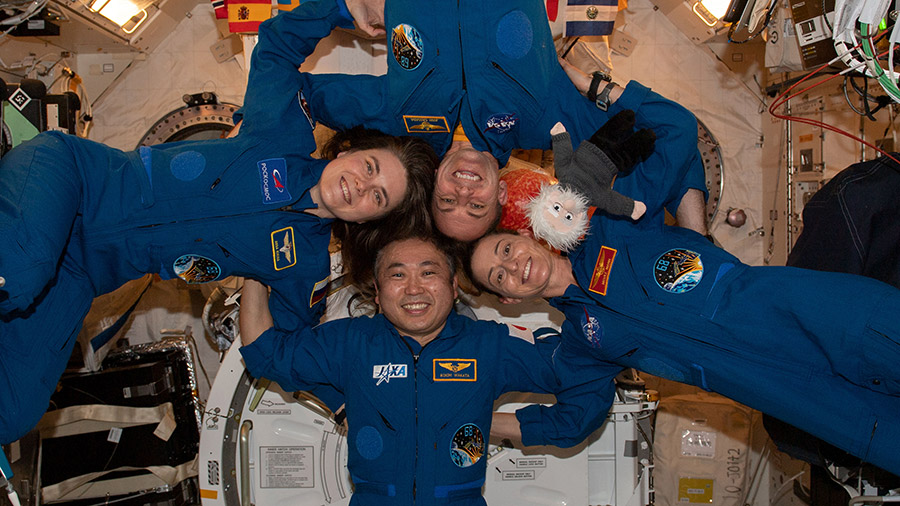
Clockwise from left, Expedition 68 Flight Engineers Anna Kikina, Josh Cassada, Nicole Mann, and Koichi Wakata pose for a fun portrait aboard the station. The quartet is planning on returning to Earth this month.
Watch live coverage now on NASA TV, the NASA app and the agency’s website as hatch closure and undocking preparations are underway for the return of NASA’s SpaceX Crew-5 mission.
NASA astronauts Mission Commander Nicole Mann and Pilot Josh Cassada, along with JAXA (Japan Aerospace Exploration Agency) astronaut Koichi Wakata and Roscosmos cosmonaut Anna Kikina, who will serve as mission specialists, are in the process of boarding the Dragon for departure from the International Space Station.
Crew-5 is targeting a return to Earth at about 9:02 p.m. EST Saturday, March 11, with a splashdown off the coast of Florida. The Dragon spacecraft, named Endurance, is scheduled to undock from the International Space Station at 2:05 a.m. to begin the journey home.
Dragon will autonomously undock, depart the space station, and splash down at one of seven targeted landing zones in the Atlantic Ocean or Gulf of Mexico off the coast of Florida. Endurance also will return important and time-sensitive research to Earth.
Light Duty on Station Before Foursome Departs on Saturday
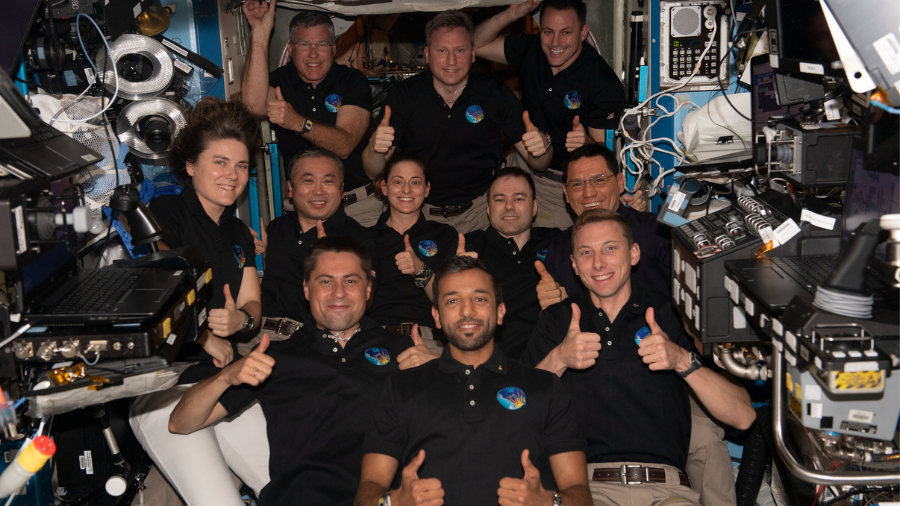
The 11-member crew aboard the International Space Station give thumbs up signs in this portrait from March 6, 2023. In the bottom row from left are Flight Engineers Andrey Fedyaev of Roscosmos, Sultan Alneyadi from UAE (United Arab Emirates), and Woody Hoburg from NASA. In the middle row from left are Flight Engineers Anna Kikina from Roscosmos, Koichi Wakata from JAXA (Japan Aerospace Exploration Agency), Nicole Mann from NASA, Dmitri Petelin from Roscosmos, and Frank Rubio from NASA. In the back are Flight Engineer Stephen Bowen from NASA, Commander Sergey Prokopyev from Roscosmos, and Flight Engineer Josh Cassada from NASA.
It was a relaxed Friday aboard the International Space Station as crew swap activities begin winding down ahead of the return to Earth of four crew members on Saturday. Three cosmonauts remained busy at the end of the week, however, working on orbital household maintenance tasks.
Expedition 68 Flight Engineers Nicole Mann and Josh Cassada of NASA, Koichi Wakata of JAXA (Japan Aerospace Exploration Agency), and Anna Kikina of Roscosmos are in their final full day aboard the space station. The quartet had a light duty day getting in a final exercise session before going to sleep early to prepare for their overnight departure activities.
The foursome will enter the SpaceX Crew Dragon Endurance and close the hatch to the vehicle at 12:15 a.m. EST on Saturday. Then at 2:05 a.m. they will undock from the Harmony module’s forward port. Endurance will fire its main engines one last time at 8:25 p.m. on Saturday sending the crew back into the Earth’s atmosphere. Finally, the crew will splashdown off the coast of Florida at 9:19 p.m. where support personnel from NASA and SpaceX will greet them after a five-month space research mission. NASA TV, on the agency’s app and website, will broadcast the crew return activities live.
The orbiting lab’s four newest crewmates have completed their first week of station orientation and familiarization tasks. New Flight Engineers Stephen Bowen and Woody Hoburg from NASA, Sultan Alneyadi of UAE (United Arab Emirates) and Andrey Fedyaev docked to the station aboard the SpaceX Dragon Endeavour on Oct. 3. All but Fedyaev had the day off as they will get up early and support their departing four crewmates when they enter the Crew Dragon Endurance and undock from the station.
Flight Engineer Frank Rubio, who has been aboard the station since Sept. 21, also had a light duty day spending just over an hour on the Food Physiology study before going to bed early with his departing crewmates. Rubio will be assisting the homebound crew before their Saturday departure.
Cosmonauts Sergey Prokopyev and Dmitri Petelin, station commander and flight engineer respectively, spent Friday working their normal shift servicing a variety of station electronics hardware. Fedyaev spent his day troubleshooting power supply systems and cleaning ventilation fans and filters.
Foursome Targets Saturday for Return to Earth as Station Ops Continue
Expedition 68 Flight Engineers (from left) Anna Kikina, Josh Cassada, Nicole Mann, and Koichi Wakata, are preparing to return to Earth this weekend.
Four Expedition 68 crew members are nearing the end of their stay aboard the International Space Station this weekend. Their replacements are completing their first week aboard the orbital outpost and getting up to speed with life in space.
The SpaceX Crew Dragon Endurance with four crewmates is targeted to depart the space station at 2:05 a.m. EST on Saturday and return to Earth less than 24 hours later. NASA astronauts Nicole Mann and Josh Cassada will command and pilot Endurance respectively flanked by Koichi Wakata of JAXA (Japan Aerospace Exploration Agency) and Anna Kikina of Roscosmos. The foursome is due to splashdown off the coast of Florida at 9:19 p.m. on Saturday.
The quartet blasted off toward the orbiting lab as the SpaceX Crew-5 mission on Oct. 5, 2022, and docked to the Harmony module’s forward port on Oct. 6. A variety of crew ships and space freighters arrived and departed, numerous spacewalks were conducted, and a multitude of advanced space research took place during Crew-5’s five-month-long stay in space.
The station’s newest crew members are several days into their orbital residency after their arrival on March 3, as the SpaceX Crew-6 mission. The new flight engineers, Stephen Bowen and Woody Hoburg of NASA, Sultan Alneyadi of UAE (United Arab Emirates), and Andrey Fedyaev of Roscosmos, have already begun a variety of space research and lab maintenance activities.
The four new station residents have started exploring how microgravity affects the human body and picked a small tomato crop growing for a space agriculture study. They also spent Thursday afternoon familiarizing themselves with space station hardware and emergency equipment located throughout the space lab.
Three other space station residents, Commander Sergey Prokopyev, Flight Engineer Dmitri Petelin, both from Roscosmos, and NASA Flight Engineer Frank Rubio, have been living in space since Sept. 21. The trio spent the day stowing biological samples in a science freezer, packing cargo inside the Soyuz MS-22 spaceship, and servicing life support components. They will continue their station mission until later this year and return home inside the Soyuz MS-23 crew ship.
Advanced Science Work Under Way Before Crew Departure
Expedition 68 Flight Engineers Josh Cassada and Nicole Mann, both from NASA, work on life support maintenance inside the Destiny laboratory module.
The four new Expedition 68 crew members are getting used to life in space while four other crewmates are preparing to go home this month. Also, today’s research includes replacing fuel bottles in the Combustion Integrated Rack and collecting samples for the Food Physiology and Host Pathogen experiment.
Flight engineers Frank Rubio of NASA and Dmitri Petelin of Roscosmos removed the CIR rack and replaced it with a new high-percentage oxygen bottle. The Combustion Integration Rack is used to perform combustion investigations in microgravity, and results could improve understanding of early fire growth behavior and help determine the best fire suppression techniques, improving crew safety in future space facilities.
Rubio also participated in the Food Physiology experiment. A variety of samples are collected and then placed in cold stowage to document the effect of dietary improvements on human physiology and the ability of those improvements to enhance adaptation to spaceflight.
Samples were also collected for the Host Pathogen experiment. This study identifies the spaceflight-induced changes in the human microbiome that causes a decrease in immune function and an increase in microbial virulence. Blood and saliva samples from crew members are collected before, during, and after spaceflight, to assess the clinical risks of infectious microbes and to develop countermeasures that restore immune function in astronauts.
The new Endeavour crew is continuing to adjust to life in orbit, while the Endurance Crew is preparing for its return to earth by cleaning, completing stowage and inventory tasks, and preparing personal items for return.
NASA and SpaceX continue to evaluate the weather for the return of NASA’s SpaceX Crew-5 mission from the International Space Station. Teams conducted a weather briefing overnight and decided to waive off the initial undocking opportunity for early Thursday, March 9, due to high winds at the splashdown sites. Teams currently target undocking for no earlier than Thursday evening, pending weather. The Crew-5 Dragon spacecraft remains healthy docked to the station and is configured for nominal return operations once weather conditions are favorable.
The space station is orbiting slightly higher today after the docked ISS Progress 83 cargo craft fired its engines for five minutes and 17 seconds this afternoon. The new orbital altitude readies the unoccupied Soyuz MS-22 crew ship for its upcoming departure following a coolant leak that was detected in December of last year.