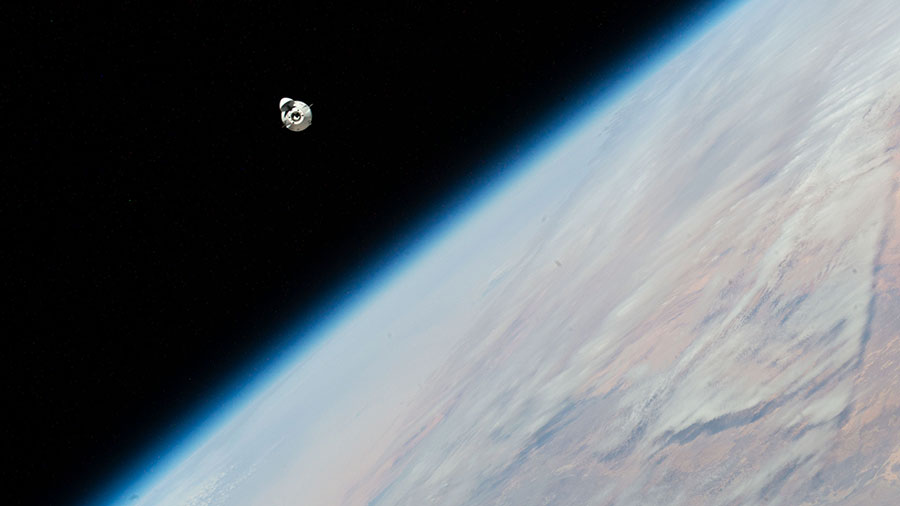
SpaceX Resupply Mission Docks to the Space Station

SpaceX Resupply Mission Docks to the Space Station

SpaceX’s 27th commercial resupply mission docked to the Harmony module's space-facing port at 7:31 a.m. EDT today as the station was flying 261 miles over northeastern China.
SpaceX’s 27th commercial resupply mission docked to the Harmony module’s space-facing port at 7:31 a.m. EDT today as the station was flying 261 miles over northeastern China. Credits: NASA TV.

While the International Space Station was traveling more than 261 miles over North Eastern China, a SpaceX Dragon cargo spacecraft autonomously docked to station’s Harmony module at 7:31 a.m. EDT, with NASA astronaut Woody Hoburg monitoring operations from the station.

The Dragon launched on SpaceX’s 27th contracted commercial resupply mission for NASA at 8:30 p.m. EDT, March 14, from Launch Complex 39A at the agency’s Kennedy Space Center in Florida. After Dragon spends about one month attached to the space station, the spacecraft will return to Earth with cargo and research.

Among the science experiments Dragon is delivering to the space station are:

Cardinal Heart 2.0

The first Cardinal Heart investigation conducted aboard the space station showed that four weeks of microgravity exposure can cause significant changes in heart cell function and gene expression. Researchers concluded that these changes could lead to long-term medical issues. The Cardinal Heart 2.0 experiment builds on these results, using heart organoids, 3D structures made up of all the different types of cells in a particular organ, to test whether clinically approved drugs reduce these microgravity-induced changes in heart cell function. Results could support the development of effective drug combinations to improve the health of astronauts and patients on Earth.

Engineered Heart Tissues-2

This study continues work with 3D cultured cardiac muscle tissue to assess human cardiac function in microgravity. Previous work with 3D cultures in space detected changes at the cellular and tissue level that could provide early indication of the development of cardiac disease. This investigation tests whether new therapies prevent these adverse spaceflight effects from occurring. The model used in this study has potential use in drug development and other applications related to diagnosing and treating cardiac dysfunction on Earth.

Cardinal Heart 2.0 and Engineered Heart Tissues-2 are the final two experiments comprising the National Institutes for Health and ISS National Lab’s Tissue Chips in Space initiative. Researchers hope to learn more about the impact of microgravity on human health and disease and translate that understanding to improved human health on Earth.

HUNCH Ball Clamp Monopod

NASA’s High school students United with NASA to Create Hardware (HUNCH) program enables students to fabricate real-world products for NASA as they apply their science, technology, engineering, and mathematics skills. The HUNCH Ball Clamp Monopod attempts to address astronaut comments on the difficulty of positioning video or still cameras in the middle of a module. The student-manufactured project is composed of an aluminum monopod fitted with a camera shoe and ball clamp that can be attached to a standard space station handrail. The ball clamp serves as a pivoting platform for photography and video.

CapiSorb Visible System

Because microgravity makes it difficult to control the flow of liquids, the space station has been unable to take advantage of carbon dioxide removal methods that use specialized liquids. Liquid-based carbon dioxide removal systems such as those on submarines offer higher efficiency than other types of systems. The CapiSorb Visible System study demonstrates liquid control using capillary forces, the interaction of a liquid with a solid that can draw a fluid up a narrow tube, which are characteristic of liquids that can absorb carbon dioxide. This is an important consideration for future longer-duration space missions where improved efficiency will support crews over many months or years.

ESA-Biofilms

Microbial biofilms are combinations of microorganisms that embed themselves in a self-produced slimy matrix. Biofilms are of concern for spaceflight because they can cause damage to equipment, are resistant to cleaning agents, and can harbor microorganisms that might cause infections. The ESA (European Space Agency) – Biofilms investigation studies bacterial biofilm formation and antimicrobial properties of different metal surfaces under spaceflight conditions. Antimicrobial surfaces that can inhibit biofilm growth, such as copper and its alloys with and without laser surface treatment, are used in this study. This project provides additional information to help develop suitable antimicrobial surfaces for future spacecraft.

Tanpopo-5

The JAXA (Japan Aerospace Exploration Agency) Tanpopo-5 investigation studies the origin, transportation, and survival of life in space and on extraterrestrial planets, such as Mars. The study focuses on exposing a radioresistant bacteria, which are resistant to radiation, and sporophytes of moss, an important piece of the lifecycle of some plants, to the harsh environment of space using the exposed Experiment Bracket Attached on I-SEEP (ExBAS) facility mounted on the outside of station. Results are helping answer key questions of the “panspermia” hypothesis, a theory for the initiation of life on Earth and the transport of life among celestial bodies.

These are just a few of the hundreds of investigations currently being conducted aboard the orbiting laboratory in the areas of biology and biotechnology, physical sciences, and Earth and space science. Advances in these areas will help keep astronauts healthy during long-duration space travel and demonstrate technologies for future human and robotic exploration beyond low-Earth orbit to the Moon through NASA’s Artemis missions and eventually Mars.


Learn more about station activities by following the space station blog, @space_station and @ISS_Research on Twitter, as well as the ISS Facebook and ISS Instagram accounts.

Get weekly video highlights at: https://roundupreads.jsc.nasa.gov/videoupdate/

Get the latest from NASA delivered every week. Subscribe here: www.nasa.gov/subscribe

Get The Details…

Heidi Lavelle

Powered by WPeMatico

NASA TV is Live for Cargo Dragon Docking

NASA TV is Live for Cargo Dragon Docking

The SpaceX Dragon cargo craft, loaded with over 7,700 pounds of science, supplies, and cargo, approaches the space station for a docking on Nov. 27, 2022.

A SpaceX Dragon is on track to arrive at the International Space Station today, Thursday, March 16, with an expected docking of the cargo spacecraft about 7:28 a.m. EDT. Live coverage is underway on NASA Television, the NASA app, and the agency’s website.

When it arrives to the space station, Dragon will dock to the station’s Harmony module.

Dragon successfully launched on a SpaceX Falcon 9 rocket at 8:30 p.m. EDT, March 14, from Launch Complex 39A at NASA’s Kennedy Space Center in Florida, carrying more than 6,200 pounds of research, hardware, and supplies to the International Space Station.


Learn more about station activities by following the space station blog, @space_station and @ISS_Research on Twitter, as well as the ISS Facebook and ISS Instagram accounts.

Get weekly video highlights at: https://roundupreads.jsc.nasa.gov/videoupdate/

Get the latest from NASA delivered every week. Subscribe here: www.nasa.gov/subscribe

Get The Details…

Heidi Lavelle

Powered by WPeMatico

Lab, Plumbing, and Ultrasounds Keep Crew Busy Before Cargo Delivery

Lab, Plumbing, and Ultrasounds Keep Crew Busy Before Cargo Delivery

A SpaceX Dragon cargo craft is seen approaching the International Space Station on Nov. 27, 2022.

The SpaceX Dragon is on track to deliver cargo to the International Space Station after lifting off on March 14, marking the company’s 27th commercial resupply mission. Meanwhile, the Expedition 68 crew kept busy completing lab work, ultrasounds, and plumbing duties.

NASA Flight Engineer Stephen Bowen spent time moving equipment to the cupola to help monitor Dragon’s docking. The spacecraft is scheduled to dock autonomously at 7:52 a.m. EDT Thursday, March 16, to the forward-facing port of the station’s Harmony module. NASA Flight Engineer Woody Hoburg will monitor the automated docking.

Bowen and Hoburg also drew blood samples for the Immunity Assay study. Bowen spun blood tubes in a centrifuge and stowed them in a freezer for later analysis. The results of the study are expected to provide a better understanding of how the immune system changes in space.

NASA Flight Engineer Frank Rubio and Flight Engineer Sultan Alneyadi from UAE (United Arab Emirates) were tasked with removing and replacing a toilet. Alneyadi also repaired damages to paint on a stall wall.

Toward the end of the day, Rubio and Bowen had their eyes scanned using an ultrasound device. Doctors on the ground remotely guide astronauts during the exam, which looks at the health of the retina, cornea, and optic nerve. They also performed ultrasounds of their necks, clavicles, shoulders, and behind the knees.

Roscosmos cosmonauts Sergey Prokopyev, Dmitri Petelin, and Andrey Fedyaev boarded the damaged Soyuz MS-22 spacecraft docked to the International Space Station and closed the hatch, without latching, for a 3-hour-and-45-minute thermal test to simulate temperature and humidity levels the descent module of a Soyuz could experience during an expedited crew return to Earth. The data from the test could be used by engineers if ever needed to return a damaged Soyuz in the future.

The Soyuz MS-22 will undock from the station March 28 for its uncrewed, parachute-assisted landing in Kazakhstan. Prokopyev, Petelin, and NASA astronaut Frank Rubio will return to Earth later this year in the new Soyuz MS-23 spacecraft that arrived at the orbital complex in February.


Learn more about station activities by following the space station blog, @space_station and @ISS_Research on Twitter, as well as the ISS Facebook and ISS Instagram accounts.

Get weekly video highlights at: https://roundupreads.jsc.nasa.gov/videoupdate/

Get the latest from NASA delivered every week. Subscribe here: www.nasa.gov/subscribe

Get The Details…

Heidi Lavelle

Powered by WPeMatico

SpaceX Resupply Mission Launches to the Space Station

SpaceX Resupply Mission Launches to the Space Station

SpaceX's 27th commercial resupply mission lifted off from Kennedy Space Center at 8:30 p.m. EDT, carrying over 6,200 lbs. of science, supplies, and food for the international crew.
SpaceX’s 27th commercial resupply mission lifted off from Kennedy Space Center at 8:30 p.m. EDT, carrying over 6,200 lbs. of science, supplies, and food for the international crew.

A SpaceX Dragon launched on the company’s Falcon 9 rocket at 8:30 p.m. EDT from Launch Complex 39A at NASA’s Kennedy Space Center in Florida, carrying more than 6,200 pounds of research, hardware, and supplies to the International Space Station.

About 12 minutes after launch, Dragon separated from the Falcon 9 rocket’s second stage, opened its nosecone, and began a carefully choreographed series of thruster firings to reach the space station.

Dragon is on track to arrive at the International Space Station Thursday, March 16, with an expected docking about 7:52 a.m. EDT. Live coverage on NASA Television, the NASA app, and the agency’s website will begin at 6:15 a.m.


Learn more about station activities by following the space station blog, @space_station and @ISS_Research on Twitter, as well as the ISS Facebook and ISS Instagram accounts.

Get weekly video highlights at: https://roundupreads.jsc.nasa.gov/videoupdate/

Get the latest from NASA delivered every week. Subscribe here: www.nasa.gov/subscribe

Get The Details…

Heidi Lavelle

Powered by WPeMatico

Biology, Botany, and Training Fill Crew Schedule Ahead of Cargo Launch

Biology, Botany, and Training Fill Crew Schedule Ahead of Cargo Launch

A view of red dwarf tomato plants growing in the Veggie plant growth facility aboard the International Space Station as part of the Pick-and-Eat Salad-Crop Productivity, Nutritional Value, and Acceptability to Supplement the ISS Food System (Veg-05) investigation from Feb. 5, 2023.

The Expedition 68 crew members spent their day carrying out biological research, harvesting vegetables, and prepping for a commercial resupply mission delivering more than 6,000 pounds of cargo to the International Space Station.

The SpaceX Dragon spacecraft is set to launch at 8:30 p.m. EDT this evening from NASA’s Kennedy Space Center in Florida. The spacecraft is providing the crew with new science investigations, food, fuel, and supplies. Dragon is slated to dock autonomously to the forward-facing port of the station’s Harmony module Thursday morning.

NASA Flight Engineer Woody Hoburg is scheduled to monitor Dragon’s automated docking. In the meantime, he completed a session using the Robotics On-board Trainer, which teaches astronauts docking and grappling techniques.

NASA Flight Engineer Stephen Bowen continued to work on the Immunity Assay study. The study aims to monitor how the immune system changes in response to the stresses of space by analyzing biological samples taken before, during, and after flight. Bowen was tasked with uninstalling containers and prepping test tubes for the experiment.

NASA Flight Engineer Frank Rubio plucked tomatoes from the Veggie Vegetable Production System (Veggie) for the Veg-05 space botany study. The investigation seeks to determine the best horticultural practices for growing fresh vegetables in space. Rubio and Bowen both capped the evening with a remotely guided eye exam.

Flight Engineer Sultan Alneyadi from UAE (United Arab Emirates) had a chance to record a video for an educational series focused on demonstrating scientific concepts in space for students and teachers. He later fit in an exercise session on the treadmill.

The cosmonauts aboard the station gathered to shoot a series of video greetings as well. Commander Sergey Prokopyev and Flight Engineers Dmitri Petelin, and Andrey Fedyaev of Roscomsos also reviewed a procedure together for checking the temperature and humidity conditions during the undocking and descent of a Soyuz spacecraft.

At 7:54 a.m. the ISS Progress 83 thrusters performed a 2-minute, 35-second burn to provide extra distance from a fragment of Russian Cosmos 1408 satellite debris. NASA and Russian flight controllers worked together to conduct the maneuver. Without the maneuver, which will have no impact on the rendezvous profile for the Dragon cargo craft or downstream vehicle operations, it is estimated that the fragment could have passed within 1/10th of a mile of the station. Crew were notified of the conjunction in advance and were never in danger.


Learn more about station activities by following the space station blog, @space_station and @ISS_Research on Twitter, as well as the ISS Facebook and ISS Instagram accounts.

Get weekly video highlights at: https://roundupreads.jsc.nasa.gov/videoupdate/

Get the latest from NASA delivered every week. Subscribe here: www.nasa.gov/subscribe

Get The Details…

Heidi Lavelle

Powered by WPeMatico