Cosmonaut Spacewalkers Exiting Station Soon Live on NASA TV
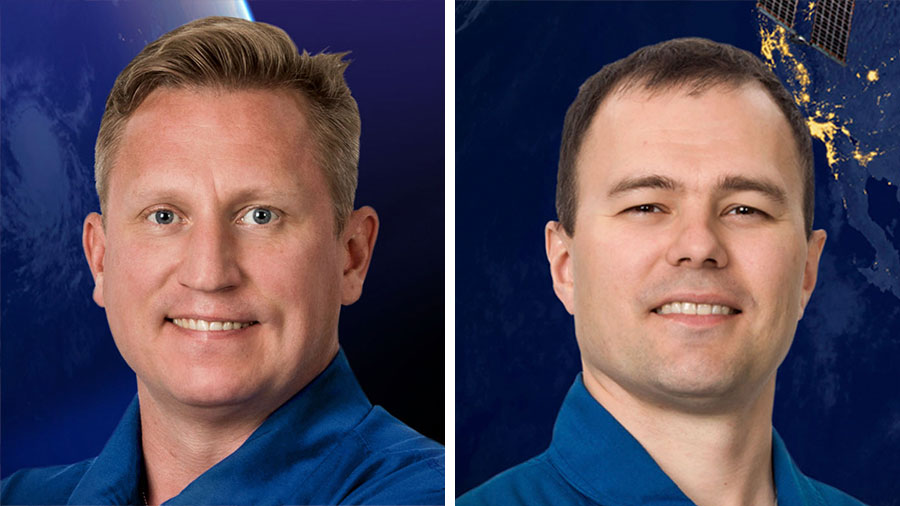
Expedition 69 Commander Sergey Prokopyev (left) is conducting his sixth career spacewalk. Flight Engineer Dmitri Petelin (right) is conducting his fourth spacewalk.
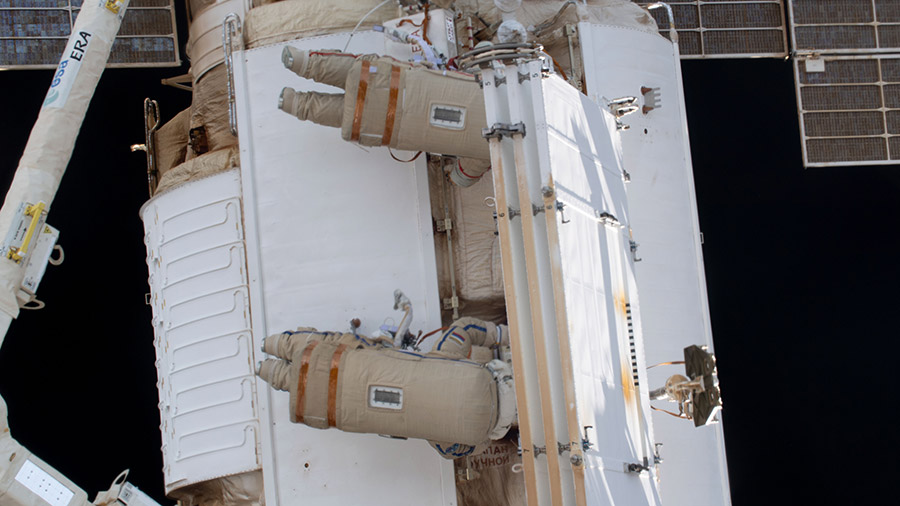
NASA Television coverage is underway for today’s spacewalk with Roscosmos cosmonauts Sergey Prokopyev and Dmitri Petelin. The duo will deploy a radiator on the on the International Space Station’sNauka science module, connect electrical, mechanical, and hydraulic lines, and fill a pair of colling loops on the radiator with coolant. Coverage of the spacewalk is on NASA Television, the NASA app, and the agency’s website.
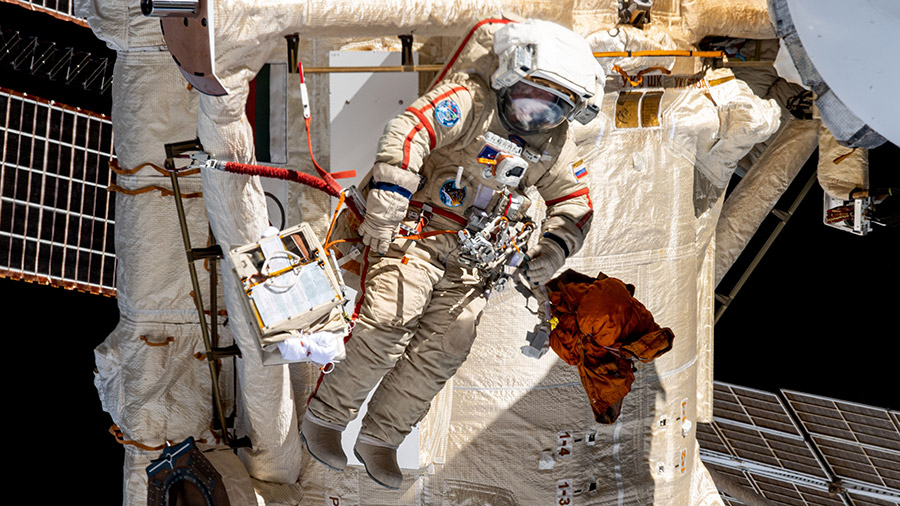
Prokopyev and Petelin will exit out of the Poisk module at about 11:55 a.m. EDT. Prokopyev is wearing the Orlan spacesuit with red stripes, while Petelin is wearing the suit with blue stripes.
This is the sixth spacewalk in Prokopyev’s career, and the fourth for Petelin. It is the sixth spacewalk at the station in 2023 and the 263rd spacewalk for space station assembly, maintenance, and upgrades.
Cosmonauts GO for Spacewalk, Astronauts Work on Science Gear
Cosmonauts Sergey Prokopyev and Dmitri Petelin install a radiator on the Nauka science module during a spacewalk on April 19, 2023.
Station managers have given the go for a spacewalk on Friday to deploy and activate a radiator on the International Space Station. Meanwhile, the Expedition 69 crew is continuing its ongoing human research activities and science hardware maintenance.
Two cosmonauts will exit the Poisk airlock in their Orlan spacesuits at 11:55 a.m. EDT on Friday beginning a spacewalk to deploy and activate a radiator on the Nauka science module. Commander Sergey Prokopyev and Flight Engineer Dmitri Petelin will spend up to seven hours in the vacuum of space configuring the same radiator they installed on Nauka during a spacewalk on April 19. Roscosmos Flight Engineer Andrey Fedyaev will remain inside the orbiting lab assisting the spacewalkers in and out of their Orlans and monitoring their excursion.
The trio from Roscosmos spent Thursday morning completing their spacewalk preparations checking Orlan suit components, finalizing procedure reviews, and discussing their readiness with mission controllers. Prokopyev and Petelin then took the rest of the afternoon off, while Fedyaev collected radiation detectors and cleaned electronics and computer gear.
The four astronauts supporting the U.S. segment of the orbiting lab spent Thursday studying the effects of microgravity on humans and servicing an array of advanced science gear.
NASA Flight Engineer Stephen Bowen spent all day Thursday helping doctors understand how the human body adapts to living long-term in weightlessness. He processed his blood and saliva samples during the morning then stowed them inside the Kubik incubator for 24 hours for the Immunity Assay investigation. After lunchtime, Bowen attached sensors and breathing gear to himself that recorded his aerobic capacity while he pedaled on the Destiny laboratory module’s exercise cycle.
Astronauts Frank Rubio and Woody Hoburg of NASA and Sultan Alneyadi of UAE (United Arab Emirates) focused their efforts on maintaining a variety of research hardware throughout the day. Rubio collected sound level readings aboard the station, installed an air quality monitor, and reconfigured a science education computer. Hoburg charged Actiwatches that monitor an astronaut’s heart activity and sleep cycle, replaced handles on the Human Research Facility, and finally cleaned and inspected U.S. module hatches. Alneyadi set up Bio-Monitor hardware and software that collects medical data from a headband and vest loaded with sensors that he is wearing for the Space Health study.
Spacesuit Work, Eye Checks, Human Research Fill Crew Day
Roscosmos spacewalker Sergey Prokopyev works outside the space station to install an experiment airlock on the Nauka science module on May 3, 2023.
Two cosmonauts spent the day readying the spacesuits they will wear for a spacewalk scheduled for Friday. The rest of the Expedition 69 crew concentrated on eye exams, orbital lab maintenance, and human research aboard the International Space Station.
Commander Sergey Prokopyev and Flight Engineer Dmitri Petelin are getting ready for their third spacewalk together since April set to begin on Friday. They will exit the Poisk airlock at 11:55 a.m. EDT in their Orlan spacesuits and translate toward the Nauka science module to deploy and activate a radiator they installed on April 19 during a previous spacewalk. NASA TV, on the agency’s app and website, will begin its live spacewalk coverage at 11:30 a.m.
The duo spent Wednesday inside Poisk setting up their Orlan spacesuits for the planned six-plus-hour spacewalk. They checked the suits for leaks, then installed batteries, helmet cameras, and other communications gear on the Orlans. Prokopyev and Petelin coordinated the suit checks with mission controllers ensuring the suits were in operating condition and suit data was being received on the ground.
NASA Flight Engineer Stephen Bowen and Frank Rubio worked on a pair of different spacesuits, the Extravehicular Mobility Units (EMUs), deconfiguring them for stowage in the Quest airlock. The two astronauts took turns dumping water and cleaning cooling loops inside the two EMUs that were worn by Bowen and UAE (United Arab Emirates) astronaut Sultan Alneyadi during a spacewalk on April 28.
At the end of the day, Bowen joined Alneyadi for eye checks using standard medical imaging gear patients on Earth would find in an optometrist’s office. Alneyadi and NASA Flight Engineer Woody Hoburg partnered together throughout Wednesday servicing station module hatches and power supply systems. The pair first inspected the Unity module’s top hatch that connects to the orbital lab’s Z1 truss. Next, Alneyadi went on and inspected and cleaned the rest of the hatches in the station’s U.S. segment. Hoburg moved on and installed an antenna power supply system with its two power cables inside the Tranquility module.
Roscosmos Flight Engineer Andrey Fedyaev conducted two different human research experiments on Wednesday. For the first experiment, Fedyaev attached sensors to himself then rested while his cardiac activity was recorded to understand blood pressure in microgravity. For his second experiment, Fedyaev wore a cap with electrodes that monitored his responses while practicing simulated spacecraft or robotic piloting techniques for future planetary missions on a computer.
Astronauts Work on Science Gear, Cosmonauts Relax Before Spacewalk
Astronaut Frank Rubio works to install the NanoRacks CubeSat Deployer inside the Kibo laboratory module’s airlock on April 20, 2023.
The Expedition 69 astronauts had their day full on Tuesday servicing a variety of science hardware and maintaining critical life support gear. The cosmonauts aboard the International Space Station cleared their schedule and relaxed before finalizing preparations for Friday’s spacewalk.
NASA Flight Engineer Frank Rubio began Tuesday removing a small satellite deployer from inside the Kibo laboratory module’s airlock. Astronauts install small satellites inside the device and place it in the airlock before it is depressurized. Kibo’s robotic arm grapples the deployer, places it in the vacuum of space, and points it away from the space station. Next, it deploys tiny satellites about the size of shoeboxes into Earth orbit for public and private research programs.
Bowen also spent a few moments assisting NASA Flight Engineer Woody Hoburg as he worked on Destiny’s carbon dioxide removal assembly (CDRA) that creates a safe breathing environment on the station. Hoburg worked throughout Tuesday replacing components and checking for leaks inside the life support apparatus.
Astronaut Sultan Alneyadi of UAE (United Arab Emirates) juggled several tasks on Tuesday as he worked on spacesuits, computers, life support gear, and science hardware. Alneyadi first checked batteries and cleaned the helmets that fit on the Extravehicular Mobility Units, or spacesuits. Then he loaded software on a tablet computer located in the Unity module. He also assisted Hoburg swapping components on the CDRA then replaced drawer handles on the Columbus HRF.
Cosmonauts Sergey Prokopyev, Dmitri Petelin, and Andrey Fedyaev had the day off Tuesday aboard the orbital outpost. Prokopyev and Petelin are resting before they go on their third spacewalk since April on Friday. The duo will spend Wednesday and Thursday checking their Orlan spacesuits and reviewing the procedures they will use to deploy a radiator on the Nauka science module. Fedyaev will assist the cosmonauts in and out of their spacesuits and monitor their spacewalking activities.
Off-Duty Day for Dragon Crew as Cosmonauts Gear Up for Spacewalk
The four crewmates who flew to the station aboard the SpaceX Crew Dragon Endeavour are (from left) Sultan Alneyadi, Woody Hoburg, Stephen Bowen, and Andrey Fedyaev.
Four Expedition 69 crew members are relaxing today following Saturday’s relocation of a U.S. crew ship. At the same time, three cosmonauts are gearing up for another spacewalk to outfit a science module on the International Space Station.
Sunday and Monday were off-duty days for flight engineers Stephen Bowen and Woody Hoburg, both from NASA, Sultan Alneyadi from UAE (United Arab Emirates, and Andrey Fedyaev from Roscosmos. The four crewmates cleared their schedules both days taking time out for personal activities, light cleaning duties, and exercise.
The foursome spent Saturday supporting the relocation of the SpaceX Crew Dragon Endeavour from the Harmony module’s space-facing port to Harmony’s forward port. The automated undocking and redocking maneuver lasted just 37 minutes while the undocking preparations and the post-docking configuration activities took up the majority of the crew’s time. This opens up Harmony’s top port for the arrival of the upcoming SpaceX Dragon cargo mission carrying the station’s newest roll-out solar arrays.
NASA Flight Engineer Frank Rubio also had Sunday and Monday off following his assistance with the Dragon relocation activities. Rubio worked Saturday configuring tools and software, opening and closing the station hatch, and monitoring Endeavour during its ride to a different Harmony port.
The year’s sixth spacewalk is planned for 11:55 a.m. EDT on Friday to continue outfitting the Roscosmos segment of the orbital outpost. Commander Sergey Prokopyev and Flight Engineer Dmitri Petelin will once again exit the Poisk airlock and maneuver to the Nauka science module for the planned six-hour-plus spacewalk. Once there, the duo will deploy and activate a radiator they installed during a previous spacewalk on April 19. Fedyaev will help the cosmonauts in and out of their Orlan spacesuits and monitor the spacewalking activities.
NASA, Axiom Space, & SpaceX are targeting no earlier than 5:37 p.m. EDT Sunday, May 21, for launch of Axiom Mission 2 to the International Space Station. NASA & SpaceX also are targeting 12:34 p.m. EDT Saturday, June 3, for launch of the company’s 28th commercial resupply flight. The mission will carry the next pair of IROSAs, roll-out solar arrays, for the space station.