Crew Works Bio-Printer, Ultra-High Res Camera and Cargo Ops

Crew Works Bio-Printer, Ultra-High Res Camera and Cargo Ops

An orbital sunrise illuminates Earth's atmosphere and reveals the cloud tops in this photograph from the space station above southern Brazil.
An orbital sunrise illuminates Earth’s atmosphere and reveals the cloud tops in this photograph from the space station above southern Brazil.

The Expedition 68 crew members serviced a variety of advanced space hardware today and conducted cargo operations inside a trio of docked space freighters. Four astronauts aboard the International Space Station also called down to Earth preparing for the next crew swap mission from SpaceX.

A 3-D bio-printer and an ultra-high resolution video camera were the top science priorities aboard the orbital outpost on Tuesday. NASA Flight Engineer Josh Cassada continued testing the performance of the BioFabrication Facility inside the Columbus laboratory module. The research device seeks to take advantage of the microgravity environment and demonstrate printing organ-like tissues in space which may lead to the future manufacturing of human organs.

NASA Flight Engineer Nicole Mann set up the SphereCAM-1 inside the cupola, the space station’s “window to the world,” and then the Tranquility module to record Earth views and crew activities on Tuesday. The ultra-high resolution video camera is demonstrating its ability to provide groundbreaking views of Earth, space, and spacecraft hardware for both audiences on Earth and space industry professionals.

Mann also joined astronauts Frank Rubio of NASA and Koichi Wakata of the Japan Aerospace Exploration Agency (JAXA) packing the Cygnus resupply ship for its eventual departure. The trio took turns loading trash and discarded gear inside Cygnus which has been berthed to the Unity module’s Earth-facing port since Nov. 9, 2022.

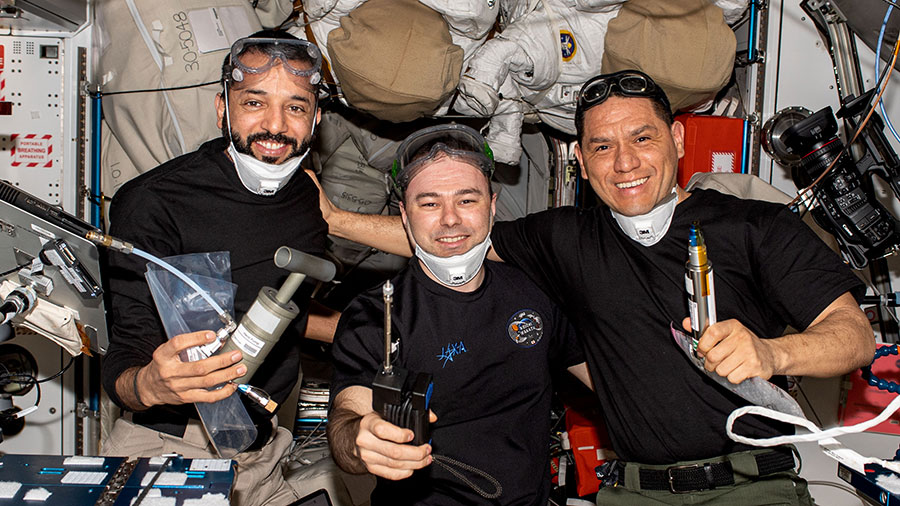
All four astronauts also joined each other after lunch time and called down to their replacements ahead of an upcoming crew swap. The station quartet launched to the orbital lab as the SpaceX Crew-5 mission aboard the Dragon Endurance on Oct. 5, 2022. The new Crew-6 astronauts, who are in Houston today, are Commander Stephen Bowen and Pilot Warren “Woody” Hoburg of NASA, and Mission Specialists Sultan Alneyadi from the Mohammed bin Rashid Space Centre and Andrey Fedyaev from Roscosmos. The Crew-6 mission will launch aboard the Crew Dragon Endeavour from Florida no earlier than Feb. 26 and swap places with the Crew-5 astronauts.

Commander Sergey Prokopyev and Flight Engineer Anna Kikina partnered together on Tuesday morning unpacking some of the nearly three tons of food, fuel, and supplies delivered Saturday inside the ISS Progress 83 resupply ship. The duo then split up in the afternoon working on various electronics maintenance and scientific tasks. Flight Engineer Dmitri Petelin refilled station water tanks with water stowed inside the ISS Progress 82 cargo craft then photographed operations during a space biology experiment.

Get The Details…

Mark Garcia

Powered by WPeMatico

International Space Station Operations Update, Crew Continues Normal Activities

International Space Station Operations Update, Crew Continues Normal Activities

Earlier today, Feb. 11, the uncrewed Roscosmos Progress 83 cargo spacecraft docked automatically to the aft end of the Zvezda service module at the International Space Station. The rendezvous and docking operations were conducted with no issues.

Meanwhile, engineers at the Russian Mission Control Center outside Moscow recorded a depressurization in the unpiloted Roscosmos Progress 82 cargo ship’s coolant loop, which is docked to the space-facing Poisk module at the station. Progress 82, which arrived to the space station in October 2022, is scheduled to undock Friday, Feb. 17, filled with trash and will be deorbited over the Pacific Ocean.

The reason for the loss of coolant in the Progress 82 spacecraft is being investigated. The hatches between the Progress 82 and the station are open, and temperatures and pressures aboard the station are all normal. The crew, which was informed of the cooling loop leak, is in no danger and continuing with normal space station operations.

NASA specialists are assisting their Russian counterparts in the troubleshooting of the Progress 82 coolant leak. Officials are monitoring all International Space Station systems and are not tracking any other issues.

Get The Details…

Sandra Jones

Powered by WPeMatico

Progress Resupply Mission Docks to Station

Progress Resupply Mission Docks to Station

Feb. 11, 2023: International Space Station Configuration. Five spaceships are parked at the space station including the Cygnus space freighter, the SpaceX Crew Dragon Endurance, and Russia's Soyuz MS-22 crew ship and the Progress 82 and 83 resupply ships.
Feb. 11, 2023: International Space Station Configuration. Five spaceships are parked at the space station including the Cygnus space freighter, the SpaceX Crew Dragon Endurance, and Russia’s Soyuz MS-22 crew ship and the Progress 82 and 83 resupply ships.

An uncrewed Roscosmos Progress 83 spacecraft arrived at the International Space Station’s aft port of the Zvezda service module at 3:45 a.m. EST. The spacecraft launched on a Soyuz rocket at 1:15 a.m. EST Thursday, Feb. 9 (11:15 a.m. Baikonur time) from the Baikonur Cosmodrome in Kazakhstan.

Progress is delivering almost three tons of food, fuel and supplies to the International Space Station for the Expedition 68 crew.


Learn more about station activities by following the space station blog@space_station and @ISS_Research on Twitter, as well as the ISS Facebook and ISS Instagram accounts.

Get weekly video highlights at: https://roundupreads.jsc.nasa.gov/videupdate/

Get the latest from NASA delivered every week. Subscribe here: www.nasa.gov/subscribe

Get The Details…

Mark Garcia

Powered by WPeMatico

NASA TV Airs Resupply Ship Docking to Station

NASA TV Airs Resupply Ship Docking to Station

The ISS Progress 82 cargo craft is pictured shortly after docking to the space station in October of 2022.

NASA Television, the agency’s website and the NASA app now are providing live coverage of the docking of a Roscosmos cargo spacecraft to the International Space Station.

The uncrewed Progress 83 launched on a Soyuz rocket at 1:15 a.m. EST Thursday, Feb. 9 (11:15 a.m. Baikonur time) from the Baikonur Cosmodrome in Kazakhstan.


Learn more about station activities by following the space station blog@space_station and @ISS_Research on Twitter, as well as the ISS Facebook and ISS Instagram accounts.

Get weekly video highlights at: https://roundupreads.jsc.nasa.gov/videupdate/

Get the latest from NASA delivered every week. Subscribe here: www.nasa.gov/subscribe

Get The Details…

Mark Garcia

Powered by WPeMatico

Crew Studies Brain, Digestion System and Waits for Saturday Space Delivery

Crew Studies Brain, Digestion System and Waits for Saturday Space Delivery

NASA astronaut and Expedition 68 Flight Engineer Frank Rubio sets up the new Particle Vibration experiment inside the Destiny laboratory module’s Microgravity Science Glovebox on Feb. 3, 2023. The physics study will investigate how particles organize themselves in fluids possibly advancing manufacturing techniques and providing new insights on astrophysics.

The International Space Station will see a new cargo mission arrive early Saturday, replenishing the Expedition 68 crew. While they wait, the orbital residents continued exploring how microgravity affects the brain and the digestive system while maintaining orbital lab systems.

The ISS Progress 83 (83P) cargo craft continues its orbital trek to deliver nearly three tons of food, fuel, and supplies to the station’s residents. The resupply ship from Roscosmos will automatically dock to the Zvezda service module’s rear port at 3:49 a.m. EST on Saturday. Commander Sergey Prokopyev and Flight Engineer Dmitri Petelin will be on-duty to monitor the automated approach and rendezvous of the 83P. Afterward, the duo will wait for the pressure to equalize between the cargo craft and the station before opening the hatches and transferring the six-month supply of cargo.

Prokopyev and Petelin called down to mission controllers on Friday and discussed preparations for the arrival of the 83P. The cosmonaut pair also reviewed operations for Zvezda’s telerobotically operated rendezvous system, or TORU, in the unlikely event the cargo craft would need to be remotely controlled from inside the station for a docking.

Human research dominated this week’s science operations as the crewmates have been studying how living in space impacts blood pressure and digestion. Flight Engineer Nicole Mann of NASA on Friday morning wore a head probe and attached sensors to her chest to measure her blood flow and learn how the brain regulates blood pressure in weightlessness. During the afternoon, she joined fellow NASA astronaut Josh Cassada for another investigation that observes the cardiorespiratory system while exercising on the station. Both studies have the potential to promote healthier humans on Earth and in space.

Roscosmos Flight Engineer Anna Kikina joined Petelin once again Friday morning using biomedical monitoring equipment to observe how their digestion system behaves when eating a meal in space. After breakfast, the duo placed electrodes on themselves and conducted ultrasound scans of their gastrointestinal system for insights into the effects of microgravity on the human body.

Flight Engineers Frank Rubio of NASA and Koichi Wakata of the Japan Aerospace Exploration Agency (JAXA) worked on a variety of orbital maintenance tasks. Rubio continued working in the Tranquility module replacing components in the station’s bathroom, also known as the Waste and Hygiene Compartment. He later swapped metallic samples inside the Materials Science Laboratory to gain new insights into the development of metal alloys. Wakata worked in the Kibo laboratory module disassembling orbital plumbing gear before moving on to the Quest airlock and configuring batteries.


Learn more about station activities by following the space station blog, @space_station and @ISS_Research on Twitter, as well as the ISS Facebook and ISS Instagram accounts.

Get weekly video highlights at: https://roundupreads.jsc.nasa.gov/videoupdate/

Get the latest from NASA delivered every week. Subscribe here: www.nasa.gov/subscribe

Get The Details…

Heidi Lavelle

Powered by WPeMatico