Expedition 70 Underway; Crew Performs Maintenance

Expedition 70 Underway; Crew Performs Maintenance

The Expedition 70 patch is designed around the central yin-yang symbol representing balance; first and foremost, the balance of our beautiful planet Earth that is encircled by the yin-yang symbol and which forms part of the Expedition number.

Expedition 70 is well underway aboard the International Space Station after yesterday’s departure of three long-serving station residents, including NASA astronaut Frank Rubio, who returned to Houston this morning. The seven crew members who are still living and working in microgravity completed an array of maintenance activities today.

NASA Flight Engineer Jasmin Moghbeli, who arrived to the station a month ago, spent her morning in the Columbus Laboratory Module performing maintenance and testing the connectivity functions of power outlets. After lunch, she switched gears, working with the Cold Atom Lab. An ongoing activity for the first-time station resident this week, Moghbeli inspected cables and ports to gear up for tomorrow’s completion of replacing components of the payload. In the evening, she started training for upcoming spacewalks, reviewing spacesuit operations and procedures.

NASA Flight Engineer Loral O’Hara, who arrived to the station two weeks ago, started her day with ISAFE eye exams, as part of a new suite of experiments, called CIPHER. Eye exams of this kind examine changes in an astronaut’s eyes and brain due to fluid shifts in microgravity. CIPHER is an all-encompassing, full-body approach that investigates how multiple systems of the body react to spaceflight before, during and after a mission. O’Hara is the first of up to 30 astronauts to participate.

Following eye exams, O’Hara trained for spacewalk emergencies in the unlikely event they would occur using SAFER, the Simplified Aid for EVA Rescue. Before bed, she reconfigured the Microgravity Science Glovebox.

Expedition 70 Commander Andreas Mogensen of ESA (European Space Agency) spent his day completing some training with Astrobee, the stations free-flying robots that help astronauts conduct daily duties. Afterward, he repaired the docking station the cube-shaped robots use for recharging.

Flight Engineer Satoshi Furukawa of JAXA (Japan Aerospace Exploration Agency) worked in the Bigelow Expandable Activity Module, or BEAM, most of the day. In the station’s first expandable habitat, Furukawa stowed hardware and reconfigured sensors.

The three Roscosmos Flight Engineers—Konstantin Borisov, Oleg Kononenko, and Nikolai Chub—had a light-duty day, completing their required two hours of exercise that helps combat the effects of bone and muscle loss in microgravity.

Powered by WPeMatico

Get The Details…

Abigail Grace Graf

NASA Astronaut Frank Rubio and Crewmates Land in Kazakhstan

NASA Astronaut Frank Rubio and Crewmates Land in Kazakhstan

The Soyuz MS-23 spacecraft deploys its parachute for landing in Kazakhstan. Credit: NASA TV

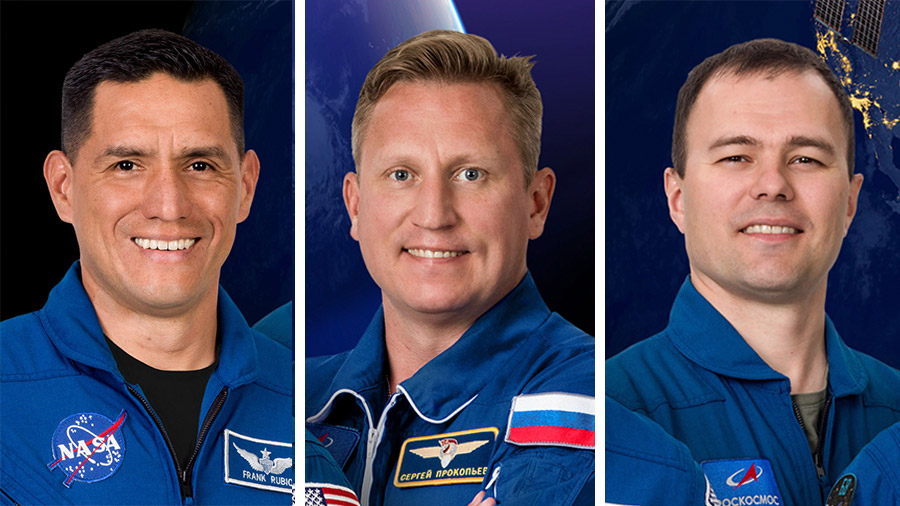
NASA astronaut Frank Rubio ended his record-breaking time in space with a parachute-assisted landing in the Soyuz MS-23 spacecraft on the steppe of Kazakhstan, southeast of the remote town of Dzhezkazgan, at 7:17 a.m. EDT (5:17 p.m. Kazakhstan time) Wednesday, Sept. 27. Rubio, along with Roscosmos cosmonauts Sergey Prokopyev and Dmitri Petelin, began the journey back to Earth at 3:54 a.m. when the Soyuz undocked from the International Space Station.

Rubio arrived at the International Space Station on Sept. 21, 2022, spending 371 days in low Earth orbit, and breaking the previous American record held by NASA astronaut Mark Vande Hei by 16 days.

During his 371 days aboard the station, Rubio experienced:

  • Approximately 5,936 orbits of Earth
  • Approximately 157,412,306 statute miles traveled (equivalent of approximately 328 round trips to the Moon and back)
  • Fifteen spacecraft visiting the International Space Station, including four Roscosmos Progress cargo ships, two Northrop Grumman Cygnus cargo spacecraft, two Roscosmos Soyuz, four crewed SpaceX Dragons, and three uncrewed SpaceX Dragons.

Expedition 70 now is underway on the space station with NASA astronauts Loral O’Hara and Jasmin Moghbeli, ESA (European Space Agency) astronaut and new station commander Andreas Mogensen, JAXA (Japan Aerospace Exploration Agency) astronaut Satoshi Furukawa and Roscosmos cosmonauts Oleg Kononenko, Nikolai Chub, and Konstantin Borisov.


Learn more about station activities by following the space station blog, @space_station and @ISS_Research on X, as well as the ISS Facebook and ISS Instagram accounts.

Get weekly video highlights at: https://roundupreads.jsc.nasa.gov/videoupdate/

Get the latest from NASA delivered every week. Subscribe here: www.nasa.gov/subscribe

Powered by WPeMatico

Get The Details…

Abby Graf

NASA Astronaut Frank Rubio and Crewmates Returning to Earth Live on NASA TV

NASA Astronaut Frank Rubio and Crewmates Returning to Earth Live on NASA TV

(From left) NASA astronaut Frank Rubio and Roscosmos cosmonauts Sergey Prokopyev and Dmitri Petelin are pictured. The three have undocked from the space station and are headed back to Earth.

NASA Television coverage of NASA astronaut Frank Rubio and two Roscosmos cosmonauts’ return to Earth is underway.

Rubio, along with Sergey Prokopyev and Dmitri Petelin, began the journey back to Earth in the early morning hours when the Soyuz MS-23 spacecraft undocked from the International Space Station’s Prichal module at 3:54 a.m. EDT. The trio are heading for a parachute-assisted landing on the steppe of Kazakhstan, southeast of the remote town of Dzhezkazgan, at 7:17 a.m. (5:17 p.m. Kazakhstan time).

Expedition 70 officially began aboard the station at the time of undocking with NASA astronauts Loral O’Hara and Jasmin Moghbeli, ESA (European Space Agency) astronaut and new station commander Andreas Mogensen, JAXA (Japan Aerospace Exploration Agency) astronaut Satoshi Furukawa and Roscosmos cosmonauts Oleg Kononenko, Nikolai Chub, and Konstantin Borisov.


Learn more about station activities by following the space station blog, @space_station and @ISS_Research on X, as well as the ISS Facebook and ISS Instagram accounts.

Get weekly video highlights at: https://roundupreads.jsc.nasa.gov/videoupdate/

Get the latest from NASA delivered every week. Subscribe here: www.nasa.gov/subscribe

Powered by WPeMatico

Get The Details…

Abby Graf

Soyuz Undocks, Crew Headed Back to Earth

Soyuz Undocks, Crew Headed Back to Earth

The Soyuz MS-23 spacecraft undocks from the space station's Prichal module. Aboard are NASA astronaut Frank Rubio and cosmonauts Sergey Prokopyev and Dmitri Petelin.
The Soyuz MS-23 spacecraft undocks from the space station’s Prichal module. Aboard are NASA astronaut Frank Rubio and cosmonauts Sergey Prokopyev and Dmitri Petelin.

At 3:54 a.m. EDT NASA astronaut Frank Rubio, along with Roscosmos cosmonauts Sergey Prokopyev and Dmitri Petelin, undocked from the International Space Station in the Soyuz MS-23 spacecraft to begin the journey back to Earth. The Soyuz is heading for a parachute-assisted landing Wednesday, Sept. 27, on the steppe of Kazakhstan, southeast of the remote town of Dzhezkazgan.

NASA coverage of the crew’s deorbit burn and landing will begin at 6 a.m. on NASA Television, the agency’s website, and the NASA app with landing scheduled at 7:17 a.m. (5:17 p.m. Kazakhstan time).

After landing, the Soyuz MS-23 crew will split up, as per standard crew return practice, with Rubio returning to NASA’s Johnson Space Center in Houston.

Expedition 70 officially began aboard the station at the time of undocking with NASA astronauts Loral O’Hara and Jasmin Moghbeli, ESA (European Space Agency) astronaut and new station commander Andreas Mogensen, JAXA (Japan Aerospace Exploration Agency) astronaut Satoshi Furukawa and Roscosmos cosmonauts Oleg Kononenko, Nikolai Chub, and Konstantin Borisov.


Learn more about station activities by following the space station blog, @space_station and @ISS_Research on X, as well as the ISS Facebook and ISS Instagram accounts.

Get weekly video highlights at: https://roundupreads.jsc.nasa.gov/videoupdate/

Get the latest from NASA delivered every week. Subscribe here: www.nasa.gov/subscribe

Powered by WPeMatico

Get The Details…

Abby Graf

Crewed Soyuz Spacecraft Undocking Live on NASA TV

Crewed Soyuz Spacecraft Undocking Live on NASA TV

The Soyuz MS-23 spacecraft, docked to the station's Prichal module, orbits Earth as crew prepares to undock. Credit: NASA TV
The Soyuz MS-23 spacecraft, docked to the station’s Prichal module, orbits Earth as crew prepares to undock. Credit: NASA TV

NASA Television coverage of NASA astronaut Frank Rubio and two Roscosmos cosmonauts’ departure from the International Space Station is underway.

Rubio, along with Sergey Prokopyev and Dmitri Petelin, closed the hatch to the Roscosmos Soyuz MS-23 spacecraft about 12:41 a.m. EDT. The Soyuz spacecraft will undock at 3:54 a.m. from the Prichal module, heading for a parachute-assisted landing at 7:17 a.m. (5:17 p.m. Kazakhstan time) on the steppe of Kazakhstan, southeast of the remote town of Dzhezkazgan.

Rubio arrived at the International Space Station on Sept. 21, 2022, spending 371 days in low Earth orbit, and breaking the previous American record held by NASA astronaut Mark Vande Hei by 16 days.

While clocking the single longest spaceflight by a NASA astronaut, Rubio has contributed to dozens of scientific studies.

Rubio helped nurture and monitor vegetables harvested with the space station’s Vegetable Production System, or Veggie. The Veggie study evaluates protocols for growing produce in space, and whether plants grown in microgravity can help satisfy the dietary needs of astronauts on more distant spaceflight missions.

In addition, Rubio provided biological samples, completed surveys, and performed tests for a study that collects a core set of measurements from astronauts, called Spaceflight Standard Measures. The measurements serve as a baseline for how multiple systems in the body react to spaceflight, from human cognition to the immune system. Other biological samples will be frozen and archived for future life science studies.

Rubio also became the first astronaut to participate in a study examining how exercising with limited gym equipment affects the human body. Recognizing that crew members traveling to the Moon and elsewhere will not have enough room in their spacecraft for a treadmill, researchers are eager to determine whether other exercise regimens could keep crews healthy on long missions. So rather than running on the space station’s treadmill, Rubio exercised only on the space station’s bicycle and weightlifting machine.

At the time of undocking, Expedition 70 will formally begin aboard the station with NASA astronauts Loral O’Hara and Jasmin Moghbeli, ESA (European Space Agency) astronaut and new station commander Andreas Mogensen, JAXA (Japan Aerospace Exploration Agency) astronaut Satoshi Furukawa and Roscosmos cosmonauts Oleg Kononenko, Nikolai Chub, and Konstantin Borisov.


Learn more about station activities by following the space station blog, @space_station and @ISS_Research on X, as well as the ISS Facebook and ISS Instagram accounts.

Get weekly video highlights at: https://roundupreads.jsc.nasa.gov/videoupdate/

Get the latest from NASA delivered every week. Subscribe here: www.nasa.gov/subscribe

Powered by WPeMatico

Get The Details…

Abby Graf