Week Wraps with Cargo Packing, Tech Research as Crew-12 Discusses Mission

Week Wraps with Cargo Packing, Tech Research as Crew-12 Discusses Mission

NASA astronaut and Expedition 74 Flight Engineer Chris Williams safely processes samples of a bacterial pathogen inside the Kibo laboratory module’s Life Science Glovebox. Williams was exploring a way to prevent the formation of biofilms, or a layer of microorganisms, anywhere water is found on a spacecraft where they pose human health risks and can damage equipment. The microbe samples are housed inside a specialized cell culture chamber, called a BioCell, and exposed to different levels of ultraviolet light to learn how to inhibit microbial growth and reduce reliance on chemical disinfectants.
NASA astronaut Chris Williams conducts microbiology research inside the Kibo laboratory module’s Life Science Glovebox aboard the International Space Station.
NASA

The Expedition 74 trio wrapped up the week packing cargo for return to Earth and exploring artificial intelligence to benefit crew operations. Earth observations and lab gear maintenance rounded out the shift aboard the International Space Station on Friday.

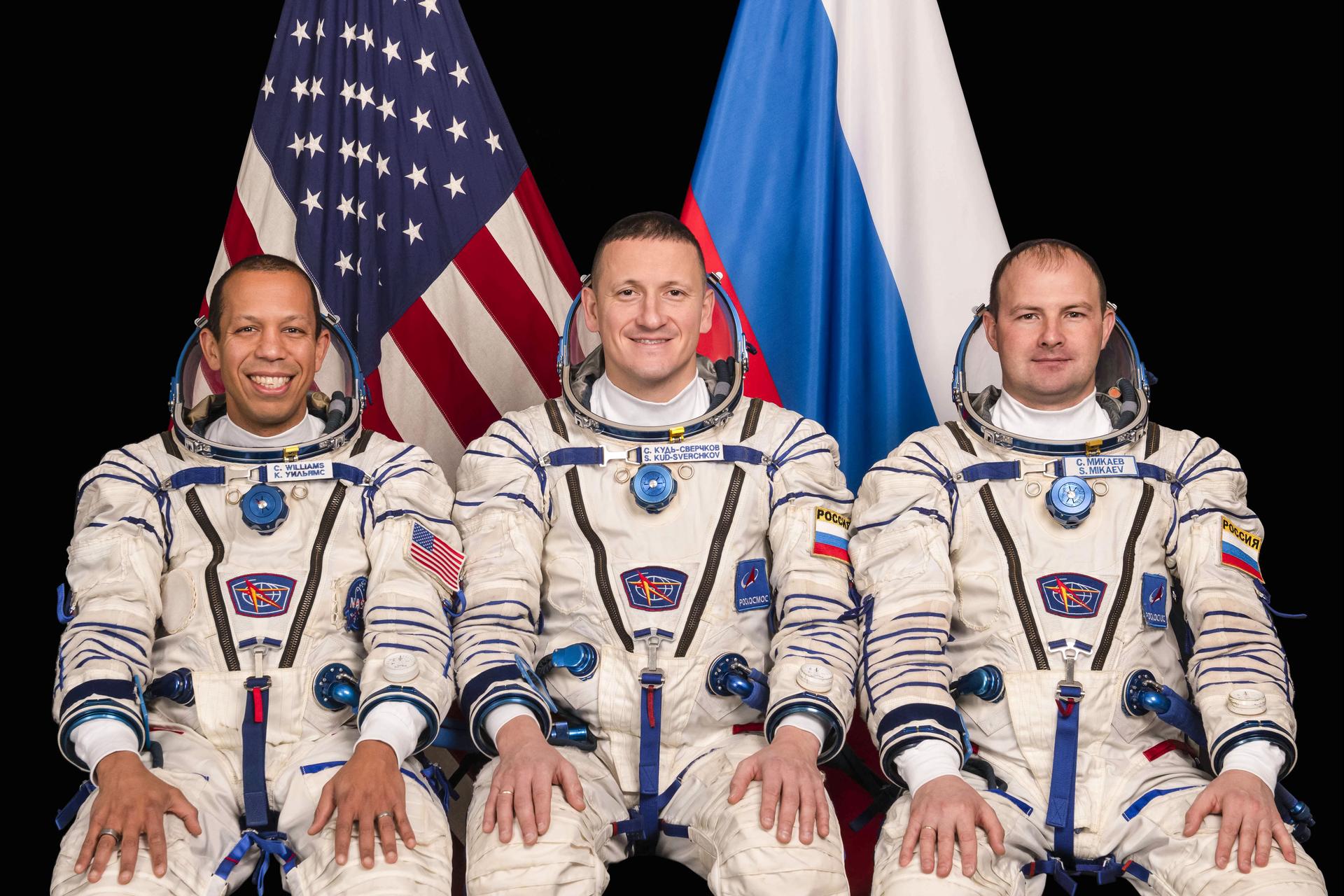
NASA Flight Engineer Chris Williams ended his shift on Friday loading gear inside a SpaceX Dragon for return to Earth next month. Williams, with assistance from station Commander Sergey Kud-Sverchkov of Roscosmos, has begun packing some of the completed experiments and their associated research samples, as well as used hardware and trash, inside Dragon for retrieval and analysis on the ground. Dragon delivered a host of science experiments, crew supplies, and more on August 25, 2025.

Williams spent the first half of his shift working in the Tranquility module servicing a variety of life support systems. He first swapped out orbital plumbing gear that helps recycle wastewater aboard the orbital outpost. Next, he cleaned the ventilation system inside the Harmony module’s overhead crew quarters then measured the airflow from Harmony into the Destiny laboratory module to ensure a safe breathing environment.

Kud-Sverchkov, on his second spaceflight, worked on a pair of different experiments, the first one documenting the effects of natural disasters across the Earth’s surface, and the second exploring plasma physics. He pointed a camera out different windows in the Zvezda service module and photographed landmarks near water bodies and mountains from northwest Africa to eastern Europe. Next, Kud-Sverchkov studied procedures for the upcoming Plasma Kristall-4 physics investigation that explores complex plasmas possibly advancing spacecraft designs, leading to a better understanding of planet formation, and improving fundamental physics research.

Roscosmos Flight Engineer Sergei Mikaev uninstalled Earth observation gear completing an overnight automated photography session that captured multi-spectral imagery of wildfires from Africa to Southeast Asia during the crew’s sleep session. Next, Mikaev configured data management and control hardware that supports experiment platforms from materials research to space physics, and artificial intelligence systems. Finally, the first-time space flyer turned his attention to another artificial intelligence study studying tools to convert speech-to-text and improve data handling and communications between the crew and ground controllers. Researchers seek to use the new technology to speed up and increase the accuracy of crew documentation benefitting operations aboard spacecraft.

The four members representing NASA’s SpaceX Crew-12 mission discussed their upcoming flight to the space station during a Crew News Conference on YouTube. Commander Jessica Meir and Pilot Jack Hathaway, both from NASA, and Mission Specialists Sophie Adenot of ESA (European Space Agency) and Andrey Fedyaev of Roscosmos are targeting a launch on Feb. 11 to begin a space research mission aboard the orbital laboratory. Mission managers from NASA, ESA, and SpaceX also discussed the research objectives of Crew-12 during the Mission Overview Conference today.

Learn more about station activities by following the space station blog, @space_station on X, as well as the ISS Facebook and ISS Instagram accounts.

Get the latest from NASA delivered every week. Subscribe here.

Powered by WPeMatico

Get The Details…

Mark A. Garcia

Expedition 74 Preps CubeSats and Photographs Earth for Research

Expedition 74 Preps CubeSats and Photographs Earth for Research

Three CubeSats are ejected outside the Kibo laboratory module
Three CubeSats are ejected from the Japanese Small Satellite Orbital Deployer attached to a robotic arm outside of the International Space Station’s Kibo laboratory module in June of 2019.
NASA

Expedition 74 focused on installing CubeSats and observing Earth aboard the International Space Station on Thursday. The trio from NASA and Roscosmos kept up ongoing research operations along with standard orbital lab maintenance throughout the day.

The numerous modules that make up the orbital outpost support a wide array of continuous microgravity experiments difficult or impossible to support in Earth’s gravity environment to benefit humanity on and off the planet. A portion of that research takes place on the outside of the space station and is even deployed into Earth orbit. NASA Flight Engineer Chris Williams spent his shift inside the Kibo laboratory module loading a small satellite orbital deployer with CubeSats on Thursday then installing the device inside Kibo’s airlock. The Japanese robotic arm—attached to Kibo—will retrieve the small satellite deployer from the airlock then point it away from the station. Afterward on an upcoming date, a series of shoebox-sized CubeSats will be deployed into Earth orbit for educational, government, and private research.

Other research aboard the International Space Station looks at the Earth to understand how the landscape is affected by natural catastrophes such as wildfires, storms, and more. Roscosmos cosmonaut Sergei Mikaev was back inside the Zvezda service module on Thursday pointing a camera outside windows at the Earth below. Mikaev photographed landmarks from northwest Africa to eastern Europe then downloaded the imagery for analysis by specialists on the ground. At the end of his shift, he configured a multi-spectral camera for an automated Earth photography session capturing imagery of wildfires from Africa to Southeast Asia during the crew’s sleep session.

The station’s commander, Sergey Kud-Sverchkov of Roscosmos, worked throughout his shift on electronics and life support maintenance. Kud-Sverchkov began his day servicing orbital plumbing hardware and testing communication systems inside Zvezda. After lunch, he moved into the Nauka science module cleaning and inspecting its ventilation system. The two-time space station resident wrapped up his day cleaning Roscosmos fluid systems using compressed air and water to remove residues, particulates, and chemical deposits.

Learn more about station activities by following the space station blog, @space_station on X, as well as the ISS Facebook and ISS Instagram accounts.

Get the latest from NASA delivered every week. Subscribe here.

Powered by WPeMatico

Get The Details…

Mark A. Garcia

NASA’s SpaceX Crew-12 Begins Quarantine for Space Station Mission

NASA’s SpaceX Crew-12 Begins Quarantine for Space Station Mission

Four side-by-side astronauts in white spacesuits look toward the camera.
From left to right, NASA astronauts Jessica Meir, Jack Hathaway, ESA (European Space Agency) astronaut Sophie Adenot, and Roscosmos cosmonaut Andrey Fedyaev are NASA’s SpaceX Crew-12 launching to the International Space Station in February.
SpaceX

The four crew members of NASA’s SpaceX Crew-12 mission began their routine two-week quarantine on Wednesday at NASA’s Johnson Space Center in Houston ahead of their upcoming launch to the International Space Station.

The earliest opportunity for Crew-12 to launch to the orbital complex is 6 a.m. EST Wednesday, Feb. 11, from Space Launch Complex 40 at Cape Canaveral Space Force Station in Florida. The next available launch opportunities are 5:38 a.m. on Thursday, Feb. 12, and 5:15 a.m. on Friday, Feb. 13. NASA continues working toward potential launch windows for two important crewed missions this February: Artemis II and Crew-12. The agency will make any decisions on the best launch opportunity for each mission closer to flight.

NASA astronauts Jessica Meir, Jack Hathaway, ESA (European Space Agency) astronaut Sophie Adenot, and Roscosmos cosmonaut Andrey Fedyaev are scheduled to travel Friday, Feb. 6, from Houston to the agency’s Kennedy Space Center in Florida, where they’ll remain in quarantine while conducting prelaunch operations.

Crew quarantine began during Apollo to reduce preflight illnesses and prevent subsequent symptoms during flight. During Crew 12’s quarantine, contact with other people is limited, and most interactions are handled remotely. Family members and select mission personnel undergo medical screening and must be cleared before interacting with the crew.

Before quarantine, the team also completed the crew equipment interface test on Jan. 12. The daylong exercise included crew members putting on their spacesuits, entering the SpaceX Dragon spacecraft, conducting suit leak checks, and confirming seat fitting. They also familiarized themselves with the spacecraft’s interior, completed communications checkouts, and listened to the Dragon’s fans and pumps to prepare for sounds they will hear during the flight to the orbiting laboratory.

More details about the launch will be posted on the mission blog, @NASAKennedy on X, or NASA Kennedy on Facebook.

Powered by WPeMatico

Get The Details…

Elyna Niles-Carnes

Advanced Tech Research on Station as Crew-12 Announces Launch Opportunities

Advanced Tech Research on Station as Crew-12 Announces Launch Opportunities

The four members of NASA's SpaceX Crew-12 mission to the International Space Station pose together for a crew portrait inside a SpaceX Dragon spacecraft at SpaceX headquarters in Hawthorne, California. From left are, Roscosmos cosmonaut and Mission Specialist Andrey Fedyaev, NASA astronauts Jack Hathaway and Jessica Meir, Pilot and Commander respectively, and ESA (European Space Agency) astronaut and Mission Specialist Sophie Adenot.
The four members of NASA’s SpaceX Crew-12 mission to the International Space Station pose together for a crew portrait inside a SpaceX Dragon spacecraft. From left are, Roscosmos cosmonaut Andrey Fedyaev, NASA astronauts Jack Hathaway and Jessica Meir, and ESA (European Space Agency) astronaut Sophie Adenot.
SpaceX

Robotics and artificial intelligence were back on the research schedule Wednesday for the Expedition 74 crew to inspire college students and explore boosting crew efficiency. Earth observations and life support maintenance also rounded out the day for the orbital residents aboard the International Space Station.

Several teams of college students from the Asia-Pacific region competed to see whose code could best command the Astrobee robotic free-flyers during a “treasure” hunt aboard the Kibo laboratory module. The challenge was to maneuver the Astrobee and properly identify and locate hidden items throughout the Kibo lab. NASA Flight Engineer Chris Williams monitored the Kibo robotics challenge ensuring the toaster-sized, cube-shaped robots were correctly configured and operated safely. The ultimate objective of the robotics challenge is to inspire students to study science, technology, engineering, and math subjects.

Station Commander Sergey Kud-Sverchkov of Roscosmos worked in the Zvezda service module and studied using artificial intelligence to boost crew efficiency aboard the orbital outpost. He tested AI-assisted tools to convert speech-to-text and improve data handling and communications between the crew and ground controllers. Researchers seek to use the new technology to speed up and increase the accuracy of crew documentation benefitting operations aboard spacecraft.

The commander also checked out a variety of cameras throughout the station’s Roscosmos segment and synchronized them to Greenwich Mean Time, or GMT, to accurately timestamp imagery. Kud-Sverchkov then moved on and serviced plumbing and ventilation systems in the Nauka and Zarya modules.

Roscosmos Flight Engineer Sergei Mikaev pointed a camera out a station window and programmed it to automatically photograph landmarks across eastern Europe at the beginning of his shift. Afterward, Mikaev uninstalled the Earth observation equipment and downloaded the imagery data for analysis on the ground. During the second half of his shift, he checked out computer software supporting physics research hardware then answered a questionnaire to help researchers improve communications between international crews and mission controllers from around the world.

The earliest opportunity for NASA’s SpaceX Crew-12 launch to the space station is 6 a.m. EST, Feb. 11, from pad 40 at Cape Canaveral Space Force Station in Florida. Next opportunities are 5:38 a.m. Feb. 12 & 5:15 a.m. Feb. 13. NASA continues working toward potential launch windows for two important crewed missions this February: Artemis II and Crew-12. We will make any decisions on the best launch opportunity for each mission closer to flight.

Learn more about station activities by following the space station blog, @space_station on X, as well as the ISS Facebook and ISS Instagram accounts.

Get the latest from NASA delivered every week. Subscribe here.

Powered by WPeMatico

Get The Details…

Mark A. Garcia

Crew Studies Robotics and Virtual Reality Advancing Space Tech

Crew Studies Robotics and Virtual Reality Advancing Space Tech

iss070e038773 (Dec. 13, 2023) --Two free-flying robotic helpers, Astrobee, float in microgravity. The robots are designed to help crews aboard the International Space Station complete daily tasks and reduce the time spent on routine duties.
Two free-flying Astrobee robotic helpers are pictured inside the Kibo laboratory module. The robots are designed to help crews aboard the International Space Station complete daily tasks and reduce the time spent on routine duties.
NASA

Robotics and virtual reality filled the science schedule aboard the International Space Station on Tuesday as the Expedition 74 crew promoted education and explored human research. The orbital trio also inspected safety equipment, worked on cargo swaps, and conducted Earth observations.

Students from the Asia-Pacific region are preparing for a robotics challenge that will see their codes uplinked to the orbital outpost to control the cube-shaped, free-flying Astrobee robotic helpers inside the Kibo laboratory module. The object of the challenge is to command an Astrobee to locate hidden objects inside Kibo promoting science, technology, engineering, and math subjects on the ground. NASA Flight Engineer Chris Williams reviewed preparations and powered on the Astrobee in advance of the robotics challenge that will take place on Wednesday.

Williams then spent the rest of his shift inspecting fire suppression and emergency breathing gear throughout the space station’s U.S. segment. He checked the equipment for damage, corrosion, and leaks and ensured the safety hardware was stowed in the proper configurations and locations.

Roscosmos cosmonauts Sergey Kud-Sverchkov and Sergei Mikaev took turns wearing virtual reality goggles and responding to visual and audio cues inside the Nauka science module on Tuesday. They also wore electrodes on their face and head and tested their how their balance and spatial orientation are adapting to microgravity. Results from the Virtual investigation may help crews adjust quicker to weightlessness and prepare for the return to Earth’s gravity after a long-term mission.

Kud-Sverchkov earlier pointed a camera out windows on the Zvezda service module and photographed landmarks from the Swiss Alps to Kazakhstan’s Lake Balkhash. Mikaev swapped a variety of cargo in and out of the Progress 92 cargo craft docked to the orbital outpost’s Poisk module.

Learn more about station activities by following the space station blog, @space_station on X, as well as the ISS Facebook and ISS Instagram accounts.

Get the latest from NASA delivered every week. Subscribe here.

Powered by WPeMatico

Get The Details…

Mark A. Garcia