Science Activation and Training Top Friday’s Orbital Schedule

Science Activation and Training Top Friday’s Orbital Schedule

NASA astronauts Nick Hague and Suni Williams, Expedition 72 Flight Engineer and Commander respectively, discuss orbital lab maintenance procedures aboard the International Space Station.

A host of activities topped Friday’s schedule aboard the orbital outpost as the Expedition 72 crew penned in time for experiment activation, spacesuit work, training, and more.

International Space Station Commander Suni Williams spent the first half of her day on spacesuit duty, removing the impact shields and inspecting the gear for any leaks. In the afternoon, she serviced biotechnology hardware and installed new cassettes for crystallization research.

Later on, Williams was joined by her three of her crewmates, NASA Flight Engineers Nick Hague and Butch Wilmore, along with Roscosmos cosmonaut Aleksandr Gorbunov, to review medical emergency procedures and hardware.

Both Hague and Wilmore separately assisted NASA Flight Engineer Don Pettit throughout the day to illuminate space-induced inflammation changes in organisms. Hague also set up new experiment containers for an investigation that will test how to transplant and grow micro-algae in space.

Meanwhile, Wilmore continued work that Williams began yesterday and activated additional mixing tubes that contain protein and bacteria for the NanoRacks Module-9 investigation, which is a student-led experiment that examines how microgravity affects protein synthesis.

The orbiting lab’s three cosmonauts completed an array of upkeep tasks throughout the day. Gorbunov and Flight Engineer Ivan Vagner conducted some orbital plumbing, while Flight Engineer Alexey Ovchinin worked some life support systems and electronics tasks before photographing various landmarks on Earth. At the end of the day, the trio was joined by their four NASA crewmates to review Dragon cargo emergency training materials and response.

On Earth, the four crew members of NASA’s SpaceX Crew-8, who splashed down off the coast of Florida on Oct. 25, will discuss their microgravity science mission during a post-flight news conference this afternoon, Nov. 8, at 3:15 p.m. EST. Watch the quartet live on NASA+ and the agency’s website.


Learn more about station activities by following the space station blog, @space_station and @ISS_Research on X, as well as the ISS Facebook and ISS Instagram accounts.

Get weekly updates from NASA Johnson Space Center at: https://roundupreads.jsc.nasa.gov/

Get the latest from NASA delivered every week. Subscribe here: www.nasa.gov/subscribe

Powered by WPeMatico

Get The Details…

Abby Graf

New Science Experiments Being Activated Aboard Station

New Science Experiments Being Activated Aboard Station

Astronaut Nick Hague explores the potential of biomanufacturing using microorganisms and cell cutlures to create food, medicine, and more in space.

The Expedition 72 crew began activating new experiments on Thursday following a day of unpacking the SpaceX Dragon cargo spacecraft, installing new science gear, and stowing fresh research samples aboard the International Space Station.

Veteran Flight Engineer Don Pettit spent his shift on DNA research first collecting station water samples to examine for microbes. Next, he extracted DNA from the microbial samples and processed them for analysis and identification. Flight Engineer Nick Hague set up biology hardware inside the Kibo laboratory module’s Life Science Glovebox to illuminate space-caused inflammation changes in organisms. At the end of their shift, Pettit imaged Hague’s eyes using standard medical imaging hardware testing a hypothesis that a B Complex vitamin supplement may prevent space-caused vision issues.

NASA Flight Engineer Butch Wilmore worked in the Destiny laboratory module and installed new physics hardware in the Microgravity Science Glovebox that measures particle movements in fluids. The investigation takes advantage of the microgravity environment to learn how to separate viruses from biological fluids for disease detection. Commander Suni Williams activated mixing tubes containing proteins and bacteria for a set of student-designed NanoRacks Module-9 experiments promoting healthy crew members and encouraging future space researchers. Williams also worked on a variety of science maintenance tasks while continuing to unpack the Dragon spacecraft.

The Canadarm2 robotic arm is in position on the Harmony module to extract experimental hardware to measure the solar wind from the SpaceX Dragon cargo spacecraft’s trunk. Robotic engineers on the ground will remotely command the Canadarm2 and its fine-tuned Dextre robotic hand to gently remove the solar measurement gear from Dragon on Saturday. Then on Monday, the solar experiment will be installed on the port side of the orbital outpost’s Integrated Truss Structure where it will soon begin operations. CODEX, or Coronal Diagnostic Experiment, will use a coronagraph to filter out the sun’s bright light to reveal its outer atmosphere, or corona, and examine how solar wind forms.

Roscosmos Flight Engineer Ivan Vagner started his day servicing a 3D printer in the Nauka science module then completed his shift conducting photographic inspections of windows on the Zvezda service module. Cosmonauts Alexey Ovchinin and Aleksandr Gorbunov worked throughout Thursday maintaining Roscosmos electronics and life support systems.


Learn more about station activities by following the space station blog, @space_station and @ISS_Research on X, as well as the ISS Facebook and ISS Instagram accounts.

Get the latest from NASA delivered every week. Subscribe here: www.nasa.gov/subscribe

Powered by WPeMatico

Get The Details…

Mark Garcia

Crew Unpacks New Station Science Delivered Aboard Dragon

Crew Unpacks New Station Science Delivered Aboard Dragon

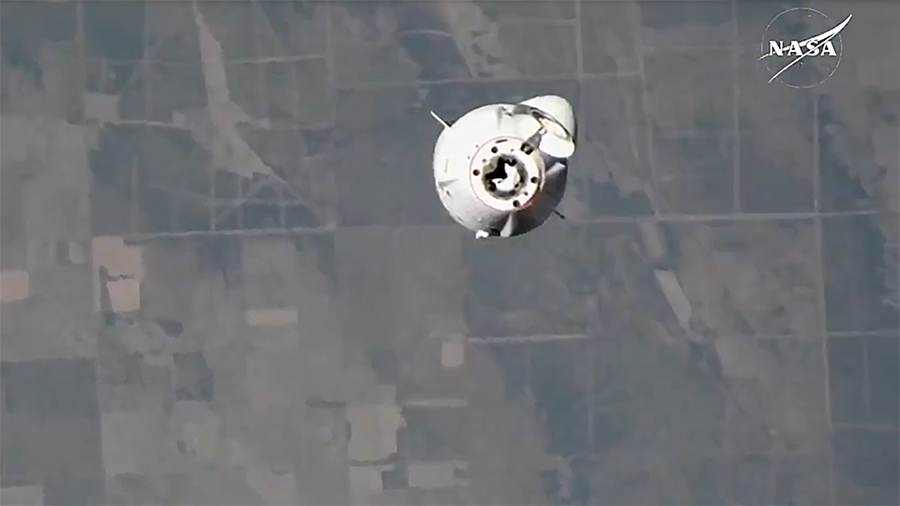
The SpaceX Dragon cargo spacecraft is pictured from an external space station camera approaching the orbital outpost above Argentina on Tuesday, Nov. 5
The SpaceX Dragon cargo spacecraft is pictured from an external space station camera approaching the orbital outpost above Argentina on Tuesday, Nov. 5. Credit: NASA+

New science experiments and research samples delivered aboard the SpaceX Dragon cargo spacecraft on Tuesday are being installed today aboard the International Space Station. Meanwhile, more science and lab maintenance continued ensuring the upkeep of the orbital outpost.

The four NASA astronauts representing the Expedition 72 crew, Flight Engineers Don Pettit, Nick Hague, and Butch Wilmore, and Commander Suni Williams, spent the day unloading the research-packed Dragon that arrived on Tuesday, Nov. 5. The quartet quickly transferred the advanced research hardware and temperature-sensitive specimens into the space station and installed them into research racks and cold storage.

Pettit entered Dragon and removed new space biology hardware to explore space-caused inflammation changes then installed it inside the Kibo laboratory module for activation. Hague partnered together with Wilmore and disconnected Dragon’s portable science freezers containing critical science samples then installed them in station EXPRESS racks for upcoming processing and analysis. Williams also participated in the Dragon science hardware transfers before joining Wilmore to unpack frozen research sample bags for stowage in a variety of station science freezers.

The space station’s three cosmonauts, Alexey Ovchinin, Ivan Vagner, and Aleksandr Gorbunov, spent Wednesday on their task list of Roscosmos science experiments and lab maintenance.

Ovchinin and Vagner worked together throughout the day in the Zvezda service module setting up an X-ray spectrometer that was delivered aboard the Progress 89 resupply ship on Aug. 17. The duo installed cables and electronics components to support the astrophysics observation study that will be installed outside the orbital lab on a later date. Gorbunov closed out an experimental session observing Earth’s nighttime atmosphere in near-ultraviolet wavelengths then spent the rest of his shift servicing electronics and life support systems.


Learn more about station activities by following the space station blog, @space_station and @ISS_Research on X, as well as the ISS Facebook and ISS Instagram accounts.

Get the latest from NASA delivered every week. Subscribe here: www.nasa.gov/subscribe

Powered by WPeMatico

Get The Details…

Mark Garcia

SpaceX Dragon Cargo Spacecraft Docks to Harmony Module

SpaceX Dragon Cargo Spacecraft Docks to Harmony Module

The International Space Station is viewed from a camera aboard the approaching SpaceX Dragon cargo spacecraft. The SpaceX Dragon Freedom crew spacecraft is pictured (at center) docked to the Harmony module's space-facing port. Credit: NASA+
The International Space Station is viewed from a camera aboard the approaching SpaceX Dragon cargo spacecraft. The SpaceX Dragon Freedom crew spacecraft is pictured (at center) docked to the Harmony module’s space-facing port. Credit: NASA+

At 9:52 a.m. EST, the SpaceX Dragon spacecraft docked to the forward port of the International Space Station’s Harmony module.

The spacecraft carried over 6,000 pounds of scientific investigations and cargo to the orbiting laboratory on SpaceX’s 31st commercial resupply services mission for NASA. The mission launched at 9:29 a.m. Nov. 4 on a SpaceX Falcon 9 rocket from Launch Complex 39A at NASA’s Kennedy Space Center in Florida.


Learn more about station activities by following the space station blog, @space_station and @ISS_Research on X, as well as the ISS Facebook and ISS Instagram accounts.

Get the latest from NASA delivered every week. Subscribe here: www.nasa.gov/subscribe

Powered by WPeMatico

Get The Details…

Mark Garcia

Dragon Approaching Station on 31st Cargo Mission

Dragon Approaching Station on 31st Cargo Mission

The SpaceX Dragon cargo spacecraft approaches the space station for a docking to the Harmony module's space-facing port on March 23, 2024.
The SpaceX Dragon cargo spacecraft approaches the space station for a docking to the Harmony module’s space-facing port on March 23, 2024.

NASA’s coverage is underway for arrival of the SpaceX Dragon spacecraft to the International Space Station on NASA+ and the agency’s website. Learn how to watch NASA content through a variety of platforms, including social media.

At approximately 9:55 a.m. EST, Dragon will dock autonomously to the forward port of the space station’s Harmony module.

The spacecraft is carrying over 6,000 pounds of scientific investigations and cargo to the orbiting laboratory on SpaceX’s 31st commercial resupply services mission for NASA. The mission launched at 9:29 p.m. Nov. 4 on a SpaceX Falcon 9 rocket from Launch Complex 39A at NASA’s Kennedy Space Center in Florida.


Learn more about station activities by following the space station blog, @space_station and @ISS_Research on X, as well as the ISS Facebook and ISS Instagram accounts.

Get the latest from NASA delivered every week. Subscribe here: www.nasa.gov/subscribe

Powered by WPeMatico

Get The Details…

Mark Garcia