Advanced Life Support, Robotics, and Repair Tech Studies Wrap Up Week

Advanced Life Support, Robotics, and Repair Tech Studies Wrap Up Week
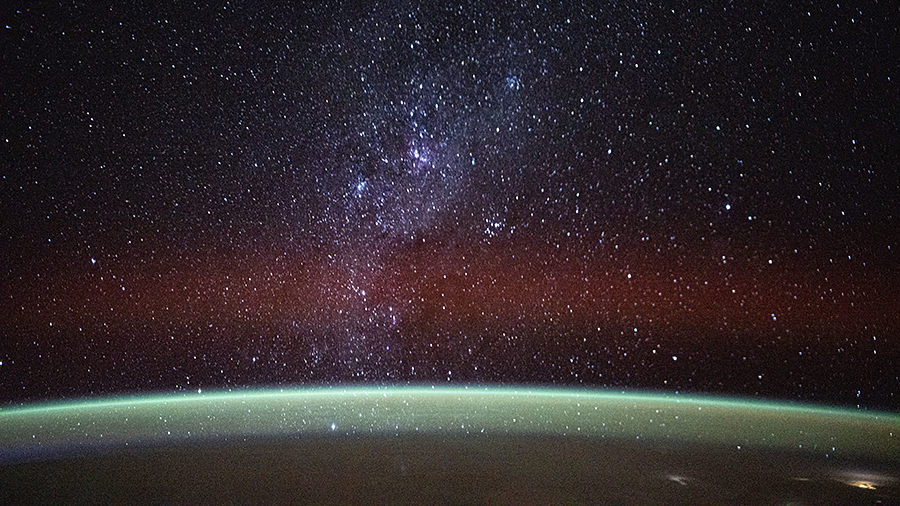
A long-exposure shot taken by NASA astronaut Don Pettit shows the intricacies of stars in the Milky Way as the International Space Station orbited 253 miles above the Atlantic Ocean.

The Expedition 72 crew explored new technologies on Friday including life support systems supported by photosynthesis, capturing satellites with robots, and cold welding in microgravity. The International Space Station residents also continued checking out spacesuits while keeping up standard lab maintenance tasks at the end of the week.

Using micro-algae to remove carbon dioxide, produce oxygen, and create food in the spacecraft environment is an important test for NASA as it plans longer human missions to the Moon, Mars, and beyond. NASA Flight Engineer Nick Hague worked in the Columbus laboratory module servicing samples of the Arthrospira C micro-algae for incubation and analysis. Scientists will expose the radiation-resistant samples to different light intensities while monitoring their cell growth and oxygen production. Results may advance life support systems and fresh food production in space.

Engineers are studying how satellites interact in close proximity with each other to learn how to capture space objects for servicing or removal. NASA Commander Suni Williams checked out the Astrobee robotic free-flyer in the Kibo laboratory module and installed tentacle-like arms containing gecko-like adhesive pads to demonstrate satellite capture techniques. Engineers on the ground then remotely-controlled the cube-shaped, toaster-sized robotic assistant testing its ability to conduct docking maneuvers and capture free-flying objects. Development of this robotic technology may increase the life span of satellites and enable the removal of space debris.

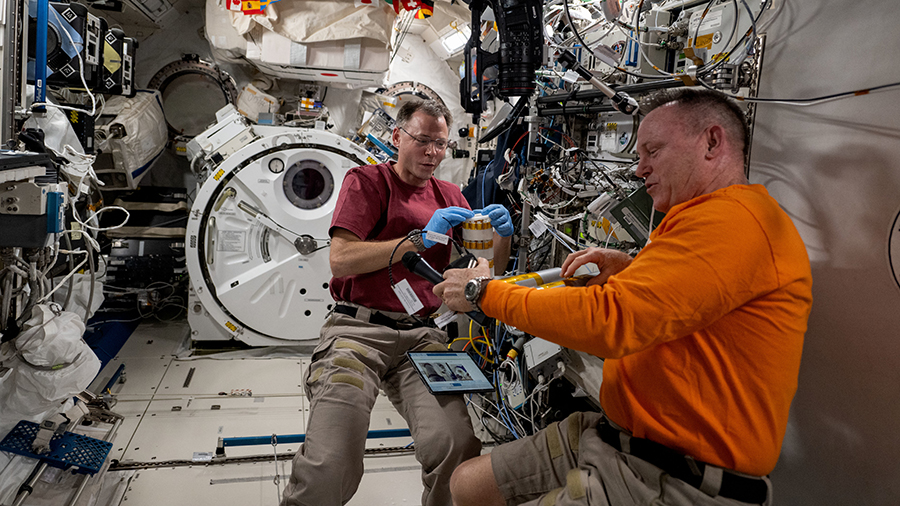
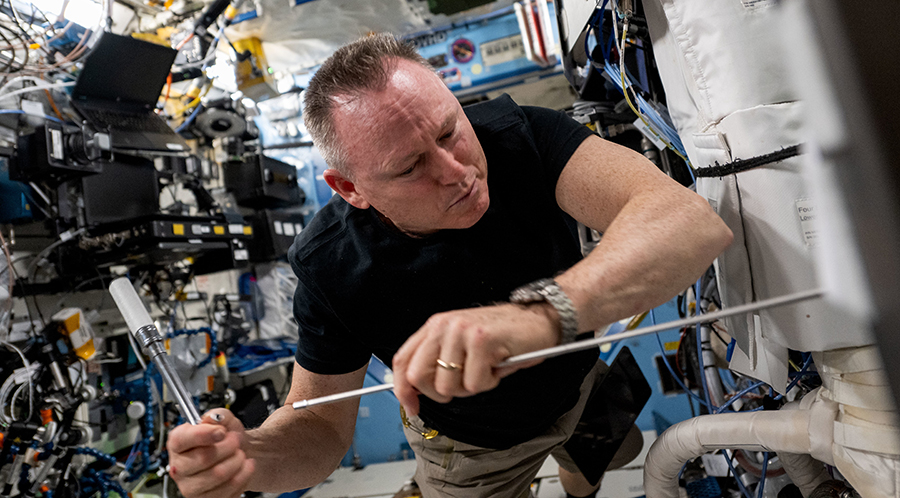
NASA Flight Engineers Don Pettit and Butch Wilmore worked on installing new scientific hardware to explore materials exposed to space radiation and test a spacecraft repair technique. Pettit set up external research gear inside Kibo that will be placed in the vacuum of space to observe how a variety of materials react to the extreme thermal environment, different types of radiation, micrometeoroids, and more to promote the space industry. Wilmore installed the Nanolab Astrobeat space repair experiment hardware in the Destiny laboratory module that will explore a cold-welding technique to repair micrometeoroid impacts to spacecraft.

Roscosmos Flight Engineers Alexey Ovchinin and Ivan Vagner were back on spacesuit duty Friday conducting leak checks, valve tests, and servicing the suits’ life support components. The duo is readying the suits for a spacewalk planned in mid-December. Cosmonaut Aleksandr Gorbunov primarily spent his day on orbital plumbing tasks before wrapping up his shift on computer maintenance in the Nauka science module.


Learn more about station activities by following the space station blog, @space_station and @ISS_Research on X, as well as the ISS Facebook and ISS Instagram accounts.

Get the latest from NASA delivered every week. Subscribe here: www.nasa.gov/subscribe

Powered by WPeMatico

Get The Details…

Mark Garcia

Station Crew Studies Immunity, Digestion Systems to Benefit Health

Station Crew Studies Immunity, Digestion Systems to Benefit Health

Star trails, an aurora, and Earth's atmospheric glow highlight this long-duration photograph taken from the International Space Station as it orbited 259 miles above the North Pacific Ocean.
Star trails, an aurora, and Earth’s atmospheric glow highlight this long-duration photograph taken from the International Space Station as it orbited 259 miles above the North Pacific Ocean.

The Expedition 72 crew’s space biology research on Thursday explored how the human immune and digestion systems react to weightlessness to improve health on Earth and in space. The seven residents aboard the International Space Station also worked on a variety of other experiments while continuing the upkeep of the orbital lab.

NASA astronauts Suni Williams and Nick Hague , Expedition 72 Commander and Flight Engineer respectively, partnered together in the Kibo laboratory module processing cell samples using the Life Science Glovebox. The duo was exploring how spaceflight and radiation affect the immunity system and blood clotting possibly providing insights to advance health protecting astronauts in space and humans on Earth.

Space physics is also a key science topic as researchers study phenomena that can only be observed in the microgravity environment to build stronger, higher quality materials benefitting Earth and space industries. Working in Kibo’s Electrostatic Levitation Furnace (ELF), a research facility that exposes materials to high temperatures, NASA Flight Engineers Don Pettit and Butch Wilmore removed samples from inside the device stowing them for return to Earth. The ELF enables measurements of thermophysical properties unobtainable on the ground.

Roscosmos cosmonauts Ivan Vagner and Aleksandr Gorbunov scanned their stomachs with an ultrasound device after breakfast again to observe how the gastrointestinal tract, part of the digestion system, changes in microgravity. The ultrasound scans, just one part of the long-running study, were looking at the system’s biochemistry, organs, and vessels.

Vagner later joined Roscosmos Flight Engineer Alexey Ovchinin and checked out a pair of Orlan spacesuits ahead of a planned spacewalk. Vagner then packed trash inside the Progress 88 resupply ship ahead of its departure next week. Ovchinin also took inventory of Roscosmos cargo and serviced communications gear. Gorbunov finished his charging video camera batteries and conducting orbital plumbing.


Learn more about station activities by following the space station blog, @space_station and @ISS_Research on X, as well as the ISS Facebook and ISS Instagram accounts.

Get the latest from NASA delivered every week. Subscribe here: www.nasa.gov/subscribe

Powered by WPeMatico

Get The Details…

Mark Garcia

DNA Tech, Life Science Top Science Schedule as Station Boosts Orbit

DNA Tech, Life Science Top Science Schedule as Station Boosts Orbit

Astronauts (from left) Nick Hague and Butch Wilmore partner together inside the Kibo laboratory module on space biology research.

Wednesday’s research schedule aboard the International Space Station was packed with DNA-like nanomaterials, ultrasound scans, and a variety of advanced science hardware maintenance.  The Expedition 72 crew also continued its ongoing life support and systems servicing ensuring the upkeep of the orbital outpost.

NASA Flight Engineers Suni Williams and Nick Hague continued exploring manufacturing DNA-like nanomaterials to develop therapies and treat space-caused and Earthbound conditions on Wednesday. The duo processed and imaged messenger RNA (mRNA) samples in the Kibo laboratory module’s Life Science Glovebox to evaluate their quality in space. The results will be compared to Earth-developed samples testing the hypothesis that space-manufacturing will create superior vaccines, regenerative medicine, and more.

NASA Flight Engineer Butch Wilmore kicked off the DNA therapy manufacturing experiment by relocating a laptop computer to support the biotechnology study. Afterward, Wilmore replaced hardware and experiment samples inside the Combustion Integrated Rack continuing a study that observes how solid fuels burn in microgravity potentially increasing spacecraft fire safety.

NASA Flight Engineer Don Pettit spent most of his day transferring biology hardware from an incubator to a glovebox located inside Kibo to study the effects of space-caused inflammation. Following that, the four-time space station visitor spent the rest of the afternoon on orbital plumbing tasks in the Tranquility module.

Roscosmos Flight Engineers Ivan Vagner and Aleksandr Gorbunov scanned their stomachs with an ultrasound device after breakfast on Wednesday.  The cosmonauts were exploring how the digestive system adapts to the long-term weightless environment aboard the orbital outpost. Vagner and Gorbunov later joined Flight Engineer Alexey Ovchinin and checked the Zvezda service module’s telerobotically operated rendezvous system, or TORU, that can be used to control Roscosmos spaceships from the station. Finally, Ovchinin and Vagner tested ways to improve communications with international crews and flight controllers while Gorbunov checked thermal sensors inside the Zarya module.

The International Space Station is orbiting higher today after the Progress 89 cargo craft docked to the rear port of Zvezda fired its thrusters for over 31 minutes. The orbital reboost places the station at the correct altitude for the Progress 90 resupply mission planned to launch next week after the departure of the Progress 88 cargo craft.


Learn more about station activities by following the space station blog, @space_station and @ISS_Research on X, as well as the ISS Facebook and ISS Instagram accounts.

Get the latest from NASA delivered every week. Subscribe here: www.nasa.gov/subscribe

Powered by WPeMatico

Get The Details…

Mark Garcia

Biotech and Human Research Fill Station Crew’s Schedule

Biotech and Human Research Fill Station Crew’s Schedule

Astronaut Butch Wilmore installs portable experiment hardware inside the Destiny laboratory module aboard the International Space Station.

Biotechnology research topped the science schedule aboard the International Space Station on Tuesday to advance in-space manufacturing of health therapies. The Expedition 72 crew members also took a physical fitness test, studied futuristic piloting techniques, and maintained a variety of research and electronics hardware throughout the day.

NASA Flight Engineers Don Pettit and Nick Hague worked together on Tuesday exploring how to manufacture nanomaterials to mimic DNA. The astronauts partnered together in the Kibo laboratory module processing and imaging samples of the DNA-inspired nanomaterials inside the Life Science Glovebox. Doctors expect results in microgravity will be superior to those on Earth helping build the space economy and improve treatments for space-caused and Earthbound health conditions.

Roscosmos Flight Engineers Alexey Ovchinin and Aleksandr Gorbunov joined each other for a pair of human research studies on Tuesday exploring physical fitness and planetary piloting techniques. Ovchinin attached electrodes to Gorbunov that recorded his heart and breathing activity while he pedaled on an exercise cycle. Afterward, the duo took turns wearing a sensor-packed cap that measured their responses as they practiced on a computer futuristic planetary and robotic piloting techniques crews might use.

Station Commander Suni Williams and Flight Engineer Butch Wilmore, both NASA astronauts, worked throughout the day servicing a host of research hardware and electronics components ensuring ongoing lab operations with high quality results. Williams first collected her blood sample, spinning it in a centrifuge, then stowing the specimen in a science freezer for later analysis. Next, she inspected a power cable in the Tranquility module, swapped batteries in medical hardware, then serviced samples for a 3D medical device printer. Wilmore started the sample operations for the 3D medical device printer study, then replaced a power cable for a wireless system, swapped fuel bottles inside the Combustion Integrated Rack, and finally serviced racks and panels inside the Columbus laboratory module.

Roscosmos cosmonaut Ivan Vagner spent his day primarily on orbital maintenance testing thermal sensors, transferring gases and liquids, and inspecting windows in the Zvezda service and Nauka science modules. He also explored ways to improve communications among international crews and flight controllers then joined Gorbunov and set up hardware for an upcoming space digestion study.


Learn more about station activities by following the space station blog, @space_station and @ISS_Research on X, as well as the ISS Facebook and ISS Instagram accounts.

Get the latest from NASA delivered every week. Subscribe here: www.nasa.gov/subscribe

Powered by WPeMatico

Get The Details…

Mark Garcia

Dragon Spacecraft Boosts Station for First Time

Dragon Spacecraft Boosts Station for First Time

The SpaceX Dragon cargo spacecraft is pictured by an external camera attached to the International Space Station. Credit: NASA

NASA and SpaceX monitored operations as the company’s Dragon spacecraft performed its first demonstration of reboost capabilities for the International Space Station at 12:50 p.m. EST on Friday. The spacecraft’s Draco thrusters adjusted the station’s orbit through a reboost of altitude by 7/100 of a mile at apogee and 7/10 of a mile at perigee, lasting approximately 12 minutes and 30 seconds.

By testing the spacecraft’s ability to provide reboost and, eventually, attitude control, NASA’s International Space Station Program will have multiple spacecraft available to provide these capabilities for the orbital complex.

Currently, the Roscosmos Progress spacecraft and the Northrop Grumman Cygnus spacecraft also provide reboost for the space station.

The SpaceX Dragon spacecraft recently delivered more than 6,000 pounds of supplies to the orbiting laboratory. The resupply mission lifted off Nov. 4 on the company’s Falcon 9 rocket from Launch Complex 39A at NASA’s Kennedy Space Center in Florida and arrived at the space station on Nov. 5. This launch was the 31st SpaceX commercial resupply services mission for the agency.

For more than two decades, the International Space Station has served as a critical testbed for NASA to understand and overcome the challenges of long-duration spaceflight and to expand commercial opportunities in low Earth orbit. The space station is a springboard for developing a low Earth economy and NASA’s next great leaps in exploration, including missions to the Moon under Artemis and, ultimately, human exploration of Mars.


Learn more about station activities by following the space station blog, @space_station and @ISS_Research on X, as well as the ISS Facebook and ISS Instagram accounts.

Get weekly updates from NASA Johnson Space Center at: https://roundupreads.jsc.nasa.gov/

Get the latest from NASA delivered every week. Subscribe here: www.nasa.gov/subscribe

Powered by WPeMatico

Get The Details…

Abby Graf