Thursday Packed With Human Research as Station’s Orbit is Boosted

Thursday Packed With Human Research as Station’s Orbit is Boosted

NASA astronaut and SpaceX Crew-12 Commander Jessica Meir enters the International Space Station after docking aboard the Dragon spacecraft to join Expedition 74 and begin a long-duration microgravity research mission.
NASA astronaut Jessica Meir enters the International Space Station after docking aboard the Dragon spacecraft on Feb. 14, 2026, to join Expedition 74 and begin a long-duration microgravity research mission.
NASA/Chris Williams

Relaxation, exercise, and biomedical studies were the key research objectives for the Expedition 74 crew on Thursday as NASA and its partners investigate ways to keep astronauts healthy on long-term missions. The International Space Station is also orbiting higher after the docked Progress 93 cargo craft fired its thrusters on Wednesday.

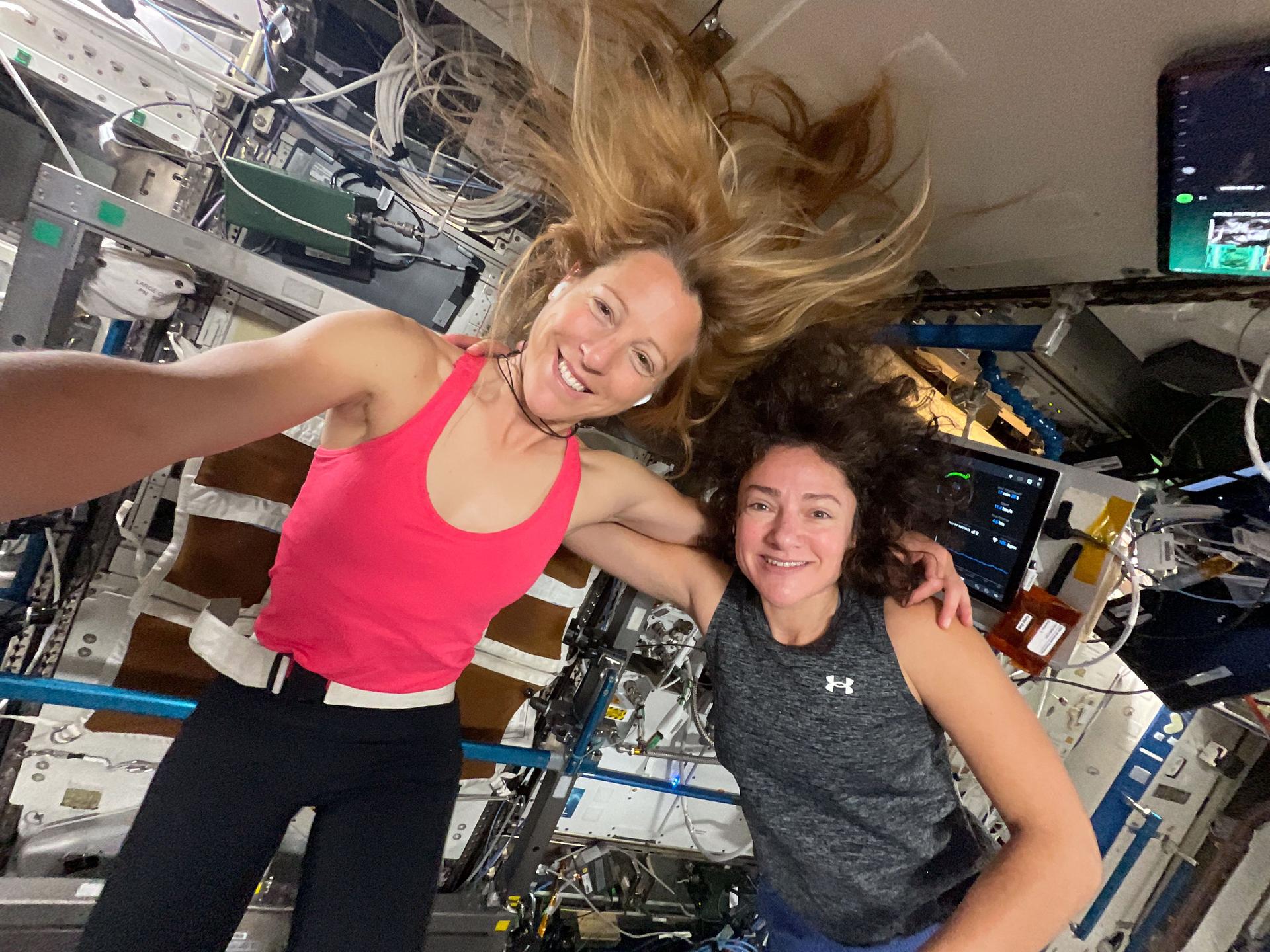
Flight Engineers Jessica Meir of NASA and Sophie Adenot of ESA (European Space Agency) kicked off Thursday exploring how to reduce stress and improve sleep while living and working aboard a spacecraft. The duo, right after waking up, first filled out a questionnaire documenting stress and emotions experienced off the Earth. Next, the two astronauts collected their saliva samples so researchers can analyze a crew member’s stress and immunity levels. The RelaxPro study sponsored by ESA explores using non-invasive relaxation and meditation techniques aboard a spacecraft to improve astronaut health and promote mission success.

The NASA and ESA astronauts then joined each other in the afternoon and reviewed setting up hardware for the ARED (advanced resistive exercise device) Kinematics exercise study that takes place in the Tranquility module. They watched a video explaining the precise positioning of four cameras to capture a crew member’s workout, calibrating the cameras, setting up a video monitor, and configuring a computer for data acquisition. Doctors are exploring the forces an astronaut’s muscles and bones experience when working out in weightlessness to maintain fitness and health during a long-term spaceflight.

NASA Flight Engineer Jack Hathaway began his shift organizing blood sampling hardware then retrieving biomedical samples from a science freezer for scientific processing. Afterward, Hathaway transferred food packs into the Harmony module and staged them for future crew usage. During the second half of his shift, he loaded cargo into a SpaceX Dragon cargo spacecraft for return to Earth then joined Meir for a call to mission controllers discussing their experience flying the Dragon crew spacecraft as it docked to the orbital outpost on Feb. 14.

NASA Flight Engineer Chris Williams partnered with Meir twice on Thursday during two short biomedical sessions. He first assisted her as she drew her blood sample, spun it in a centrifuge, then stowed it in a science freezer to analyze her bone health. Toward the end of the crew’s shift, Meir imaged William’s eyes using medical imaging hardware as doctors on the ground remotely monitored to see how microgravity is affecting his retina, optic nerve, and cornea. Williams also worked in the Kibo laboratory module uninstalling the Solid Combustion Experiment Module following the completion of its scientific objectives, including improving spacecraft fire safety and observing how solid fuels burn in microgravity.

Roscosmos Flight Engineer Andrey Fedyaev, who is beginning his second spaceflight, worked on a pair of investigations on Thursday using advanced technology. For the first experiment, Fedyaev wore virtual reality goggles and responded to visual and audio signals to test his sense of balance and orientation in space. For the second experiment, he tested artificial intelligence-assisted tools to convert speech-to-text for improved documentation for data and communications with ground controllers.

Station Commander Sergey Kud-Sverchkov assisted Fedyaev with the advanced human research studies. Kud-Sverchkov also trained to perform procedures and use medical hardware in case of a medical emergency board the orbital outpost. Finally, the two-time station resident downloaded radiation data the station is exposed to while orbiting Earth for analysis.

Roscosmos Flight Engineer Sergei Mikaev primarily spent Thursday on lab upkeep activities focusing most of his time on locating and inventorying hardware throughout the station’s Roscosmos segment. Mikaev also checked the Elektron oxygen generator’s water tanks for air bubbles to ensure the life support device’s continuous operation.

The Roscosmos Progress 93 spacecraft fired its thrusters for 10 minutes, 55 seconds to reboost the station ahead of the launch of the Progress 94 resupply spacecraft. The maneuver raised the station’s altitude by 2 miles at perigee, placing the space station in an orbit of 269.2 x 255 statute miles.

Learn more about station activities by following the space station blog, @space_station on X, as well as the ISS Facebook and ISS Instagram accounts.

Get the latest from NASA delivered every week. Subscribe here.

Powered by WPeMatico

Get The Details…

Mark A. Garcia

New Expedition 74 Foursome Kicks off Science, Gets Used to Space

New Expedition 74 Foursome Kicks off Science, Gets Used to Space

ESA (European Space Agency) astronaut and Expedition 74 Flight Engineer Sophie Adenot swaps hard drives inside the Advanced Space Experiment Processor-4 (ADSEP-4). Located aboard the International Space Station's Destiny laboratory module, the ADESP-4 houses and processes research samples for an array of microbiology and physics studies and can be operated onboard the Dragon and Cygnus spacecraft, as well as the orbital outpost.
ESA (European Space Agency) astronaut Sophie Adenot swaps sample processing hard drives inside the International Space Station’s Destiny laboratory module. The scientific hardware processes research samples for an array of microbiology and physics experiments.
NASA/Chris Williams

Vein scans and pharmaceutical research topped the science schedule aboard the International Space Station on Wednesday. The Expedition 74 crew rounded out the day with Dragon cargo transfers, lab familiarization activities, and life support maintenance duties.

NASA Flight Engineers Jack Hathaway and Jessica Meir kicked off their shift with vein scans using the new Ultrasound 3 device delivered last year aboard the Cygnus XL spacecraft. Hathaway led the scans imaging Meir’s neck, shoulder, and leg veins while chest electrodes measured her heart cardiac activity as doctors on Earth assisted in real time. Hathaway then operated the Ultrasound 2 device and scanned the veins of ESA (European Space Agency) astronaut Sophie Adenot as doctors on the ground monitored. Living in space long term induces fluid shifts in an astronaut’s body increasing the risk of blood clots—also called thromboembolism—that flight surgeons constantly monitor and seek to counteract.

The trio, along with Roscosmos cosmonaut Andrey Fedyaev, continued getting familiar with station systems and operations while getting used to living and working in weightlessness. At the beginning of his shift, Fedyaev wore acoustic sensors around his neck that recorded his rapid exhalation helping doctors understand how microgravity affects the respiratory system. Adenot serviced sample processing hardware supporting research into the development and manufacturing of pharmaceuticals in space. Meir wrapped up her day unpacking crew supplies and station hardware delivered aboard Dragon on Saturday.

NASA Flight Engineer Chris Williams, who has been aboard the orbital outpost since November, worked throughout Wednesday with a variety of life support tasks, medical training, and an emergency drill. Williams first measured airflow throughout the modules in the station’s U.S. segment then inspected vents for cleanliness and proper configuration. Next, he trained to use medical hardware, including an automated external defibrillator, and performed different procedures such as conducting eye exams and administering medicine. Williams also joined his crewmates Sergey Kud-Sverchkov and Sergei Mikaev from Roscosmos and practiced using emergency respirators in the unlikely event of a chemical leak aboard the station.

Kud-Sverchkov and Mikaev, who arrived with Williams aboard the Soyuz MS-28 spacecraft, spent Wednesday focusing primarily on research and maintenance in the station’s Roscosmos segment. Kud-Sverchkov wrapped up an overnight automated photography session that imaged the Earth’s nighttime atmosphere in near-ultraviolet wavelengths. Mikaev configured scientific hardware that controls and processes data for numerous experiments. The duo also split their day with computer hardware replacements in the Nauka science module and ventilation system maintenance in the Zvezda service module.

Learn more about station activities by following the space station blog, @space_station on X, as well as the ISS Facebook and ISS Instagram accounts.

Get the latest from NASA delivered every week. Subscribe here.

Powered by WPeMatico

Get The Details…

Mark A. Garcia

Expedition 74 Expands to Seven as Science Speeds Up

Expedition 74 Expands to Seven as Science Speeds Up

A SpaceX Falcon 9 rocket carrying the company's Dragon spacecraft is launched on NASA’s SpaceX Crew-12 mission to the International Space Station with NASA astronauts Jessica Meir, Jack Hathaway, ESA (European Space Agency) astronaut Sophie Adenot, and Roscosmos cosmonaut Andrey Fedyaev onboard, Friday, Feb. 13, 2026, from Cape Canaveral Space Force Station in Florida. NASA’s SpaceX Crew-12 mission is the twelfth crew rotation mission of the SpaceX Dragon spacecraft and Falcon 9 rocket to the International Space Station as part of the agency’s Commercial Crew Program. Meir, Hathaway, Adenot, and Fedyaev launched at 5:15 a.m. EST from Space Launch Complex 40 at the Cape Canaveral Space Force Station to begin a mission aboard the orbital outpost.
A SpaceX Falcon 9 rocket carrying the company’s Dragon spacecraft is launched on NASA’s SpaceX Crew-12 mission to the International Space Station with NASA astronauts Jessica Meir, Jack Hathaway, ESA (European Space Agency) astronaut Sophie Adenot, and Roscosmos cosmonaut Andrey Fedyaev onboard, Friday, Feb. 13, 2026.
NASA/Aubrey Gemignani

The seven-member Expedition 74 crew is in its first full week together aboard the International Space Station following Saturday’s arrival of NASA’s SpaceX Crew-12 mission. The orbital septet is resuming its full complement of advanced space science and lab maintenance as the Crew-12 quartet familiarizes itself with station operations.

Crew-12 members Jessica Meir and Jack Hathaway of NASA, Sophie Adenot of ESA (European Space Agency), and Andrey Fedyaev of Roscosmos began their mission with a launch aboard a SpaceX Dragon on Friday, Feb. 13, and docked to the orbital outpost a day-and-a-half later. After a standard safety review, the commercial crew foursome spent the weekend and worked into Monday unpacking science and cargo from Dragon and getting used to life in weightlessness. The new crew members are also beginning their advanced research duties to benefit humans living on and off the Earth.

Meir, on her second spaceflight, swapped a camera inside the Destiny laboratory module‘s Microgravity Science Glovebox to explore ways to control a spacecraft’s fuel tank pressure due to cryogenic fuel propellants evaporating. First-time space flyer Hathaway readied gear that will measure how a crew member’s body temperature adapts to microgravity then reviewed operations with the Kibo laboratory module’s Life Science Glovebox with assistance from NASA Flight Engineer Chris Williams.

Adenot, France’s second female astronaut to fly in space, swapped out computer hardware supporting research into manufacturing medicine in space then exercised for research as advanced video gear monitored her musculoskeletal system during her microgravity workout. Fedyaev, who last rode to space in March of 2023 aboard a Dragon to join Expedition 69, began exploring how his sense of balance, orientation, and cognition, as well as his breathing, are affected by living in weightlessness.

Williams, who has been aboard the station since November with Roscosmos cosmonauts Sergey Kud-Sverchkov and Sergei Mikaev, began the week helping Crew-12 get used to station hardware, systems, and procedures. On Tuesday, he continued helping the new crew unpack Dragon then investigated using ultraviolet light as a method to disinfect spacecraft inhibiting microbial growth to protect crew health and space equipment.

Station Commander Kud-Sverchkov and Flight Engineer Mikaev uninstalled hardware and wrapped up a session of automated Earth photography taken in a variety of wavelengths as the crew slept. Kud-Sverchkov then worked on orbital plumbing and life support maintenance tasks inside the Nauka science module. Mikaev located and inventoried a variety of Roscosmos station hardware then explored using artificial intelligence-assisted tools to boost crew efficiency aboard the orbital outpost.

Learn more about station activities by following the space station blog, @space_station on X, as well as the ISS Facebook and ISS Instagram accounts.

Get the latest from NASA delivered every week. Subscribe here.

Powered by WPeMatico

Get The Details…

Mark A. Garcia

Dragon Hatches Open, Crew-12 Enters Station and Joins Expedition 74

Dragon Hatches Open, Crew-12 Enters Station and Joins Expedition 74

Expedition 74 welcomes NASA's SpaceX Crew-12 members aboard the International Space Station. In the front from left are, Andrey Fedyaev of Roscosmos, Jack hatchway and Jessica Meir, both from NASA, and Sophie Adenot from ESA (European Space Agency). In the back are, Sergey Kud-Sverchkov of Roscosmos, Chris Williams of NASA, and Sergei Mikaev of Roscosmos.
Expedition 74 welcomes NASA’s SpaceX Crew-12 members aboard the International Space Station. In the front from left are, Andrey Fedyaev of Roscosmos, Jack Hathaway and Jessica Meir, both from NASA, and Sophie Adenot from ESA (European Space Agency). In the back are, Sergey Kud-Sverchkov of Roscosmos, Chris Williams of NASA, and Sergei Mikaev of Roscosmos.
NASA+

NASA astronauts Jessica Meir and Jack Hathaway, ESA (European Space Agency) astronaut Sophie Adenot, and Roscosmos cosmonaut Andrey Fedyaev have entered the International Space Station after opening the hatches at 5:14 p.m. EST between the space station and the SpaceX Dragon spacecraft. 

Meir, Hathaway, Adenot, and Fedyaev now join Expedition 74 crew, including NASA astronaut Chris Williams and Roscosmos cosmonauts Sergey Kud-Sverchkov and Sergei Mikaev already aboard the orbiting laboratory. 

NASA’s live coverage continues through the welcome ceremony on NASA+Amazon Prime, and the agency’s YouTube channel. Learn how to watch NASA content through a variety of online platforms, including social media. 

Learn more about station activities by following the space station blog, @space_station on X, as well as the ISS Facebook and ISS Instagram accounts.

Get the latest from NASA delivered every week. Subscribe here.

Powered by WPeMatico

Get The Details…

Mark A. Garcia

SpaceX Crew-12 Docks to Station Beginning Long-Duration Mission

SpaceX Crew-12 Docks to Station Beginning Long-Duration Mission

The SpaceX Dragon carrying for Crew-12 members nears the International Space Station for a docking to the Harmony module's space-facing port.
The SpaceX Dragon carrying four Crew-12 members nears the International Space Station for a docking to the Harmony module’s space-facing port.
NASA+

NASA astronauts Jessica Meir and Jack Hathaway, ESA (European Space Agency) astronaut Sophie Adenot, and Roscosmos cosmonaut Andrey Fedyaev arrived at the International Space Station as the SpaceX Dragon spacecraft docked with the orbiting complex at 3:15 p.m. EST. 

After Dragon linked up to the space-facing port of the station’s Harmony module, the crew aboard Dragon and the station began standard leak checks and pressurization between the spacecraft and the station in preparation for hatch opening, scheduled for about 5 p.m. 

NASA’s live coverage continues on NASA+Amazon Prime, and the agency’s YouTube channel. Learn how to watch NASA content through a variety of online platforms, including social media. 

Learn more about station activities by following the space station blog, @space_station on X, as well as the ISS Facebook and ISS Instagram accounts.

Get the latest from NASA delivered every week. Subscribe here.

Powered by WPeMatico

Get The Details…

Mark A. Garcia