Crew Works Exercise Research and Lab Maintenance on Light Duty Day

Crew Works Exercise Research and Lab Maintenance on Light Duty Day
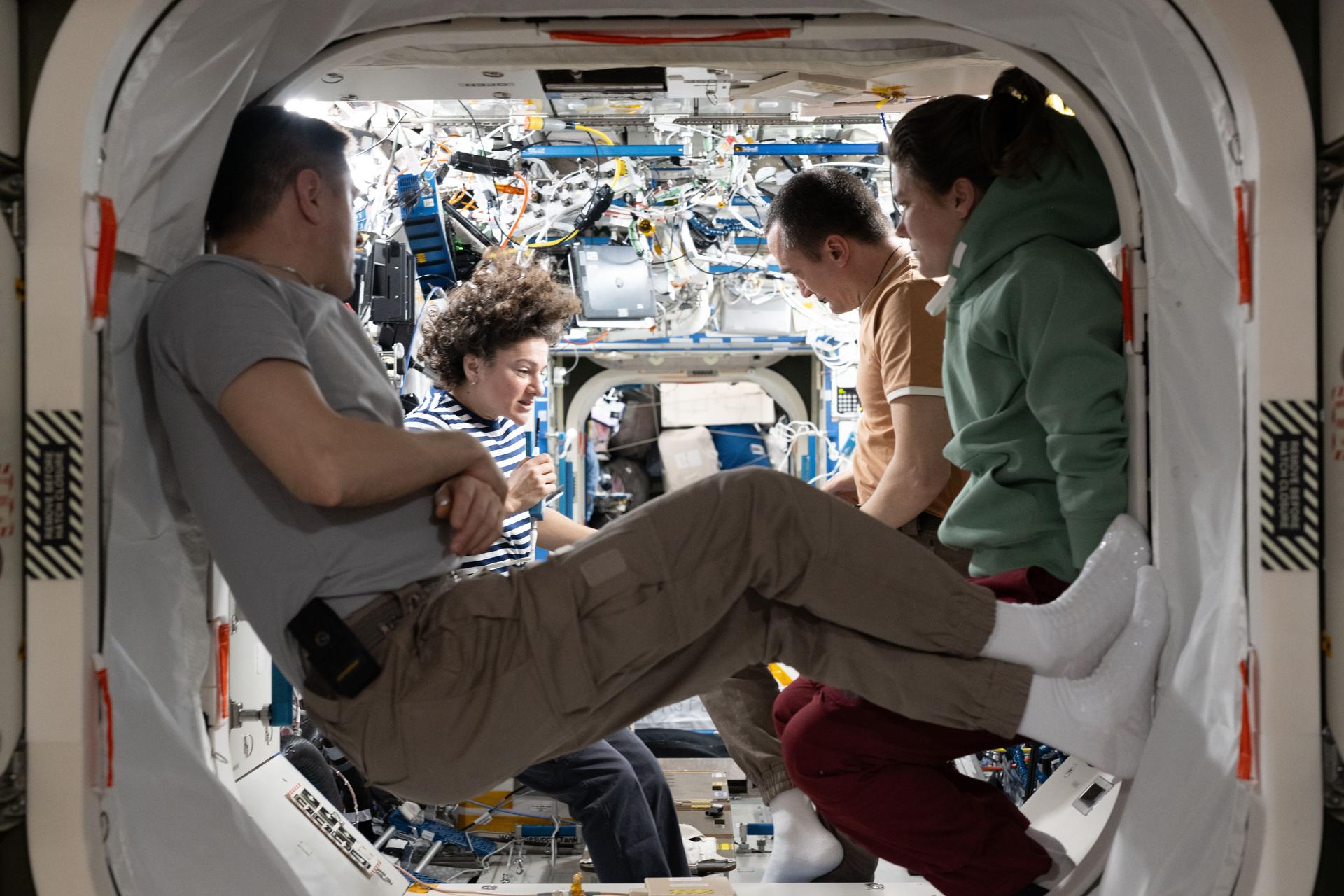
Four Expedition 75 crew members gather together and review procedures for emergency scenarios such as a pressure leak, a chemical leak, or a fire aboard the International Space Station. From left are, flight engineer Andrey Fedyaev of Roscosmos, station commander Jessica Meir of NASA, and Roscosmos flight engineers Pyotr Dubrov and Anna Kikina.
Four Expedition 75 crew members gather together and review procedures for emergency scenarios. From left are, flight engineer Andrey Fedyaev of Roscosmos, station commander Jessica Meir of NASA, and Roscosmos flight engineers Pyotr Dubrov and Anna Kikina.
NASA/Anil Menon

The Expedition 75 crew had a light duty day on Friday studying microgravity’s effect on exercise and transferring cargo aboard the International Space Station. Earth observations, hardware inventory, and life support maintenance rounded out the schedule for the orbital septet at the end of the week.

Blood draws began the day for flight engineers Jack Hathaway of NASA and Sophie Adenot of ESA (European Space Agency) in the Columbus laboratory module. Hathaway collected his blood samples and processed them in a centrifuge with assistance from Adenot before stowing them for preservation in a science freezer. Scientists will analyze the samples after they are returned to Earth for insights into electrical muscle stimulation to counteract space-caused muscle loss.

Hathway later activated the Astrobee robotic free-flyers and photographed the cube-shaped, toaster-sized robot assistants as they demonstrated autonomous maneuvers inside the Kibo laboratory module. Adenot exercised on the new European Enhanced Exploration Exercise Device (E4D) then filled out a questionnaire evaluating its usability for use on future long-duration missions.

Station commander Jessica Meir and flight engineer Anil Menon, both from NASA, took turns transferring cargo in and out of Northrop Grumman’s Cygnus XL cargo spacecraft berthed to the Unity module’s Earth-facing port. Meir then videotaped her work out on the advanced resistive device for the Standard Measures investigation that documents astronaut health and performance before, during, and after a spaceflight. Menon also joined Hathaway in the Quest airlock and continued to stow tools used during a spacewalk on Sept. 1.

Roscosmos flight engineers Pyotr Dubrov and Anna Kikina installed and activated Earth observation gear to automatically photograph islands and volcanoes across the Indian Ocean and Pacific Ocean. Next, Dubrov tested Bluetooth hardware and USB connections while Kikina inspected and cleaned cargo stowage areas inside the Zarya module.

Flight engineer Andrey Fedyaev spent most of his shift inside the Zvezda service module taking inventory of laptop computers and their power systems. Fedyaev finally wrapped up his day in the Nauka science module servicing orbital plumbing components.

Learn more about station activities by following the space station blog, @space_station on X, as well as the ISS Facebook and ISS Instagram accounts.

Get the latest from NASA delivered every week. Subscribe here.

Powered by WPeMatico

Get The Details…

Mark A. Garcia

Expedition 75 Works on Science Hardware, Spacesuits, and Crew Filming

Expedition 75 Works on Science Hardware, Spacesuits, and Crew Filming

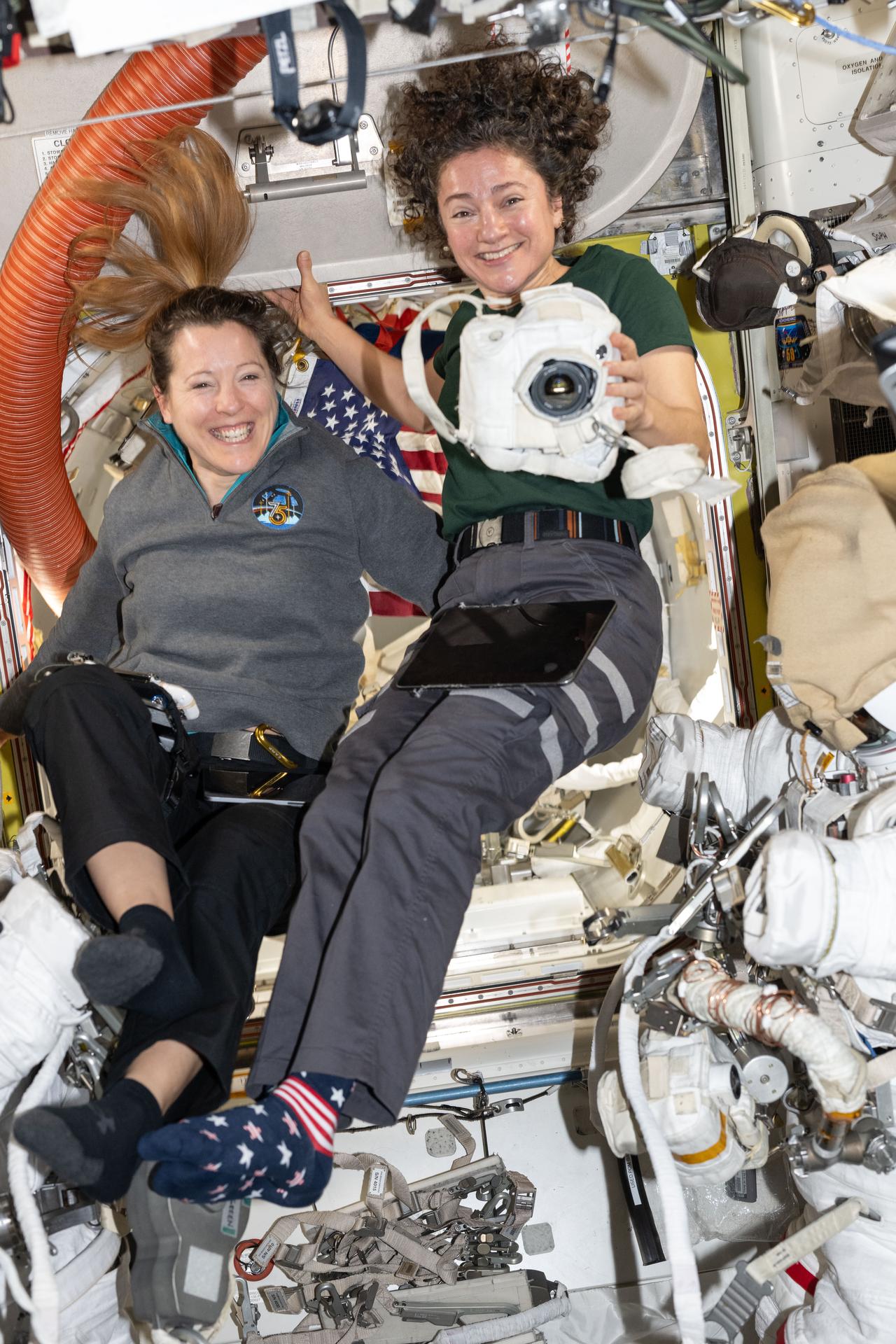
From left, Expedition 75 crewmates Sophie Adenot of ESA (European Space Agency) and Jessica Meir of NASA, flight engineer and station commander respectively, smile for a portrait while working together inside the International Space Station’s Quest airlock. Meir is holding a camera covered in a protective thermal blanket that shields it from space radiation, as the two astronauts prepare spacesuits and tools for a spacewalk they conducted together on Sept. 1.
From left, Expedition 75 crewmates Sophie Adenot and Jessica Meir smile for a portrait while working together inside the International Space Station. Meir is holding a camera covered in a protective thermal blanket that shields it from space radiation during a spacewalk.
NASA/Anil Menon

Science hardware and spacesuit maintenance were the main tasks aboard the International Space Station on Thursday. The Expedition 75 crew members also filmed and photographed daily life inside of the station for audiences on Earth.

Station commander Jessica Meir of NASA configured the new NEMO microscope in the Destiny laboratory module. Meir assembled the biology research microscope, installed tissue samples inside for viewing, set up hardware that monitors and controls sample carbon dioxide levels, then verified its power and functionality. NEMO, or Nikon Experimentation Microscope in Orbit, enables automated imaging of growing cells to study microgravity’s effects on disease, tissue development, and drug responses.

Afterward, she disconnected and stowed physics hardware that supported crystal growth research that took place inside Destiny’s Microgravity Science Glovebox. Insights may advance semiconductor manufacturing and related industries on and off the Earth.

Meir also assisted NASA flight engineer Anil Menon in the Quest airlock as he swapped radio communications gear between a pair of spacesuits. Next, Menon powered up and the tested the communication system, checked multiple frequency bands, and confirmed data transmission with mission controllers on the ground. Meir then inspected and stowed tethers used during four spacewalks that took place from Aug. 6 to Sept. 1.

NASA flight engineer Jack Hathaway began his shift checking the operation and charging of laptop computers. Next, Hathaway stowed cargo in a hatch above the Unity module and installed protective window covers. He spent the second half of his shift on orbital plumbing maintenance in the Tranquility module.

Flight engineer Sophie Adenot of ESA (European Space Agency) spent her shift filming and narrating a series of tours inside the orbital outpost as she floated from one module to another. The videos were recorded in both French and English with the purpose of keeping kids and adults interested in space topics.

In the Roscosmos segment of the space station, flight engineers Pyotr Dubrov and Anna Kikina took turns inspecting and photographing the condition of stowage areas inside the Zarya and Nauka modules. Dubrov also photographed and videotaped his fellow crew members documenting their daily activities for audiences on Earth. Kikina worked on ventilation maintenance inside the Zvezda service module.

Roscosmos flight engineer Andrey Fedyaev checked out a tablet computer, inspected its cables and battery, then monitored its recharging and rebooting operations. Afterward, Fedyaev replaced dust filters inside the Nauka science module before ending his shift jogging on Zvezda’s treadmill then working out on Tranquility’s advanced resistive exercise device.

Learn more about station activities by following the space station blog, @space_station on X, as well as the ISS Facebook and ISS Instagram accounts.

Get the latest from NASA delivered every week. Subscribe here.

Powered by WPeMatico

Get The Details…

Mark A. Garcia

Crew Studies Medicine and Physics, Works on Spacesuits and Earth Photo Gear

Crew Studies Medicine and Physics, Works on Spacesuits and Earth Photo Gear

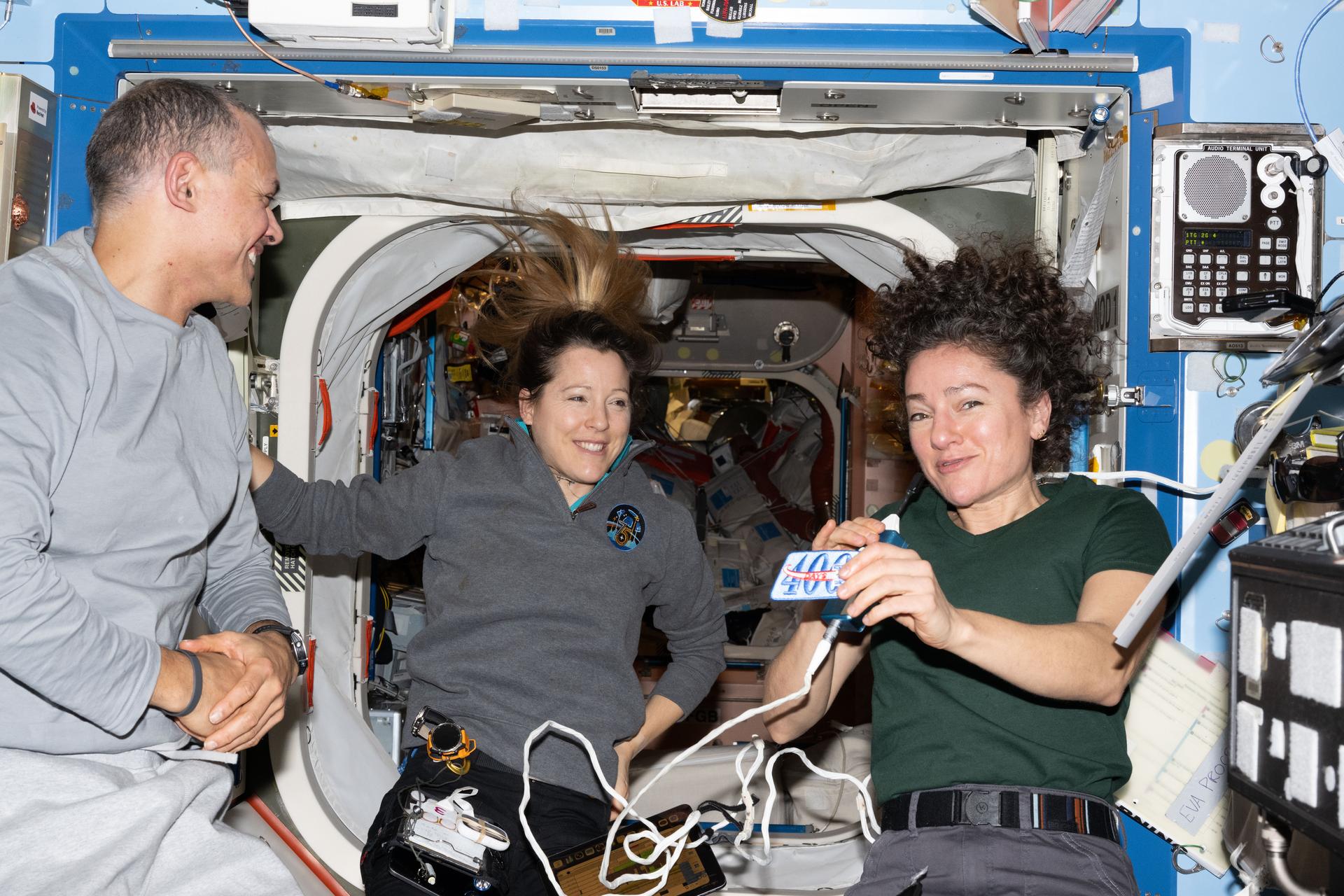
Expedition 75 flight engineers Anil Menon of NASA and Sophie Adenot of ESA (European Space Agency) and International Space Station commander Jessica Meir of NASA gather together inside the International Space Station's Destiny laboratory module. Meir is holding a patch given to her commemorating 400 cumulative days in space (and counting) across two missions to the orbital outpost.
Expedition 75 flight engineers Anil Menon and Sophie Adenot and International Space Station commander Jessica Meir gather together and celebrate Meir’s 400 cumulative days in space with a commemorative patch on Aug. 28.
NASA

Vein scans, ultra-hot physics, and Earth observations were the main research activities aboard the International Space Station on Wednesday. The Expedition 75 crew members rounded out their mid-week shift and swapped out spacesuit components and serviced life support gear.

NASA astronauts Jessica Meir and Anil Menon joined Roscosmos cosmonauts Anna Kikina and Pyotr Dubrov in the Columbus laboratory module for regularly scheduled vein scans with the Ultrasound 3 biomedical device. Meir was responsible as crew medical officer and operated the Ultrasound 3 with real time assistance from doctors on the ground. Menon was first followed by Kikina then Dubrov as Meir scanned their veins while doctors remotely guided her to observe how weightlessness affects blood flow in crew members. Insights will help promote healthy crews on long-duration missions to the Moon, Mars, and beyond.

Flight engineer Sophie Adenot of ESA (European Space Agency) worked inside the Kibo laboratory module and cleaned the Electrostatic Levitation Furnace (ELF), a research facility that uses electric fields to float and heat materials in microgravity. She removed samples, cleaned sensitive components including windows and electrodes, then installed new samples inside the research furnace. ELF safely heats materials to over 2,000 degrees Celsius using lasers and measures their thermophysical properties unobtainable in Earth’s gravity.

After the vein scans, Menon moved into the Quest airlock and swapped out a radio communications unit on a spacesuit. The unit will be returned to Earth for standard refurbishment with the SpaceX Crew-12 members aboard the Dragon spacecraft when they end their mission. NASA flight engineer Jack Hathaway worked throughout Wednesday inside Quest and the Unity and Tranquility modules continuing to replace filters that remove particles, gases, and odors from the station’s atmosphere ensuring a safe, breathable environment for the crew.

Kikina and Dubrov joined Roscosmos flight engineer Andrey Fedyaev and worked together throughout Wednesday swapping, configuring, and activating a variety of Earth observation gear aboard the orbital outpost. The advanced photography hardware captures Earth landmarks and the effects of storms, wildfires, volcanos, and more in numerous wavelengths revealing phenomena invisible in the visual spectrum. Imaging sessions can take place manually when a crew member points a camera out a window or when a camera is programmed with coordinates and times to automatically photograph ground sites.

Kikina and Dubrov also inspected the custom-fitted seat-liners crews ride in when returning to Earth aboard a Soyuz spacecraft. Fedyaev worked on Roscosmos orbital plumbing components then took inventory of hardware stowed inside the Zvezda service module.

Learn more about station activities by following the space station blog, @space_station on X, as well as the ISS Facebook and ISS Instagram accounts.

Get the latest from NASA delivered every week. Subscribe here.

Powered by WPeMatico

Get The Details…

Mark A. Garcia

Astronaut Health, Lunar and Earth Photography Fill Crew’s Research Schedule

Astronaut Health, Lunar and Earth Photography Fill Crew’s Research Schedule

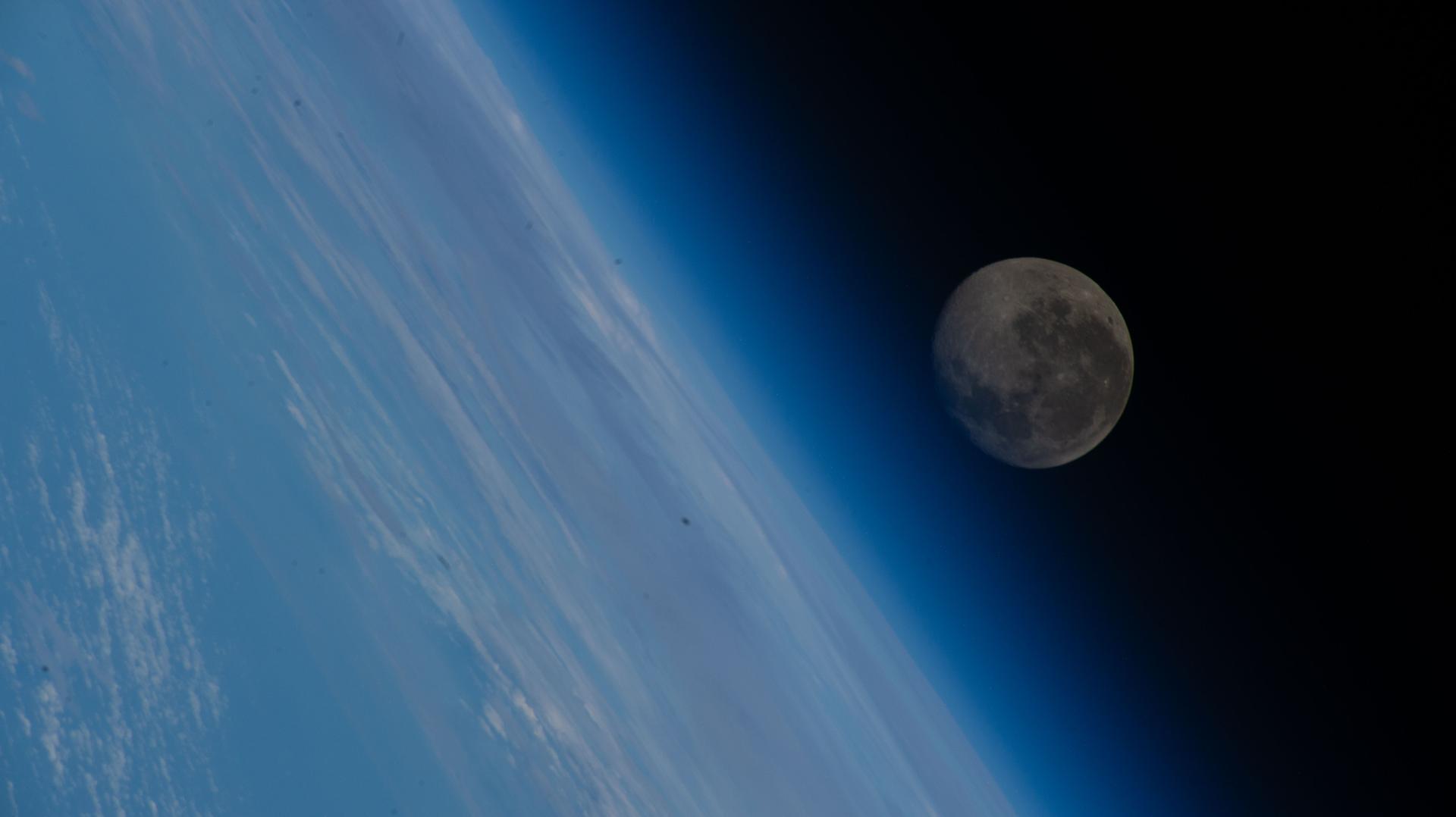
The waning gibbous Moon appears above Earth’s blue atmosphere in this image taken from the International Space Station while orbiting 258 miles above the coast of Hong Kong, China.
NASA

Exploring astronaut health and photographing the Moon and Earth topped the research schedule for the Expedition 75 crew aboard the International Space Station on Tuesday. The orbital residents also kept up life support maintenance following the departure of cargo spacecraft the day before.

Station commander Jessica Meir of NASA assisted flight engineer Sophie Adenot of ESA (European Space Agency) in the Columbus laboratory module during the PhysioTool experiment that monitors an astronaut’s blood flow, mental condition, and sleep quality. Adenot first measured her blood pressure then completed cognitive tasks on a computer to understand how living in microgravity affects her mental capabilities and behavioral style. Afterward, NASA flight engineer Jack Hathaway measured Adenot’s muscles and tendons for firmness and elasticity as part of the Myotones investigation that is contributing to inflight health monitoring.

Meir started her day wearing a smartwatch to track her rest and activity cycles for the RelaxPro study that seeks to reduce stress and improve sleep quality in space. Next, she ended her shift looking into a visual field device to measure her peripheral vision and help doctors identify potential space-caused vision issues. Hathaway worked throughout Tuesday in the Destiny and Harmony modules replacing filters that remove particles, gases, and odors from the station’s environment to keep it safe and comfortable.

NASA flight engineer Anil Menon spent most of his shift on maintenance tasks stowing spacewalking gear and spacesuit batteries in the Quest airlock, configuring an autonomous free-flying camera in the Kibo laboratory module, and inspecting the advanced resistive exercise device in the Tranquility module. Menon completed his day in the cupola photographing the Moon and the light reflecting off the lunar surface from both the sun and Earth.

Roscosmos flight engineer Andrey Fedyaev started his shift wearing virtual reality goggles and responding to computerized visual stimuli testing how his sense of balance and direction is adapting to microgravity. At the end of his day, Fedyaev collected his blood sample, spun it in a centrifuge, then measured his red blood cell count.

Roscosmos flight engineer Anna Kikina checked the operation of biomedical gear that uses a tiny digital camera and a bright light to image a crew member’s ear drum and ear canal. Roscosmos flight engineer Pyotr Dubrov installed hyperspectral Earth imagery to automatically photograph coastal landmarks in Australia and South America during the crew’s sleep shift.

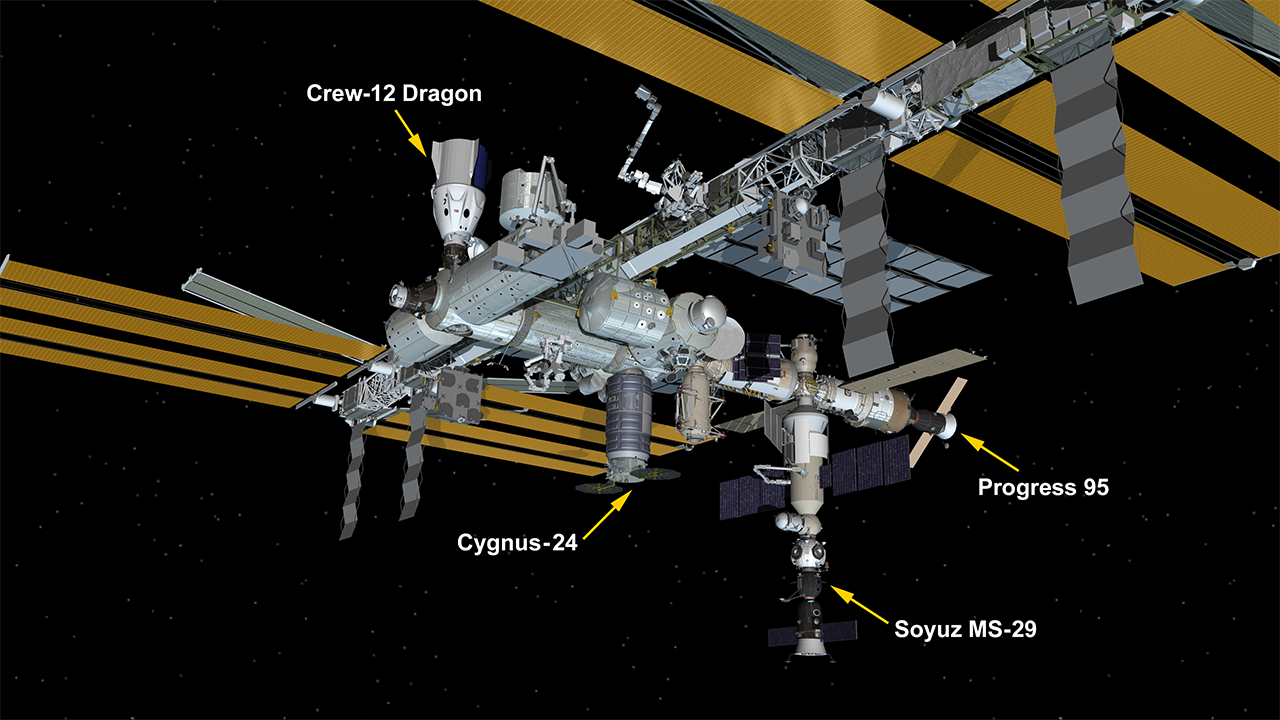
The trash-packed Progress 94 cargo spacecraft undocked from the Poisk module at 11:18 a.m. EDT on Monday and reentered Earth’s atmosphere less than four hours later for a fiery, but safe demise above the South Pacific Ocean. Four spaceships are now attached to the orbital outpost including the SpaceX Dragon crew spacecraft, Northrop Grumman’s Cygnus XL resupply spacecraft, the Progress 95 cargo spacecraft, and the Soyuz MS-29 crew spacecraft.

Learn more about station activities by following the space station blog, @space_station on X, as well as the ISS Facebook and ISS Instagram accounts.

Get the latest from NASA delivered every week. Subscribe here.

Powered by WPeMatico

Get The Details…

Mark A. Garcia

Roscosmos Progress Cargo Spacecraft Departs Space Station

Roscosmos Progress Cargo Spacecraft Departs Space Station

Sept. 7, 2026: International Space Station Configuration. Four spaceships are attached to the space station including the SpaceX Crew-12 Dragon, Northrop Grumman’s Cygnus XL, the Soyuz MS-29 crew spacecraft, and the Progress 95 resupply ship.
NASA

The unpiloted Roscosmos Progress 94 spacecraft undocked from the International Space Station at 11:18 a.m. EDT Monday, backing away for a deorbit maneuver and a planned destructive re-entry later today into Earth’s atmosphere to dispose of trash loaded by the crew.

The spacecraft launched in March on a Soyuz rocket from the Baikonur Cosmodrome in Kazakhstan, carrying about three tons of food, fuel, and supplies for the space station’s crew. After a two-day journey, it arrived at the orbiting laboratory and automatically docked to Poisk module of the space station.

Learn more about station activities by following the space station blog, @space_station on X, as well as the ISS Facebook and ISS Instagram accounts.

Get the latest from NASA delivered every week. Subscribe here.

Powered by WPeMatico

Get The Details…

Mark A. Garcia