NASA to Demonstrate Miniature CubeSat Swarm Technology 

NASA to Demonstrate Miniature CubeSat Swarm Technology 
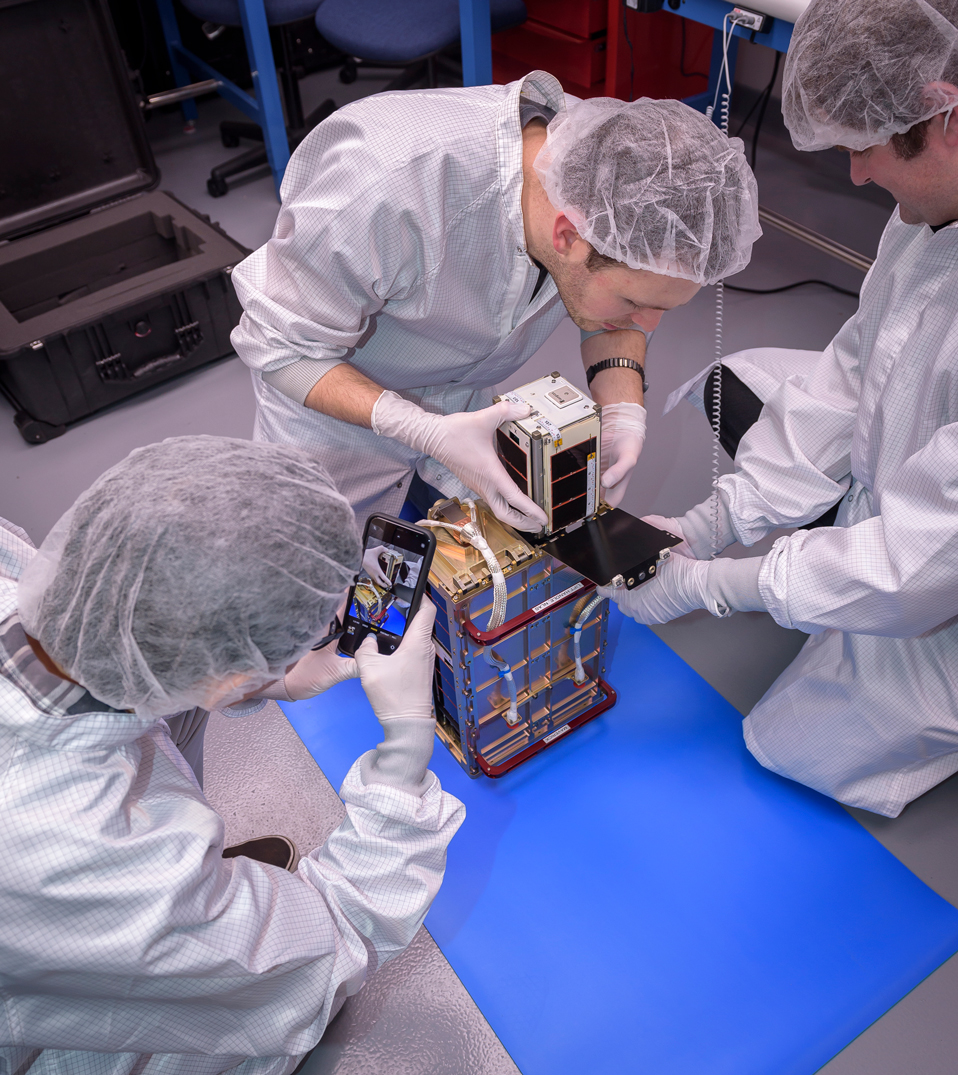
A person puts a small box-like structure into a dispenser – larger box-like structure – as a second person holds the dispenser steady. A third person documents the process with a smart phone camera.
On Nov. 8, 2023, Max Holliday, middle, installs one of the four PY4 spacecraft into the dispenser supplied by Maverick Space Systems ahead of vibration testing. David Pignatelli, Maverick Space Systems, right, holds the dispenser steady as Watson Attai, left, documents the installation with a smart phone camera.
Credits: NASA/Don Richey

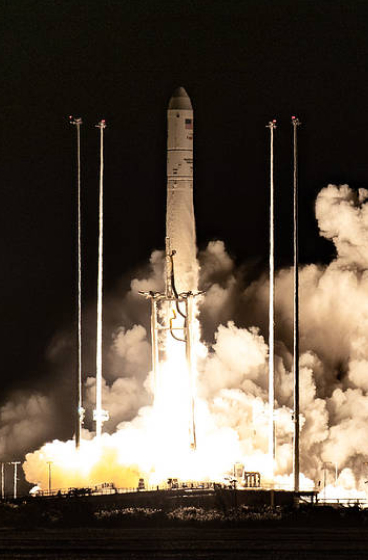
Preparations are underway for a new, small spacecraft technology demonstration that will test cost-efficient swarm capabilities – the ability for multiple spacecraft to communicate and perform coordinated actions. The PY4 mission’s four CubeSats are slated to launch Monday March 4, 2:05 p.m. PST to low Earth orbit aboard SpaceX’s Transporter-10 mission from Vandenberg Space Force Base in California.

Led by Carnegie Mellon University in Pittsburgh and funded by NASA’s Small Spacecraft Technology program, PY4 seeks to demonstrate spacecraft-to-spacecraft ranging, in-orbit navigation, and coordinated simultaneous multi-point radiation measurements at low size, weight, power, and cost. It uses a unique avionics platform called PyCubed that integrates power, computing, communications, attitude determination, and orbit control functionalities into a single board system. The PyCubed system is also open-source, programmable entirely in the Python programming language and uses affordable commercial off-the-shelf components.
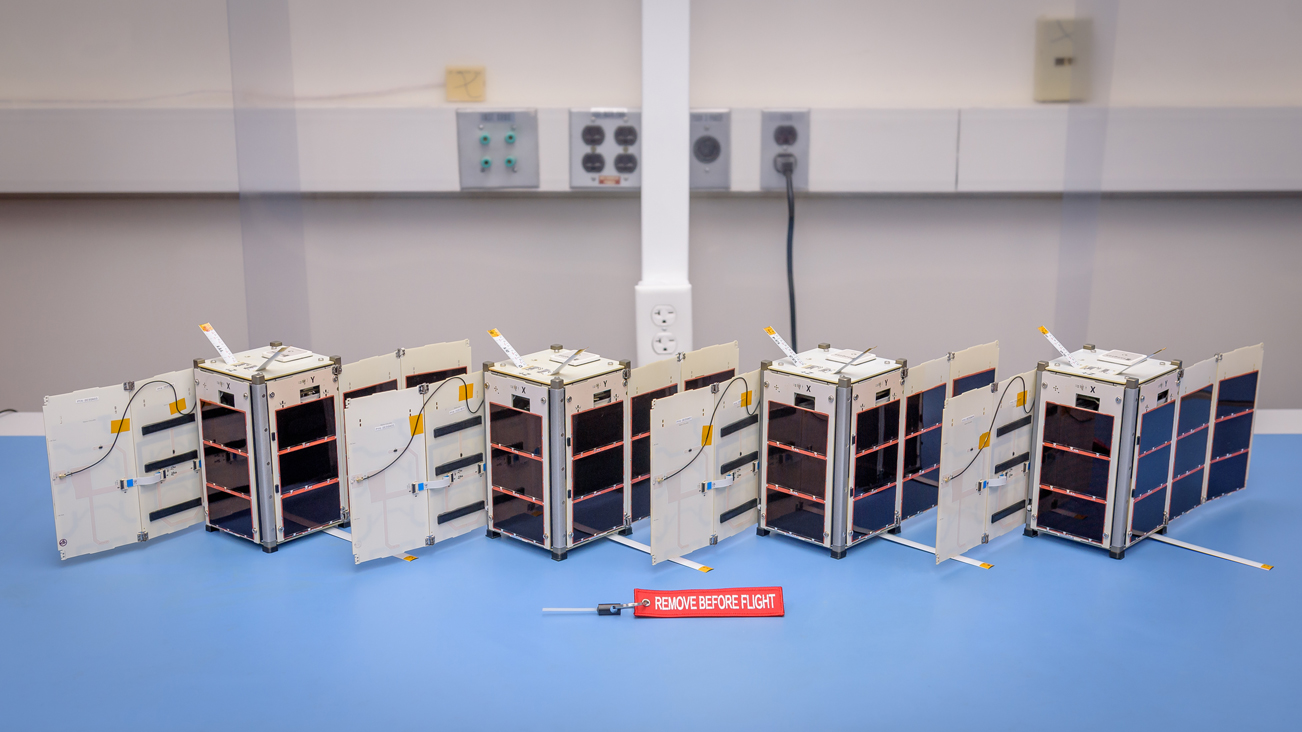
Four small box-like structures with two flaps on each side arranged in a row on a table in a lab.
Four-CubeSat swarm of PyCubed-based spacecraft in the Small Spacecraft Technology lab. The goal of PY4 is to demonstrate spacecraft-to-spacecraft ranging, in-orbit relative navigation, and coordinated simultaneous multi-point radiation measurements.
Credits: NASA/Don Richey

Once in orbit at over 325 miles above Earth, the spacecraft will periodically measure their relative distances. These range measurements provide information about the spacecrafts’ positions relative to each other, and when combined with other sensor data, can be used to determine the configuration of the swarm. Advancing these capabilities could decrease the workload for operators on the ground while enabling multi-spacecraft missions at an accessible price point. The PY4 platform was previously used in demonstrations of the V-R3x technology, both in orbit and in a suborbital flight test on a commercial high-altitude balloon with NASA’s Flight Opportunities program. Those initial tests helped researchers evaluate PY4’s functionality ahead of this larger demonstration mission.

In addition to the PY4 demonstration, NASA is also testing critical swarming technologies via the agency’s ongoing Starling mission that launched in 2023. PY4 could dramatically reduce the cost of small spacecraft swarming capabilities and make demonstrating technologies like the autonomous navigation system tested via Starling more widely accessible by offering a flight-ready hardware and software platform.

In the top image, engineers at NASA’s Ames Research Center in California’s Silicon Valley insert the mission’s four spacecraft into their dispenser supplied by Maverick Space Systems of San Luis Obispo, California in preparation for vibration testing.  Each of the one-and-a-half-unit (1.5U) CubeSats measure about 4 inches x 4 inches x 6.5 inches. The spacecraft were later transported to SpaceX for integration on the Falcon 9 rocket in preparation for launch.
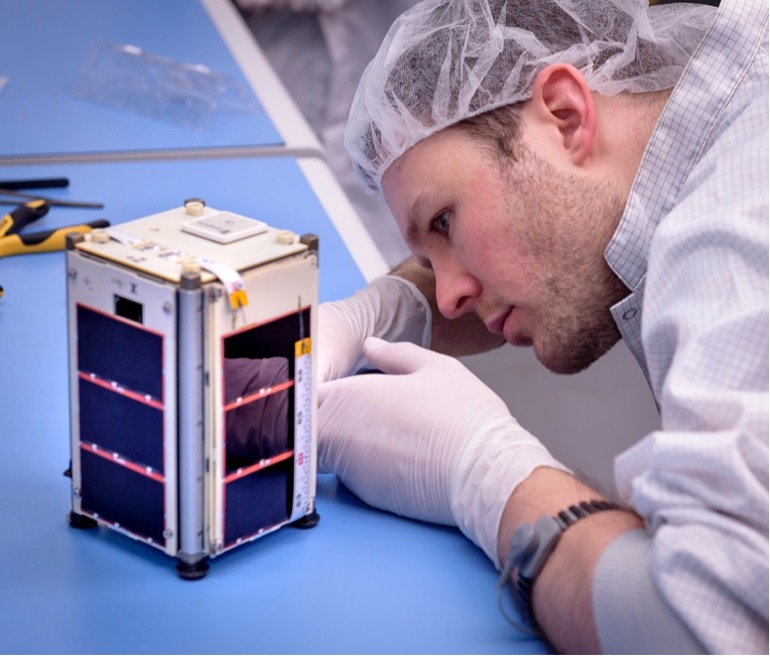
A person in a lab reaches into a small box-like structure on a table.
On Nov. 8, 2023, Max Holliday, creator and maintainer of the PyCubed avionics platform, prepares one of the four PY4 spacecraft for installation into the dispenser supplied by Maverick Space Systems ahead of vibration testing.
Credits: NASA/Don Richey

PY4 is led by the Robotic Exploration Laboratory at Carnegie Mellon University with funding from the Small Spacecraft Technology program at NASA’s Ames. The Small Spacecraft Technology program expands the ability to execute unique missions through rapid development and demonstration of capabilities for small spacecraft applicable to exploration, science and the commercial space sector. Engineers at NASA Ames supporting the Small Spacecraft Technology program aided the assembly, testing, and integration of the four PY4 spacecraft as well as their delivery to Maverick Space Systems – the PY4 mission’s launch integrator.

Author:
Chloe E. Tuck

For news media:

  • Members of the news media interested in covering this topic should reach out to the Ames newsroom.

Powered by WPeMatico

Get The Details…
Gianine Figliozzi

NASA Johnson Director to Discuss Exploration Park Facility

NASA Johnson Director to Discuss Exploration Park Facility

Vanessa Wyche smiles in an official portrait. She has short brown hair and wears an indigo suit jacket with a NASA pin and a white blouse. The background is blue, and she sits in front of American and NASA flags.
NASA Portrait of JSC Center Director – Vanessa Wyche. Photographer: Robert Markowitz

March 4, 2024

MEDIA ADVISORY: J24-005

The director of NASA’s Johnson Space Center will discuss the objectives behind the center’s new Exploration Park initiative at the next meeting of the Bay Area Houston Economic Partnership’s (BAHEP) aerospace advisory committee at 12 p.m. CST Wednesday, March 6, at 1150 Gemini in Houston.

Johnson Director Vanessa Wyche will be joined by representatives from the American Center for Manufacturing and Innovation (ACMI), which recently signed the second agreement to lease acres of underutilized land in a 240-acre Exploration Park. NASA signed a separate lease with the Texas A&M University System earlier this month.

Media are invited to attend the opening discussion of BAHEP’s committee meeting, then have a brief opportunity for interviews with Wyche, John Burer, founder of ACMI and other ACMI experts.

NASA is leasing the land to create facilities for a collaborative development environment that increases commercial access and enhances the United States’ commercial competitiveness in the space and aerospace industries. 

Media wishing to participate in person are asked to RSVP by 9 a.m. Wednesday, March 6, by contacting the Johnson newsroom at 281-483-5111 or jsccommu@mail.nasa.gov.

To learn more about NASA Johnson and Exploration Park, visit:

https://www.nasa.gov/johnson/johnson-news/#news-releases

-end-

Kelly Humphries
Johnson Space Center, Houston
281-483-5111
kelly.o.humphries@nasa.gov

Powered by WPeMatico

Get The Details…
Wendy K. Avedisian

Women of NASA Langley Research Center

Women of NASA Langley Research Center

A large group of women gathered for a photo on the street in front of the Katherine G. Johnson Computational Research Facility building.
NASA/David C. Bowman

In honor of Women’s History Month and those who paved the way for them, hundreds of female staff – from artists to administrative support, educators to engineers, and scientists to safety officers – gathered in front of the Katherine G. Johnson Computational Research Facility at NASA’s Langley Research Center in Hampton, Virginia, on Feb. 6, 2024.

“Their path to advancement might look less like a straight line and more like some of the pressure distributions and orbits they plotted, but they were determined to take a seat at the table.”  Margot Lee Shetterly, Hidden Figures

Shetterly wrote these words about Dorothy Vaughan, Mary Jackson, Christine Darden, and Katherine Johnson, the first Black women who worked as mathematicians at the Langley Memorial Aeronautical Laboratory, now NASA’s Langley Research Center­. These women were essential to the success of early spaceflight.

Text Credit: Sondra D. Woodward

Image Credit: NASA/David C. Bowman

Powered by WPeMatico

Get The Details…
Monika Luabeya

Multiple Spacecraft Tell the Story of One Giant Solar Storm

Multiple Spacecraft Tell the Story of One Giant Solar Storm

5 min read

Multiple Spacecraft Tell the Story of One Giant Solar Storm

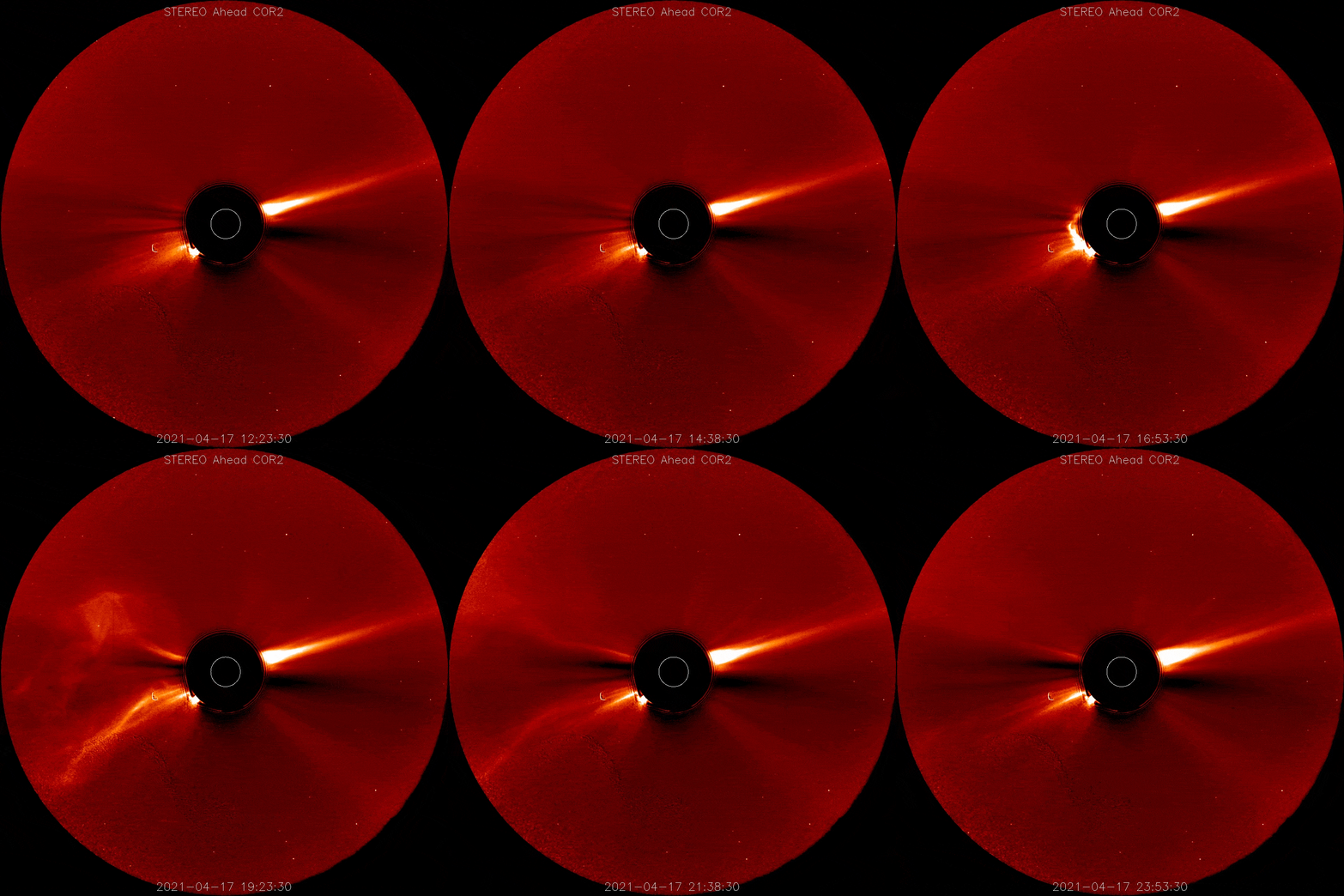
April 17, 2021, was a day like any other day on the Sun, until a brilliant flash erupted and an enormous cloud of solar material billowed away from our star. Such outbursts from the Sun are not unusual, but this one was unusually widespread, hurling high-speed protons and electrons at velocities nearing the speed of light and striking several spacecraft across the inner solar system.

In fact, it was the first time such high-speed protons and electrons – called solar energetic particles (SEPs) – were observed by spacecraft at five different, well-separated locations between the Sun and Earth as well as by spacecraft orbiting Mars. And now these diverse perspectives on the solar storm are revealing that different types of potentially dangerous SEPs can be blasted into space by different solar phenomena and in different directions, causing them to become widespread.

An animation shows a white cloud of material billowing away from the Sun (which is covered by a black disk at the center) toward the left side of the image, set against a red background with a couple dozen stars. The top says
On April 17, 2021, one of the Solar Terrestrial Relations Observatory (STEREO) spacecraft captured this view of a coronal mass ejection billowing away from the Sun (which is covered by the black disk at center to better see features around it). Learn more.
NASA/STEREO-A/COR2

“SEPs can harm our technology, such as satellites, and disrupt GPS,” said Nina Dresing of the Department of Physics and Astronomy, University of Turku in Finland. “Also, humans in space or even on airplanes on polar routes can suffer harmful radiation during strong SEP events.”

Scientists like Dresing are eager to find out where these particles come from exactly – and what propels them to such high speeds – to better learn how to protect people and technology in harm’s way. Dresing led a team of scientists that analyzed what kinds of particles struck each spacecraft and when. The team published its results in the journal Astronomy & Astrophysics.

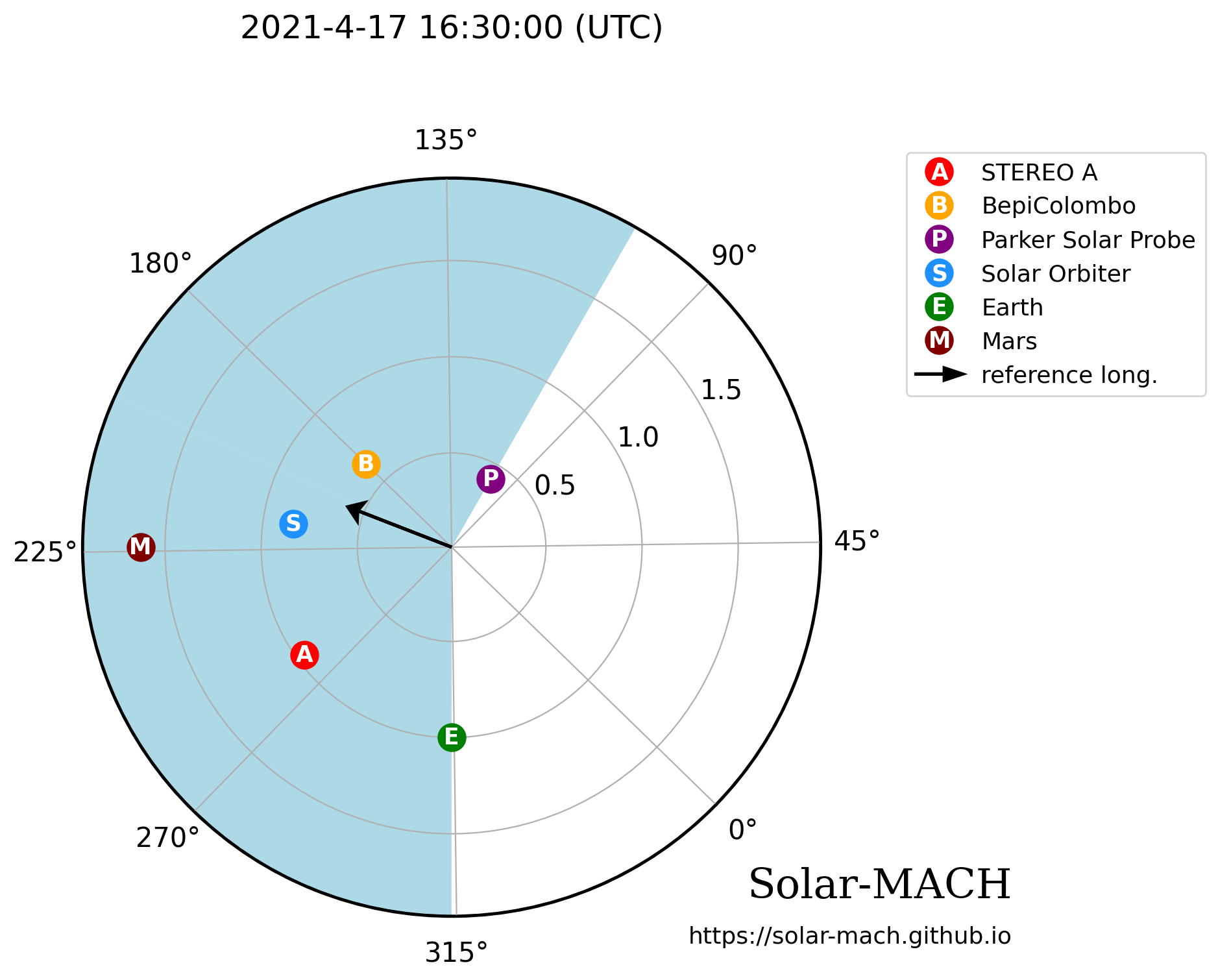
Currently on its way to Mercury, the BepiColombo spacecraft, a joint mission of ESA (the European Space Agency) and JAXA (Japan Aerospace Exploration Agency), was closest to the blast’s direct firing line and was pounded with the most intense particles. At the same time, NASA’s Parker Solar Probe and ESA’s Solar Orbiter were on opposite sides of the flare, but Parker Solar Probe was closer to the Sun, so it took a harder hit than Solar Orbiter did. Next in line was one of NASA’s two Solar Terrestrial Relations Observatory (STEREO) spacecraft, STEREO-A, followed by the NASA/ESA Solar and Heliospheric Observatory (SOHO) and NASA’s Wind spacecraft, which were closer to Earth and well away from the blast. Orbiting Mars, NASA’s MAVEN and ESA’s Mars Express spacecraft were the last to sense particles from the event.

A diagram shows a circle representing the solar system with the Sun (not shown) in the center of the circle and gray lines radiating from the center to the edge of the circle. Degree labels, from 0 degrees to 315 degrees, appear at the end of the lines just outside the circle. The circle is shaded in blue from roughly 95 degrees to 315 degrees. In various places throughout the shaded area are dots representing STEREO A, BepiColombo, Parker Solar Probe, Solar Orbiter, Earth, and Mars. A short black arrow extends from the center of the circle toward the upper left, between BepiColombo and Solar Orbiter. At the top the text
This diagram shows the positions of individual spacecraft, as well as Earth and Mars, during the solar outburst on April 17, 2021. The Sun is at the center. The black arrow shows the direction of the initial solar flare. Several spacecraft detected solar energetic particles (SEPs) over 210 degrees around the Sun (blue shaded area).
Solar-MACH

Altogether, the particles were detected over 210 longitudinal degrees of space (almost two-thirds of the way around the Sun) – which is a much wider angle than typically covered by solar outbursts. Plus, each spacecraft recorded a different flood of electrons and protons at its location. The differences in the arrival and characteristics of the particles recorded by the various spacecraft helped the scientists piece together when and under what conditions the SEPs were ejected into space.

These clues suggested to Dresing’s team that the SEPs were not blasted out by a single source all at once but propelled in different directions and at different times potentially by different types of solar eruptions.

“Multiple sources are likely contributing to this event, explaining its wide distribution,” said team member Georgia de Nolfo, a heliophysics research scientist at NASA’s Goddard Space Flight Center in Greenbelt, Maryland. “Also, it appears that, for this event, protons and electrons may come from different sources.”

The team concluded that the electrons were likely driven into space quickly by the initial flash of light – a solar flare – while the protons were pushed along more slowly, likely by a shock wave from the cloud of solar material, or coronal mass ejection.

“This is not the first time that people have conjectured that electrons and protons have had different sources for their acceleration,” de Nolfo said. “This measurement was unique in that the multiple perspectives enabled scientists to separate the different processes better, to confirm that electrons and protons may originate from different processes.”

In addition to the flare and coronal mass ejection, spacecraft recorded four groups of radio bursts from the Sun during the event, which could have been accompanied by four different particle blasts in different directions. This observation could help explain how the particles became so widespread.

“We had different distinct particle injection episodes – which went into significantly different directions – all contributing together to the widespread nature of the event,” Dressing said.

“This event was able to show how important multiple perspectives are in untangling the complexity of the event,” de Nolfo said.

These results show the promise of future NASA heliophysics missions that will use multiple spacecraft to study widespread phenomena, such as the Geospace Dynamics Constellation (GDC), SunRISE, PUNCH, and HelioSwarm. While single spacecraft can reveal conditions locally, multiple spacecraft orbiting in different locations provide deeper scientific insight and offer a more complete picture of what’s happening in space and around our home planet.

It also previews the work that will be done by future missions such as MUSE, IMAP, and ESCAPADE, which will study explosive solar events and the acceleration of particles into the solar system.

by Vanessa Thomas
NASA’s Goddard Space Flight Center, Greenbelt, Md.

Powered by WPeMatico

Get The Details…

NASA’s Juno Mission Measures Oxygen Production at Europa

NASA’s Juno Mission Measures Oxygen Production at Europa

5 min read

Preparations for Next Moonwalk Simulations Underway (and Underwater)

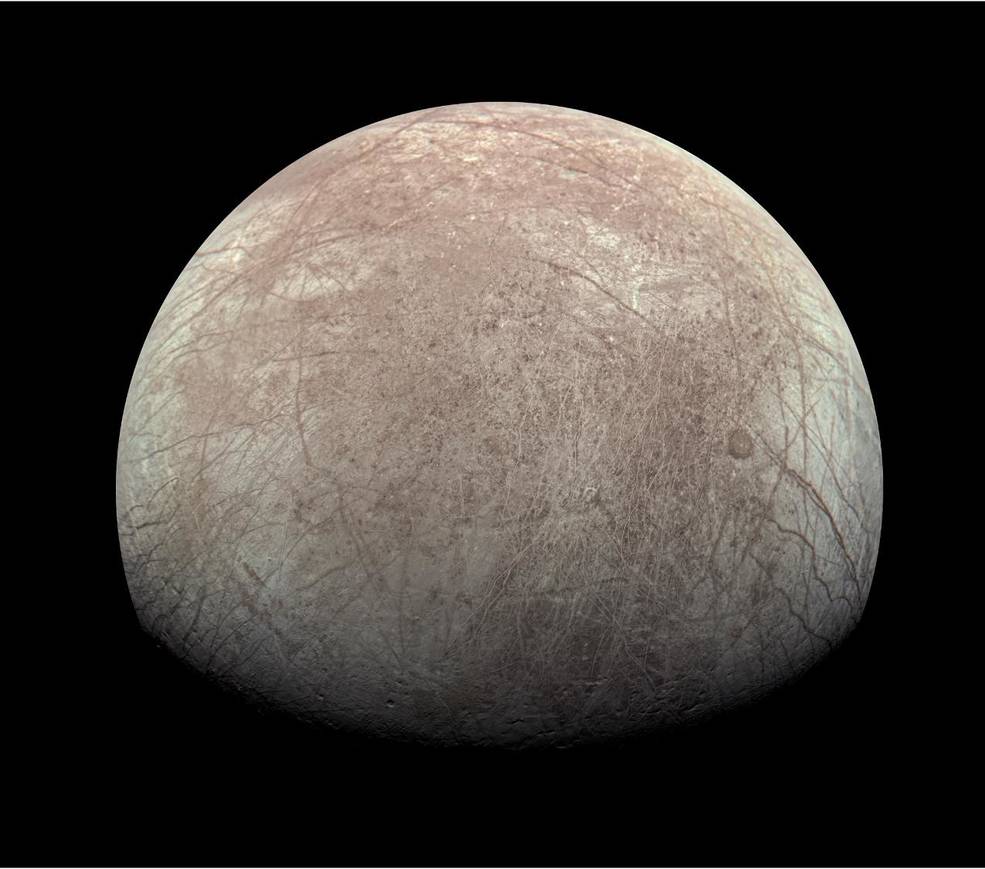
This view of Jupiter’s icy moon Europa was captured by the JunoCam imager aboard NASA’s Juno spacecraft during the mission’s close flyby on Sept. 29, 2022.
Image data: NASA/JPL-Caltech/SwRI/MSSS
Image processing: Kevin M. Gill CC BY 3.0 

The ice-covered Jovian moon generates 1,000 tons of oxygen every 24 hours – enough to keep a million humans breathing for a day.

Scientists with NASA’s Juno mission to Jupiter have calculated the rate of oxygen being produced at the Jovian moon Europa to be substantially less than most previous studies. Published on March 4 in Nature Astronomy, the findings were derived by measuring hydrogen outgassing from the icy moon’s surface using data collected by the spacecraft’s Jovian Auroral Distributions Experiment (JADE) instrument.

The paper’s authors estimate the amount of oxygen produced to be around 26 pounds every second (12 kilograms per second). Previous estimates range from a few pounds to over 2,000 pounds per second (over 1,000 kilograms per second). Scientists believe that some of the oxygen produced in this manner could work its way into the moon’s subsurface ocean as a possible source of metabolic energy.

With an equatorial diameter of 1,940 miles (3,100 kilometers), Europa is the fourth largest of Jupiter’s 95 known moons and the smallest of the four Galilean satellites. Scientists believe a vast internal ocean of salty water lurks beneath its icy crust, and they are curious about the potential for life-supporting conditions to exist below the surface.

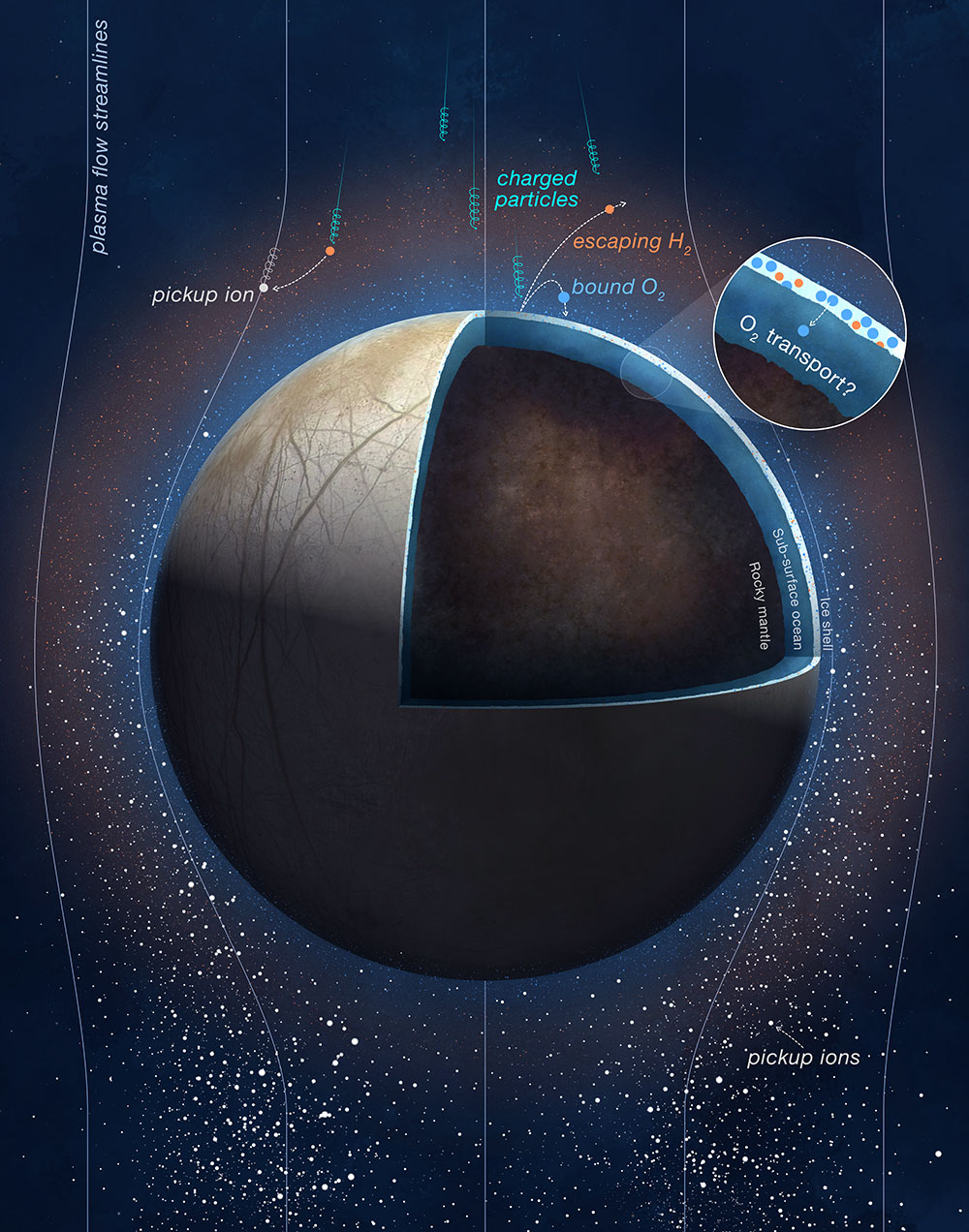
This illustration shows charged particles from Jupiter impacting Europa’s surface
This illustration shows charged particles from Jupiter impacting Europa’s surface, splitting frozen water molecules into oxygen and hydrogen molecules. Scientists believe some of these newly created oxygen gases could migrate toward the moon’s subsurface ocean, as depicted in the inset image.
NASA/JPL-Caltech/SWRI/PU

It is not just the water that has astrobiologists’ attention: The Jovian moon’s location plays an important role in biological possibilities as well. Europa’s orbit places it right in the middle of the gas giant’s radiation belts. Charged, or ionized, particles from Jupiter bombard the icy surface, splitting water molecules in two to generate oxygen that might find its way into the moon’s ocean.

“Europa is like an ice ball slowly losing its water in a flowing stream. Except, in this case, the stream is a fluid of ionized particles swept around Jupiter by its extraordinary magnetic field,” said JADE scientist Jamey Szalay from Princeton University in New Jersey. “When these ionized particles impact Europa, they break up the water-ice molecule by molecule on the surface to produce hydrogen and oxygen. In a way, the entire ice shell is being continuously eroded by waves of charged particles washing up upon it.”

Capturing the Bombardment

As Juno flew within 220 miles (354 kilometers) of Europa at 2:36 p.m. PDT Sept. 29, 2022, JADE identified and measured hydrogen and oxygen ions that had been created by the bombarding charged particles and then “picked up” by Jupiter’s magnetic field as it swept past the moon.

“Back when NASA’S Galileo mission flew by Europa, it opened our eyes to the complex and dynamic interaction Europa has with its environment. Juno brought a new capability to directly measure the composition of charged particles shed from Europa’s atmosphere, and we couldn’t wait to further peek behind the curtain of this exciting water world,” said Szalay. “But what we didn’t realize is that Juno’s observations would give us such a tight constraint on the amount of oxygen produced in Europa’s icy surface.”

Juno carries 11 state-of-the-art science instruments designed to study the Jovian system, including nine charged-particle and electromagnetic-wave sensors for studying Jupiter’s magnetosphere.

“Our ability to fly close to the Galilean satellites during our extended mission allowed us to start tackling a breadth of science, including some unique opportunities to contribute to the investigation of Europa’s habitability,” said Scott Bolton, Juno’s principal investigator from the Southwest Research Institute in San Antonio. “And we’re not done yet. More moon flybys and the first exploration of Jupiter’s close ring and polar atmosphere are yet to come.”

Oxygen production is one of many facets that NASA’s Europa Clipper mission will investigate when it arrives at Jupiter in 2030. The mission has a sophisticated payload of nine science instruments to determine if Europa has conditions that could be suitable for life.

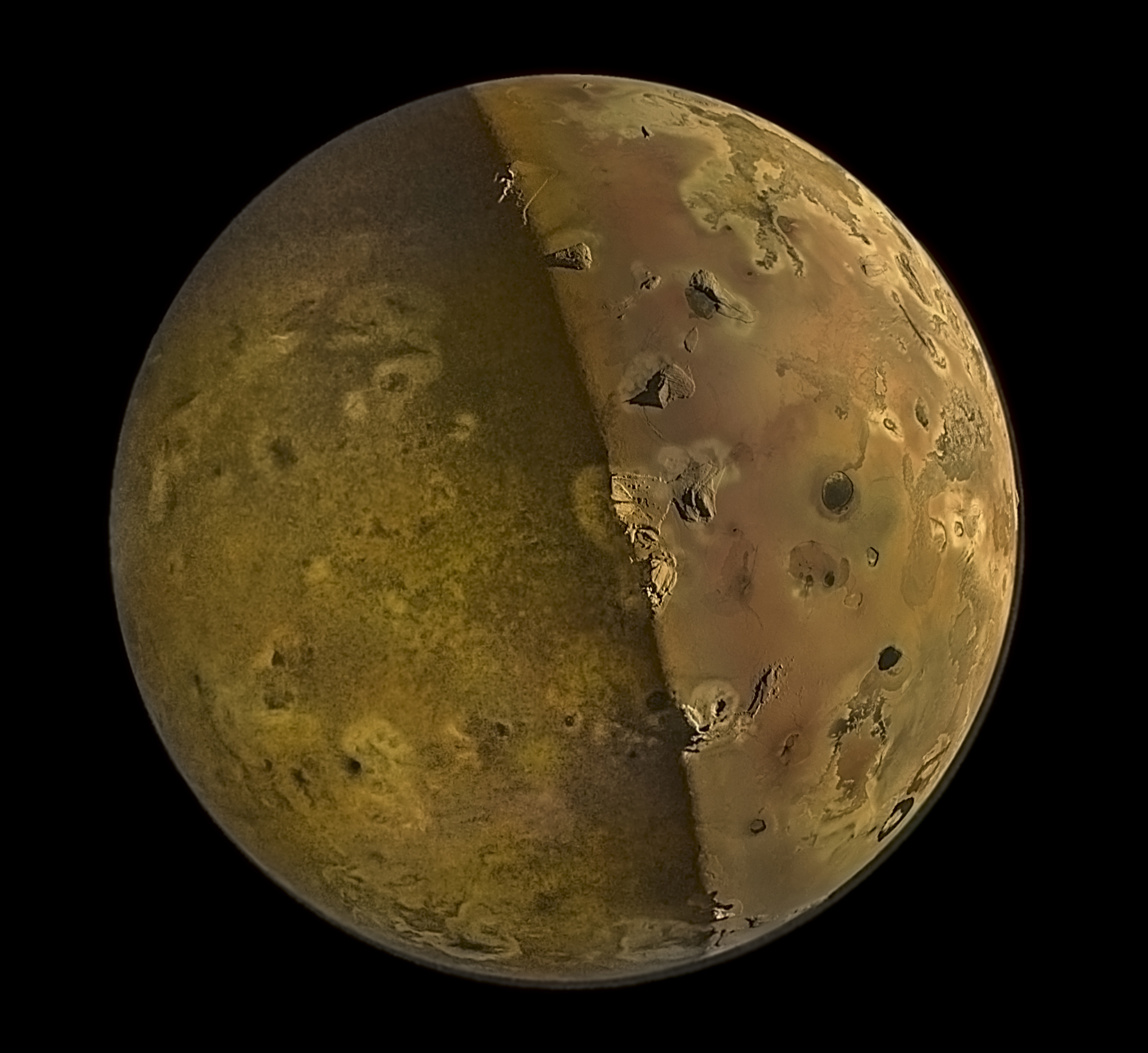
Now Bolton and the rest of the Juno mission team are setting their sights on another Jovian world, the volcano-festooned moon Io. On April 9, the spacecraft will come within about 10,250 miles (16,500 kilometers) of its surface. The data Juno gathers will add to findings from past Io flybys, including two extremely close approaches of about 932 miles (1,500 kilometers) on Dec. 30, 2023, and Feb. 3, 2024.

More About the Mission

NASA’s Jet Propulsion Laboratory, a division of Caltech in Pasadena, California, manages the Juno mission for the principal investigator, Scott Bolton, of the Southwest Research Institute in San Antonio. Juno is part of NASA’s New Frontiers Program, which is managed at NASA’s Marshall Space Flight Center in Huntsville, Alabama, for the agency’s Science Mission Directorate in Washington. The Italian Space Agency (ASI) funded the Jovian InfraRed Auroral Mapper. Lockheed Martin Space in Denver built and operates the spacecraft.

More information about Juno is available at:
https://www.nasa.gov/juno

News Media Contacts

DC Agle
Jet Propulsion Laboratory, Pasadena, Calif.
818-393-9011
agle@jpl.nasa.gov

Karen Fox / Alana Johnson
NASA Headquarters, Washington
301-286-6284 / 202-358-1501
karen.c.fox@nasa.gov / alana.r.johnson@nasa.gov

Deb Schmid
Southwest Research Institute, San Antonio
210-522-2254
dschmid@swri.org

2024-020

Share

Details

Last Updated

Mar 04, 2024

Powered by WPeMatico

Get The Details…
Anthony Greicius