NASA’s LRO Spots China’s Chang’e 6 Spacecraft on Lunar Far Side

NASA’s LRO Spots China’s Chang’e 6 Spacecraft on Lunar Far Side

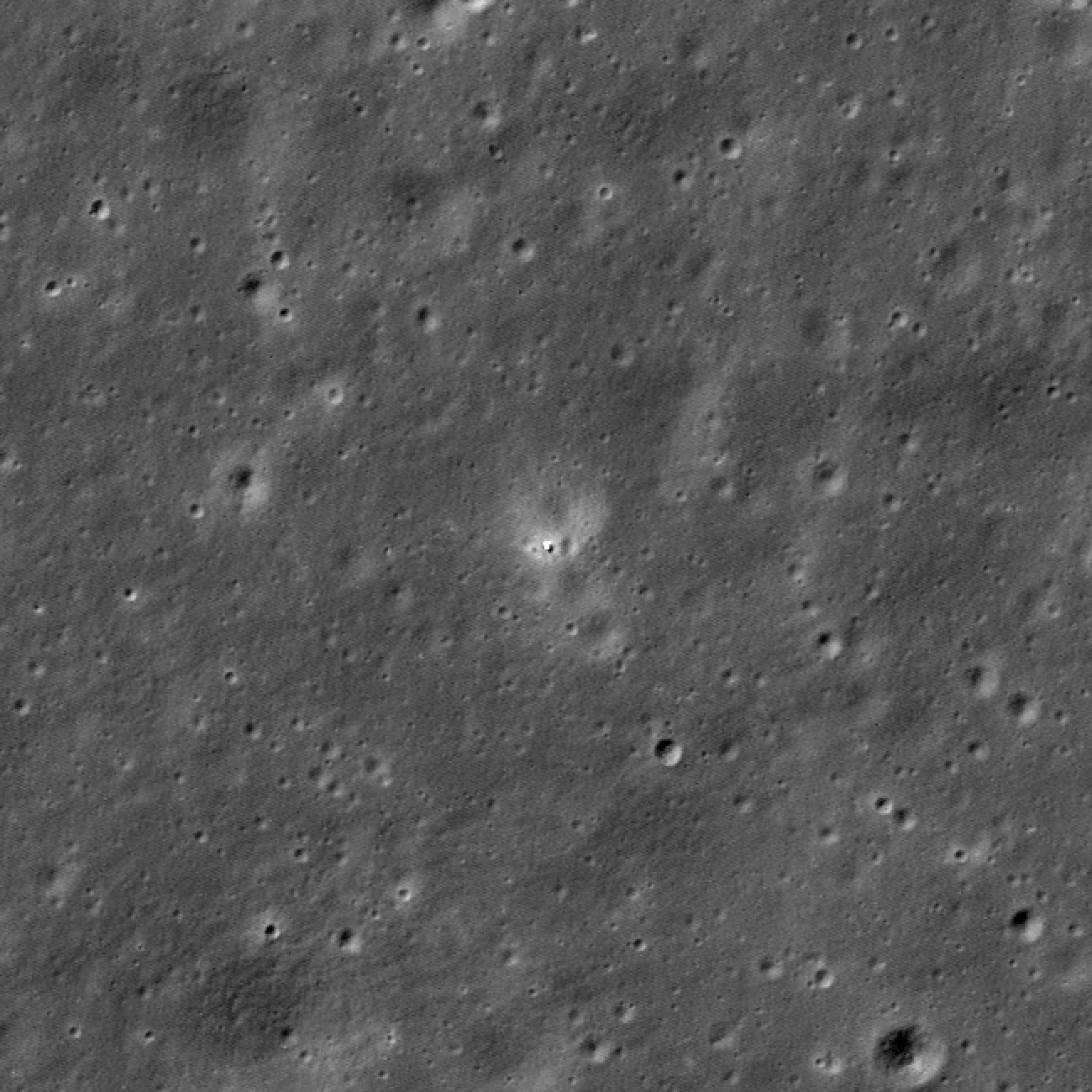
A black and white image of the surface of the Moon taken from NASA's LRO showing a white dot that is China's Chang'e 6 lander in the Apollo basin.
This image from NASA’s Lunar Reconnaissance Orbiter shows China’s Chang’e 6 lander in the Apollo basin on the far side of the Moon on June 7, 2024. The lander is the bright dot in the center of the image. The image is about 0.4 miles wide (650 meters); lunar north is up.
Credit: NASA/Goddard/Arizona State University

NASA’s LRO (Lunar Reconnaissance Orbiter) imaged China’s Chang’e 6 sample return spacecraft on the far side of the Moon on June 7. Chang’e 6 landed on June 1, and when LRO passed over the landing site almost a week later, it acquired an image showing the lander on the rim of an eroded, 55-yard-diameter (about 50 meters) crater. 

The LRO Camera team computed the landing site coordinates as about 42 degrees south latitude, 206 degrees east longitude, at an elevation of about minus 3.27 miles (minus 5,256 meters).

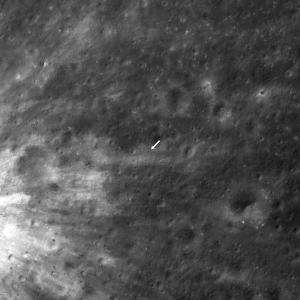
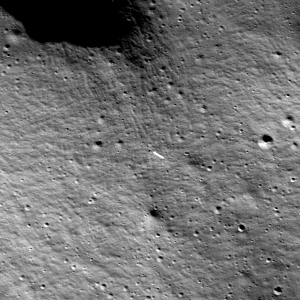
A black and white gif of two images of the Moon's surface before and after Chang'e 6 landed on the surface. A scale line for 100m is in the bottom right. The second image is slightly brighter around the landing site.
This before and after animation of LRO images shows the appearance of the Chang’e 6 lander. The increased brightness of the terrain surrounding the lander is due to disturbance from the lander’s engines and is similar to the blast zone seen around other lunar landers. The before image is from March 3, 2022, and the after image is from June 7, 2024.
Credit: NASA/Goddard/Arizona State University

The Chang’e 6 landing site is situated toward the southern edge of the Apollo basin (about 306 miles or 492 km in diameter, centered at 36.1 degrees south latitude, 208.3 degrees east longitude). Basaltic lava erupted south of Chaffee S crater about 3.1 billion years ago and flowed downhill to the west until it encountered a local topographic high, likely related to a fault. Several wrinkle ridges in this region have deformed and raised the mare surface. The landing site sits about halfway between two of these prominent ridges. This basaltic flow also overlaps a slightly older flow (about 3.3 billion years old), visible further west, but the younger flow is distinct because it has higher iron oxide and titanium dioxide abundances.

Map of the Moon's surface with a 20 km scale. Chaffee, Chaffee S, and Chaffee F craters are labeled in the upper left of the image and the Chang'e 6 Landing Site is a white dot in the center labeled with an arrow.
A regional context map of the Chang’e 6 landing site. Color differences have been enhanced for clarity. The dark area is a basaltic mare deposit; bluer areas of the mare are higher-titanium flows. Contour lines marking 100-meter (about 328 feet) elevation intervals are overlaid to provide a sense of the topography. Image is about 118 miles (190 km) across.
Credit: NASA/Goddard/Arizona State University

LRO is managed by NASA’s Goddard Space Flight Center in Greenbelt, Maryland, for the Science Mission Directorate at NASA Headquarters in Washington. Launched on June 18, 2009, LRO has collected a treasure trove of data with its seven powerful instruments, making an invaluable contribution to our knowledge about the Moon. NASA is returning to the Moon with commercial and international partners to expand human presence in space and bring back new knowledge and opportunities.

Media Contact:
Nancy N. Jones
NASA’s Goddard Space Flight Center, Greenbelt, Md.

Share

Details

Last Updated

Jun 14, 2024

Editor
Madison Olson
Contact
Nancy N. Jones
Location
Goddard Space Flight Center

Powered by WPeMatico

Get The Details…
Madison Olson

Johnson Celebrates LGBTQI+ Pride Month: Meet Michael Chandler

Johnson Celebrates LGBTQI+ Pride Month: Meet Michael Chandler

Michael Chandler has provided configuration and data management support at Houston’s Johnson Space Center for the last 13 years. After roughly seven years supporting the Exploration Systems Development Division, Chandler transitioned to the Moon to Mars Program Office in 2019. He and his team work to ensure that the baseline for Moon to Mars products, like agreements and documents, is appropriately controlled and that configuration and data management processes are integrated across the office’s six programs – Orion, Gateway, EHP, Space Launch System, Human Landing system, and Exploration Ground Systems.

“The most rewarding part of my job is not only the magnitude of what I have the privilege of working on every day, returning humans to the surface of the Moon, but also the experience I get in working with such a diverse group of members of the aerospace community,” said Chandler, a contractor with The Aerospace Corporation. “It’s also so rewarding to work as a team on a common goal and to look forward to the work I do every day!”

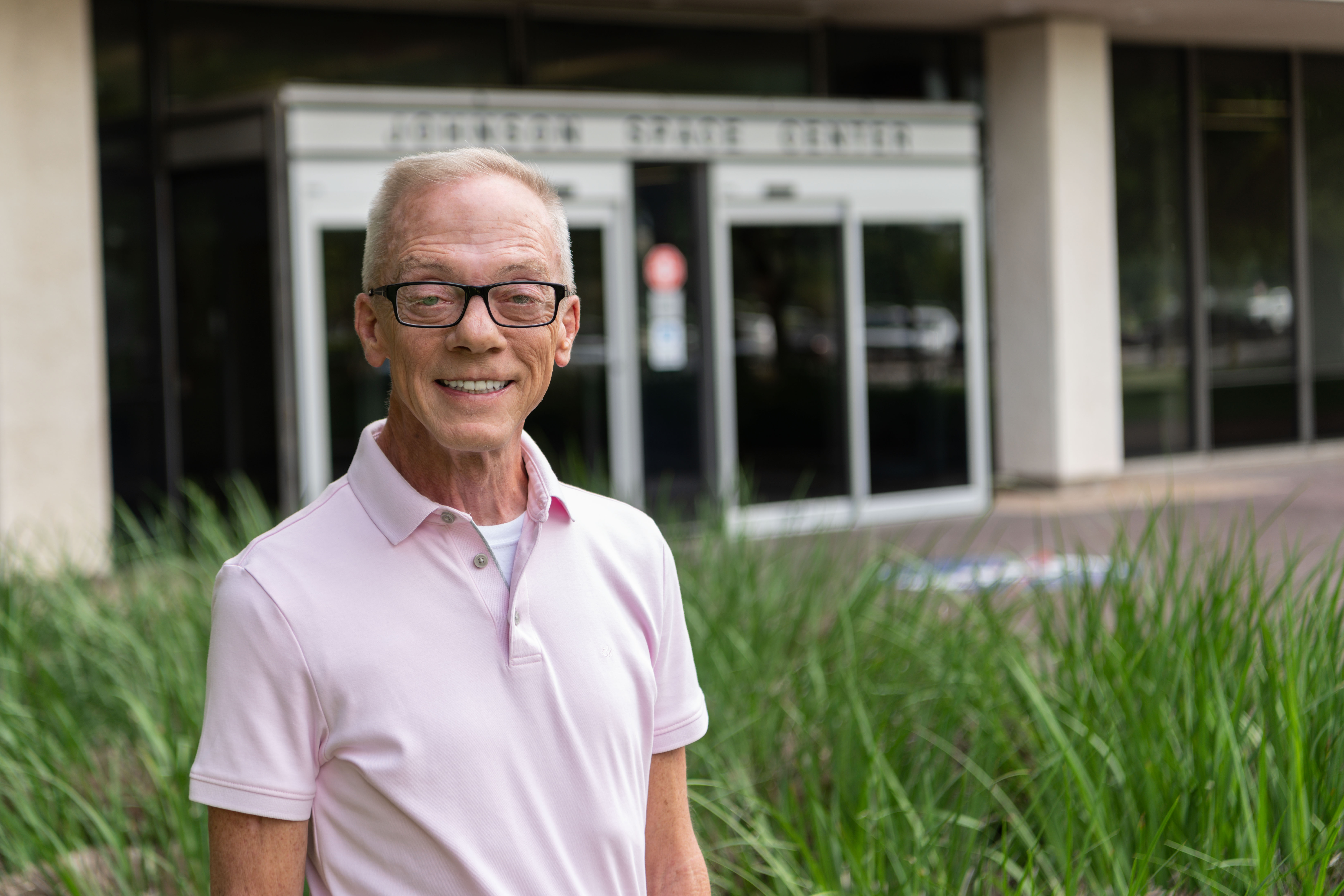
A thin white man with thick-rimmed glasses and wearing a light pink polo shirt stands in front of an office building with Johnson Space Center written over the door.
Portrait of Michael Chandler onsite at Johnson Space Center.
NASA/Noah Moran

Chandler has been an active member of the Out & Allied Employee Resource Group (OAERG) since 2018 and says his involvement with the group led to some groundbreaking life events. “I was very shy and reticent about revealing who I was until I got involved with Out & Allied,” he said. “I now believe that being ‘out’ is a way to support and encourage others to be themselves.”

Chandler learned about OAERG while attending a training about how to be an ally for the LGBTQ+ community. In his first year with the group, he helped organize a panel discussion on allyship and creating safe workplaces. He then became co-chair of OAERG’s Pride Committee, working with ERG colleagues and others to plan the group’s LGBTQ+ Pride Month events and participation in Houston’s annual Pride Parade. “I had a wonderful experience managing events and bringing everyone together for Pride,” he said – efforts that earned him a Trailblazer Award.

Chandler said he has grown personally and professionally through his involvement with OAERG. “I was very shy and kind of uptight at the first meeting that I went to, but everyone was so kind and accepting, and I slowly started taking on responsibilities and planning events,” he said. “These activities helped me grow as a communicator and a leader in my regular work and personal life.”

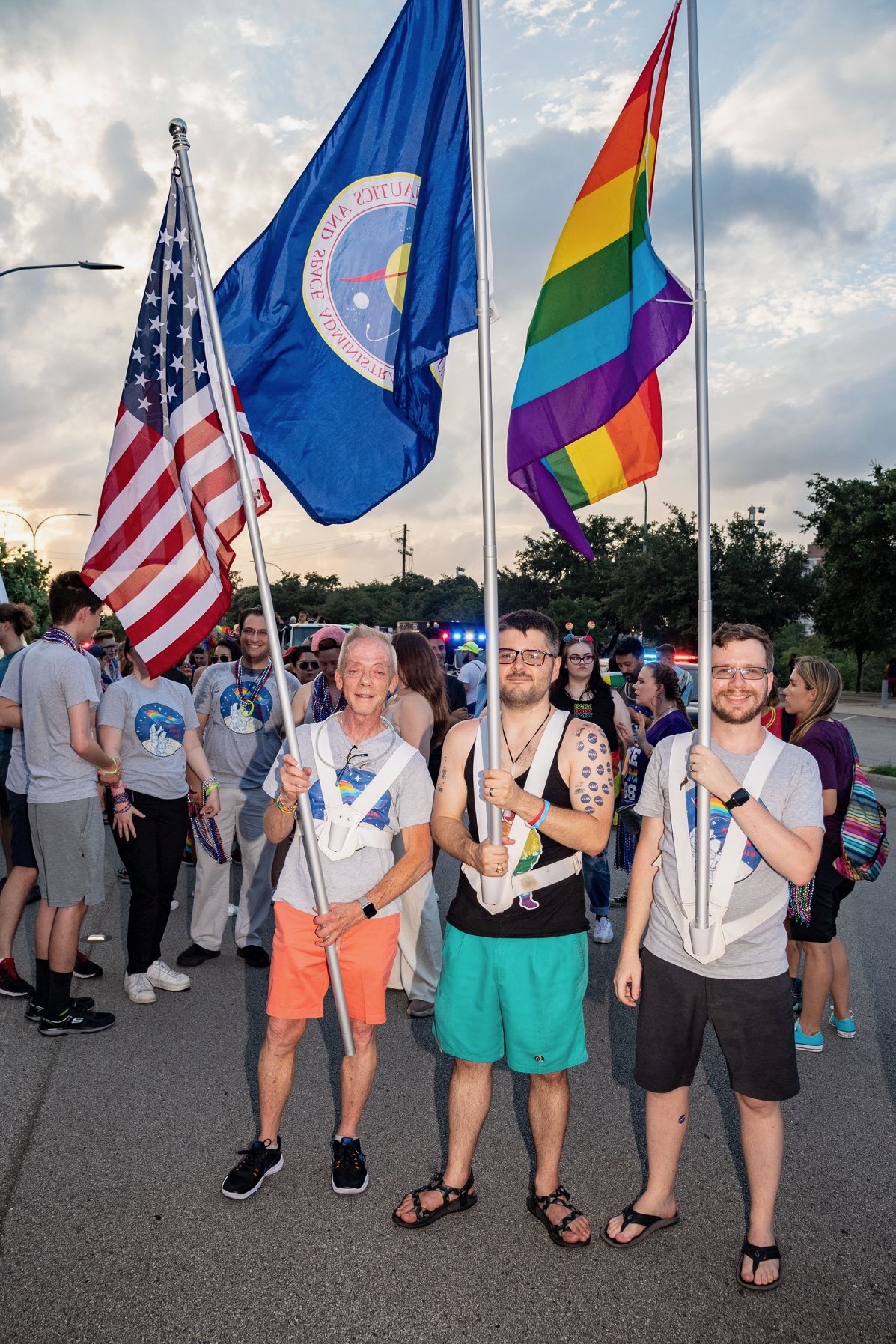
Three men hold a U.S., NASA, and Pride flag as they prepare to march in Houston's annual Pride Parade.
Michael Chandler (left) stands with fellow Out & Allied Employee Resource Group members, waiting for the Houston Pride Parade to begin.
Image courtesy of Michael Chandler

Chandler belongs to other employee resource groups (ERGs) at Johnson to support different communities and find opportunities to collaboratively promote diversity, equity, and inclusion (DEI) at the center, and he encourages others to do the same. “Even if you only participate when you have time, it can lead to knowledge and ways to support other communities that have the same challenges in this world,” he said.

Chandler has been impressed with agency and center leadership’s involvement in DEI efforts and support for ERGs to date. He suggested that increased communication around DEI initiatives may help to quell anxieties about the political landscape and developments outside of NASA by reassuring team members that their employer supports them for who they are. He believes that every person at Johnson can help create an inclusive environment by being respectful, listening with an open heart, and joining the fight to ensure that everyone can be themselves.

“The most important thing is that everyone needs to be their true self,” he said. “It’s so rewarding and makes life so much more fun!”

Powered by WPeMatico

Get The Details…
Linda E. Grimm

NASA Invites Media to See Artemis II Moon Rocket Elements at Kennedy

NASA Invites Media to See Artemis II Moon Rocket Elements at Kennedy

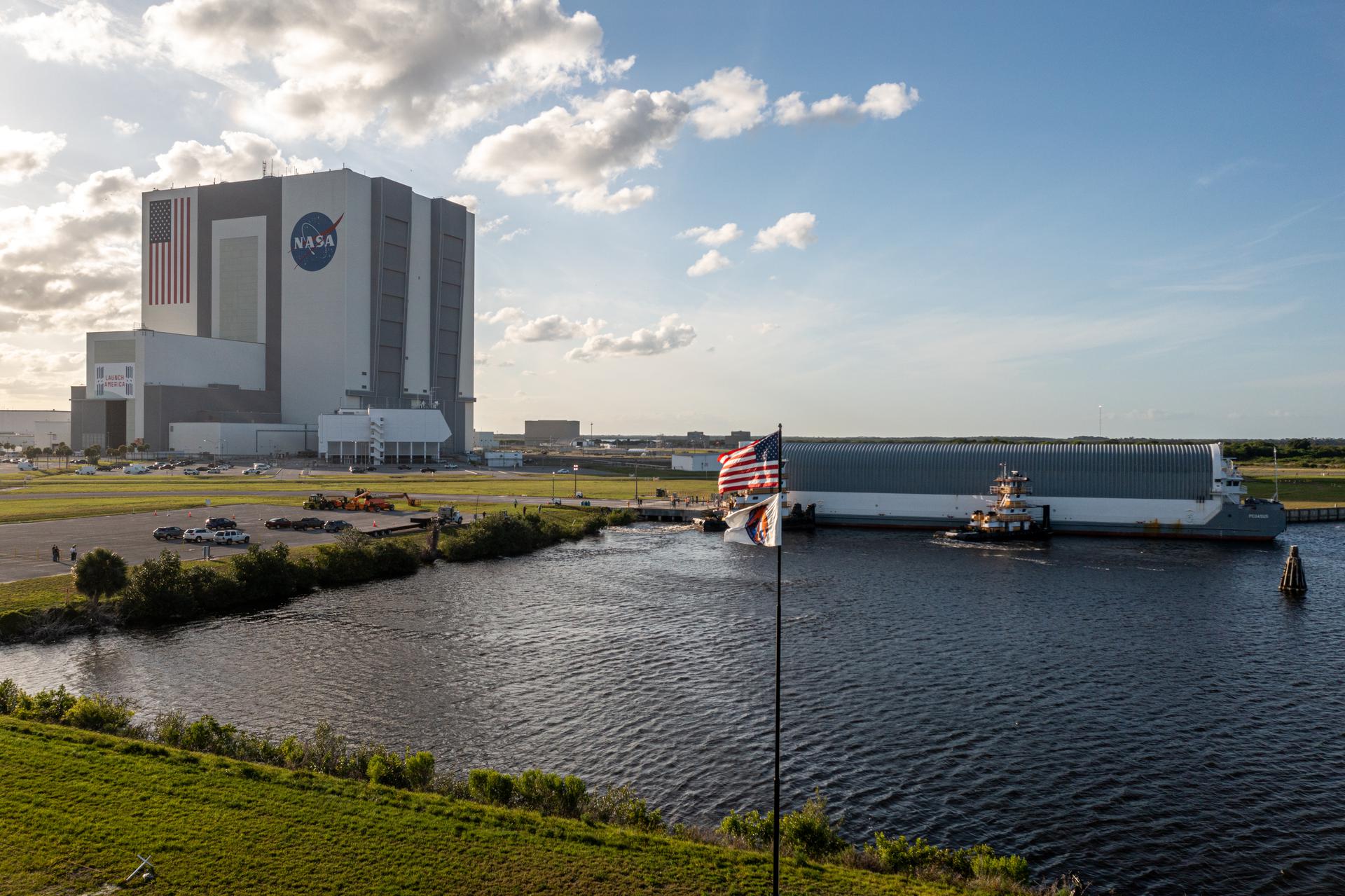
NASA’s Pegasus barge delivers the SLS (Space Launch System) rocket’s core stage for the 2022 Artemis I mission to the turn basin at Kennedy Space Center in Florida in April 2021.
Credits: NASA/Michael Downs

Media are invited in late July to NASA’s Kennedy Space Center in Florida to see progress on the agency’s SLS (Space Launch System) Moon rocket as preparations continue for the Artemis II test flight around the Moon.

Participants joining the multi-day events will see the arrival and unloading of the 212-foot-tall SLS core stage at the center’s turn basin before it is transported to the nearby Vehicle Assembly Building. The stage will arrive on NASA’s Pegasus barge from the agency’s Michoud Assembly Facility in New Orleans, where it was manufactured and assembled.

Media also will see the twin pair of solid rocket boosters inside the Rotation, Processing, and Surge Facility at the spaceport, where NASA’s Exploration Ground Systems Program is processing the motor segments in preparation for rocket assembly. NASA and industry subject matter experts will be available to answer questions. At launch, the SLS rocket’s two solid rocket boosters and four RS-25 engines, located at the base of its core stage, will produce 8.8 million pounds of thrust to send the first crewed mission of the Artemis campaign around the Moon.

Media interested in participating must apply for credentials at:

https://media.ksc.nasa.gov

To receive credentials, international media must apply by Friday, June 28, and U.S. citizens must apply by Thursday, July 5.

Credentialed media will receive a confirmation email upon approval, along with additional information about the specific date for the activities when they are finalized. NASA’s media accreditation policy is available online. For questions about accreditation, please email ksc-media-accreditat@mail.nasa.gov. For other questions, please contact Kennedy’s newsroom at: 321-867-2468.

Para obtener información sobre cobertura en español en el Centro Espacial Kennedy o si desea solicitar entrevistas en español, comuníquese con Antonia Jaramillo o Messod Bendayan a: antonia.jaramillobotero@nasa.gov o messod.c.bendayan@nasa.gov.

The approximately 10-day Artemis II flight will test NASA’s SLS rocket, Orion spacecraft, and ground systems for the first time with astronauts and will pave the way for lunar surface missions, including landing the first woman, first person of color, and first international partner astronaut on the Moon.

Learn more about Artemis at:

www.nasa.gov/artemis/

-end-

Rachel Kraft 
Headquarters, Washington 
281-358-1100  
rachel.h.kraft@nasa.gov  

Tiffany Fairley/Antonia Jaramillo
Kennedy Space Center, Florida
321-867-2468
tiffany.l.fairley@nasa.gov/antonia.jaramillobotero@nasa.gov

Share

Details

Last Updated

Jun 14, 2024

Powered by WPeMatico

Get The Details…
Tiernan P. Doyle

Transportation Officer Melissa Coleman

Transportation Officer Melissa Coleman

“Don’t let the NASA emblem scare you away.

“I was very intimidated by it because it was a childhood dream [to make it to NASA]. I saw a picture of me at Kennedy Space [Center’s] visitor center the last time I went home. I must have been five years old. I always used to tell myself that I wasn’t smart enough. [I assumed you needed to be] a literal rocket scientist, and I have absolutely no STEM [science, technology, engineering, and math] degree whatsoever.

“So my advice is, as long as you’re true to who you are, you’re transparent, you’re yourself, and you put the work in, you will get what you want.

“And make them tell you no — that was one of the first things I learned. If you don’t ask and you don’t apply, you have your answer. So make them tell you no. If you don’t ask, you’ll never know.

“And don’t be intimidated or influenced by an emblem or your perception of what kind of people are behind that emblem. Because now I realize, once I’ve made it to NASA, that it’s nothing like I thought it was. In a lot of ways, it’s better, right? Because I get these opportunities to do things that are not in my primary role to serve others, and in that capacity, it’s serving me. That’s my advice.”

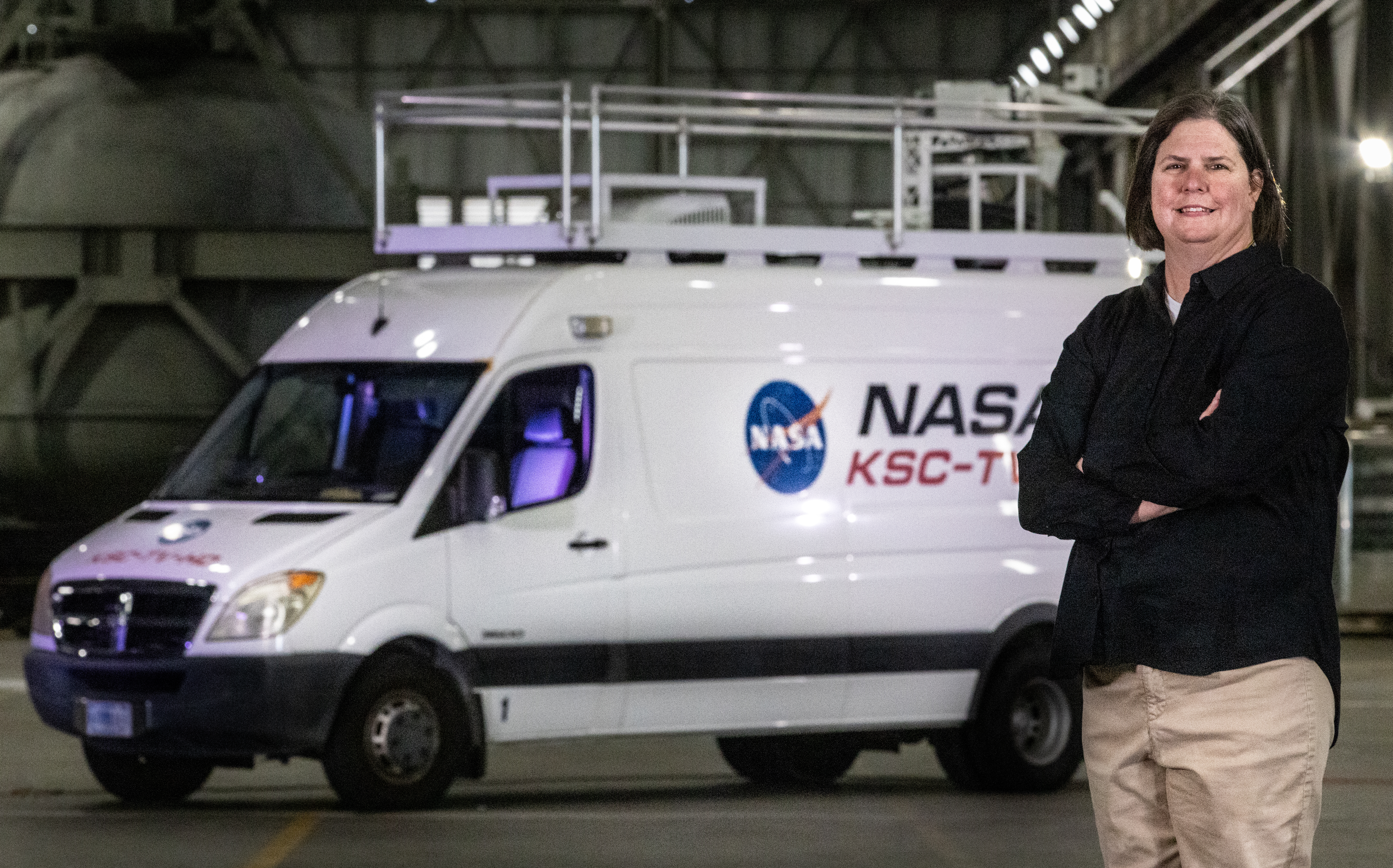
— Melissa Coleman, Transportation Officer, Logistics Branch, NASA’s Kennedy Space Center

Image Credit: NASA/Cory Huston
Interviewer: NASA/Thalia Patrinos

Check out some of our other Faces of NASA. 

Powered by WPeMatico

Get The Details…
Thalia K. Patrinos

Johnson Celebrates LGBTQI+ Pride Month: Meet Margaret Kennedy

Johnson Celebrates LGBTQI+ Pride Month: Meet Margaret Kennedy

Although surrounded by the big and bold missions of human spaceflight, Margaret Kennedy, an aerospace systems engineer on the Human Health and Performance Contract, still appreciates the little things. Ask about her favorite NASA experience to date and she will tell you it is getting to show her badge to the gate guards at Houston’s Johnson Space Center every day. “Knowing I get to be a part of things that can change the world – that I’m helping to make it possible for astronauts to do their job safely, which in turn supports life on Earth – is very rewarding,” she said.

A woman wearing a red, white, and blue dress stands next to an inflatable astronaut mascot at Comicpalooza.
Margaret Kennedy poses with Johnson Space Center’s inflatable mascot, Cosmo, at Comicpalooza 2024 in Houston, Texas.
Image courtesy of Margaret Kennedy

Kennedy joined the Johnson team as a contractor with Aegis Aerospace in October 2019. Since then, she has spent most of her time as a systems engineer for the Human Research Program’s Program Integration and Strategic Planning group. That role required her to collect technical information for various projects and to ensure systems were in place to correctly track and manage program documents and agreements. This spring, Kennedy transitioned to a new role in which she provides systems engineering for flight hardware supporting Gateway and exploration missions to the Moon and Mars.

She started engaging with Johnson’s Employee Resource Groups (ERGs) shortly before the COVID-19 pandemic and jumped at the chance to get more involved once employees came back onsite. “A few people have been surprised when I tell them I’m really an introvert, not an extrovert, but I had to get out of my shell or I’d still be stuck in my apartment,” she said. “The ERGs were a way for me get out of my space and have allowed me to grow.”

Kennedy is thankful the Johnson Parenting ERG started allowing contractors to serve as secretaries because that led to similar opportunities with other ERGs. She served as the membership secretary for both Emerge and Out & Allied ERG (OAERG) in 2023 and is currently OAERG’s executive secretary. “I help keep our chair and co-chair up to date,” she said. “I have my finger on everything that’s happening in the ERG.” Filling these roles gives Kennedy numerous opportunities to support diversity, equity, and inclusion at Johnson, the most recent of which was her participation on a panel during the center’s Diversity, Equity, Inclusion, and Accessibility Day.  

Margaret Kennedy (left) participates in a panel discussion during Johnson Space Center’s 2024 Diversity, Equity, Inclusion, and Accessibility Day with Kent Kalogera, Out & Allied ERG chair, Livette Santiago Cardona, Greening and Restoring Our World ERG chair, Andrea Browne, African American ERG chair, and Anika Isaac, Employee Assistance Program counselor.
NASA/Robert Markowitz

“The main advice I’d give to others wanting to get involved is find your people and don’t be afraid to take a risk,” she said. “Many of us deal with risk every day in our work so find a way to buy down risk by finding allies and a support system. Even if you only get a hair’s width outside your zone of comfort, it makes a difference.”

She also said that simply participating in ERG meetings and events – whether in person or virtually – is another great way to get involved. “The ERGs can’t do what we do without you,” she said. “We do it because it’s important to us and to others, but we sometimes struggle to know what people want. We need your thoughts and your ideas because it helps us provide programming and inform the center about what is happening.”

Being a part of OAERG in particular has helped Kennedy personally and professionally. “It has provided me with a space to be my authentic self and bring that person to both the world and work,” she said. “In the long line of LGBTQI+ letter soup, I end up in the + on the end more times than not. Out & Allied has given me a way to not only embrace my identity but also help spread awareness about it.” Professionally, the ERG has helped her network with a range of people, including upper and middle management, and strengthen her communication, problem solving, and leadership skills.

A white man, white woman, and black woman wear NASA shirts while volunteering for a Montrose Center LGBTQI+ event in Houston.
Margaret Kennedy (center) volunteering at a Hatch Youth event in Houston, Texas, with Kent Kalogera, Out & Allied ERG chair, and Chasity Williams, the group’s former chair.
Image courtesy of Margaret Kennedy

Kennedy acknowledged that change can take time, noting that while Johnson’s safety-oriented culture is a strength, it can sometimes slow the pace of initiatives that may not be considered mission critical, as can staffing shortages in some areas. “Things like accessible walkways and gender-neutral bathrooms are still important,” she said, adding that leadership is working on it.

Kennedy encourages everyone at Johnson to check in with their teammates and have “water cooler moments” with their colleagues as a way of promoting inclusivity. “Be patient and willing to give everyone some grace,” she said. “We can get so focused on the mission and what we need that we sometimes forget there are things happening in other people’s lives that can affect their work.”

Powered by WPeMatico

Get The Details…
Linda E. Grimm