NASA’s OSIRIS-REx Etched into Collier Trophy, Aerospace History

NASA’s OSIRIS-REx Etched into Collier Trophy, Aerospace History

NASA’s OSIRIS-REx mission has been immortalized at the Smithsonian’s National Air and Space Museum in Washington as the latest awardee of the Robert J. Collier Trophy. Bestowed annually by the National Aeronautic Association, the trophy recognizes groundbreaking aerospace achievements.

a crowd of people stand around a tall wooden plinth and sculpture
Members of the OSIRIS-REx team at the Smithsonian Institute’s National Air and Space Museum in Washington, D.C., with the Collier trophy on June 13, 2024. From left to right: Nayi Castro, mission operations manager, NASA’s Goddard Space Flight Center, Greenbelt, Md.; Nicole Lunning, curator, NASA’s Johnson Space Center, Houston; Anjani Polit, mission implementation systems engineer, University of Arizona, Tucson; Coralie Adam, OSIRIS-REx optical navigation lead, KinetX Inc.; Michael Moreau, OSIRIS-REx deputy project manager, NASA Goddard; Dennis Reuter, OVIRS instrument scientist, NASA Goddard; Ronald Mink, OSIRIS-REx missions systems engineer, NASA Goddard; Joshua Wood, system design lead, Lockheed Martin Space; Peter Antreasian, OSIRIS-REx navigation team chief, KinetX Inc.; Sandy Freund, program manager, Lockheed Martin Space; Eric Sahr, optical navigation engineer, KinetX Inc.
NASA/Rani Gran

OSIRIS-REx, formally the Origins, Spectral Interpretation, Resource Identification, and Security – Regolith Explorer, was honored “for successfully executing the first American retrieval of an asteroid sample and its return to Earth,” according to the award citation. The award was announced in March, and the OSIRIS-REx team visited the museum on June 13, 2024, to see the mission’s name engraved in brass at the base of the statue.

“It just blows me away to see the OSIRIS-REx team engraved on the Collier trophy, next to names like Orville Wright, the Apollo 8 crew, and the Voyager Mission Team,” said Michael Moreau, OSIRIS-REx deputy project manager at NASA’s Goddard Space Flight Center in Greenbelt, Maryland.  “I’m so proud of our amazing team that their excellence and sacrifice to make the OSIRIS-REx mission so successful have been recognized with this prestigious award.”

While NASA’s accomplishments have been honored with the Collier award many times, this is one of just a handful of instances that NASA Goddard has been a major partner on a winning team. NASA Goddard most recently claimed a share of the award in 2022 for the James Webb Space Telescope. Previous wins also include 1993 honors for the Hubble Space Telescope and the 1974 prize for a NASA–U.S. Geological Survey satellite that began the long-running Landsat program that studies and monitors changes to Earth’s land masses.

The OSIRIS-REx team includes NASA’s Goddard Space Flight Center in Greenbelt, Maryland; Lockheed Martin in Littleton, Colorado; the University of Arizona, Tucson; and KinetX in Tempe, Arizona. NASA’s Johnson Space Center is responsible for the curation of the Bennu sample material that OSIRIS-REx returned to Earth in September 2023.

The Collier Trophy resides in a glass case in the “America by Air” section on the museum’s first floor. The century-old trophy stands at over 7 feet tall and weighs 525 pounds. The bronze sculpture depicts a globe, with three figures emerging from it. The sculpture rests on two walnut bases, each adorned with an engrave brass plaque bearing the names of the recipients.

Baltimore sculptor Ernest Wise Keyser designed the Trophy in 1910 for Robert J. Collier, the publisher of Collier’s Weekly magazine and president of the Aero Club of America.

By Rani Gran
NASA’s Goddard Space Flight Center, Greenbelt, Md.

Share

Details

Last Updated

Jun 18, 2024

Editor
Rob Garner
Contact
Rani Gran

Powered by WPeMatico

Get The Details…
Rob Garner
NASA’s OSIRIS-REx Etched into Collier Trophy, Aerospace History

NASA’s OSIRIS-REx Etched into Collier Trophy, Aerospace History

NASA’s OSIRIS-REx mission has been immortalized at the Smithsonian’s National Air and Space Museum in Washington as the latest awardee of the Robert J. Collier Trophy. Bestowed annually by the National Aeronautic Association, the trophy recognizes groundbreaking aerospace achievements.

a crowd of people stand around a tall wooden plinth and sculpture
Members of the OSIRIS-REx team at the Smithsonian Institute’s National Air and Space Museum in Washington, D.C., with the Collier trophy on June 13, 2024. From left to right: Nayi Castro, mission operations manager, NASA’s Goddard Space Flight Center, Greenbelt, Md.; Nicole Lunning, curator, NASA’s Johnson Space Center, Houston; Anjani Polit, mission implementation systems engineer, University of Arizona, Tucson; Coralie Adam, OSIRIS-REx optical navigation lead, KinetX Inc.; Michael Moreau, OSIRIS-REx deputy project manager, NASA Goddard; Dennis Reuter, OVIRS instrument scientist, NASA Goddard; Ronald Mink, OSIRIS-REx missions systems engineer, NASA Goddard; Joshua Wood, system design lead, Lockheed Martin Space; Peter Antreasian, OSIRIS-REx navigation team chief, KinetX Inc.; Sandy Freund, program manager, Lockheed Martin Space; Eric Sahr, optical navigation engineer, KinetX Inc.
NASA/Rani Gran

OSIRIS-REx, formally the Origins, Spectral Interpretation, Resource Identification, and Security – Regolith Explorer, was honored “for successfully executing the first American retrieval of an asteroid sample and its return to Earth,” according to the award citation. The award was announced in March, and the OSIRIS-REx team visited the museum on June 13, 2024, to see the mission’s name engraved in brass at the base of the statue.

“It just blows me away to see the OSIRIS-REx team engraved on the Collier trophy, next to names like Orville Wright, the Apollo 8 crew, and the Voyager Mission Team,” said Michael Moreau, OSIRIS-REx deputy project manager at NASA’s Goddard Space Flight Center in Greenbelt, Maryland.  “I’m so proud of our amazing team that their excellence and sacrifice to make the OSIRIS-REx mission so successful have been recognized with this prestigious award.”

While NASA’s accomplishments have been honored with the Collier award many times, this is one of just a handful of instances that NASA Goddard has been a major partner on a winning team. NASA Goddard most recently claimed a share of the award in 2022 for the James Webb Space Telescope. Previous wins also include 1993 honors for the Hubble Space Telescope and the 1974 prize for a NASA–U.S. Geological Survey satellite that began the long-running Landsat program that studies and monitors changes to Earth’s land masses.

The OSIRIS-REx team includes NASA’s Goddard Space Flight Center in Greenbelt, Maryland; Lockheed Martin in Littleton, Colorado; the University of Arizona, Tucson; and KinetX in Tempe, Arizona. NASA’s Johnson Space Center is responsible for the curation of the Bennu sample material that OSIRIS-REx returned to Earth in September 2023.

The Collier Trophy resides in a glass case in the “America by Air” section on the museum’s first floor. The century-old trophy stands at over 7 feet tall and weighs 525 pounds. The bronze sculpture depicts a globe, with three figures emerging from it. The sculpture rests on two walnut bases, each adorned with an engrave brass plaque bearing the names of the recipients.

Baltimore sculptor Ernest Wise Keyser designed the Trophy in 1910 for Robert J. Collier, the publisher of Collier’s Weekly magazine and president of the Aero Club of America.

By Rani Gran
NASA’s Goddard Space Flight Center, Greenbelt, Md.

Share

Details

Last Updated

Jun 18, 2024

Editor
Rob Garner
Contact
Rani Gran

Powered by WPeMatico

Get The Details…
Rob Garner

Celebrating Juneteenth

Celebrating Juneteenth

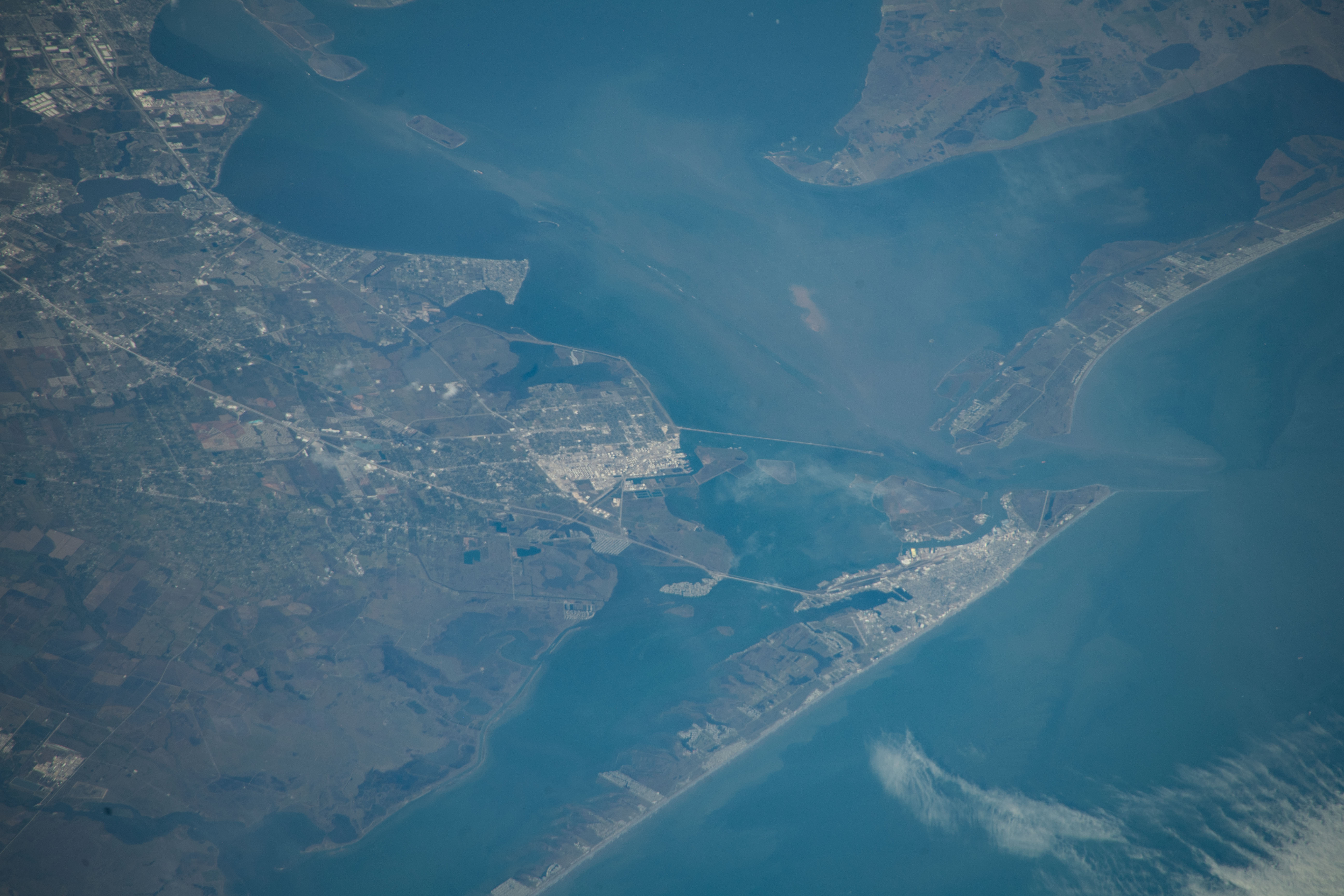
A view of Galveston from the International Space Station. The colors are faded: the land is a muted green, while the water is a hazy blue.
NASA

The crew aboard the International Space Station captured this image of Galveston, Texas, the birthplace of Juneteenth, as the station orbited 224 miles above on Nov. 23, 2011.

In the early 1800s, slavers periodically used Galveston Island as an outpost for operations. By 1860, about one-third of Galveston’s population lived under the oppression of chattel slavery. Even after President Abraham Lincoln issued the Emancipation Proclamation in 1863, in the midst of America’s Civil War, change came slowly to Galveston. Most enslaved people were unaware of Lincoln’s executive order, and the practice of buying and selling Black people based on race continued in Galveston and other parts of Texas until well into 1865.

When Union troops arrived in April 1865, circumstances changed. U.S. Major General Gordon Granger then issued General Order No. 3 on June 19, 1865, and Union troops marched through Galveston and read the order aloud at several locations, informing the people of Texas that all enslaved people were free. As news of the order spread, spontaneous celebrations broke out in African American churches, homes, and other gathering places. As years passed, the picnics, barbecues, parades, and other celebrations that sprang up to commemorate June 19th became more formalized as freed men and women purchased land, or “emancipation grounds,” to hold annual Juneteenth celebrations.

Image Credit: NASA

Powered by WPeMatico

Get The Details…
Monika Luabeya

Celebrating Juneteenth

Celebrating Juneteenth

A view of Galveston from the International Space Station. The colors are faded: the land is a muted green, while the water is a hazy blue.
NASA

The crew aboard the International Space Station captured this image of Galveston, Texas, the birthplace of Juneteenth, as the station orbited 224 miles above on Nov. 23, 2011.

In the early 1800s, slavers periodically used Galveston Island as an outpost for operations. By 1860, about one-third of Galveston’s population lived under the oppression of chattel slavery. Even after President Abraham Lincoln issued the Emancipation Proclamation in 1863, in the midst of America’s Civil War, change came slowly to Galveston. Most enslaved people were unaware of Lincoln’s executive order, and the practice of buying and selling Black people based on race continued in Galveston and other parts of Texas until well into 1865.

When Union troops arrived in April 1865, circumstances changed. U.S. Major General Gordon Granger then issued General Order No. 3 on June 19, 1865, and Union troops marched through Galveston and read the order aloud at several locations, informing the people of Texas that all enslaved people were free. As news of the order spread, spontaneous celebrations broke out in African American churches, homes, and other gathering places. As years passed, the picnics, barbecues, parades, and other celebrations that sprang up to commemorate June 19th became more formalized as freed men and women purchased land, or “emancipation grounds,” to hold annual Juneteenth celebrations.

Image Credit: NASA

Powered by WPeMatico

Get The Details…
Monika Luabeya

Happy Birthday, Redshift Wrangler!

Happy Birthday, Redshift Wrangler!

2 Min Read

Happy Birthday, Redshift Wrangler!

Redshift Wranglers have roped nearly 8,000 galaxies! The project is now on its 3rd data set, and more data is on the way.
Credits:
Sadie Coffin

About one year ago the Redshift Wrangler project first asked you to help examine “spectra” of distant galaxies. These spectra are diagrams that show how much light we receive from them as a function of wavelength. 

“Since launching on May 30, 2023, we have reached almost 2,000 volunteers joining our project.” said Coffin.  “Together we have made over 143,000 measurements on 11,100 galaxy spectra!”

When you join Redshift Wrangler on Zooniverse, you learn about how astronomers use these spectra to look back in time. These data help reveal the rate at which the galaxies are forming stars, what their chemical compositions are, and how their central supermassive black holes behave. The goal is to assemble a timeline of galaxy formation. There’s still much more wrangling to do!

“We’re continuing to prepare new, exciting data for Redshift Wrangler,” said Coffin. “You can expect better resolution data coming in the next round, and you can look forward to seeing spectra from space telescopes like the Webb Space Telescope in the future as well!”

So come help make the project’s second year an even bigger success at https://www.zooniverse.org/projects/jeyhansk/redshift-wrangler.  No lasso necessary!

This work is also supported by the National Science Foundation (NSF).

Share

Details

Last Updated
Jun 18, 2024

Powered by WPeMatico

Get The Details…