What’s Up: June 2024 Skywatching Tips from NASA

What’s Up: June 2024 Skywatching Tips from NASA

Planets rule the a.m., and what’s that bright light?

Saturn and Mars meet up with the Moon, Jupiter returns at dawn, and tips for identifying some common objects seen in the sky.

Highlights

  • All month – All the planetary action continues to be in the morning sky, with Saturn and Mars rising in the early morning hours. They are joined later in the month by Jupiter.
  • June 2 – In the hour before sunrise, reddish Mars hangs just beneath the crescent Moon. Find the pair low in the east with Saturn lurking nearby, toward the south.
  • June 3 – The crescent Moon sits beneath Mars in morning twilight. Look for them low in the eastern sky.
  • June 6 – New moon
  • June 21 – Full moon
  • June 24 – Jupiter is now visible low in the east before sunrise. Look for the bright planet around 10 degrees above the horizon this final week of June, forming a line with Mars and Saturn that stretches toward the south.
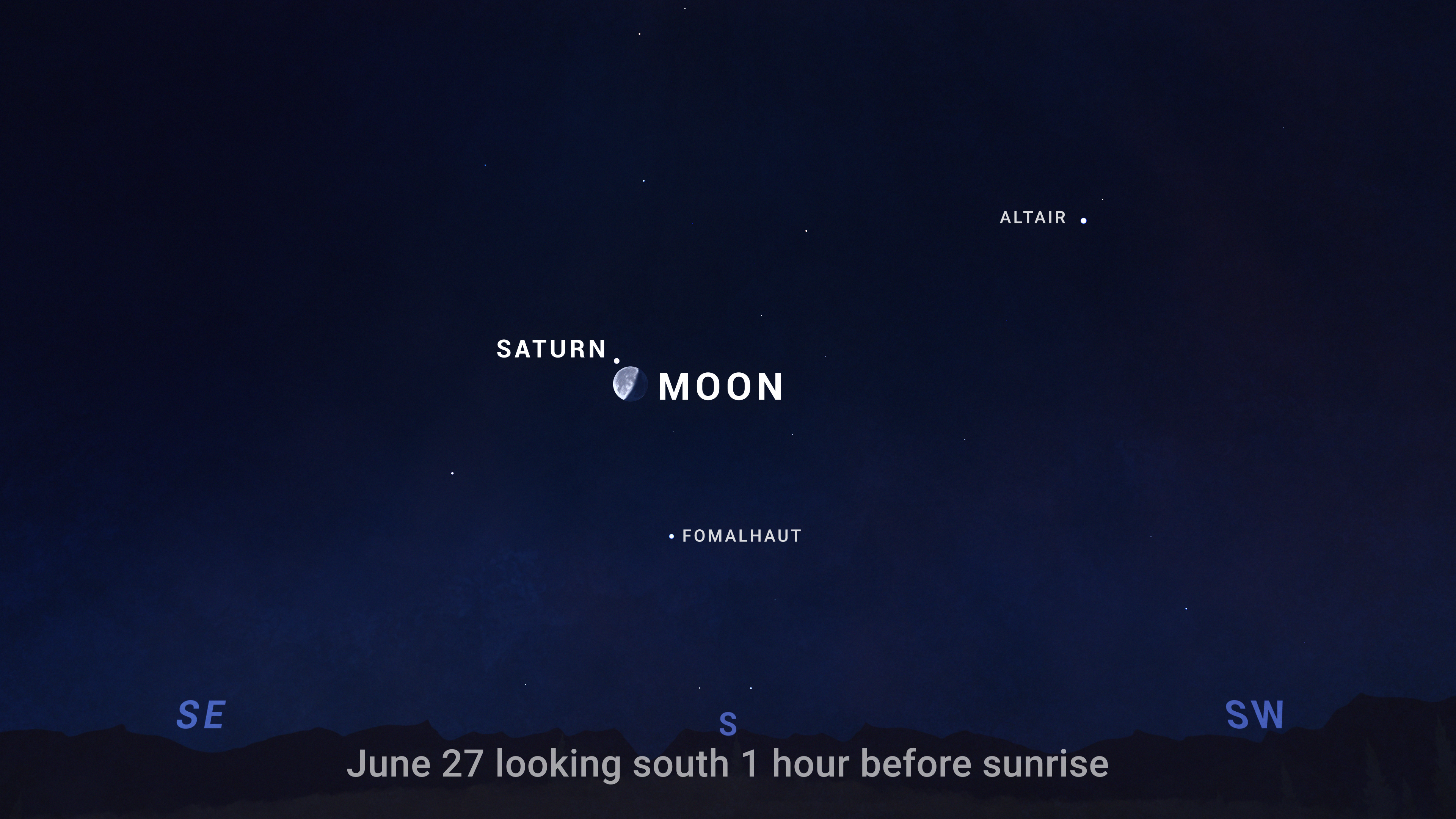
  • June 27 – Look for the Moon rising in the east with Saturn around midnight. By dawn this morning, you’ll find them high in the southern sky. They appear super close together – close enough to appear in the same field of view through binoculars.

“Planet Parade” note: Some online sources have shared excitement about a “parade of planets” visible in the morning sky in early June (June 3 in particular). In reality, only two of the six planets supposedly on display (Saturn and Mars) will actually be visible. In early June, Jupiter and Mercury will be at or below the horizon in morning twilight and not visible; Uranus and Neptune are far too faint to see without a telescope, especially as the morning sky brightens. The closest thing to a planet parade will be June 29, when Saturn, the Moon, Mars, and Jupiter will line up across the morning sky. This arrangement persists into July, and we’ll talk more about that lineup in the next “What’s Up” video.
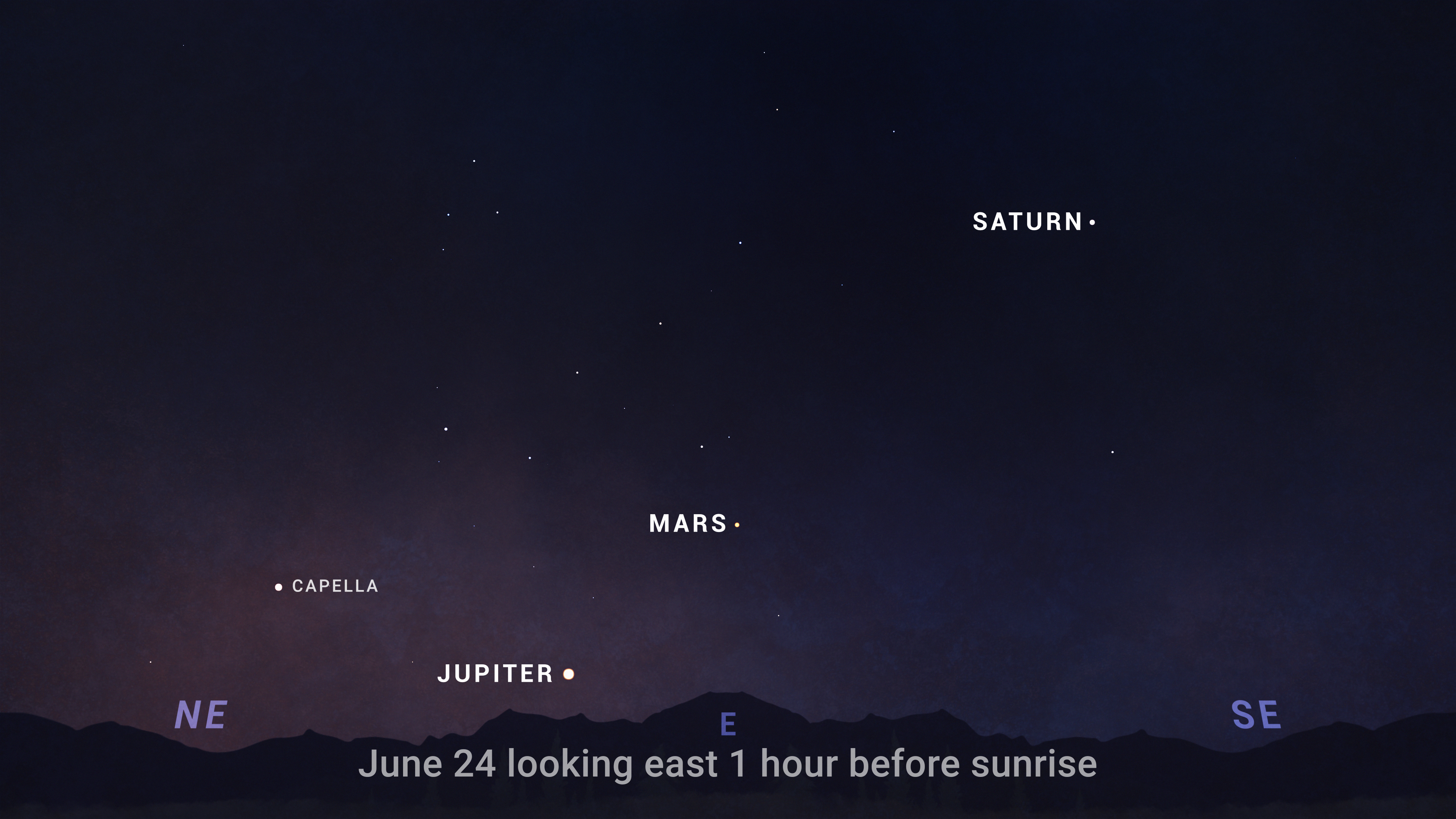
An illustrated sky chart shows the morning sky facing eastward, 1 hour before sunrise on June 24, 2024. The planets Jupiter, Mars, and Saturn are pictured as small white dots. Jupiter is quite low in the sky, left of center. Mars is higher to its right, just below center in the image. Saturn is seen higher, toward the upper right corner of the view. The bright star Capella is seen at far left, slightly higher and to the left of Jupiter.
Sky chart showing the planets’ Saturn, Mars, and Jupiter forming a diagonal line across the morning sky in late June.

Transcript

What’s Up for June? Saturn and Mars meet up with the Moon, Jupiter returns at dawn, and tips for identifying some common objects seen in the sky.

On June 2nd in the hour before sunrise, reddish Mars hangs beneath the crescent Moon. Find the pair low in the east with Saturn lurking nearby. The following morning, on June 3rd, the Moon has moved so that it sits beneath Mars.

During the last week of June, giant Jupiter re-emerges as a morning planet, after passing behind the Sun, from our point of view on Earth, over the past couple of months. By June 24th, you can find it about 10 degrees above the horizon as the morning sky begins to brighten. It climbs a little higher each morning after that as July approaches.

Then on June 27th, look for the Moon with Saturn. The pair rise around midnight, and by dawn you’ll find them high in the southern sky. They appear super close together this morning – close enough to appear in the same field of view through binoculars.
An illustrated sky chart shows the morning sky facing eastward, 1 hour before sunrise on June 3, 2024. The planets Mars and Saturn are pictured as small white dots. Mars is low in the sky, below center. Saturn appears higher, right of center. The crescent Moon also sits low in the sky, below and to the left of Mars. The bright star Fomalhaut is seen at far right, halfway up the sky.
Sky chart showing the pre-dawn sky on June 3, with Saturn, Mars, and the crescent Moon.
NASA/JPL-Caltech

When you spot bright or moving objects in the night sky, it might not be immediately clear what you’re looking at. Is that a planet, or just a bright star? Is it a satellite, or maybe just an airplane? Here are a few quick tips on how to tell the difference.

First, there are five planets that are easily observed with the unaided eye. Of these, two planets – Venus and Jupiter – can sometimes appear incredibly bright, like shining beacons in the sky. The other planets are much less bright, but still generally shine as brightly as bright stars.

The big tipoff that you’re looking at a star and not a planet is that planets tend to shine steadily, whereas stars twinkle. Stars are so far away that they’re just points of light,

and ripples in our atmosphere easily distort them, causing the familiar flicker. The planets are relatively closeby, being here in our solar system. Through binoculars or a telescope, instead of a single point, planets show us a tiny disk or crescent that’s illuminated by the Sun. So even though they appear star-like to the eye, the light from a planet is coming from a slightly more spread-out area, making planets appear more constant in brightness. Both planets and stars rise in the east and set in the west, and they move very slowly across the sky during the night.

But what if you see an object that’s moving? Distant aircraft are usually pretty easy to identify, because they follow a slow, steady path that’s straight or gently curving. They have exterior lights that flash in a regular pattern, often including a red beacon.

Satellites tend to be most visible in the hour or so after dark or before dawn, when it’s night here on the surface, but the satellites are high enough in the sky to be illuminated by sunlight. They’re generally fainter than aircraft, and move in slow, very steady, very straight paths. They might briefly flare in brightness, but they don’t have lights that blink.
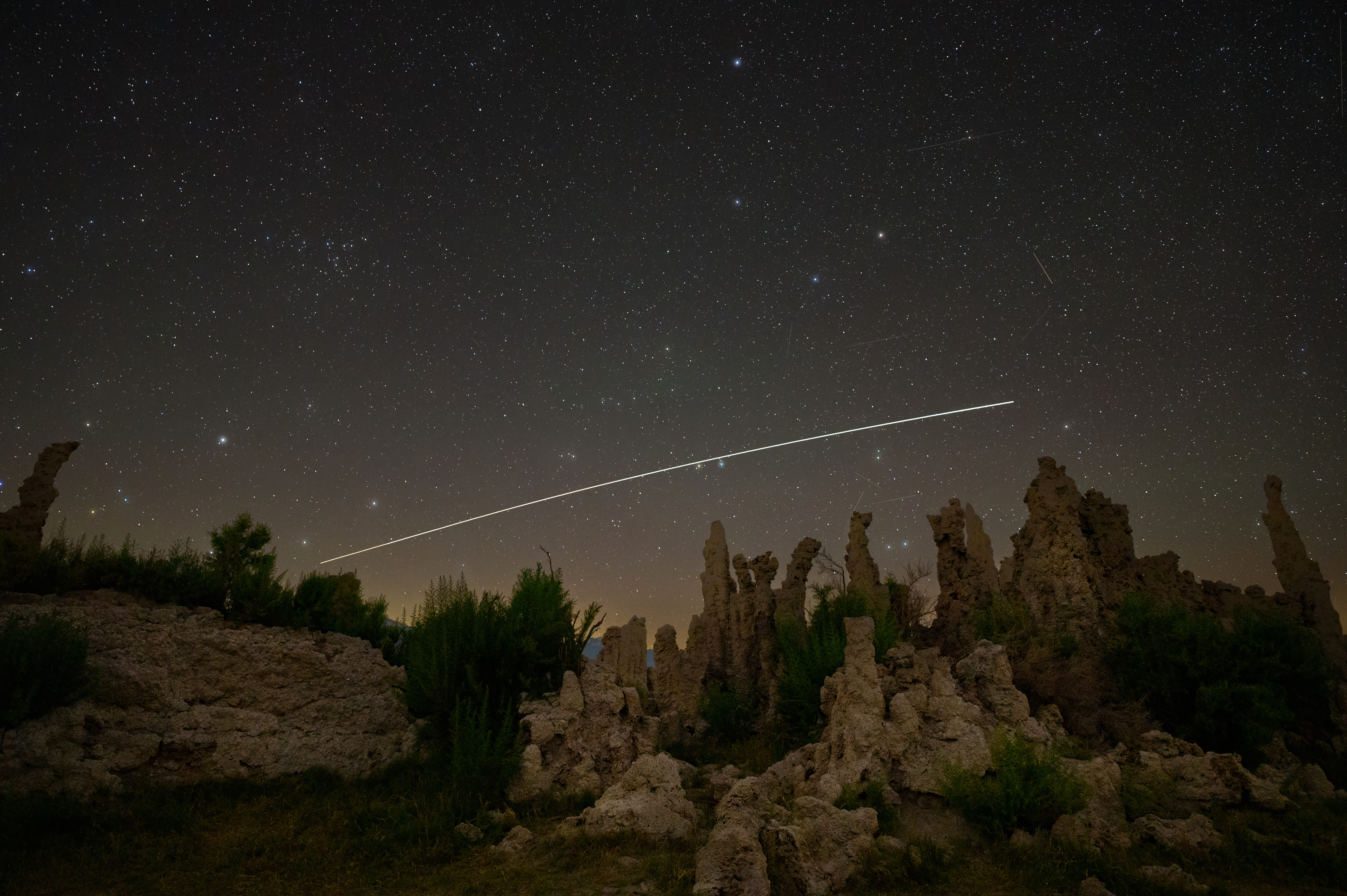
The International Space Station leaves a streak of light over a desert twilight landscape.
The International Space Station traces its path across the twilight sky over a California desert landscape.
NASA/Preston Dyches

The International Space Station is an exception, because it’s very bright, and is often visible for long enough to observe the curving path of its orbit. But it doesn’t have flashing lights you can see from the ground, and it does something else satellites do:  Satellites often fade out of view as they travel into Earth’s shadow, or fade into view as they emerge. And occasionally you might see a train of satellites moving slowly and silently in formation.

One other sight that’s sometimes confusing is rocket launches that happen soon after sunset or before sunrise. Similar to spotting satellites, this is when it’s darker here on the ground, but launching rockets climb high enough to be illuminated by sunlight. When rockets launching at these times of day get really high in altitude, their exhaust can be brilliantly illuminated, and sometimes you might even see spiral or circular shapes that slowly grow and then dissipate, as a spent rocket stage empties its propellant into space.

With so much to see in the night sky, it’s helpful to be familiar with some of these common sights, so you can get on with your skywatching and investigate whatever mysteries and wonders you’re in search of.

Here are the phases of the Moon for June.
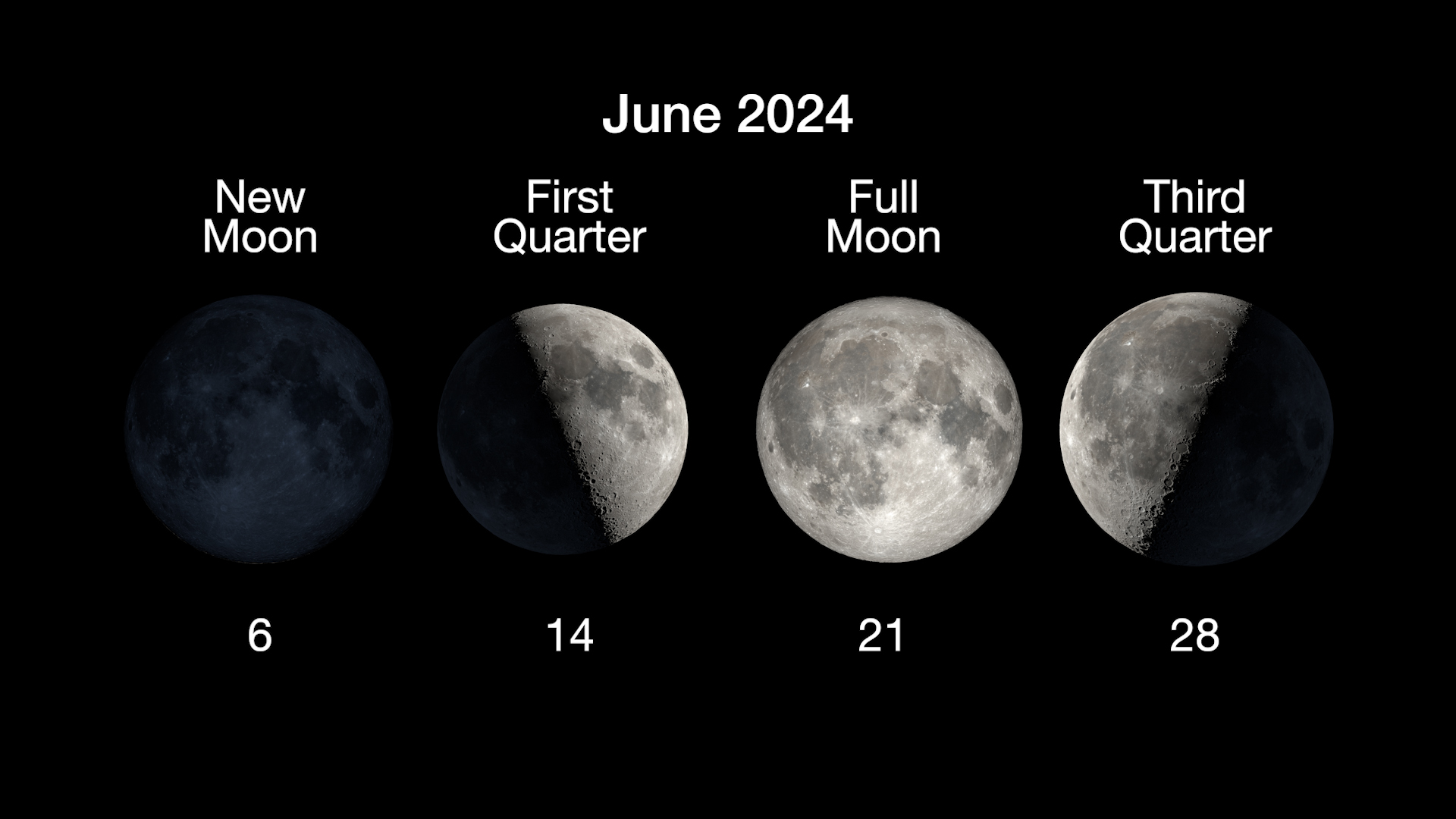
The main phases of the Moon are illustrated in a horizontal row, with the new moon on June 6th, first quarter on June 14th, full moon on June 21st, and the third quarter moon on June 28th.
The phases of the Moon for June 2024.
NASA/JPL-Caltech

Stay up to date on NASA’s missions exploring the solar system and beyond at science.nasa.gov. I’m Preston Dyches from NASA’s Jet Propulsion Laboratory, and that’s What’s Up for this month.

Powered by WPeMatico
Get The Details…

NASA Releases New High-Quality, Near Real-Time Air Quality Data

NASA Releases New High-Quality, Near Real-Time Air Quality Data

4 Min Read

NASA Releases New High-Quality, Near Real-Time Air Quality Data

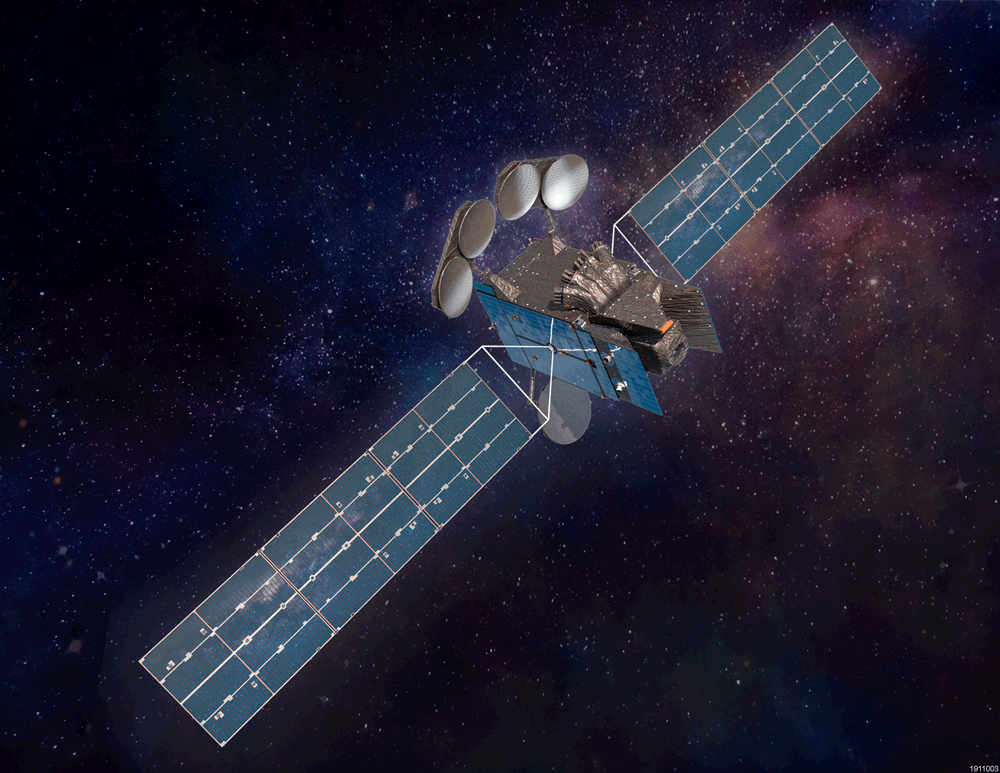
Artist illustration of the satellite Intelsat 40e. NASA’s TEMPO instrument launched into geostationary orbit 22,236 miles above Earth’s equator in April 2023 as a payload on the satellite.

Credits:
Maxar Technologies

NASA has made new data available that can provide air pollution observations at unprecedented resolutions – down to the scale of individual neighborhoods. The near real-time data comes from the agency’s TEMPO (Tropospheric Emissions: Monitoring of Pollution) instrument, which launched last year to improve life on Earth by revolutionizing the way scientists observe air quality from space. This new data is available from the Atmospheric Science Data Center at NASA’s Langley Research Center in Hampton, Virginia.

“TEMPO is one of NASA’s Earth observing instruments making giant leaps to improve life on our home planet,” said NASA Administrator Bill Nelson. “NASA and the Biden-Harris Administration are committed to addressing the climate crisis and making climate data more open and available to all. The air we breathe affects everyone, and this new data is revolutionizing the way we track air quality for the benefit of humanity.”

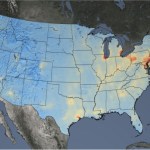
The TEMPO instrument measured elevated levels of nitrogen dioxide (NO2) from a number of different areas and emission sources throughout the daytime on March 28, 2024. Yellow, red, purple, and black clusters represent increased levels of pollutants from TEMPO’s data and show drift over time.
Credit: Trent Schindler/NASA’s Scientific Visualization Studio

The TEMPO mission gathers hourly daytime scans of the atmosphere over North America from the Atlantic Ocean to the Pacific Coast, and from Mexico City to central Canada. The instrument detects pollution by observing how sunlight is absorbed and scattered by gases and particles in the troposphere, the lowest layer of Earth’s atmosphere.

“All the pollutants that TEMPO is measuring cause health issues,” said Hazem Mahmoud, science lead at NASA Langley’s Atmospheric Science Data Center. “We have more than 500 early adopters using these datasets right away. We expect to see epidemiologists and health experts using this data in the near future. Researchers studying the respiratory system and the impact of these pollutants on people’s health will find TEMPO’s measurements invaluable.”

NO2 levels are elevated along major traffic corridors including I-35 in Texas with the highest levels between 9:00 a.m. and 12:00 p.m. Elevated NO2 levels are shown across cities including Houston, Dallas, and San Antonio, with the highest levels persisting across Houston from morning to evening.
Credit: Trent Schindler/NASA’s Scientific Visualization Studio

An early adopter program has allowed policymakers and other air quality stakeholders to understand the capabilities and benefits of TEMPO’s measurements. Since October 2023, the TEMPO calibration and validation team has been working to evaluate and improve TEMPO data products. 

We have more than 500 early adopters that will be using these datasets right away.

hazem mahmoud

hazem mahmoud

NASA Data Scientist

“Data gathered by TEMPO will play an important role in the scientific analysis of pollution,” said Xiong Liu, senior physicist at the Smithsonian Astrophysical Observatory and principal investigator for the mission. “For example, we will be able to conduct studies of rush hour pollution, linkages of diseases and health issues to acute exposure of air pollution, how air pollution disproportionately impacts underserved communities, the potential for improved air quality alerts, the effects of lightning on ozone, and the movement of pollution from forest fires and volcanoes.” 

Measurements by TEMPO include air pollutants such as nitrogen dioxide, formaldehyde, and ground-level ozone.

High NO2 levels associated with prescribed burns are seen popping up across East Texas, Oklahoma, Louisiana, Arkansas, and Mississippi, beginning around 1:00 p.m. and extending into the evening. Elevated NO2 levels are visible in cities from El Paso to Memphis.
Credit: Trent Schindler/NASA’s Scientific Visualization Studio

“Poor air quality exacerbates pre-existing health issues, which leads to more hospitalizations,” said Jesse Bell, executive director at the University of Nebraska Medical Center’s Water, Climate, and Health Program. Bell is an early adopter of TEMPO’s data.

Bell noted that there is a lack of air quality data in rural areas since monitoring stations are often hundreds of miles apart. There is also an observable disparity in air quality from neighborhood to neighborhood.

“Low-income communities, on average, have poorer air quality than more affluent communities,” said Bell. “For example, we’ve conducted studies and found that in Douglas County, which surrounds Omaha, the eastern side of the county has higher rates of pediatric asthma hospitalizations. When we identify what populations are going to the hospital at a higher rate than others, it’s communities of color and people with indicators of poverty. Data gathered by TEMPO is going to be incredibly important because you can get better spatial and temporal resolution of air quality across places like Douglas County.”

Determining sources of air pollution can be difficult as smoke from wildfires or pollutants from industry and traffic congestion drift on winds. The TEMPO instrument will make it easier to trace the origin of some pollutants.

TEMPO observes the northerly transport of NO2 from the Permian basin, a large oil and natural gas producing area spanning parts of West Texas and southeastern New Mexico, with the highest levels measured during the morning over the basin. NO2 plumes from coal-fired power plants are visible in the rural areas far west and northwest of Houston and far east of Dallas between 8:00 a.m. and 2:00 p.m.
Credit: Trent Schindler/NASA’s Scientific Visualization Studio

“The National Park Service is using TEMPO data to gain new insight into emerging air quality issues at parks in southeast New Mexico,” explained National Park Service chemist, Barkley Sive. “Oil and gas emissions from the Permian Basin have affected air quality at Carlsbad Caverns and other parks and their surrounding communities. While pollution control strategies have successfully decreased ozone levels across most of the United States, the data helps us understand degrading air quality in the region.” 

The TEMPO instrument was built by BAE Systems, Inc., Space & Mission Systems (formerly Ball Aerospace) and flies aboard the Intelsat 40e satellite built by Maxar Technologies. The TEMPO Ground System, including the Instrument Operations Center and the Science Data Processing Center, are operated by the Smithsonian Astrophysical Organization, part of the Center for Astrophysics | Harvard & Smithsonian.

To learn more about TEMPO visit: https://nasa.gov/tempo

Powered by WPeMatico

Get The Details…
Charles G. Hatfield

NASA Updates Coverage for Boeing’s Starliner Launch, Docking

NASA Updates Coverage for Boeing’s Starliner Launch, Docking

Boeing’s CST-100 Starliner crew ship approaches the International Space Station on the company’s Orbital Flight Test-2 mission before automatically docking to the Harmony module’s forward port.

NASA will provide live coverage of prelaunch and launch activities for the agency’s Boeing Crew Flight Test, which will carry NASA astronauts Butch Wilmore and Suni Williams to and from the International Space Station.

Launch of the ULA (United Launch Alliance) Atlas V rocket and Boeing Starliner spacecraft is targeted for 12:25 p.m. EDT Saturday, June 1, from Space Launch Complex-41 at Cape Canaveral Space Force Station in Florida. Starliner will dock to the forward-facing port of the station’s Harmony module at approximately 1:50 p.m., Sunday, June 2.

Wilmore and Williams will remain at the space station for about a week to test the Starliner spacecraft and its subsystems before NASA works to complete final certification of the transportation system for rotational missions to the orbiting laboratory as part of the agency’s Commercial Crew Program.

NASA, Boeing, and ULA scrubbed the previous launch opportunity on May 6 due to a suspect oxygen relief valve on the Atlas V rocket’s Centaur second stage. Since, teams have removed and replaced the valve, and completed an assessment of Starliner’s performance and redundancy after discovering a small helium leak in the spacecraft’s service module.

As part of the helium leak investigation, NASA and Boeing conducted a follow-on propulsion system assessment to understand potential helium system impacts to some Starliner return scenarios. NASA also completed a Delta-Agency Flight Test Readiness Review on May 29 to evaluate all work performed and flight rationale before proceeding toward launch.

The deadline for media accreditation for in-person coverage of this launch has passed. The agency’s media credentialing policy is available online. For questions about media accreditation, please email: ksc-media-accreditat@mail.nasa.gov.

NASA’s mission coverage is as follows (all times Eastern and subject to change based on real-time operations):

Friday, May 31

1 p.m. – Prelaunch briefing with the following participants:

  • NASA Associate Administrator Jim Free
  • Steve Stich, manager, NASA’s Commercial Crew Program
  • Dana Weigel, manager, NASA’s International Space Station Program
  • NASA astronaut Mike Fincke
  • Mark Nappi, vice president and program manager, Commercial Crew Program, Boeing
  • Gary Wentz, vice president, Government and Commercial Programs, ULA
  • Mark Burger, launch weather officer, 45th Weather Squadron, Cape Canaveral Space Force Station

Coverage of the briefing will stream live on NASA+, NASA Television, the NASA app, YouTube, and the agency’s website.

Media may ask questions in person and via phone. Limited auditorium space will be available for in-person participation. For the dial-in number and passcode, media should contact the newsroom at NASA’s Kennedy Space Center in Florida no later than one hour before the start of the event at ksc-newsroom@mail.nasa.gov.

Saturday, June 1

8:15 a.m. – Launch coverage begins on NASA+, NASA Television, the NASA app, YouTube, and the agency’s website.

12:25 p.m. – Launch

Launch coverage on NASA+ will end shortly after Starliner orbital insertion. NASA Television will provide continuous coverage leading up to docking and through hatch opening and welcome remarks.

2 p.m. – Postlaunch news conference with the following participants:

  • NASA Administrator Bill Nelson
  • Ken Bowersox, associate administrator, NASA’s Space Operations Mission Directorate
  • Steve Stich, manager, NASA’s Commercial Crew Program
  • Dana Weigel, manager, NASA’s International Space Station Program
  • Mark Nappi, vice president and program manager, Commercial Crew Program, Boeing
  • Tory Bruno, president and CEO, ULA

Coverage of the postlaunch news conference will air live on NASA+, NASA Television, the NASA app, YouTube, and the agency’s website.

Media may ask questions in person and via phone. Limited auditorium space will be available for in-person participation. For the dial-in number and passcode, media should contact the Kennedy newsroom no later than three hours before the start of the event at ksc-newsroom@mail.nasa.gov.

NASA+ will resume coverage and NASA Television’s public channel will break from in-orbit coverage to carry the postlaunch news conference. Mission operational coverage will continue on NASA Television’s media channel and the agency’s website. Once the postlaunch news conference is complete, NASA+ coverage will end, and mission coverage will continue on both NASA channels.

Sunday, June 2

11:15 a.m. – Arrival coverage resumes on NASA+, the NASA app, and YouTube, and continues on NASA Television and the agency’s website.

1:50 p.m. – Targeted docking to the forward-facing port of the station’s Harmony module

3:35 p.m. – Hatch opening

3:55 p.m. – Welcome remarks

5 p.m. – Post-docking news conference at NASA’s Johnson Space Center with the following participants:

  • NASA Associate Administrator Jim Free
  • Steve Stich, manager, NASA’s Commercial Crew Program
  • Dana Weigel, manager, NASA’s International Space Station Program
  • Mark Nappi, vice president and program manager, Commercial Crew Program, Boeing

Coverage of the post-docking news conference will air live on NASA+, NASA Television, the NASA app, YouTube, and the agency’s website.

All times are estimates and could be adjusted based on operations after launch. Follow the space station blog for the most up-to-date operations information.

Audio Only Coverage

Audio only of the news conferences and launch coverage will be carried on the NASA “V” circuits, which may be accessed by dialing 321-867-1220, -1240 or -7135. On launch day, “mission audio,” countdown activities without NASA Television launch commentary, will be carried on 321-867-7135.

Launch audio also will be available on Launch Information Service and Amateur Television System’s VHF radio frequency 146.940 MHz and KSC Amateur Radio Club’s UHF radio frequency 444.925 MHz, FM mode, heard within Brevard County on the Space Coast.

Live Video Coverage Prior to Launch

NASA will provide a live video feed of Space Launch Complex-41 approximately 48 hours prior to the planned liftoff of the mission. Pending unlikely technical issues, the feed will be uninterrupted until the prelaunch broadcast begins on NASA Television, approximately four hours prior to launch. Once the feed is live, find it on NASA Kennedy’s YouTube: http://youtube.com/kscnewsroom.

NASA Website Launch Coverage

Launch day coverage of the mission will be available on the agency’s website. Coverage will include live streaming and blog updates beginning no earlier than 8:15 a.m., June 1, as the countdown milestones occur. On-demand streaming video and photos of the launch will be available shortly after liftoff.

For questions about countdown coverage, contact the Kennedy newsroom at 321-867-2468. Follow countdown coverage on the commercial crew or the Crew Flight Test blog.

Attend Launch Virtually

Members of the public can register to attend this launch virtually. NASA’s virtual guest program for this mission also includes curated launch resources, notifications about related opportunities or changes, and a stamp for the NASA virtual guest passport following launch.

Watch, Engage on Social Media

Let people know you’re following the mission on X, Facebook, and Instagram by using the hashtags #Starliner and #NASASocial. You can also stay connected by following and tagging these accounts:

X: @NASA, @NASAKennedy, @NASASocial, @Space_Station, @ISS_Research, @ISS National Lab, @BoeingSpace, @Commercial_Crew

Facebook: NASA, NASAKennedy, ISS, ISS National Lab

Instagram: @NASA, @NASAKennedy, @ISS, @ISSNationalLab

Coverage en Espanol

Did you know NASA has a Spanish section called NASA en Espanol? Check out NASA en Espanol on X, Instagram, Facebook, and YouTube for additional mission coverage.

Para obtener información sobre cobertura en español en el Centro Espacial Kennedy o si desea solicitar entrevistas en español, comuníquese con Antonia Jaramillo: 321-501-8425;antonia.jaramillobotero@nasa.gov.

NASA’s Commercial Crew Program has delivered on its goal of safe, reliable, and cost-effective transportation to and from the International Space Station from the United States through a partnership with American private industry. This partnership is changing the arc of human spaceflight history by opening access to low-Earth orbit and the International Space Station to more people, science, and commercial opportunities. The space station remains the springboard to NASA’s next great leap in space exploration, including future missions to the Moon and, eventually, to Mars.

For NASA’s launch blog and more information about the mission, visit:

https://www.nasa.gov/commercialcrew

-end-

Jimi Russell / Claire O’Shea
Headquarters, Washington
202-358-1100
james.j.russell@nasa.gov / claire.a.o’shea@nasa.gov

Steven Siceloff / Danielle Sempsrott / Stephanie Plucinsky
Kennedy Space Center, Florida
321-867-2468
steven.p.siceloff@nasa.gov / danielle.c.sempsrott@nasa.gov / stephanie.n.plucinsky@nasa.gov

Leah Cheshier
Johnson Space Center, Houston
281-483-5111
leah.d.cheshier@nasa.gov

Powered by WPeMatico

Get The Details…
Abbey A. Donaldson

The Moon and Amaey Shah

The Moon and Amaey Shah

8 Min Read

The Moon and Amaey Shah

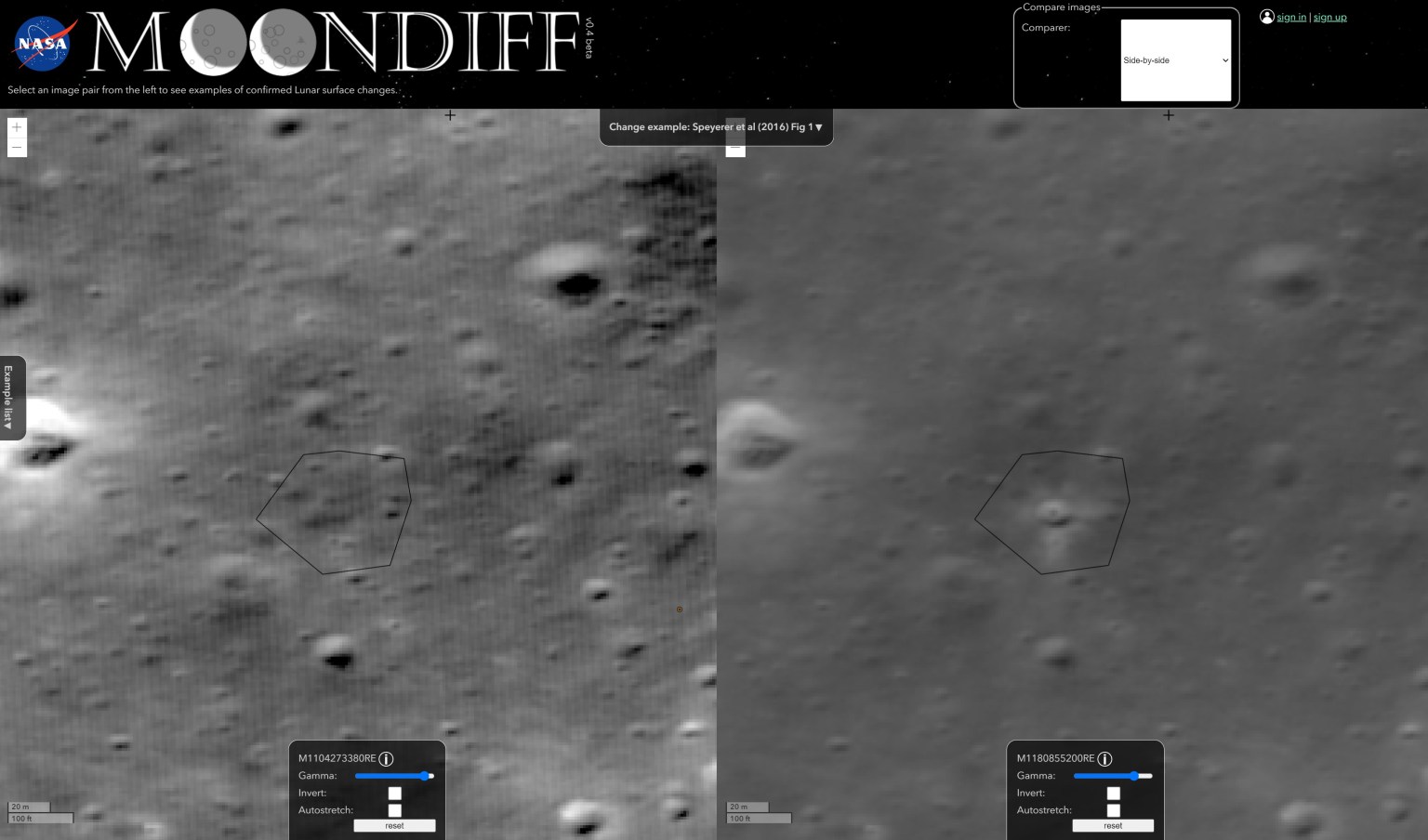
A comparison of two lunar surface images showing changes over time. The left image (M1104273380RE) displays a section of the Moon's surface with various craters and terrain features, while the right image (M1180555200RE) shows the same area at a different time, highlighting changes within the outlined hexagonal region. The images are presented side-by-side using NASA's MoonDiff tool, which allows for detailed examination of lunar surface changes. Each image has controls for adjusting gamma, inverting colors, and autostretching for better visibility of surface details.
Comparing two Lunar images using NASA’s MoonDiff project. Join this project, and help search for new features on the Moon!
Credits:
NASA/JPL-Caltech

Sometimes a story about a NASA volunteer just grabs your heart and won’t let go. NASA Scientist Dr. Brian Day shared with us the incredible story of what first ignited his passion for involving the public in his scientific research. It’s a story about a boy named Amaey Shah.

A young boy with short dark hair and glasses is participating in a science art activity. He is wearing glasses, a green t-shirt and an apron splattered with paint. The child is smiling slightly while holding a paintbrush and working on a colorful painting in front of them. The painting features abstract shapes with a prominent central figure surrounded by a circular design. Various art supplies, including cups of water, paintbrushes, and paper towels, are arranged on the table. Other children and adults can be seen in the background, engaged in similar activities.
Amaey Shah’s passion for science helped inspire NASA’s MoonDiff Project.
Credit: Purvi Shah

“Through the NASA Speakers Bureau, I was paired with a local teacher, Leslie Herleikson, and her after-school science program for K-12 students” Brian began.  “I’d talk to the students in the program periodically and take them on tours of the NASA Ames facilities.”  

“One of the kids in Leslie’s elementary program, a young boy named Amaey Shah, was recovering from treatment for childhood leukemia when I first met him. He was feeling fatigued from the treatment. As we did the tours of Ames he sometimes had to rest.  But he was a very precocious kid. He remained very excited about science, posing a rapid stream of very insightful questions, and always full of joyous enthusiasm for the new things that he would learn.  

Over time, Amaey rallied and his strength improved, fueled by his insatiable curiosity. I continued to meet with Amaey and his fellow students, with our discussions spanning the Solar System and beyond.

Then, one day, I showed up at the after-school program and Amaey was not there. Leslie took me aside after my presentation and let me know that Amaey had had a relapse which seemed pretty serious. He was going to need a bone marrow transplant. This news hit me especially hard. Shortly before the class meeting, I had been diagnosed with cancer myself.  Just as Amaey was going to be heading in for whole body radiation as part of his bone marrow transplant, I was going to be going in for radiation for my own cancer treatment.  

Leslie shared my situation with Amaey and his parents. She also asked if I would be willing to come talk with him about our upcoming shared experience.  The idea seemed strangely comforting and healthy. So I showed up at his house. Amaey and I sat down together, with his parents and older brother sitting off to the side in the same room.  

I said: Well, I understand we have something in common.

He said, Well, we both like science!

I said: That’s true.

He said: And we both wear glasses.

I said:  Yes.

Then, I said: And we’re both incredibly handsome!

We all had a good laugh. But then he looked at me and got serious. 

He said: And we both have cancer.

I said: Yes, and we’re both going to get radiation.

And he said: Yeah.

So I said: How do we feel about that?

He told me what was bothering him most. He said that in his case, the radiation was to kill all of his bone marrow, and hopefully the cancer that was within it.  Then he would get a transplant of new bone marrow.  But during the period of time in between losing his old bone marrow and when his new bone marrow kicked in, he would essentially be without an immune system. He would become a bubble boy—confined to a room for a very long period of time.  He expressed that he was really going to miss going out and exploring, going out and looking up at the night sky, because one of the things he really, really wanted to do was explore space.

I’d been given a warning about this from his parents, so I’d come prepared with my laptop. I pulled up MoonZoo.  MoonZoo was a citizen science application that asked people to look at pieces of lunar real estate and identify and count craters. Crater counts are the primary way of estimating the ages of various lunar terrains. If we want to understand the history and evolution of the lunar surface, getting these crater counts and the ages they represent is a really critical endeavor.

Amaey was quite excited to work on MoonZoo.  We played with that for a long while!  Then I pulled up GalaxyZoo, another Zooniverse project. 

We reviewed the fact that galaxies come in a great variety of sizes and shapes.  And we see a mind-bending number of galaxies out there. To understand their formation and evolution, we must first understand what kinds of galaxies they are. So, we need people to help classify these galaxies—which involves looking at a lot of galaxies.  Amaey really liked that too.

We went into our respective cancer treatments. Amaey did indeed become confined in isolation after his irradiation and transplant—but I heard from his teacher Leslie that from his room he was keeping himself busy exploring the Moon, counting craters with MoonZoo, and classifying galaxies with GalaxyZoo.  Even though Amaey was physically confined to his room, his intellect and curiosity were free to roam the Solar System and the Universe, exploring limitless expanses, thanks to the citizen science tools that he put to such good use. Soon, I got distracted with my own treatment, and I wasn’t online as much as I would have liked to have been.  

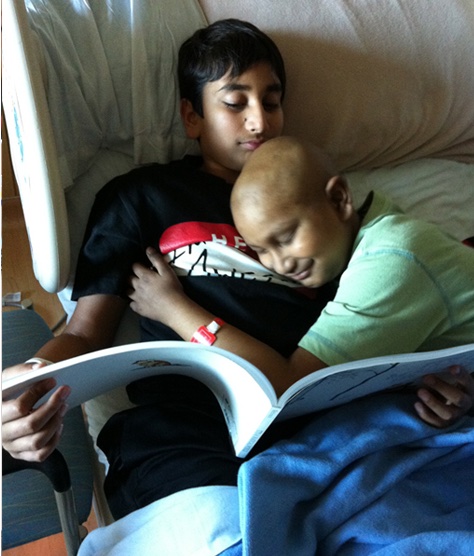
Two brothers are sharing a tender moment in a hospital setting. The older brother, wearing a black t-shirt with red and white graphics, is sitting up in a hospital bed and holding a book open. The younger brother, who has a bald head and is wearing a green shirt, is lying next to him with his head resting on the older brother's chest. The younger brother has a hospital wristband on his wrist. Both boys appear relaxed and content as they enjoy the book together. The background shows typical hospital furnishings, including the bed and some medical equipment.
Amaey with his brother Arjun.
Credit: Purvi Shah

As I was going through my own treatment, I didn’t get the news. Amaey’s treatment didn’t work. His parents and teachers opted not to tell me that he had passed away while I was in the midst of fighting my own battle.

The day after I successfully finished my final radiation treatment, I remember talking to Leslie on the phone. I told her that I was done, and I wanted to come talk to the kids again as soon as I was feeling a bit stronger. She said she had something to tell me. She let me know that Amaey had passed away.  I was devastated. 

Leslie also told me that Amaey’s funeral service was coming up soon. Amaey’s parents then contacted me, asking me if I might be feeling well enough to come speak at the service. I had to go. There was no way I could not be there!  

There were many people gathered together at the service and several speakers. At one point, Amaey’s grandfather got up and in a quiet, sorrowful way, explained how Amaey’s desire had always been to be a scientist. Amaey had wanted to study the stars, do research, and contribute. One of the great sadnesses of the grandfather’s own life was that Amaey never had the opportunity to become a scientist, to explore the Universe, and to contribute to the science like he had so loved.  

Then it was my turn to speak. I stood up, and I said that I mean no disrespect—I fully understood the sorrow that the family was feeling.  But the very important fact of the matter was that Amaey did not miss this opportunity! Amaey HAD realized his dream. He DID become a scientist. From his isolation room, Amaey DID explore. He DID do research. He DID make contributions. Amaey’s ambitions had been realized, and his discoveries had been added to the scientific record.

I said we can all take heart in knowing that under very difficult circumstances Amaey had achieved his dream.  That seemed to become a source of comfort to Amaey’s family. And that’s because he stepped up to the role and adventure of being a citizen scientist.”

Brian Day is the staff scientist at NASA’s Solar System Exploration Research Virtual Institute, headquartered at NASA’s Ames Research Center in California. His duties include serving as science lead for NASA’s Solar System Treks Project a family of open science online portals that make it easy to analyze the surfaces of the Moon and other planetary bodies in our Solar System. The project has a citizen science component called MoonDiff, which invites you to help search for changes and newly formed features on the Moon.

You can make your own contributions to science! Check out Brian’s project, MoonDiff. And if you know any other children like Amaey, please share it with them.

Share

Details

Last Updated
May 30, 2024

Powered by WPeMatico

Get The Details…

Webb Spots a Starburst

Webb Spots a Starburst

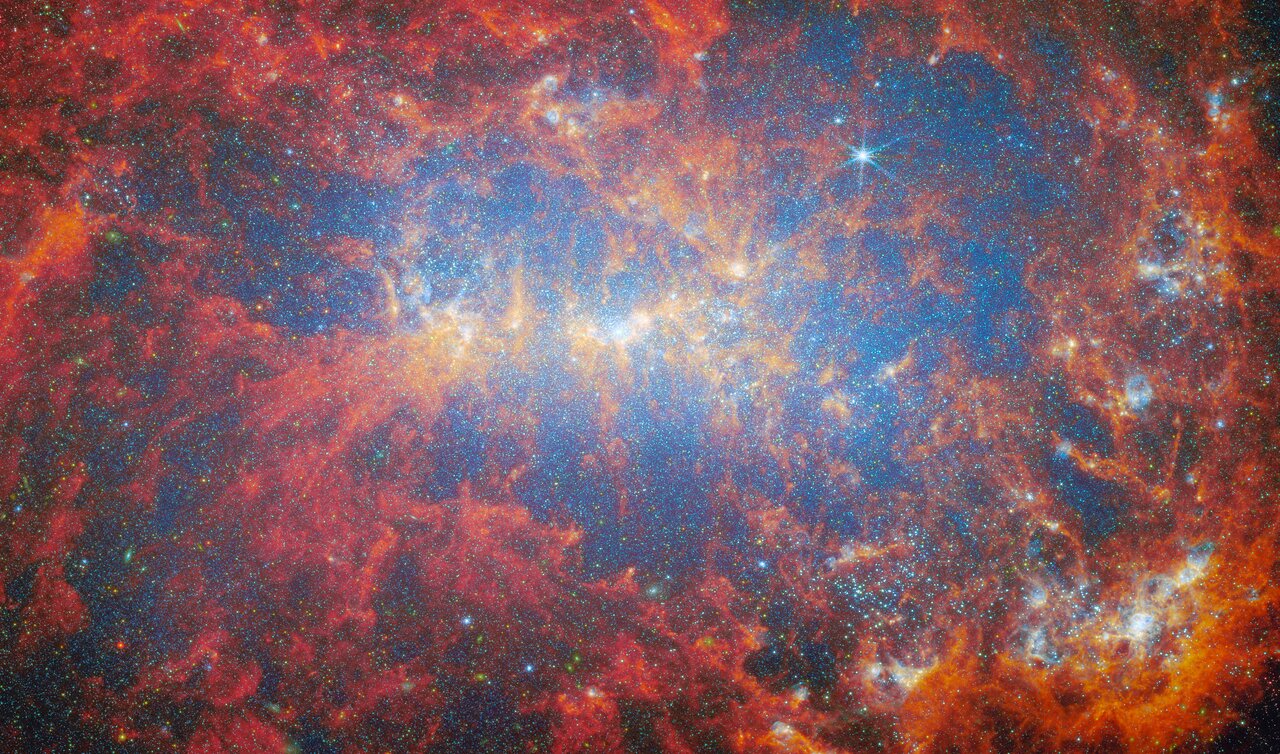
A close view of the central area of a dwarf galaxy. A huge number of stars fill the whole galaxy as tiny glowing points. They are brightest around the galaxy’s shining core. Thick clouds of gas and dust billow out across the scene, curling like moving flames. They glow in warm colours following their location: orange around the galaxy’s core, and around glowing star clusters in the bottom-left, and dark red elsewhere.
ESA/Webb, NASA & CSA, A. Adamo (Stockholm University) and the FEAST JWST team

The James Webb Space Telescope observed “starburst” galaxy NGC 4449, seen in this image released on May 29, 2024. Starbursts are intense periods of star formation usually concentrated at a galaxy’s core, but NGC 4449’s activity is much more widespread — likely due to past interactions with its galactic neighbors. Astronomers can study this galaxy to look into the past: NGC 4449 is similar to early star-forming galaxies, which also grew by merging with other systems.

See more Webb images from this year.

Image Credit: ESA/Webb, NASA & CSA, A. Adamo (Stockholm University) and the FEAST JWST team

Powered by WPeMatico

Get The Details…
Monika Luabeya