NASA Mission Flies Over Arctic to Study Sea Ice Melt Causes

NASA Mission Flies Over Arctic to Study Sea Ice Melt Causes

4 min read

Preparations for Next Moonwalk Simulations Underway (and Underwater)

It’s not just rising air and water temperatures influencing the decades-long decline of Arctic sea ice. Clouds, aerosols, even the bumps and dips on the ice itself can play a role. To explore how these factors interact and impact sea ice melting, NASA is flying two aircraft equipped with scientific instruments over the Arctic Ocean north of Greenland this summer. The first flights of the field campaign, called ARCSIX (Arctic Radiation Cloud Aerosol Surface Interaction Experiment), successfully began taking measurements on May 28.
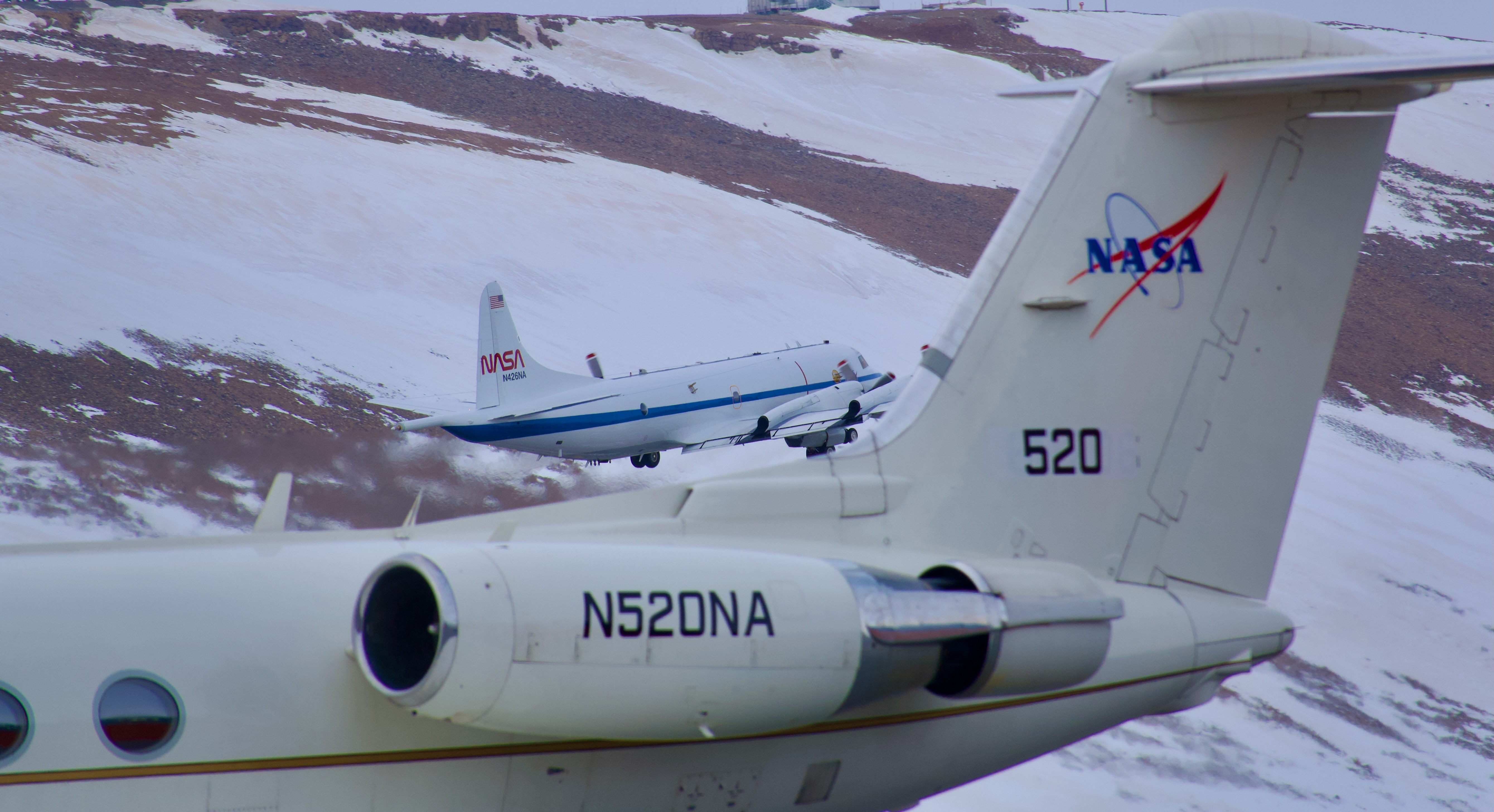
An image of two aircraft in front of a hill covered in snow and rock. In the foreground is the tail end of a white jet, filling the bottom and right side. The NASA logo and number 520 are on the tail. Behind the jet, in the middle of the image, another white aircraft takes off. It’s white with a blue horizontal stripe, with the NASA ‘worm’ logo on the tail. The brown and white hillside fills the rest of the frame.
Two NASA aircraft are taking coordinated measurements of clouds, aerosols and sea ice in the Arctic this summer as part of the ARCSIX field campaign. In this image from Thursday, May 30, NASA’s P-3 aircraft takes off from Pituffik Space Base in northwest Greenland behind the agency’s Gulfstream III aircraft.
Credit: NASA/Dan Chirica

“The ARCSIX mission aims to measure the evolution of the sea ice pack over the course of an entire summer,” said Patrick Taylor, deputy science lead with the campaign from NASA’s Langley Research Center in Hampton, Virginia. “There are many different factors that influence the sea ice. We’re measuring them to determine which were most important to melting ice this summer.”

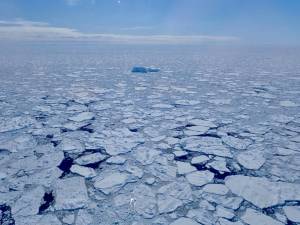
On a completely clear day over smooth sea ice, most sunlight would reflect back into the atmosphere, which is one way that sea ice cools the planet. But when the ice has ridges or darker melt ponds — or is dotted with pollutants — it can change the equation, increasing the amount of ice melt. In the atmosphere, cloudy conditions and drifting aerosols also impact the rate of melt.

“An important goal of ARCSIX is to better understand the surface radiation budget — the energy interacting with the ice and the atmosphere,” said Rachel Tilling, a campaign scientist from NASA’s Goddard Space Flight Center in Greenbelt, Maryland.

About 75 scientists, instrument operators, and flight crew are participating in ARCSIX’s two segments based out of Pituffik Space Base in northwest Greenland. The first three-week deployment, in May and June of this year, is timed to document the start of the ice melt season. The second deployment will occur in July and August to monitor late summer conditions and the start of the freeze-up period.

“Scientists from three key disciplines came together for ARCSIX: sea ice surface researchers, aerosol researchers, and cloud researchers,” Tilling said. “Each of us has been working to understand the radiation budget in our specific area, but we’ve brought all three areas together for this campaign.”

Two aircraft will fly over the Arctic during each deployment. NASA’s P-3 Orion aircraft from the agency’s Wallops Flight Facility in Virginia, will fly below the clouds at times to document the surface properties of the ice and the amount of energy radiating off it. The team will also fly the aircraft through the clouds to sample aerosol particles, cloud optical properties, chemistry, and other atmospheric components.

A Gulfstream III aircraft, managed by NASA Langley, will fly higher in the atmosphere to observe properties of the tops of the clouds, take profiles of the atmosphere above the ice, and add a perspective similar to that of orbiting satellites.

The teams will also compare airborne data with satellite data. Satellite instruments like the Multi-angle Imaging Spectroradiometer and the Moderate Resolution Imaging Spectroradiometer will provide additional information about clouds and aerosol particles, while the Ice, Cloud, and land Elevation Satellite 2 will provide insights into the ice topography below both satellites and aircraft.

The aircraft will fly coordinated routes to take measurements of the atmosphere above ice in three-dimensional space, said Sebastian Schmidt, the mission’s science lead with the University of Colorado Boulder.

“The area off the northern coast of Greenland can be considered the last bastion of multi-year sea ice, as the Arctic transitions to a seasonally ice-free ocean,” Schmidt said. “By observing here, we will gain insight into cloud-aerosol-sea ice-interaction processes of the ‘old’ and ‘new’ Arctic — all while improving satellite-based remote sensing by comparing what we’re seeing with the airborne and satellite instruments.” 

By Kate Ramsayer

NASA’s Goddard Space Flight Center, Greenbelt, Md.

Share

Details

Last Updated

May 31, 2024

Editor
Kate D. Ramsayer
Contact
Kate D. Ramsayer
Location
Goddard Space Flight Center

Powered by WPeMatico

Get The Details…
Erica McNamee
Space Station Research Advances NASA’s Plans to Explore the Moon, Mars

Space Station Research Advances NASA’s Plans to Explore the Moon, Mars

4 Min Read

Space Station Research Advances NASA’s Plans to Explore the Moon, Mars

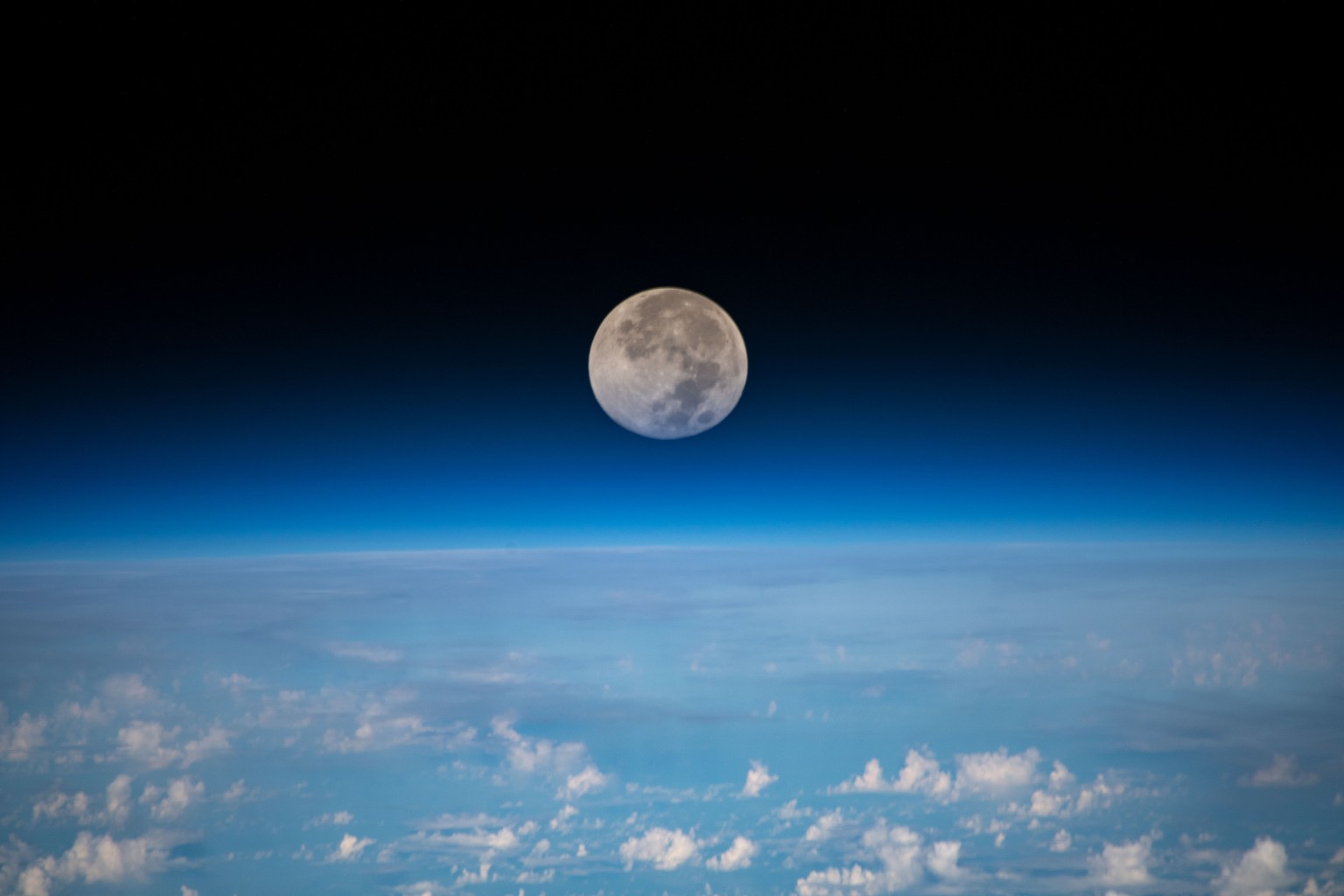
The full moon is pictured as the International Space Station orbited 254 miles above the Pacific Ocean northeast of Guam.

The full moon is pictured as the International Space Station orbited 254 miles above the Pacific Ocean northeast of Guam.

Credits:
NASA

Space, the saying goes, is hard. And the farther humans go, the harder it can get.

Some of the challenges on missions to explore the Moon and Mars include preventing microbial contamination of these destinations, navigating there safely, protecting crew members and hardware from radiation, and maintaining and repairing equipment.

Research on the International Space Station is helping NASA scientists develop tools and processes to ensure success on these important missions. Here are highlights from some of the investigations making space a little easier.

Tracking Tiny Stowaways

Bacteria and fungi live in and on all humans and all around us on Earth. Most of these microorganisms are beneficial or harmless but introducing them to other celestial bodies could adversely affect our ability to study ecosystems on those other worlds.

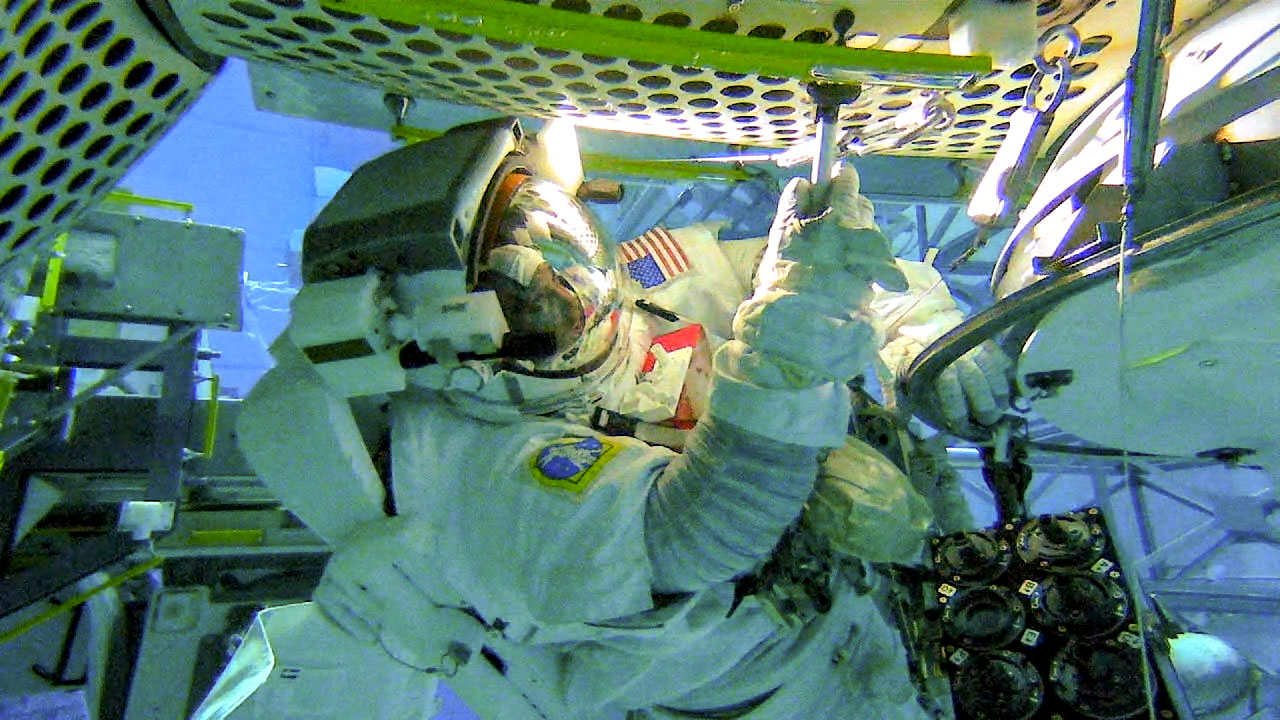
Crew members will conduct a spacewalk to collect samples near space station life support system vents for ISS External Microorganisms, an investigation to assess whether the orbiting laboratory releases microorganisms into space. Results could provide insight into the potential for organisms to survive and reproduce in space and help researchers determine which microbes would most likely contaminate other planetary bodies visited by crewed missions.

Underwater at the Neutral Buoyancy Lab pool, Glover is wearing a white spacesuit and helmet as he uses a tool in his right hand and holds on to a rail with his left hand. A black box of circular sample containers is attached to the front of his suit.
NASA astronaut Victor Glover trains for the ISS External Microorganisms spacewalk in the Neutral Buoyancy Laboratory pool at NASA’s Johnson Space Center in Houston.
NASA

A miniature, hand-held digital microscope designed to make in-flight medical diagnoses, the Moon Microscope, also can test water, food, and surfaces for contamination. The device images samples at high resolution and processes data on web-enabled devices such as phones or tablets. Multiple users can access the microscope simultaneously, and some applications run autonomously.

Getting There and Back

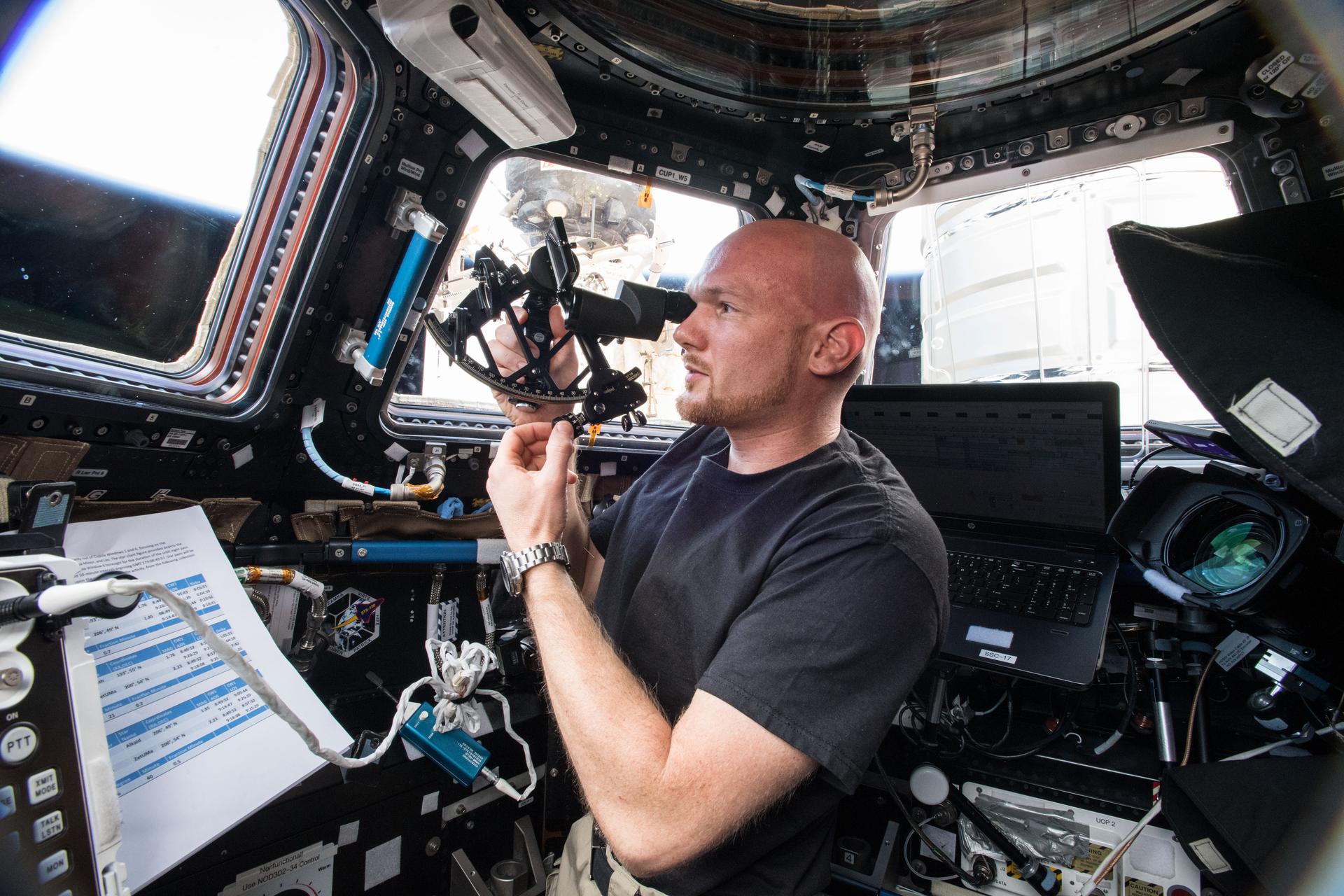
Spacecraft must have sophisticated high-tech systems for navigating. Sextant Navigation tests the function of sextants in microgravity as an emergency backup navigation technique for Artemis and other future exploration missions. These mechanical devices have guided navigators for centuries, and Gemini and Apollo missions demonstrated they were useful for astronauts.

Gerst, wearing a short-sleeved black t-shirt and a watch on his left wrist, holds the sextant up to his right eye as he faces a window in the cupola. The black device has a sighting eye piece and a curved positioning piece across the bottom that Gerst is adjusting with his left hand. There is a laptop behind him and a sheet of instructions in front of him.
Astronaut Alexander Gerst of ESA (European Space Agency) tests the Sextant Navigation device.
NASA

Refining Radiation Detection

Missions beyond low Earth orbit increase exposure to radiation, which can pose a hazard to human health and interfere with equipment operation. As NASA prepares for future missions, providing adequate protection is vital.

The Hybrid Electronic Radiation Assessor, or HERA, was built to serve as a primary radiation detection system for the Orion spacecraft, which will carry crews into orbit around the Moon. The International Space Station Hybrid Electronic Radiation Assessor investigation modified the system to operate on the space station to provide researchers input for use on future exploration missions.

Artemis HERA on Space Station further modified the radiation detection system so researchers could continue to evaluate the hardware in the space radiation environment prior to Artemis II.

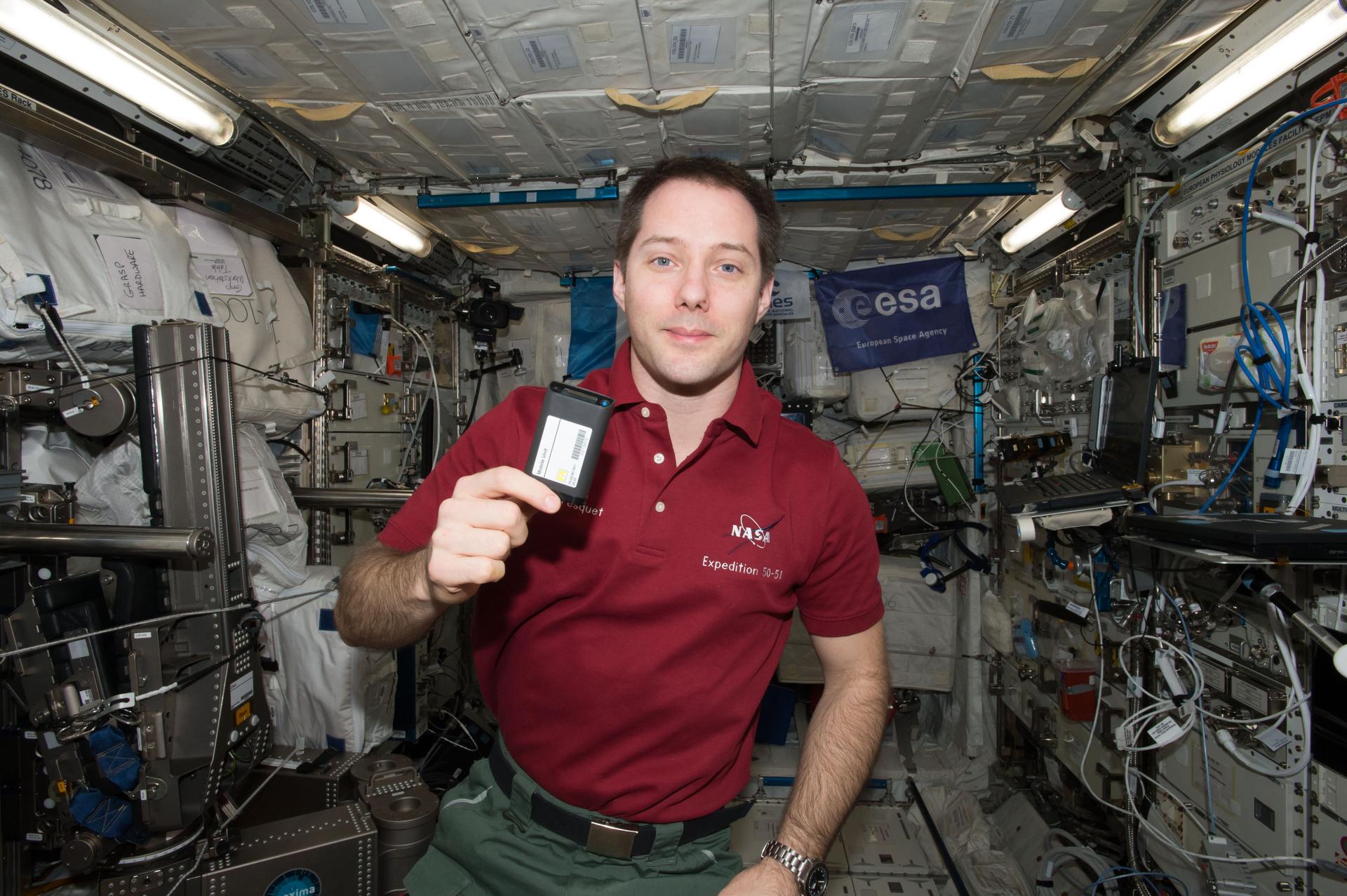
Pesquet, wearing a red polo, green pants, and a black belt, holds a rectangular black device smaller than a cell phone in his right hand. An ESA flag is visible over his left shoulder, equipment and storage bags to his right, and several laptops and cables to his left.
ESA (European Space Agency) astronaut Thomas Pesquet holds a mobile unit for the ESA-Active-Dosimeters experiment.
NASA

Active-Dosimeters, an investigation led by ESA (European Space Agency), tested a wearable system to measure radiation exposure to crew members on the space station and how it changes with the station’s orbit and altitude. Data from the wearable dosimeter improved radiation risk assessments and could lead to better protection for astronauts, including the ability to quickly respond to changes in exposure throughout future exploration missions.

Robot Helpers

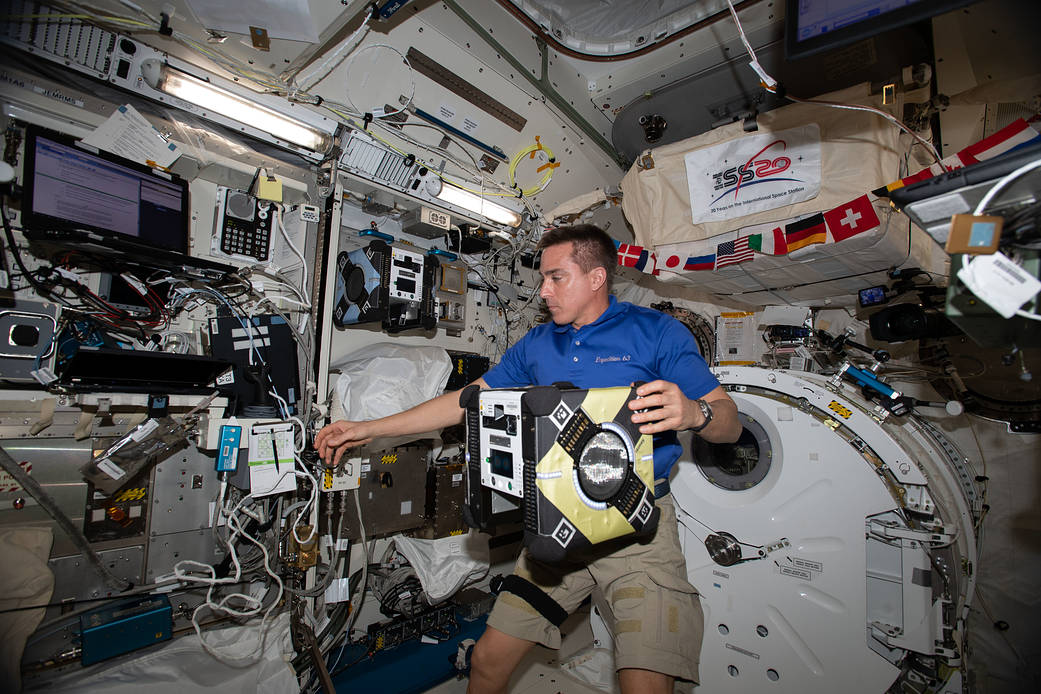
On future exploration missions, robotic technology can help crew members with basic tasks, monitor and maintain equipment, and conduct operations such as sample collection, reducing the need to expose astronauts to harsh environments. Integrated System for Autonomous and Adaptive Caretaking demonstrates using autonomous robots to transfer and unpack cargo and to track and respond to maintenance issues such as leaks and fires, which could protect valuable equipment and reduce costly repairs on future missions. The investigation uses the space station’s Astrobee and Robonaut robots.

Cassidy, wearing a blue polo shirt and khaki shorts, holds the yellow Astrobee in his left hand as he reaches for a clipboard with his right hand. Also visible is the blue Astrobee in the docking station to his right, a round white hatch behind him, and a string of small flags just above his head.
NASA astronaut Chris Cassidy sets up a test with an Astrobee robotic assistant.
NASA

Multi-Resolution Scanning uses the station’s Astrobees to test sensors and robotics to support automated 3D sensing, mapping, and situational awareness functions. On future Gateway and lunar surface missions, such systems could automatically detect defects and conduct remote maintenance and autonomous operation of vehicles such as rovers.

Cristoforetti, wearing a gray sweatshirt and a headset, looks at a computer screen in front of her as she works a joystick with her left hand and holds a white control arm with her right hand.
ESA (European Space Agency) astronaut Samantha Cristoforetti practices maneuvers for the Surface Avatar investigation.
NASA

Surface Avatar evaluates crew operation of multiple autonomous robots in space. The investigation also assesses crew member responsiveness to feedback on the consoles used to operate robots remotely, which supports design of effective setups for operating robots on the ground from a spacecraft orbiting above. Results contribute to the development of other uses of robotic assistance such as returning samples from Mars and asteroids.

Melissa Gaskill
International Space Station Research Communications Team
NASA’s Johnson Space Center

Search this database of scientific experiments to learn more about those mentioned above.

Powered by WPeMatico

Get The Details…
Ana Guzman

Hubble Views the Lights of a Galactic Bar

Hubble Views the Lights of a Galactic Bar

2 min read

Hubble Views the Lights of a Galactic Bar

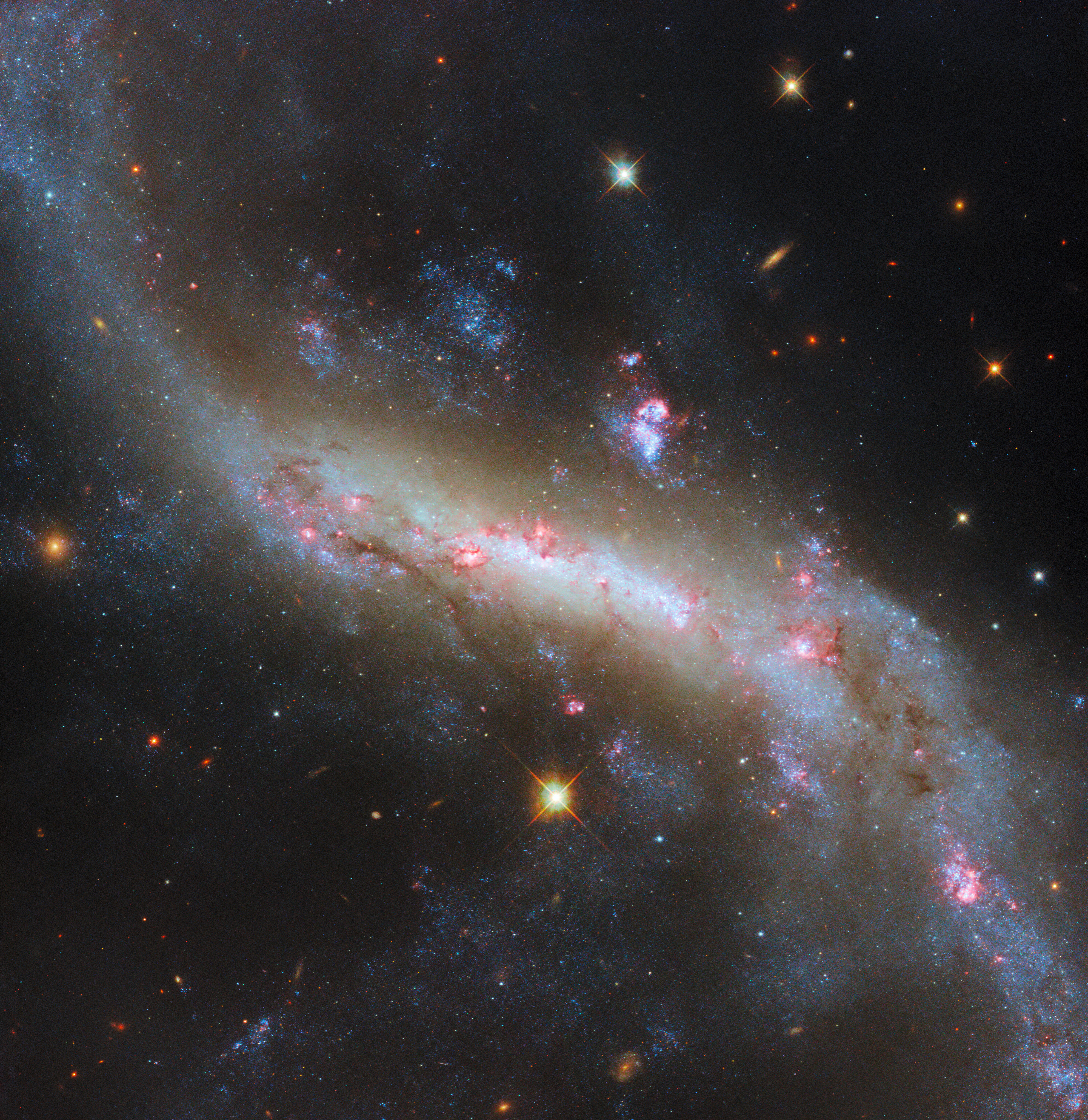
A close-in view of a barred spiral galaxy. The bright, glowing bar crosses the center of the galaxy, with spiral arms curving away from the bar’s ends and continuing out of view. Bright patches of light where stars are forming surround the bar, which also holds dark lines of dust. The galaxy’s clouds of gas spread out from its arms and bar, giving way to a dark background with some foreground stars and small, distant galaxies.
This Hubble Space Telescope image reveals details in the barred spiral galaxy NGC 4731.
ESA/Hubble & NASA, D. Thilker

This new image from the NASA/ESA Hubble Space Telescope shows the broad and sweeping spiral galaxy NGC 4731. It lies in the constellation Virgo and is located 43 million light-years from Earth. This highly detailed image uses data collected from six different filters. The abundance of color illustrates the galaxy’s billowing clouds of gas, dark dust bands, bright pink star-forming regions and, most obviously, the long, glowing bar with trailing arms.

Barred spiral galaxies outnumber both regular spirals and elliptical galaxies put together, numbering around 60% of all galaxies. The visible bar structure is a result of orbits of stars and gas in the galaxy lining up, forming a dense region that individual stars move in and out of over time. This is the same process that maintains a galaxy’s spiral arms, but it is somewhat more mysterious for bars: spiral galaxies seem to form bars in their centers as they mature, which helps explain the large number of bars we see today, but they can also lose them if the accumulated mass along the bar grows unstable. The orbital patterns and the gravitational interactions within a galaxy that sustain the bar also transport matter and energy into it, fueling star formation. Indeed, the observing program studying NGC 4731 seeks to investigate this flow of matter in galaxies.

Beyond the bar, the spiral arms of NGC 4731 stretch out far past the confines of this close-in Hubble view. Astronomers think the galaxy’s elongated arms are the result of gravitational interactions with other, nearby galaxies in the Virgo cluster.

Text Credit: European Space Agency (ESA)

Explore More

Media Contact:

Claire Andreoli
NASA’s Goddard Space Flight CenterGreenbelt, MD
claire.andreoli@nasa.gov

Share

Details

Last Updated
May 31, 2024
Editor
Andrea Gianopoulos

Powered by WPeMatico

Get The Details…

June’s Night Sky Notes: Constant Companions: Circumpolar Constellations, Part III

June’s Night Sky Notes: Constant Companions: Circumpolar Constellations, Part III

2 min read

June’s Night Sky Notes: Constant Companions: Circumpolar Constellations, Part III

by Kat Troche of the Astronomical Society of the Pacific

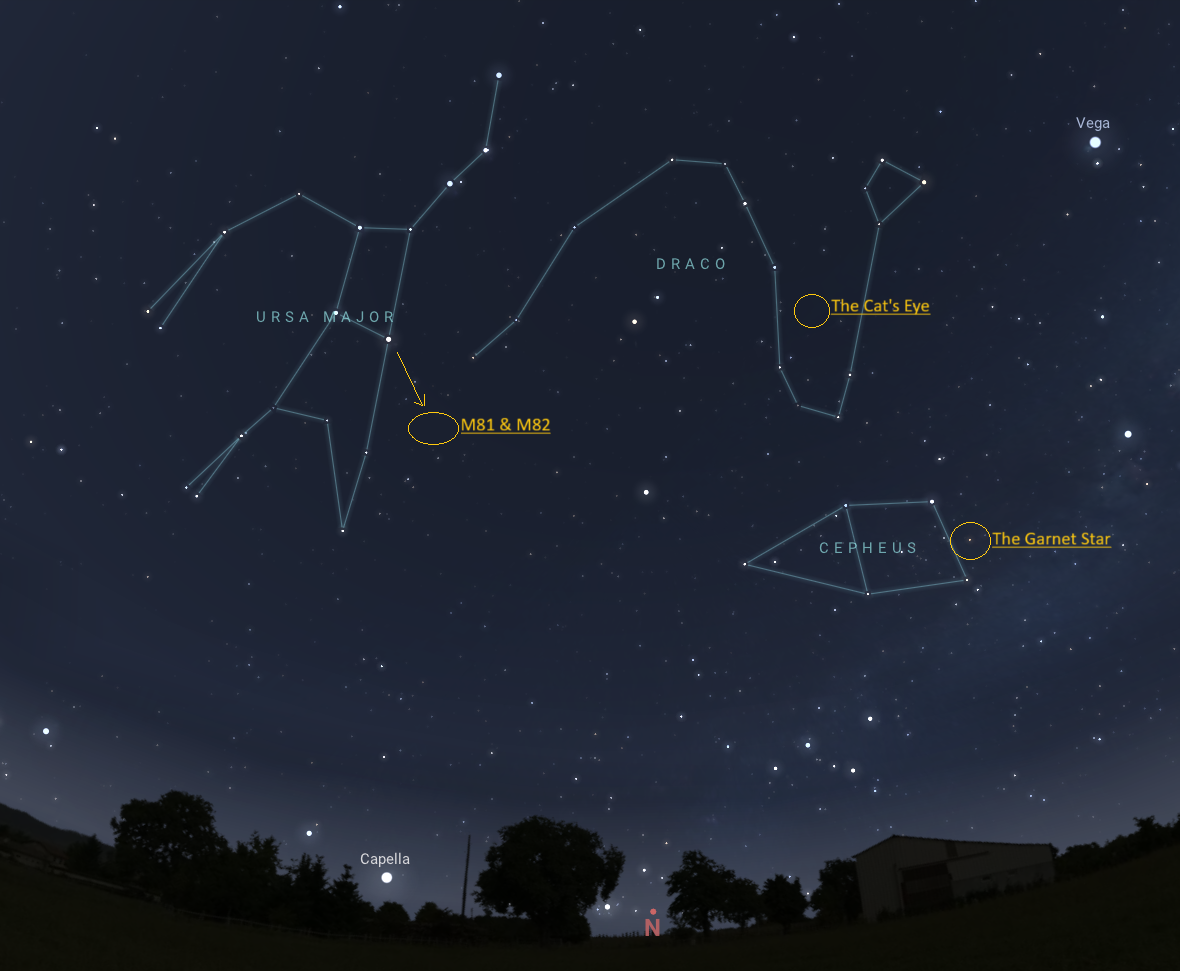
In our final installment of the stars around the North Star, we look ahead to the summer months, where depending on your latitude, the items in these circumpolar constellations are nice and high. Today, we’ll discuss Cepheus, Draco, and Ursa Major. These objects can all be spotted with a medium to large-sized telescope under dark skies.

Constellations in the sky at night noting the galaxies M81 and M82, the Garnet Star, and the Cat's Eye nebula.
From left to right: Ursa Major, Draco, and Cepheus.
Credit: Stellarium Web

Herschel’s Garnet Star: Mu Cephei is a deep-red hypergiant known as The Garnet Star, or Erakis. While the star is not part of the constellation pattern, it sits within the constellation boundary of Cepheus, and is more than 1,000 times the size of our Sun. Like its neighbor Delta Cephei, this star is variable, but is not a reliable Cepheid variable. Rather, its brightness can vary anywhere between 3.4 to 5.1 in visible magnitude, over the course of 2-12 years.

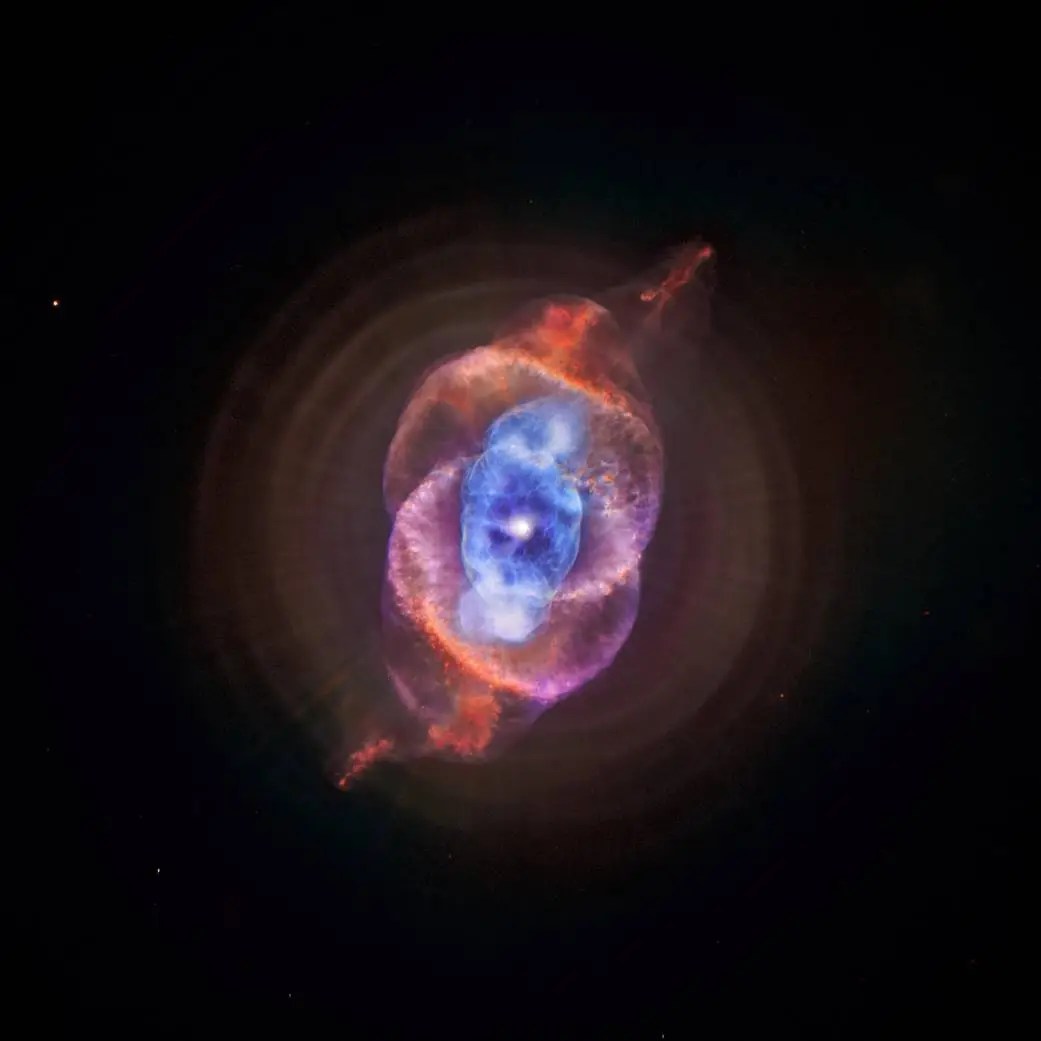
This composite of data from NASA's Chandra X-ray Observatory and Hubble Space Telescope gives astronomers a new look for NGC 6543, better known as the Cat's Eye nebula. This planetary nebula represents a phase of stellar evolution that our sun may well experience several billion years from now.
This composite of data from NASA’s Chandra X-ray Observatory and Hubble Space Telescope gives astronomers a new look for NGC 6543, better known as the Cat’s Eye nebula. This planetary nebula represents a phase of stellar evolution that our sun may well experience several billion years from now.
Credit: X-ray: NASA/CXC/SAO; Optical: NASA/STScI

The Cat’s Eye Nebula: Labeled a planetary nebula, there are no planets to be found at the center of this object. Observations taken with NASA’s Chandra X-ray Observatory and Hubble Space Telescopes give astronomers a better understanding of this complex, potential binary star, and how its core ejected enough mass to produce the rings of dust. When searching for this object, look towards the ‘belly’ of Draco with a medium-sized telescope.

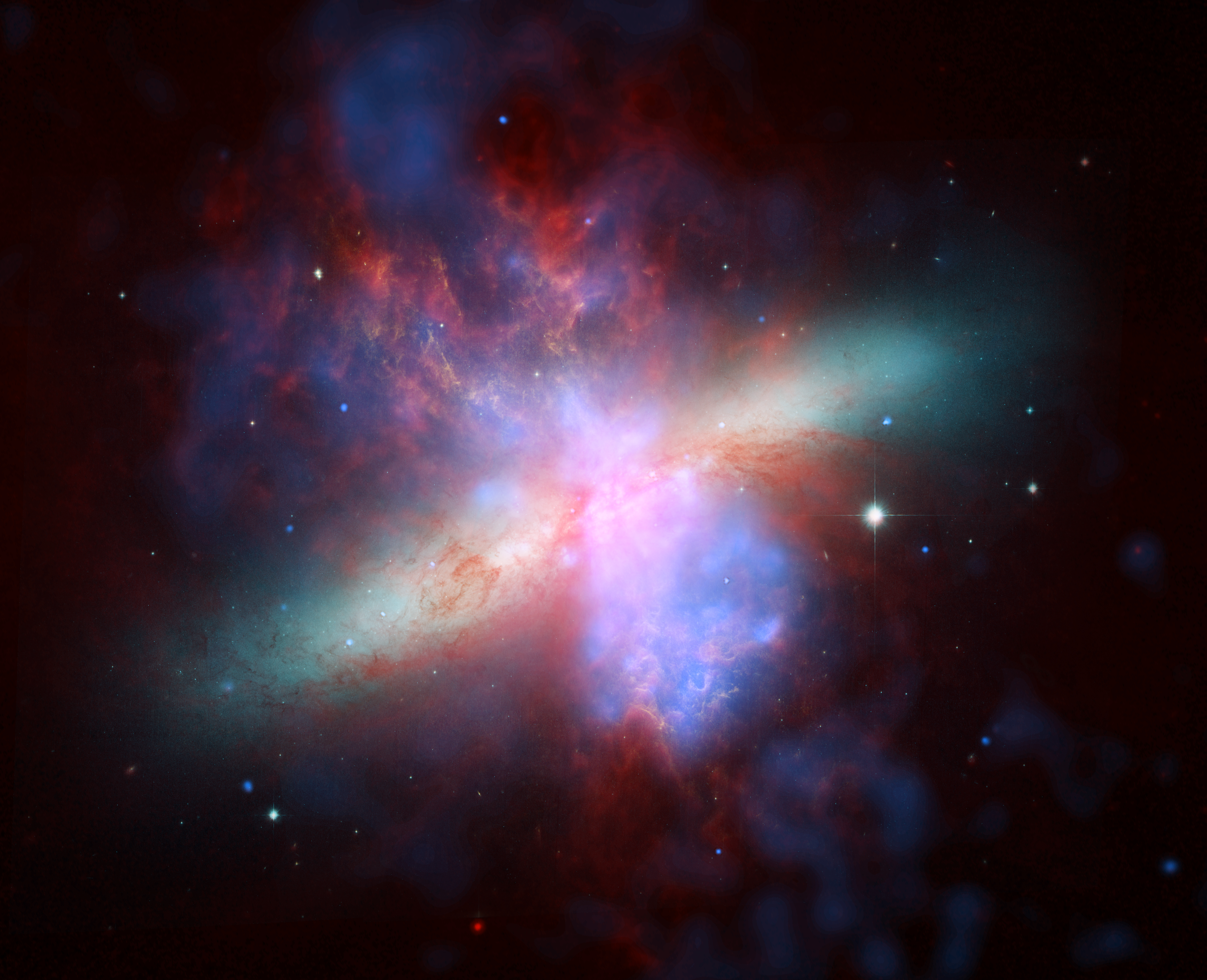
NASA's Spitzer, Hubble, and Chandra space observatories teamed up to create this multi-wavelength view of the M82 galaxy. The lively portrait celebrates Hubble's
NASA’s Spitzer, Hubble, and Chandra space observatories teamed up to create this multi-wavelength view of the M82 galaxy. The lively portrait celebrates Hubble’s “sweet sixteen” birthday .X-ray data recorded by Chandra appears in blue; infrared light recorded by Spitzer appears in red; Hubble’s observations of hydrogen emission appear in orange, and the bluest visible light appears in yellow-green.
Credit: NASA, ESA, CXC, and JPL-Caltech

Bode’s Galaxy and the Cigar Galaxy: Using the arrow on the star map, look diagonal from the star Dubhe in Ursa Major. There you will find Bode’s Galaxy (Messier 81) and the Cigar Galaxy (Messier 82). Sometimes referred to as Bode’s Nebula, these two galaxies can be spotted with a small to medium-sized telescope. Bode’s Galaxy is a classic spiral shape, similar to our own Milky Way galaxy and our neighbor, Andromeda. The Cigar Galaxy, however, is known as a starburst galaxy type, known to have a high star formation rate and incredible shapes. This image composite from 2006 combines the power of three great observatories: the Hubble Space Telescope imaged hydrogen in orange, and visible light in yellow green; Chandra X-Ray Observatory portrayed X-ray in blue; Spitzer Space Telescope captured infrared light in red.

Up next, we celebrate the solstice with our upcoming mid-month article on the Night Sky Network page through NASA’s website!

Powered by WPeMatico

Get The Details…

NASA Welcomes Slovakia as New Artemis Accords Signatory

NASA Welcomes Slovakia as New Artemis Accords Signatory

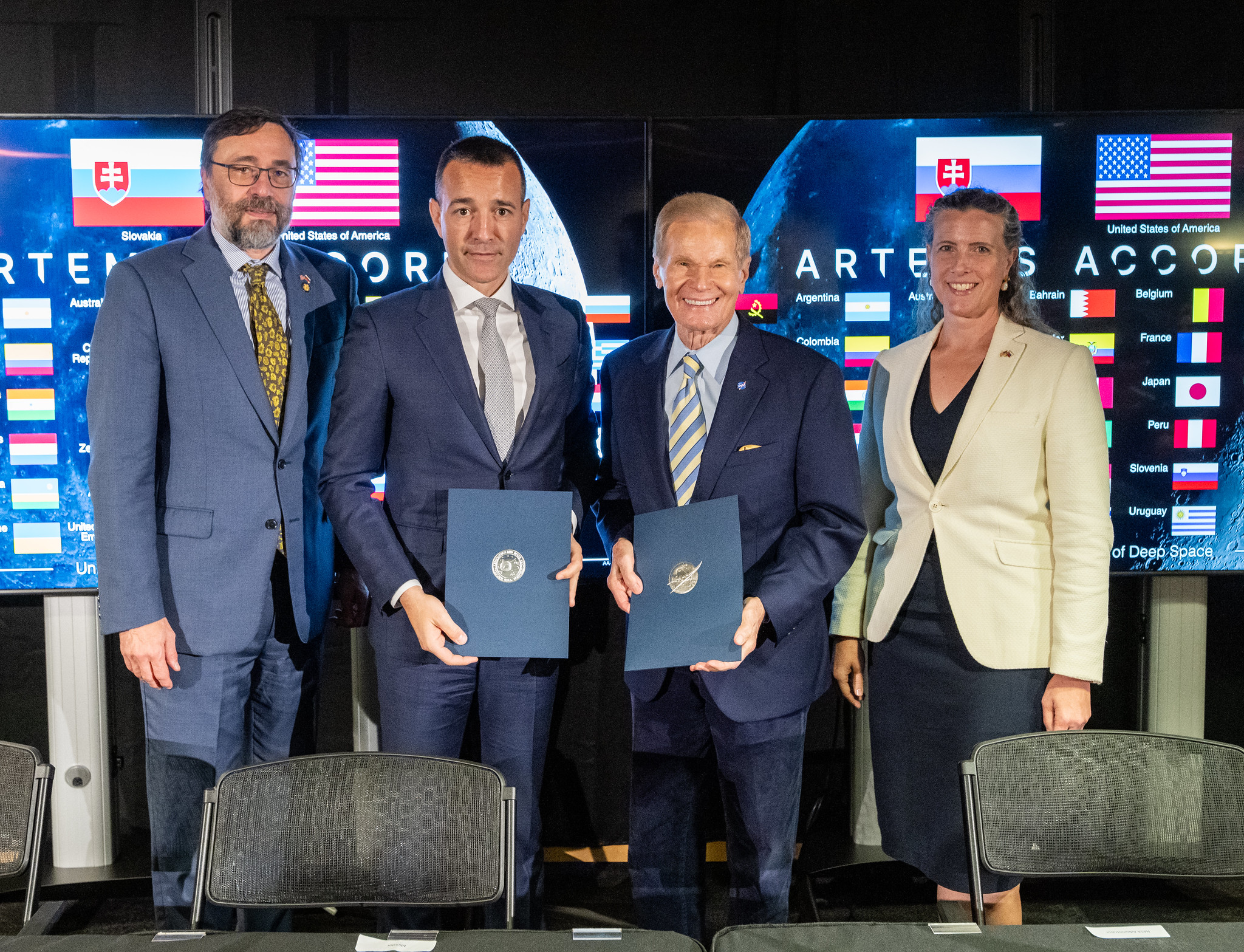
From left to right, Ambassador of the Slovak Republic to the United States Radovan Javorcik, Slovak Republic Minister of Education, Research, Development, and Youth Tomáš Drucker, NASA Administrator Bill Nelson, and United States Department of State Deputy Assistant Secretary for the Bureau of European and Eurasian Affairs Sonata Coulter pose for a photo during an Artemis Accords signing ceremony, Thursday, May 30, 2024, at the Mary W. Jackson NASA Headquarters building in Washington. Slovakia is the 42nd country to sign the Artemis Accords, which establish a practical set of principles to guide space exploration cooperation among nations participating in NASA’s Artemis program.
Credits: NASA/Keegan Barber

Slovakia signed the Artemis Accords Thursday during a ceremony hosted by NASA Administrator Bill Nelson at the agency’s headquarters in Washington, becoming the 42nd nation to join an international community in a commitment to peaceful, transparent, and responsible exploration of space for the benefit of all.

“NASA welcomes Slovakia as the newest signatory of the Artemis Accords,” said Nelson. “The United States and Slovakia share a deep understanding of the power of exploration. Through this new chapter in our nations’ partnership, we will further this global coalition to explore the cosmos openly, responsibly, in peace.”

Tomáš Drucker, Minister of Education, Research, Development, and Youth signed the Accords on behalf of Slovakia. Sonata Coulter, deputy assistant secretary for the Bureau of European and Eurasian Affairs, U.S. State Department, and Radovan Javorcik, ambassador of the Slovak Republic to the U.S., also participated in the signing ceremony.

“Slovakia perceives the Artemis Accords as a great opportunity for this generation to positively define guidelines and principles for the responsible and sustainable exploration and use of outer space,” said Drucker.

Earlier Thursday, Peru became the 41st country to sign the Artemis Accords. The United States and seven other nations were the first to sign the Artemis Accords in 2020, which identified an early set of principles promoting the beneficial use of space for all humanity. The accords are grounded in the Outer Space Treaty and other agreements including the Registration Convention, the Rescue and Return Agreement, as well as best practices and norms of responsible behavior that NASA and its partners have supported, including the public release of scientific data.

Several accords signatories also met face-to-face for a workshop in May to continue implementing the principles. The commitments of the Artemis Accords, and the efforts by the signatories to advance implementation of these principles, support NASA’s Artemis campaign with its partners, as well as for the success of the safe and sustainable exploration activities of the other Accords signatories.

For more information on the Artemis Accords, visit:

https://www.nasa.gov/artemis-accords

-end-

Faith McKie / Jennifer Dooren
Headquarters, Washington
202-358-1600
faith.d.mckie@nasa.gov / jennifer.m.dooren@nasa.gov

Powered by WPeMatico

Get The Details…
Jennifer M. Dooren