Controlled Propulsion for Gentle Landings 

Controlled Propulsion for Gentle Landings 

2 min read

Preparations for Next Moonwalk Simulations Underway (and Underwater)
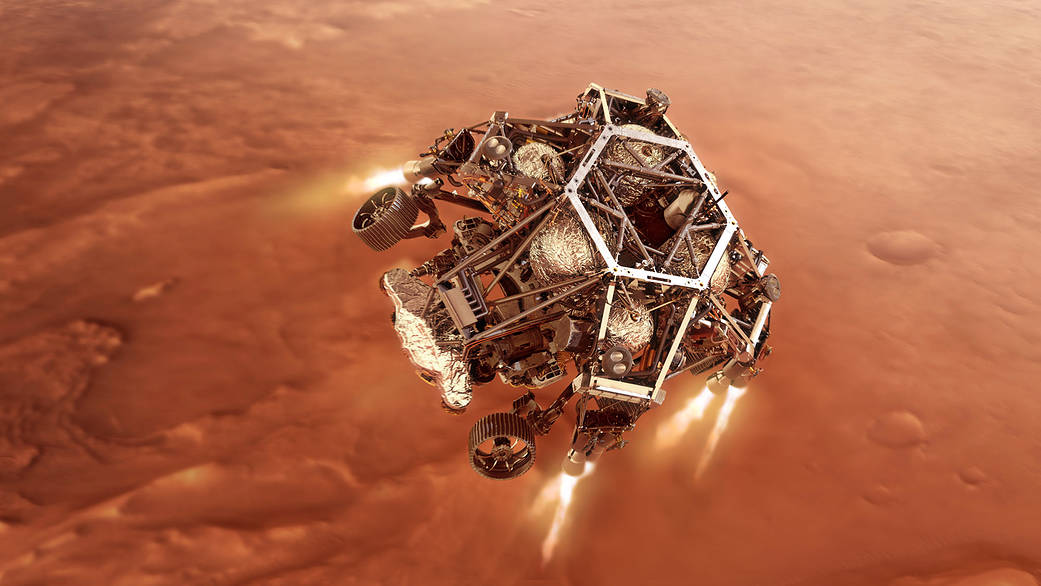
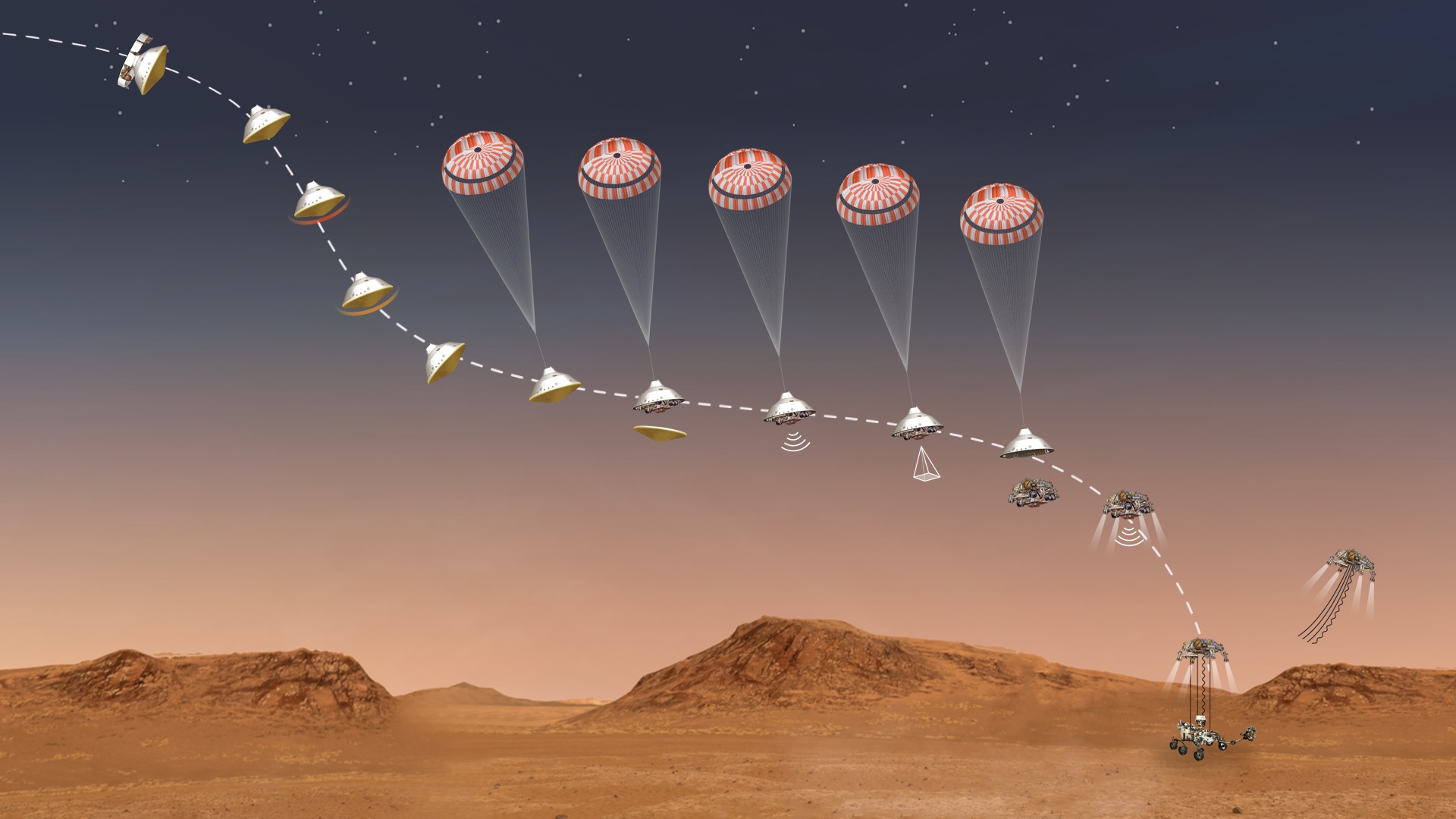
Illustration of NASA’s Perseverance rover begins its descent through the Martian atmosphere
The controlled descent of the Mars Curiosity rover included the use of propulsion rockets pointing to the surface to allow a gentle landing. The engine, shown firing in this illustration of Perseverance and the sky crane landing system relied on a pyrovalve that released the rocket fuel.
Credit: NASA /JPL-Caltech

The Curiosity and Perseverance Mars rovers continue to provide a wealth of information about the Red Planet. This was made possible in part by the sky crane landing systems that safely lowered them to the planet’s surface. Their successful descent, managed by eight powerful engines, depended on one small part – a valve. 

The engines produced about 750 pounds of thrust each, so they required more fuel than a conventional valve could deliver, said Carl Guernsey, propulsion subsystem chief engineer for the Mars Sample Laboratory Mission. 

“With the engines pointing down, we throttle up and increase the thrust, so we slow down,” said Guernsey. “At a certain altitude above the surface, you hold at a constant velocity to collect more sensor data, and then proceed with the rest of the descent.”  

With only seconds for sensor data to identify the landing area and direct any last-minute diversion maneuvers, landing requires fuel available at the right time. To build the valve to help accomplish this task, NASA turned to a company that has provided the space program with reliable gas regulators since the 1950s. Through a series of mergers, by 2021, the original company, called Conax Florida, became part of Eaton based in Orchard Park, New York.  

Working under contract with NASA’s Jet Propulsion Laboratory in Southern California, the company developed a new one-time-use pyrovalve to sit between the hydrazine fuel tank and engines. The zero-leak valve was the largest ever made of its type at the time, at three-fourths of an inch. 

This one-time-use pyrovalve sat between the hydrazine fuel tank and the controlled-descent engines on the sky crane for the Curiosity and Perseverance Mars rovers. The zero-leak valve developed by Eaton also ensured no fuel was lost on the long flight to Mars.
Credit: Eaton Corp.

The Y-shaped pipe with a pair of leak-proof solid metal barriers prevented propellant from flowing. The valve contains a pyrotechnic charge that activates a piston called a flying ram, which shears off the barriers, allowing fuel to flow. But a problem arose during flight qualification testing. Sometimes the ram didn’t stay wedged in place at the bottom, posing a blockage risk. 

The solution the team came up with had never been tried before – magnets at the bottom of the valve. But the successful Perseverance landing in 2021 proved it works. The same valve is included in the Perseverance rover and now enables commercial rocket-stage separation in space. 

Share

Details

Last Updated

Oct 11, 2024

Powered by WPeMatico

Get The Details…
Andrew Wagner

Program Executive Dr. Yaítza Luna-Cruz

Program Executive Dr. Yaítza Luna-Cruz

Yaíta smiles broadly at the camera wearing a white dress with a pearl necklace. Her hair is long with curls and she's wearing red lipstick. She stands in front of a larger model of a globe.

“My mom had to leave school after 9th grade to support her family, but she always emphasized the importance of education. And with a lot of sacrifices, got us an encyclopedia in Spanish, ‘Enciclopedia de Las Ciencias’. By getting that encyclopedia for us, without knowing it, my mom was my first mentor because she introduced me to science. So that’s what helped fall in love with physics.

“I was the first of many things. I was the only one in my whole class that decided to study physics at the University of Puerto Rico at Mayagüez. I was the first master student to do a thesis related to atmospheric physics. There was no atmospheric sciences and meteorology in Puerto Rico, I saw the need and potential, so I started the first student chapter of the American Meteorological Society in Puerto Rico. I was the first one to get a PhD in atmospheric physics from the program and there have been so many firsts since then. 

“I’m leading by example. I don’t want the people who look like me to experience what I experienced because I was alone many times. And there’s a saying that says you cannot be what you can’t see.

“So, I’m not just doing science. I’m doing Science with Purpose, and my purpose is to be the voice for those who are underrepresented in science, open doors and opportunities and help them understand that they have a space in science.”

– Dr. Yaíta Luna-Cruz, Program Executive, Earth Science Division, NASA Headquarters

Image Credit: NASA/Keegan Barber
Interviewer: NASA/Jessica Salani

Lee esta historia en español aquí.

Check out some of our other Faces of NASA. 

Powered by WPeMatico

Get The Details…
Tahira S. Allen

Hubble Spots a Grand Spiral of Starbursts

Hubble Spots a Grand Spiral of Starbursts

2 min read

Hubble Spots a Grand Spiral of Starbursts

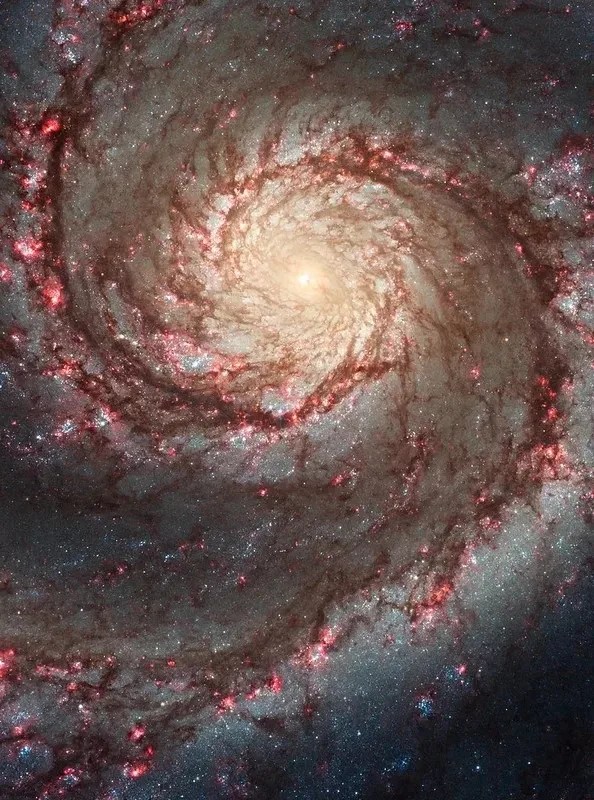
A close-in, face-on view of a spiral galaxy. It has two large arms that curve outward from the round, bright, central region to nearly the corners of the image. Channels of dark reddish dust that blocks light line the arms while bright pink, glowing points denote where stars are forming. Beyond its prominent spiral arms, the galaxy’s oval disk is generally cloudy in form and speckled with stars. A black background is visible behind it.
The glittering NASA/ESA Hubble Space Telescope image is of the spiral galaxy NGC 5248, also known as Caldwell 45.
ESA/Hubble & NASA, F. Belfiore, J. Lee and the PHANGS-HST Team

The sparkling scene depicted in this NASA/ESA Hubble Space Telescope image is of the spiral galaxy NGC 5248, located 42 million light-years from Earth in the constellation Boötes. It is also known as Caldwell 45. The Caldwell catalog holds visually interesting celestial objects that are not as commonly observed by amateur astronomers as the more famous Messier objects.

NGC 5248 is one of the so-called ‘grand design’ spirals, with prominent spiral arms that reach from near the core out through the disk. It also has a faint bar structure at its center, between the inner ends of the spiral arms, which is not quite so obvious in this visible-light portrait from Hubble. Features like these which break the rotational symmetry of a galaxy have a huge influence on how matter moves through it, and eventually its evolution through time. They feed gas from a galaxy’s outer reaches to inner star-forming regions, and even to a galaxy’s central black hole where it can kick-start an active galactic nucleus.

These flows of gas have shaped NGC 5248 in a big way; it has many bright ‘starburst regions’ of intense star formation spread across its disk, which a population of young stars dominates. The galaxy even has two very active, ring-shaped starburst regions around its nucleus, filled with young clusters of stars. These ‘nuclear rings’ are remarkable enough, but normally a nuclear ring tends to block gas from getting further into the core of a galaxy. NGC 5248 having a second ring inside the first is a marker of just how forceful its flows of matter and energy are! Because the galaxy is relatively nearby, its highly visible starburst regions make the galaxy a target for professional and amateur astronomers alike.

Media Contact:

Claire Andreoli
NASA’s Goddard Space Flight CenterGreenbelt, MD
claire.andreoli@nasa.gov

Powered by WPeMatico

Get The Details…

Sail Along with NASA’s Solar Sail Tech Demo in Real-Time Simulation

Sail Along with NASA’s Solar Sail Tech Demo in Real-Time Simulation

Unable to render the provided source

NASA invites the public to virtually sail along with the Advanced Composite Solar Sail System‘s space journey using NASA’s “Eyes on the Solar System” visualization tool, a digital model of the solar system. This simulation shows the real-time positions of the planets, moons, and spacecraft – including NASA’s Advanced Composite Solar Sail System.

Solar sails use the pressure of sunlight for propulsion, angling toward or away from the Sun so that photons bounce off the reflective sail to push a spacecraft. This eliminates the need for heavy propulsion systems and could enable longer duration and lower cost missions. The results from this technology demonstration – including the test of the sail’s composite boom system – will advance future space exploration to expand our understanding of our Sun and solar system. 

The Advanced Composite Solar Sail System, which launched in April 2024, and deployed its reflective sail in August, is currently orbiting approximately 600 miles (1,000 kilometers) above Earth and is frequently visible in the night sky to observers in the Northern Hemisphere. Fans of the spacecraft can look for the sail in the night sky using a new feature in the NASA mobile app. Visibility may be intermittent, and the spacecraft could appear at variable levels of brightness as it moves in orbit.

For more mission updates, follow NASA’s Small Satellite Missions blog.

NASA’s Ames Research Center in California’s Silicon Valley, manages the Advanced Composite Solar Sail System project and designed and built the onboard camera diagnostic system. NASA Langley designed and built the deployable composite booms and solar sail system. NASA’s Small Spacecraft Technology (SST) program office based at NASA Ames and led by the agency’s Space Technology Mission Directorate (STMD), funds and manages the mission. NASA STMD’s Game Changing Development program funded the development of the deployable composite boom technology.    

Powered by WPeMatico

Get The Details…