NASA’s Kennedy Marks New Chapter for Florida Space Industry

NASA’s Kennedy Marks New Chapter for Florida Space Industry
Kennedy Space Center Director and charter members of the Florida University Space Research Consortium signed a memorandum of understanding on Jan. 8, 2025. Comprised of the University of Florida, Embry-Riddle Aeronautical University, and University of Central Florida, the consortium was designated in 2024 as the state’s official space research entity, making Florida the only state with a university consortium affiliated with one of NASA’s centers. This critical milestone in a one-of-a-kind partnership to advance research, technology development, education, and communication between the spaceport and the state’s growing space industry. From left: Jennifer Kunz, Associate Director, Technical, Kennedy Space Center; Kelvin Manning, Deputy Director, Kennedy Space Center; Dr. Kent Fuchs, Interim President, University of Florida; Janet Petro, Director, Kennedy Space Center; Jeanette Nuñez, Florida Lieutenant Governor; Dr. Alexander Cartwright, President, University of Central Florida; Dr. Barry Butler, President, Embry-Riddle Aeronautical University.
Kennedy Space Center Director and charter members of the Florida University Space Research Consortium signed a memorandum of understanding on Jan. 8, 2025. From left: Jennifer Kunz, Associate Director, Technical, Kennedy Space Center; Kelvin Manning, Deputy Director, Kennedy Space Center; Dr. Kent Fuchs, Interim President, University of Florida; Janet Petro, Director, Kennedy Space Center; Jeanette Nuñez, Florida Lieutenant Governor; Dr. Alexander Cartwright, President, University of Central Florida; Dr. Barry Butler, President, Embry-Riddle Aeronautical University.
NASA/Kim Shiflett

The future of research and technology at NASA’s Kennedy Space Center in Florida is expanding Wednesday, as Kennedy’s center director and charter members in the Florida University Space Research Consortium signed a memorandum of understanding in research and development to assist with missions and contribute to NASA’s Moon to Mars exploration approach.

Officials from the consortium – designated in 2024 as the state’s official space research entity – NASA leaders, and guests participated in the signing ceremony held at Kennedy, marking a critical milestone in a partnership to advance research, technology development, education, and communication between the spaceport and the state’s growing space industry.

“Through this agreement, NASA will benefit in new and exciting ways from our longtime partnership with the universities that make Florida shine,” said NASA Administrator Bill Nelson. “As we move deeper into this golden era of space exploration, a new generation of thinkers and leaders will lead the way – thinkers and leaders like the researchers, faculty, and students of the Artemis Generation, whom we are pleased to work with through the consortium.”

The creation of the consortium was the result of more than a year of effort by leaders at Kennedy, the University of Florida, the University of Central Florida, and Embry-Riddle Aeronautical University. The agreement highlights the partnership and serves as the official start to partnering activities, with Florida now the only state with a university consortium affiliated with one of NASA’s centers.

Present at the event was Florida Governor Ron DeSantis. “It was great to visit the Space Coast Jan. 8 to announce the Florida University Space Research Consortium—our state’s official space research entity. Home to a thriving aerospace industry and world-class higher education institutions, Florida is the ideal place to launch this initiative. We are primed to lead the nation in developing a blueprint for state-space partnerships into the future.”

The mission of the consortium is to foster a symbiotic relationship between NASA Kennedy and Florida’s universities to drive innovation in space exploration, research, and technology through academic collaboration, joint projects, and workforce development.

“The launch of the Florida University Space Research Consortium is a significant milestone for our state’s aerospace sector, bringing together our world-class education system with cutting edge research and development,” said Lieutenant Governor Jeanette Nuñez. “This consortium will undoubtedly further strengthen and deepen Florida’s position as the leader in the global aerospace economy.”

The memorandum of understanding marks the dawn of a new era of cooperation between the Florida spaceport and the state’s university system, starting with the three charter universities with plans to expand to other state universities interested in participating. The push to enhance research and technological collaboration with universities has been a priority at NASA for years and has seen success at other NASA centers across the country.

While Kennedy becomes the first NASA center affiliated with a university consortium, recently NASA’s Ames Research Center in California’s Silicon Valley partnered with University of California, Berkeley, on development of the Berkeley Space Center at NASA Research Park, located at Ames. Still in development, the project is envisioned as a 36-acre discovery and innovation hub to include educational spaces, labs, offices, student housing, and a new conference center. More recently, NASA’s Johnson Space Center in Houston teamed up with Texas A&M University to break ground on a building that will become a testing laboratory for apparatuses in development for NASA’s Moon to Mars plans. In attendance for the groundbreaking was Kennedy Space Center Director Janet Petro, who was one of the signatories on the agreement.

Kennedy Space Center Janet Petro signs a memorandum of understanding between Kennedy Space Center and the Florida University Space Research Consortium on Jan. 8, 2025. Comprised of the University of Florida, Embry-Riddle Aeronautical University, and University of Central Florida, the consortium was designated in 2024 as the state’s official space research entity, making Florida the only state with a university consortium affiliated with one of NASA’s centers. This critical milestone in a one-of-a-kind partnership to advance research, technology development, education, and communication between the spaceport and the state’s growing space industry.
NASA’s Kennedy Space Center Director Janet Petro signs a memorandum of understanding between Kennedy Space Center and the Florida University Space Research Consortium on Jan. 8, 2025.
NASA/Kim Shiflett

“This agreement is a shining example of what it looks like when we link arms and create a space for the whole to be greater than all our parts,” said Petro. “This symbiotic partnership makes way for collaborative research opportunities and increased exposure to advanced technology, significantly enhancing NASA’s research output in fields such as aerospace engineering, materials science, robotics, and environmental science, all of which are necessary for long-term human exploration as we learn to live and work deeper into space than ever before.”

For more information about NASA Kennedy, visit:

https://www.nasa.gov/kennedy

Powered by WPeMatico

Get The Details…
Jason Costa
A Rover Retrospective: Turning Trials to Triumphs in 2024

A Rover Retrospective: Turning Trials to Triumphs in 2024

3 min read

A Rover Retrospective: Turning Trials to Triumphs in 2024

A look back at a few Mars 2020 mission highlights of 2024  

Perseverance’s past year operating on the surface of Mars was filled with some of the mission’s highest highs, but also some of its greatest challenges. True to its name and its reputation as a mission that overcomes challenges, Perseverance and its team of scientists and engineers turned trials to triumphs in yet another outstanding year for the mission. There’s a lot to celebrate about Perseverance’s past year on Mars, but here are three of my top mission moments this year, in the order in which they happened. 

1. SHERLOC’s cover opens 

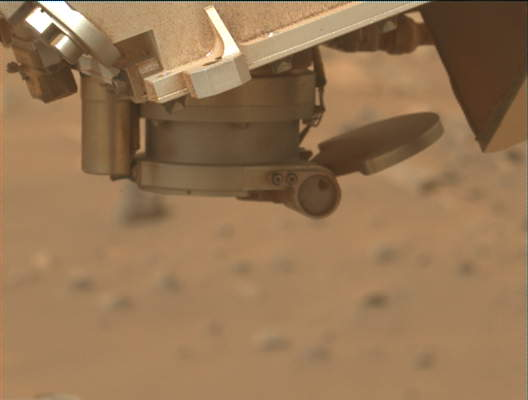
A close-up photo of an instrument on the Perseverance rover shows — against a blurred background of light tan-orange terrain — a metallic structure at the top of the frame, dusted with fine orange powder in some places. Pointing down from that is a short, barrel-shaped extension. Attached to the bottom of that is a “D”-shaped cover, attached to the mouth of the barrel on the right by a cylindrical hinge, fully opened toward the right, to an angle greater than 180 degrees.
NASA’s Mars Perseverance rover captured this image of its SHERLOC instrument (Scanning Habitable Environments with Raman & Luminescence for Organics and Chemicals), showing the cover mechanism of SHERLOC’s Autofocus and Context Imager camera (ACI) in a nearly open configuration. The rover acquired this image using its Left Mastcam-Z camera — one of a pair of cameras located high on the rover’s mast — on March 3, 2024 (sol 1079, or Martian day 1,079 of the Mars 2020 mission), at the local mean solar time of 12:18:41.
NASA/JPL-Caltech/ASU

In early January the SHERLOC instrument’s cover mechanism stopped responding during a routine attempt to acquire data on a rock outcrop in the Margin unit. After six weeks of team diagnostics, the SHERLOC instrument was declared offline and many of us feared that the instrument had met its end. In early March, the team made significant progress in driving the cover to a more open position. Then, to everyone’s surprise, the SHERLOC cover moved unexpectedly to a nearly completely open position during a movement of the arm on sol 1077. I remember staring in wonder at the image of the cover (taken on sol 1079), feeling real optimism for the first time that SHERLOC could be recovered. The team spent the next few months developing a new plan for operating SHERLOC with its cover open, and the instrument was declared back online at the end of June.  

2. A potential biosignature at Cheyava Falls  

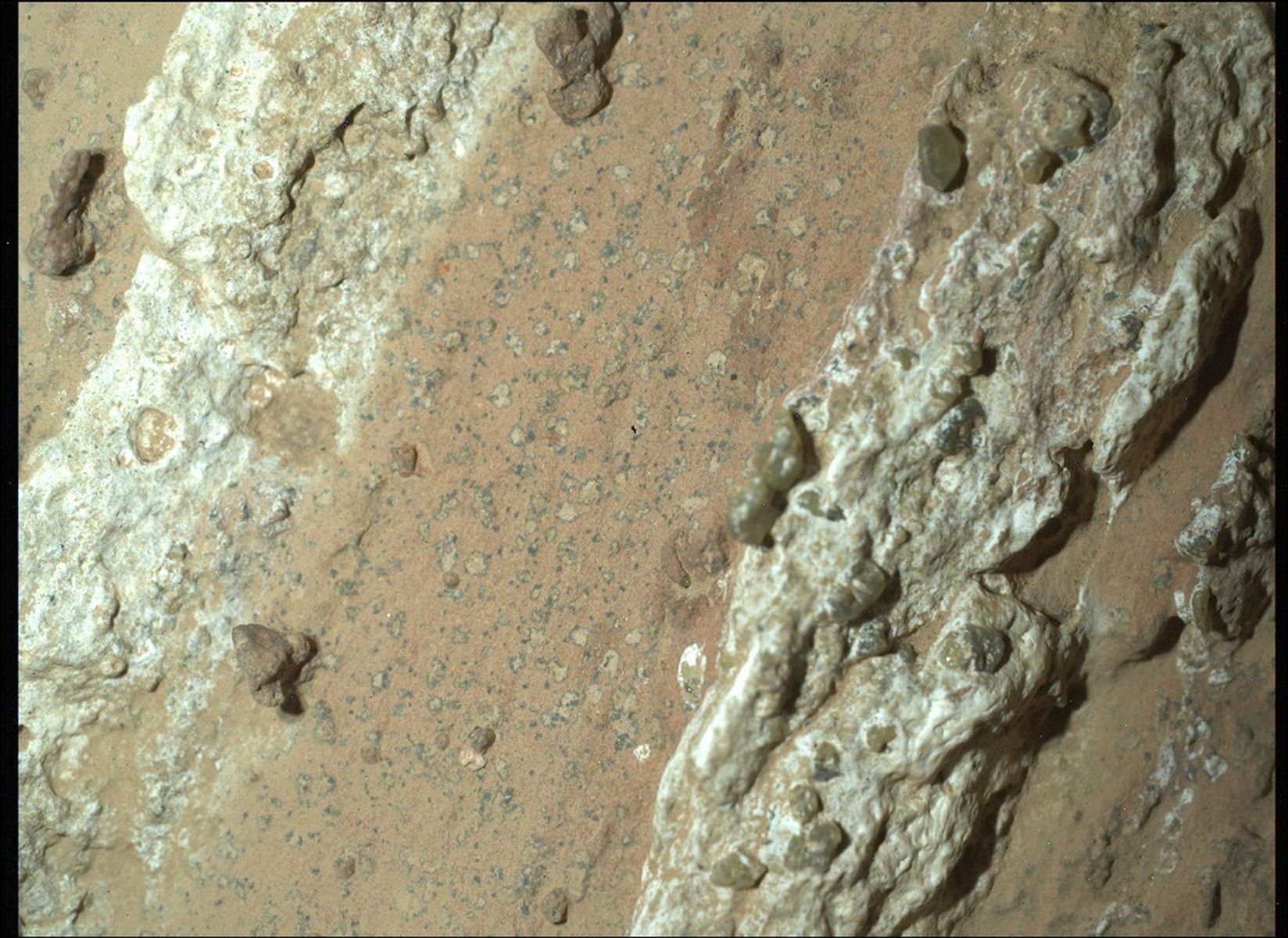
A color image of a Mars rock shows a smooth band of orange-tan down the center of the image, flanked by lumpy strips of lighter materials, smooth and in shades of light mint green and turquoise. The center portion shows innumerable small spots — light tan, outlined in very dark gray.
NASA’s Perseverance Mars rover captured this image of “leopard spots” on a rock nicknamed “Cheyava Falls” on July 18, 2024 — sol 1212. or the 1,212th Martian day of the mission. Running the length of the rock are large white calcium sulfate veins. Between those veins are bands of material whose reddish color suggests the presence of hematite, one of the minerals that gives Mars its distinctive rusty hue. Scientists are particularly interested in the millimeter-size, irregularly shaped light patches on the central reddish band (from lower left to upper right of the image) that resemble leopard spots. Perseverance captured the image using a camera called WATSON (Wide Angle Topographic Sensor for Operations and eNgineering), part of the SHERLOC (Scanning Habitable Environments with Raman and Luminescence for Organics and Chemicals) instrument suite located on the end of Perseverance’s robotic arm.
NASA/JPL-Caltech/MSSS

No top list would be complete without Perseverance’s discovery in July 2024 of a potential biosignature in the form of sub-millimeter-scale “leopard spots” at an outcrop called Cheyava Falls. These features, which formed during chemical reactions within the rock, have dark rims and light cores and occur together with organic carbon. On Earth, these chemical reactions are often driven by or associated with microbes. Although we can’t say for sure that microbes were involved in the formation of the leopard spots at Cheyava Falls, this question can be answered when Perseverance’s samples are returned to Earth. In the meantime, this rock remains one of the most compelling rocks discovered on Mars.  

3. Arrival at Witch Hazel Hill 

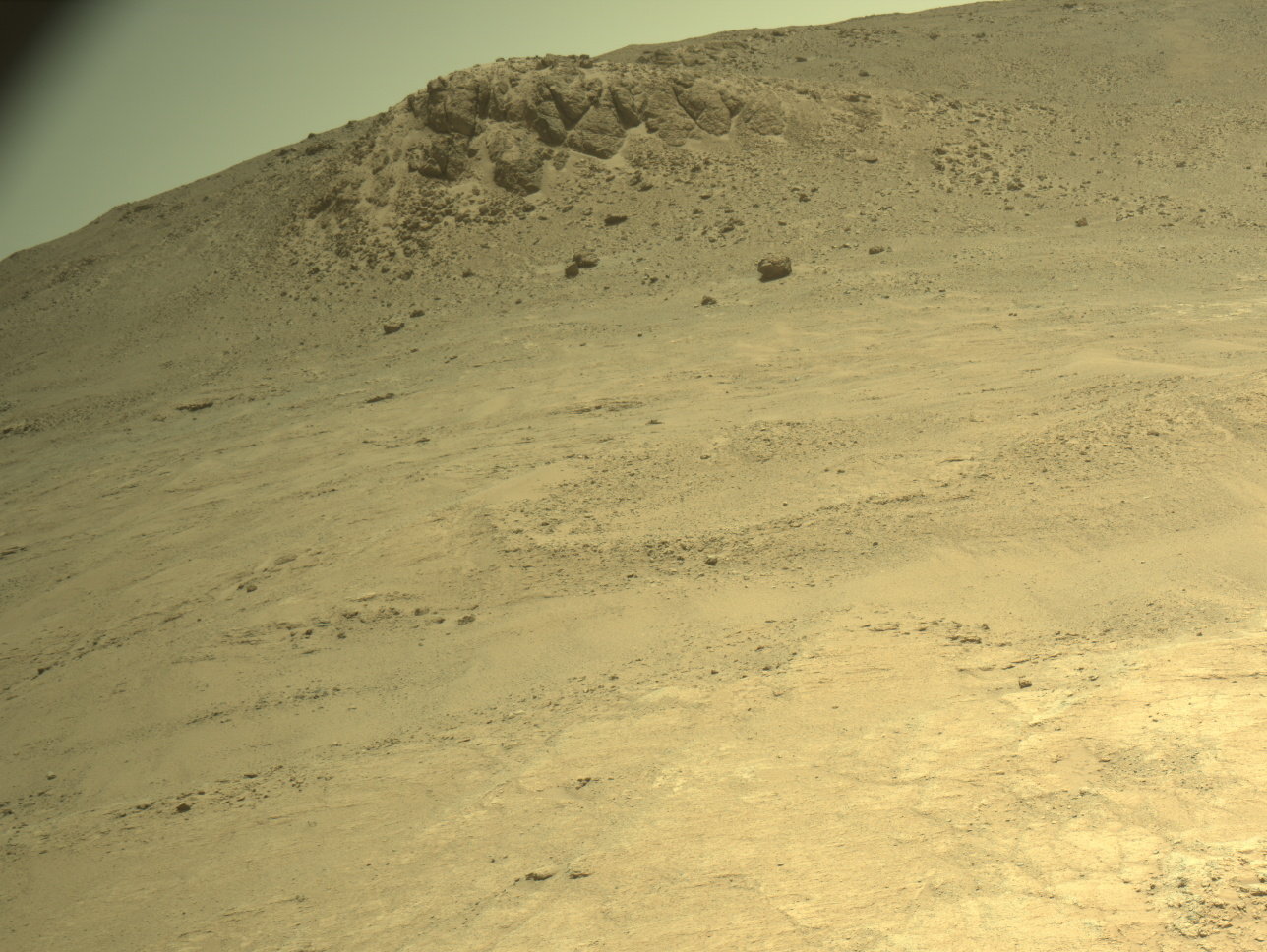
A color image from the Martian surface shows uneven yellow-tan ground leading up to the base of a hill, where the smoother ground dotted with small rocks turns into an outcropping of much larger rocks. That outcropping is on the horizon, which runs diagonally in the image, from the upper left side to the top right of the frame.
NASA’s Mars Perseverance rover acquired this image at the top of Witch Hazel Hill, of the South Arm and Minnie Hill outcrops. Perseverance used its Left Navigation Camera (Navcam) — which also aids in driving — located high on the rover’s mast. The rover captured the image on Dec. 16, 2024 (sol 1359, or Martian day 1,359 of the Mars 2020 mission), at the local mean solar time of 13:26:38.
NASA/JPL-Caltech

Closing out 2024 on a high note, in mid-December Perseverance arrived at the top of a sequence of rock exposed on the western edge of the Jezero crater rim called Witch Hazel Hill. These rocks pre-date the formation of Jezero crater and could be amongst the oldest rocks exposed on the surface of Mars. These rocks have the potential to tell us about a period of solar system history not well-preserved on our own planet Earth, and they may record important clues about the early history and habitability of Mars. Witch Hazel Hill first caught my attention during landing site selection several years ago, when we were debating the merits of landing Perseverance in Jezero versus sites outside the crater. At the time, this area seemed just out of reach for a Jezero-focused mission, so I’m thrilled that the rover is now exploring this site!   

The Mars 2020 mission had its ups and downs and a fair share of surprises during 2024, but we are looking ahead to 2025 with excitement, as Perseverance continues to explore and sample the Jezero crater rim.

Written by Katie Stack Morgan, Mars 2020 Deputy Project Scientist

Share

Details

Last Updated
Jan 08, 2025

Related Terms

Powered by WPeMatico

Get The Details…

NASA Selects Electrical Systems Engineering Services Contractor

NASA Selects Electrical Systems Engineering Services Contractor

The letters NASA on a blue circle with red and white detail, all surrounded by a black background
Credit: NASA

NASA has selected Columbus Technologies and Services Inc. of El Segundo, California, to provide electrical and electronic engineering support to the agency’s Goddard Space Flight Center in Greenbelt, Maryland.

The Electrical Systems Engineering Services IV is a cost-plus-award-fee indefinite-delivery/indefinite-quantity contract with a maximum estimated value of $1.1 billion. The base period of performance begins on April 9 and runs for five years.

Work performed as part of the contract will assist various technical divisions at NASA Goddard with electrical and electronic responsibilities. These divisions include the Electrical Engineering Division, Instrument Systems and Technology Division, Software Engineering Division, and Mission Engineering and Systems Analysis Division. The contractor also will help manage the development of space flight, airborne, and ground system hardware, including design, testing, and fabrication.

For information about NASA and agency programs, visit:

https://www.nasa.gov

-end-

Tiernan Doyle
Headquarters, Washington
202-358-1600
tiernan.doyle@nasa.gov

Share

Details

Last Updated

Jan 08, 2025

Powered by WPeMatico

Get The Details…
Tiernan P. Doyle

NASA to Test Solution for Radiation-Tolerant Computing in Space

NASA to Test Solution for Radiation-Tolerant Computing in Space

3 min read

Preparations for Next Moonwalk Simulations Underway (and Underwater)

The Radiation Tolerant Computer, or RadPC, payload undergoes final checkout at Montana State University in Bozeman, which leads the payload project. RadPC is one of 10 NASA payloads set to fly aboard the next delivery for NASA’s CLPS (Commercial Lunar Payload Services) initiative in 2025. RadPC prototypes previously were tested aboard the International Space Station and Earth-orbiting satellites, but the technology demonstrator will undergo its biggest trial in transit to the Moon – passing through the Earth’s Van Allen radiation belts – and during its roughly two-week mission on the lunar surface.
Photo courtesy Firefly Aerospace

Onboard computers are critical to space exploration, aiding nearly every spacecraft function from propulsion and navigation systems to life support technology, science data retrieval and analysis, communications, and reentry.

But computers in space are susceptible to ionizing solar and cosmic radiation. Just one high-energy particle can trigger a so-called “single event effect,” causing minor data errors that lead to cascading malfunctions, system crashes, and permanent damage. NASA has long sought cost-effective solutions to mitigate radiation effects on computers to ensure mission safety and success.

Enter the Radiation Tolerant Computer (RadPC) technology demonstration, one of 10 NASA payloads set to fly aboard the next lunar delivery for the agency’s CLPS (Commercial Lunar Payload Services) initiative. RadPC will be carried to the Moon’s surface by Firefly Aerospace’s Blue Ghost 1 lunar lander.

Developed by researchers at Montana State University in Bozeman, RadPC aims to demonstrate computer recovery from faults caused by single event effects of ionizing radiation. The computer is designed to gauge its own real-time state of health by employing redundant processors implemented on off-the-shelf integrated circuits called field programmable gate arrays. These tile-like logic blocks are capable of being easily replaced following a confirmed ionizing particle strike. In the event of a radiation strike, RadPC’s patented recovery procedures can identify the location of the fault and repair the issue in the background.

As an added science benefit, RadPC carries three dosimeters to measure varying levels of radiation in the lunar environment with each tuned to different sensitivity levels. These dosimeters will continuously measure the interaction between Earth’s magnetosphere and the solar wind during its journey to the Moon. It will also provide detailed radiation information about Blue Ghost’s lunar landing site at Mare Crisium, which could help to safeguard future Artemis astronauts.

“This is RadPC’s first mission out into the wild, so to speak,” said Dennis Harris, who manages the payload for the CLPS initiative at NASA’s Marshall Space Flight Center in Huntsville, Alabama. “The RadPC CLPS payload is an exciting opportunity to verify a radiation-tolerant computer option that could make future Moon to Mars missions safer and more cost-effective.”

Under the CLPS model, NASA is investing in commercial delivery services to the Moon to enable industry growth and support long-term lunar exploration. As a primary customer for CLPS deliveries, NASA aims to be one of many customers on future flights. Marshall manages the development of seven of the 10 CLPS payloads carried on Firefly’s Blue Ghost lunar lander.

T

Learn more about. CLPS and Artemis at:

https://www.nasa.gov/clps

Alise Fisher
Headquarters, Washington
202-358-2546
Alise.m.fisher@nasa.gov

Corinne Beckinger 
Marshall Space Flight Center, Huntsville, Ala. 
256-544-0034  
corinne.m.beckinger@nasa.gov 

Share

Details

Last Updated

Jan 08, 2025

Editor
Beth Ridgeway
Contact
Corinne M. Beckinger

Powered by WPeMatico

Get The Details…
Beth Ridgeway

Houston, We Have the Holiday Cookies

Houston, We Have the Holiday Cookies

Supporting the International Space Station is an around-the-clock responsibility for NASA and its international partners. This means there is always a team of flight operations and payload personnel working with the orbiting laboratory’s crew – including overnight, on weekends, and during the holidays.

At Johnson Space Center’s Mission Control Center (MCC) in Houston, flight directors organize fun activities to help these teams build camaraderie and celebrate holidays while they work, no matter the hour.

“Working in mission control is a very rewarding job, but it also demands a lot from flight controllers and leads to time away from family,” said Fiona Antkowiak, a flight director in the MCC. “We really want to make the holiday shifts in MCC extra special.”

Six flight controllers stand in Johnson Space Center's Mission Control Center, holding up holiday cookies.
Fiona Antkowiak (front right) and her Orbit 3 shift team members show off their holiday cookie creations in the Mission Control Center (MCC) at NASA’s Johnson Space Center in Houston. Image courtesy of Fiona Antkowiak

Antkowiak recalled working Christmas 2018 as a space station flight controller. That year, teams participated in a friendly cookie-decorating competition, with the three different MCC shifts going head-to-head. When flight directors started brainstorming festive ideas for the 2024 holiday season, Antkowiak suggested reviving the contest and asked the Expedition 72 crew if they would be willing to judge the entries. “They agreed, and also told us they would decorate some cookies for us to judge, too!”

Astronauts aboard the International Space Station often decorate cookies as part of their holiday celebrations and have become adept at manipulating icing in zero gravity. NASA astronaut Nick Hague shared on social media, “It opened up a whole new dimension, quite literally, with layer upon layer of icing.”  

The Expedition 72 crew decorates holiday cookies aboard the International Space Station.
The Expedition 72 crew decorates cookies aboard the International Space Station (left), and their finished products.
NASA

Teams in the MCC in Houston and NASA’s Marshall Space Flight Center Payload Operations Integration Center in Huntsville, Alabama, were joined by international partners ESA (European Space Agency) and JAXA (Japan Aerospace Exploration Agency) from their respective control centers. The decorating began late on Christmas Eve and concluded on Christmas Day, ensuring space station crew members could participate in the fun on their days off.

The 36 entries drew inspiration from traditional holiday imagery, human spaceflight, sports teams, and comic books. Each crew member selected their personal favorite cookie, in addition to choosing an overall winner. Payload Operations Director Jaclyn Poteraj created the winning cookie, depicting an astronaut riding on a reindeer made of cargo transfer bags, which are used to transport cargo to and store it aboard the International Space Station.

A holiday cookie decorated with an astronaut and cargo bags.
The winning cookie design. Image courtesy of Jaclyn Poteraj

“We had a lot of fun figuring out how to mix the colors we wanted for icing, deciding on designs, and ultimately decorating our cookies,” said Antkowiak. “Our team is lucky to have the responsibility of keeping the space station and her crew safe, and I’m glad we can find ways to still celebrate the holidays while at work.”

Enjoy more photos from the cookie-decorating competition below.

Powered by WPeMatico

Get The Details…
Linda E. Grimm