Beyond the Console: Kenneth Attocknie’s Mission to Bridge Cultures at NASA

Beyond the Console: Kenneth Attocknie’s Mission to Bridge Cultures at NASA

From the Mission Control Center to community celebrations, Kenneth Attocknie blends safety expertise with a commitment to cultural connection. 

For the past 25 years at NASA, Attocknie has dedicated his career to safeguarding the International Space Station and supporting real-time mission operations at Johnson Space Center in Houston.  

As a principal safety engineer in the Safety and Mission Assurance Directorate, Attocknie ensures the safe operation of the space station’s environmental control and life support system. This system is vital for maintaining the life-sustaining environment aboard the orbiting laboratory— a critical foundation for similar systems planned for future Artemis missions. 

Professional headshot of a man with short dark hair wearing a blue button-down shirt and striped tie, standing in front of a U.S. flag and NASA insignia.
Official portrait of Kenneth Attocknie.
NASA/Bill Stafford

As a contractor with SAIC, Attocknie has served as a flight controller, astronaut crew office engineer, and astronaut crew instructor. He joined NASA just as the first two modules of the space station, Zarya and Unity, connected in space on Dec. 6, 1998.  

“I’ve supported the space station ever since and have been blessed to witness the remarkable progression of this amazing orbiting experiment,” he said. “I feel I have found a way to contribute positively to NASA’s mission: to improve life for all people on our planet.” 

He also contributed to closing out the Space Shuttle Program and worked in system safety for the Constellation program. 

As part of SAIC’s Employee Resource Group, Attocknie supports the Mathematics, Engineering, Science Achievement project, which uses project-based learning to inspire high school students from underrepresented communities to pursue careers in science, technology, engineering, and mathematics. He continues to advocate for Native Americans as a member of the American Indian Science and Engineering Society, helping NASA engage with college students across Indian Country. 

Flight controller Kenneth Attocknie on console in the Blue Flight Control Room during Expedition 11.
NASA/Mark Sowa

Attocknie strives to contribute to a space exploration legacy that uplifts and unites cultures, paving the way for a future in human spaceflight that honors and empowers all. 

A member of the Comanche and Caddo tribes of Oklahoma, he has made it his mission to create a cross-cultural exchange between NASA and Native communities to provide opportunities for Natives to visit Johnson.  

One of his proudest moments was organizing a Native American Heritage Month event with NASA’s Equal Opportunity and Diversity Office. The celebration brought together Native dancers and singers from Oklahoma and Texas to honor their heritage at Johnson.  

“Seeing the Johnson community rally around this event was amazing,” said Attocknie. “It was a profound experience to share and celebrate my culture here.” 

A traditional dance exhibition during a Native American cultural celebration at NASA’s Johnson Space Center in Houston.
NASA/Allison Bills

Overcoming challenges and setbacks has been part of his NASA experience as well. “Finding and achieving my purpose is always an ongoing journey,” he said. “Accepting what might seem like a regression is the first step of growth. There’s always a lesson to be found, and every disappointment can fuel a new ambition and direction. Ride the waves, be humble, learn lessons, and above all, always keep going.” 

He believes that NASA’s mission is deeply connected to diversity and inclusion. “You can’t truly benefit humankind if you don’t represent humankind,” said Attocknie. “The status quo may feel comfortable, but it leads to stagnation and is the antithesis of innovation.” 

A group of Indigenous people and a NASA employee pose together in front of a model of the Space Shuttle Endeavour. The individuals wear traditional clothing, including sashes and beaded garments.
Kenneth Attocknie (middle) celebrates his Native American culture with the Caddo tribe of Oklahoma.
NASA/Allison Bills

Attocknie’s hope for the Artemis Generation? “A healthier planet, society, and the desire to pass on lessons of stewardship for our environment. All life is precious.” 

He sees NASA as a gateway to a brighter future: “NASA can truly harness its influence to be an example for our planet, not only in the new heavenly bodies we journey to but also in the new human spirits we touch.” 

Powered by WPeMatico

Get The Details…
Sumer Loggins
Bundling the Best of Heliophysics Education: DigiKits for Physics and Astronomy Teachers

Bundling the Best of Heliophysics Education: DigiKits for Physics and Astronomy Teachers

3 min read

Bundling the Best of Heliophysics Education: DigiKits for Physics and Astronomy Teachers

For nearly a decade, the American Association of Physics Teachers (AAPT) has been working to bring together resources through its DigiKits–multimedia collections of vetted high-quality resources for teachers and their students. These resources are toolkits, allowing teachers to pick and choose interesting content to support their instruction. As a partner with the NASA Heliophysics Education Activation Team (HEAT), this work has directly supported the bundling of digital content around heliophysics lessons created by the AAPT team.

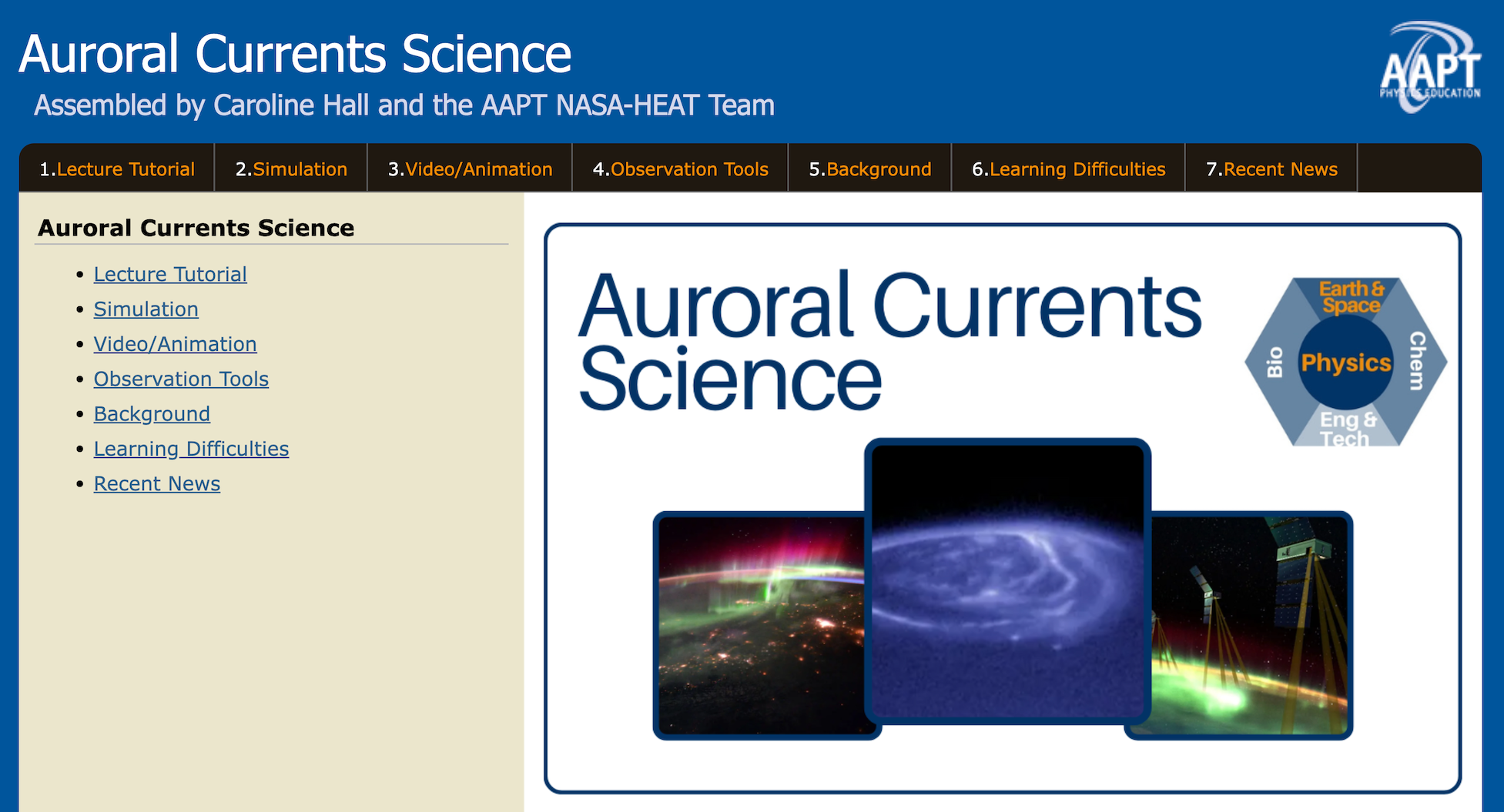
As an example, AAPT’s most recent DigiKit publication, Auroral Currents Science (Figure 1), was developed for educators of advanced high school students and university physics/astronomy majors. DigiKits materials are collected by digital content specialist, Caroline Hall, who searches for high-quality, open digital content and checks it for accuracy and accessibility. The Auroral Currents DigiKit centers around a lecture tutorial that gives students the opportunity to practice and extend their knowledge of magnetic fields produced by current-carrying wires, and relating those understandings to auroral currents – the primary phenomenon underlying the dramatic auroral light shows seen in the sky over the past months.

The corresponding DigiKit includes a collection of relevant simulations, videos/animations, and other teacher resources for background that can help to teach the content in the primary lesson. The DigiKit highlights NASA’s forthcoming Electrojet Zeeman Imaging Explorer (EZIE) mission, including an animation of the relationship between the Earth and space, an explanation of Earth’s electrojets and a visualization of the spacecraft. It also includes links to NASA’s ongoing Magnetospheric Multiscale spacecraft video explanation of magnetic reconnection, among many other useful resources that can be shown in the classroom or explored individually by students. Unique to this DigiKit are recent science news articles covering 2024’s spectacular auroral displays.

The light in the aurora comes from atoms in the ionosphere that have been excited by collisions with electrons that were accelerated between 6000 km and 20000 km above Earth’s surface. Those electrons carry electric currents from space along the magnetic field, but the currents flow horizontally some distance through the ionosphere at about 100-150 km in altitude before returning to space. We call those currents the ionospheric electrojets, and we can see the magnetic effects of the electrojets because electric currents are the source of magnetic fields. The AAPT digikit allows students to explore the magnetic signature of the electrojets and determine the size and location of the currents.

As a result of participation in NASA HEAT, AAPT has produced ten DigiKits, all linked below and available alongside the collection of other tutorials/core resources on the AAPT NASA HEAT page. Although the DigiKits are directed toward teachers, and the lessons are intended for standard classroom contexts, the resources can also be a great introduction to NASA-related concepts and modern science ideas for the general public.

Mechanics

Light and Optics

Magnetism

Eclipses

Are you an educator curious to learn more? Register for AAPT’s monthly mini webinar series, with the next event on November 9, 2024, featuring the Auroral Currents DigiKit core activity.

NASA HEAT is part of the NASA Science Activation Program portfolio. Learn more about how Science Activation connects NASA science experts, real content, and experiences with community leaders to do science in ways that activate minds and promote deeper understanding of our world and beyond: https://science.nasa.gov/learn

Cover image of Auroral Currents DigiKit, displaying three images of glowing auroral ribbons in the Earth’s atmosphere. The DigiKit cover includes the following menu options: 1. Lecture Tutorial, 2. Simulation, 3. Video/Animation, 4. Observation Tools, 5. Background, 6. Learning Difficulties, 7. Recent News.
Figure 1: Cover image of Auroral Currents DigiKit.
Caroline Hall/AAPT NASA-HEAT

Share

Details

Last Updated
Nov 05, 2024
Editor
NASA Science Editorial Team

Powered by WPeMatico

Get The Details…

U.S. Navy Fleet Training Launch to be Conducted at NASA Wallops

U.S. Navy Fleet Training Launch to be Conducted at NASA Wallops

1 min read

Preparations for Next Moonwalk Simulations Underway (and Underwater)

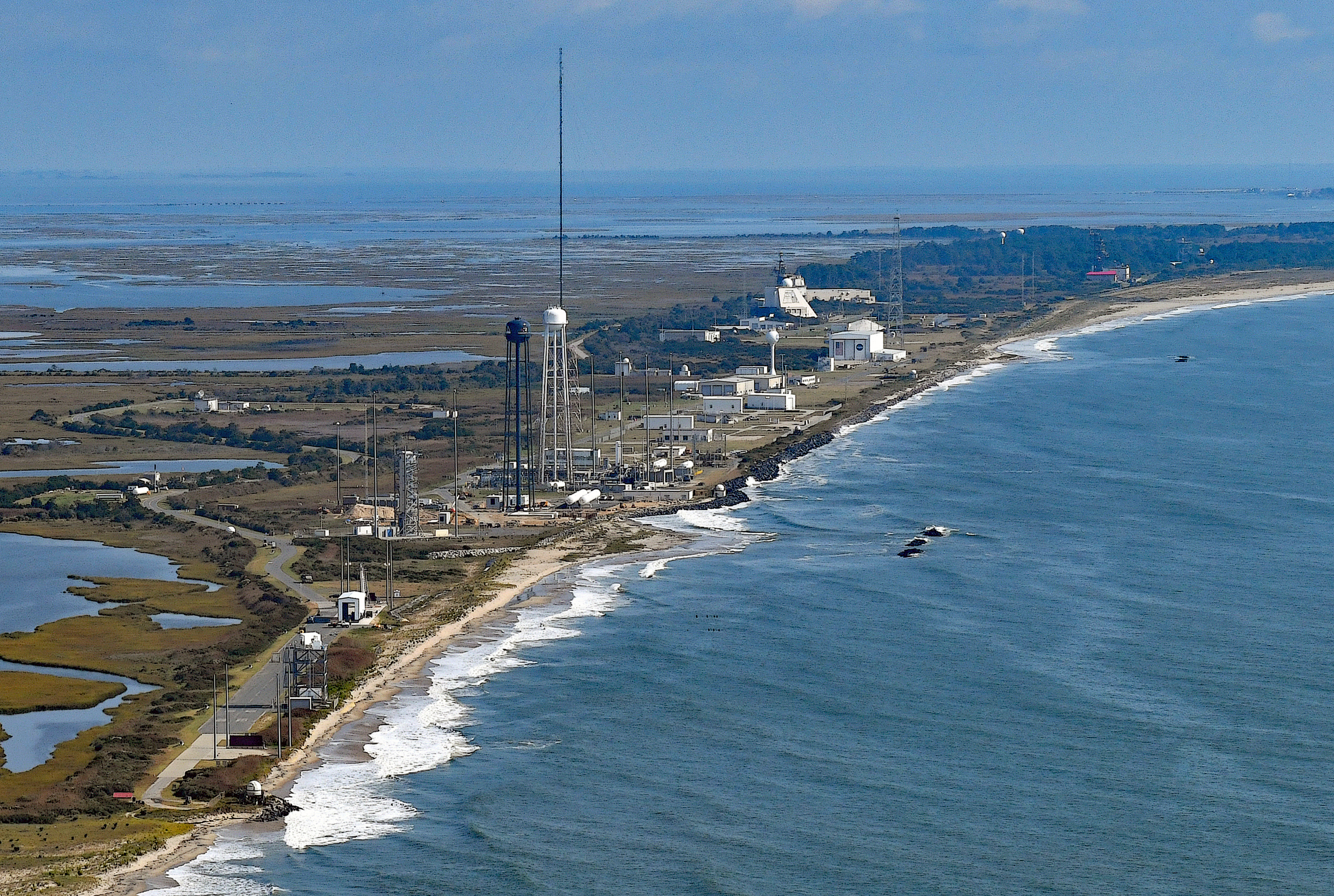
Aerial view of NASA's Wallops Flight Facility's launch range structures along the coastline of Wallops Island, Virginia. Ocean, bay and marsh lands surround the range.
This September 2024 aerial photograph shows the coastal launch range at NASA’s Wallops Flight Facility on Virginia’s Eastern Shore. Wallops is the agency’s only owned-and-operated launch range.
Courtesy Patrick J. Hendrickson; used with permission

A rocket-propelled target is scheduled to launch from NASA’s Wallops Flight Facility in Virginia during a window Thursday, Nov. 7 to Friday, Nov. 8 between 9:30 a.m. and 2:30 p.m. EST both days as part of a U.S. Navy Fleet Training exercise.

No real-time launch status updates will be available. The launch will not be livestreamed nor will launch status updates be provided during the countdown. The rocket launch may be visible from the Chesapeake Bay region.

Share

Details

Last Updated

Nov 05, 2024

Location
Wallops Flight Facility

Related Terms

Powered by WPeMatico

Get The Details…
Amy Barra

From Campus to Cosmos: NASA Grants Boost Student, University Innovation

From Campus to Cosmos: NASA Grants Boost Student, University Innovation

5 min read

Preparations for Next Moonwalk Simulations Underway (and Underwater)

Nicholas Bitner and jesse Rhoades standing in front of machinery in a BiPed lab.
Nicholas Bitner from Candeska Cikana Community College, left, and Jesse Rhoades from the University of North Dakota (UND), right, are pictured in UND’s BiPed lab, where their students test and capture motion data for the Mapi Hapa.
Walter Criswell, UND Today

Human exploration on the lunar surface is no small feat. It requires technologists and innovators from all walks of life to tackle many challenges, including feet. 

From designing astronaut boots, addressing hazardous Moon dust, and researching new ways to land on Mars, NASA is funding valuable research through M-STAR (Minority University Research and Education Project’s (MUREP) Space Technology Artemis Research). The M-STAR program provides opportunities for students and faculty at Minority Serving Institutions to participate in space technology development through capacity building and research grants. With more than $11.5 million awarded since 2020, M-STAR aims to ensure NASA isn’t leaving any potential solution behind. 

Best Foot Forward 

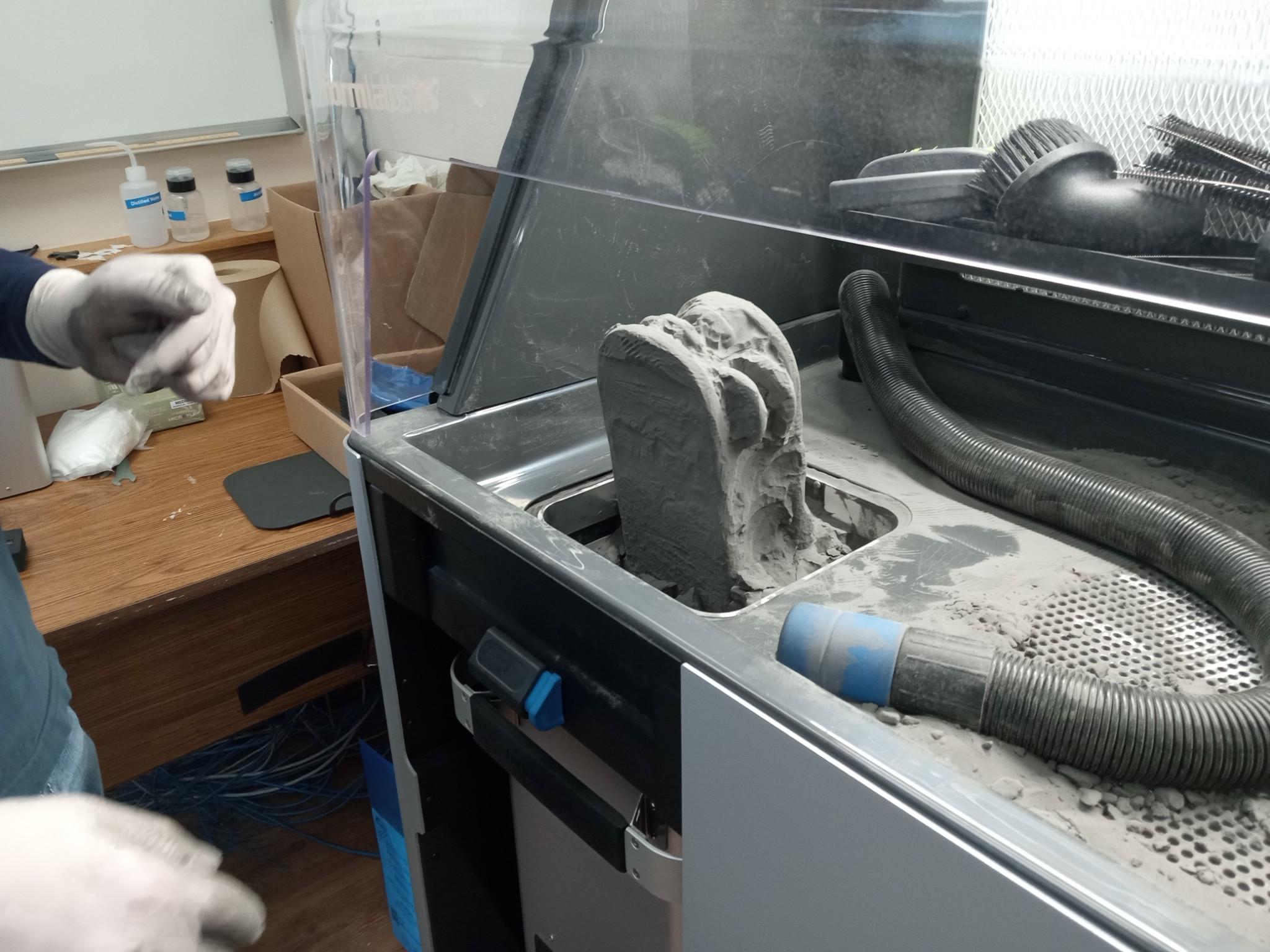
3D printing machine using a gray powder substance.
Candeska Cikana Community College uses selective laser sintering, a type of 3D-printing in which heat and pressure form specific structures using layers of powdered material. Shown here, a student works to remove excess material, in this case a powdered form of nylon with carbon fibers, to reveal a prototype of the “Mapi Hapa,” or “sky shoe.”
Candeska Cikana Community College

Supportive boots are required for astronauts who will perform long duration Artemis missions on the Moon. With astronaut foot health in mind, students and faculty of North Dakota’s Candeska Cikana Community College in Fort Totten and the University of North Dakota in Grand Forks are designing a solution for extravehicular activity Moon boots. The project, called Mapi Hapa, proposes a 3D printed device that helps astronauts achieve the range of motion that takes place in the ankle when you draw your toe back towards the shin. 

Candeska Cikana Community College is a tribal college that serves the Spirit Lake Nation, including the Dakota, Lakota, Sisseton, Wahpeton, and Yanktonai peoples.  

Nicholas Bitner, an instructor at Candeska Cikana and graduate student at the University of North Dakota, notes the unique skills that tribal students possess. “Their perspective, which is unlike that of any other student body, thrives on building with their hands and taking time to make decisions.” 

Bitner also attributes many opportunities and successes of their program to M-STAR and its partnership which exemplifies the dire importance of consistent funding. 

“Given the relationships, we have been able to expand our capabilities and our lab, but it has also given us funding. We were able to hire all our students in the engineering department as lab technicians. So, they get paid to do the research that they are a part of, and not only do they have that psychological ownership, but they also have a good paying job that looks nice on their resumes.”  

In addition to addressing astronaut foot health, M-STAR funding is helping develop solutions to combat lunar regolith, or Moon dust, which can damage landers, spacesuits, and human lungs, if inhaled. 

Lunar Dust Development 

With M-STAR, New Mexico State University in Las Cruces developed affordable, reliable lunar regolith simulants to help test lunar surface technologies. The team also designed testing facilities that mimic environmental conditions on the Moon.   

New Mexico State has already started sharing their simulants, including with a fellow M-STAR awardee. An M-STAR project selected in 2023 from the University of Maryland Eastern Shore in Princess Anne uses the simulants to help test their experience in smart agriculture to test applications for crop production on the Moon. 

Plants growing in plastic bins.
University of Maryland, Eastern Shore explores the possibility of growing crops in lunar regolith by mixing varying proportions of lunar regolith simulant, horse manure, and potting soil. The lunar regolith simulant was provided by fellow M-STAR awardee at New Mexico State University in in Las Cruces.
Stephanie Yeldell/NASA

Douglas Cortez, associate professor in civil engineering at New Mexico State, believes different perspectives are essential to maximizing solutions.  

“There are hundreds of people working at Minority Serving Institutions that are used to looking at the world in a completely different way,” said Cortez. “When they start looking at the same problem and parameters, they come up with very different solutions.” 

As we look to sustainable presence on the Moon, NASA also has its sights set on Mars and M-STAR is helping develop technologies to inform crewed Martian exploration.  

Stick the Landing 

San Diego State University in California was awarded funding for research on Mars entry, descent, and landing technologies. The team aims to achieve optimal trajectory by developing onboard algorithms that guide vehicles to descent autonomously. 

The M-STAR research opportunities have been invaluable to students like Chris Davami and his teammates working to develop improved methods to land on Mars.  

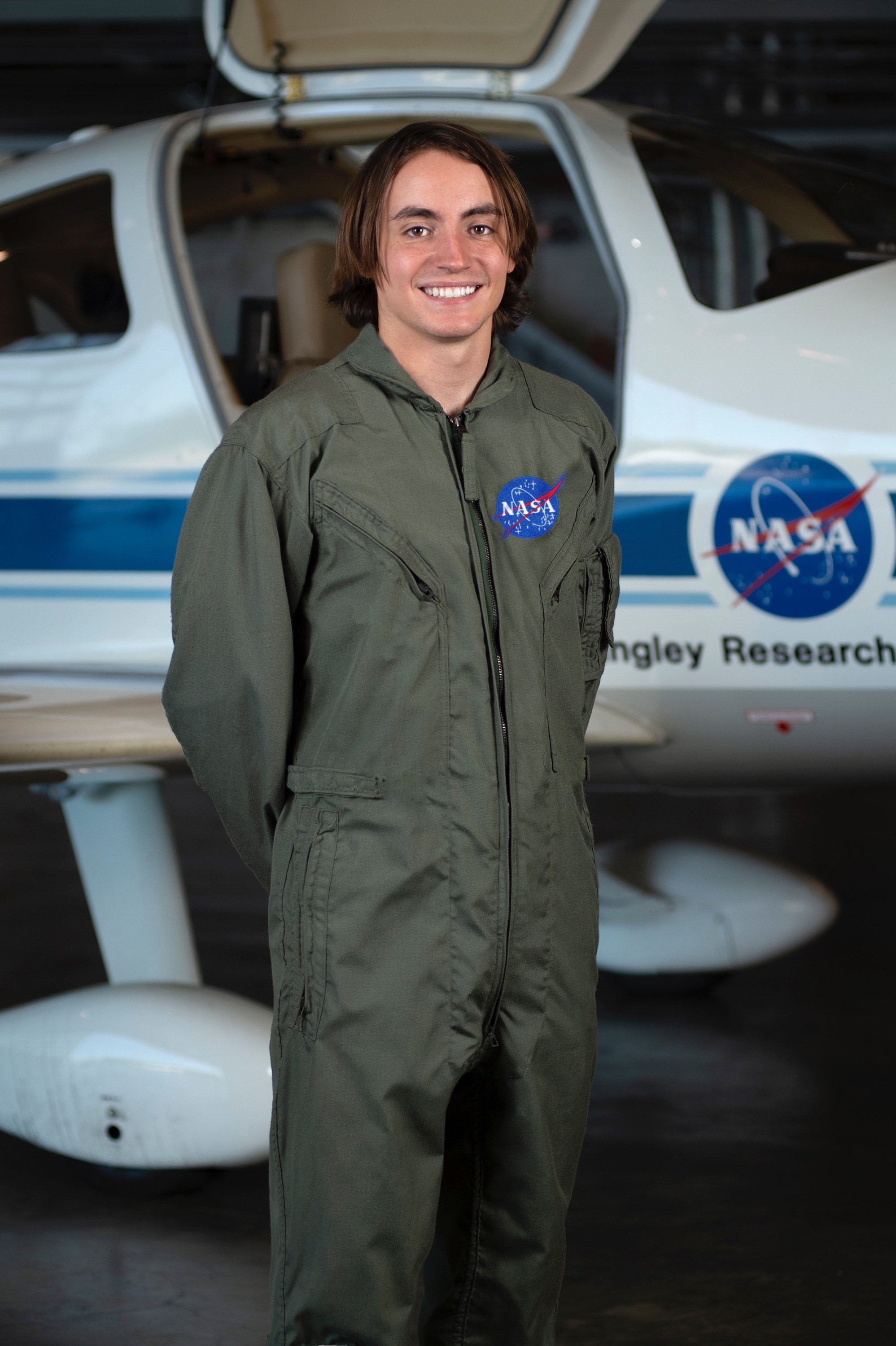
Christopher Davami standing in front of aircraft.
Christopher Davami, who supported San Diego State University’s 2021 M-STAR project, is pictured here at NASA’s Langley Research Center, where he was selected for internships supporting research in aeroelasticity, atmospheric flight, and entry systems research.
NASA

“I would definitely not have been able to have these opportunities with NASA if it weren’t for M-STAR,” said Davami. “M-STAR helped pay for my education, which helped me save a lot in student loans. I probably wouldn’t be going to graduate school right now if I did not have this opportunity. This program enabled me to keep pursuing my research and continue doing what I love.” 

Following his contributions to the M-STAR-funded project, Davami was awarded a NASA Space Technology Graduate Research Opportunity in 2023 on his work in autonomous end-to-end trajectory planning and guidance constrained entry and precision power decent.  

Through efforts like M-STAR, NASA aims to seed the future workforce and prepare colleges and universities to win other NASA research opportunities. When it comes to the advancement of space technology, people of different backgrounds and skillsets are needed to achieve what was once known as impossible. Not only can the diversification of ideas spark fundamental innovations in space, but it can also help students apply these technological advancements to solving problems here on Earth. 

To learn more about M-STAR visit: 

https://go.nasa.gov/442k76s

by: Gabrielle Thaw, NASA’s Space Technology Mission Directorate 

Share

Details

Last Updated

Nov 05, 2024

Editor
Loura Hall

Powered by WPeMatico

Get The Details…
Loura Hall

NASA Science, Cargo Launch on 31st SpaceX Resupply Mission to Station

NASA Science, Cargo Launch on 31st SpaceX Resupply Mission to Station

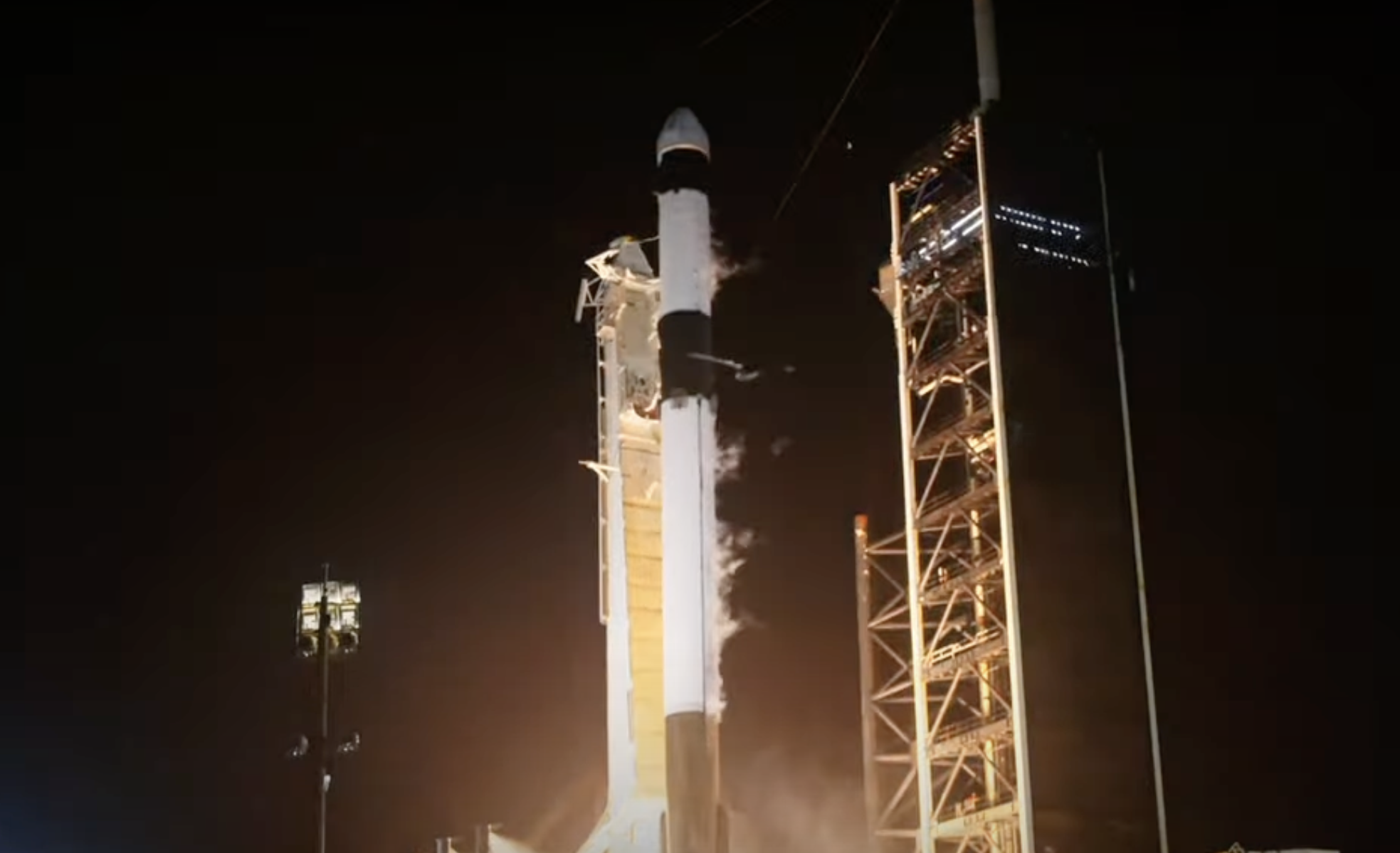
The SpaceX Dragon spacecraft, carrying more than 6,000 pounds of supplies to the orbiting laboratory, lifted off at 9:29 p.m. EST Monday, on the company’s Falcon 9 rocket from Launch Complex 39A at NASA’s Kennedy Space Center in Florida.
Credits: NASA

Following a successful launch of NASA’s SpaceX 31st commercial resupply mission, new scientific experiments and cargo for the agency are bound for the International Space Station.

The SpaceX Dragon spacecraft, carrying more than 6,000 pounds of supplies to the orbiting laboratory, lifted off at 9:29 p.m. EST Monday, on the company’s Falcon 9 rocket from Launch Complex 39A at NASA’s Kennedy Space Center in Florida.

Live coverage of the spacecraft’s arrival will begin at 8:45 a.m. Tuesday, Nov. 5, on NASA+ and the agency’s website. Learn how to watch NASA content through a variety of platforms, including social media.

The spacecraft is scheduled to autonomously dock at approximately 10:15 a.m. to the forward port of the space station’s Harmony module.

The resupply mission will support dozens of research experiments conducted during Expedition 72. In addition to food, supplies, and equipment for the crew, Dragon will deliver several new experiments, including the Coronal Diagnostic Experiment, to examine solar wind and how it forms. Dragon also delivers Antarctic moss to observe the combined effects of cosmic radiation and microgravity on plants. Other investigations aboard include a device to test cold welding of metals in microgravity and an investigation that studies how space impacts different materials.

These are just a sample of the hundreds of investigations conducted aboard the orbiting laboratory in the areas of biology and biotechnology, physical sciences, and Earth and space science. Such research benefits humanity and lays the groundwork for future human exploration through the agency’s Artemis campaign, which will send astronauts to the Moon to prepare for future expeditions to Mars.

The Dragon spacecraft is scheduled to remain at the space station until December when it will depart the orbiting laboratory and return to Earth with research and cargo, splashing down off the coast of Florida.

Learn more about space station activities by following @space_station and @ISS_Research on X, as well as the ISS Facebook, ISS Instagram, and the space station blog.

Learn more about the commercial resupply mission at:

https://www.nasa.gov/mission/nasas-spacex-crs-31

-end-

Claire O’Shea / Josh Finch
Headquarters, Washington
202-358-1100
joshua.a.finch@nasa.gov / claire.a.o’shea@nasa.gov

Stephanie Plucinsky / Steven Siceloff
Kennedy Space Center, Fla.
321-876-2468
stephanie.n.plucinsky@nasa.gov / steven.p.siceloff@nasa.gov

Sandra Jones
Johnson Space Center, Houston
281-483-5111
sandra.p.jones@nasa.gov

Share

Details

Last Updated

Nov 04, 2024

Editor
Jennifer M. Dooren

Powered by WPeMatico

Get The Details…
Jennifer M. Dooren