Commitment to Service Continues at Johnson for Military Retirees

Commitment to Service Continues at Johnson for Military Retirees

NASA and the military have shared strong connections since the agency’s early days. From the nation’s earliest aeronautic research and the recruitment of test pilot astronauts to modern-day technology development, satellite management, and planetary defense, NASA has built a longstanding partnership with the military.

This legacy of collaboration has created natural opportunities for former service members to join NASA’s ranks at the conclusion of their military careers.

Lewis Swain is one of the many veterans working at Johnson Space Center in Houston today. Swain was recruited by NASA contractor McDonnell Douglas after leaving the military in 1980. He commissioned as a second lieutenant and served in the Air Force for 12 years, flying nearly 200 combat missions during two tours in Vietnam.

“The shuttle program was starting, and they needed ex-military pilots to serve as simulation instructors,” he said. Swain specialized in control and propulsion systems instruction for several years before becoming the training team lead for shuttle missions. Following the Challenger accident in 1986, Swain transitioned to supporting the International Space Station Program and Return to Flight evaluations. He has been a civil servant since 1989 and a training facility manager since 2006.

Side-by-side photos showing L. Jerry Swain as a second lieutenant in the Air Force and as a facility manager at Johnson Space Center.
L. Jerry Swain during his Air Force career (left) and as a facility manager at Johnson Space Center in Houston (right).
Images courtesy of L. Jerry Swain

NASA’s Pathways Internship Program has also provided a point of entry for former service members. John Smith was studying mechanical engineering at the University of Texas at El Paso when he made an impactful Johnson connection. “I met with a former flight director, Ms. Ginger Kerrick, at a career fair hosted by my university,” he said. “Pathways happened to be accepting applications at the time and she enthusiastically encouraged me to apply. I never expected to get a response, much less an offer. I couldn’t say yes fast enough when it came!”

For others, the NASA SkillBridge Program has been instrumental in transitioning from the military to civilian careers. The program connects individuals in their final months of military service with a NASA office or organization. SkillBridge fellows work anywhere from 90 to 180 days, contributing their unique skillsets to the agency while building their network and knowledge. Since fellows’ pay and benefits are provided by their military branch, their support comes at no additional cost to NASA.

Johnson hosted the agency’s first-ever SkillBridge fellow in spring 2019, paving the way for many others to follow. Albert Meza, an Air Force space professional, was among this first wave of service members at NASA. 

Approaching retirement from the Air Force in November 2019, Meza planned to move his family back to Houston that summer, then join them in the fall once his military service ended. A colleague encouraged him to apply for SkillBridge because it would let Meza move with his family. Meza was skeptical, noting the military is not typically flexible on moves or timelines, but after a quick meeting with his commanding officer and finding a Johnson team to work with, he was on his way to Houston. “It was unbelievable,” he said. “It kind of fell into my lap.”

Side-by-side photos showing Albert Meza in the Air Force and during his retirement ceremony.
Albert Meza visits Johnson Space Center’s Space Vehicle Mockup Facility while serving in the Air Force (left) and receives an award from NASA astronaut Rex J. Walheim during his retirement ceremony at Space Center Houston (right).
Images courtesy of Albert Meza

Today Meza is a payload integration manager for NASA’s CLPS (Commercial Lunar Payload Services) program, working within the Exploration Architecture, Integration, and Science Directorate at Johnson. In this role, he acts as a liaison between payload teams and the vendor developing a lander to help ensure flight requirements are understood and met.

Meza is also one of SkillBridge’s on-site coordinators. He said that when he first arrived at Johnson, he realized the program was relatively unknown. “I thought, I need to take the responsibility for waving the flag for SkillBridge at NASA.” Meza works tirelessly to educate service members, military leaders, and NASA supervisors about the program’s benefits. He also emphasizes how easy it is for NASA supervisors to host a fellow. “You get someone for six months who is already disciplined, loyal, and has all of these highly trained credentials,” he said. “Any civil servant supervisor can host a SkillBridge fellow. The only real requirement is that the supervisor can provide IT assets and a work location.”

Johnson has hosted more than 25 SkillBridge fellows since the program’s inception. Many fellows have since accepted full-time positions with NASA, including Patricia “Trish” Elliston. Meza found her a SkillBridge position with the center’s Protective Services Division in spring 2023. Elliston relocated to Houston in 2020, a few years prior to her anticipated retirement from the U.S. Coast Guard. Living in Houston and interacting with numerous NASA employees, along with prior experience working with the agency in maritime safety, convinced Elliston that Johnson was the place for her.

Side-by-side pictures of Trish Elliston during her service with the U.S. Coast Guard.
Trish Elliston flies aboard an aircraft during a mission (left) and visits Johnson Space Center’s Space Vehicle Mockup Facility (right) while serving in the U.S. Coast Guard.
Images courtesy of Trish Elliston

“During my internship I networked as much as possible and made every effort to learn as much as I could so that I could be better prepared to start my civilian career,” Elliston said. “I worked hard and learned a lot, and when a job opportunity became available, I applied.” She now works as a cyber intelligence analyst within the Flight Operations Directorate.

Meza notes that SkillBridge is a transition program, not a hiring program, and that some fellows have not received a job offer or have decided to pursue other opportunities. What happens after a SkillBridge fellowship depends on each individual and whether they’ve demonstrated their potential and built relationships in a way that turns this ‘foot in the door’ into a full-time position.  

Interested in becoming a SkillBridge fellow at NASA? Learn more about the program and submit your application here.

Powered by WPeMatico

Get The Details…
Linda E. Grimm

Sols 4359-4361: The Perfect Road Trip Destination For Any Rover!

Sols 4359-4361: The Perfect Road Trip Destination For Any Rover!

2 min read

Sols 4359-4361: The Perfect Road Trip Destination For Any Rover!

A grayscale photograph of the Martian surface from the Curiosity rover captures medium gray, very uneven terrain in front of the rover, with many angular, lighter-toned, medium-sized rocks protruding from the smooth soil. The scene looks like soup with vegetable chunks floating on the surface. The bottom of the frame shows part of the rover, running from the middle left to the lower right corner of the image, including part of its robotic arm which carries a nameplate imprinted with “Curiosity” outlined in all capital letters, and to the right of that a line drawing of the rover.
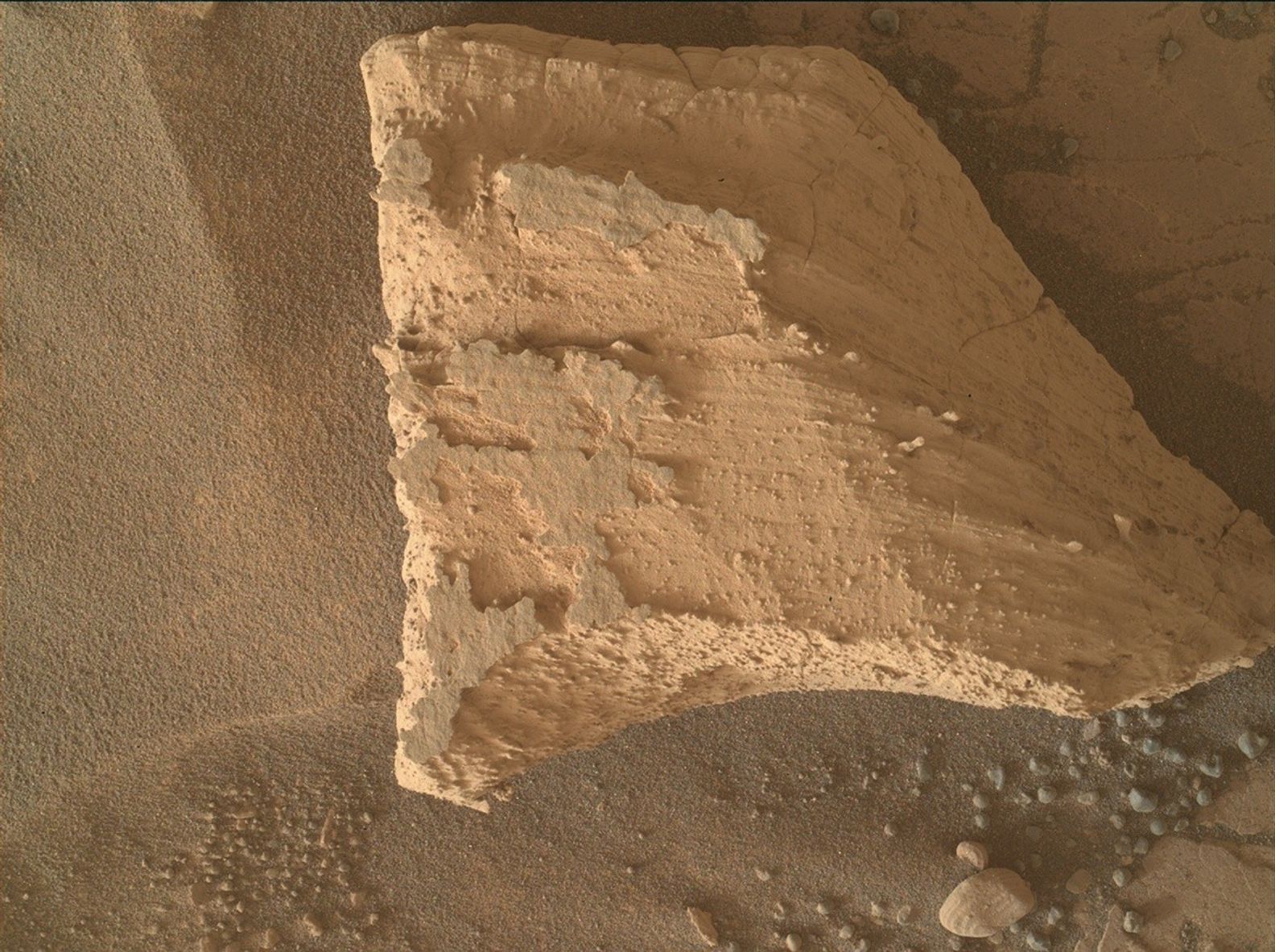
NASA’s Mars rover Curiosity acquired this image of its workspace, which includes several targets for investigation — “Buttress Tree,” “Forester Pass,” “Crater Mountain,” “Mahogany Creek,” and “Filly Lake.” Curiosity used its Left Navigation Camera on Nov. 8, 2024 — sol 4357, or Martian day 4.357, of the Mars Science Laboratory mission — at 00:06:17 UTC.
NASA/JPL-Caltech

Earth planning date: Friday, Nov. 8, 2024

After the excitement of Wednesday’s plan, it was a relief to come in today to hear that the drive toward our exit from Gediz Vallis completed successfully and that we weren’t perched on any rocks or in any other precarious position. This made for a very smooth planning morning, which is always nice on a Friday after a long week. 

But that isn’t to say that Curiosity will be taking it easy for the weekend. Smooth planning means we have lots of time to pack in as much science as we can fit. Today, this meant that the geology group (GEO) got to name eight new targets, and the environmental group (ENV) got to spend some extra time contemplating the atmosphere. Reading through the list of target names from GEO felt a bit like reading a travel guide — top rocks to visit when you’re exiting Gediz Vallis! 

If you look to the front of your rover, what we refer to as the “workspace” (and which you can see part of in the image above), you’ll see an array of rocks. Take in the polygonal fractures of “Colosseum Mountain” and be amazed by the structures of “Tyndall Creek” and “Cascade Valley.” Get up close and personal with our contact science targets, “Mahogany Creek,” “Forester Pass,” and “Buttress Tree.” Our workspace has something for everyone, including the laser spectrometers in the family, who will find plenty to explore with “Filly Lake” and “Crater Mountain.” We have old favorites too, like the upper Gediz Vallis Ridge and the Texoli outcrop. 

After a busy day sightseeing, why not kick back with ENV and take a deep breath? APXS and ChemCam have you covered, watching the changing atmospheric composition. Look up with Navcam and you may see clouds drifting by, or spend some time looking for dust devils in the distance. Want to check the weather before planning your road trip? Our weather station REMS works around the clock, and Mastcam and Navcam are both keeping an eye on how dusty the crater is. 

All good vacations must come to an end, but know that when it’s time to drive away there will be many more thrilling sights to come!

Written by Alex Innanen, Atmospheric Scientist at York University

Share

Details

Last Updated
Nov 11, 2024

Related Terms

Powered by WPeMatico

Get The Details…

Mining Old Data From NASA’s Voyager 2 Solves Several Uranus Mysteries

Mining Old Data From NASA’s Voyager 2 Solves Several Uranus Mysteries

4 min read

Preparations for Next Moonwalk Simulations Underway (and Underwater)

Uranus
NASA’s Voyager 2 captured this image of Uranus while flying by the ice giant in 1986. New research using data from the mission shows a solar wind event took place during the flyby, leading to a mystery about the planet’s magnetosphere that now may be solved.
NASA/JPL-Caltech

NASA’s Voyager 2 flyby of Uranus decades ago shaped scientists’ understanding of the planet but also introduced unexplained oddities. A recent data dive has offered answers.

When NASA’s Voyager 2 spacecraft flew by Uranus in 1986, it provided scientists’ first — and, so far, only — close glimpse of this strange, sideways-rotating outer planet. Alongside the discovery of new moons and rings, baffling new mysteries confronted scientists. The energized particles around the planet defied their understanding of how magnetic fields work to trap particle radiation, and Uranus earned a reputation as an outlier in our solar system.

Now, new research analyzing the data collected during that flyby 38 years ago has found that the source of that particular mystery is a cosmic coincidence: It turns out that in the days just before Voyager 2’s flyby, the planet had been affected by an unusual kind of space weather that squashed the planet’s magnetic field, dramatically compressing Uranus’ magnetosphere.

“If Voyager 2 had arrived just a few days earlier, it would have observed a completely different magnetosphere at Uranus,” said Jamie Jasinski of NASA’s Jet Propulsion Laboratory in Southern California and lead author of the new work published in Nature Astronomy. “The spacecraft saw Uranus in conditions that only occur about 4% of the time.”

Artist’s concept depicts how Uranus’s magnetosphere was behaving before and during the flyby of NASA’s Voyager 2.
The first panel of this artist’s concept depicts how Uranus’s magnetosphere — its protective bubble — was behaving before the flyby of NASA’s Voyager 2. The second panel shows an unusual kind of solar weather was happening during the 1986 flyby, giving scientists a skewed view of the magnetosphere.
NASA/JPL-Caltech

Magnetospheres serve as protective bubbles around planets (including Earth) with magnetic cores and magnetic fields, shielding them from jets of ionized gas — or plasma — that stream out from the Sun in the solar wind. Learning more about how magnetospheres work is important for understanding our own planet, as well as those in seldom-visited corners of our solar system and beyond.

That’s why scientists were eager to study Uranus’ magnetosphere, and what they saw in the Voyager 2 data in 1986 flummoxed them. Inside the planet’s magnetosphere were electron radiation belts with an intensity second only to Jupiter’s notoriously brutal radiation belts. But there was apparently no source of energized particles to feed those active belts; in fact, the rest of Uranus’ magnetosphere was almost devoid of plasma.

The missing plasma also puzzled scientists because they knew that the five major Uranian moons in the magnetic bubble should have produced water ions, as icy moons around other outer planets do. They concluded that the moons must be inert with no ongoing activity.

Solving the Mystery

So why was no plasma observed, and what was happening to beef up the radiation belts? The new data analysis points to the solar wind. When plasma from the Sun pounded and compressed the magnetosphere, it likely drove plasma out of the system. The solar wind event also would have briefly intensified the dynamics of the magnetosphere, which would have fed the belts by injecting electrons into them.

The findings could be good news for those five major moons of Uranus: Some of them might be geologically active after all. With an explanation for the temporarily missing plasma, researchers say it’s plausible that the moons actually may have been spewing ions into the surrounding bubble all along.

Planetary scientists are focusing on bolstering their knowledge about the mysterious Uranus system, which the National Academies’ 2023 Planetary Science and Astrobiology Decadal Survey prioritized as a target for a future NASA mission.

JPL’s Linda Spilker was among the Voyager 2 mission scientists glued to the images and other data that flowed in during the Uranus flyby in 1986. She remembers the anticipation and excitement of the event, which changed how scientists thought about the Uranian system.

“The flyby was packed with surprises, and we were searching for an explanation of its unusual behavior. The magnetosphere Voyager 2 measured was only a snapshot in time,” said Spilker, who has returned to the iconic mission to lead its science team as project scientist. “This new work explains some of the apparent contradictions, and it will change our view of Uranus once again.”

Voyager 2, now in interstellar space, is almost 13 billion miles (21 billion kilometers) from Earth.

News Media Contacts

Karen Fox / Molly Wasser
NASA Headquarters, Washington
202-358-1600
karen.c.fox@nasa.gov / molly.l.wasser@nasa.gov  

Gretchen McCartney
Jet Propulsion Laboratory, Pasadena, Calif.
818-393-6215
gretchen.p.mccartney@jpl.nasa.gov

2024-156

Powered by WPeMatico

Get The Details…
Anthony Greicius

Interview with OCEANOS Instructor María Fernanda Barbarena-Arias

Interview with OCEANOS Instructor María Fernanda Barbarena-Arias

4 min read

Preparations for Next Moonwalk Simulations Underway (and Underwater)

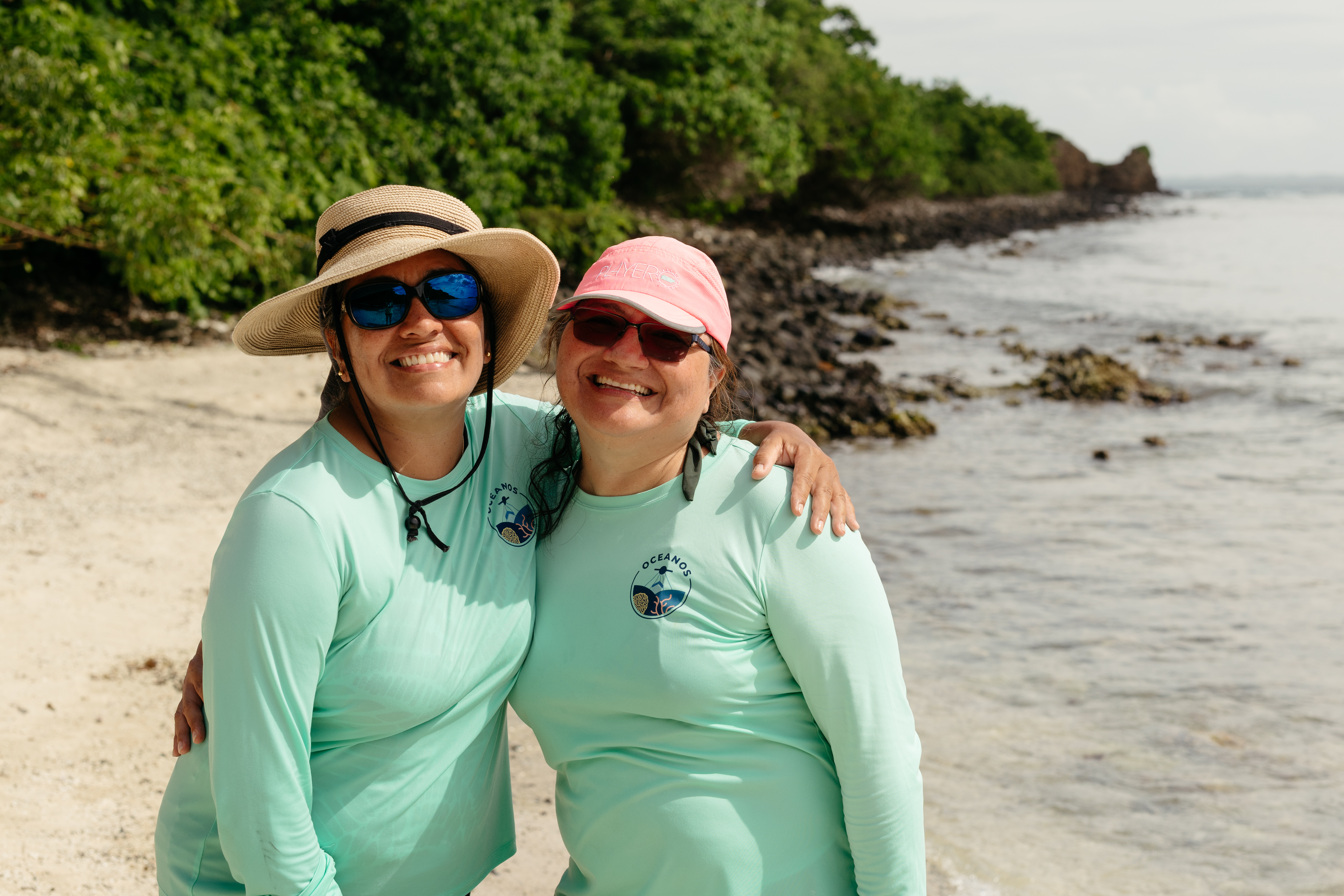
Two Puerto Rican women stand on a beach, both wearing teal longsleeve shirts and sunglasses. The one on the left has a tan, wide-brimmed hat, and the one on the right has a pink baseball cap.
María Fernanda Barbarena-Arias (left), an associate professor of biology and instructor for the OCEANOS internship, stands on the sand of Playa Melones, Culebra Island, during the field work section of the internship.
NASA ARC/Milan Loiacono

What is your name and your role with OCEANOS?

My name is María Fernanda Barbarena-Arias. I am an associate professor of biology at the American University of Puerto Rico, Metropolitan Campus. I am also a co-PI in the OCEANOS project, and an instructor and mentor for the students during the internship.

What is the importance of a program like OCEANOS, especially in Puerto Rico?

I think it makes a difference for the students because it gives them the opportunity to learn and to become familiar with ocean science, and with coastal and marine natural resources. In particular with OCEANOS one of the great [elements] is that usually marine science is offered in the upper system, which is the public university in Puerto Rico, and OCEANOS is engaging a private university where usually students who cannot enter the public system can begin studying. They have those kind of opportunities, because of OCEANOS.

What are some ways you’ve seen the students grow over the course of the internship?

The growth and changes that I’ve seen in students is mostly gaining confidence in the water. I think it’s great! Their first time they are apprehensive, and then as time passes and they engage more into their projects they seem much more familiar with swimming. The students also become more familiar and more confident on their projects. The first time they try to collect data they ask a lot of questions, and then by the third day they already know what to do. They are really empowered and I love that.

What is something you hope the students take with them after this program?

I hope that the students learn and become voices to help spread the word about natural sciences: we can study it and work in marine science. Usually in Puerto Rico, natural sciences are seen like a first step when you’re going to be focused in medical science or human health-related disciplines, and so that’s in some ways the tradition; it’s what the public knows. I hope this experience helped the students to spread the word that other kinds of careers are an alternative. I also hope it made them aware that we live in a vulnerable island and that we need to take action to become conscious, and to take action to be ready and to protect our natural resources.

How did you become involved in marine science, and eventually OCEANOS?

I actually come from Colombia. I did a bachelors degree in biology there and a minor in entomology, because at that point in my life I wanted to work in agriculture and to do pest control. But then I took a class on insect ecology, and I had to do a project and that’s when I discovered that my passion is ecology. So I applied to the University of Puerto Rico and I came here and did my master’s and my bachelor’s in tropical biology, but actually related to forests. But in the meantime I got married to a Puerto Rican guy, so I decided to stay here.

Three years later I was able to land a permanent position as a faculty in a private university, and I realized that I didn’t like the way we usually teach science in the classroom. So I began taking trainings and looking for opportunities to mentor students and to teach students in non-traditional settings. I got involved in many projects and I have a strong collaboration with University of Maryland, and we have had these kinds of projects/training/research opportunities for students outside the classroom for many years. And that I why I think one PI called me and invited me to OCEANOS, and here I am.

Powered by WPeMatico

Get The Details…
Milan Loiacono

Interview with OCEANOS Instructor Samuel Suleiman

Interview with OCEANOS Instructor Samuel Suleiman

3 min read

Preparations for Next Moonwalk Simulations Underway (and Underwater)

A Puerto Rican man with a bushy white beard, green bucket hat, teal longsleeve shirt, and black shorts gestures to a group of high school students wearing neon orange shirts.
Samuel Suleiman, an instructor for the OCEANOS internship, teaches students about sargassum and shore ecology on Culebra Island, Puerto Rico, during the fieldwork section of the project. Suleiman is also the Executive Director of Sociedad Ambiente Marino: a Puerto Rican NGO that works in conservation and coral reef restoration.
NASA ARC/Milan Loiacono

What is your name and your role with OCEANOS?

My name is Samuel Suleiman and I am the Executive Director of Sociedad Ambiente Marino: an NGO in Puerto Rico that has been working for the last 25 years to conserve our coastline and our reefs. During the OCEANOS internship, I am one of the Co-PIs (a co-instructor) for the project, and I’m in charge of the marine ecosystem in Culebra Island.  

What is the importance of a program like OCEANOS, especially in Puerto Rico?

The OCEANOS internship is pretty important for those students that don’t have the opportunity to go directly to our natural resources. Puerto Rico is an archipiélago – an island surrounded with other small islands  – and most of the population that we have on the island doesn’t appreciate or understand or protect our resources, because they haven’t had the opportunity to learn about it. OCEANOS provide this experience for these kids and also allows them to grow in different areas; not just in the in the lectures and the information and the marine science data, but also about working together as collaborators.

What are some ways you’ve seen the students grow over the course of the internship?

They have become more confident in the water compared to where we started, and they have start collaborating amongst themselves in their different research groups. They have also been changing their minds and attitudes, [which is] what we need for a better Puerto Rico and a better world.

How did you get into science?

I started in science because I wanted to be a pediatrician when I was a kid. I started in the Natural Science College at the University of Puerto Rico, then I changed to education in science. And I try to mix together my experience from the past: I almost drowned when I was five years old. Instead of paralyzing myself with fear of the water, I tried to explore, and I have been exploring since then; since I was five years old. Every time that I have the opportunity, I learn something new from the ocean.

What is something that has been rewarding about working with these students?

I think that we have to create a new kind of people that protect our resources. People that are willing to take what is needed to make a better world, and a better Puerto Rico.

What is something you hope the students take with them after this program?

I hope they feel a sense of belonging with the ocean, our coastline, our beaches, our resources, our reefs, our marine ecosystems. And I hope they can be ambassadors of these places.

Powered by WPeMatico

Get The Details…
Milan Loiacono