James Gentile: Shaping the Artemis Generation, One Simulation at a Time 

James Gentile: Shaping the Artemis Generation, One Simulation at a Time 

James Gentile always wanted to fly. As he prepared for an appointment to the U.S. Air Force Academy to become a pilot, life threw him an unexpected curve: a diagnosis of Type 1 diabetes. His appointment was rescinded. 

With his dream grounded, Gentile had two choices—give up or chart a new course. He chose the latter, pivoting to aerospace engineering. If he could not be a pilot, he would design the flight simulations that trained those who could. 

Official portrait of James Gentile.
NASA/Robert Markowitz 

As a human space vehicle simulation architect at NASA’s Johnson Space Center in Houston, Gentile leads the Integrated Simulation team, which supports the Crew Compartment Office within the Simulation and Graphics Branch. He oversees high-fidelity graphical simulations that support both engineering analysis and flight crew training for the Artemis campaign. 

His team provides critical insight into human landing system vendor designs, ensuring compliance with NASA’s standards. They also develop human-in-the-loop simulations to familiarize teams with the challenges of returning humans to the lunar surface, optimizing design and safety for future space missions. 

“I take great pride in what I have helped to build, knowing that some of the simulations I developed have influenced decisions for the Artemis campaign,” Gentile said.  

One of the projects he is most proud of is the Human Landing System CrewCo Lander Simulation, which helps engineers and astronauts tackle the complexities of lunar descent, ascent, and rendezvous. He worked his way up from a developer to managing and leading the project, transforming a basic lunar lander simulation into a critical tool for the Artemis campaign. 

What began as a simple model in 2020 is now a key training asset used in multiple facilities at Johnson. The simulation evaluates guidance systems and provides hands-on piloting experience for lunar landers. 

Five people pose for a group photo in a dark lit room in front of two blue monitor screens.
James Gentile in the Simulation Exploration and Analysis Lab during a visit with Apollo 16 Lunar Module Pilot Charlie Duke. From left to right: Katie Tooher, Charlie Duke, Steve Carothers, Mark Updegrove, and James Gentile.
NASA/James Blair

Before joining Johnson as a contractor in 2018, Gentile worked in the aviation industry developing flight simulations for pilot training. Transitioning to the space sector was challenging at first, particularly working alongside seasoned professionals who had been part of the space program for years. 

“I believe my experience in the private sector has benefited my career,” he said. “I’ve been able to bring a different perspective and approach to problem-solving that has helped me advance at Johnson.” 

Gentile attributes his success to never being afraid to speak up and ask questions. “You don’t always have to be the smartest person in the room to make an impact,” he said. “I’ve been able to show my value through my work and by continuously teaching myself new skills.” 

As he helps train the Artemis Generation, Gentile hopes to pass on his passion for aerospace and simulation development, inspiring others to persevere through obstacles and embrace unexpected opportunities. 

“The most important lessons I’ve learned in my career are to build and maintain relationships with your coworkers and not to be afraid to step out of your comfort zone,” he said.  

A man, left, kneels down next to a boy with a mockup of an astronaut spacesuit behind them.
James Gentile with his son at NASA’s Johnson Space Center during the 2024 Bring Youth to Work Day.

His journey did not go as planned, but in the end, it led him exactly where he was meant to be—helping humanity take its next giant leap. 

“I’ve learned that the path to your goals may not always be clear-cut, but you should never give up on your dreams,” Gentile said. 

Powered by WPeMatico

Get The Details…
Sumer Loggins
Hubble Unveils a Glittering View of Sh2-284

Hubble Unveils a Glittering View of Sh2-284

2 min read

Hubble Unveils a Glittering View of Sh2-284

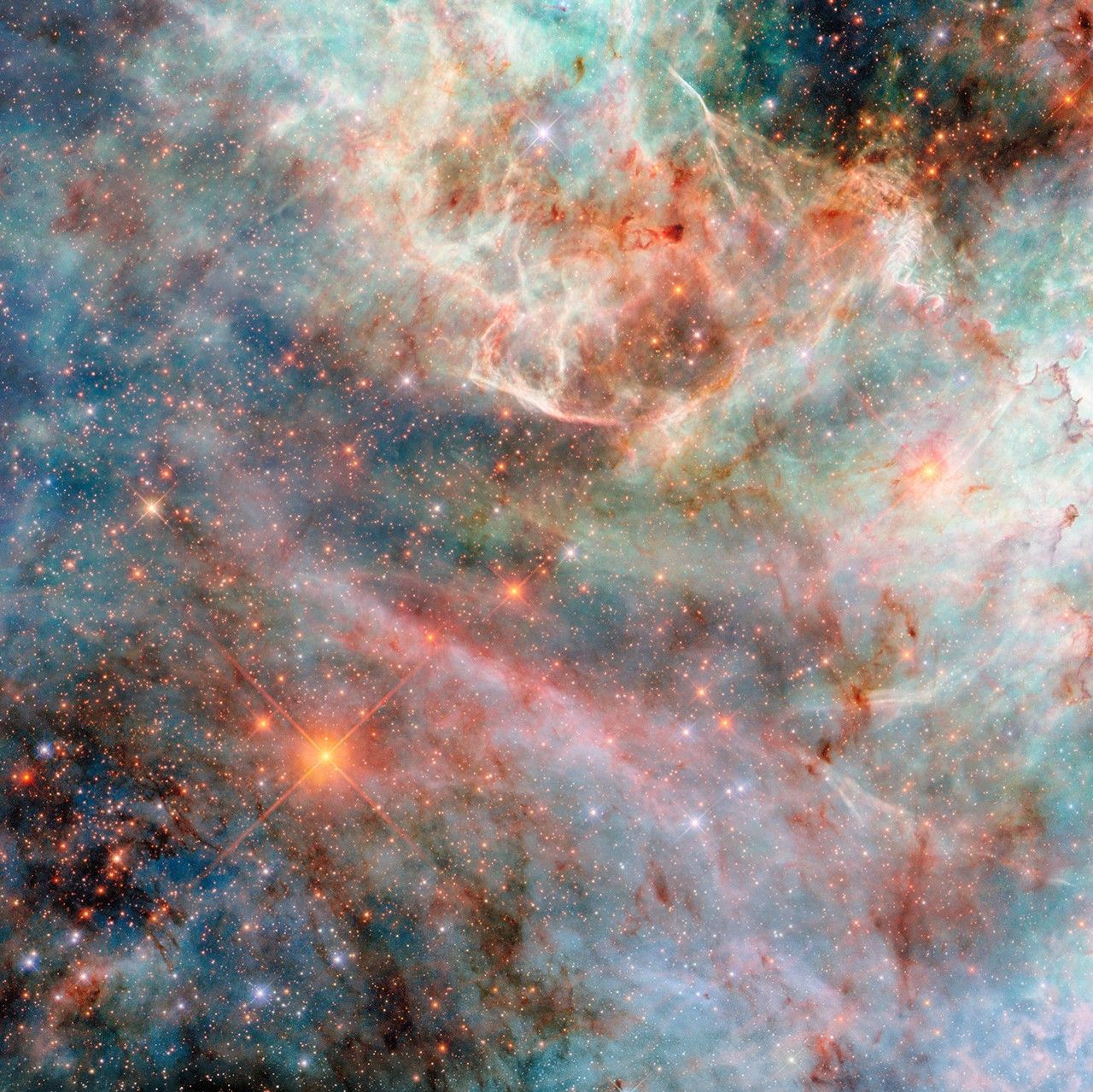
Against the dark background of space, pale, misty clouds of gas and dust are liberally sprinkled with blue and pink stars. Some bright pink patches of clustered stars are visible, as are dark brown knots of dust.
Hubble’s infrared view of emission nebula Sh2-284 provides a glimpse of the brilliant young stars hidden within clouds of gas and dust.
Credit: NASA, ESA, and M. Andersen (European Southern Observatory – Germany); Processing: Gladys Kober (NASA/Catholic University of America)

A tiny fraction of the stellar nursery known as Sh2-284 is visible in this glittering, star-filled NASA Hubble Space Telescope image. This immense region of gas and dust is the birthing place of stars, which shine among the clouds. Bright clusters of newborn stars glow pink in infrared light, and clouds of gas and dust, resembling puffy cumulus clouds, are dotted with dark knots of denser dust.

This image shows an infrared view from Hubble, giving an excellent view of the stars that might otherwise be obscured by Sh2-284’s clouds. Unlike visible light, infrared wavelengths can travel through clouds of gas and dust, providing a glimpse of the stars forming within the obscuring clouds.

The nebula is shaped by a young central star cluster, Dolidze 25 (not visible in the Hubble image), whose stars range from 1.5 to 13 million years old (our Sun, in contrast, is 4.6 billion years old). The cluster blasts out ionizing winds and radiation, pushing at the gas and dust of the nebula and carving out intricate shapes and pillars, as seen in detail here. This ionizing radiation gives Sh2-284 its classification as an HII region, an emission nebula consisting primarily of ionized hydrogen. An emission nebula like Sh2-284 glows with its own light as stars within or nearby energize its gas with a flood of intense ultraviolet radiation.

Reddish-colored, ground-based image of Shw-284 (top) contains a box that shows the location of the smaller but more detailed Hubble image (bottom). The gas clouds are more prominent in the ground-based image.
The ground-based image (top) of M24 shows the location of the Hubble view (bottom). The European Southern Observatory’s visible-light image shows prominent clouds of gas and dust, while the Hubble image’s infrared vision highlights the stars within and behind the clouds.
Ground-based image: ESO/VPHAS+ Team; Hubble image: NASA, ESA, and M. Andersen (European Southern Observatory – Germany); Processing: Gladys Kober (NASA/Catholic University of America)

Sh2-284 is also a low-metallicity region, which means it is poor in elements heavier than hydrogen and helium. These conditions mimic the early universe, when matter was mostly helium and hydrogen and heavier elements were just beginning to form via nuclear fusion within massive stars. Hubble took these images as part of an effort to examine how low metallicity influences stellar formation and how this would apply to the early universe.

Sh2-284 resides 15,000 light-years away at the end of an outer spiral arm of our Milky Way galaxy, in the constellation Monoceros.

Explore More

Media Contact:

Claire Andreoli
NASA’s Goddard Space Flight CenterGreenbelt, MD
claire.andreoli@nasa.gov

Powered by WPeMatico

Get The Details…

Hubble Jams With A Cosmic Guitar

Hubble Jams With A Cosmic Guitar

3 min read

Hubble Jams With A Cosmic Guitar

An elliptical galaxy (upper left) and a spiral galaxy (lower right) are connected by a stream of drawn-out gas. Two significant bright blue blobs of star formation are visible on the outskirts of the spiral galaxy, and another extends away from the center of the elliptical. A long tail is visible extending from the spiral galaxy.
Elliptical galaxy NGC 3561B (upper left) and spiral galaxy NGC 3561A (lower right) form a shimmering guitar shape in the ongoing merger known collectively as Arp 105.
NASA, ESA and M. West (Lowell Observatory); Processing: Gladys Kober (NASA/Catholic University of America)

Arp 105 is a dazzling ongoing merger between an elliptical galaxy and a spiral galaxy drawn together by gravity, characterized by a long, drawn out tidal tail of stars and gas more than 362,000 light-years long. The immense tail, which extends beyond this image from NASA’s Hubble Space Telescope, was pulled from the two galaxies by their gravitational interactions and is embedded with star clusters and dwarf galaxies. The distinctively shaped arrangement of galaxies and tail gives the grouping its nickname: The Guitar.

The gravitational dance between elliptical galaxy NGC 3561B and spiral galaxy NGC 3561A creates a wealth of fascinating colliding galaxy features. A long lane of dark dust emerging from the elliptical galaxy ends in, and may be feeding, a bright blue area of star formation on the base of the guitar known as Ambartsumian’s Knot. Ambartsumian’s Knot is a tidal dwarf galaxy, a type of star-forming system that develops from the debris in tidal arms of interacting galaxies.

Two more bright blue areas of star formation are obvious in the Hubble image at the edges of the distorted spiral galaxy. The region to the left in the spiral galaxy is likely very similar to Ambartsumian’s Knot, a knot of intense star formation triggered by the merger. The region to the right is still under investigation ― it could be part of the collision, but its velocity and spectral data (indicating distance) are different from the rest of the system, so it may be a foreground galaxy.

Thin, faint tendrils of gas and dust are just barely visible stretching between and connecting the two galaxies. These tendrils are particularly interesting to astronomers since they may help define the timescale of the evolution of this collision.

A multitude of more-distant background galaxies are visible around and even through this merging duo. The bright blue blob of stars to the left of Ambartsumian’s Knot may be a particularly bright background galaxy.

Arp 105 is one of the brightest objects in the crowded galaxy cluster Abell 1185 in the constellation Ursa Major. Abell 1185, located around 400 million light-years away, is a chaotic cluster of at least 82 galaxies, many of which are interacting, as well as a number of wandering globular clusters that are not gravitationally attached to any particular galaxy. This Hubble image was taken as part of a study of the ongoing creation of galactic and intergalactic stellar populations in Abell 1185.

Explore More

Media Contact:

Claire Andreoli (claire.andreoli@nasa.gov)
NASA’s Goddard Space Flight CenterGreenbelt, MD

Powered by WPeMatico

Get The Details…

Hubble Spies a Spectacular Starburst Galaxy

Hubble Spies a Spectacular Starburst Galaxy

2 min read

Hubble Spies a Spectacular Starburst Galaxy

A spiral galaxy with one especially large sweeping, curving arm in view to the left. The galaxy's core glows golden. Pink clumps of ionized hydrogen and blue clusters of stars, along with dark dust lanes, are visible in the arms. Some of the galaxy is cut off  to the right.
Starburst spiral NGC 4536 is bright with blue clusters of star formation and pink clumps of ionized hydrogen.
NASA, ESA, and J. Lee (Space Telescope Science Institute); Processing: Gladys Kober (NASA/Catholic University of America) 

Sweeping spiral arms extend from NGC 4536, littered with bright blue clusters of star formation and red clumps of hydrogen gas shining among dark lanes of dust. The galaxy’s shape may seem a little unusual, and that’s because it’s what’s known as an “intermediate galaxy”: not quite a barred spiral, but not exactly an unbarred spiral, either ― a hybrid of the two.

NGC 4536 is also a starburst galaxy, in which star formation is happening at a tremendous rate that uses up the gas in the galaxy relatively quickly, by galactic standards. Starburst galaxies can happen due to gravitational interactions with other galaxies or ― as seems to be the case for NGC 4536 ― when gas is packed into a small region. The bar-like structure of NGC 4536 may be driving gas inwards toward the nucleus, giving rise to a crescendo of star formation in a ring around the nucleus. Starburst galaxies birth lots of hot blue stars that burn fast and die quickly in explosions that unleash intense ultraviolet light (visible in blue), turning their surroundings into glowing clouds of ionized hydrogen, called HII regions (visible in red).

NGC 4536 is approximately 50 million light-years away in the constellation Virgo. It was discovered in 1784 by astronomer William Herschel. Hubble took this image of NGC 4536 as part of a project to study galactic environments to understand connections between young stars and cold gas, particularly star clusters and molecular clouds, throughout the local universe.

Explore More

Media Contact:

Claire Andreoli
NASA’s Goddard Space Flight CenterGreenbelt, MD
claire.andreoli@nasa.gov

Powered by WPeMatico

Get The Details…

Hubble Examines Stars Ensconced in a Cocoon of Gas

Hubble Examines Stars Ensconced in a Cocoon of Gas

2 min read

Hubble Examines Stars Ensconced in a Cocoon of Gas

Two bulbous, bluish clouds of gas against a field of multi-colored stars. Stars shine within the clouds as well as outside.
NGC 460 is an open cluster of stars within a greater collection of nebulae and star clusters known as the N83-84-85 complex.
NASA, ESA, and C. Lindberg (The Johns Hopkins University); Processing: Gladys Kober (NASA/Catholic University of America)

An open cluster of stars shines through misty, cocoon-like gas clouds in this Hubble Space Telescope image of NGC 460.

NGC 460 is located in a region of the Small Magellanic Cloud, a dwarf galaxy that orbits the Milky Way. This particular region contains a number of young star clusters and nebulae of different sizes ― all likely related to each other. The clouds of gas and dust can give rise to stars as portions of them collapse, and radiation and stellar winds from those hot, young bright stars in turn shape and compress the clouds, triggering new waves of star formation. The hydrogen clouds are ionized by the radiation of nearby stars, causing them to glow.

The NGC 460 star cluster resides in one of the youngest parts of this interconnected complex of stellar clusters and nebulae, which is also home to a number of O-type stars: the brightest, hottest and most massive of the normal, hydrogen-burning stars (called main-sequence stars) like our Sun. O-type stars are rare ― out of more than 4 billion stars in the Milky Way, only about 20,000 are estimated to be O-type stars. The area that holds NGC 460, known as N83, may have been created when two hydrogen clouds in the region collided with one another, creating several O-type stars and nebulae.

Open clusters like NGC 460 are made of anywhere from a few dozen to a few thousand stars loosely knitted together by gravity. Open clusters generally contain young stars, which may migrate outward into their galaxies as time progresses. NGC 460’s stars may someday disperse into the Small Magellanic Cloud, one of the Milky Way’s closest galactic neighbors at about 200,000 light-years away. Because it is both close and bright, it offers an opportunity to study phenomena that are difficult to examine in more distant galaxies.

Six overlapping observations from a study of the gas and dust between stars, called the interstellar medium, were combined to create this Hubble image. The study aims to understand how gravitational forces between interacting galaxies can foster bursts of star formation. This highly detailed 65 megapixel mosaic includes both visible and infrared wavelengths. Download the 400 MB file and zoom in to see some of the intricacies captured by Hubble.

Explore More

Media Contact:

Claire Andreoli
NASA’s Goddard Space Flight CenterGreenbelt, MD
claire.andreoli@nasa.gov

Powered by WPeMatico

Get The Details…