NASA to Launch SNIFS, Sun’s Next Trailblazing Spectator

NASA to Launch SNIFS, Sun’s Next Trailblazing Spectator

4 min read

NASA to Launch SNIFS, Sun’s Next Trailblazing Spectator

July will see the launch of the groundbreaking Solar EruptioN Integral Field Spectrograph mission, or SNIFS. Delivered to space via a Black Brant IX sounding rocket, SNIFS will explore the energy and dynamics of the chromosphere, one of the most complex regions of the Sun’s atmosphere. The SNIFS mission’s launch window at the White Sands Missile Range in New Mexico opens on Friday, July 18. 

The chromosphere is located between the Sun’s visible surface, or photosphere, and its outer layer, the corona. The different layers of the Sun’s atmosphere have been researched at length, but many questions persist about the chromosphere. “There’s still a lot of unknowns,” said Phillip Chamberlin, a research scientist at the University of Colorado Boulder and principal investigator for the SNIFS mission.  

A total solar eclipse showing the dark silhouette of the Moon completely covering the Sun, with the Sun’s bright corona radiating around the edges against a dark sky. A faint sliver of red appears on the upper right of the eclipse, showing the Sun's chromosphere.
The reddish chromosphere is visible on the Sun’s right edge in this view of the Aug. 21, 2017, total solar eclipse from Madras, Oregon.
Credit: NASA/Nat Gopalswamy

The chromosphere lies just below the corona, where powerful solar flares and massive coronal mass ejections are observed. These solar eruptions are the main drivers of space weather, the hazardous conditions in near-Earth space that threaten satellites and endanger astronauts. The SNIFS mission aims to learn more about how energy is converted and moves through the chromosphere, where it can ultimately power these massive explosions.  

“To make sure the Earth is safe from space weather, we really would like to be able to model things,” said Vicki Herde, a doctoral graduate of CU Boulder who worked with Chamberlin to develop SNIFS.  

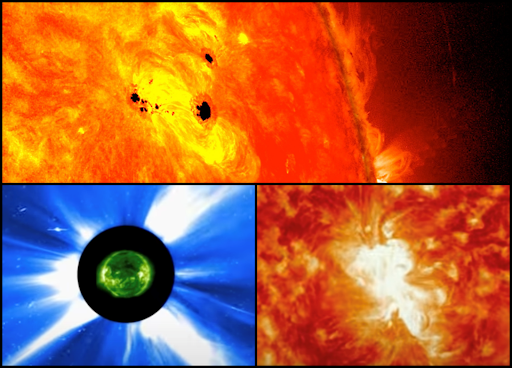
This footage from NASA’s Solar Dynamics Observatory shows the Sun in the 304-angstrom band of extreme ultraviolet light, which primarily reveals light from the chromosphere. This video, captured on Feb. 22, 2024, shows a solar flare — as seen in the bright flash on the upper left.
Credit: NASA/SDO

The SNIFS mission is the first ever solar ultraviolet integral field spectrograph, an advanced technology combining an imager and a spectrograph. Imagers capture photos and videos, which are good for seeing the combined light from a large field of view all at once. Spectrographs dissect light into its various wavelengths, revealing which elements are present in the light source, their temperature, and how they’re moving — but only from a single location at a time. 

The SNIFS mission combines these two technologies into one instrument.  

“It’s the best of both worlds,” said Chamberlin. “You’re pushing the limit of what technology allows us to do.” 

By focusing on specific wavelengths, known as spectral lines, the SNIFS mission will help scientists to learn about the chromosphere. These wavelengths include a spectral line of hydrogen that is the brightest line in the Sun’s ultraviolet (UV) spectrum, and two spectral lines from the elements silicon and oxygen. Together, data from these spectral lines will help reveal how the chromosphere connects with upper atmosphere by tracing how solar material and energy move through it. 

The SNIFS mission will be carried into space by a sounding rocket. These rockets are effective tools for launching and carrying space experiments and offer a valuable opportunity for hands-on experience, particularly for students and early-career researchers.

Three people stand smiling in front of a tall, silver rocket inside an industrial workshop. The workspace contains equipment, tools, a forklift, and an Air Force flag hanging above.
(From left to right) Vicki Herde, Joseph Wallace, and Gabi Gonzalez, who worked on the SNIFS mission, stand with the sounding rocket containing the rocket payload at the White Sands Missile Range in New Mexico.
Credit: courtesy of Phillip Chamberlin

“You can really try some wild things,” Herde said. “It gives the opportunity to allow students to touch the hardware.” 

Chamberlin emphasized how beneficial these types of missions can be for science and engineering students like Herde, or the next generation of space scientists, who “come with a lot of enthusiasm, a lot of new ideas, new techniques,” he said. 

The entirety of the SNIFS mission will likely last up to 15 minutes. After launch, the sounding rocket is expected to take 90 seconds to make it to space and point toward the Sun, seven to eight minutes to perform the experiment on the chromosphere, and three to five minutes to return to Earth’s surface.  

A previous sounding rocket launch from the White Sands Missile Range in New Mexico. This mission carried a copy of the Extreme Ultraviolet Variability Experiment (EVE).
Credit: NASA/University of Colorado Boulder, Laboratory for Atmospheric and Space Physics/James Mason

The rocket will drift around 70 to 80 miles (112 to 128 kilometers) from the launchpad before its return, so mission contributors must ensure it will have a safe place to land. White Sands, a largely empty desert, is ideal. 

Herde, who spent four years working on the rocket, expressed her immense excitement for the launch. “This has been my baby.” 

By Harper Lawson
NASA’s Goddard Space Flight Center, Greenbelt, Md.

Powered by WPeMatico

Get The Details…

Space Station Crew Celebrates Milestone

Space Station Crew Celebrates Milestone

Anne McClain, a white woman with short brown hair, floats while pointing downward with her right hand. Her left hand holds something that looks almost like a cake tin in place. There is a hamburger-shaped cake in the "cake tin." There are dessert ingredients on the surface to the left.
NASA/Jonny Kim

In this June 13, 2025, photo, NASA astronaut Anne McClain shows off a hamburger-shaped cake to celebrate 200 cumulative days in space for JAXA (Japan Aerospace Exploration Agency) astronaut Takuya Onishi since his first spaceflight as an Expedition 48-49 Flight Engineer in 2016.

Onishi and McClain launched to the International Space Station along with NASA astronaut Nichole Ayers and Roscosmos cosmonaut Kirill Peskov on March 14, 2025, as part of the Crew-10 mission. Aboard the orbital laboratory, the Crew-10 members conduct scientific research to prepare for human exploration beyond low Earth orbit and benefit humanity on Earth. McClain and Ayers also performed a spacewalk on May 1, 2025 – McClain’s third and Ayers’ first.

Check out the International Space Station blog to follow the crew’s research and other activities.

Image credit: NASA/Jonny Kim

Powered by WPeMatico

Get The Details…
Monika Luabeya

Registration Opens for 2025 NASA International Space Apps Challenge

Registration Opens for 2025 NASA International Space Apps Challenge

3 min read

Preparations for Next Moonwalk Simulations Underway (and Underwater)

Six people look at a laptop computer in a classroom setting. Four wear blue t-shirts, one wears a white jacket, and one wears a plaid shirt with a black vest.
A team works together on their project during the 2024 NASA Space Apps Challenge event in in Arequipa, Peru. Teams have two days to respond to the challenges and submit their project for the chance to win one of 10 global awards.

Lee esta historia en español aquí

NASA invites innovators of all ages to register for the NASA Space Apps Challenge, held on Oct. 4-5. The 2025 theme is Learn, Launch, Lead, and participants will work alongside a vibrant community of scientists, technologists, and storytellers at more than 450 events worldwide. Participants can expect to learn skills to succeed in STEM fields, launch ideas that transform NASA’s open data into actionable tools, and lead their communities in driving technological innovation.
 
During the NASA Space Apps Challenge, participants in the U.S. and around the world gather at hundreds of in-person and virtual events to address challenges authored by subject matter experts across NASA divisions. These challenges range in complexity and topic, tasking participants with everything from creating machine learning models and leveraging artificial intelligence, to improving access to NASA research, to designing sustainable recycling systems for Mars, and to developing tools to evaluate local air quality here on Earth.
 
Dr. Yoseline Angel Lopez, a former space apps challenge winner and now an assistant research scientist at NASA’s Goddard Spaceflight Center in Greenbelt, Maryland, can attest that the opportunity to Learn, Launch, Lead goes far beyond the hackathon.   
 
“The NASA Space Apps Challenge gave me and my team a meaningful opportunity to apply science to real-world problems and gain validation from NASA scientists and industry experts,” said Angel.
 
In 2021, her team’s winning web-app prototype was adopted by Colombia’s Ministry of Agriculture, connecting smallholder farmers with local buyers. The platform also supported agricultural land-use monitoring using satellite imagery.
 
After the hackathon, project submissions are judged by NASA and space agency experts. Winners are selected for one of 10 global awards.
 
“Participating in the hackathon is exciting on its own. But when your project can lead to greater opportunities and make a difference in your community, that’s a dream come true,” said Angel. She will return to the 2025 hackathon as a NASA subject matter expert and challenge author, giving a Golden Age of innovators the opportunity to make a difference in their communities through the use of data from NASA and 14 space agency partners.
 
This year’s partners include: Bahrain Space Agency; Brazilian Space Agency; CSA (Canadian Space Agency); ESA (European Space Agency); ISRO (Indian Space Research Organisation); Italian Space Agency; JAXA (Japan Aerospace Exploration Agency); Mohammed Bin Rashid Space Centre of the United Arab Emirates; National Space Activities Commission of Argentina;  Paraguayan Space Agency; South African National Space Agency; Spanish Space Agency; Turkish Space Agency; and the UK Space Agency.
 
NASA Space Apps is funded by NASA’s Earth Science Division through a contract with Booz Allen Hamilton, Mindgrub, and SecondMuse.
 
We invite you to register for the 2025 NASA Space Apps Challenge and choose a virtual or in-person event near you at:

https://www.spaceappschallenge.org

Find videos about Space Apps at:

youtube.com/c/NASASpaceAppsChallenge

Social Media

Stay up to date with #SpaceApps by following these accounts:

Powered by WPeMatico

Get The Details…
Elizabeth R. Landau

NASA Program Builds Bridge From Military to Civilian Careers for Johnson Team Members

NASA Program Builds Bridge From Military to Civilian Careers for Johnson Team Members

Of all the possible entry points to NASA, the agency’s SkillBridge Program has been instrumental in helping servicemembers transition from the military and into civilian careers. Offered in partnership with the Department of Defense (DoD), the program enables individuals to spend their final months of military service working with a NASA office or organization. SkillBridge fellows work anywhere from 90 to 180 days, contributing their unique skillsets to the agency while building their network and knowledge.

The Johnson Space Center in Houston hosted NASA’s first SkillBridge fellow in 2019, paving the way for dozens of others to follow. SkillBridge participants are not guaranteed a job offer at the end of their fellowship, but many have gone on to accept full-time positions with NASA. About 25 of those former fellows currently work at Johnson, filling roles as varied as their military experiences.

Side-by-side photos of Miguel Shears show him during his military service and during his SkillBridge fellowship at Johnson Space Center.
Miguel Shears during his military service (left) and his SkillBridge fellowship at Johnson Space Center.
Images courtesy of Miguel Shears

Miguel Shears retired from the Marine Corps in November 2023. He ended his 30 years of service as the administration, academics, and operations chief for the Marine Corps University in Quantico, Virginia, where he was also an adjunct professor. Shears completed a SkillBridge fellowship with FOD in the summer and fall of 2023, supporting the instructional systems design team. He was hired as a full-time employee upon his military retirement and currently serves as an instructional systems designer for the Instructor Training Module, Mentorship Module, and Spaceflight Academy. He conducts training needs analysis for FOD, as well.

Side-by-side images show Johnson Space Center employee Ever Zavala in a military airplane cockpit and the Mission Control Center.
Ever Zavala as a flight test engineer in the U.S. Air Force (left) and as a capsule communicator in the Mission Control Center at Johnson Space Center.
Images courtesy of Ever Zavala

Ever Zavala was very familiar with Johnson before becoming a SkillBridge fellow. He spent the last three of his nearly 24-year Air Force career serving as the deputy director of the DoD Human Spaceflight Payloads Office at Johnson. His team oversaw the development, integration, launch, and operation of payloads hosting DoD experiments on small satellites and the International Space Station. He also became a certified capsule communicator, or capcom, in December 2022, and was the lead capcom for SpaceX’s 28th commercial resupply services mission to the orbiting laboratory.

Zavala’s SkillBridge fellowship was in Johnson’s Astronaut Office, where he worked as a capcom, capcom instructor, and an integration engineer supporting the Extravehicular Activity and Human Surface Mobility Program. He was involved in developing a training needs analysis and agency simulators for the human landing system, among other projects.

He officially joined the center team as a full-time contractor in August 2024. He is currently a flight operations safety officer within the Flight Operations Directorate (FOD) and continues to serve as a part-time capcom.

Side-by-side photos of Johnson Space Center employee Carl Johnson show him during a tour of the center with his wife, and working on some electrical components during his SkillBridge fellowship.
Carl Johnson with his wife during his first visit to Johnson Space Center (left) and completing some electrical work as part of his SkillBridge fellowship.
Images courtesy of Carl Johnson

Carl Johnson thanks his wife for helping him find a path to NASA. While she was a Pathways intern — and his girlfriend at the time — she gave him a tour of the center that inspired him to join the agency when he was ready to leave the Army. She helped connect him to one of the center’s SkillBridge coordinators and the rest is history.

Johnson was selected for a SkillBridge fellowship in the Dynamic System Test Branch. From February to June 2023, he supported development of the lunar terrain vehicle ground test unit and contributed to the Active Response Gravity Offload System (ARGOS), which simulates reduced gravity for astronaut training.

Johnson officially joined the center team as an electrical engineer in the Engineering Directorate’s Software, Robotics, and Simulation Division in September 2023. He is currently developing a new ARGOS spacewalk simulator and training as an operator and test director for another ARGOS system. 

Johnson holds an electrical engineering degree from the United States Military Academy. He was on active duty in the Army for 10 years and concluded his military career as an instructor and small group leader for the Engineer Captains Career Course. In that role, he was responsible for instructing, mentoring, and preparing the next generation of engineer captains.

Black man wearing a military-green flight suit stands in front of an American flag.
Kevin Quinn during his Navy service.
Image courtesy of Kevin Quinn

Kevin Quinn served in the Navy for 22 years. His last role was maintenance senior chief with Air Test and Evaluation Squadron 31, known as “the Dust Devils.” Quinn managed the operations and maintenance of 33 aircraft, ensuring their readiness for complex missions and contributing to developmental flight tests and search and rescue missions. He applied that experience to his SkillBridge fellowship in quality assurance at Ellington Field in 2024. Quinn worked to enhance flight safety and astronaut training across various aircraft, including the T-38, WB-57, and the Super Guppy. He has continued contributing to those projects since being hired as a full-time quality assurance employee in 2025.

A bald Asian man wearing an Air Force dress uniform stands in front of an American flag.
Andrew Ulat during his Air Force career.
Image courtesy of Andrew Ulat

Andrew Ulat retired from the Air Force after serving for 21 years as an intercontinental ballistic missile launch control officer and strategic operations advisor. His last role in the military was as a director of staff at the Air Command and Staff College at Maxwell Air Force Base in Montgomery, Alabama. There he served as a graduate-level instructor teaching international security concepts to mid-level officers and civilian counterparts from all branches of the military and various federal agencies. 

Ulat started his SkillBridge fellowship as an integration engineer in Johnson’s X-Lab, supporting avionics, power, and software integration for the Gateway lunar space station. Ulat transitioned directly from his fellowship into a similar full-time position at Johnson in May 2024.

Side-by-side pictures of Ariel Vargas show him receiving an award during his military service and in his official NASA employee portrait.
Ariel Vargas receives a commendation during his Army service (left) and in his official NASA portrait.

Ariel Vargas transitioned to NASA after serving for five years in the Army. His last role in the military was as a signal officer, which involved leading teams managing secure communications and network operations in dynamic and mission-critical environments in the Middle East and the United States.

Vargas completed his SkillBridge fellowship in November 2023, supporting Johnson’s Office of the Chief Information Officer (OCIO). During his fellowship, he led a center-wide wireless augmentation project that modernized Johnson’s connectivity.

He became a full-time civil servant in May 2024 and currently serves as the business operations and partnerships lead within OCIO, supporting a digital transformation initiative. In this role, he leads efforts to streamline internal business operations, manage strategic partnerships, and drive cross-functional collaboration.

My time in the military taught me the value of service, leadership, and adaptability—qualities that I now apply daily in support of NASA’s mission,” Vargas said. “I’m proud to be part of the Johnson team and hope my story can inspire other service members considering the SkillBridge pathway.”

Powered by WPeMatico

Get The Details…
Linda E. Grimm

NASA Invites Media to Marshall’s 65th Anniversary Celebration July 19

NASA Invites Media to Marshall’s 65th Anniversary Celebration July 19

2 min read

Preparations for Next Moonwalk Simulations Underway (and Underwater)

An invitation to the Marshall 65 event.
NASA

NASA’s Marshall Space Flight Center will host astronauts for a media opportunity as the center celebrates its 65th anniversary during a free, community event on Saturday, July 19, from noon to 5 p.m. CDT at The Orion Amphitheater in Huntsville, Alabama.

Marshall, along with its partners and collaborators, will fill the amphitheater with space exhibits, music, food vendors, and hands-on activities for all ages. The summer celebration will mark 65 years of innovation and exploration, not only for Marshall, but for Huntsville and other North Alabama communities.

The event will kick off with a program at 12:30 p.m. led by Joseph Pelfrey, director of NASA Marshall, and will include a presentation from some of the Expedition 72 crew members who recently returned from their mission after dedicating more than 1,000 combined hours to scientific research and technology demonstrations aboard the International Space Station. The crew will share their experiences in space with the community.

The official portrait of the International Space Station's Expedition 72 crew. At the top (from left) are Roscosmos cosmonaut and Flight Engineer Alexey Ovchinin, NASA astronaut and space station Commander Suni Williams, and NASA astronaut and Flight Engineer Butch Wilmore. In the middle row are Roscosmos cosmonaut and Flight Engineer Ivan Vagner and NASA astronaut and Flight Engineer Don Pettit. In the bottom row are Roscosmos cosmonaut and Flight Engineer Aleksandr Gorbunov and NASA astronaut and Flight Engineer Nick Hague.
The official portrait of the International Space Station’s Expedition 72 crew. At the top (from left) are Roscosmos cosmonaut and Flight Engineer Alexey Ovchinin, NASA astronaut and space station Commander Suni Williams, and NASA astronaut and Flight Engineer Butch Wilmore. In the middle row are Roscosmos cosmonaut and Flight Engineer Ivan Vagner and NASA astronaut and Flight Engineer Don Pettit. In the bottom row are Roscosmos cosmonaut and Flight Engineer Aleksandr Gorbunov and NASA astronaut and Flight Engineer Nick Hague.
NASA/Bill Stafford and Robert Markowitz

Media are invited to attend the event and participate in a news conference with the astronauts after the presentation but must confirm their attendance by 4:30 p.m., Thursday, July 17, to Lance D. Davis – lance.d.davis@nasa.gov – in Marshall’s Office of Communications.

Media should arrive at the front entrance of The Orion Amphitheater by 11:45 a.m., Saturday, July 19, to be escorted by the Office of Communications.

Founded July 1, 1960, in Huntsville, Marshall has shaped or supported nearly every facet of the nation’s ongoing mission of space exploration and discovery, solving the most complex, technical flight challenges, and contributing to science to improve life and protect resources around the world.

Learn more about Marshall’s 65th anniversary celebration at:

https://www.nasa.gov/marshall65/

Lance D. Davis
Marshall Space Flight Center, Huntsville, Ala. 
256-640-9065 
lance.d.davis@nasa.gov

Share

Details

Last Updated

Jul 16, 2025

Editor
Beth Ridgeway

Powered by WPeMatico

Get The Details…
Beth Ridgeway