How NASA’s Roman Mission Will Hunt for Primordial Black Holes

How NASA’s Roman Mission Will Hunt for Primordial Black Holes

Astronomers have discovered black holes ranging from a few times the Sun’s mass to tens of billions. Now a group of scientists has predicted that NASA’s Nancy Grace Roman Space Telescope could find a class of “featherweight” black holes that has so far eluded detection.

Today, black holes form either when a massive star collapses or when heavy objects merge. However, scientists suspect that smaller “primordial” black holes, including some with masses similar to Earth’s, could have formed in the first chaotic moments of the early universe.
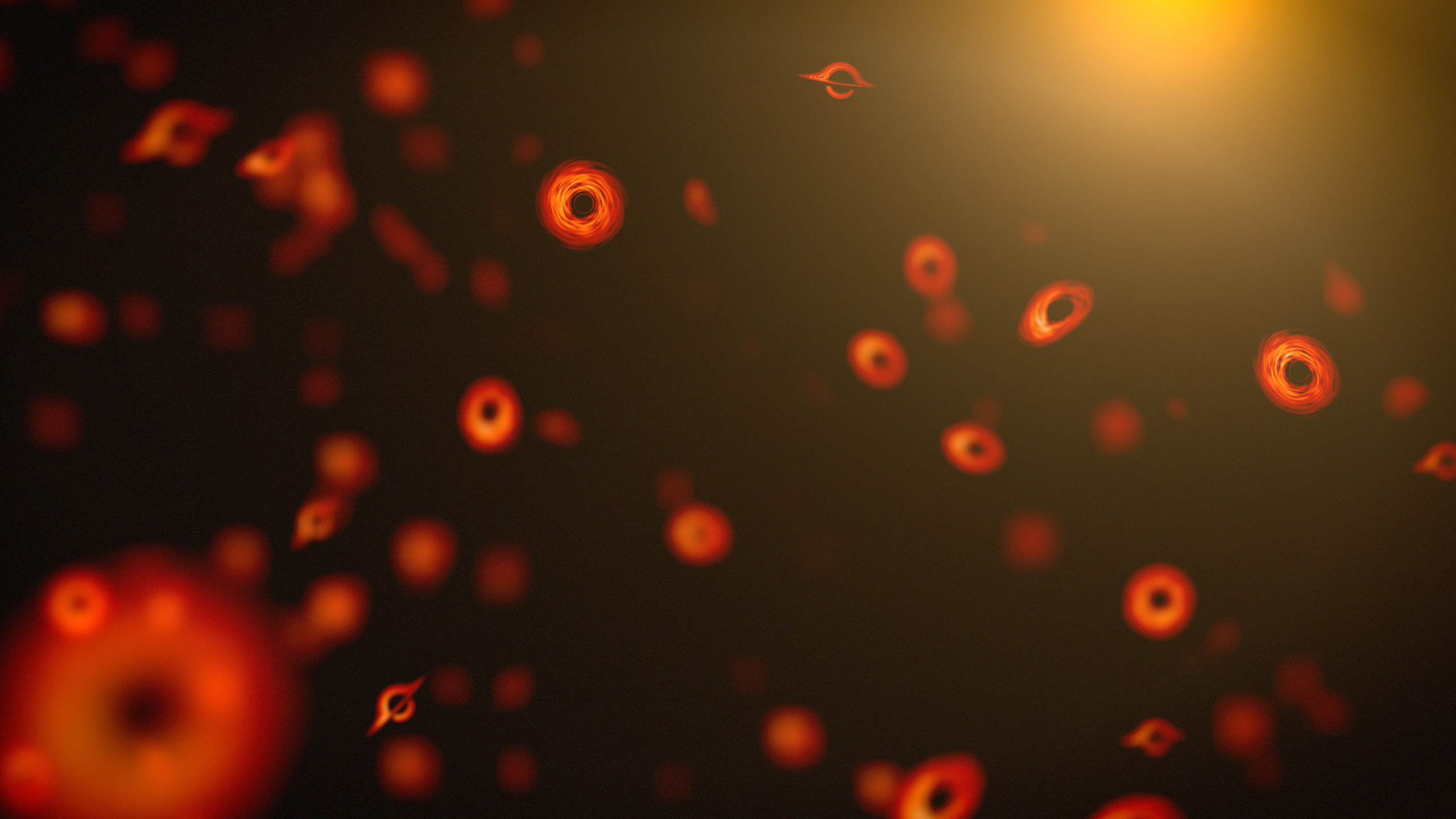
Primordial black hole visualization
This artist’s concept takes a fanciful approach to imagining small primordial black holes. In reality, such tiny black holes would have a difficult time forming the accretion disks that make them visible here.
NASA’s Goddard Space Flight Center

“Detecting a population of Earth-mass primordial black holes would be an incredible step for both astronomy and particle physics because these objects can’t be formed by any known physical process,” said William DeRocco, a postdoctoral researcher at the University of California Santa Cruz who led a study about how Roman could reveal them. A paper describing the results has been published in the journal Physical Review D. “If we find them, it will shake up the field of theoretical physics.”

Primordial Black Hole Recipe

The smallest black holes that form nowadays are born when a massive star runs out of fuel. Its outward pressure wanes as nuclear fusion dies down, so inward gravitational pull wins the tug-of-war. The star contracts and may get so dense it becomes a black hole.

But there’s a minimum mass required: at least eight times that of our Sun. Lighter stars will either become white dwarfs or neutron stars.

Conditions in the very early universe, however, may have allowed far lighter black holes to form. One weighing the mass of Earth would have an event horizon –– the point of no return for infalling objects –– about as wide as a U.S. dime coin.

Just as the universe was being born, scientists think it experienced a brief but intense phase known as inflation when space expanded faster than the speed of light. In these special conditions, areas that were denser than their surroundings may have collapsed to form low-mass primordial black holes.

While theory predicts the smallest ones should evaporate before the universe has reached its current age, those with masses similar to Earth could have survived.

Discovering these tiny objects would have an enormous impact on physics and astronomy.

“It would affect everything from galaxy formation to the universe’s dark matter content to cosmic history,” said Kailash Sahu, an astronomer at the Space Telescope Science Institute in Baltimore, who was not involved in the study. “Confirming their identities will be hard work and astronomers will need a lot of convincing, but it would be well worth it.”
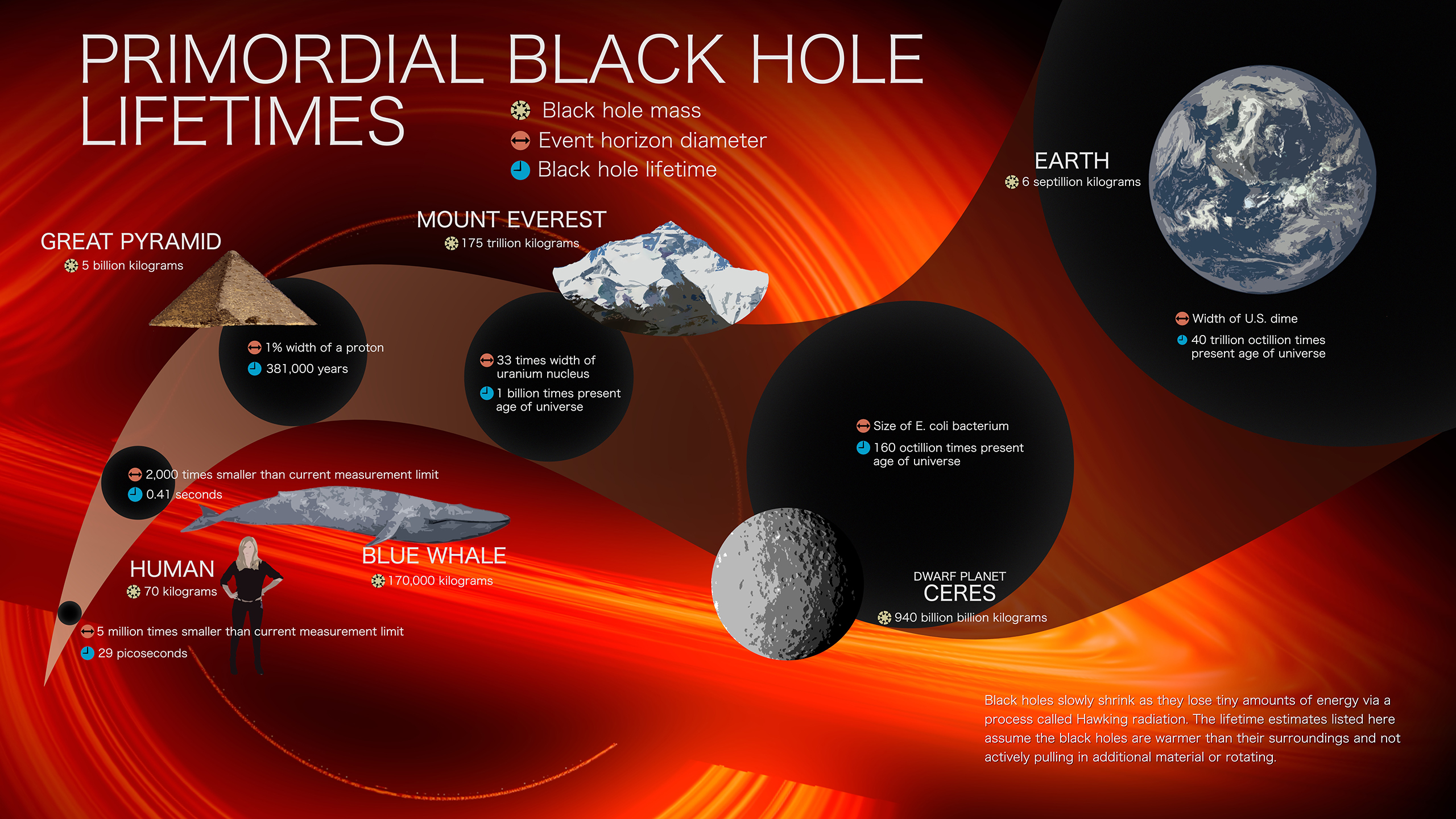
Primordial Black Hole Lifetimes Infographic
Stephen Hawking theorized that black holes can slowly shrink as radiation escapes. The slow leak of what’s now known as Hawking radiation would, over time, cause the black hole to simply evaporate. This infographic shows the estimated lifetimes and event horizon –– the point past which infalling objects can’t escape a black hole’s gravitational grip –– diameters for black holes of various small masses.
NASA’s Goddard Space Flight Center

Hints of Hidden Homesteaders

Observations have already revealed clues that such objects may be lurking in our galaxy. Primordial black holes would be invisible, but wrinkles in space-time have helped round up some possible suspects.

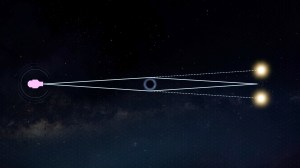
Microlensing is an observational effect that occurs because the presence of mass warps the fabric of space-time, like the imprint a bowling ball makes when set on a trampoline. Any time an intervening object appears to drift near a background star from our vantage point, the star’s light must traverse the warped space-time around the object. If the alignment is especially close, the object can act like a natural lens, focusing and amplifying the background star’s light.

Separate groups of astronomers using data from MOA (Microlensing Observations in Astrophysics) –– a collaboration that conducts microlensing observations using the Mount John University Observatory in New Zealand –– and OGLE (the Optical Gravitational Lensing Experiment) have found an unexpectedly large population of isolated Earth-mass objects.

Planet formation and evolution theories predict certain masses and abundances of rogue planets ––worlds roaming the galaxy untethered to a star. The MOA and OGLE observations suggest there are more Earth-mass objects drifting through the galaxy than models predict.

“There’s no way to tell between Earth-mass black holes and rogue planets on a case-by-case basis,” DeRocco said. But scientists expect Roman to find 10 times as many objects in this mass range than ground-based telescopes. “Roman will be extremely powerful in differentiating between the two statistically.”

DeRocco led an effort to determine how many rogue planets should be in that mass range, and how many primordial black holes Roman could discern amongst them.

Finding primordial black holes would reveal new information about the very early universe, and would strongly suggest that an early period of inflation did indeed occur. It could also explain a small percentage of the mysterious dark matter scientists say makes up the bulk of our universe’s mass, but have so far been unable to identify.

“This is an exciting example of something extra scientists could do with data Roman is already going to get as it searches for planets,” Sahu said. “And the results are interesting whether or not scientists find evidence that Earth-mass black holes exist. It would strengthen our understanding of the universe in either case.”

The Nancy Grace Roman Space Telescope is managed at NASA’s Goddard Space Flight Center in Greenbelt, Maryland, with participation by NASA’s Jet Propulsion Laboratory and Caltech/IPAC in Southern California, the Space Telescope Science Institute in Baltimore, and a science team comprising scientists from various research institutions. The primary industrial partners are BAE Systems, Inc in Boulder, Colorado; L3Harris Technologies in Rochester, New York; and Teledyne Scientific & Imaging in Thousand Oaks, California.

Download high-resolution video and images from NASA’s Scientific Visualization Studio

By Ashley Balzer
NASA’s Goddard Space Flight Center, Greenbelt, Md.

Media Contact:
Claire Andreoli
301-286-1940
claire.andreoli@nasa.gov
NASA’s Goddard Space Flight Center, Greenbelt, Md.

Powered by WPeMatico

Get The Details…
Ashley Balzer

NASA’s Boeing Crew Flight Test Targets No Earlier than Friday, May 10

NASA’s Boeing Crew Flight Test Targets No Earlier than Friday, May 10

Six people sit at a news desk with a large screen behind them with an image of a spacecraft in front of the Earth.
After the first launch attempt of NASA’s Boeing Crew Flight Test, a news conference is held on Monday, May 6, 2024 at the agency’s Kennedy Space Center in Florida. As part of the agency’s Commercial Crew Program, the first crewed launch to the International Space Station aboard Boeing’s Starliner spacecraft atop a United Launch Alliance Atlas V rocket from Space Launch Complex-41 at nearby Cape Canaveral Space Force Station was targeted for 10:34 p.m. ET but scrubbed for the day.  Photo credit: NASA/Kim Shiflett

NASA, Boeing, and ULA (United Launch Alliance) are targeting no earlier than Friday, May 10, for launch of the agency’s Boeing Crew Flight Test to the International Space Station, pending resolution of the technical issue that prevented the May 6 launch attempt.

The delay allows teams to complete data analysis on a pressure regulation valve on the liquid oxygen tank of the Atlas V rocket ‘s Centaur upper stage and determine whether it is necessary to replace the valve.

Mission managers discussed the details that led to the decision during a news conference Monday night at NASA’s Kennedy Space Center.

Following the scrub, NASA astronaut Butch Wilmore and Suni Williams exited the Starliner spacecraft and launch pad at Space Launch Complex-41 at Cape Canaveral Space Force Station in Florida and returned to the astronaut crew quarters at Kennedy. ULA, as per the normal recycle process, also removed liquid oxygen and hydrogen from the Atlas V first and second stages.

Learn about the crew flight test by following the mission blog, the commercial crew blog@commercial crew on X, and commercial crew on Facebook. Learn more about station activities by following the space station blog@space_station and @ISS_Research on X, as well as the ISS Facebook and ISS Instagram accounts.

Powered by WPeMatico

Get The Details…

Jamie Groh

NASA, Boeing to Update Media on Starliner Crew Flight Test Tonight

NASA, Boeing to Update Media on Starliner Crew Flight Test Tonight

A United Launch Alliance Atlas V rocket with Boeing’s Starliner spacecraft aboard is seen on the launch pad at Space Launch Complex-41  on Sunday, May 5, 2024 at Cape Canaveral Space Force Station in Florida. Photo Credit: NASA/Joel Kowsky

NASA, Boeing, and United Launch Alliance will host a news conference at 10:30 p.m. EDT to discuss Monday’s scrubbed launch attempt of the agency’s Crew Flight Test due to a faulty oxygen relief valve observation on the United Launch Alliance Atlas V rocket Centaur second stage. NASA astronauts Butch Wilmore and Suni Williams exited the Starliner spacecraft at Space Launch Complex-41 at Cape Canaveral Space Force Station in Florida and returned to astronaut crew quarters.

NASA will provide news conference coverage on NASA+, NASA Television, the NASA appYouTube, and the agency’s website.

The following will participate in the news conference:

  • Ken Bowersox, associate administrator, NASA’s Space Operations Mission Directorate
  • Steve Stich, manager, NASA’s Commercial Crew Program
  • Dana Weigel, manager, International Space Station Program at NASA
  • Mark Nappi, vice president and program manager, Commercial Crew Program, Boeing
  • Tory Bruno, president and CEO, United Launch Alliance

Learn more about NASA’s Boeing Crew Flight Test by following the mission blog, the commercial crew blog@commercial_crew on X, and commercial crew on Facebook.

Powered by WPeMatico

Get The Details…

Elyna Niles-Carnes

NASA’s Boeing Crew Flight Test Scrubbed

NASA’s Boeing Crew Flight Test Scrubbed

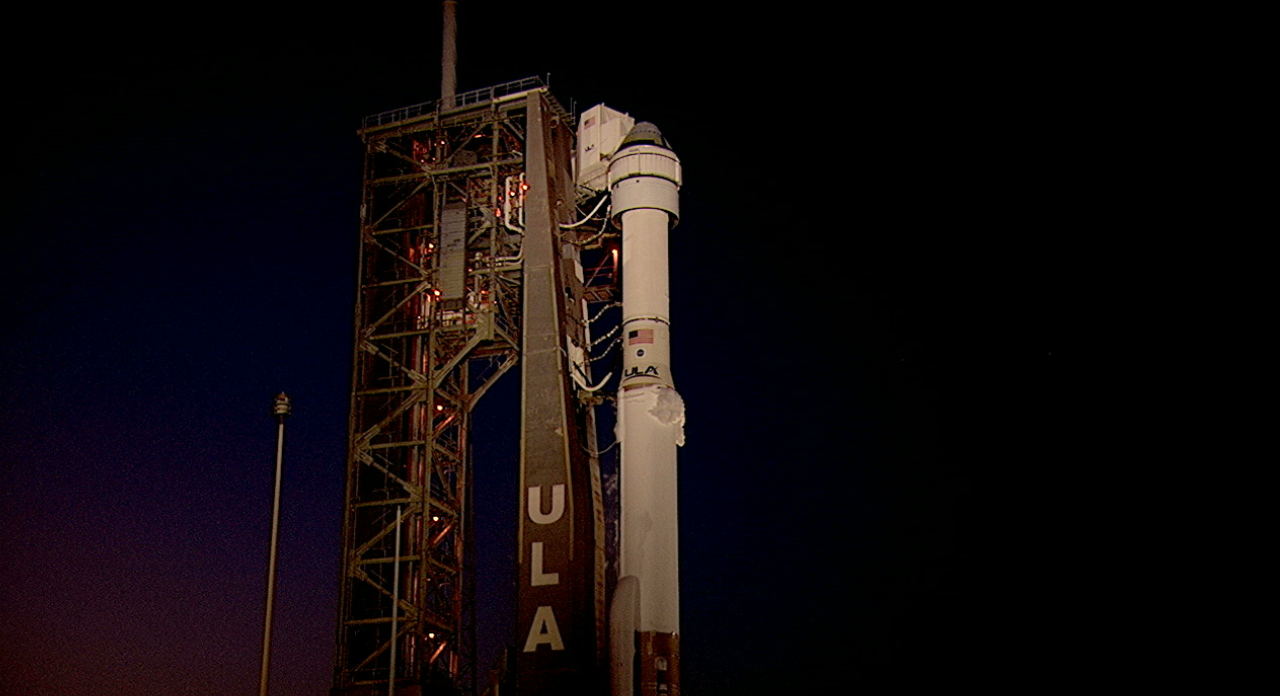
Boeing’s Starliner spacecraft atop the United Launch Alliance Atlas V rocket is seen on the launch pad of Space Launch Complex-41 at Cape Canaveral Space Force Station in Florida on Monday, May 6, 2024. Photo credit: NASA

NASA, Boeing, and United Launch Alliance scrubbed the launch opportunity on Monday, May 6 for the agency’s Boeing Crew Flight Test to the International Space Station due to a faulty oxygen relief valve observation on the United Launch Alliance Atlas V rocket Centaur second stage.

NASA astronauts Butch Wilmore and Suni Williams exited the Starliner spacecraft at Space Launch Complex-41 at Cape Canaveral Space Force Station in Florida and will return to astronaut crew quarters.

NASA’s coverage continues on NASA+, NASA Television, the NASA app, YouTube, and the agency’s website. Learn how to stream NASA TV through a variety of platforms including social media.

Learn more about NASA’s Boeing Crew Flight Test by following the mission blog, the commercial crew blog@commercial_crew on X, and commercial crew on Facebook.

Powered by WPeMatico

Get The Details…

Elyna Niles-Carnes

Meet the NASA Boeing Crew Flight Test Astronauts

Meet the NASA Boeing Crew Flight Test Astronauts

NASA's Boeing Crew Flight Test astronauts Suni Williams (left) and Butch Wilmore (right) pose for photo ahead of May 6 flight to the International Space Station
The official crew portrait for NASA’s Boeing Crew Flight Test. Left is Suni Williams, who will serve as the pilot, and to the right is Barry “Butch” Wilmore, spacecraft commander.

Let’s get to know the two NASA astronauts flying Boeing’s Starliner spacecraft for the first time as part of the agency’s Boeing Crew Flight Test mission.

Butch Wilmore is the commander of tonight’s mission. Previously, he was a fighter pilot, U.S. Navy captain, and completed two other spaceflights for Expedition 41 in 2014 and for STS-129 for space shuttle Atlantis in 2009. Wilmore has logged 178 days in space. He was selected as an astronaut by NASA in July 2000.

Outside of his current mission, he serves as pastor and leads weekly Bible studies and participates in mission trips throughout South and Central America to assist medical professionals.

Wilmore grew up in Mt. Juliet, Tennessee. He earned a bachelor’s degree and master’s degree in electrical engineering from Tennessee Technological University, Cookeville, before graduating with another master’s degree in aviation systems from the University of Tennessee, Knoxville. He is also a graduate of the United States Naval Test Pilot School, Patuxent River, Maryland. He is married and has two children.

Suni Williams is the pilot of the Starliner spacecraft and is the first woman to fly on the first flight of a crewed spacecraft. She is also a retired U.S. Navy captain and completed two spaceflight missions – Expeditions 14/15 in 2006 and 32/33 in 2012. Williams has logged 322 days in space. She became a NASA astronaut in 1998.

While not training for NASA’s Boeing Crew Flight Test, Williams spends time with her two rescue Labrador retrievers, Gunner and Rotor. She plans to bring their dogs tags to the space station while on the week-long mission.

Williams graduated with her bachelor’s degree in physical science from the U.S. Naval Academy, Annapolis, Maryland, before obtaining her master’s degree in engineering management from the Florida Institute of Technology, Melbourne. In total, she has logged more than 3,000 flight hours in over 30 different aircraft.

Williams grew up in Needham, Massachusetts. She is married and enjoys working on cars, homes, and airplanes.

Liftoff remains on schedule for 10:34 p.m. EDT from Space Launch Complex-41 at Cape Canaveral Space Force Station in Florida.

Learn more about NASA’s Boeing Crew Flight Test by following the mission blog, the commercial crew blog, @commercial_crew on X, and commercial crew on Facebook.

Powered by WPeMatico

Get The Details…

Elyna Niles-Carnes