Crew Works Human Research and Payload Prep, Orbital Upkeep Continues

Crew Works Human Research and Payload Prep, Orbital Upkeep Continues

NASA astronaut Jeanette Epps prepares tubes to collect samples from the crew for the Immunity Assay investigation.

Orbital upkeep was at the forefront of Wednesday’s schedule aboard the International Space Station, but the Expedition 71 crew did have some time to conduct human health research and prepare scientific payloads for future operations.

NASA Flight Engineer Mike Barratt spent the morning completing tasks for the CIPHER investigation, collecting blood samples—with assistance from NASA Flight Engineer Jeanette Epps—and completing a cognition test. CIPHER, or the Complement of Integrated Protocols for Human Exploration Research, helps scientists on Earth pinpoint how the human body reacts to long-duration missions in space.

After human research activities wrapped, Barratt moved into the Destiny laboratory module to help NASA Flight Engineer Tracy C. Dyson install a vacuum jumper to the Major Constituent Analyzer, which checks the quality of the orbital complex’s air. The duo was then joined by Epps and NASA Flight Engineer Matthew Dominick for a midday conference with ground teams.

Epps also spent the day gathering kits for future Immunity Assay operations and setting up Kubik, an incubator designed to study biological samples in microgravity. In the afternoon, she worked on cargo operations, stowing items in Northrop Grumman’s Cygnus spacecraft.

Dyson and Dominick worked on additional orbital plumbing tasks throughout the day, inspecting the toilet after wrapping up maintenance and re-installing the port stalls to the bathroom. The duo also worked inside the station’s cupola, or “window to the world,” separately to clean the area and its seven windows.

Near the end of the day, Dyson removed and replaced samples from the Materials Science Lab and prepared the payload for its next sample run, while Dominick completed some on-orbit medical training.

In the Zarya module, current station Commander Oleg Kononenko ran the 3D printer, while Flight Engineer Alexander Grebenkin completed some computer maintenance. Later on, Grebenkin practiced his piloting techniques during a Pilot-T session, and his Roscosmos crewmate, Nikolai Chub, investigated the behavior of liquid phases exposed to different temperatures and vibrations in microgravity.

On Earth, NASA, Boeing, and ULA (United Launch Alliance) teams continue working remaining open tasks in preparation for the agency’s Boeing Crew Flight Test to the International Space Station. The teams now are targeting a launch date of no earlier than 4:43 p.m. EDT on Tuesday, May 21, to complete additional testing. For more information, please visit the CFT blog.


Learn more about station activities by following the space station blog, @space_station and @ISS_Research on X, as well as the ISS Facebook and ISS Instagram accounts.

Get weekly updates from NASA Johnson Space Center at: https://roundupreads.jsc.nasa.gov/

Get the latest from NASA delivered every week. Subscribe here: www.nasa.gov/subscribe

Powered by WPeMatico

Get The Details…

Abby Graf

NASA’s X-59 Passes Milestone Toward Safe First Flight

NASA’s X-59 Passes Milestone Toward Safe First Flight

4 min read

Preparations for Next Moonwalk Simulations Underway (and Underwater)

An aircraft parked with desert landscape in the background.
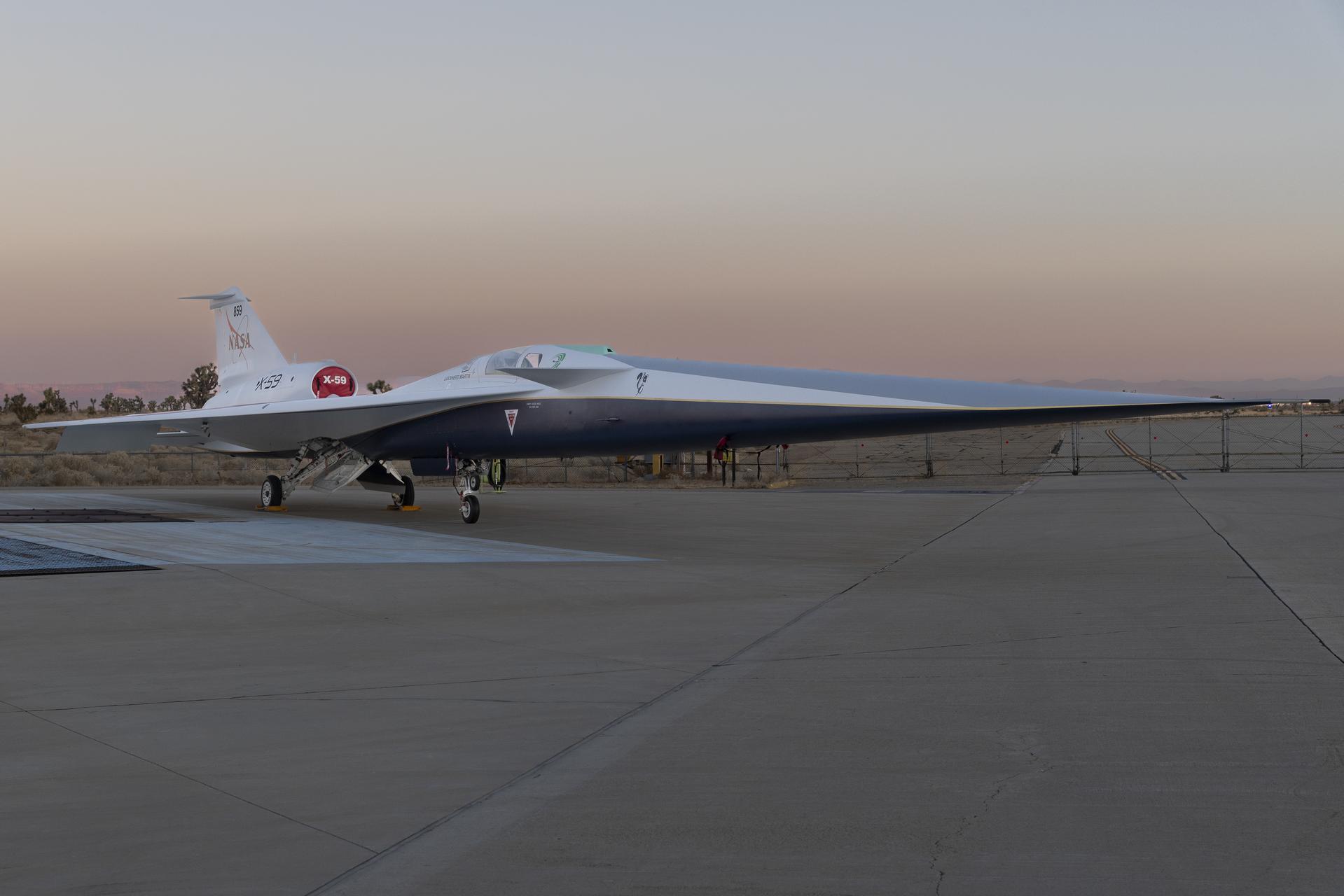
NASA’s X-59 quiet supersonic research aircraft sits on the ramp at Lockheed Martin Skunk Works in Palmdale, California during sunrise, shortly after completion of painting. With its unique design, including a 38-foot-long nose, the X-59 was built to demonstrate the ability to fly supersonic, or faster than the speed of sound, while reducing the typically loud sonic boom produced by aircraft at such speeds to a quieter sonic “thump”. The X-59 is the centerpiece of NASA’s Quesst mission, which seeks to solve one of the major barriers to supersonic flight over land, currently banned in the United States, by making sonic booms quieter.
NASA/Steve Freeman

NASA has taken the next step toward verifying the airworthiness for its quiet supersonic X-59 aircraft with the completion of a milestone review that will allow it to progress toward flight.

A Flight Readiness Review board composed of independent experts from across NASA has completed a study of the X-59 project team’s approach to safety for the public and staff during ground and flight testing. The review board looked in detail at the project team’s analysis of potential hazards, focusing on safety and risk identification.

Flight Readiness Review is the first step in the flight approval process. The board’s work will provide the X-59 team with insights and recommendations toward systems checkouts on the ground and first flight.

“It’s not a pass-fail,” said Cathy Bahm, NASA’s Low Boom Flight Demonstrator project manager. “We’ll be getting actions from the board and will work with them to resolve those and work toward the Airworthiness and Flight Safety Review.”

NASA and prime contractor Lockheed Martin Skunk Works are developing the X-59 to reduce the sound of a sonic boom to a quieter “thump.” The aircraft is at the center of NASA’s Quesst mission, which will use it to gather data that could revolutionize air travel, potentially paving the way for a new generation of commercial aircraft that can travel faster than the speed of sound. Commercial supersonic flight over land has been banned for more than 50 years because of the noise of sonic booms.

“The Flight Readiness Review focused on specific aspects of the X-59 team’s work on the aircraft, but also served as an overview and update on the entire project,” said Jay Brandon, chief engineer for the Low Boom Flight Demonstrator project.

 “It gave us the opportunity to stop working for a minute and gather what we’ve done so we could tell our story, not just to the board, but to the whole project team,” Brandon said.

With the Flight Readiness Review complete, the upcoming Airworthiness and Flight Safety Review will be the next safety milestone. The Airworthiness and Flight Safety Review board includes senior leaders from several NASA centers and Skunk Works. It will review findings from the Flight Readiness Review, as well as the project team’s response to those filings. The board will send a recommendation to NASA Armstrong’s center director, who signs the airworthiness certificate.

Finally, the team will provide a technical brief to another review board based on test objectives, how the tests are being carried out, the risks involved, and the risk-mitigation actions the team has taken. The X-59 team would have to address any issues raised in the brief before the board, led by NASA Armstrong chief engineer Cynthia J. “CJ” Bixby, will sign a flight request.

“It’s really an exciting time on the project,” Bahm said. “It’s not an easy road, but there’s a finite set of activities that are in front of us.”

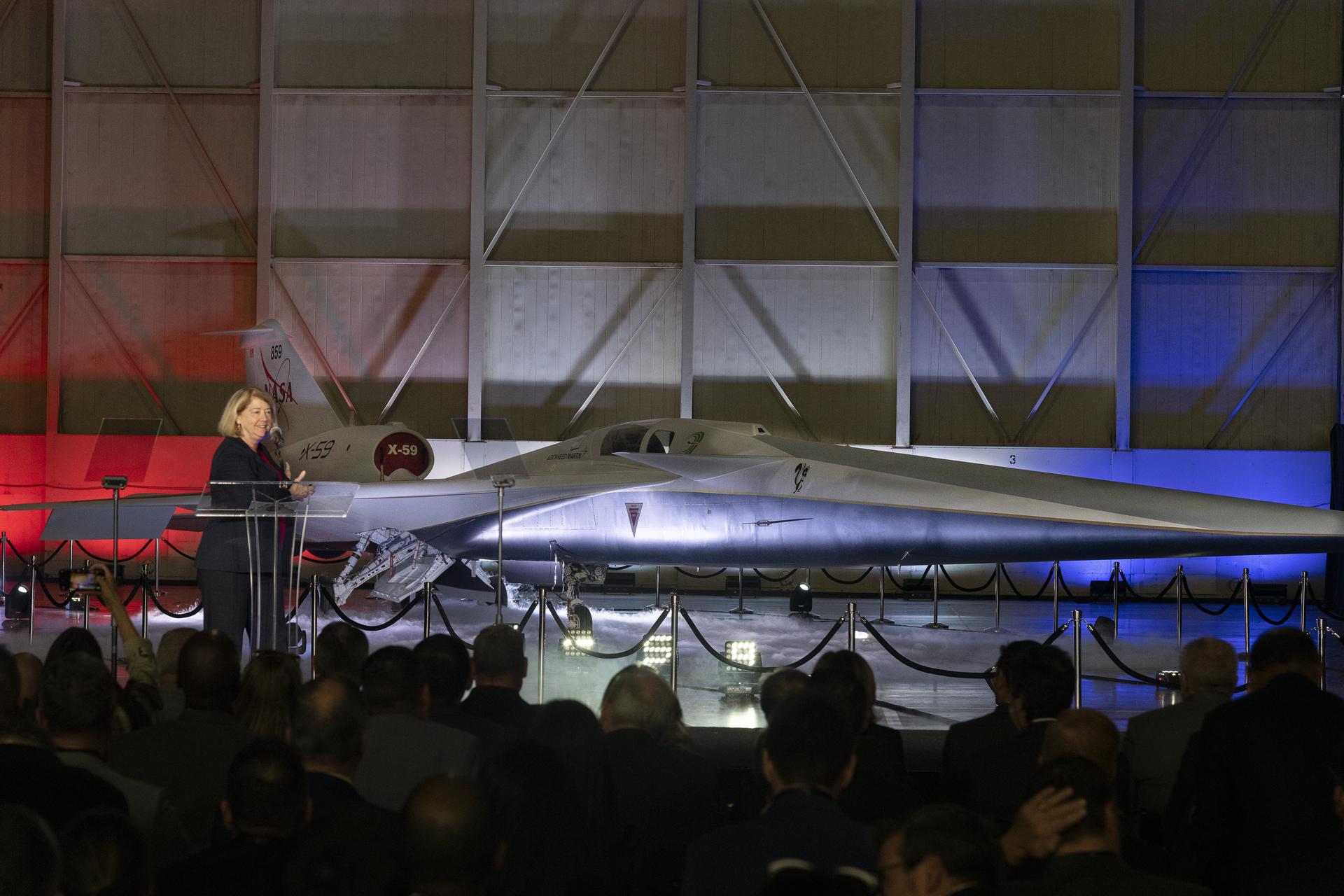
View of a lit stage inside a hangar. A woman speaks at a podium. In the immediate background, the X-59 sits, newly painted in its red, white, blue and gold livery.
NASA Deputy Administrator Pam Melroy speaks on stage immediately following the unveiling of the agency’s X-59 quiet supersonic research aircraft at a January 12, 2024 event at Lockheed Martin Skunk Works in Palmdale, California. The X-59 is the centerpiece of NASA’s Quesst mission, which seeks to solve one of the major barriers to supersonic flight over land, currently banned in the United States, by making sonic booms quieter.
NASA/Steve Freeman

The Path Forward

There are significant steps to be completed before flights can begin. The X-59 team is preparing for upcoming major ground tests focused on systems integration engine runs, and electromagnetic interference.

The X-59 aircraft is a bold, new design, but many of its components are from well-established aircraft, including landing gear from an Air Force F-16 fighter, a cockpit canopy from a NASA T-38 trainer, and a control stick from an Air Force F-117 stealth fighter are among those parts.

“None of these systems have ever worked and played together before,” said Brad Neal, chairman for the X-59 Airworthiness and Flight Safety Review board. “It’s a brand-new thing that we are developing, even though they’re components that have been on different legacy aircraft. As we get into integration testing here, it’s going to be a great opportunity to learn.’’

Powered by WPeMatico

Get The Details…
Dede Dinius

Good Night, Moon

Good Night, Moon

The silvery waning gibbous moon against the darkness of space, as seen from the International Space Station.
An illuminated waning gibbous moon contrasts the deep black of space as the International Space Station soared 270 miles over the Southern Ocean.
NASA

The waning gibbous moon stands out against the dark backdrop of space in this April 26, 2024, image from the International Space Station. Waning gibbous is one of eight moon phases, occurring after the full moon. The Sun always illuminates half of the Moon while the other half remains dark, but how much we can see of that illuminated half changes as the Moon travels through its orbit. As the Moon begins its journey back toward the Sun, the lighted side appears to shrink, but the Moon’s orbit is simply carrying it out of view from our perspective.

See NASA’s interactive map for observing the Moon—from Earth—every day of the year.

Image Credit: NASA

Powered by WPeMatico

Get The Details…
Monika Luabeya

Hubble Views the Dawn of a Sun-like Star 

Hubble Views the Dawn of a Sun-like Star 

2 min read

Hubble Views the Dawn of a Sun-like Star 

Three bright stars with diffraction spikes shine near the center-right of the image, illuminating nearby clouds that glow in pale blue. The clouds darken at the edges of the image, and are dotted with smaller stars, some also with diffraction spikes.
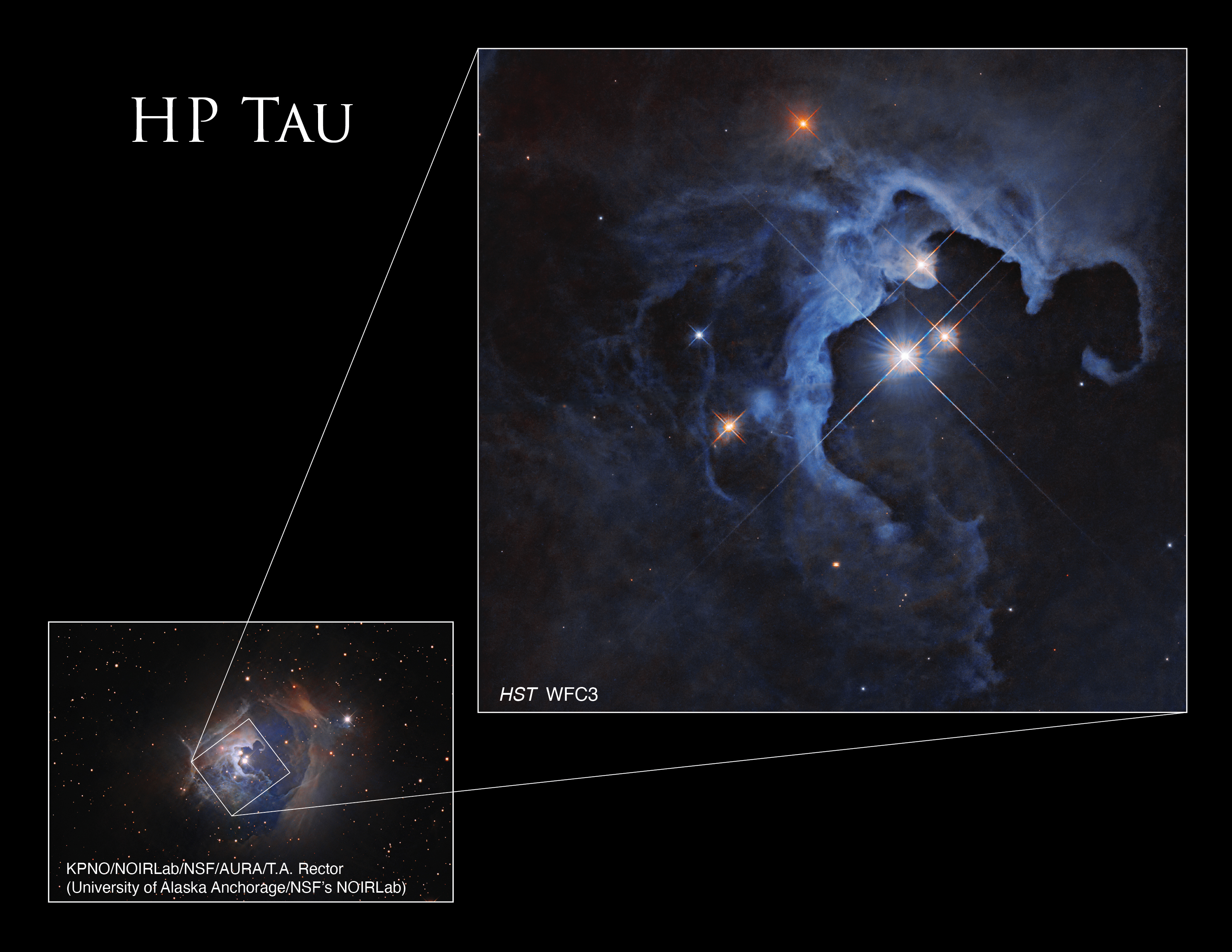
This NASA Hubble Space Telescope image captures a triple-star star system.
NASA, ESA, G. Duchene (Universite de Grenoble I); Image Processing: Gladys Kober (NASA/Catholic University of America)

Looking like a glittering cosmic geode, a trio of dazzling stars blaze from the hollowed-out cavity of a reflection nebula in this new image from NASA’s Hubble Space Telescope. The triple-star system is made up of the variable star HP Tau, HP Tau G2, and HP Tau G3. HP Tau is known as a T Tauri star, a type of young variable star that hasn’t begun nuclear fusion yet but is beginning to evolve into a hydrogen-fueled star similar to our Sun. T Tauri stars tend to be younger than 10 million years old ― in comparison, our Sun is around 4.6 billion years old ― and are often found still swaddled in the clouds of dust and gas from which they formed.

As with all variable stars, HP Tau’s brightness changes over time. T Tauri stars are known to have both periodic and random fluctuations in brightness. The random variations may be due to the chaotic nature of a developing young star, such as instabilities in the accretion disk of dust and gas around the star, material from that disk falling onto the star and being consumed, and flares on the star’s surface. The periodic changes may be due to giant sunspots rotating in and out of view.

Large image at upper right: Three bright stars with diffraction spikes shine near the center-right of the image, illuminating nearby clouds that glow in pale blue. The clouds darken at the edges of the image, and are dotted with smaller stars, some also with diffraction spikes. Small inset image in the lower-left corner: A colorful nebula or gas cloud. A white square outlines the area of the nebula that Hubble image captures.
The box in the ground-based image reveals the location of Hubble’s view within the wider context of this triple-star system.
NASA, ESA, G. Duchene (Universite de Grenoble I); Image Processing: Gladys Kober (NASA/Catholic University of America); Inset: KPNO/NOIRLab/NSF/AURA/T.A. Rector (University of Alaska Anchorage/NSF’s NOIRLab)

Curving around the stars, a cloud of gas and dust shines with their reflected light. Reflection nebulae do not emit visible light of their own, but shine as the light from nearby stars bounces off the gas and dust, like fog illuminated by the glow of a car’s headlights.

HP Tau is located approximately 550 light-years away in the constellation Taurus. Hubble studied HP Tau as part of an investigation into protoplanetary disks, the disks of material around stars that coalesce into planets over millions of years.

Media Contact:

Claire Andreoli
NASA’s Goddard Space Flight CenterGreenbelt, MD
claire.andreoli@nasa.gov

Share

Details

Last Updated
May 15, 2024
Editor
Andrea Gianopoulos
Location
Goddard Space Flight Center

Powered by WPeMatico

Get The Details…

Space Physics and Space Weather Scientist Dr. Yihua (Eva) Zheng

Space Physics and Space Weather Scientist Dr. Yihua (Eva) Zheng

Space Physics and Space Weather Scientist Dr. Yihua Zheng, poses for a portrait, Wednesday, Feb. 7, 2024 at NASA’s Goddard Space Flight Center in Greenbelt, Maryland. Photo Credit: (NASA/Thalia Patrinos)

“I grew up in China. In China, everybody talks about what they want to be [when they grow up]. Many want to grow up to be a scientist or engineer. So I aspired to be a scientist from an early age.

“… For the girls or women in science — or in any profession or job — opportunities are more abundant than they were previously. Sometimes you need to take bold steps. Just a little push, and then you will get there. I initially started as a foreign national, so not a lot of opportunities existed for a foreign national, and some of them [required a] green card or citizenship. I think it’s hard, but still, there is a path forward. I think it’s important to work hard and be optimistic, and you will find something.”

—Dr. Yihua (Eva) Zheng, Space Physics and Space Weather Scientist, Heliophysics Science Division, NASA’s Goddard Space Flight Center

Image Credit: NASA/Thalia Patrinos
Interviewer: NASA/Thalia Patrinos

Check out some of our other Faces of NASA. 

Powered by WPeMatico

Get The Details…
Thalia K. Patrinos