NASA Selects BAE Systems to Develop Ocean Color Instrument for NOAA

NASA Selects BAE Systems to Develop Ocean Color Instrument for NOAA

NASA logo

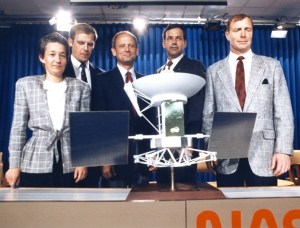
NASA, on behalf of the National Oceanic and Atmospheric Administration (NOAA), has selected BAE Systems (formerly known as Ball Aerospace & Technologies Corporation) of Boulder, Colorado, to develop an instrument to analyze ocean data as part of NOAA’s Geostationary Extended Observations (GeoXO) satellite program.

This cost-plus-award-fee contract is valued at approximately $450 million. It includes the development of two flight instruments as well as options for additional units. The anticipated period of performance for this contract includes support for 10 years of on-orbit operations and five years of on-orbit storage, for a total of 15 years for each flight model. The work will take place at BAE Systems, NASA’s Goddard Space Flight Center in Greenbelt, Maryland, and the agency’s Kennedy Space Center in Florida.

The GeoXO Ocean Color instrument (OCX) will monitor U.S. coastal waters, the exclusive economic zone, and the Great Lakes. The instrument will observe ocean biology, chemistry, and ecology to assess ocean productivity, ecosystem change, coastal and inland water quality, seafood safety, and hazards like harmful algal blooms. With updates at least every three hours, the instrument will deliver a more frequent and comprehensive view of ocean and coastal conditions than is currently available.

Frequent observations will show daily changes in ocean biology and rapid coastal ocean dynamics. The instrument also will track and assist in the response to climate-driven ocean and coastal ecosystem changes, supporting ecological forecasters, marine resource managers, fisheries, health departments, water treatment managers, and the commerce, recreation, and tourism industries.

The contract scope includes the tasks and deliverables necessary to design, analyze, develop, fabricate, integrate, test, verify, and evaluate the ocean color instrument; support the launch; supply and maintain the instrument ground support equipment; and support mission operations at the NOAA Satellite Operations Facility in Suitland, Maryland.

The GeoXO Program is the follow-on to the Geostationary Operational Environmental Satellites – R (GOES-R) Series Program. The GeoXO satellite system will advance Earth observations from geostationary orbit. The mission will supply vital information to address major environmental challenges of the future in support of weather, ocean, and climate operations in the United States. Advanced capabilities from GeoXO will help address our changing planet and the evolving needs of NOAA’s data users. NOAA and NASA are working to ensure these critical observations are in place by the early 2030s when the GOES-R Series nears the end of its operational lifetime.

Together, NOAA and NASA will oversee the development, launch, testing, and operation of all the satellites in the GeoXO Program. NOAA funds and manages the program, operations, and data products. On behalf of NOAA, NASA and commercial partners develop and build the instruments and spacecraft and launch the satellites.

For more information on the GeoXO program, visit:

https://www.nesdis.noaa.gov/geoxo

-end-

Liz Vlock
Headquarters, Washington
202-358-1600
elizabeth.a.vlock@nasa.gov

Jeremy Eggers
Goddard Space Flight Center, Greenbelt, Md.
757-824-2958
jeremy.l.eggers@nasa.gov

John Leslie
NOAA’s National Environmental Satellite, Data, and Information Service
202-527-3504
nesdis.pa@noaa.gov

Share

Details

Last Updated

May 20, 2024

Powered by WPeMatico

Get The Details…
Abbey A. Donaldson

Crew Starts Week with Space Biology, Robotics, and Medical Skills

Crew Starts Week with Space Biology, Robotics, and Medical Skills

An atmosphreric glow blankets Earth's horizon and a web of city lights interconnect across India in this photograph from the space station.
An atmosphreric glow blankets Earth’s horizon and a web of city lights interconnect across India in this photograph from the space station.

The week kicked off with a multitude of space biology activities as the Expedition 71 crew studied microgravity’s effect on humans and serviced research hardware. Robotics and lab maintenance rounded out Monday’s schedule aboard the International Space Station.

NASA Flight Engineer Jeanette Epps worked throughout Monday on biomedical activities processing her blood, saliva, and urine samples for analysis. After her blood draws, she spun the samples inside a centrifuge then stowed them in a science freezer. The biological specimens are then compared to astronaut samples collected both pre-flight and post-flight to understand how the human body adapts to long-term weightlessness.

In the afternoon, NASA astronaut Mike Barratt operated the Ultrasound 2 device and scanned the neck, shoulder, and leg veins of NASA Flight Engineer Tracy C. Dyson. Doctors on the ground remotely provided guidance and monitored the vein scans. The ultrasound converts the echo scans into a video signal that is downlinked to Earth and viewed as part of periodic crew health exams.

Earlier, Barratt measured the airflow in the Harmony module crew quarters then reorganized combustion research components to enable a space fire safety experiment. Dyson investigated ways to improve the delivery of respiratory system drugs potentially offering benefits to both the health care and food industries.

NASA Flight Engineer Matthew Dominick spent his day servicing science gear throughout the orbital lab. He started the day checking out and configuring hardware supporting the Rodent Research-28 investigation that is exploring a gene therapy to maintain eye health in microgravity. In the afternoon, he opened up the Life Science Glovebox and audited its systems and components to ensure ongoing advanced biology research operations.

Roscosmos Mission Specialist Alexander Grebenkin powered up the European robotic arm attached to the Nauka science module and practiced maneuvering it in basic operator mode. Cosmonaut Nikolai Chub brushed up on his medical skills familiarizing himself with emergency hardware and procedures onboard the station. Station Commander Oleg Kononenko inspected components inside the Zarya module, photographed the condition of windows in the Nauka and Zvezda modules, then worked on an oxygen generator.

NASA, Boeing, and ULA (United Launch Alliance) teams now are targeting a launch no earlier than 3:09 p.m. EDT Saturday, May 25, for the agency’s Crew Flight Test carrying NASA astronauts Butch Wilmore and Suni Williams to the International Space Station.


Learn more about station activities by following the space station blog@space_station and @ISS_Research on X, as well as the ISS Facebook and ISS Instagram accounts.

Get weekly video highlights at: https://roundupreads.jsc.nasa.gov/videoupdate/

Get the latest from NASA delivered every week. Subscribe here: www.nasa.gov/subscribe

Powered by WPeMatico

Get The Details…

Mark Garcia

55 Years Ago: Two Months Until the Moon Landing

55 Years Ago: Two Months Until the Moon Landing

The march to the first Moon landing took a giant leap forward in May 1969 with the successful completion of Apollo 10, essentially a dress rehearsal for the landing mission. During their eight-day flight, the all-veteran Apollo 10 crew of Thomas P. Stafford, John W. Young, and Eugene A. Cernan rehearsed nearly every aspect of the Moon landing with the exception of the landing itself, flying to within nine miles of the lunar surface. Their mission sorted many of the unknowns for the lunar landing. While Apollo 10 traveled to the Moon, workers at NASA’s Kennedy Space Center (KSC) in Florida rolled Apollo 11 to its launch pad. The Apollo 11 astronauts continued training for their July Moon landing mission while workers across NASA continued other preparations for the historic flight.

Apollo 10
The Apollo 10 flight plan
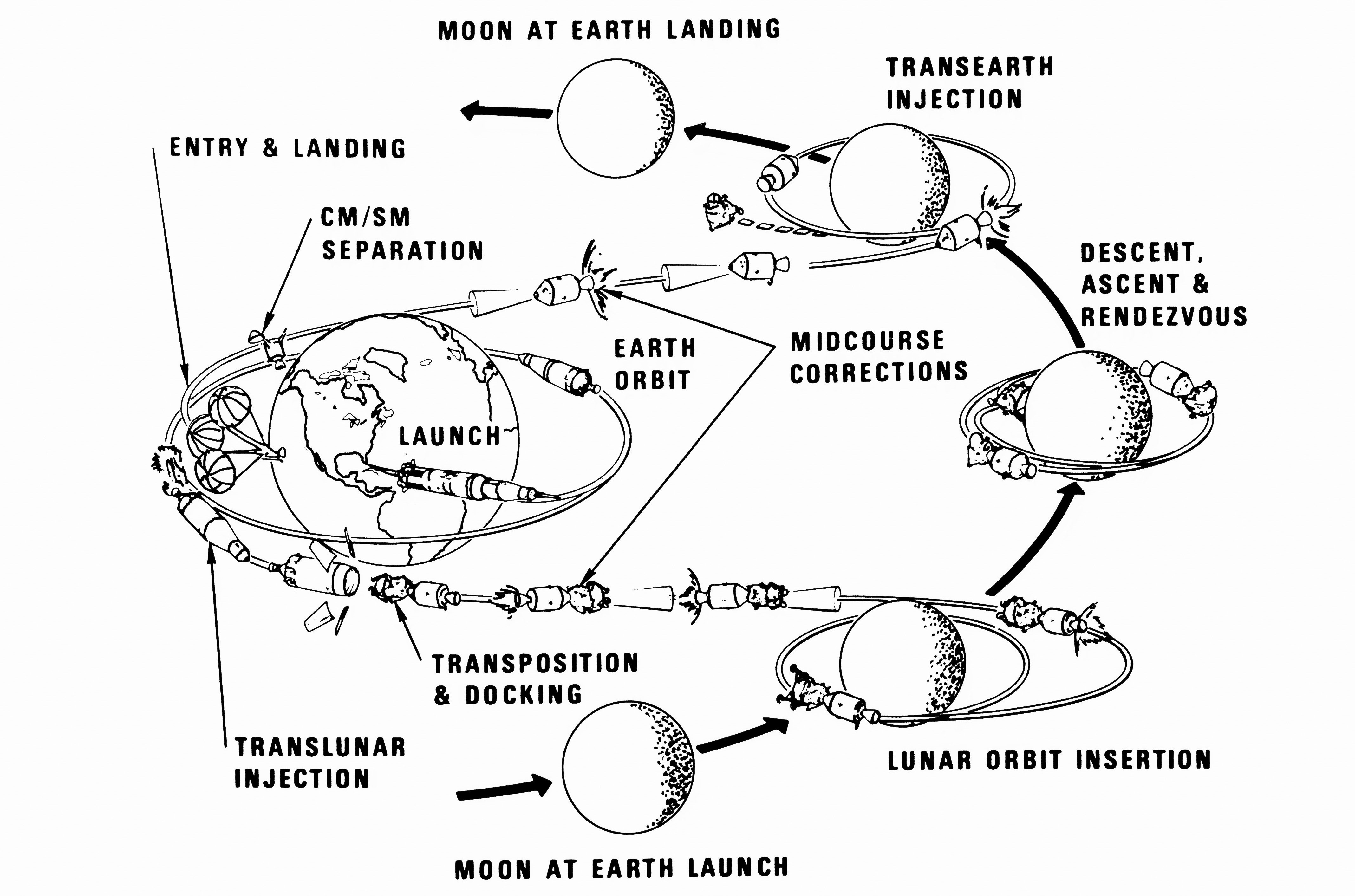
The Apollo 10 flight plan.

Designed as a final dress rehearsal for the Moon landing, the Apollo 10 mission plan replicated all aspects of that flight except for the landing itself. During the eight-day flight, Stafford, Young, and Cernan would spend three days traveling to the Moon before entering orbit around it. Stafford and Cernan would board the Lunar Module (LM) Snoopy, leaving Young aboard the Command Module (CM) Charlie Brown, and simulating a descent to the surface, fly to within 50,000 feet of the Moon. They would fly an approach to Apollo 11’s designated landing site in the Sea of Tranquility, photographing the area in as much detail as possible. After eight hours, Stafford and Cernan would rejoin Young. The primary goal of the mission accomplished, they would leave lunar orbit and travel back to Earth for a splashdown in the Pacific Ocean. Apollo 10 would address unknowns about navigation and communications required for a successful lunar landing.

Astronaut-geologist Harrison H. Schmitt, second from left, provides geology instruction to Apollo 10 astronauts Thomas P. Stafford, left, John W. Young, and Eugene A. Cernan The Launch Control Center at NASA’s Kennedy Space Center in Florida during the Apollo 10 Countdown Demonstration Test Cernan, left, Young, and Stafford pose in front of their Saturn V rocket
Left: Astronaut-geologist Harrison H. Schmitt, second from left, provides geology instruction to Apollo 10 astronauts Thomas P. Stafford, left, John W. Young, and Eugene A. Cernan. Middle: The Launch Control Center at NASA’s Kennedy Space Center in Florida during the Apollo 10 Countdown Demonstration Test. Right: Cernan, left, Young, and Stafford pose in front of their Saturn V rocket.

During the final weeks before launch, Stafford, Young, and Cernan honed their skills in spacecraft simulators. They also received many hours of lunar geology instruction from experts, including Harrison H. Schmitt, the only geologist in the astronaut corps. At KSC, engineers completed the Countdown Demonstration Test on May 6, with Stafford, Young, and Cernan participating in the final hours, much as they would on launch day.
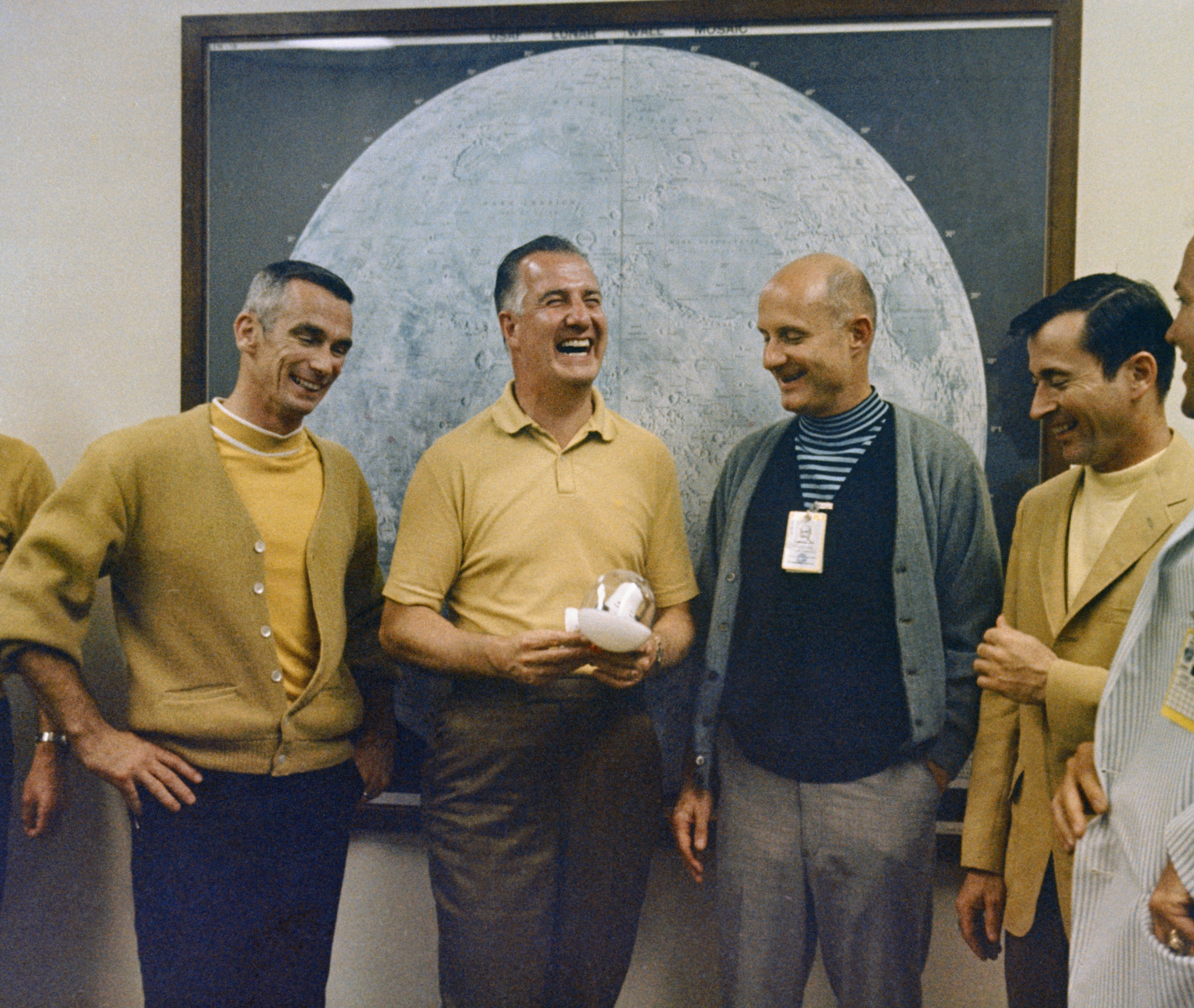
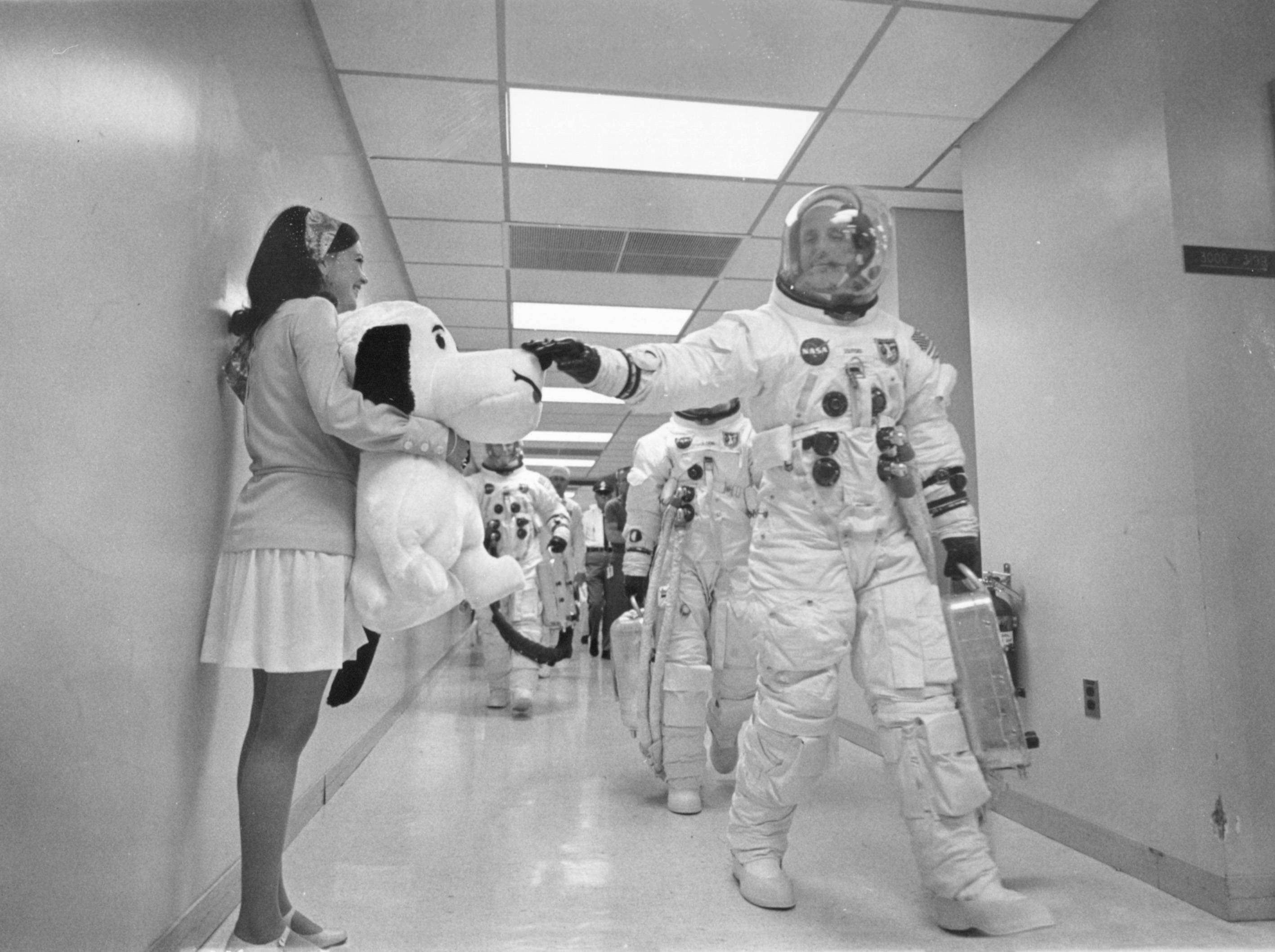
Vice President Spiro T. Agnew, second from left, shares a laugh with Apollo 10 astronauts Eugene A. Cernan, left, Thomas P. Stafford, and John W. Young the day before launch Stafford pats a giant stuffed Snoopy as he and Young and Cernan leave crew quarters for the trip to the launch pad Young, front, Stafford, and Cernan prepare to board the van for the ride to Launch Pad 39B
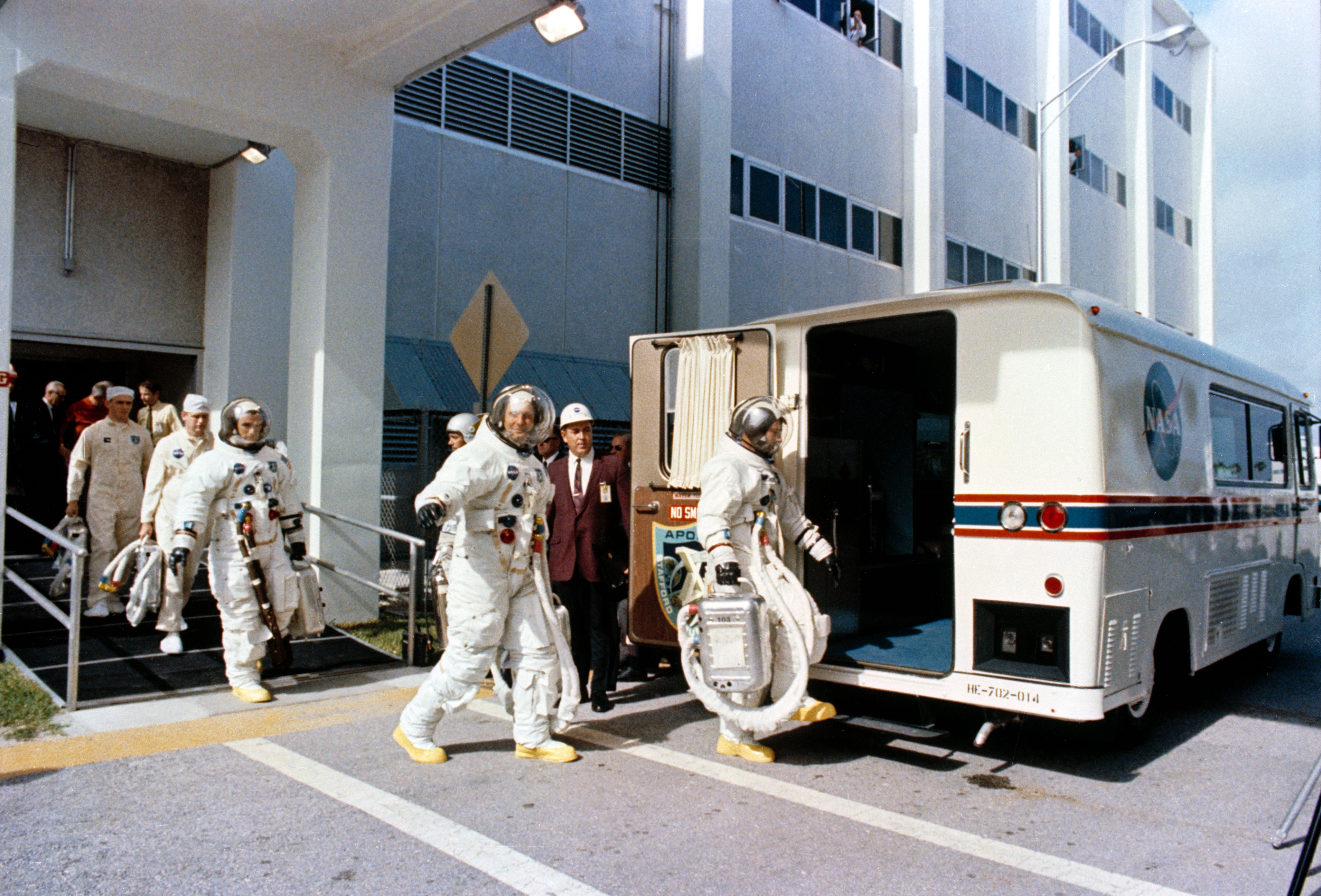
Left: Vice President Spiro T. Agnew, second from left, shares a laugh with Apollo 10 astronauts Eugene A. Cernan, left, Thomas P. Stafford, and John W. Young the day before launch. Middle: Stafford pats a giant stuffed Snoopy as he and Young and Cernan leave crew quarters for the trip to the launch pad. Right: Young, front, Stafford, and Cernan prepare to board the van for the ride to Launch Pad 39B.

Engineers began the countdown for Apollo 10 on May 13, as Stafford, Young, and Cernan finished their final simulator runs. Vice President Spiro T. Agnew joined them for dinner the night before launch. On launch day, they donned their spacesuits and boarded the van for the ride to Launch Pad 39B, where they climbed aboard their spacecraft.
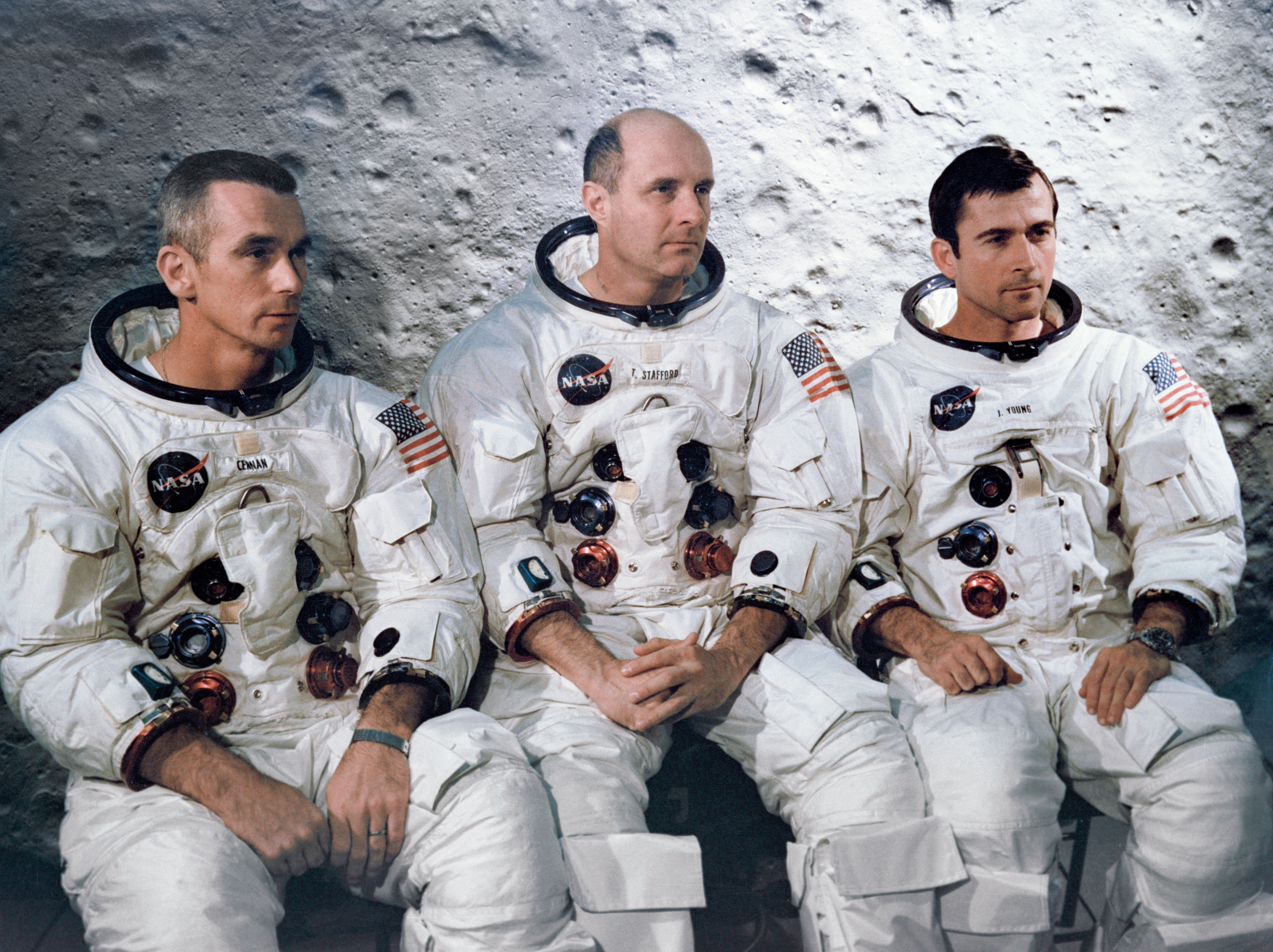
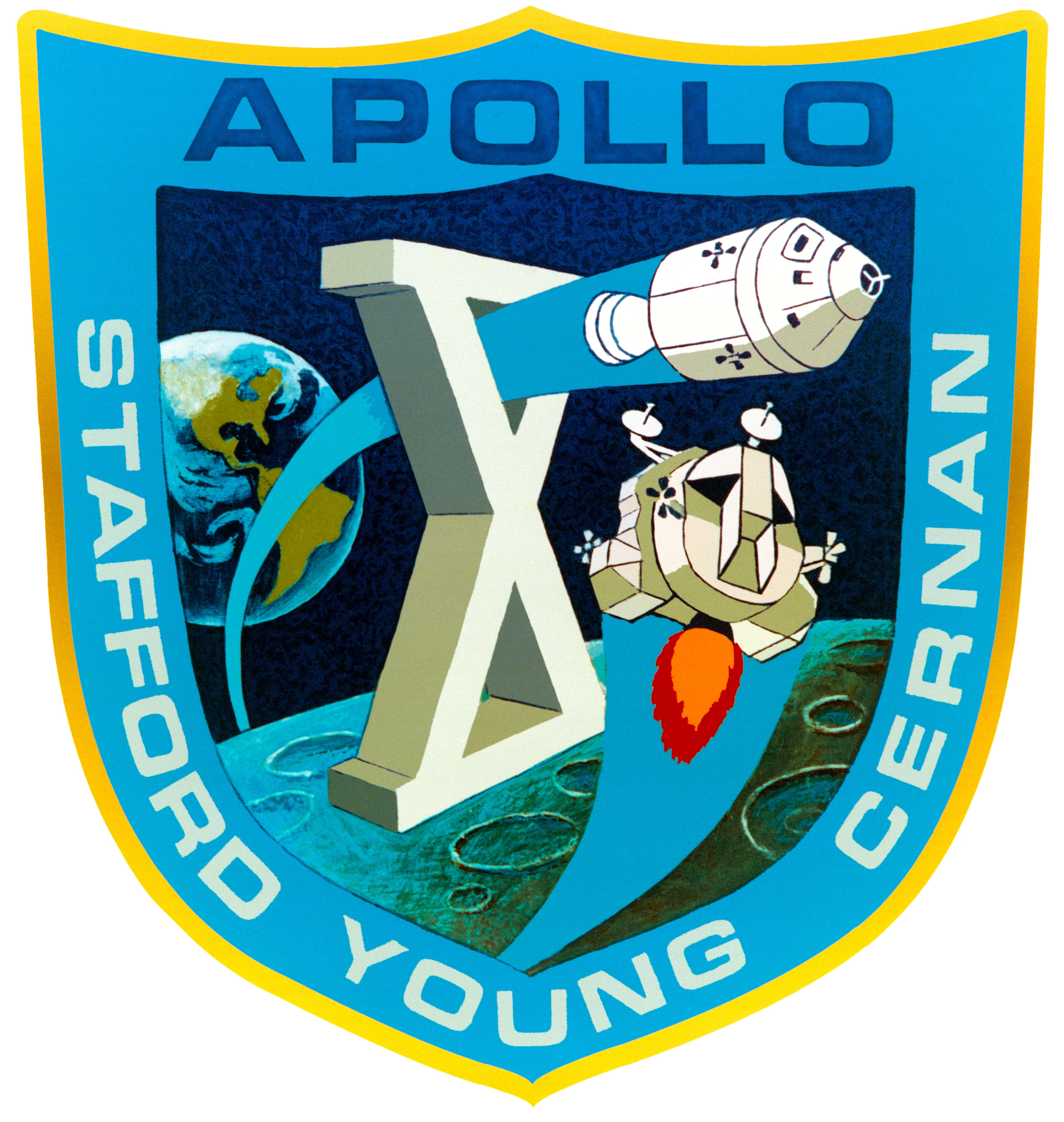
The official photo of the Apollo 10 crew of Eugene A. Cernan, left, Thomas P. Stafford, and John W. Young The Apollo 10 crew patch Liftoff of Apollo 10
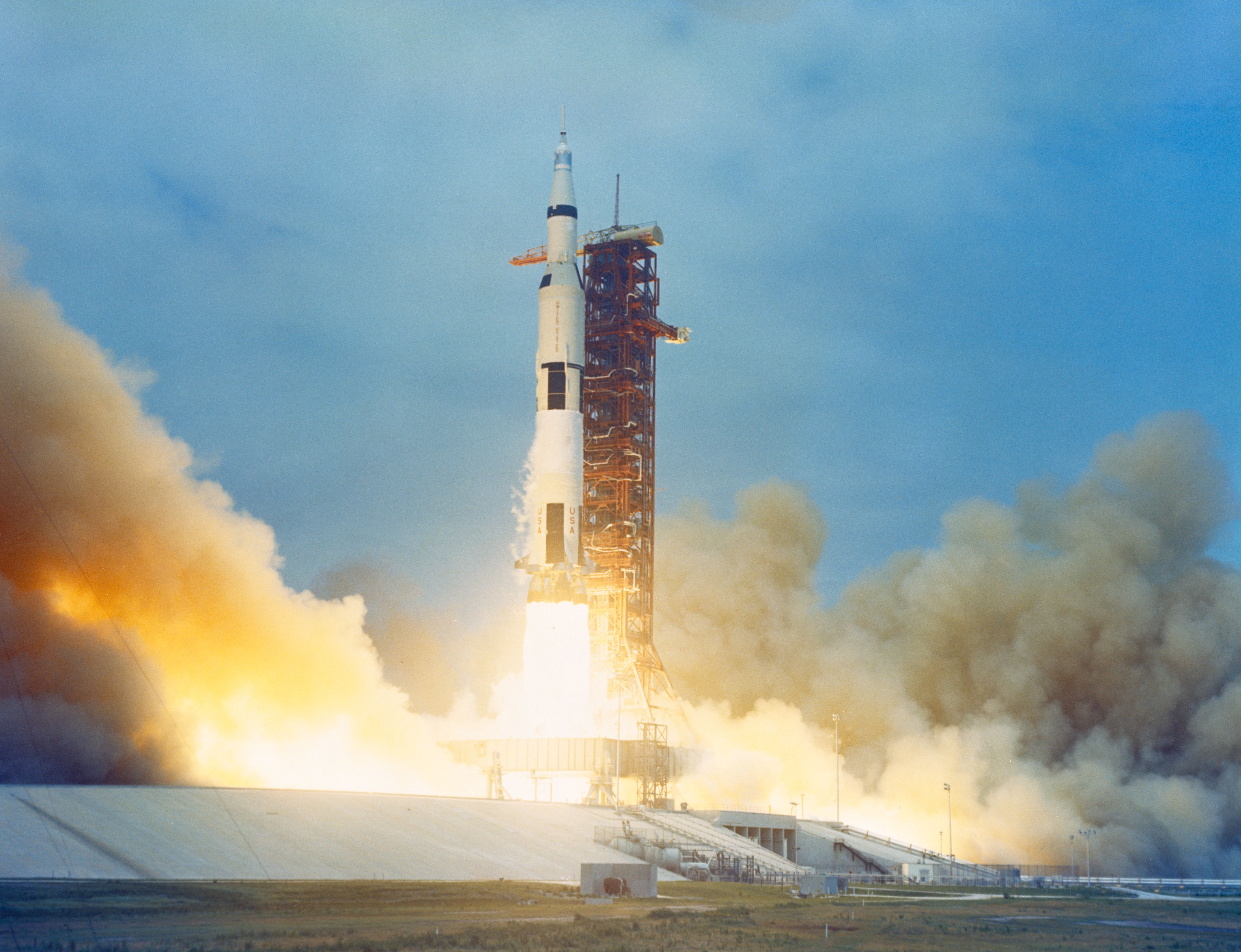
Left: The official photo of the Apollo 10 crew of Eugene A. Cernan, left, Thomas P. Stafford, and John W. Young. Middle: The Apollo 10 crew patch. Right: Liftoff of Apollo 10.

Apollo 10 lifted off at 12:49 p.m. EDT, the only lunar mission to use Launch Pad 39B. The three stages of the Saturn V rocket performed flawlessly, placing Apollo 10 and its attached S-IVB third stage into a temporary parking orbit around the Earth. Two and a half hours later, after the ground and crew verified the normal functioning of all spacecraft systems, Mission Control called up, “10, you’re go for TLI,” the Trans-Lunar Injection. The S-IVB fired for 5 minutes and 43 seconds, sending Apollo 10 toward the Moon. The engine burned so precisely that Apollo 10 needed only one of the planned four midcourse corrections.
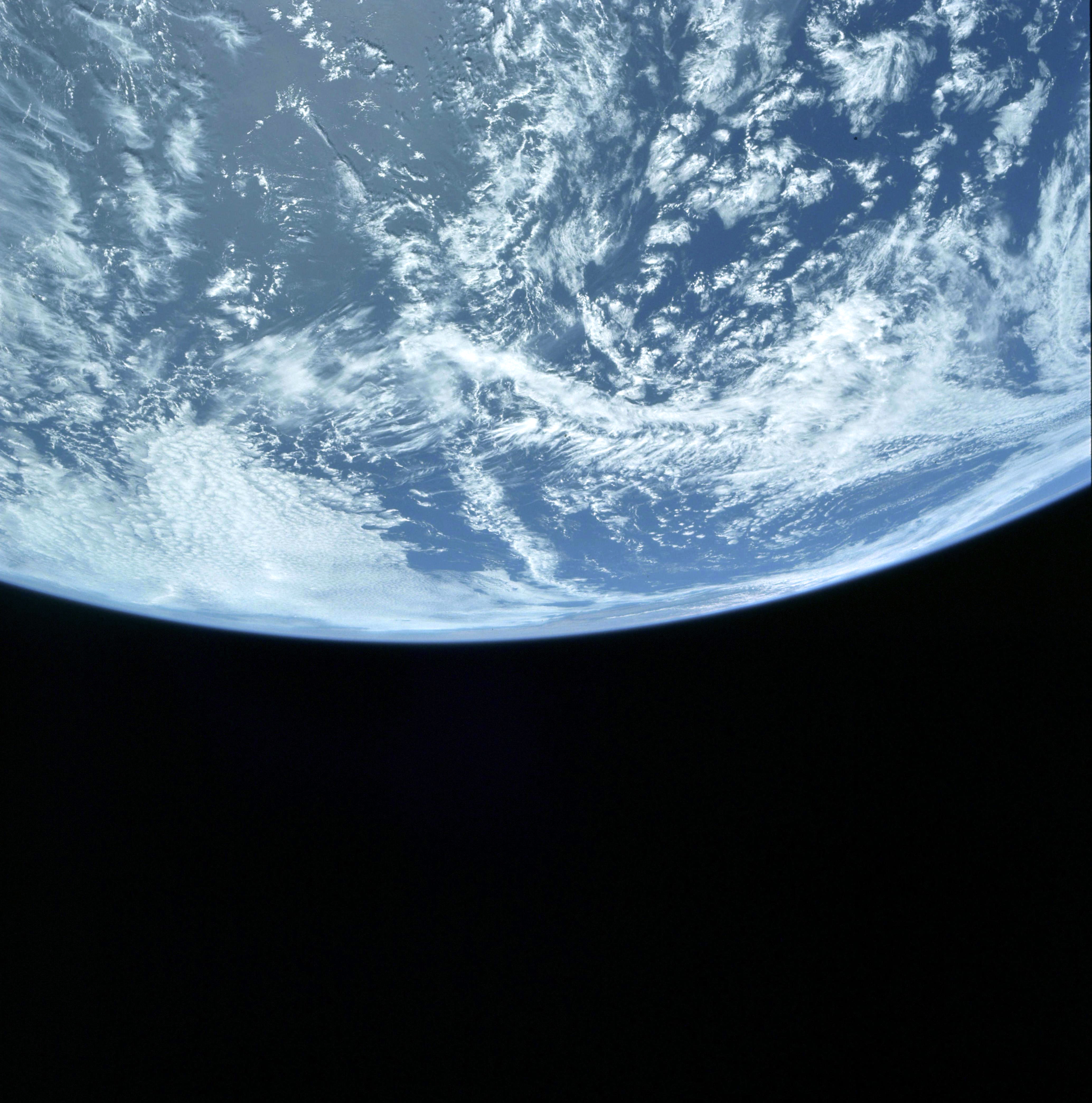
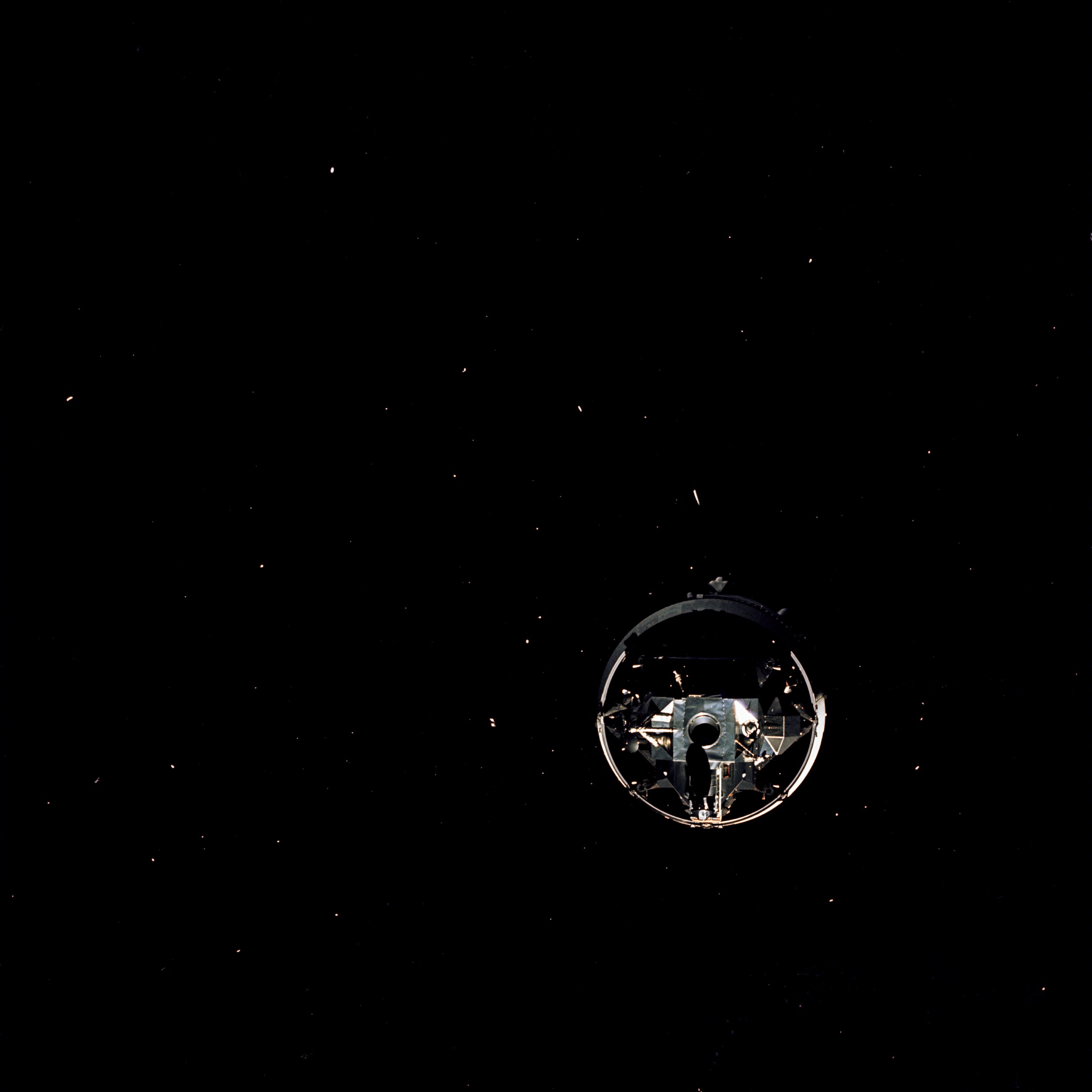
Image of the rapidly receding Earth taken shortly after Trans-Lunar Injection The Lunar Module Snoopy still attached to the S-IVB third stage during the Transposition and Docking maneuver A much smaller Earth taken late during the translunar coast
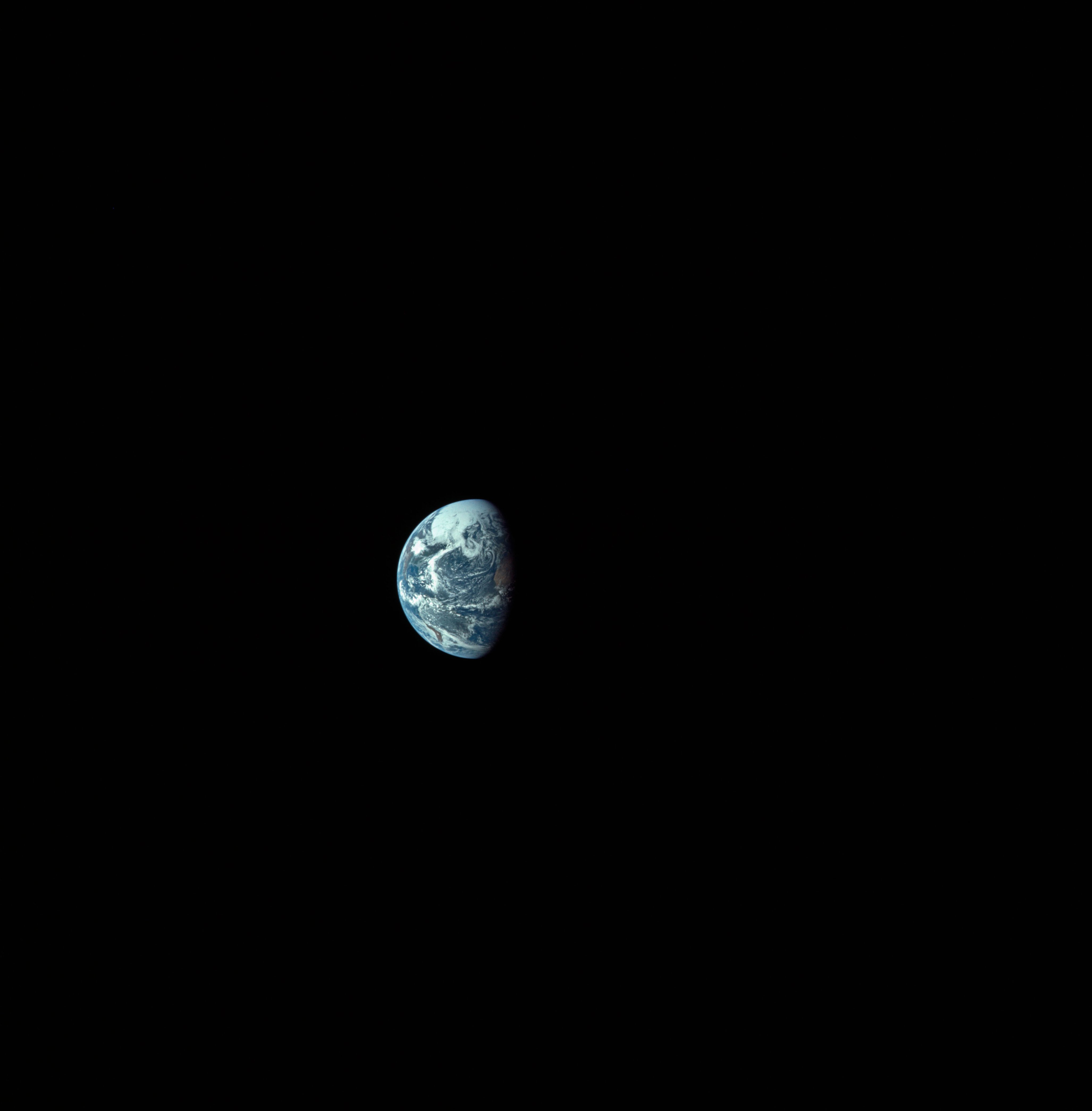
Left: Image of the rapidly receding Earth taken shortly after Trans-Lunar Injection. Middle: The Lunar Module Snoopy still attached to the S-IVB third stage during the Transposition and Docking maneuver. Right: A much smaller Earth taken late during the translunar coast.

Thirty minutes after the TLI burn, the crew separated Charlie Brown from the S-IVB, with Snoopy still snuggled atop the third stage. Young guided Charlie Brown about 150 feet away, turned the spacecraft around, then flew it back to dock with Snoopy, completing the Transposition and Docking maneuver. Viewers received the first color TV images from space, the first of 17 transmission during the mission, showing Snoopy atop the S-IVB as Young brought Charlie Brown in for the docking. Thirty minutes later springs ejected Snoopy, now firmly docked with Charlie Brown, from the S-IVB, with Stafford exclaiming, “Snoopy’s coming out of the doghouse.” By this time, Apollo 10 had traveled more than 13,000 miles from Earth, with its velocity decreasing as the home planet’s gravity inexorably tugged at the spacecraft. The next two days passed without incident, with the astronauts performing routine navigation and housekeeping tasks and providing viewers at home more televised views of themselves and the receding Earth. About 62 hours after launch, they crossed into the Moon’s gravitational sphere of influence and their speed began to increase. Eleven hours later and still about 9,000 miles from the Moon, Apollo 10 passed into the darkness of the lunar shadow. Less than three hours later, Apollo 10 passed behind the Moon, cutting off communications with Earth.

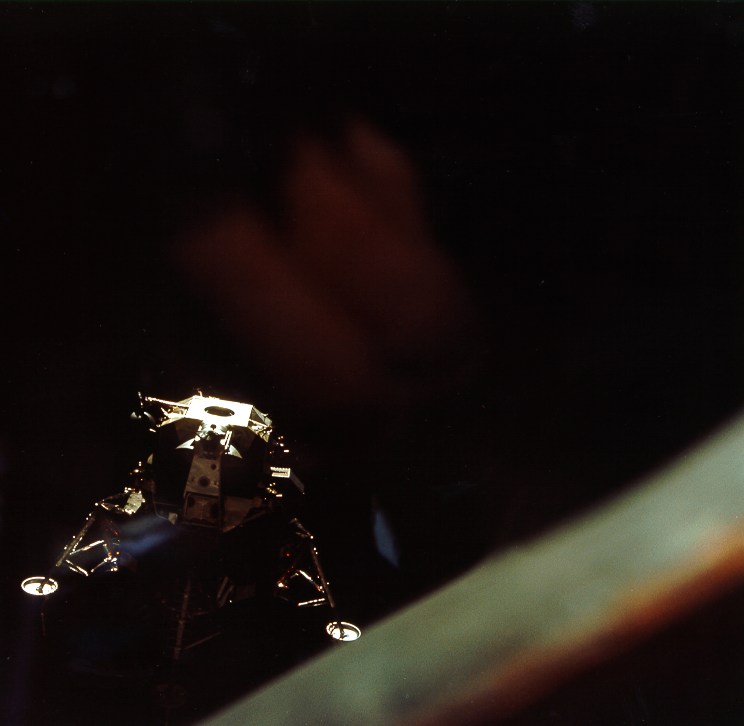
Earthrise as seen from lunar orbit The Lunar Module Snoopy as seen from the Command Module Charlie Brown shortly after undocking Charlie Brown seen from Snoopy after undocking
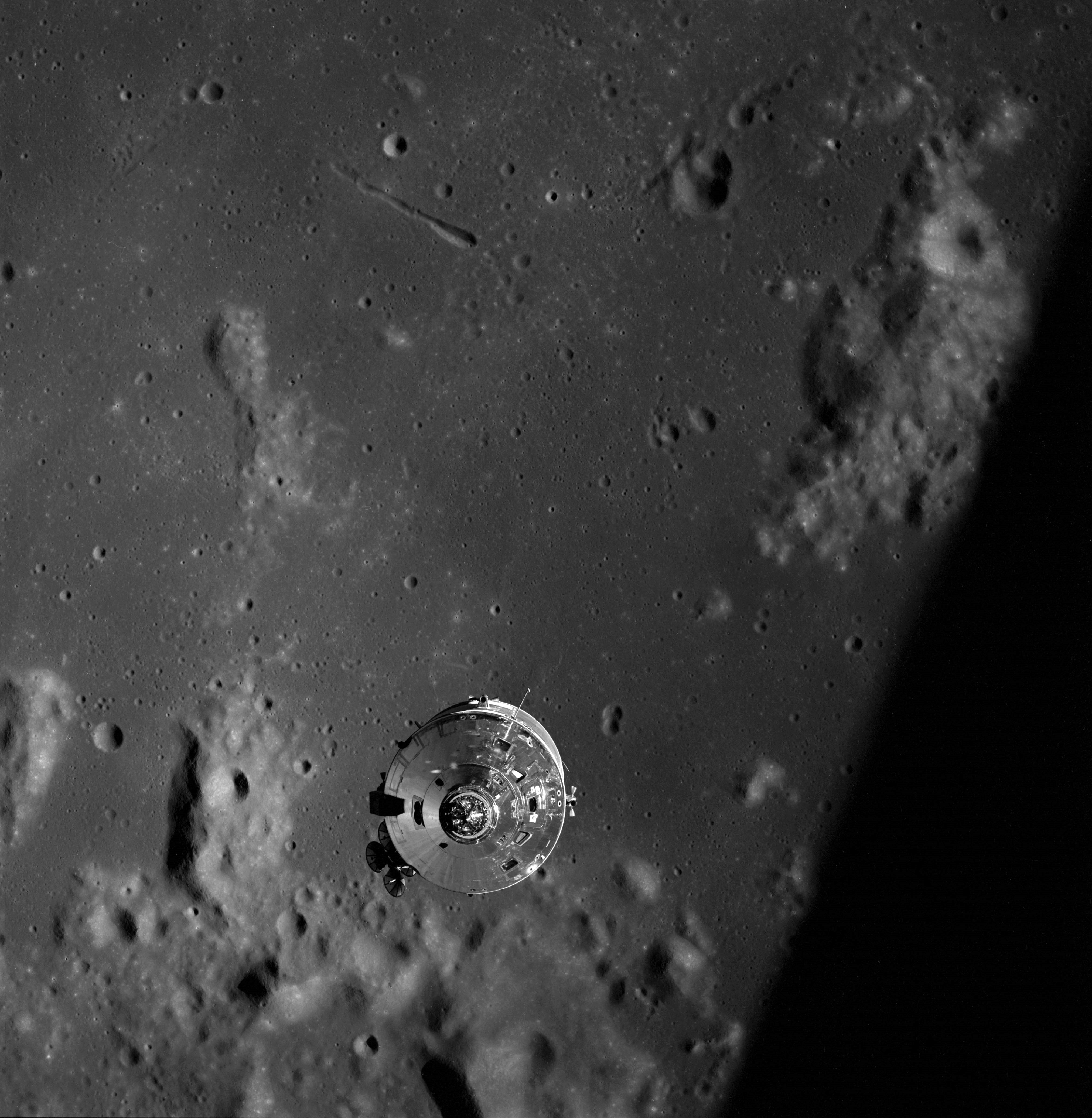
Left: Earthrise as seen from lunar orbit. Middle: The Lunar Module Snoopy as seen from the Command Module Charlie Brown shortly after undocking. Right: Charlie Brown seen from Snoopy after undocking.

The Lunar Orbit Insertion (LOI) maneuver, a six-minute firing of the Service Propulsion System (SPS) engine, took place behind the Moon, placing Apollo 10 into an elliptical orbit. As they rounded the backside of the Moon, Stafford radioed to Mission Control, “You can tell the world that we have arrived.” All three crew members began excitedly describing the lunar scenery passing by beneath them, with Cernan summing it up best, “It might sound corny, but the view is really out of this world.” After two revolutions around the Moon, the astronauts once again fired the SPS engine, this time for 14 seconds, to circularize their orbit. Cernan opened the hatch to Snoopy for the first time, and floated inside to partially activate it, perform a brief inspection, conduct communications checks, and transfer equipment needed later during Snoopy’s free flight. Cernan reported on Snoopy’s condition, “I’m personally very happy with the fellow.” The crew prepared to settle down for their first night’s sleep in lunar orbit, with Cernan asking the ground to “watch Snoopy well tonight, and make him sleep good, and we’ll take him out for a walk and let him stretch his legs in the morning.” The next morning, all three crew members donned their spacesuits, Stafford and Cernan transferred to Snoopy, leaving Young in Charlie Brown, and then closed the hatches between the two spacecraft. Mission Control gave the crew the go to undock, and soon after Young separated the two spacecraft. Minutes later, with the two spacecraft flying separately, Snoopy began a slow roll so that Young could inspect and photograph the vehicle. Young then fired Charlie Brown’s thrusters to separate from Snoopy. And then, the time came to take Snoopy for a walk and let him stretch his legs, as Cernan had promised the night before.
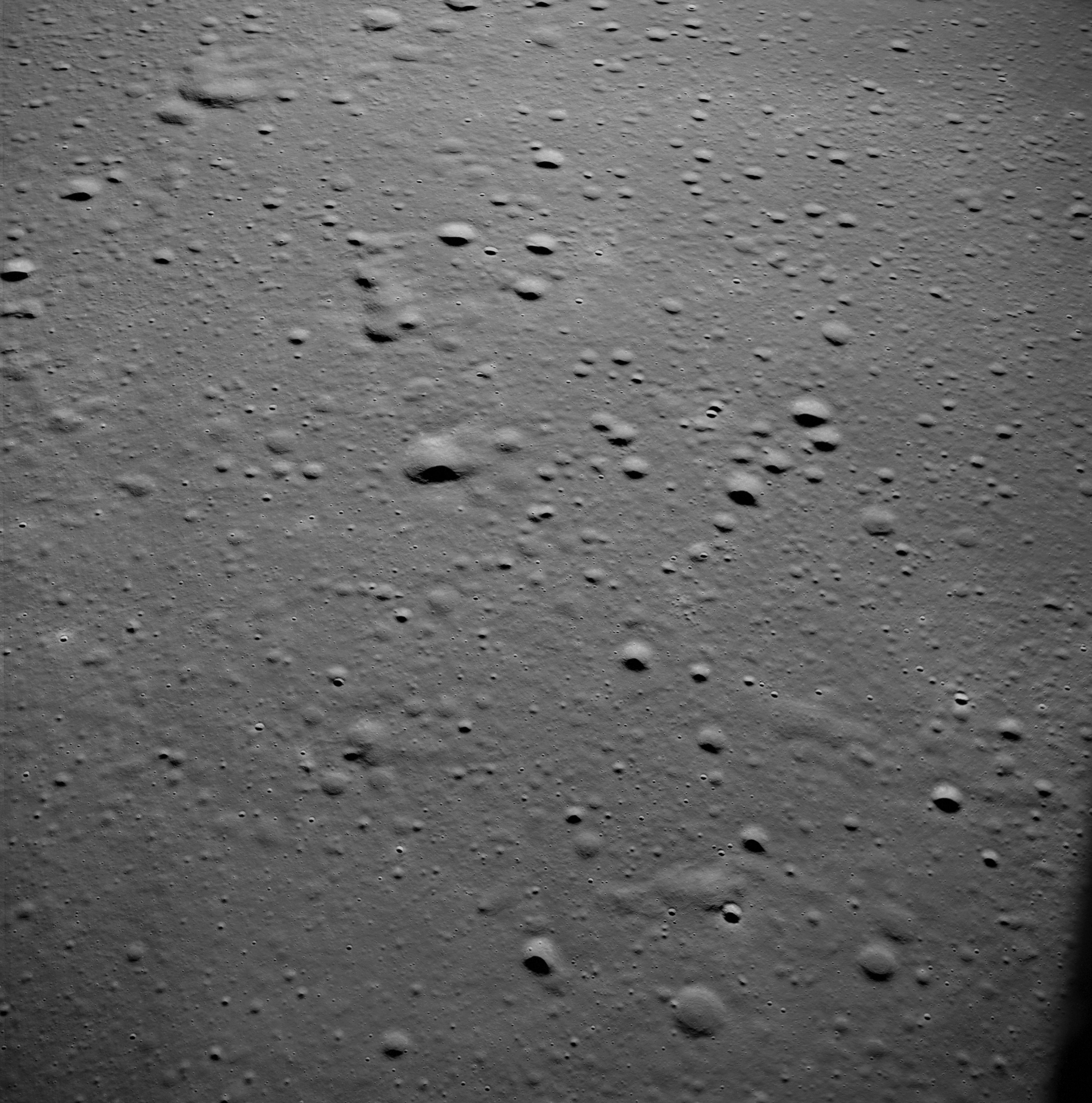
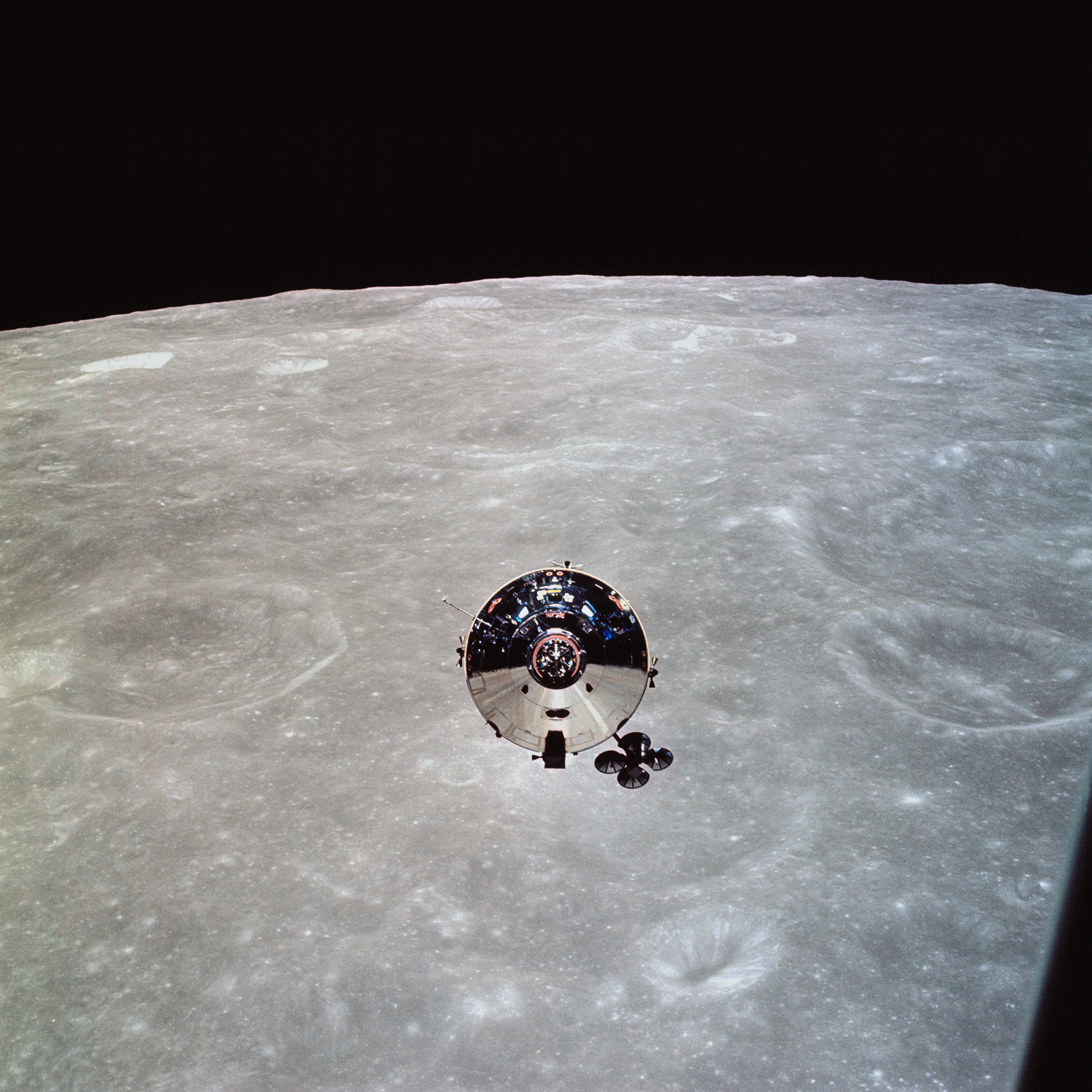
View of the Apollo 11 landing site in the Sea of Tranquility taken from the Lunar Module Snoopy during its close approach to the surface Command and Service Module Charlie Brown as seen from Snoopy during the rendezvous and docking maneuver Snoopy as seen from Charlie Brown during the rendezvous and docking maneuver
Left: View of the Apollo 11 landing site in the Sea of Tranquility taken from the Lunar Module Snoopy during its close approach to the surface. Middle: Command and Service Module Charlie Brown as seen from Snoopy during the rendezvous and docking maneuver. Right: Snoopy as seen from Charlie Brown during the rendezvous and docking maneuver.

Mission Control gave Snoopy the go for the Descent Orbit Insertion burn of the LM’s Descent Propulsion System (DPS) engine to lower its orbital low point to about 50,000 feet. The 27-second burn began with the engine at 11.3% thrust for the first 15 seconds, then Stafford throttled it up to 40% thrust for the remainder of the maneuver. Stafford and Cernan began taking photographs and film of the surface as they started their descent to the low point, later calculated as about 47,000 feet. Cernan reported, “We is down among them,” referring to their low altitude over the lunar landscape. They successfully tested Snoopy’s landing radar, a critical test before the actual landing mission, all the while continuing a running commentary describing the landscape below them including all the landmarks leading up to the planned Apollo 11 landing site in the Sea of Tranquility. Stafford and Cernan then separated the LM’s ascent stage from the descent stage. During the staging, Snoopy experienced some unexpected motions in all three axes that Stafford and Cernan quickly brought under control. Investigators later attributed the gyrations to a switch placed in the wrong position. Ten minutes later, they fired Snoopy’s Ascent Propulsion System (APS) engine for 15 seconds that simulated a liftoff from the Moon, and began the rendezvous process to rejoin Young in Charlie Brown, using the same maneuvers as during a landing mission. Young completed the docking and Stafford exclaimed, “Snoopy and Charlie Brown are hugging each other.” Snoopy had been on a very long leash, travelling up to 390 miles from Charlie Brown, meeting all planned objectives during its 8-hour 10-minute solo flight. Soon, the crew opened the hatches between the two spacecraft and Stafford and Cernan rejoined Young in Charlie Brown, bringing with them cameras and exposed film. They then closed the hatches for the final time and bid farewell to Snoopy. Due to residual air pressure in the docking tunnel that couldn’t be vented, Snoopy departed at a higher than expected speed. Stafford commented, “Snoop went some place,” and Young added, “Man, when he leaves, he leaves.” To prevent an unwanted recontact between the two spacecraft, Snoopy fired its APS engine to fuel depletion, which sent it safely out of lunar orbit and into an orbit around the Sun. Cernan, perhaps feeling some guilt about disposing of Snoopy, said, “I feel sort of bad about that, because he’s a pretty nice guy; he treated us pretty well today.” 
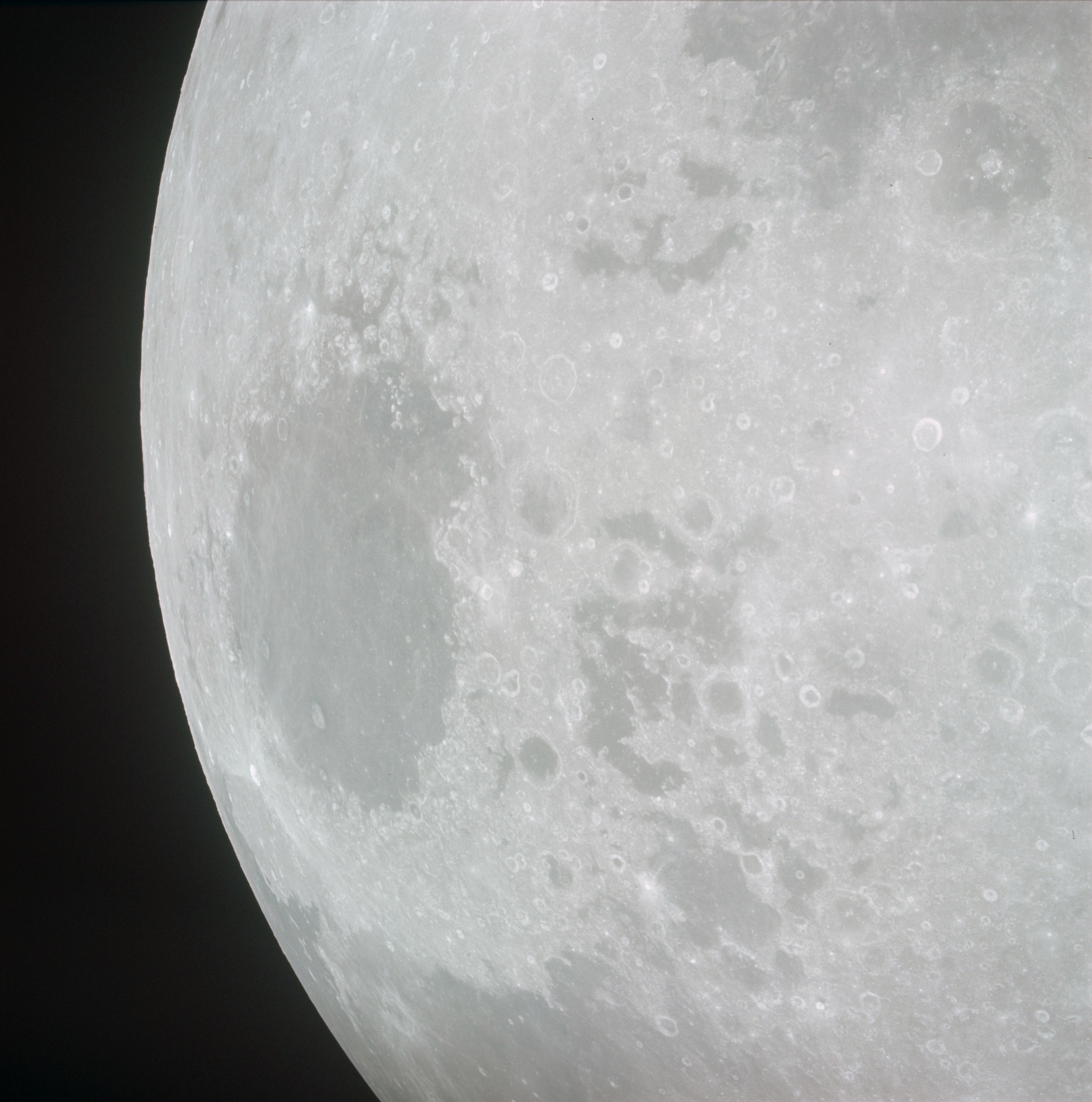
The rapidly receding Moon shortly after the Trans-Earth Injection Earth photographed during the trans Earth coast Apollo 10 on its three main parachutes shortly before splashdown
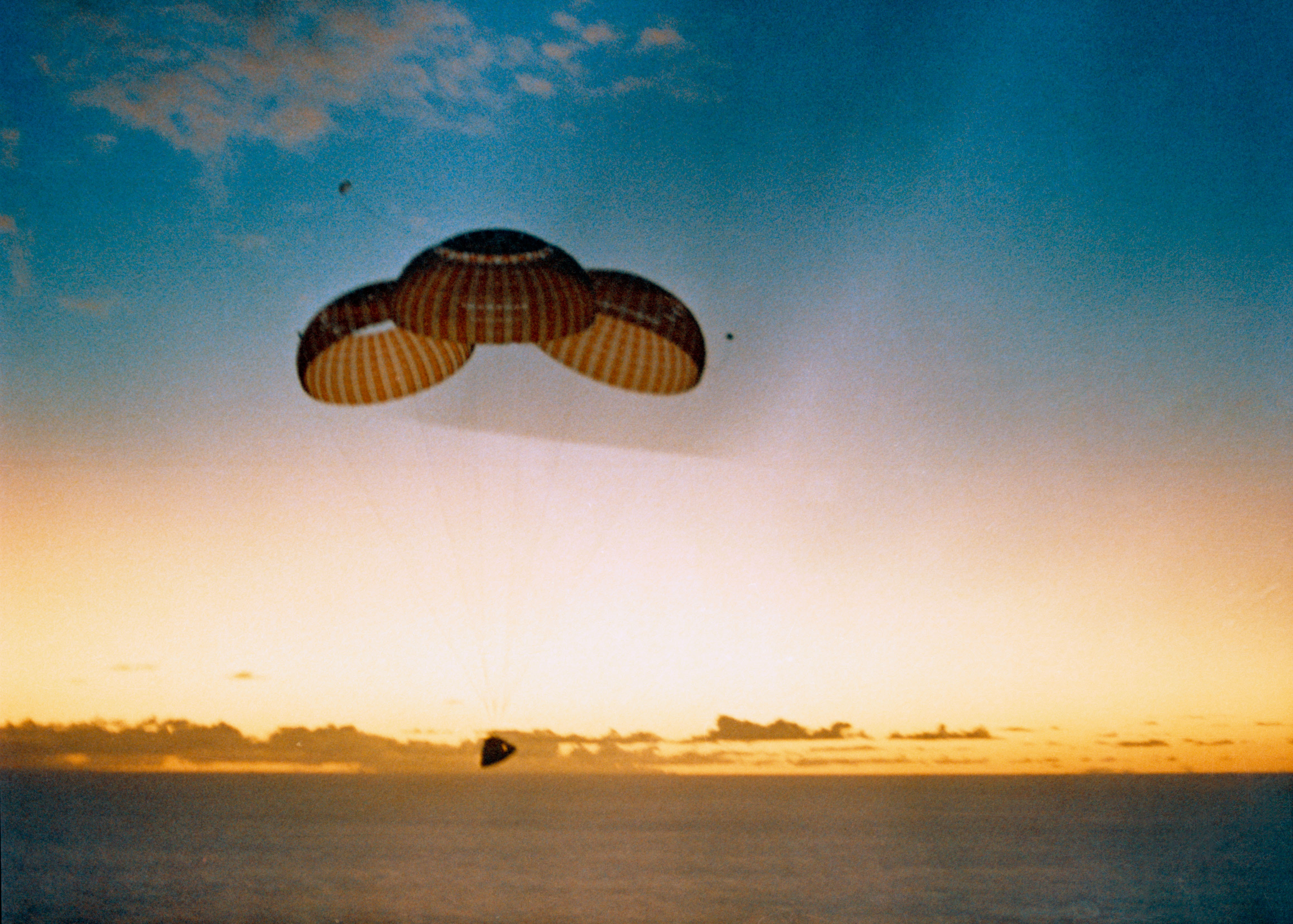
Left: The rapidly receding Moon shortly after the Trans-Earth Injection. Middle: Earth photographed during the trans Earth coast. Right: Apollo 10 on its three main parachutes shortly before splashdown.

During their 31st and final orbit around the Moon, the astronauts prepared the spacecraft for its next critical maneuver, the Trans Earth Injection (TEI), to propel them out of lunar orbit and back toward home. “Houston, we are returning to Earth!” With those words, Stafford announced that the TEI, a 165-second burn of the SPS engine had succeeded. The three-day return trip to Earth passed uneventfully, the crew conducting a single midcourse maneuver. As they approached the Earth, the crew separated the CM from the Service Module and turned its blunt heat shield into the direction of travel. By the time it made first contact with the Earth’s atmosphere 16 minutes later at an altitude of 400,000 feet, the point called Entry Interface, Apollo 10 had accelerated to 24,791 miles per hour, the fastest reentry for any crewed space mission. The spacecraft entered a radio blackout period a few seconds later, caused by the buildup of ionized gases as a result of rapid deceleration. At 24,000 feet altitude, two drogue parachutes deployed to provide initial deceleration, followed at 10,000 feet by the three main parachutes that provided a splashdown velocity of about 22 miles per hour.
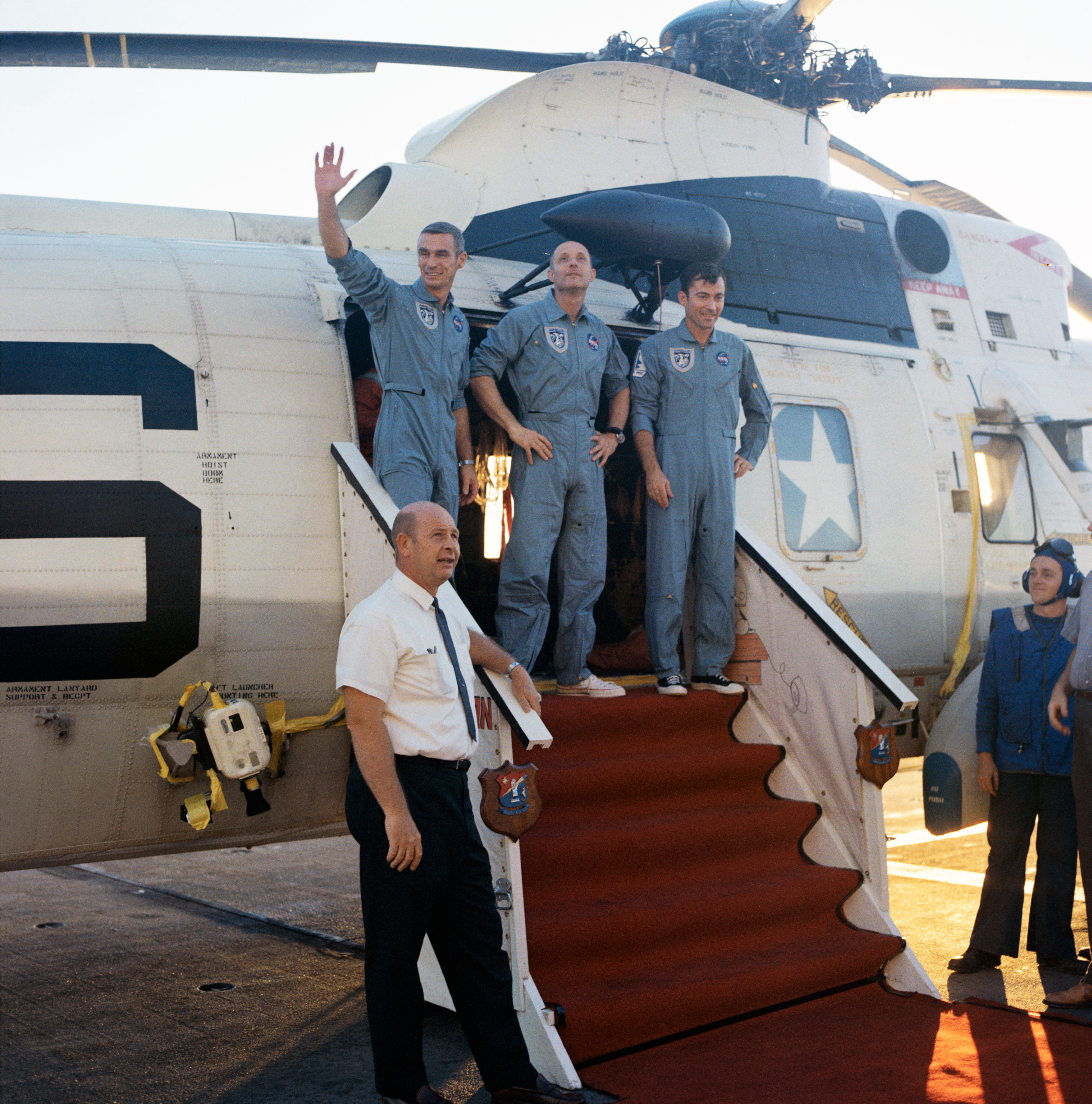
The recovery helicopter delivered Apollo 10 astronauts Eugene A. Cernan, left, Thomas P. Stafford, and John W. Young to the deck of the U.S.S. Princeton Dignitaries greet Cernan, left, Stafford, and Young during their stopover in American Samoa Young, Stafford, and Cernan greet well-wishers upon their arrival at Houston’s Ellington Air Force Base
Left: The recovery helicopter delivered Apollo 10 astronauts Eugene A. Cernan, left, Thomas P. Stafford, and John W. Young to the deck of the U.S.S. Princeton. Middle: Dignitaries greet Cernan, left, Stafford, and Young during their stopover in American Samoa. Right: Young, Stafford, and Cernan greet well-wishers upon their arrival at Houston’s Ellington Air Force Base.

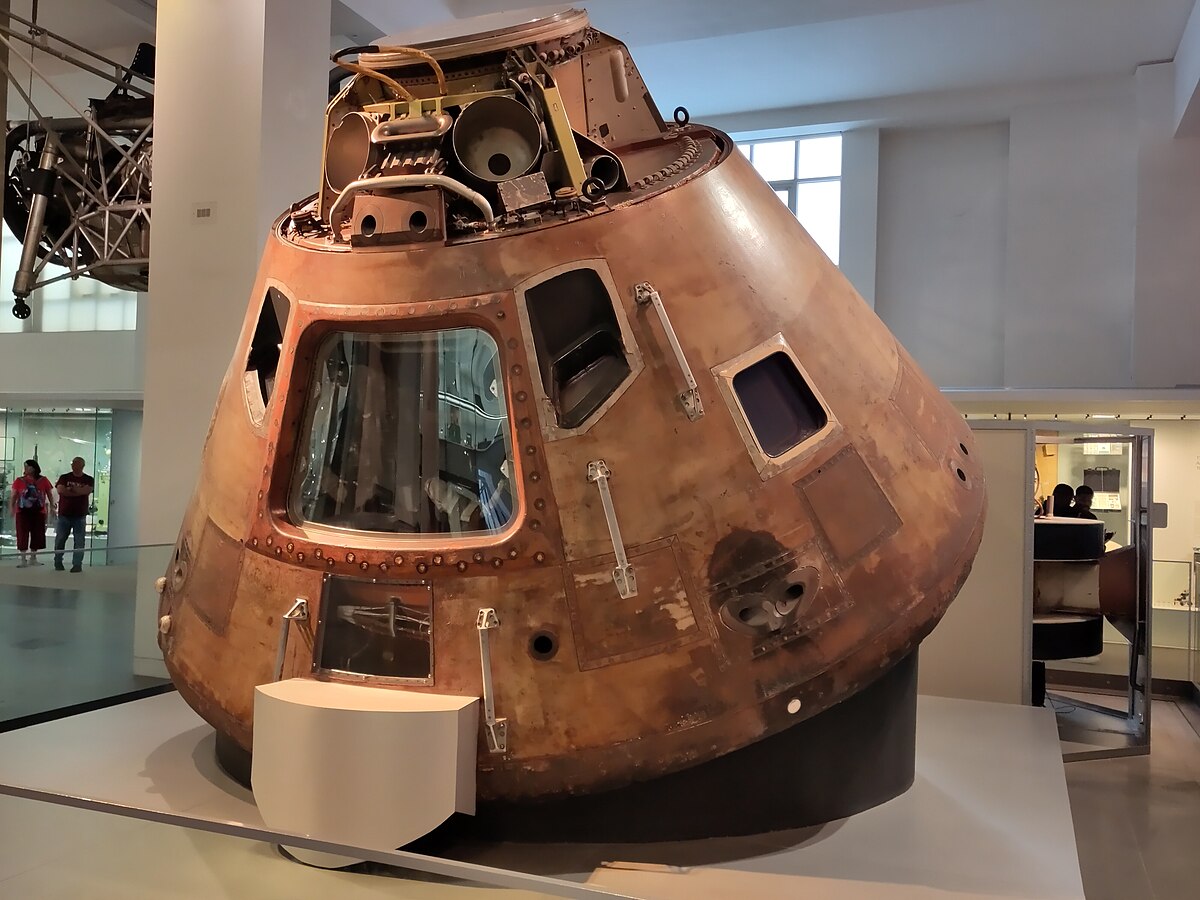
At precisely 11:53 a.m. CDT on May 26, 1969, Apollo 10 splashed down in the Pacific Ocean 460 miles east of American Samoa. The splashdown occurred shortly before sunrise, just 1.5 miles from the targeted point and 3.3 miles from the prime recovery ship the U.S.S. Princeton (LPH-5). Stafford, Cernan, and Young had completed a flight lasting 192 hours and 3 minutes. Within 39 minutes, recovery forces delivered the trio to the deck of the Princeton, where the ship’s captain and dozens of cheering sailors greeted them. After a brief stay aboard the Princeton, Stafford, Cernan, and Young flew by helicopter to Pago Pago, American Samoa, where the governor, his wife, and 5,000 Samoan well-wishers greeted them. From there, they took a C-141 transport aircraft back to Ellington Air Force Base (AFB) in Houston, where they reunited with their families and a cheering crowd welcomed them home. Sailors offloaded the CM Charlie Brown from the Princeton in Hawaii on May 31. From there, workers flew it to Long Beach, California, on June 4, and then trucked it to the North American Rockwell plant in Downey to undergo postflight inspection. NASA transferred accountability for Charlie Brown to the Smithsonian Institution in April 1970, following which the United States Information Agency took it on a tour of Europe, including the Soviet Union, France, and The Netherlands. The Smithsonian loaned the spacecraft to the London Science Museum in January 1976, where it remains on display today.

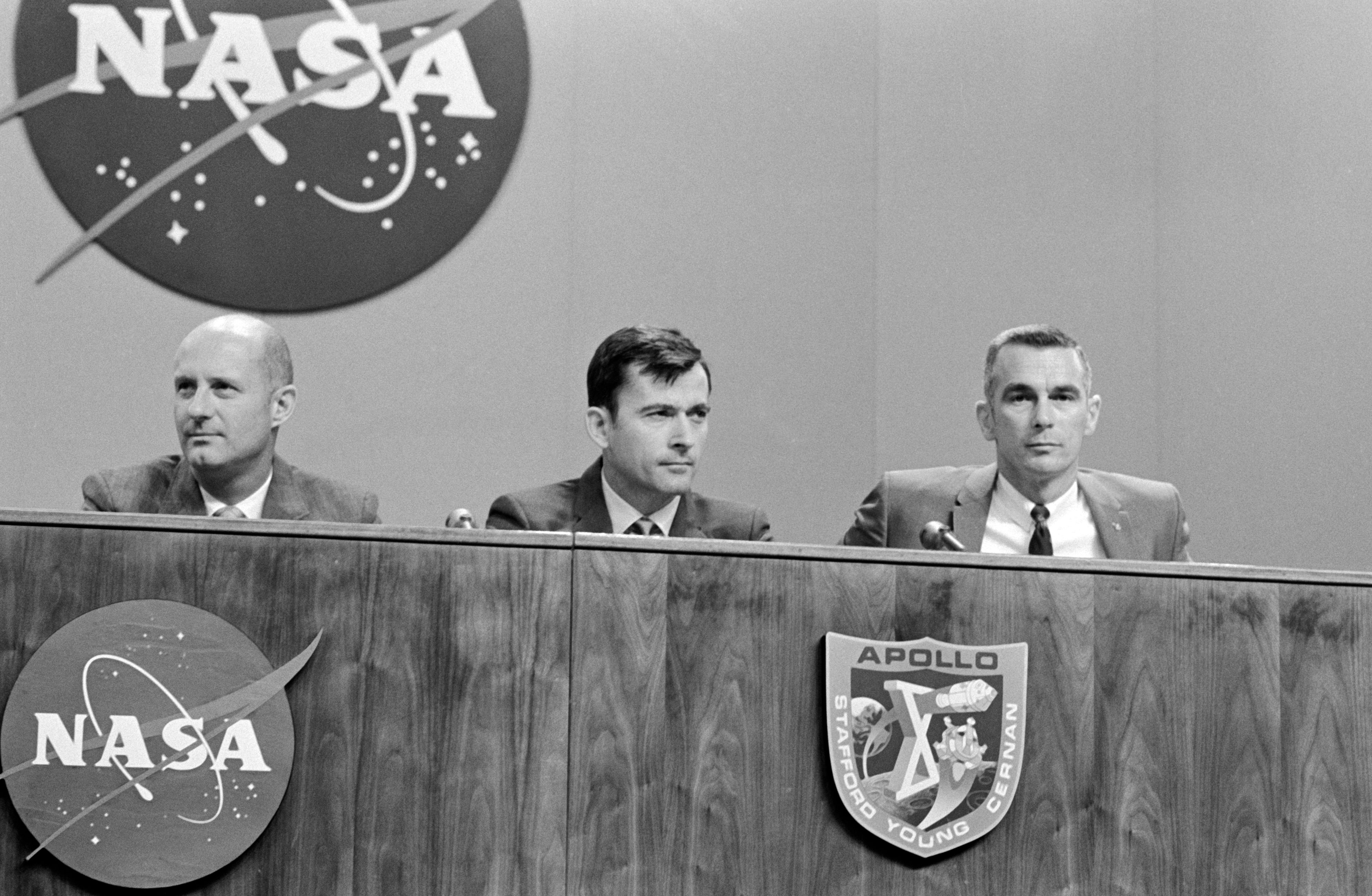
Meeting of the minds – the Apollo 10 crew debriefs the Apollo 11 crew Stafford, left, Young, and Cernan brief reporters during their postflight press conference The Apollo 10 Command Module on display at the London Science Museum
Left: Meeting of the minds – the Apollo 10 crew debriefs the Apollo 11 crew. Middle: Stafford, left, Young, and Cernan brief reporters during their postflight press conference. Right: The Apollo 10 Command Module on display at the London Science Museum. Image credit: courtesy London Science Museum.

Apollo 11
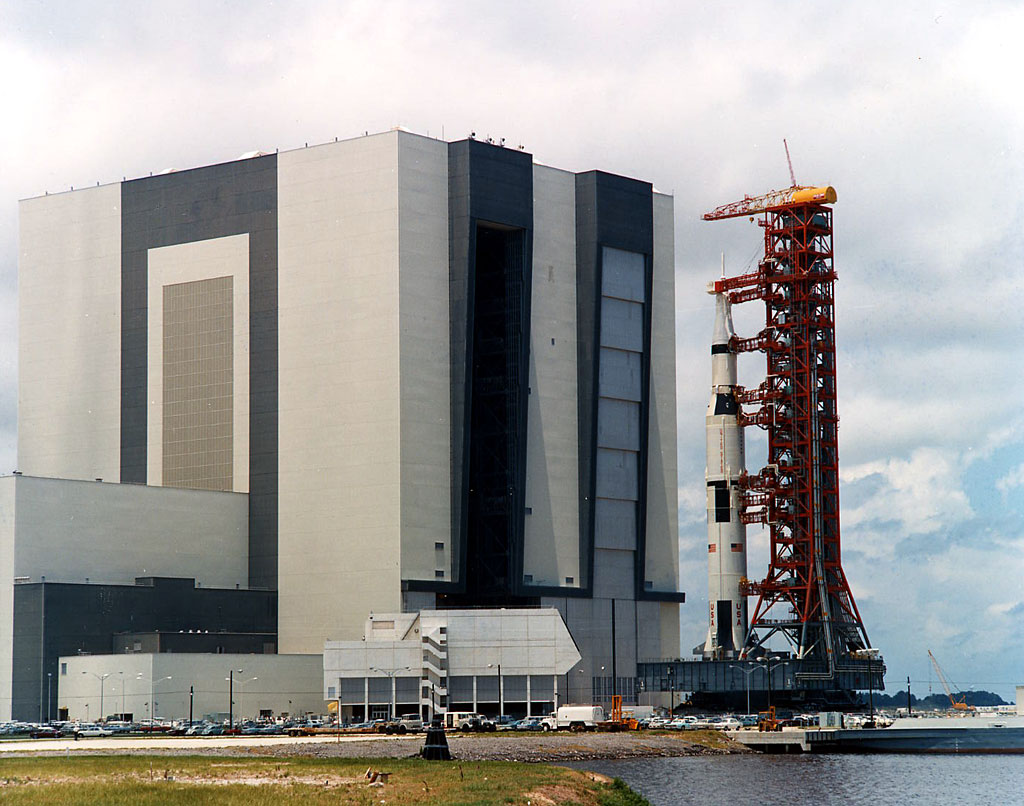
The Apollo 11 Saturn V leaves the Vehicle Assembly Building at NASA’s Kennedy Space Center in Florida on its way to Launch Pad 39A Apollo 11 at Launch Pad 39A Apollo 11 astronauts Neil A. Armstrong, left, Michael Collins, and Edwin E. “Buzz” Aldrin pose with their Saturn V rocket
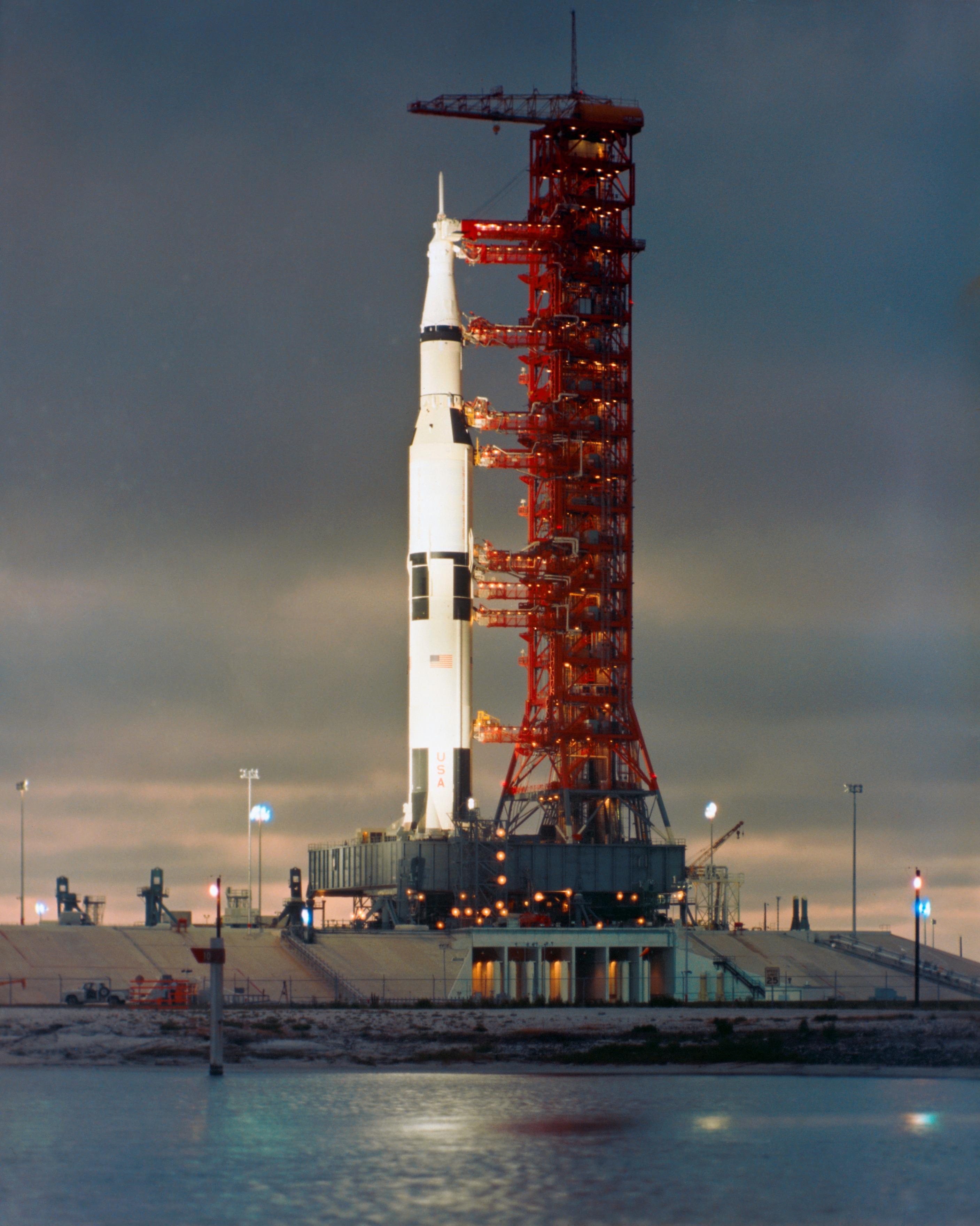
Left: The Apollo 11 Saturn V leaves the Vehicle Assembly Building at NASA’s Kennedy Space Center in Florida on its way to Launch Pad 39A. Middle: Apollo 11 at Launch Pad 39A. Right: Apollo 11 astronauts Neil A. Armstrong, left, Michael Collins, and Edwin E. “Buzz” Aldrin pose with their Saturn V rocket.

While Apollo 10 headed for the Moon, on May 20 workers at KSC rolled the Apollo 11 Saturn V from the Vehicle Assembly Building (VAB) to Launch Pad 39A. Two days later, they rolled the Mobile Service Structure around the rocket and began integrated tests on the launch vehicle.

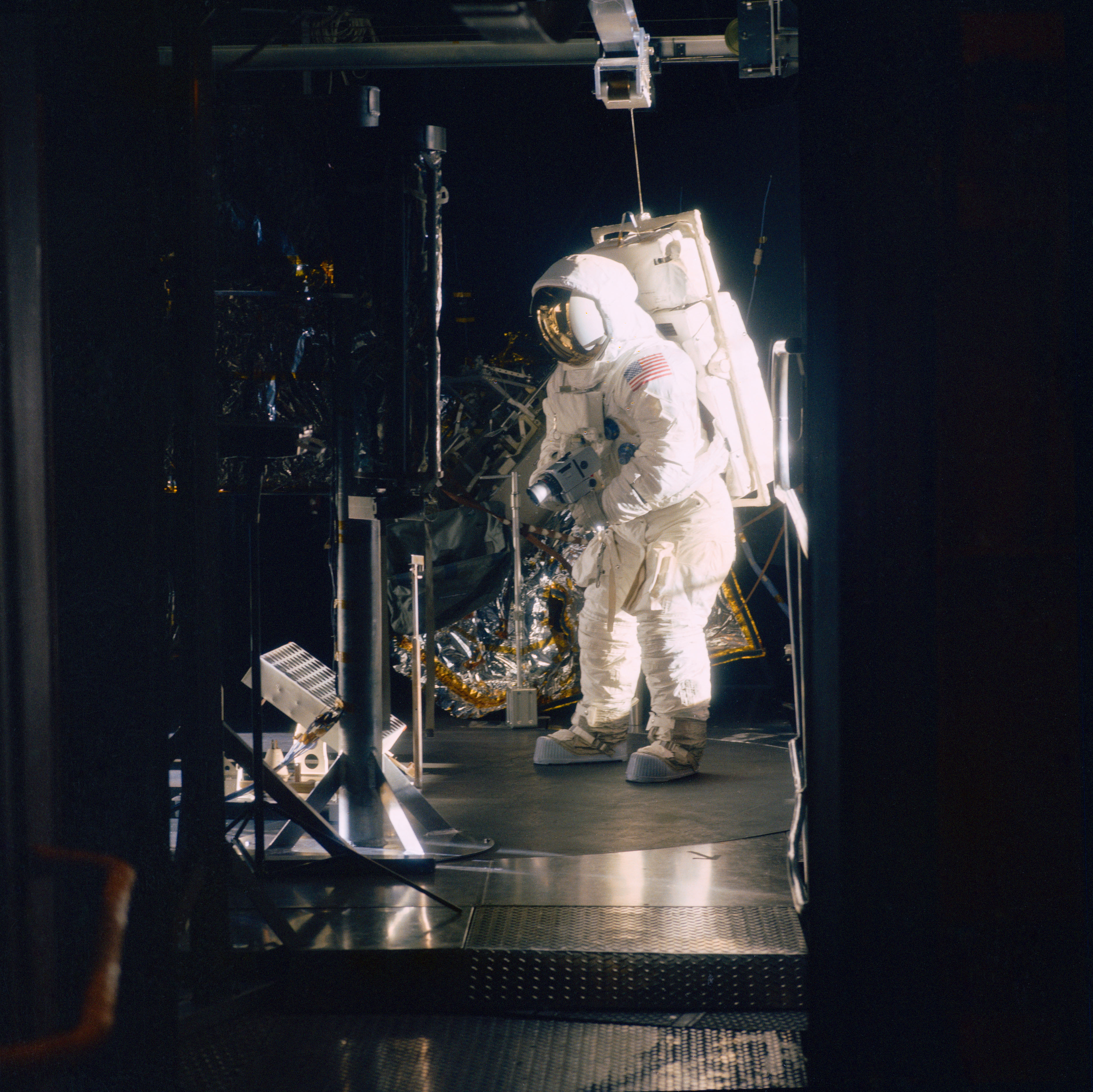
Apollo 11 Prime crew member Neil A. Armstrong Apollo 11 Prime crew member Edwin E. “Buzz” Aldrin Apollo 11 backup crew member James A. Lovell Apollo 11 backup crew member Fred W. Haise
At the Manned Spacecraft Center, now NASA’s Johnson Space Center in Houston, Apollo 11 astronauts conduct vacuum runs in Chamber B of the Space Environment Simulation Laboratory. Prime crew members Neil A. Armstrong, left, and Edwin E. “Buzz” Aldrin, and backup crew members James A. Lovell, and Fred W. Haise.

The Apollo 11 prime crew of Neil A. Armstrong, Michael Collins, and Edwin E. “Buzz” Aldrin and their backups James A. Lovell, William A. Anders, and Fred W. Haise continued training for the Moon landing. Armstrong, Aldrin, Lovell, and Haise each completed altitude runs in Chamber B of MSC’s Space Environment Simulation Laboratory. During these tests, the spacesuited astronauts practiced various lunar surface activities, such as activating the television camera, collecting rock samples, and deploying the scientific experiments of the Early Apollo Surface Experiment Package (EASEP).
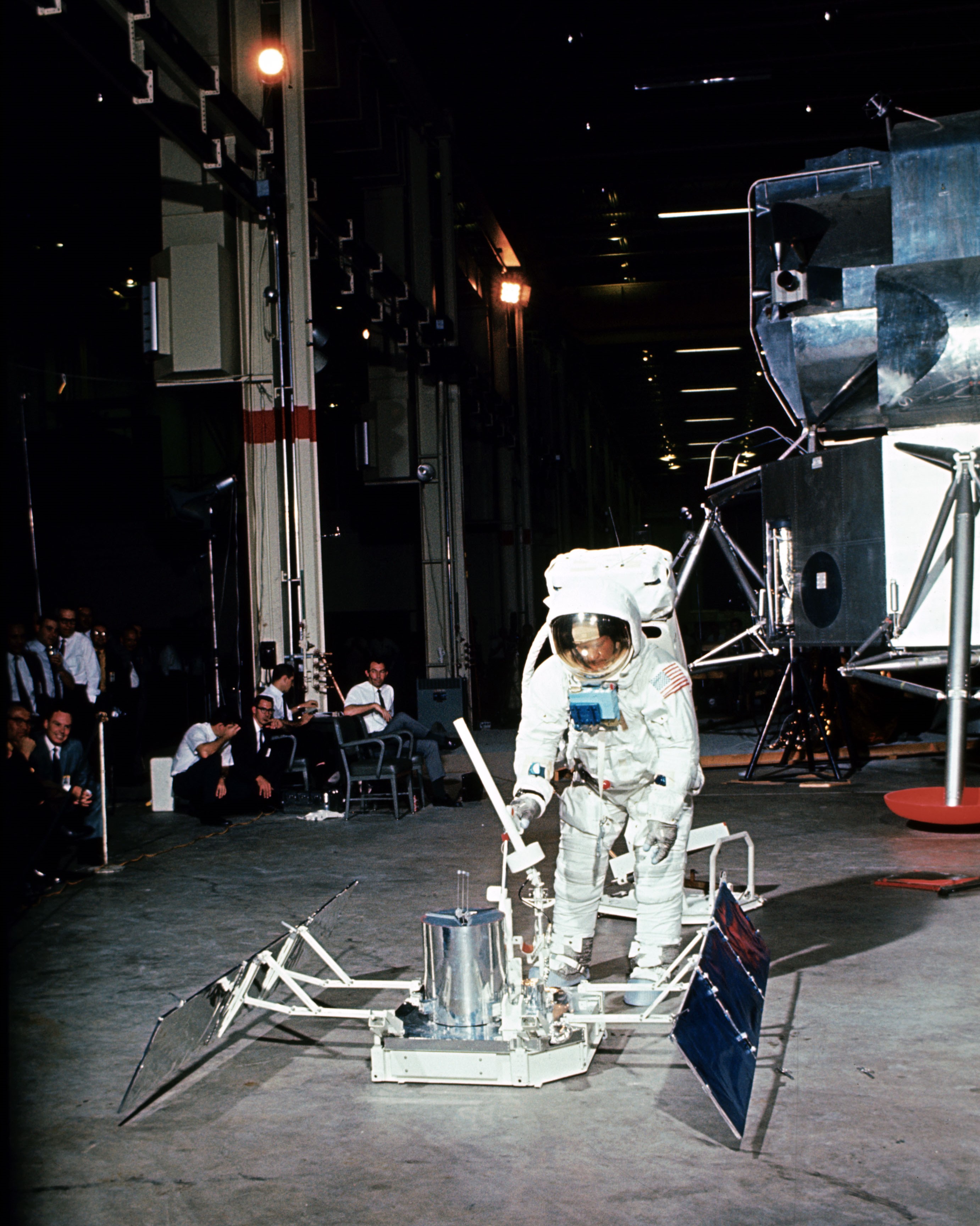
Neil A. Armstrong deploys the Passive Seismic Experiment Package An Apollo 11 astronaut deploys the Laser Ranging Retro-Reflector Edwin E. “Buzz” Aldrin deploys the Solar Wind Collection experiment
Left: Neil A. Armstrong deploys the Passive Seismic Experiment Package. Middle: An Apollo 11 astronaut deploys the Laser Ranging Retro-Reflector. Right: Edwin E. “Buzz” Aldrin deploys the Solar Wind Collection experiment.

Armstrong and Aldrin practiced the deployment of the three scientific instruments they planned to deploy during their 2.5-hour surface excursion. Two instruments made up the EASEP – the Passive Seismic Experiment Package (PSEP), and the Laser Ranging Retro-Reflector (LRRR). The EASEP instruments remained on the surface after the astronauts departed, while the astronauts deployed and retrieved a third instrument, the Solar Wind Composition (SWC) experiment, during their spacewalk. The solar powered PSEP collected data to detect any possible moonquakes. Scientists used the passive LRRR to make precise measurements of the Earth-Moon distance. The SWC’s sheet of aluminum collected particles of the solar wind, in particular the noble gases helium, neon, argon, krypton, and xenon. 
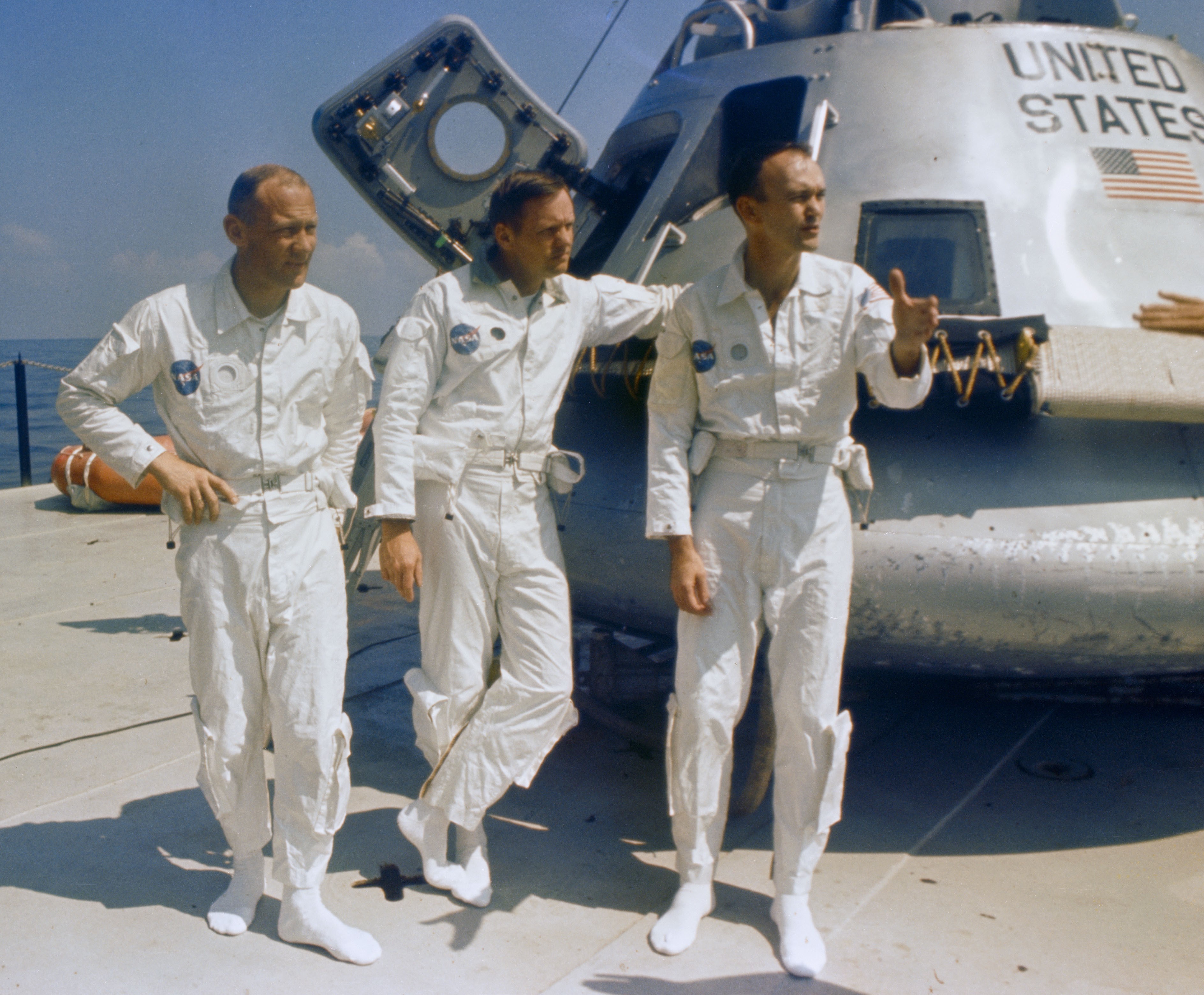
Apollo 11 astronauts Edwin E. “Buzz” Aldrin, left, Neil A. Armstrong, and Michael Collins aboard the MV Retriever prepare for the water egress test using the Biological Isolation Garment (BIG) Engineer John K. Hirasaki demonstrates the BIG Armstrong emerges from the boilerplate Command Module to join Aldrin and Collins, as recovery team’s decontamination office Clancy Hatleberg monitors the activity
Left: Apollo 11 astronauts Edwin E. “Buzz” Aldrin, left, Neil A. Armstrong, and Michael Collins aboard the MV Retriever prepare for the water egress test using the Biological Isolation Garment (BIG). Middle: Engineer John K. Hirasaki demonstrates the BIG. Right: Armstrong emerges from the boilerplate Command Module to join Aldrin and Collins, as recovery team’s decontamination office Clancy Hatleberg monitors the activity.

On May 24, the Apollo 11 astronauts rehearsed splashdown procedures in the Gulf of Mexico near Galveston, Texas, using a boilerplate Apollo CM and supported by the Motorized Vessel (MV) Retriever. The week before, NASA had decided that following splashdown, helicopter recovery forces would retrieve the astronauts from life rafts as on earlier missions. NASA rejected an alternative plan to have sailors aboard the carrier hoist the spacecraft with the astronauts inside onto the deck as too dangerous. Because the standard method would expose the astronauts to the air, raising the risk of contamination, the biological decontamination swimmer would give the astronauts Biological Isolation Garments (BIG) prior to their exiting the spacecraft after splashdown. For Apollo 11, the U.S. Navy’s Underwater Demolition Team-11 (UDT-11) assigned Lieutenant Clarence J. “Clancy” Hatleberg as the decontamination swimmer, and he joined Armstrong, Collins, and Aldrin for the May 24 exercise. Exactly two months later, they would carry out the activity for real in the Pacific Ocean.
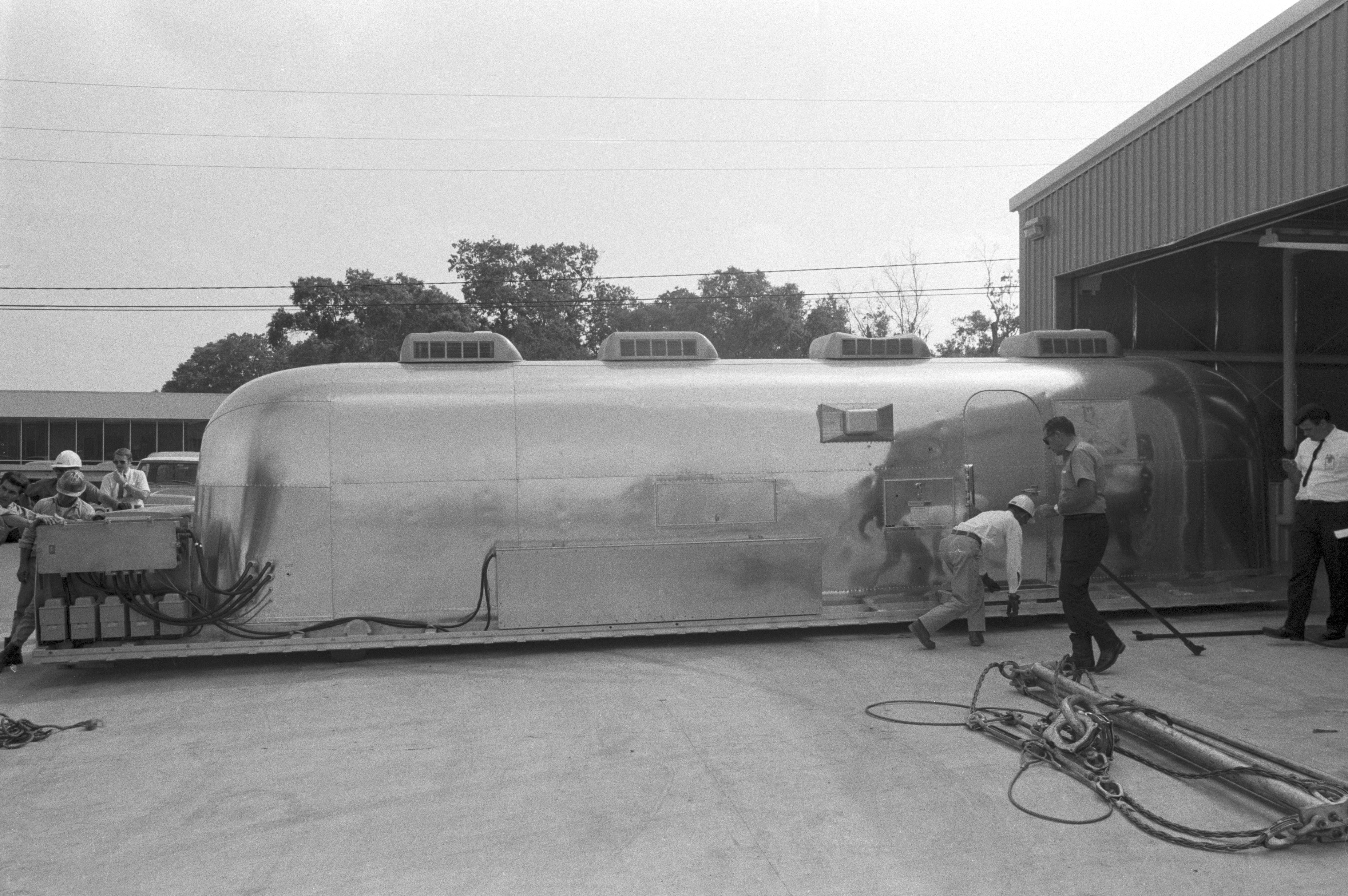
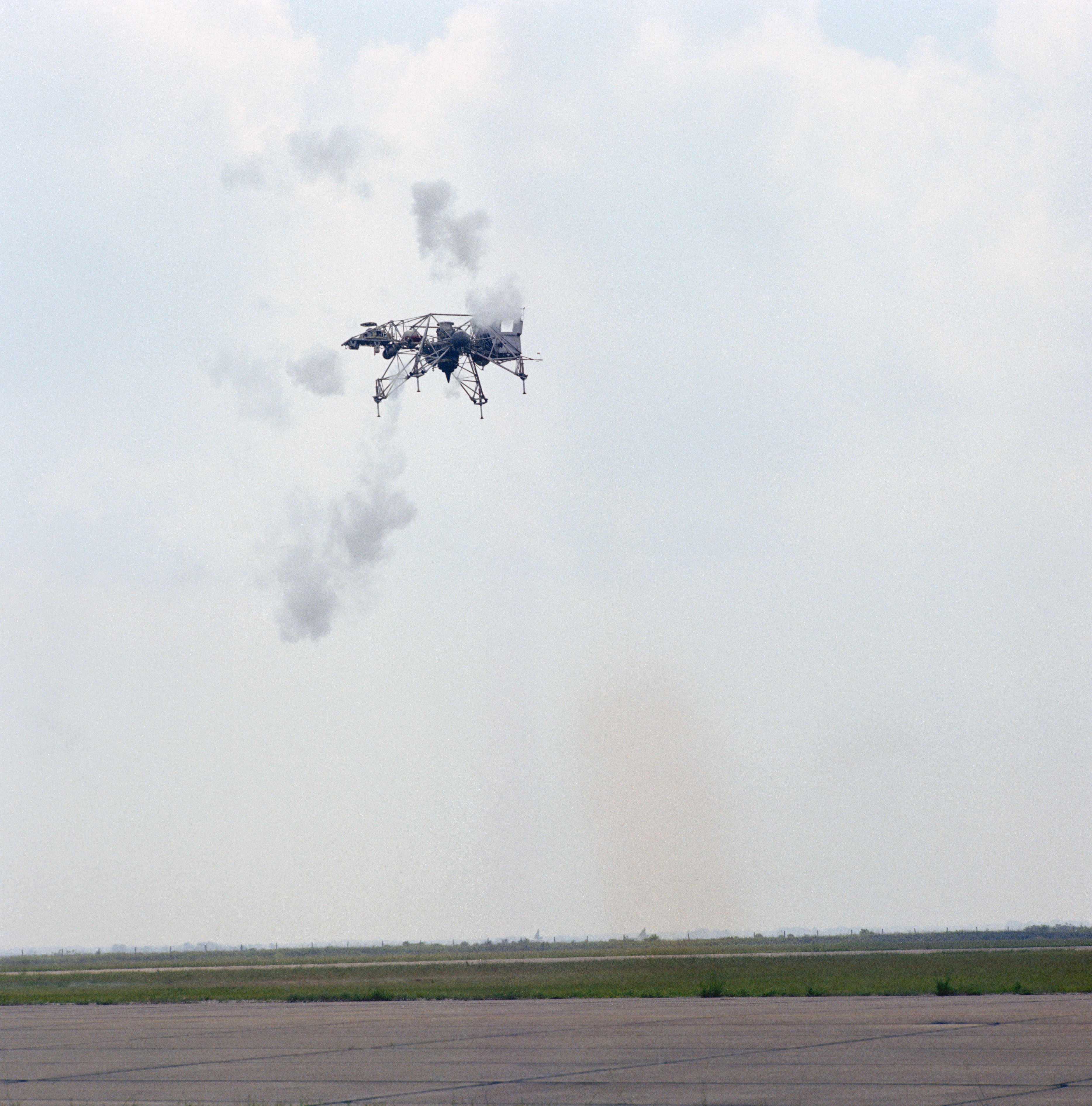
The Mobile Quarantine Facility planned for Apollo 11 arrives at the Manned Spacecraft Center (MSC), now NASA’s Johnson Space Center in Houston NASA test pilot Harold E. “Bud” Ream flies the Lunar Landing Training Vehicle at Ellington Air Force Base to certify it for astronaut operations Lunar Module-2 during one of the drop tests at the Vibration and Acoustics Test Facility at MSC
Left: The Mobile Quarantine Facility planned for Apollo 11 arrives at the Manned Spacecraft Center (MSC), now NASA’s Johnson Space Center in Houston. Middle: NASA test pilot Harold E. “Bud” Ream flies the Lunar Landing Training Vehicle at Ellington Air Force Base to certify it for astronaut operations. Right: Lunar Module-2 during one of the drop tests at the Vibration and Acoustics Test Facility at MSC.

The next step in the quarantine process involved the astronauts entering the Mobile Quarantine Facility (MQF) aboard the recovery ship. The astronauts remained inside the MQF until delivered portside, from where a cargo jet would fly them back to Ellington AFB in Houston. From there, a truck delivered the MQF and the astronauts to the Lunar Receiving Laboratory at MSC where they finished their 21-day quarantine. The MQF assigned to Apollo 11, the third of four units built, arrived at MSC on May 12.  At Ellington AFB, MSC pilot Harold E. “Bud” Ream continued to fly the Lunar Landing Training Vehicle-2 (LLTV-2) to certify it for astronaut flights following the December 1968 crash of LLTV-1. Astronauts used the LLTV as a key training tool to simulate the flying characteristics of the LM especially of the final 500 feet of the descent. With astronauts still barred from flying the LLTV, they used the LLTV simulator and the Lunar Landing Research Facility (LLRF) at NASA’s Langley Research Center in Hampton, Virginia, to practice the final descent to the surface. Once managers cleared the LLTV for astronaut use in early June, Armstrong and Lovell completed their training flights later that month. On May 7, in MSC’s Vibration and Acoustics Test Facility engineers completed drop tests using LM-2, certifying the LM and its systems for the loads they would encounter during a lunar landing.

Apollo 12
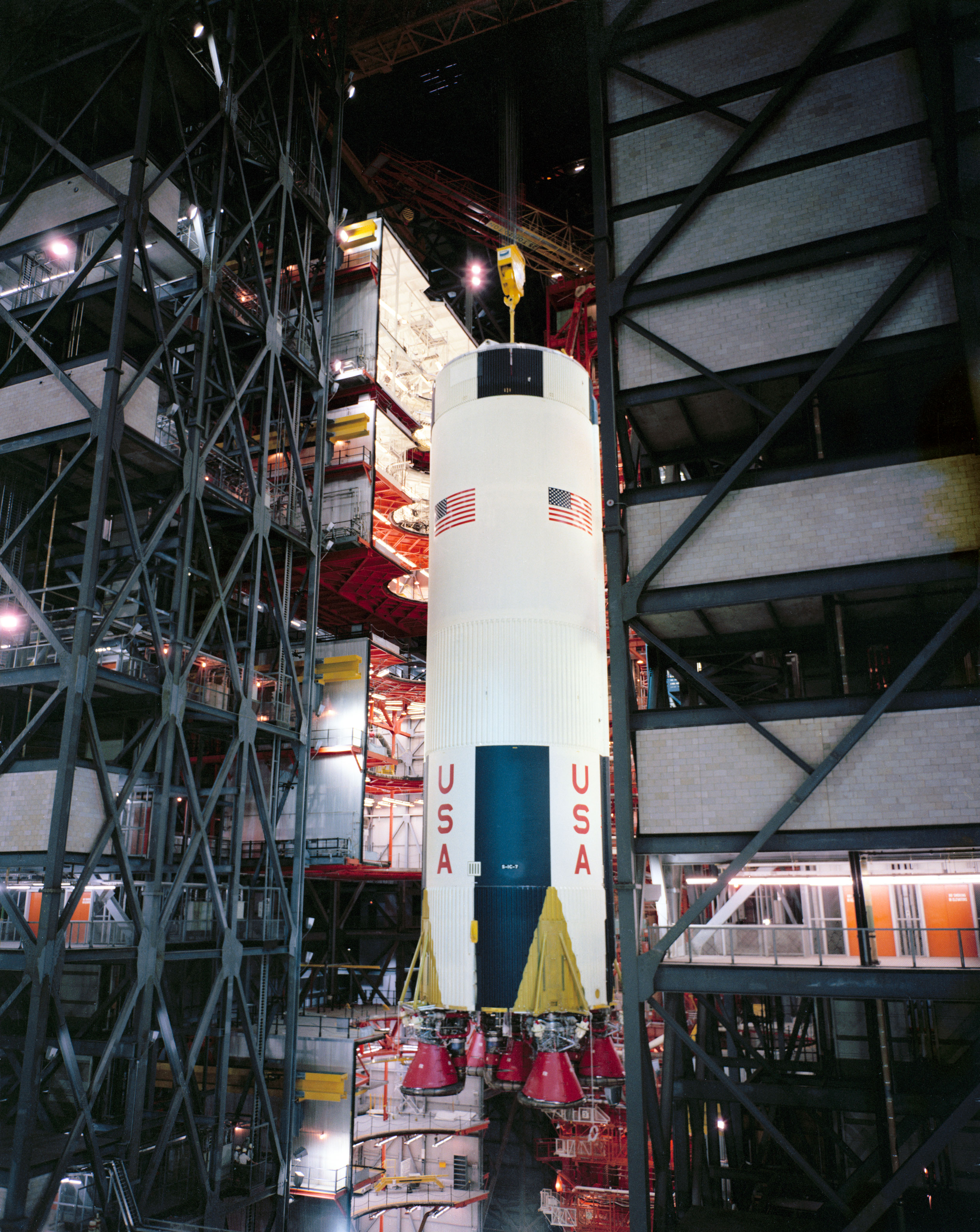
In the Vehicle Assembly Building at NASA’s Kennedy Space Center in Florida, workers lift the first stage of the Apollo 12 Saturn V rocket to begin the stacking process Workers lower the second stage onto the first stage Workers have lowered the third stage onto stack
Left: In the Vehicle Assembly Building at NASA’s Kennedy Space Center in Florida, workers lift the first stage of the Apollo 12 Saturn V rocket to begin the stacking process. Middle: Workers lower the second stage onto the first stage. Right: Workers have lowered the third stage onto stack.

While Apollo 10 headed for the Moon and Apollo 11 headed for its launch pad, workers prepared Apollo 12 for its eventual journey to the Moon, then tentatively planned for September. If Apollo 11 succeeded in its Moon landing mission, Apollo 12 would fly later, most likely in November. At KSC, the S-IC first stage of the Apollo 12 Saturn V arrived on May 3, joining the second and third stages already there. Workers in the VAB’s High Bay 3 stacked the first stage on its Mobile Launcher on May 7, added the S-II second stage on May 21, and the S-IVB third stage the following day. In the nearby Manned Spacecraft Operations Building, workers prepared the Apollo 12 CSM and LM for altitude chamber runs with the prime and backup crews, planned for June.

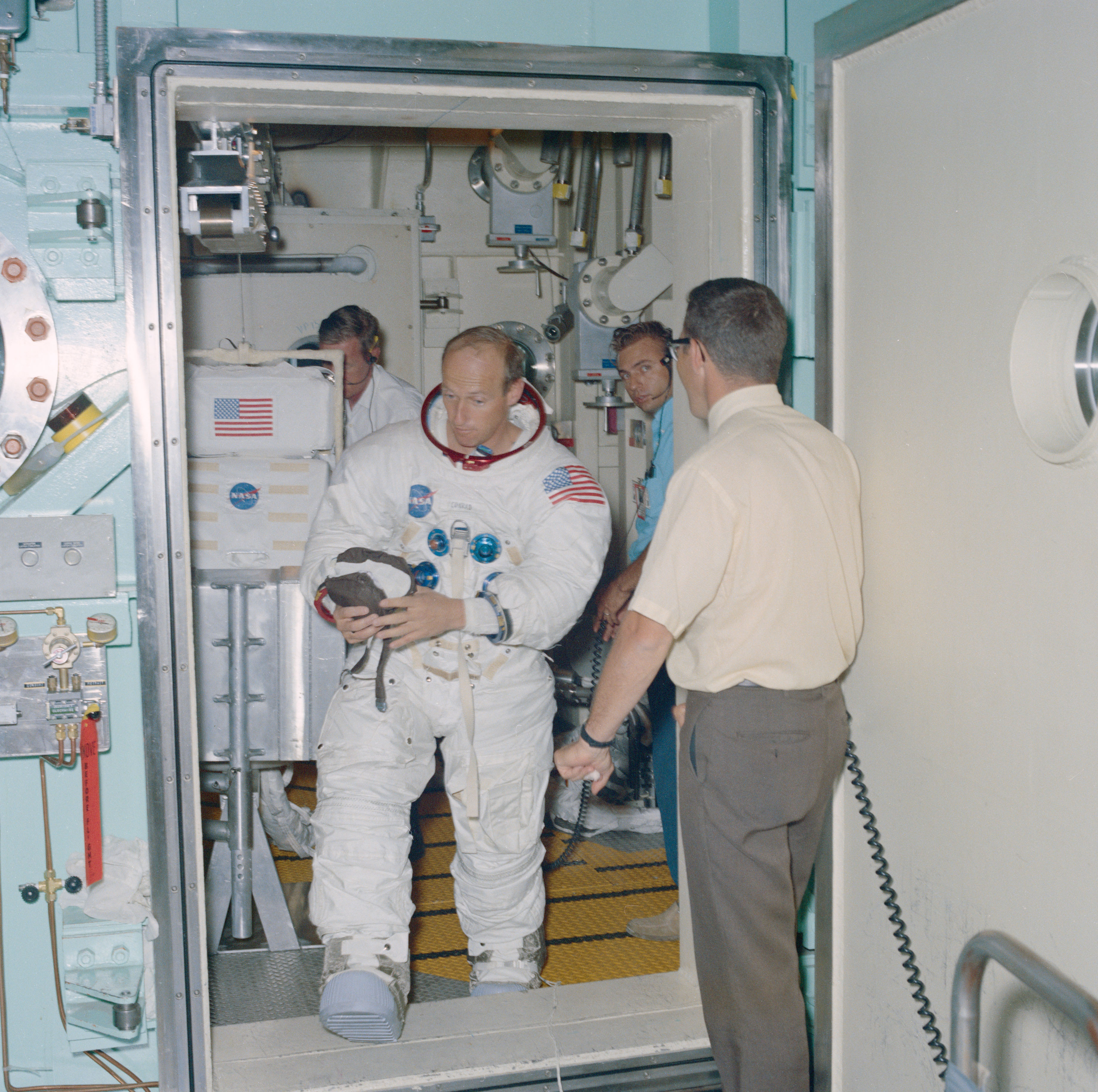
Apollo 12 astronaut Charles “Pete” Conrad during the geology field trip to Big Bend, Texas At the Manned Spacecraft Center, now NASA’s Johnson Space Center in Houston, Apollo 12 astronaut Conrad conduct vacuum runs in Chamber B of the Space Environment Simulation Laboratory At the Manned Spacecraft Center, now NASA’s Johnson Space Center in Houston, Apollo 12 astronaut Alan L. Bean conduct vacuum runs in Chamber B of the Space Environment Simulation Laboratory
Left: Apollo 12 astronaut Charles “Pete” Conrad during the geology field trip to Big Bend, Texas. Middle and right: At the Manned Spacecraft Center, now NASA’s Johnson Space Center in Houston, Apollo 12 astronauts Conrad and Alan L. Bean conduct vacuum runs in Chamber B of the Space Environment Simulation Laboratory.

The Apollo 12 prime crew of Charles “Pete” Conrad, Richard F. Gordon, and Alan L. Bean and their backups David R. Scott, Alfred M. Worden, and James B. Irwin continued their training. Conrad and Bean, along with support astronaut Edward G. Gibson and several geologists, took part in a geology field trip to Big Bend, Texas, on May 1-2. During the two-day event, they simulated various lunar surface tasks to verify procedures, while receiving geology instruction along the way. Back at MSC, Conrad and Bean tested their spacesuits and spacewalking equipment and procedures in SESL’s Chamber B.
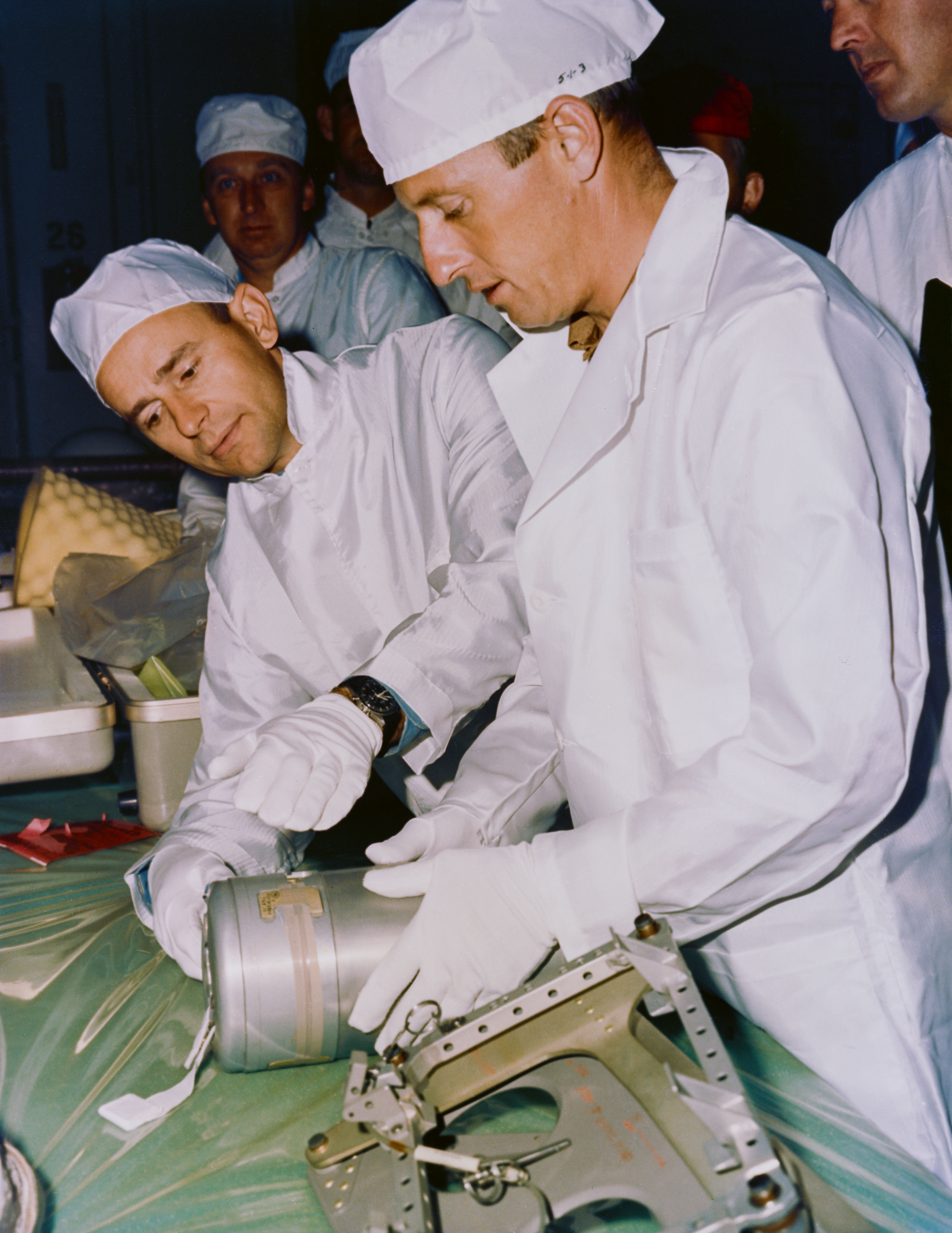
Apollo 12 astronauts Alan L. Bean, left, and Charles “Pete” Conrad examine lunar surface science instruments Apollo 12 support astronauts Gerald P. Carr, second from left, and Edward G. Gibson, right, assist Bean and Conrad in examining lunar surface science instruments Bean, wearing spacesuit at right, participates in procedures development for lunar surface activities
Left: Apollo 12 astronauts Alan L. Bean, left, and Charles “Pete” Conrad examine lunar surface science instruments. Middle: Apollo 12 support astronauts Gerald P. Carr, second from left, and Edward G. Gibson, right, assist Bean and Conrad in examining lunar surface science instruments. Right: Bean, wearing spacesuit at right, participates in procedures development for lunar surface activities.

The Apollo 12 mission plan called for two surface excursions and deployment of the first Apollo Lunar Surface Experiment Package (ALSEP), a more complex set of instruments than the Apollo 11 EASEP. Conrad and Bean completed their first examination of the hardware for the four ALSEP instruments planned for their mission.

In other NASA news:
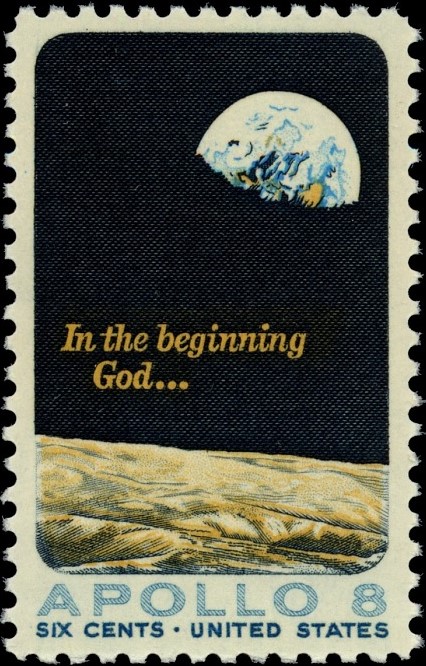
U.S. postage stamp dedication to Apollo 8 Apollo 8 astronauts Frank Borman, left, James A. Lovell, and William A. Anders hold the Collier Trophy Borman narrates a film of the Apollo 8 mission at the COSPAR meeting in Prague
Left: U.S. postage stamp dedication to Apollo 8. Image credit: courtesy USPS. Middle: Apollo 8 astronauts Frank Borman, left, James A. Lovell, and William A. Anders hold the Collier Trophy. Right: Borman narrates a film of the Apollo 8 mission at the COSPAR meeting in Prague.

On May 5, in a ceremony at the Rice Hotel in Houston, Postmaster General Winton M. Blount dedicated a postage stamp commemorating the Apollo 8 mission, presenting the first albums to the Apollo 8 crew of Frank Borman, James A. Lovell, and William A. Anders. Two days later, Borman, Lovell, and Anders accepted the Robert J. Collier award for their participation in the Apollo 8 mission.

On May 5, astronaut Alan B. Shepard marked the eighth anniversary of his suborbital Mercury-Redstone-3 mission aboard the Freedom 7 capsule. Two days later, Shepard had more reason to celebrate – flight surgeons returned him to full spaceflight status. Surgeons grounded Shepard in 1963 when he developed Meniere’s disease, an inner ear condition that causes dizziness. A minor operation in 1968 corrected the problem and Shepard remained symptom-free. Said Shepard of his return to flight status, “The sooner I get off the ground, the better.” He went on to command Apollo 14 in 1971, the only Mercury 7 astronaut to walk on the Moon.

On May 7, NASA established a task group to study development of a space station, headed by George E. Mueller, Associate Administrator for Manned Space Flight, with Apollo 8 astronaut Borman reporting to him as Field Director of Advanced Space Stations at MSC.

On May 16, President Richard M. Nixon nominated Apollo 8 astronaut Anders, also serving on Apollo 11 backup crew, as Executive Secretary of the National Aeronautics and Space Council, chaired by Vice President Agnew, effective in August, after Apollo 11 mission.

Between May 19-22, Borman attended the 12th annual meeting of the Committee on Space Research (COSPAR) in Prague, Czechoslovakia. He presented a film of the Apollo 8 mission and received a medal from the Czechoslovak Academy of Sciences.

To be continued …

News from around the world in May 1969:

May 2 – The new cruise ship “Queen Elizabeth II” sets sail from Southampton to New York, marking first private use of Global Position System, relying on four U.S. Navy satellites.

May 5 – Milwaukee Bucs sign number one draft pick, UCLA center Lew Alcindor, who now calls himself Kareem Abdul Jabbar.

May 11 – British comedy group Monty Python forms.

May 16 – The Soviet Union’s Venera 5 spacecraft descends through Venus’ atmosphere, returning 43 minutes of data.

May 17 – The Soviet Union’s Venera 6 spacecraft descends through Venus’ atmosphere, returning data for 51 minutes.

May 19 – The Who release their rock opera album “Tommy.”

May 21 – President Richard M. Nixon selects Warren E. Burger as the next Chief Justice of the United States.

May 24 – The cartoon band “The Archies” release their song “Sugar, Sugar,” Billboard’s Song of the Year for 1969.

May 27 – Walt Disney World construction begins in Florida.

May 29 – Britain’s Trans-Arctic expedition makes first crossing of Arctic sea ice.

May 31 – Stevie Wonder releases the single “My Cherie Amour.”

Powered by WPeMatico

Get The Details…
Kelli Mars

NASA, Sierra Space Deliver Dream Chaser to Florida for Launch Preparation

NASA, Sierra Space Deliver Dream Chaser to Florida for Launch Preparation


Dream Chaser Tenacity, Sierra Space’s uncrewed cargo spaceplane, is processed inside the Space Systems Processing Facility (SSPF) at NASA’s Kennedy Space Center in Florida on Monday, May 20, 2024. The spaceplane arrived inside a climate-controlled transportation container from the agency’s Neil Armstrong Test Facility in Ohio. Final testing and prelaunch processing will be completed inside the high bay of the SSPF ahead of Dream Chaser’s inaugural launch atop a ULA (United Launch Alliance) Vulcan rocket from nearby Cape Canaveral Space Force Station.  
Photo credit: NASA/Kim Shiflett

As part of NASA’s efforts to expand commercial resupply in low Earth orbit, Sierra Space’s uncrewed spaceplane arrived at NASA’s Kennedy Space Center in Florida ahead of its first flight to the International Space Station. 
 
The Dream Chaser spaceplane, named Tenacity, arrived at Kennedy on May 18 inside a climate-controlled transportation container from NASA’s Neil Armstrong Test Facility in Sandusky, Ohio, and joined its companion Shooting Star cargo module, which arrived on May 11. 
 
Before arriving at Kennedy, the spaceplane and its cargo module underwent vibration testing atop the world’s highest capacity and most powerful spacecraft shaker system inside the agency’s Space Environments Complex, exposing the stack to vibrations like those it will experience during launch and re-entry to the Earth’s atmosphere. Following vibration testing, the duo moved to NASA’s In-Space Propulsion Facility and was exposed to low ambient pressures and temperatures ranging from -150 to 300 degrees Fahrenheit. 

A recap of the NASA testing procedures that Sierra Space’s Dream Chaser Tenacity spaceplane underwent at NASA’s Neil Armstrong Test Facility in Sandusky, Ohio. This included vibration testing and exposure to low ambient pressures and temperatures.
Credits: NASA/Steve Logan

Upon arrival at Kennedy, teams moved Dream Chaser Tenacity to the high bay inside the Space Systems Processing Facility, where it will undergo final testing and prelaunch processing ahead of its launch scheduled for later this year. 

The spaceplane will lift off aboard a ULA (United Launch Alliance) Vulcan rocket from Space Launch Complex-41 at Cape Canaveral Space Force Station and is set to deliver 7,800 pounds of cargo to the orbiting laboratory. 
 
The remaining pre-flight activities at Kennedy include acoustic and electromagnetic interference and compatibility testing, completion of work on the spaceplane’s thermal protection system, and final payload integration. 
 
Dream Chaser is a lifting body design spaceplane that measures 30 feet long by 15 feet wide. The unique winged design allows it to transport cargo to and from low Earth orbit and maintain the ability to land on a runway in the style of NASA’s space shuttle. The 15-foot Shooting Star module can carry up to 7,000 pounds of cargo internally and features three unpressurized external payload mounts. 
 
The partially reusable transportation system will perform at least seven cargo missions to the space station as part of the agency’s efforts to expand commercial resupply services in low Earth orbit. Future missions may last as long as 75 days and deliver as much as 11,500 pounds of cargo. 
 
While the Dream Chaser spacecraft is reusable and can return up to 3,500 pounds of cargo to Earth, the Shooting Star module is designed to be jettisoned and burn up during reentry, creating the opportunity to dispose of up to 8,500 pounds of trash with each mission. 
 
Dream Chaser Tenacity is the first in a planned fleet of Sierra Space spaceplanes to help carry out these missions. 
 
As part of the process to certify the vehicle system for future agency resupply missions, NASA and Sierra Space will put the spaceplane through its paces once in-orbit. As Dream Chaser Tenacity approaches the space station, it will conduct a series of demonstrations to prove attitude control, translational maneuvers, and abort capabilities. After completing the maneuverability demonstration, space station astronauts will use the Canadarm2 robotic arm to grapple the spacecraft and dock it to an Earth-facing port. 
 
After remaining at the orbiting laboratory for about 45 days, the spaceplane will be released from the station and return for a landing at Kennedy’s Launch and Landing Facility. After landing, Dream Chaser is powered down, and the Sierra Space team will transfer it back to the processing facility to perform necessary inspections, offload remaining NASA cargo, and begin the process of preparing it for its next mission. 
 
For updates on NASA’s commercial resupply services, visit: 

https://www.nasa.gov/international-space-station/commercial-resupply/

Powered by WPeMatico

Get The Details…
Jamie Groh

Astronaut Exercise

Astronaut Exercise

Science in Space: May 2024

Future missions to the Moon and Mars must address many challenges, including preventing loss of bone and muscle tissue in astronauts. Research on the International Space Station is helping to address this challenge.

Without Earth’s gravity, both bone and muscle atrophy, or become smaller and weaker. Early on, scientists realized that exercise is a critical part of maintaining healthy bones and muscles in space, just as it is on Earth. From simple elastic bands on early missions, exercise hardware has become increasingly advanced. Current equipment includes the Advanced Resistive Exercise Device (ARED) weight-lifting system, a second generation-treadmill called T2, and the Cycle Ergometer with Vibration Isolation and Stabilization System (CEVIS) cycling machine. Studies continue to refine this equipment as well as the intensity and duration of how astronauts use it, with crew members now averaging two hours of exercise per day.

NASA astronauts Bob Hines and Kjell Lindgren work out on the Advanced Resistive Exercise Device (ARED).
NASA

Installed in 2008, ARED uses a piston and flywheel system to provide loading that essentially mimics weightlifting in weightlessness. A current investigation from ESA (European Space Agency), ARED Kinematics analyzes the effect of this type of exercise on the body in microgravity to help determine optimal workout programs before, during, and after spaceflight. Results have shown that preflight exercise training improves an individual’s performance while on the space station just as pre-season training helps athletes in later competition.1

From 2001 to 2011, crew members used the Interim Resistive Exercise Device (IRED), which could be configured for at least 18 different exercises using both upper and lower body muscles with up to 300 pounds of resistive force. A retrospective evaluation showed some correlation between preflight strength and postflight changes, and analysis suggested that a resistance device that provides higher loads and improved exercise prescriptions could provide greater benefits.2

Furukawa wears a black shirt, shorts, and shoes. He holds on to a bar behind him and has his feet on the pedals on CEVIS, a teal boxy device about the size of a sofa cushion. Three pairs of shoes hang from bars to his right and the walls around him are covered in equipment, laptops, cords, hoses, and storage bags.
JAXA (Japan Aerospace Exploration Agency) astronaut Satoshi Furukawa pedals on the upgraded CEVIS system.
NASA

CEVIS, installed in 2001 and upgraded in 2023, uses friction and resistance and is computer-controlled to maintain an accurate workload. The system displays parameters such as cycling speed, heart rate, elapsed time, and exercise prescription details. A study using the data collected by CEVIS concluded that up to 17% of astronauts could experience loss of muscle performance, bone health, and cardiorespiratory fitness if future missions continue to use current exercise countermeasures. The researchers note that this highlights the need to further refine current regimens, add other interventions, or enhance conditioning preflight.3

Fisher is wearing a gray shirt, black shorts, and white socks, with his feet tucked into straps, and is holding on to a bar with his left hand. Whitson, wearing a red sweatshirt and green pants, applies strips of red tape to Fisher’s leg that are used to guide an ultrasound of his muscles. There is a multi-colored control panel in front of Fisher and an inflatable Earth ball behind it, and the wall behind them has multiple laptops, equipment, and coiled cords.
NASA astronauts Jack Fischer and Peggy Whitson prepare for a session of the Sprint study.
NASA

Appropriate equipment is important, but so is the way it is used. Early exercise regimens included running on a treadmill at low velocity and conducting resistance exercise at low loads for long periods of time. Despite spending up to 10 hours per week exercising, astronauts continued to lose muscle mass and bone density. Growing evidence showed that high-intensity, low-volume exercise was more effective at maintaining fitness on Earth. The Integrated Resistance and Aerobic Training Study (Sprint) compared results of low-intensity, high-volume with high-intensity, low-volume workouts in microgravity. The outcomes were similar, but shorter workouts save crew time – a valuable resource on missions – and reduce wear and tear on exercise equipment.4 Future missions may be limited to a single device for both aerobic and resistance exercise, necessitating shorter workouts so each crew member gets a turn. Higher intensity exercise could compensate for these limits.

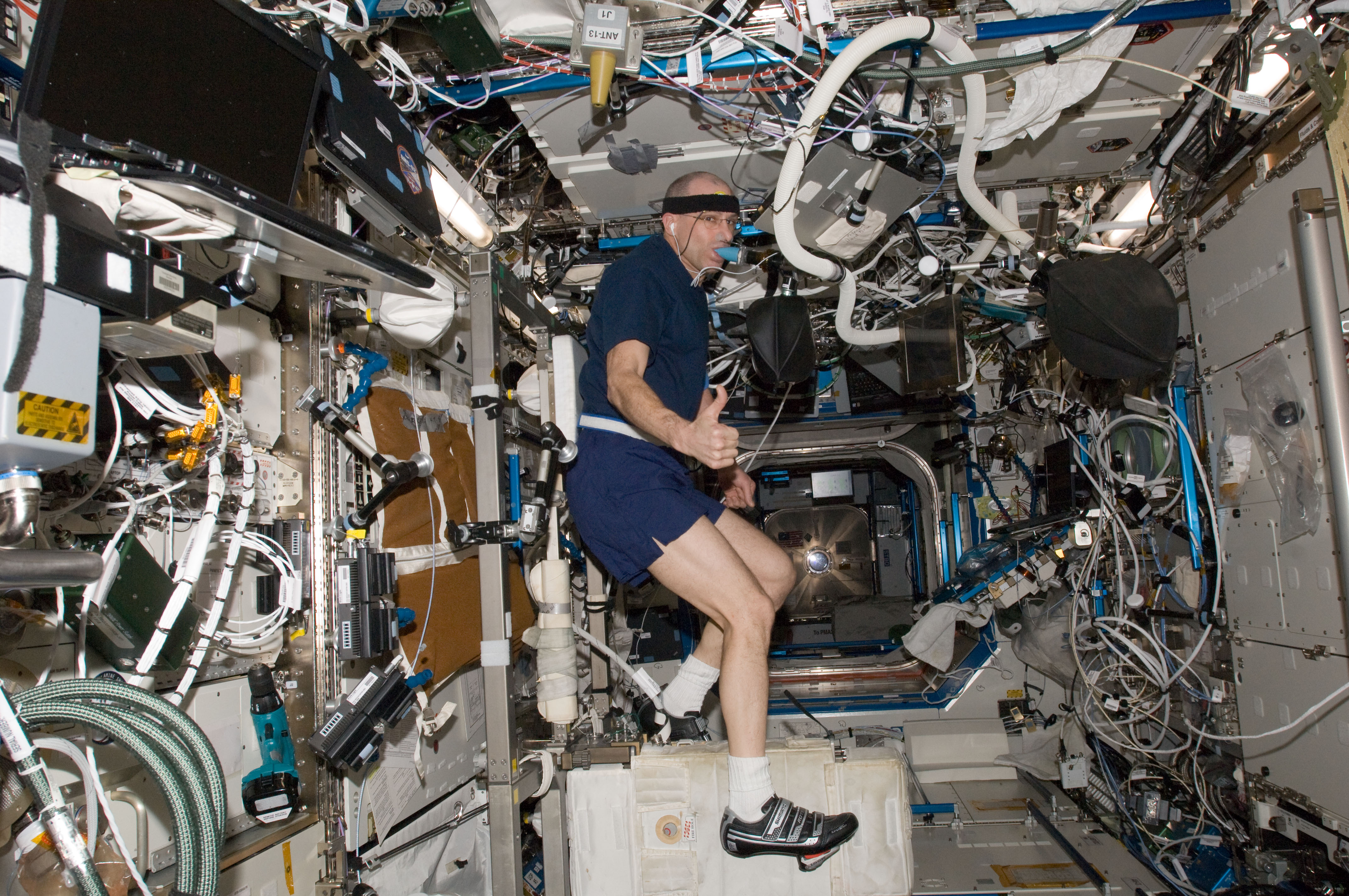
Pettit is wearing a blue t-shirt and shorts, earbuds, a head band, and black running shoes, giving a thumbs up from the station’s cycling machine, a white suitcase-sized box with bicycle pedals. Pettit holds a blue mouthpiece in his mouth attached to a tube that measures his oxygen uptake. The walls of the station around him are covered with equipment, laptops, hoses, and cords.
NASA astronaut Don Pettit conducts the VO2max experiment using the CEVIS.
NASA

An investigation called VO2max documented changes in maximum oxygen uptake, which is considered a standard measure of a person’s aerobic and physical working capacity. Long-duration spaceflight caused a significant decrease in maximal oxygen uptake and aerobic exercise capacity.5 These results have important implications for future long-duration space missions, adding to the evidence that current countermeasures may not be adequate.

Cristoforetti wears a hot pink shirt, black pants with white stripes on the side, and blue running shoes and is watching a laptop in front of her. A white harness on her torso connects her to the sides of the green treadmill. Her legs are slightly blurred from the motion of her running and the entire image is tilted to the left so that she seems to be running down a steep hill.
ESA (European Space Agency) astronaut Samantha Cristoforetti runs on the station’s T2 treadmill.
ESA/NASA

Muscle Biopsy, an investigation from ESA (European Space Agency), analyzed molecular changes in skeletal muscle before and after spaceflight and identified an enzyme product that could be used as a possible indicator of muscle health. The findings suggest that current exercise protocols are effective in preventing muscle deconditioning and support improvements in countermeasures to protect crew health and performance on future deep space exploration missions.6

While current exercise programs appear to moderate changes in musculoskeletal systems, individual results vary. In addition, current regimens likely cannot directly transfer to longer exploration missions due to space constraints, environmental issues such as removal of heat and moisture, device maintenance and repair needs, and the challenges of finding time for exercise and avoiding interference with the work of other crew members.7

Planned missions to explore the Moon and deep space may last up to three years. Research continues to zero in on the combination of diet, exercise, and medication that could keep astronauts healthy during spaceflight, when they set foot on the Moon or Mars, and when they return to Earth. Because aging, sedentary lifestyles, and illnesses cause bone and muscle loss on Earth, this research also can benefit people on the ground.

Melissa Gaskill
International Space Station Research Communications Team
NASA’s Johnson Space Center

Search this database of scientific experiments to learn more about those mentioned above.

Citations:

1 Lambrecht G, Petersen N, Weerts G, Pruett CJ, Evetts SN, et al. The role of physiotherapy in the European Space Agency strategy for preparation and reconditioning of astronauts before and after long duration space flight. Musculoskeletal Science & Practice. 2017 January; 27 Suppl 1S15-S22. DOI: 10.1016/j.math.2016.10.009

2 English KL, Lee SM, Loehr JA, Ploutz-Snyder RJ, Ploutz-Snyder LL. Isokinetic strength changes following long-duration spaceflight on the ISS. Aerospace Medicine and Human Performance. 2015 December 1; 86(12): 68-77. DOI: 10.3357/AMHP.EC09.2015.

3 Scott JM, Feiveson AH, English KL, Spector ER, Sibonga JD, et al. Effects of exercise countermeasures on multisystem function in long duration spaceflight astronauts. npj Microgravity. 2023 February 3; 9(1): 11. DOI: 10.1038/s41526-023-00256-5.

4 English KL, Downs ME, Goetchius EL, Buxton RE, Ryder JW, et al. High intensity training during spaceflight: results from the NASA Sprint Study. npj Microgravity. 2020 August 18; 6(1): 21. DOI: 10.1038/s41526-020-00111-x.

5 Ade CJ, Broxterman RM, Moore Jr. AD, Barstow TJ. Decreases in maximal oxygen uptake following long-duration spaceflight: Role of convective and diffusive O2 transport mechanisms. Journal of Applied Physiology. 2017 April; 122(4): 968-975. DOI: 10.1152/japplphysiol.00280.2016.

6 Blottner D, Moriggi M, Trautmann G, Furlan S, Block K, et al. Nitrosative Stress in Astronaut Skeletal Muscle in Spaceflight. Antioxidants. 2024 April; 13(4): 432. DOI: 10.3390/antiox13040432

7 Scott JP, Weber T, Green DA. Introduction to the Frontiers Research Topic: Optimisation of Exercise Countermeasures for Human Space Flight – Lessons from Terrestrial Physiology and Operational Considerations. Frontiers in Physiology. 2019 10173. DOI: 10.3389/fphys.2019.00173.

Powered by WPeMatico

Get The Details…
Ana Guzman