Welcome Back to Planet Earth, Expedition 70 Crew! 

Welcome Back to Planet Earth, Expedition 70 Crew! 

On May 16, 2024, a crowd of more than 500 people gathered at Space Center Houston’s IMAX theater for the Expedition 70 crew debrief and awards ceremony. Crew members from NASA’s SpaceX Crew-7 and Soyuz MS-24 missions shared reflections from their voyage aboard the International Space Station and bestowed well-deserved recognition upon Johnson Space Center employees and partners whose dedication and support contributed to the expedition’s success. 

A large group photo taken indoors. The background features three large insignias: one for the International Space Station, the NASA logo in the center, and a mission patch on the right.
A group photo of participants from the Expedition 70 crew debrief and awards ceremony on May 16, 2024, at Space Center Houston’s IMAX theater.
Credit: NASA/David DeHoyos

The special event featured four Expedition 70 astronauts: 

  • Jasmin Moghbeli, Crew-7 commander and Expedition 70 flight engineer, NASA 
  • Loral O’Hara, Soyuz MS-24 and Expedition 70 flight engineer, NASA 
  • Andreas Mogensen, Crew-7 pilot and Expedition 70 commander, ESA (European Space Agency) 
  • Satoshi Furukawa, Crew-7 mission specialist and Expedition 70 flight engineer, JAXA (Japan Aerospace Exploration Agency) 

NASA astronaut Stephen Bowen kicked off the event by striking the ceremonial bell to complete the 70th voyage to the orbiting laboratory. 

Johnson Deputy Director Stephen Koerner honored the crew’s achievements. “Through the Johnson Space Center’s Dare | Unite | Explore initiatives, we are called to unite with our partners to complete these bold missions,” said Koerner. “Tonight, we are celebrating the completion of one of those such missions.” 

NASA’s SpaceX Crew-7 crew inside the vestibule in between the SpaceX Dragon Endurance spacecraft and the International Space Station’s Harmony module. From left are Roscosmos cosmonaut Konstantin Borisov, ESA (European Space Agency) astronaut Andreas Mogensen, NASA astronaut Jasmin Moghbeli, and JAXA (Japan Aerospace Exploration Agency) astronaut Satoshi Furukawa.
Credit: NASA

The Crew-7 mission was the first in the history of the Commercial Crew Program to have each seat in the Dragon spacecraft occupied by a different international partner.  

The Expedition 70 crew successfully conducted 286 experiments and received five cargo resupply missions that delivered thousands of pounds of scientific research, supplies, and hardware to the orbital outpost.  

The astronauts performed numerous science experiments and technology demonstrations, including the first robotic surgery (on simulated tissue) in space. The crew also encountered several other notable firsts. O’Hara and Moghbeli undertook their inaugural spacewalk together, while ESA astronaut Andy Mogensen became the first non-US pilot to fulfill that role on the Dragon vehicle. The crew also welcomed the third private astronaut mission, Ax-3, aboard the orbiting laboratory, along with Marina Vasilevskaya, the first female Belarusian in space as a spaceflight participant. 

“Even after more than 25 years of operations, we continue to experience exciting firsts aboard station,” said Dana Weigel, program manager for the International Space Station Program. “On behalf of the ISS Program, I want to thank the crew and the ground teams around the world for your passion and commitment to the International Space Station mission. The incredible advancements we make that benefit life here on Earth and inspire future generations are a direct result of your work.” 

Watch below to recap the Expedition 70 crew members’ unique journey aboard the International Space Station and to celebrate those who helped make the mission a success. 

Powered by WPeMatico

Get The Details…
Sumer Loggins
NASA Leaders to Host Agency Town Hall on Artificial Intelligence

NASA Leaders to Host Agency Town Hall on Artificial Intelligence

Credit: NASA

NASA Administrator Bill Nelson and Deputy Administrator Pam Melroy are hosting an employee town hall at 1 p.m. EDT Wednesday, May 22, to discuss how the agency is using and developing Artificial Intelligence (AI) tools to advance missions and research.

The event will steam live on NASA+, NASA Television, and the agency’s website.

The town hall also will feature the NASA experts pioneering and leading the use of AI across the agency, including:

  • A.C. Charania, chief technologist
  • David Salvagnini, chief artificial intelligence officer
  • Jeff Seaton, chief information officer
  • Kate Calvin, chief scientist

A wide variety of AI tools are used by NASA to benefit humanity from supporting missions and research projects across the agency, analyzing data to reveal trends and patterns, and developing systems capable of supporting spacecraft and aircraft autonomously.

On May 13, Nelson named Salvagnini as NASA’s first chief artificial intelligence officer. The agency continues developing recommendations on leveraging emerging AI technology for a variety of missions including sifting through Earth science imagery to identifying areas of interest, to searching for data on planets outside our solar system from NASA’s James Webb Space Telescope, scheduling communications from the Perseverance Mars rover through the Deep Space Network, and more.

Learn more about artificial intelligence at NASA at:

https://www.nasa.gov/artificial-intelligence

-end-

Faith McKie / Jennifer Dooren
Headquarters, Washington
202-358-1600
faith.d.mckie@nasa.gov / jennifer.m.dooren@nasa.gov

Hillary Smith
Ames Research Center, Silicon Valley
650-604-4789
hillary.smith@nasa.gov

Powered by WPeMatico

Get The Details…
Tiernan P. Doyle

NASA “Wildfire Digital Twin” Pioneers New AI Models and Streaming Data Techniques for Forecasting Fire and Smoke

NASA “Wildfire Digital Twin” Pioneers New AI Models and Streaming Data Techniques for Forecasting Fire and Smoke

5 min read

NASA “Wildfire Digital Twin” Pioneers New AI Models and Streaming Data Techniques for Forecasting Fire and Smoke

NASA’s “Wildfire Digital Twin” project will equip firefighters and wildfire managers with a superior tool for monitoring wildfires and predicting harmful air pollution events and help researchers observe global wildfire trends more precisely.

The tool, developed with funding from NASA’s Earth Science Technology Office and NASA’s FireSense Program, will use artificial intelligence and machine learning to forecast potential burn paths in real time, merging data from in situ, airborne, and spaceborne sensors to produce global models with high precision.

A wildfire simulation describing the spread of PM 2.5 aerosols during a recent controlled burn, generated using the WRF-SFIRE model. “Wildfire Digital Twin” will build on this and other models to simulate active burns with unprecedented resolution.
Credit: Kathleen Clough/San Jose State University

Whereas current global models describing the spread of wildfires and smoke have a spatial resolution of about 10 kilometers per pixel, the Wildfire Digital Twin would produce regional ensemble models with a spatial resolution of 10-to-30 meters per pixel, an improvement of two orders of magnitude.

These models could be generated in a span of mere minutes. By comparison, current global models can take hours to produce.

Models with such high spatial resolution produced at this speed would be immensely valuable to first-responders and wildfire managers trying to observe and contain dynamic burns.

Milton Halem, a Professor of Computer Science and Electrical Engineering at the University of Maryland, Baltimore County, leads the Wildfire Digital Twin project, which includes a team of more than 20 researchers from six universities.

“We want to be able to provide firefighters with useful, timely information,” said Halem, adding that in the field, “there is generally no internet, and no access to big supercomputers, but with our API version of the model, they could run the digital twin not just on a laptop, but even a tablet,” he said.

NASA’s FireSense project is focused on leveraging the agency’s unique Earth science and technological capabilities to achieve improved wildfire management across the United States.

NASA’s Earth Science Technology Office supports this effort with its newest program element, Technology Development for support of Wildfire Science, Management, and Disaster Mitigation (FireSense Technology), which is dedicated to developing novel observation capabilities for predicting and managing wildfires –including technologies like Earth System Digital Twins.

Earth System Digital Twins are dynamic software tools for modeling and forecasting climate events in real time. These tools rely on data sources distributed across multiple domains to create ensemble predictions describing everything from floods to severe weather.

In addition to assisting first responders, an Earth System Digital Twin dedicated to modeling wildfires would also be valuable to scientists monitoring wildfire trends globally. In particular, Halem hopes Wildfire Digital Twins will improve our ability to study wildfires across global boreal forests of cold-hardy conifers, which sequester vast amounts of carbon.

When these forests burn, all of that carbon is released back into the atmosphere. One study, released in August of 2023, found that boreal wildfires alone accounted for 25% of all global CO2 emissions for that year to date.

“The reason CO2 emissions from Boreal wildfires are taking place at an increasing yearly rate is because global warming is rising faster at high latitudes than the rest of the planet, and as a result, boreal summers there are becoming longer,” said Halem. “Whereas the rest of the planet may have warmed one degree Celsius since the pre-industrial revolution, this region has warmed well over two degrees.”

Halem’s work builds on other wildfire models, particularly the NASA-Unified Weather Research and Forecasting (NUWRF) model, developed by NASA, and WRF-SFIRE, developed by a team of researchers with support from the National Science Foundation. These models simulate phenomena like wind speed and cloud cover, which makes them the perfect foundation for a Wildfire Digital Twin.

Specifically, Halem’s team is working on new satellite data assimilation techniques that will blend information from space-based remote sensors into their Wildfire Digital Twin, enabling improved global data forecasts that will be useful for emergencies and science missions alike.

In October, Halem’s team participated in the first FireSense field campaign in collaboration with the National Forest Service’s Fire and Smoke Model Evaluation Experiment (FASMEE) to observe smoke as it traveled more than 10 miles during a controlled burn in Utah, using a ceilometer. Now the team is feeding that data into their modeling software to help it track plumes more accurately.

They’re especially interested in tracking particles smaller than 2.5 micrometers, which are small enough to pass through a person’s lungs and enter the bloodstream. These particles, also known as PM 2.5, can cause serious health issues even if a person is nowhere near an active burn.

“When these fires ignite and start to burn, they produce smoke, and this smoke travels considerable distances. It affects people not only locally, but also at distances of thousands of kilometers or more,” said Halem.

Data from the controlled burn will also help Halem and his team quantify the relationship between aerosols and precipitation. Increased aerosols from wildfires have a huge impact on cloud formation, which in turn impacts how precipitation occurs downstream of an affected fire burn.

Assimilating all this information as it streams from sensors in real time is essential for detailing the full impact of wildfires at local, regional, and global scales.

PROJECT LEAD

Milton Halem, University of Maryland at Baltimore County

SPONSORING ORGANIZATION

NASA’s FireSense Technology Program, a part of the agency’s Earth Science Technology Office (ESTO), funds this project.

Powered by WPeMatico

Get The Details…

Sols 4188-4190: Aurora Watch on Mars

Sols 4188-4190: Aurora Watch on Mars

4 min read

Sols 4188-4190: Aurora Watch on Mars

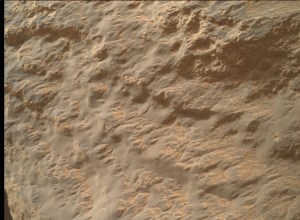
This image was taken by MAHLI onboard NASA's Mars rover Curiosity on Sol 4187
This image was taken by MAHLI onboard NASA’s Mars rover Curiosity on Sol 4187
NASA/JPL-Caltech/MSSS

Earth planning date: Friday, May 17, 2024

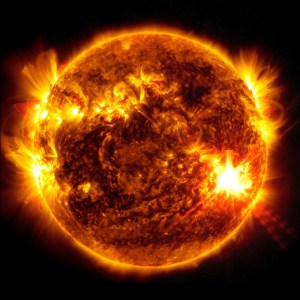
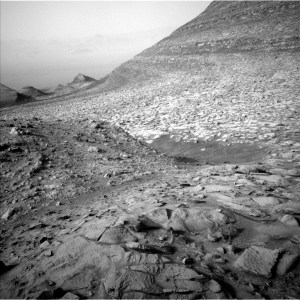
During the night of May 10, Earth experienced a fantastic display of aurorae (Northern and Southern Lights) which extended all the way to tropical latitudes, courtesy of the strongest geomagnetic storm since 2003. The enormous solar active region 3664, which produced the X-class flares and powerful coronal mass ejections powering this magnetic storm, has since rotated away from Earth. However, this explosive sunspot group now faces Mars. Just as the active region rotated into Mars view, it unleashed the largest flare in 20 years, an X8.7 monster. This solar flare also aimed a coronal mass ejection (CME) at Mars, which is potentially capable of producing auroras. Given Mars’ lack of a global magnetic field, Martian aurorae are not concentrated at the poles as they are on Earth, but instead appear as a “global diffuse aurora” that are associated with Mars’ ancient, magnetized crust. One of the planned observations for Curiosity this weekend will be a night-time 12×1 Mastcam observation of the sky above Texoli Butte, in a hope to capture one of these elusive Martian aurorae. 

Contact science on “Tuolumne Meadows” and “Parker Lakes” on sol 4187 completed successfully. The included picture is a MAHLI image of “Parker Lakes” taken on Sol 4187, which shows abundant bedrock nodules, some perched on tiny stalks like a miniature version of the hoodoos in Bryce Canyon National Park. Unfortunately, the drive on sol 4187 faulted after 10 m due to a steer stall on the right rear wheel, and the resulting wheel placement was too uncertain to support contact science. Our current plan skips sol 4188, as Earth passes are too low on the horizon for Curiosity to successfully receive commands for that sol. On Sol 4189,  Curiosity will observe the layered bedrock target “Polemonium Pass” with ChemCam LIBS and Mastcam, as well as more distant white rocks around “Falls Ridge” with ChemCam RMI and Mastcam. The first target is named for a 11,600 ft pass near the northern border of Yosemite National Park. The word “Polemonium” refers to Polemonium eximium, the skypilot or showy sky pilot alpine flower only found above 10000 feet in the Sierra Nevada. The target name “Falls Ridge” honors a towering ridge-line of granite domes forming the southern wall of the Grand Canyon of the Tuolumne River. All targets in this area of Mount Sharp are named after the Bishop geological quadrangle in the High Sierra and Owens Valley of Calfornia. Mastcam will also image a nearby troughs between the blocky rocks surrounding the rover.  Atmospheric observations in this science block include a dust devil survey, atmospheric opacity measurement, Navcam suprahorizon movie, and rover deck image. Curiosity will then perform a block of atmospheric observations with APXS and SAM to measure atmospheric constituents. Well after dark, Mastcam will search for aurora in the sky above our rover. Curiosity starts the next sol (4190) with a ChemCam LIBS and Mastcam observation of “The Fissures,” a finely laminated bedrock target named for a deep bedrock joint on the south wall of Yosemite Valley. This is followed by a 10×1 RMI mosaic of Texoli butte, ChemCam passive sky, deck monitor, and dust devil survey.  Curiosity then will start its 27 m drive, finishing near the lip of the Gediz Vallis channel. After the drive ends, Curiosity will perform its usual post drive panoramic imaging and take a MARDI frame of the ground under the rover. The next morning, Curiosity will perform early morning atmospheric observations including Mastcam solar tau to measure dust in the atmosphere, Navcam opacity measurement, and Navcam zenith and suprahorizon cloud movies.  On Monday, we will do contact science at the new location, then decide where to drive across the channel sands on our way up Mount Sharp.

Written by Deborah Padgett, OPGS Task Lead at NASA’s Jet Propulsion Laboratory

Share

Details

Last Updated
May 20, 2024

Related Terms

Powered by WPeMatico

Get The Details…

Aurorasaurus Roars During Historic Solar Storm

Aurorasaurus Roars During Historic Solar Storm

2 min read

Aurorasaurus Roars During Historic Solar Storm

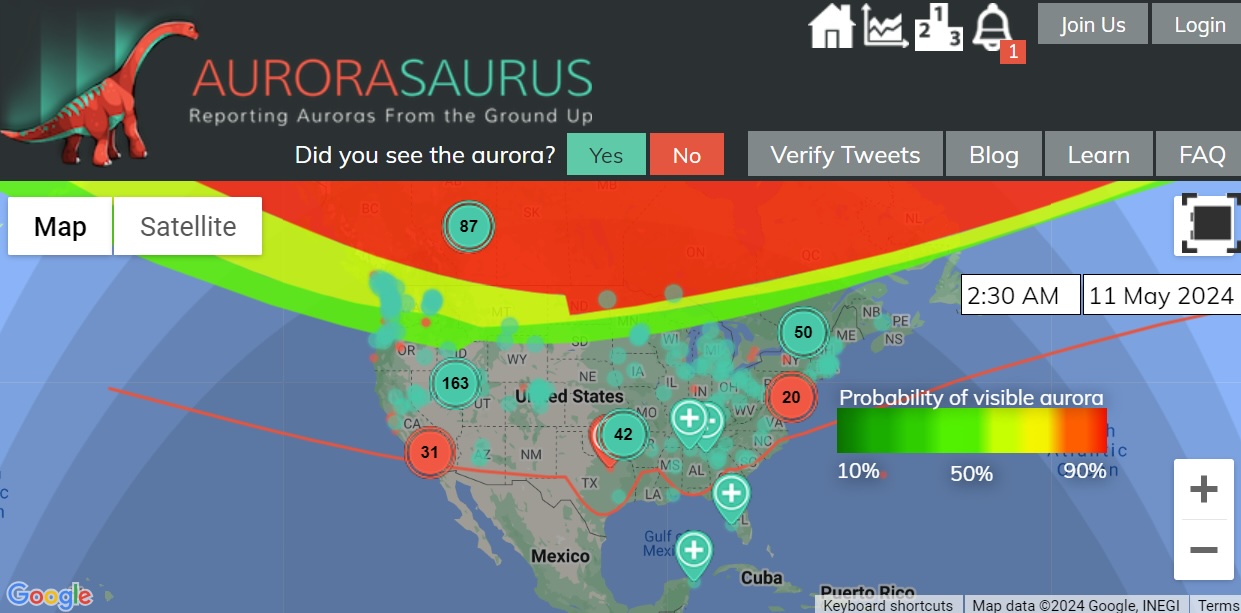
A computer screen still frame of the Aurorasaurus application showing a map of the US will
During the peak of activity (May 10-11, 2024) the Aurorasaurus website showed widespread reports and real-time alerts.

The largest geomagnetic storm in 21 years lit up the sky last weekend, and NASA’s volunteers were ready. Between May 10th and 12th 2024, NASA’s Aurorasaurus project received an unprecedented number of reports from around the world. It also helped eager aurora chasers get a better view.

“Aurorasaurus made all the difference for me,” said volunteer Damon Tighe. “I was able to see it in Oakland, CA and knew it was coming based upon user data in Reno.”

At Aurorasaurus.org you’ll see the latest model predictions for where the aurora is visible. Then you can submit your own report, helping scientists test and improve the models and characterize what is seen. When people report seeing the aurora beyond where the model predicts the system adapts in real time and puts out volunteer-generated alerts in those areas. During the May 10-12 extreme event, auroras visible as far south as Texas and Alabama triggered those special alerts.

Thank you to everyone who submitted data! During the last major solar storm, back in 2003, digital cameras were not widespread and cell phones didn’t even have cameras. But during this current solar maximum, the data you’re collecting has incredible scientific value.

It’s not too late to help document this historic event. You can submit back-dated reports at our website and help do NASA Science. While you’re there, sign up for your own alerts and don’t miss out on the next spectacular storm!

Share

Details

Last Updated
May 20, 2024

Powered by WPeMatico

Get The Details…