Lakita Lowe: Leading Space Commercialization Innovations and Fostering STEM Engagement 

Lakita Lowe: Leading Space Commercialization Innovations and Fostering STEM Engagement 

Lakita Lowe is at the forefront of space commercialization, seamlessly merging scientific expertise with visionary leadership to propel NASA’s commercial ambitions and ignite a passion for STEM in future generations. As a project integrator for NASA’s Commercial Low Earth Orbit Development Program (CLDP), Lowe leverages her extensive background in scientific research and biomedical studies to bridge the gap between science and commercial innovation. 

Lowe recently supported both planning and real-time operations contributing to the successful completion of the Axiom-3 private astronaut mission which launched in January 2024 and is gearing up to serve as CLDP’s Axiom-4 private astronaut mission lead. Her responsibilities include managing commercial activity requests to ensure they align with NASA’s policies, supporting real-time mission operations from CLDP’s console station, and working with various stakeholders to ensure commercial policy documentation is updated to align with the agency’s current guidelines. 

“The commercially owned and operated low Earth orbit destinations will offer services that NASA, along with other customers, can purchase, thereby stimulating the growth of commercial activities,” said Lowe.  

A woman with long, wavy hair and a bright smile poses in front of a U.S. flag and a NASA flag. She is wearing a black blazer with white trim over a white blouse. The background is a gradient blue.
Official portrait of Lakita Lowe.
Credit: NASA/Bill Stafford

Initially set to attend pharmacy school, a chance encounter at a career fair led her to NASA. Seventeen years later, Lowe now supports the enablement of NASA’s goal to transition human presence in low Earth orbit from a government-run destination to a sustainable economy.  

Lowe’s work has spanned various NASA programs, including the Human Health and Performance Directorate in the Biomedical Research and Environmental Sciences (BRES) Division. Lowe’s role in BRES supported NASA research involving the understanding of human adaptation to spaceflight and planetary environments, the development of effective countermeasures, and the development and dissemination of scientific and technological knowledge.  

“The efforts that go into preparing crew members for spaceflight and ensuring they maintain good health upon their return to Earth is amazing,” she said, highlighting their rigorous pre-flight and post-flight testing.

A woman in a white lab coat and purple gloves works in a laboratory. She is carefully holding a small vial or container up to eye level, examining its contents.
Lakita Lowe prepares samples for analysis in a microbiology laboratory at NASA’s Johnson Space Center in Houston.

Lowe’s passion for science was ignited in high school by her biology teacher, whose teaching style captivated her curiosity. She received a bachelor’s degree in biology and a master’s in chemistry from Southern University and A&M College in Baton Rouge, Louisiana. With five publications completed during her tenure at NASA (two of which were NASA-related), Lowe has contributed to our understanding of the agency’s vision for human spaceflight and commercial research and development on the orbiting laboratory. 

Lowe is in the process of completing her Ph.D. in Education (Learning, Design, and Technology) from Oklahoma State University in Stillwater, Oklahoma, with a dissertation involving the establishment of telesurgery training programs at medical institutions. She is exploring a field that holds significant promise for space exploration and remote medical care. This technology will enable surgical procedures to be performed remotely, a vital capability for astronauts on long-duration missions. 

A woman with long, wavy hair and a bright smile sits at a round table during a formal event, surrounded by other attendees. She is wearing a brown cardigan and a patterned blouse.
Lakita Lowe at the 2022 International Space Station Research & Development Conference (ISSRDC) in Washington D.C.

Lowe dedicated 14 years of her career to integrating science payloads for the International Space Station Program. Early in her career, she worked as a payloads flight controller as a lead increment scientist representative, a dual position between NASA’s Johnson Space Center in Houston and Marshall Space Flight Center in Huntsville, Alabama. After two years supporting real-time console operations, Lowe served as a research scientist with NASA’s Program Scientist’s Office, where she assessed individual science priorities for the agency’s sponsoring organizations’ portfolio to be implemented on the space station.  

Later in her career, she worked as a research portfolio manager in the International Space Station Program’s Research Integration Office where she managed the feasibility and strategic planning for investigations involving remote sensing, technology development, STEM, and commercial utilization. She worked closely with researchers sending their experiments to the orbiting laboratory, tracking their progress from start to finish.  

Now, in the commercial sector, her focus has shifted toward policy and compliance, ensuring commercial activities align with NASA’s regulations and guidance. 

Lakita Lowe (second to left) at a NSBE SCP (National Society of Black Engineers – Space City Professionals) Chapter membership drive on May 23, 2023.
Credit: NASA/Robert Markowitz

For Lowe, one of the most rewarding aspects of her job is the ability to inspire young minds. Her advice to young Black women interested in STEM is to not limit themselves and to explore the vast opportunities NASA offers beyond engineering and science roles. She emphasizes the importance of NASA engaging with Historically Black Colleges and Universities and minority-serving institutions to spread awareness about the opportunities within the agency.  

“Considering my busy schedule, I try to make myself available for speaking engagements and mentoring early-career individuals when possible,” she said. 

Lowe actively participates in organizations like the National Society of Black Engineers and serves as a mentor to interns at Johnson. She is also a member of Alpha Kappa Alpha Sorority Incorporated, the Honor Society of Phi Kappa Phi, and Johnson’s African American Employee Resource Group. 

Lowe poses for a selfie at Oklahoma State University in Stillwater, Oklahoma.

Lowe’s relentless pursuit of knowledge and her unwavering dedication to STEM education continue to inspire generations and pave the way for a more dynamic future in human spaceflight.  

“As an African American woman at NASA, I am excited about the future of space exploration, where diversity and inclusion will drive innovative solutions and inspire the next generation to reach for the stars.” 

Powered by WPeMatico

Get The Details…
Sumer Loggins

Quirky Circling Behavior in Mice Informs Research on Humans in Space

Quirky Circling Behavior in Mice Informs Research on Humans in Space

During the Rodent Research-1 (RR-1) mission flown to the ISS in 2014, videos that were taken to observe the mice revealed an unusual behavior that researchers are still working to understand. Young (16-week-old) but not old (32-week-old) mice engaged in a high level of ‘running’ behavior beginning within two weeks of launch (Sci Reports, 2019).

Some alternate interpretations of the running behavior of mice on orbit include significant scientific literature on the rewarding effects of physical exercise, as seen in the footage of Astronaut Alan Bean on Space Lab below. A multi-investigator collaborative team of scientists is conducting follow-up studies on the ground as well as in space on the upcoming Rodent Research-26 mission to understand more about what could be driving this behavior. Comprehensive and in-depth molecular biology studies will be looking at potential indicators of stress (maladaptive coping) or whether the running behavior is a beneficial adaptation to the weightlessness of space.

Watch the video below to see the mice (and humans) in space.

Video of the quirky circling behavior of mice aboard the ISS was recently released. Scientists will be doing further research to understand what’s behind this unexplained behavior.
NASA

Powered by WPeMatico

Get The Details…
Elizabeth E. Keller

A Solitary Sight

A Solitary Sight

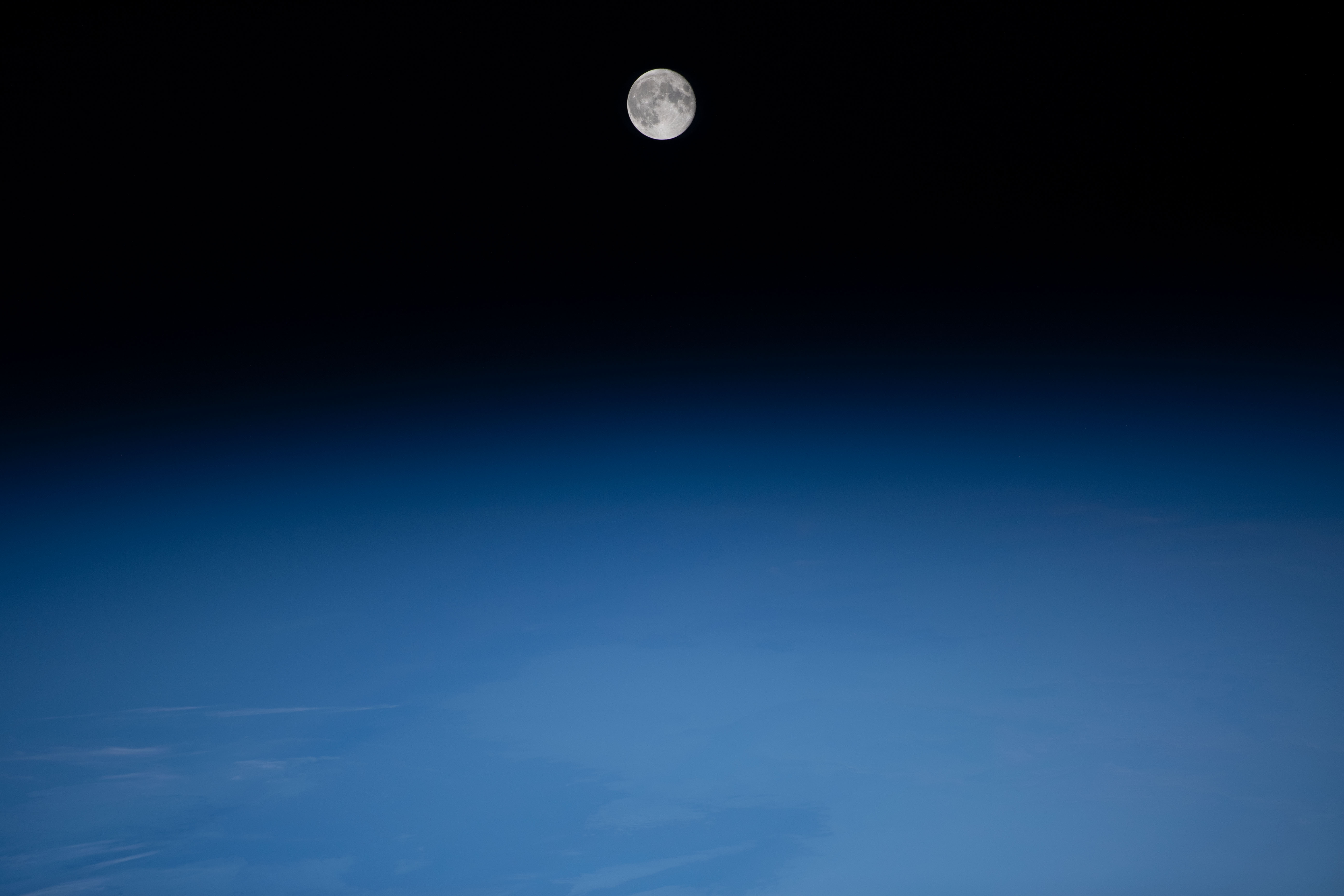
The waning gibbous moon is a small gray circle at the top middle of this photo. Some details of the Moon's surface can be seen. The top half of the photo is black, while the bottom half is a hazy blue.
NASA, ESA/Andreas Mogensen

ESA (European Space Agency) astronaut Andreas Mogensen snapped a photo of the waning gibbous moon from the International Space Station as it soared 260 miles above the Atlantic Ocean near the northeast coast of South America on Sept. 30, 2023.

Waning gibbous is one of eight moon phases, occurring after the full moon. The Sun always illuminates half of the Moon while the other half remains dark, but how much we can see of that illuminated half changes as the Moon travels through its orbit. As the Moon begins its journey back toward the Sun, the lighted side appears to shrink, but the Moon’s orbit is simply carrying it out of view from our perspective.

Image Credit: NASA, ESA/Andreas Mogensen

Powered by WPeMatico

Get The Details…
Monika Luabeya

Coming in Hot — NASA’s Chandra Checks Habitability of Exoplanets

Coming in Hot — NASA’s Chandra Checks Habitability of Exoplanets

Movie: Cal Poly Pomona/B. Binder; Illustration: NASA/CXC/M.Weiss

This graphic shows a three-dimensional map of stars near the Sun. These stars are close enough that they could be prime targets for direct imaging searches for planets using future telescopes. The blue haloes represent stars that have been observed with NASA’s Chandra X-ray Observatory and ESA’s XMM-Newton. The yellow star at the center of this diagram represents the position of the Sun. The concentric rings show distances of 5, 10, and 15 parsecs (one parsec is equivalent to roughly 3.2 light-years).

Astronomers are using these X-ray data to determine how habitable exoplanets may be based on whether they receive lethal radiation from the stars they orbit, as described in our latest press release. This type of research will help guide observations with the next generation of telescopes aiming to make the first images of planets like Earth.

Researchers examined stars that are close enough to Earth that telescopes set to begin operating in the next decade or two — including the Habitable Worlds Observatory in space and Extremely Large Telescopes on the ground — could take images of planets in the stars’ so-called habitable zones. This term defines orbits where the planets could have liquid water on their surfaces.

There are several factors influencing what could make a planet suitable for life as we know it. One of those factors is the amount of harmful X-rays and ultraviolet light they receive, which can damage or even strip away the planet’s atmosphere.

Based on X-ray observations of some of these stars using data from Chandra and XMM-Newton, the research team examined which stars could have hospitable conditions on orbiting planets for life to form and prosper. They studied how bright the stars are in X-rays, how energetic the X-rays are, and how much and how quickly they change in X-ray output, for example, due to flares. Brighter and more energetic X-rays can cause more damage to the atmospheres of orbiting planets.

The researchers used almost 10 days of Chandra observations and about 26 days of XMM observations, available in archives, to examine the X-ray behavior of 57 nearby stars, some of them with known planets. Most of these are giant planets like Jupiter, Saturn or Neptune, while only a handful of planets or planet candidates could be less than about twice as massive as Earth.

These results were presented at the 244th meeting of the American Astronomical Society meeting in Madison, Wisconsin, by Breanna Binder (California State Polytechnic University in Pomona).

NASA’s Marshall Space Flight Center manages the Chandra program. The Smithsonian Astrophysical Observatory’s Chandra X-ray Center controls science from Cambridge, Massachusetts and flight operations from Burlington, Massachusetts.

Read more from NASA’s Chandra X-ray Observatory.

For more Chandra images, multimedia and related materials, visit:

https://www.nasa.gov/mission/chandra-x-ray-observatory/

Visual Description:

This video shows a three-dimensional map of stars near the Sun on the left side of our screen and a dramatic illustration of a star with a planet orbiting around it on the right side.

The star map on the left shows many circular dots of different colors floating within an illustrated three-sided box. Each wall of the box is constructed in a grid pattern, with straight lines running horizontally and vertically like chicken wire. Dots that are colored blue represent stars that have been observed with NASA’s Chandra and ESA’s XMM-Newton.

Suspended in the box, at about the halfway point, is a series of three concentric circles surrounding a central dot that indicates the placement of our Sun. The circles represent distances of 5, 10, and 15 parsecs. One parsec is equivalent to roughly 3.2 light-years.

In the animation, the dot filled, chicken wire box spins around slowly, first on its X axis and then on its Y axis, providing a three-dimensional exploration of the plotted stars.

News Media Contact

Megan Watzke
Chandra X-ray Center
Cambridge, Mass.
617-496-7998

Jonathan Deal
Marshall Space Flight Center
Huntsville, Ala.
256-544-0034

Powered by WPeMatico

Get The Details…
Lee Mohon

Astronauts Work Final Spacewalk Preps and Genetic Sequencing

Astronauts Work Final Spacewalk Preps and Genetic Sequencing

Astronaut Tracy C. Dyson works inside the Quest airlock and checks procedures on a computer tablet to prepare a spacesuit for a fit verification.

The Expedition 71 crew is in final preparations for a science and maintenance spacewalk set to begin Thursday morning. The two astronauts on NASA’s Boeing Crew Flight Test spent their day aboard the International Space Station performing genetic sequencing and orbital plumbing.

NASA astronauts Tracy C. Dyson and Matthew Dominick are in their final day of preparations for a spacewalk planned to start at 8 a.m. EDT on Thursday. Once the astronauts set their spacesuits to battery power, the spacewalkers will exit the Quest airlock into the vacuum of space for six-and-a-half hours of maintenance and science work. The duo will first remove the radio frequency group hardware from a pallet on the side of the Destiny laboratory module with assistance from the Canadarm2 robotic arm. Next, the spacewalkers will swab surfaces on the Destiny and Quest modules to determine if microorganisms released through station vents can survive the external microgravity environment.

Dyson and Dominick readied Quest, checked their spacesuits, and organized spacewalking tools on Wednesday morning. NASA Flight Engineers Mike Barratt and Jeanette Epps practiced on a computer the Canadarm2 maneuvers they will use during Thursday’s spacewalk. All four astronauts at the end of the day called down to mission controllers for a final spacewalk preparedness conference.

NASA TV will begin its spacewalk broadcast at 6:30 a.m. on Thursday. Live coverage will air on NASA+, NASA Television, the NASA appYouTube, and the agency’s website. Learn how to stream NASA TV through a variety of platforms including social media.

NASA astronauts Butch Wilmore and Suni Williams spent Wednesday focusing on lab maintenance and researching advanced biotechnology. Wilmore started his day checking cargo stowed in the Harmony module before replacing components in the station’s bathroom, known as the waste and hygiene compartment located in the Tranquility module. Williams extracted DNA from microbes collected from station water samples and sequenced their genes for identification. Results may inform ways to keep crews healthy and space habitats cleaner.

The station’s three cosmonauts, Oleg Kononenko, Nikolai Chub, and Alexander Grebenkin, had an off-duty day on Wednesday spending time relaxing, exercising, and on light housekeeping tasks.


Learn more about station activities by following the space station blog@space_station and @ISS_Research on X, as well as the ISS Facebook and ISS Instagram accounts.

Get weekly video highlights at: https://roundupreads.jsc.nasa.gov/videoupdate/

Powered by WPeMatico

Get The Details…

Mark Garcia