A SpaceX Falcon Heavy rocket with the National Oceanic and Atmospheric Administration’s GOES-U (Geostationary Operational Environmental Satellite) satellite lifts off from NASA’s Kennedy Space Center in Florida on June 25, 2024. GOES-U is the fourth and final satellite in the current series of advanced weather satellites; it will provide continuous coverage of weather and hazardous environmental conditions across much of the Western Hemisphere.
In addition to its critical role in predicting weather on Earth, the GOES series of satellites helps forecasters predict space weather near Earth that can interfere with satellite electronics, GPS, and radio communications. The GOES-U satellite has a new space weather instrument, the Compact Coronograph-1, which blocks the Sun’s bright light so scientists can observe the relatively fainter solar atmosphere.
GOES-U will take about two weeks to reach geostationary orbit. Once there, the satellite will be renamed GOES-19. Follow GOES-U’s journey.
NASA Advances Research to Grow Habitats in Space from Fungi
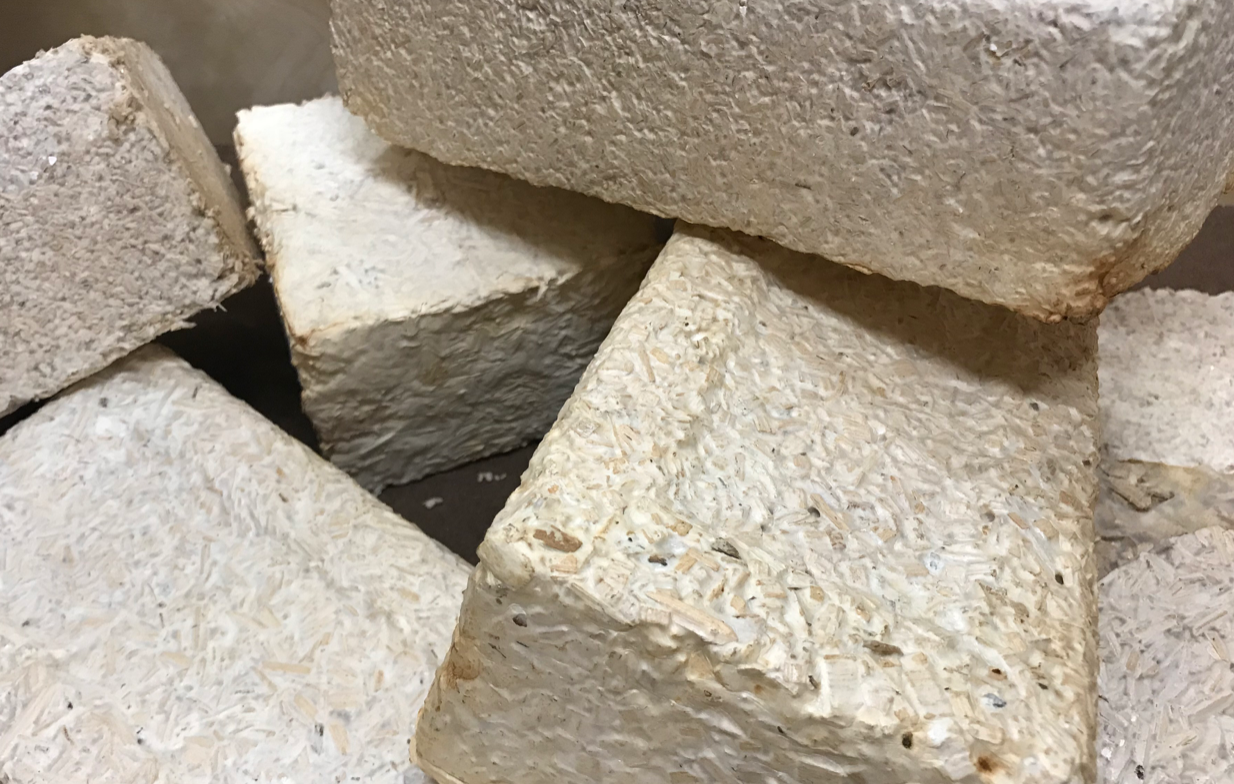
Bricks produced using mycelium, yard waste and wood chips as a part of the myco-architecture project. Similar materials could be used to build habitats on the Moon or Mars.
Credits: NASA
As NASA prepares for long-duration missions to the Moon and Mars for the benefit of all, a habitat-growing concept selected Wednesday by the agency could help “grow” homes using fungi for future explorers. A team of researchers at NASA Ames Research Center in California’s Silicon Valley will receive new funding under the NASA’s Innovative Advanced Concepts (NIAC) program to propel their habitat research.
The Phase III NIAC award will provide $2 million over two years to continue technology development of the Mycotecture Off Planet project in preparation for a potential future demonstration mission. The work is led by Lynn Rothschild, a senior research scientist at NASA Ames.
“As NASA prepares to explore farther into the cosmos than ever before, it will require new science and technology that doesn’t yet exist” said NASA Administrator Bill Nelson. “NASA’s space technology team and the NIAC program unlock visionary ideas – ideas that make the impossible, possible. This new research is a steppingstone to our Artemis campaign as we prepare to go back to the Moon to live, to learn, to invent, to create – then venture to Mars and beyond.”
Some habitats, such as landers and rovers, will be delivered to planetary surfaces. However, the mycotecture project team is developing technologies that could “grow” habitats on the Moon, Mars, and beyond using fungi and the underground threads that comprise the main part of fungi, known as mycelia. With this development, explorers could travel with a compact habitat built out of lightweight material containing dormant fungi. By adding water, fungi can potentially grow around that framework into a fully functional human habitat, while being safely contained to avoid contaminating the environment.
“We are committed to advancing technologies to transport our astronauts, house our explorers, and facilitate valuable research,” said Walt Engelund, associate administrator for Programs in the Space Technology Mission Directorate at NASA Headquarters in Washington. “We invest in these technologies throughout their lifecycle, recognizing their potential to help us accomplish our goals – benefiting industry, our agency, and humanity.”
The mycotecture project could enable a new, multi-use material for in-space construction, reducing mass and saving resources for additional mission priorities. The proof of concept for this technology was demonstrated through earlier NIAC awards. The team created multiple combinations of fungal-based biocomposites, fabricated prototypes, tested materials in a planetary simulator, evaluated enhancements including incorporating radiation protection, and drafted detailed mycelium-based Moon habitat designs. This project also has uses on Earth in addition to applications on other worlds. Mycelia could be used for water filtration and systems that extract minerals from wastewater.
From deep space human exploration to advanced propulsion and robotics, NASA aims to change the possible by supporting early-stage space technology research that could radically change the future.
“Mycotecture Off Planet exemplifies how advanced concepts can change how we envision future exploration missions,” said John Nelson, NIAC Program Executive. “As NASA embarks on the next era of space exploration, NIAC helps the agency lay the necessary groundwork to bring innovative visions to life.”
Work under the Phase III award will allow the research team to optimize material properties. It also will enable the team to progress toward testing in low Earth orbit. Future applications of this project could include integration into commercial space stations or infusion into missions to the Moon with the ultimate goal of use on Mars.
NASA Innovative Advanced Concepts supports visionary, early-stage research ideas through multiple progressive phases of study. In January 2024, NASA announced 19 Phase I and Phase II proposal selections. NASA’s Space Technology Mission Directorate, which is responsible for developing the new cross-cutting technologies and capabilities the agency needs to achieve its current and future missions, funds NIAC activities.
For more information about NASA’s investments in space technology, visit:
Surprising Phosphate Finding in NASA’s OSIRIS-REx Asteroid Sample
6 Min Read
Surprising Phosphate Finding in NASA’s OSIRIS-REx Asteroid Sample
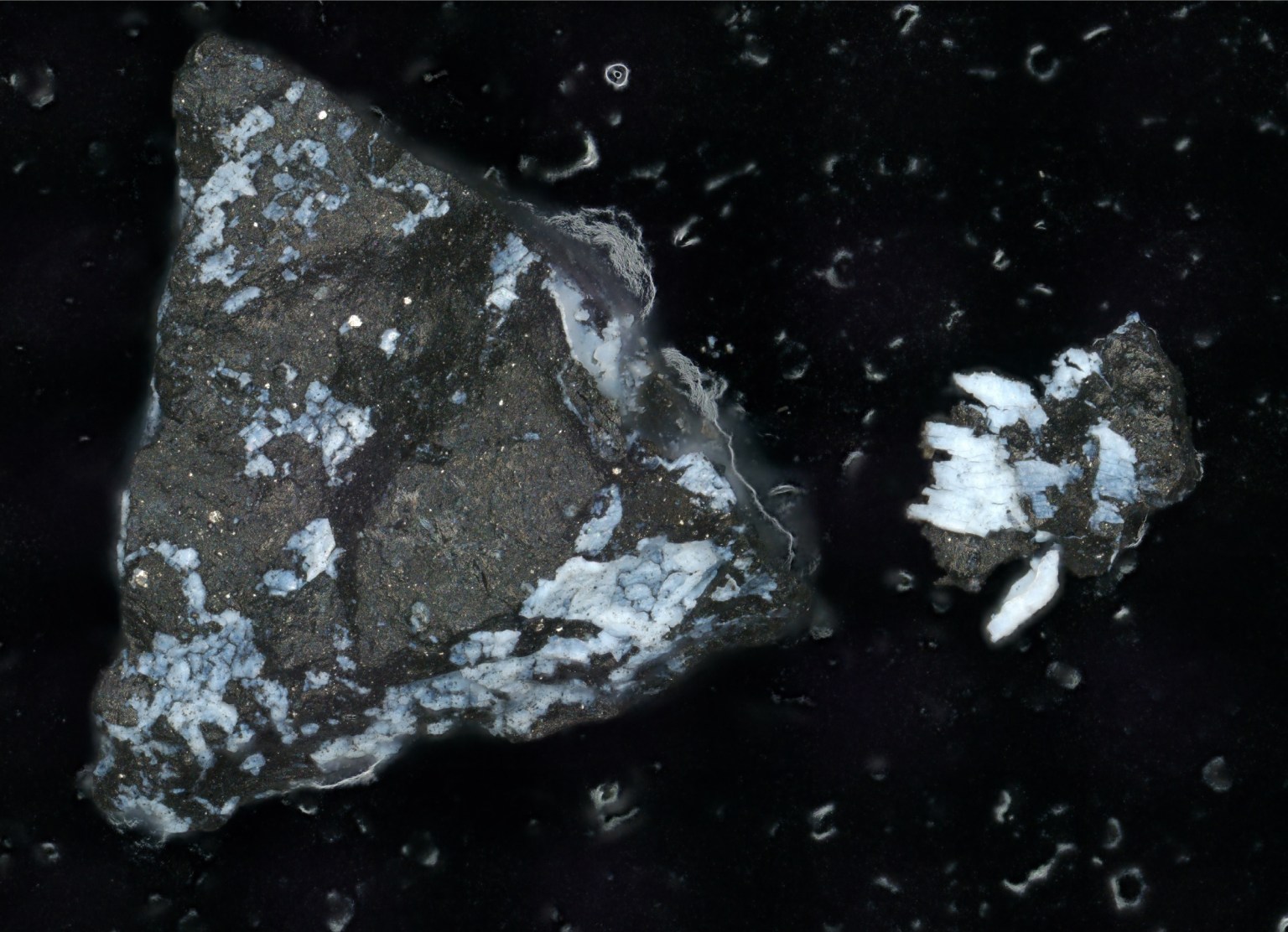
A microscope image of a dark Bennu particle, about a millimeter long, with a crust of bright phosphate. To the right is a smaller fragment that broke off.
Credits: From Lauretta & Connolly et al. (2024) Meteoritics & Planetary Science, doi:10.1111/maps.14227.
Early analysis of the asteroid Bennu sample returned by NASA’s OSIRIS-REx mission has revealed dust rich in carbon, nitrogen, and organic compounds, all of which are essential components for life as we know it. Dominated by clay minerals, particularly serpentine, the sample mirrors the type of rock found at mid-ocean ridges on Earth.
The magnesium-sodium phosphate found in the sample hints that the asteroid could have splintered off from an ancient, small, primitive ocean world. The phosphate was a surprise to the team because the mineral had not been detected by the OSIRIS-REx spacecraft while at Bennu.
While a similar phosphate was found in the asteroid Ryugu sample delivered by JAXA’s (Japan Aerospace Exploration Agency) Hayabusa2 mission in 2020, the magnesium-sodium phosphate detected in the Bennu sample stands out for its purity (that is, the lack of other materials included in the mineral) and the size of its grains, unprecedented in any meteorite sample.
Scientists have eagerly awaited the opportunity to dig into the 4.3-ounce (121.6-gram) pristine asteroid Bennu sample collected by NASA’s OSIRIS-REx (Origins, Spectral Interpretation, Resource Identification, and Security – Regolith Explorer) mission since it was delivered to Earth last fall. They hoped the material would hold secrets of the solar system’s past and the prebiotic chemistry that might have led to the origin of life on Earth. An early analysis of the Bennu sample, published June 26 in Meteoritics & Planetary Science, demonstrates this excitement was warranted.
The OSIRIS-REx Sample Analysis Team found that Bennu contains the original ingredients that formed our solar system. The asteroid’s dust is rich in carbon and nitrogen, as well as organic compounds, all of which are essential components for life as we know it. The sample also contains magnesium-sodium phosphate, which was a surprise to the research team, because it wasn’t seen in the remote sensing data collected by the spacecraft at Bennu. Its presence in the sample hints that the asteroid could have splintered off from a long-gone, tiny, primitive ocean world.
A Phosphate Surprise
Analysis of the Bennu sample unveiled intriguing insights into the asteroid’s composition. Dominated by clay minerals, particularly serpentine, the sample mirrors the type of rock found at mid-ocean ridges on Earth, where material from the mantle, the layer beneath Earth’s crust, encounters water.
This interaction doesn’t just result in clay formation; it also gives rise to a variety of minerals like carbonates, iron oxides, and iron sulfides. But the most unexpected discovery is the presence of water-soluble phosphates. These compounds are components of biochemistry for all known life on Earth today.
A tiny fraction of the asteroid Bennu sample returned by NASA’s OSIRIS-REx mission, shown in microscope images. The top-left pane shows a dark Bennu particle, about a millimeter long, with an outer crust of bright phosphate. The other three panels show progressively zoomed-in views of a fragment of the particle that split off along a bright vein containing phosphate, captured by a scanning electron microscope.
From Lauretta & Connolly et al. (2024) Meteoritics & Planetary Science, doi:10.1111/maps.14227.
While a similar phosphate was found in the asteroid Ryugu sample delivered by JAXA’s (Japan Aerospace Exploration Agency) Hayabusa2 mission in 2020, the magnesium-sodium phosphate detected in the Bennu sample stands out for its purity — that is, the lack of other materials in the mineral — and the size of its grains, unprecedented in any meteorite sample.
The finding of magnesium-sodium phosphates in the Bennu sample raises questions about the geochemical processes that concentrated these elements and provides valuable clues about Bennu’s historic conditions.
“The presence and state of phosphates, along with other elements and compounds on Bennu, suggest a watery past for the asteroid,” said Dante Lauretta, co-lead author of the paper and principal investigator for OSIRIS-REx at the University of Arizona, Tucson. “Bennu potentially could have once been part of a wetter world. Although, this hypothesis requires further investigation.”
“OSIRIS-REx gave us exactly what we hoped: a large pristine asteroid sample rich in nitrogen and carbon from a formerly wet world,” said Jason Dworkin, a co-author on the paper and the OSIRIS-REx project scientist at NASA’s Goddard Space Flight Center in Greenbelt, Maryland.
From a Young Solar System
Despite its possible history of interaction with water, Bennu remains a chemically primitive asteroid, with elemental proportions closely resembling those of the Sun.
“The sample we returned is the largest reservoir of unaltered asteroid material on Earth right now,” said Lauretta.
This composition offers a glimpse into the early days of our solar system, over 4.5 billion years ago. These rocks have retained their original state, having neither melted nor resolidified since their inception, affirming their ancient origins.
Hints at Life’s Building Blocks
The team has confirmed the asteroid is rich in carbon and nitrogen. These elements are crucial in understanding the environments where Bennu’s materials originated and the chemical processes that transformed simple elements into complex molecules, potentially laying the groundwork for life on Earth.
“These findings underscore the importance of collecting and studying material from asteroids like Bennu — especially low-density material that would typically burn up upon entering Earth’s atmosphere,” said Lauretta. “This material holds the key to unraveling the intricate processes of solar system formation and the prebiotic chemistry that could have contributed to life emerging on Earth.”
What’s Next
Dozens more labs in the United States and around the world will receive portions of the Bennu sample from NASA’s Johnson Space Center in Houston in the coming months, and many more scientific papers describing analyses of the Bennu sample are expected in the next few years from the OSIRIS-REx Sample Analysis Team.
“The Bennu samples are tantalizingly beautiful extraterrestrial rocks,” said Harold Connolly, co-lead author on the paper and OSIRIS-REx mission sample scientist at Rowan University in Glassboro, New Jersey. “Each week, analysis by the OSIRIS-REx Sample Analysis Team provides new and sometimes surprising findings that are helping place important constraints on the origin and evolution of Earth-like planets.”
Launched on Sept. 8, 2016, the OSIRIS-REx spacecraft traveled to near-Earth asteroid Bennu and collected a sample of rocks and dust from the surface. OSIRIS-REx, the first U.S. mission to collect a sample from an asteroid, delivered the sample to Earth on Sept. 24, 2023.
NASA’s Goddard Space Flight Center in Greenbelt, Maryland, provided overall mission management, systems engineering, and the safety and mission assurance for OSIRIS-REx. Dante Lauretta of the University of Arizona, Tucson, is the principal investigator. The university leads the science team and the mission’s science observation planning and data processing. Lockheed Martin Space in Littleton, Colorado, built the spacecraft and provided flight operations. Goddard and KinetX Aerospace were responsible for navigating the OSIRIS-REx spacecraft. Curation for OSIRIS-REx takes place at NASA Johnson. International partnerships on this mission include the OSIRIS-REx Laser Altimeter instrument from CSA (Canadian Space Agency) and asteroid sample science collaboration with JAXA’s Hayabusa2 mission. OSIRIS-REx is the third mission in NASA’s New Frontiers Program, managed by NASA’s Marshall Space Flight Center in Huntsville, Alabama, for the agency’s Science Mission Directorate in Washington.
Find more information about NASA’s OSIRIS-REx mission at:
NASA’s Juno Gets a Close-Up Look at Lava Lakes on Jupiter’s Moon Io
6 min read
Preparations for Next Moonwalk Simulations Underway (and Underwater)
The JunoCam instrument aboard NASA’s Juno spacecraft captured two volcanic plumes rising above the horizon of Jupiter’s moon Io. The image was taken Feb. 3 from a distance of about 2,400 miles (3,800 kilometers).
Image data: NASA/JPL-Caltech/SwRI/MSSS, Image processing by Andrea Luck (CC BY)
Infrared imagery from the solar-powered spacecraft heats up the discussion on the inner workings of Jupiter’s hottest moon.
New findings from NASA’s Juno probe provide a fuller picture of how widespread the lava lakes are on Jupiter’s moon Io and include first-time insights into the volcanic processes at work there. These results come courtesy of Juno’s Jovian Infrared Auroral Mapper (JIRAM) instrument, contributed by the Italian Space Agency, which “sees” in infrared light. Researchers published a paper on Juno’s most recent volcanic discoveries on June 20 in the journal Nature Communications Earth and Environment.
Io has intrigued the astronomers since 1610, when Galileo Galilei first discovered the Jovian moon, which is slightly larger than Earth’s Moon. Some 369 years later, NASA’s Voyager 1 spacecraft captured a volcanic eruption on the moon. Subsequent missions to Jupiter, with more Io flybys, discovered additional plumes — along with lava lakes. Scientists now believe Io, which is stretched and squeezed like an accordion by neighboring moons and massive Jupiter itself, is the most volcanically active world in the solar system. But while there are many theories on the types of volcanic eruptions across the surface of the moon, little supporting data exists.
In both May and October 2023, Juno flew by Io, coming within about 21,700 miles (35,000 kilometers) and 8,100 miles (13,000 kilometers), respectively. Among Juno’s instruments getting a good look at the beguiling moon was JIRAM.
Infrared data collected Oct. 15, 2023, by the JIRAM instrument aboard NASA’s Juno shows Chors Patera, a lava lake on Jupiter’s moon Io. The team believes the lake is largely covered by a thick, molten crust, with a hot ring around the edges where lava from Io’s interior is directly exposed to space.
NASA/JPL-Caltech/SwRI/ASI/INAF/JIRAM/MSSS
Designed to capture the infrared light (which is not visible to the human eye) emerging from deep inside Jupiter, JIRAM probes the weather layer down to 30 to 45 miles (50 to 70 kilometers) below the gas giant’s cloud tops. But during Juno’s extended mission, the mission team has also used the instrument to study the moons Io, Europa, Ganymede, and Callisto. The JIRAM Io imagery showed the presence of bright rings surrounding the floors of numerous hot spots.
“The high spatial resolution of JIRAM’s infrared images, combined with the favorable position of Juno during the flybys, revealed that the whole surface of Io is covered by lava lakes contained in caldera-like features,” said Alessandro Mura, a Juno co-investigator from the National Institute for Astrophysics in Rome. “In the region of Io’s surface in which we have the most complete data, we estimate about 3% of it is covered by one of these molten lava lakes.” (A caldera is a large depression formed when a volcano erupts and collapses.)
Fire-Breathing Lakes
JIRAM’s Io flyby data not only highlights the moon’s abundant lava reserves, but also provides a glimpse of what may be going on below the surface. Infrared images of several Io lava lakes show a thin circle of lava at the border, between the central crust that covers most of the lava lake and the lake’s walls. Recycling of melt is implied by the lack of lava flows on and beyond the rim of the lake, indicating that there is a balance between melt that has erupted into the lava lakes and melt that is circulated back into the subsurface system.
This animation is an artist’s concept of Loki Patera, a lava lake on Jupiter’s moon Io, made using data from the JunoCam imager aboard NASA’s Juno spacecraft. With multiple islands in its interior, Loki is a depression filled with magma and rimmed with molten lava. NASA/JPL-Caltech/SwRI/MSSS
“We now have an idea of what is the most frequent type of volcanism on Io: enormous lakes of lava where magma goes up and down,” said Mura. “The lava crust is forced to break against the walls of the lake, forming the typical lava ring seen in Hawaiian lava lakes. The walls are likely hundreds of meters high, which explains why magma is generally not observed spilling out of the paterae” — bowl-shaped features created by volcanism — “and moving across the moon’s surface.”
JIRAM data suggests that most of the surface of these Io hot spots is composed of a rocky crust that moves up and down cyclically as one contiguous surface due to the central upwelling of magma. In this hypothesis, because the crust touches the lake’s walls, friction keeps it from sliding, causing it to deform and eventually break, exposing lava just below the surface.
An alternative hypothesis remains in play: Magma is welling up in the middle of the lake, spreading out and forming a crust that sinks along the rim of the lake, exposing lava.
“We are just starting to wade into the JIRAM results from the close flybys of Io in December 2023 and February 2024,” said Scott Bolton, principal investigator for Juno at the Southwest Research Institute in San Antonio. “The observations show fascinating new information on Io’s volcanic processes. Combining these new results with Juno’s longer-term campaign to monitor and map the volcanoes on Io’s never-before-seen north and south poles, JIRAM is turning out to be one of the most valuable tools to learn how this tortured world works.”
Juno executed its 62nd flyby of Jupiter — which included an Io flyby at an altitude of about 18,175 miles (29,250 kilometers) — on June 13. The 63rd flyby of the gas giant is scheduled for July 16.
More About the Mission
NASA’s Jet Propulsion Laboratory, a division of Caltech in Pasadena, California, manages the Juno mission for the principal investigator, Scott Bolton, of the Southwest Research Institute in San Antonio. Juno is part of NASA’s New Frontiers Program, which is managed at NASA’s Marshall Space Flight Center in Huntsville, Alabama, for the agency’s Science Mission Directorate in Washington. The Italian Space Agency (ASI) funded the Jovian InfraRed Auroral Mapper. Lockheed Martin Space in Denver built and operates the spacecraft.
Mycotecture off Planet: En route to the Moon and Mars
4 min read
Preparations for Next Moonwalk Simulations Underway (and Underwater)
Artist concept depicting a new novel aerospace concept for NIAC Phase III 2024.
Credit: Lynn Rothschild
LynnRothschild NASA Ames Research Center (ARC)
A turtle carries its habitat. While reliable, it costs energy in transporting mass. NASA makes the same trade-off when it transports habitats and other structures off planet “on the back” of its missions. While this approach is reliable, to save upmass and increase mission flexibility, NASA must be more like a bird, low mass, agile and building structures from local resources. We identified a novel biology-based solution to the in situ production of usable structures for space exploration: using fungal mycelial (myco) composites to grow structures off-planet, from habitats to furniture to tableware. As a living material it has the potential to self heal, self replicate, be bioengineered, and enhanced with materials such as metals and melanin. Prior performance: During Phase 1, we raised the TRL to 2 by assessing the growth of fungi on different food substrates and analyzing their use on Mars and Earth. In Phase II we completed TRL 3 for an integrated system of inflatables and myco-material production. We designed prototypes and subsystems. We performed proof-of-concepts analyzing myco-material function before and after exposure to relevant environments in a planetary simulator. Our Phase II report and publications documented analytical and experimental results on fungal and inflatable components of the system validating prediction of key parameters. Phase II developed the Phase I mission concept, with an Artemis-inspired focus towards lunar habitats with a “feed forward to Mars” concept.
We assessed fungal/algal/bacterial mixtures by testing different combinations at different temperatures with different food sources, and developed a high throughput, reproducible method for producing fungal materials. We tested sand and regolith simulant composites for in situ material construction. We developed prototypes in silicone scale models, and a 4X4 m model of inflatable architecture and grew a mycelium dome on top. We determined the effect of simulated extraterrestrial conditions on materials showing hyphal damage under UV. By tuning different steps of production, we can change the mechanical properties of the mycelium biocomposites as they undergo compression. We incorporated melanin-producing strains into experiments and models for radiation protection. We drafted designs for mycelium-based lunar habitats. We utilized the 500-Day DRM to the Apollo 15 Hadley-Apenine Region to define science objective and infrastructure requirements to support extended exploration missions to the Moon and Mars, identifying critical gaps that can be filled by mycotecture. Archetypes were drafted per this DRM. Terrestrial applications demonstrated the spin-off potential of the NIAC technology from habitats to tableware.
Innovation and Benefits: If we succeed in developing a fungal biocomposite that can grow itself, we will provide NASA with a radically new, cheaper, faster, more flexible, lighter and sustainable material for extended duration Lunar and Mars mission habitats, as well as for furniture and other structures in flight or at destination.
Milestones and Transition Strategy: The mission context of Phase I was Martian habitats. Mindful of the more immediate focus on Artemis, Phase II focused on a lunar implementation, with a DRM for a 500 day mission to the Apollo 15 Hadley-Max region and the south polar region. En route to realizing these visions, we have identified two intermediate opportunities, both of which require NIAC Phase III funding. They are to (1) test mycotecture suitability and growth in LEO by the integration into an orbiting space station, Starlab, and (2) test mycotecture habitat prototypes on the lunar surface through a CLPS mission. To participate in Starlab, we will develop prototypes for this application and then team with Starlab LLC to raise funding to produce flight-ready structures. To be competitive for a CLPS mission, we will use NIAC funding to raise the technology to TRL6 for this lunar demo mission.