NASA Selects Participating Scientists to Join ESA’s Hera Mission
3 min read
NASA Selects Participating Scientists to Join ESA’s Hera Mission
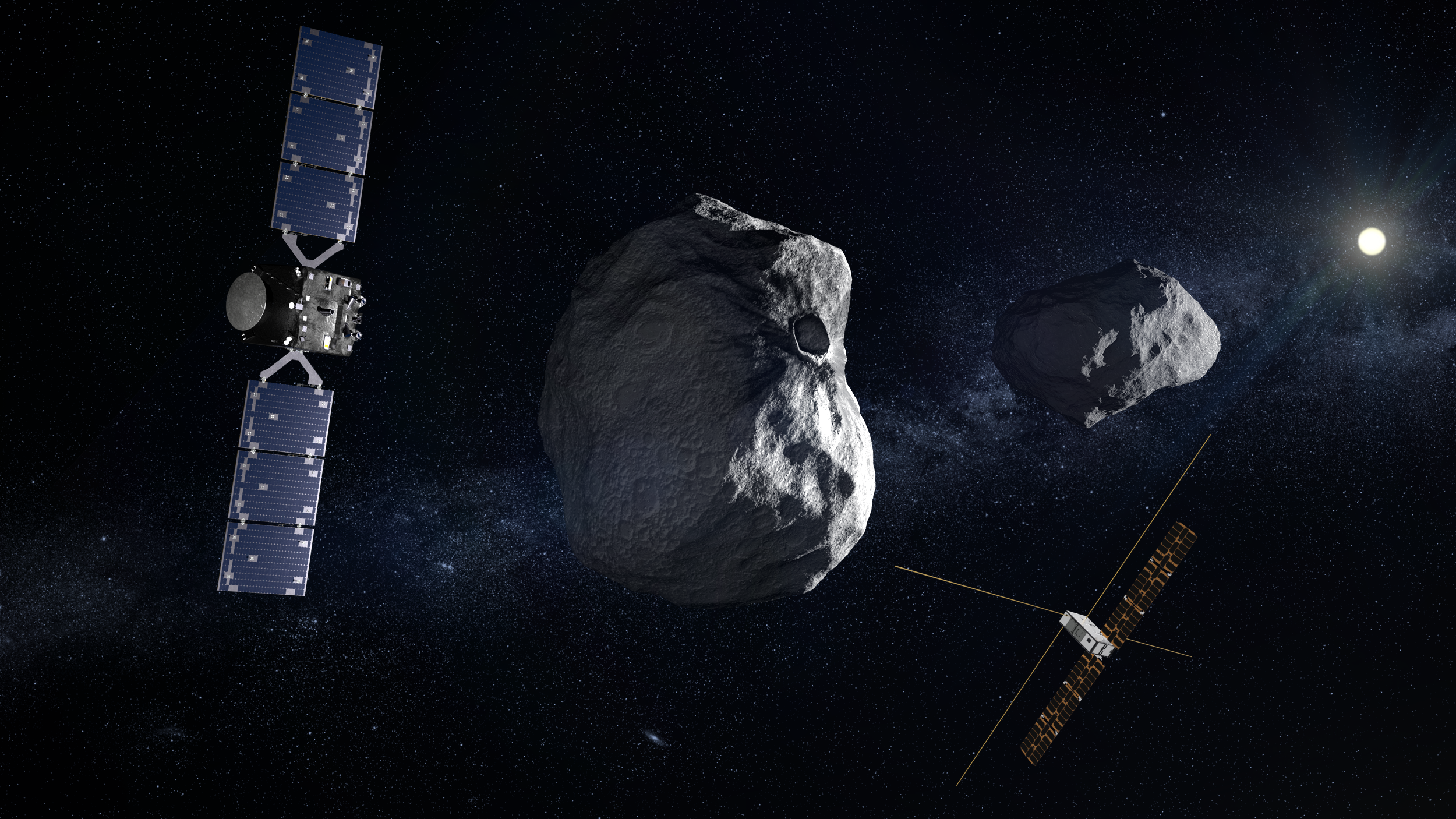
NASA has selected 12 participating scientists to join ESA’s (European Space Agency) Hera mission, which is scheduled to launch in October 2024. Hera will study the binary asteroid system Didymos, including the moonlet Dimorphos, which was impacted by NASA’s DART (Double Asteroid Redirection Test) spacecraft on Sept. 26, 2022. The objectives of DART and Hera collectively aim to validate the kinetic impact method as a technology to deflect an asteroid on a collision course with Earth, if one is ever discovered, and to learn more about the near-Earth asteroids that are the source of this natural hazard.
This artist’s concept shows ESA’s Hera spacecraft and its CubeSats in orbit around the Dimorphos moonlet. NASA has selected 12 participating scientists to join the Hera mission.
ESA-Science Office
Hera is scheduled to arrive at the Didymos/Dimorphos binary asteroid system at the end of 2026, where it will gather otherwise unobtainable data about the mass and makeup of both bodies and assess the changes caused by the DART spacecraft’s kinetic impact.
The goal of NASA’s Hera Participating Scientist Program is to support scientists at U.S. institutions to participate on the Hera mission and address outstanding questions in planetary defense and near-Earth asteroid science. The participating scientists will become Hera science team members during their 5-year tenure with the mission.
The newly selected participating scientists are:
Bonnie Buratti – NASA’s Jet Propulsion Laboratory, Southern California
Ingrid Daubar – Brown University, Providence, Rhode Island
Carolyn Ernst – Johns Hopkins Applied Physics Laboratory
Dawn Graninger – Johns Hopkins University Applied Physics Laboratory
Mark Haynes – NASA JPL
Masatoshi Hirabayashi – Georgia Institute of Technology, Atlanta
Tim Lister – Las Cumbres Observatory, Goleta, California
Ryan Park – NASA JPL
Andrew Rivkin – Johns Hopkins Applied Physics Laboratory
Daniel Scheeres – University of Colorado, Boulder
Timothy Titus – U.S. Geological Survey, Flagstaff, Arizona
Yun Zhang – University of Michigan, Ann Arbor
DART was the first planetary defense test mission from NASA’s Planetary Defense Coordination Office, which oversees the agency’s ongoing efforts in planetary defense. International participation in DART and Hera, including the Hera Participating Scientist Program, has been enabled by an ongoing worldwide collaboration in the planetary defense research community known as the Asteroid Impact and Deflection Assessment.
DART was designed, built, and operated by the Johns Hopkins Applied Physics Laboratory (APL) in Laurel, Maryland, for NASA’s Planetary Defense Coordination Office, which oversees the agency’s ongoing efforts in planetary defense.
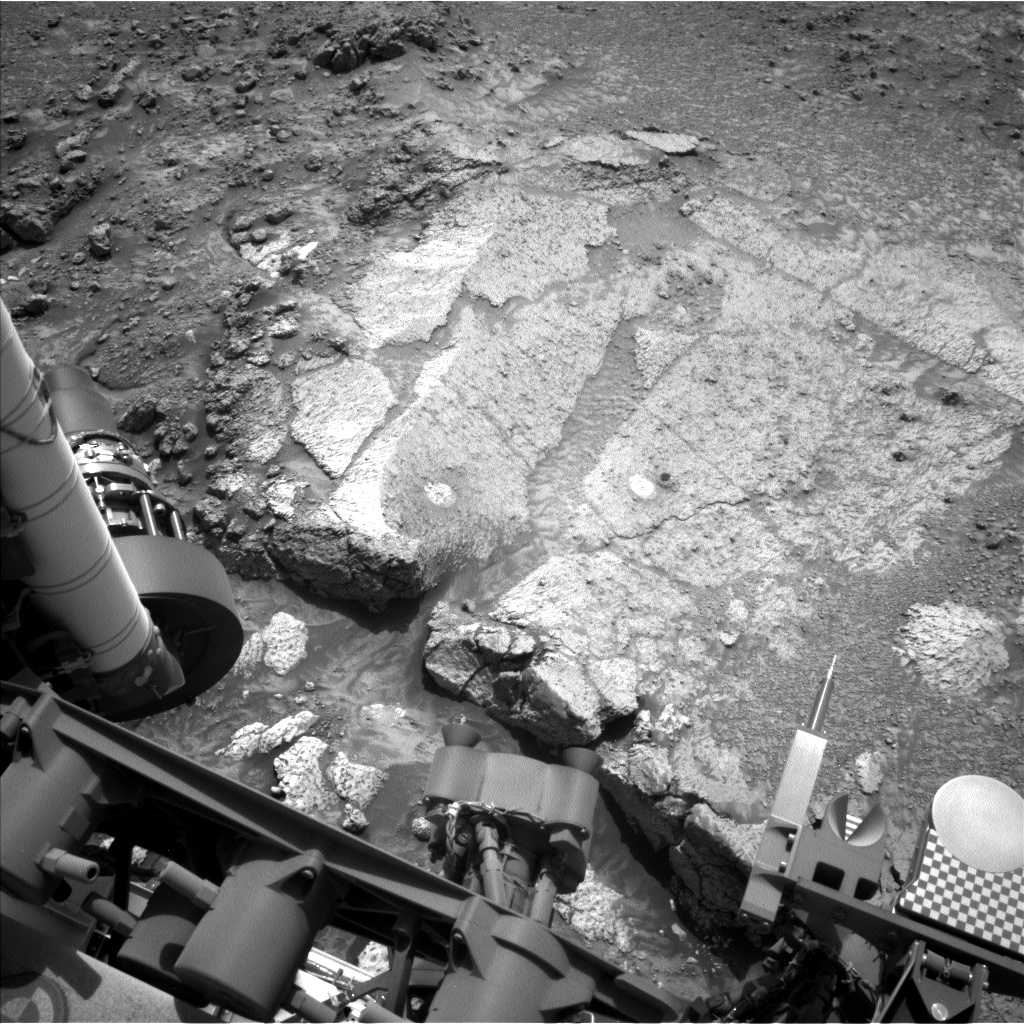
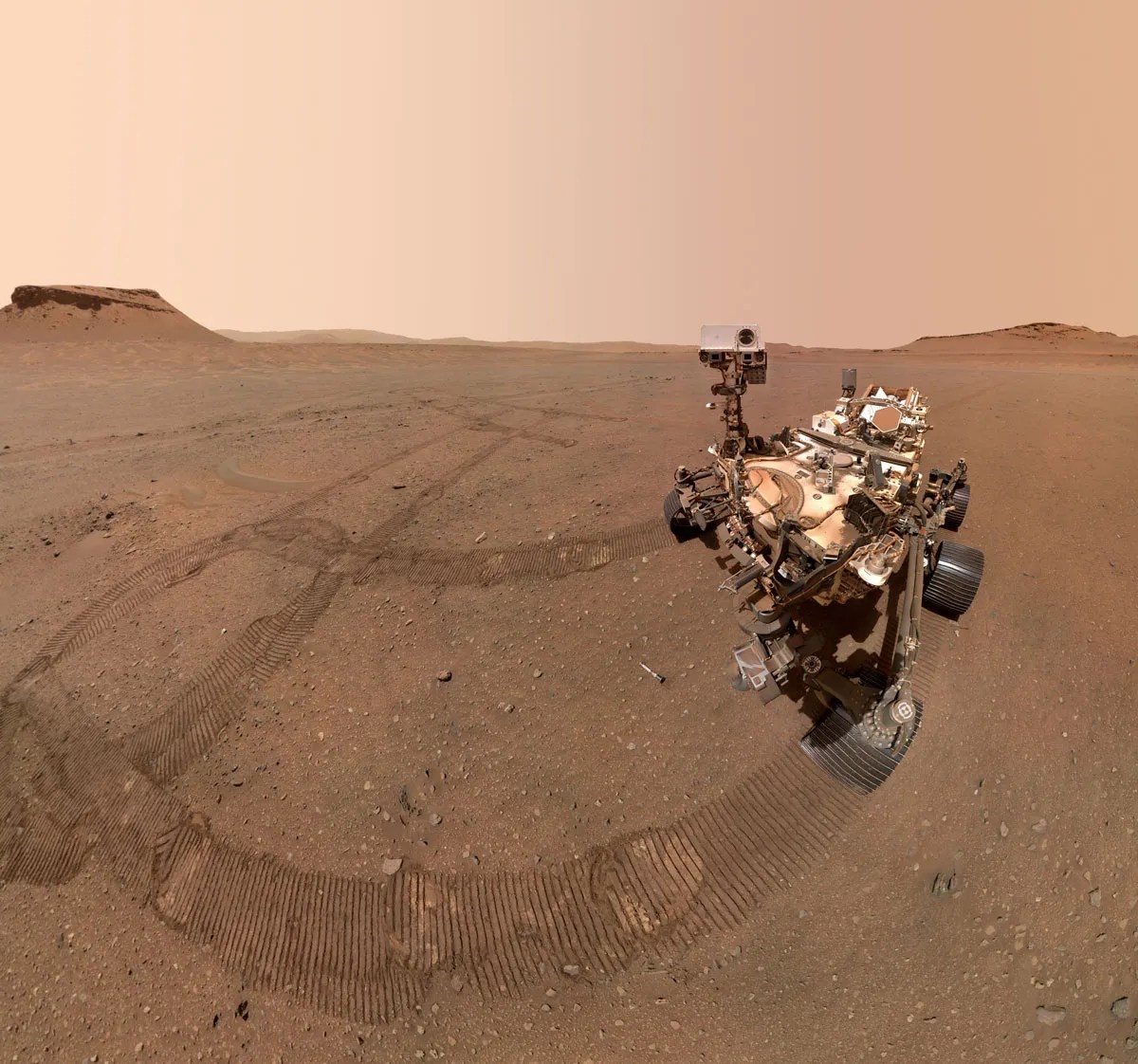
This image was taken by Left Navigation Camera onboard NASA’s Mars rover Curiosity on Sol 4219 (2024-06-19 02:21:53 UTC).
NASA/JPL-Caltech
Earth planning date: Monday, June 24, 2024
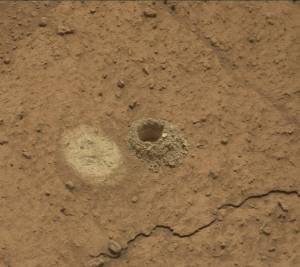
This will be an important week for chemistry on our latest drill sample “Mammoth Lakes 2.” Curiosity’s primary goal today was a preconditioning of the SAM instrument in preparation for its chemical analysis. Due to the large amounts of power required by SAM, today’s science block was limited to one hour, although it grew a bit at the cost of next sol’s science allocation. Today’s planning only covers one sol (4225), as our usual Wednesday planning day will not have Deep Space Network availability. We will plan 3 sols on Tuesday as a result.
Over the weekend, the “Mammoth Lakes 2” drill sample was dropped off to CheMin for analysis. Mastcam change detection observations of “Walker Pass 2” and “Finch Lake” were begun and will complete on Sol 4225. Remote science on “Whitebark Pass,” “Quarry Peak,” “Broken Finger Peak,” and “Shout of Relief Pass” completed successfully. On Sol 4225, the focus for remote science was a ChemCam laser spectroscopic characterization and Mastcam imaging of “Horsetail Falls,” an area near the edge of the “Whitebark Pass” workspace slab. The Navcam image below shows the rough surface of “Horsetail Falls” as a stripe of dark rubbly material near the top just right of center edge of the light colored “Whitebark Pass” slab. “Horsetail Falls” is an example of bedrock texture diversity. This target is named for an iconic 270 ft waterfall emerging from Agnew Lake and easily seen from the June Lake Loop road. “Shout of Relief Pass” honors the 11000 ft pass on the Sierra High Route trail which is a gateway to much easier terrain for the next 25 miles of the trail. All targets in this area of Mount Sharp are named after the Bishop geological quadrangle in the High Sierra and Owens Valley of California. ChemCam RMI will also image an 11×1 mosaic of the nearby channel floor where there are interesting color variations. Atmospheric observations in this science block consist of a dust devil survey. In the next plan, SAM will complete its initial analysis. Based on the SAM and CheMin results, the team will then decide whether to do more chemistry at this intriguing location or continue our drive up Mount Sharp.
Written by Deborah Padgett, Curiosity Operations Product Generation Subsystem Lead Engineer at NASA’s Jet Propulsion Laboratory
Open Call to New York-based Artists to Create Collaborative NASA Mural
1 min read
Preparations for Next Moonwalk Simulations Underway (and Underwater)
Credits: NASA
NASA and the Hudson Square Business Improvement District are launching an open call to New York-based artists and artist teams to design and install a large-scale, space-themed neighborhood mural. The NASA x Hudson Square partnership was developed to inspire the surrounding Manhattan Hudson Square community by showcasing NASA’s work and missions.
Artists are encouraged to submit proposals for the project and detail how their mural will illustrate the impact of NASA’s priorities, such as the agency’s James Webb Space Telescope, climate science and innovation, and the Artemis campaign exploring the Moon. Applications are due by Friday, June 28.
The selected project will receive a $20,000 award for design fees, materials, labor, and equipment, with a portion of funds provided by NASA and matched by Hudson Square Business Improvement District. The mural installation is expected to be complete by September.
NASA continues to seek opportunities to inspire the next generation of explorers – the Artemis Generation – through collaborations with partners like the Hudson Square Business Improvement District. Details about submitting project proposals are available on the Hudson Square web page. For questions about applying to the NASA x Hudson Square mural project, contact PublicArt@HudsonSquareBID.org.
Unity in Orbit: Astronauts Soar with Pride Aboard Station
A powerful symbol of pride waved high above Earth aboard the International Space Station in December 2021, reflecting NASA’s commitment to a collaborative and inclusive environment in human spaceflight. The Pride flag was unveiled by NASA astronauts to celebrate our identities and unite in our commitment to equality and acceptance for all individuals.
At NASA’s Johnson Space Center in Houston, leveraging diverse talents is key to achieving the ambitious goals of space exploration.
Johnson supports its employees by standing in solidarity and providing resources such as the Out & Allied Employee Resource Group that recognize the unique strengths of the LGBTQI+ workforce and encourage individuals to bring their authentic selves to the workplace. That support extends all the way to low Earth orbit and beyond.
The Pride flag flows aboard the International Space Station inside the cupola during Expedition 66.
Credit: NASA/Raja Chari
NASA astronaut Raja Chari, as a flight engineer for Expedition 66, captured a monumental image of the Pride flag flowing freely aboard the orbiting laboratory inside the Cupola.
“As government astronauts, we explore on behalf of all humankind,” said Chari. “Whether it’s on the International Space Station or developing the Artemis vehicles that will take us back to the Moon, it’s NASA’s goal to make space accessible to everyone.”
Reflecting on his experiences aboard the space station, Chari expressed gratitude for the global support network that supported him along the way. “Nothing I did in space would have been possible without leveraging the diversity of thought that makes human spaceflight possible,” he said.
Chari also stressed the importance of diverse perspectives in overcoming the technical challenges of space exploration. “Every day I’m in meetings and testing events where we are tasked with the very real technical challenges of sustaining humans on the Moon and eventually Mars,” he said. “There is no way we will solve the problems on or off our planet if we don’t take advantage of having the most diverse team we can to ensure we don’t overlook a possible solution.”
“Being in the Cupola with the Pride flag was a way to thank and encourage people to be proud of who they are, and bring their whole selves to work, because we’ll need all of them to get back to the Moon.”
Six Adapters for Crewed Artemis Flights Tested, Built at NASA Marshall
5 Min Read
Six Adapters for Crewed Artemis Flights Tested, Built at NASA Marshall
Six adapters for the next of NASA’s SLS (Space Launch System) rockets for Artemis II through Artemis IV are currently at NASA’s Marshall Space Flight Center in Alabama. Engineers are analyzing data and applying lessons learned from extensive in-house testing and the successful uncrewed Artemis I test flight to improve future iterations of the rocket.
Credits: NASA/Sam Lott
As a child learning about basic engineering, you probably tried and failed to join a square-shaped toy with a circular-shaped toy: you needed a third shape to act as an adapter and connect them both together. On a much larger scale, integration of NASA’s powerful SLS (Space Launch System) rocket and the Orion spacecraft for the agency’s Artemis campaign would not be possible without the adapters being built, tested, and refined at NASA’s Marshall Space Flight Center in Huntsville, Alabama.
Marshall is currently home to six adapters designed to connect SLS’s upper stages with the core stages and propulsion systems for future Artemis flights to the Moon.
Preparing Block 1 Adapters for Upcoming Crewed Flights
The first three Artemis flights use the SLS Block 1 rocket variant, which can send more than 27 metric tons (59,500 pounds) to the Moon in a single launch with the assistance of the interim cryogenic propulsion stage. The propulsion stage is sandwiched between two adapters: the launch vehicle stage adapter and the Orion stage adapter.
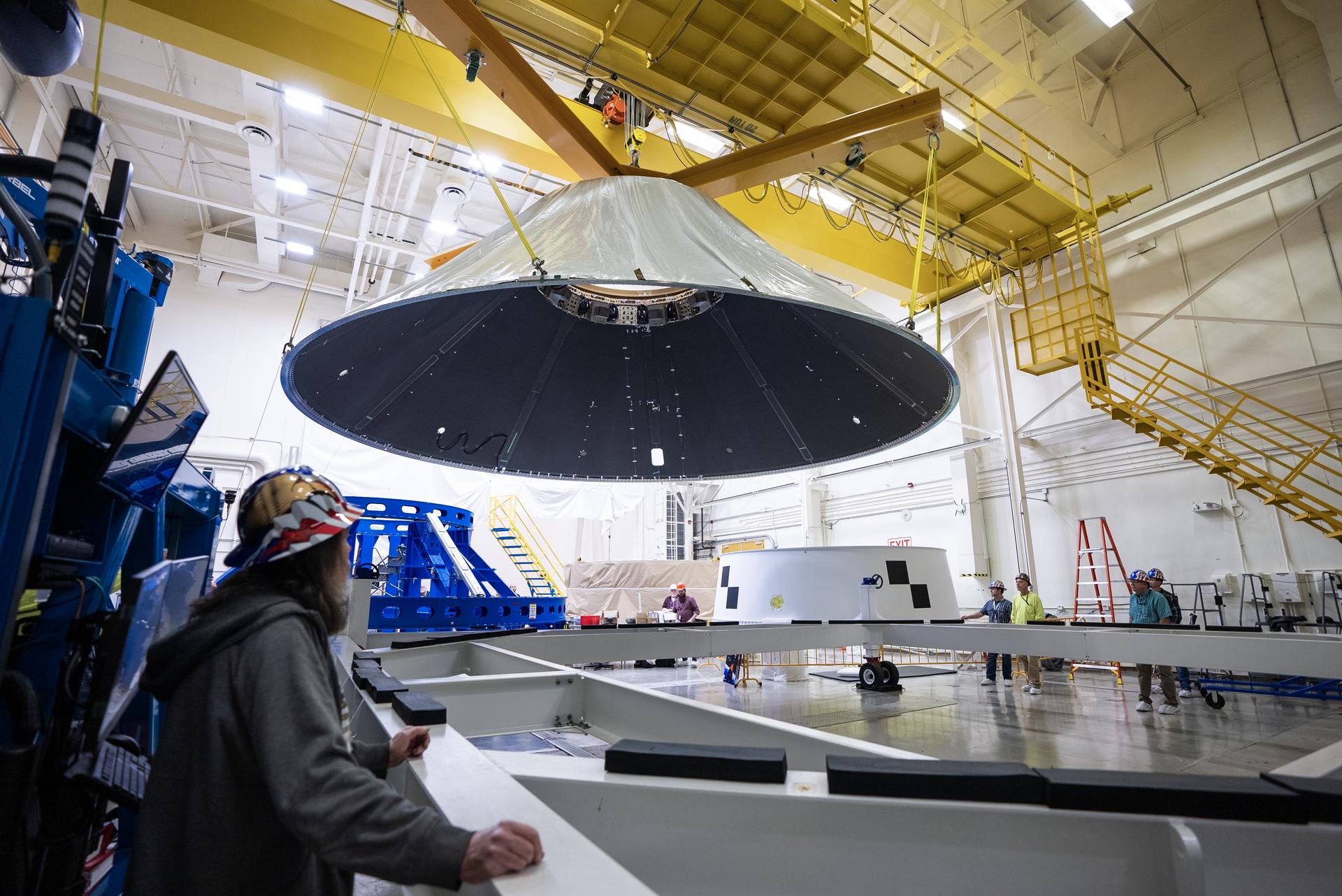
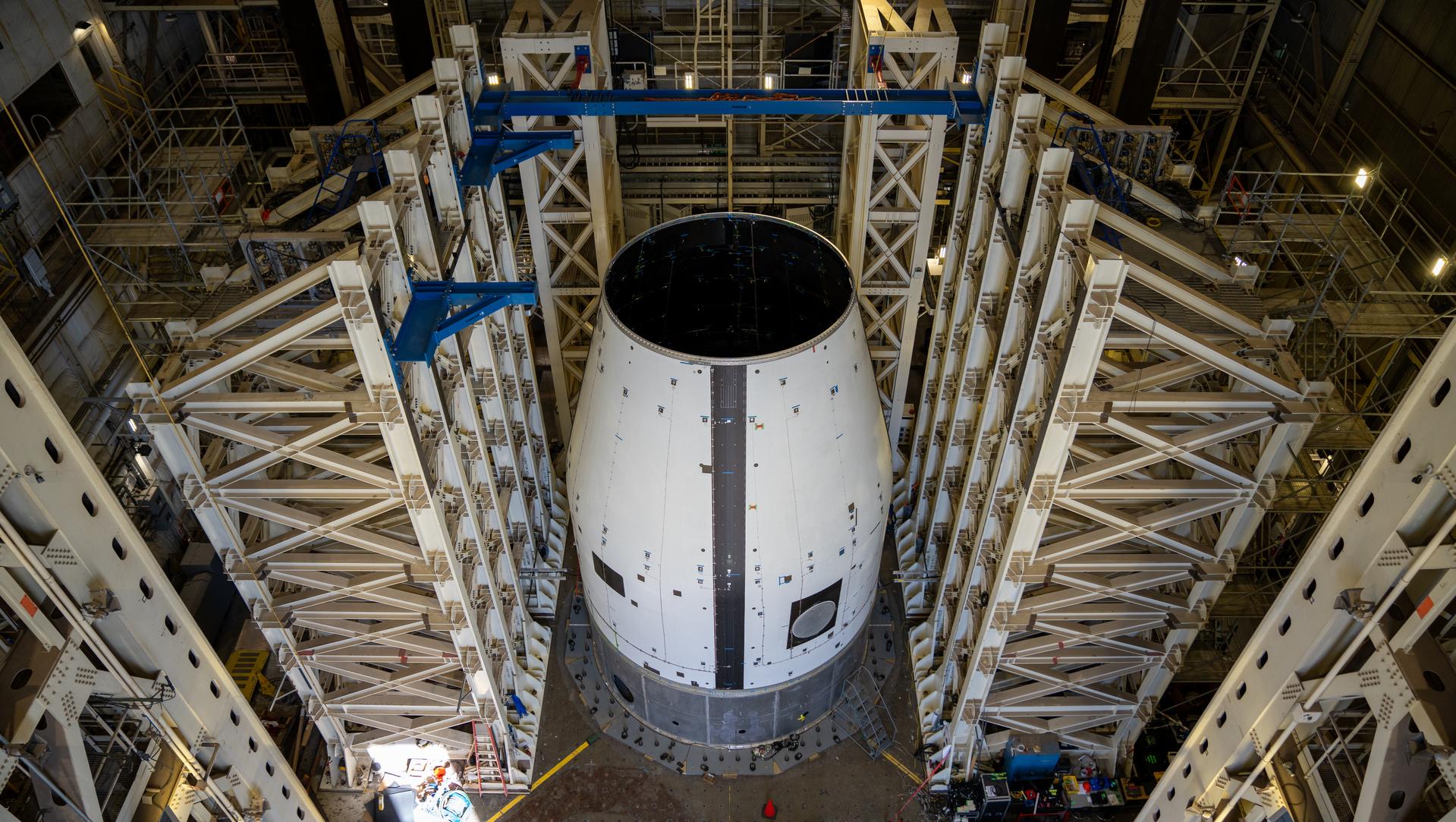
The cone-shaped launch vehicle stage adapter provides structural strength and protects the rocket’s flight computers and other delicate systems from acoustic, thermal, and vibration effects.
“The inside of the launch vehicle stage adapter for the SLS rocket uses orthogrid machining – also known as waffle pattern machining,” said Keith Higginbotham, launch vehicle stage adapter hardware manager supporting the SLS Spacecraft/Payload Integration & Evolution Office at Marshall. “The aluminum alloy plus the grid pattern is lightweight but also very strong.”
The launch vehicle stage adapter for Artemis II is at Marshall and ready for shipment to NASA’s Kennedy Space Center in Florida, while engineering teams are completing outfitting and integration work on the launch vehicle stage adapter for Artemis III. These cone-shaped adapters differ from their Artemis I counterpart, featuring additional avionics protection for crew safety.
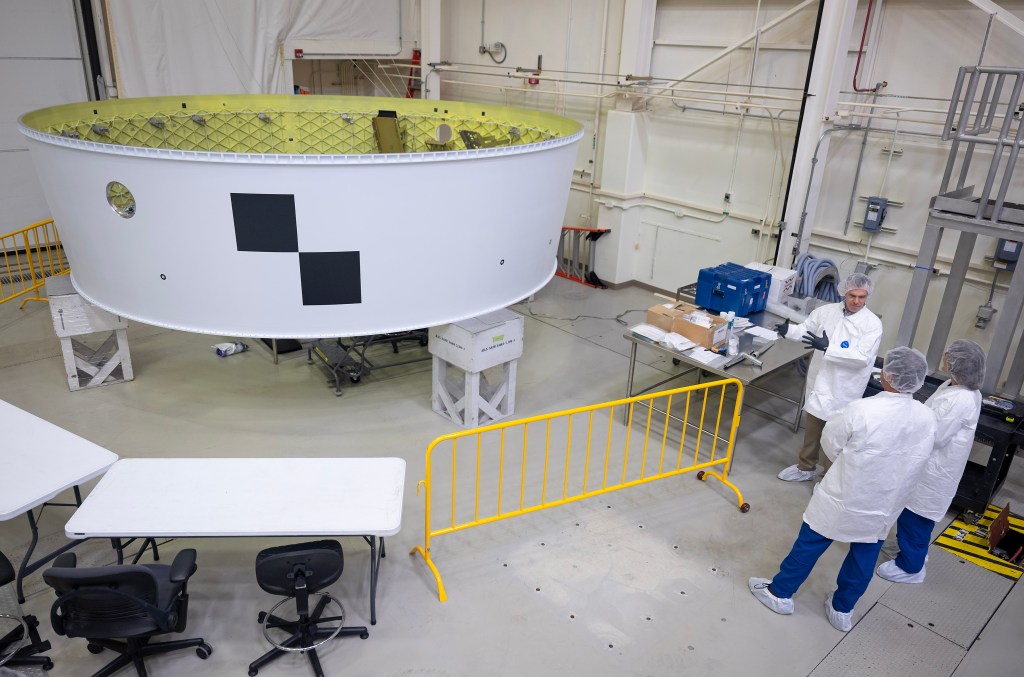
Just a few buildings over, the Orion stage adapter for Artemis II, with its unique docking target that mimics the target on the interim cryogenic propulsion stage to test Orion’s handling during the piloting demonstration test, is in final outfitting prior to shipment to Kennedy for launch preparations. The five-foot-tall, ring-shaped adapter is small but mighty: in addition to having space to accommodate small secondary payloads, it contains a diaphragm that acts as a barrier to prevent gases generated during launch from entering Orion.
The Artemis III Orion stage adapter’s major structure is complete and its avionics unit and diaphragm will be installed later this year.
Following the first flight of SLS with Artemis I, technicians adjusted their approach to assembling the launch vehicle stage adapter by introducing the use of a rounding tool to ensure that no unintended forces are placed on the hardware.
NASA/Sam Lott
The Orion stage adapter is complete at Marshall, including welding, painting, and installation of the secondary payload brackets, cables, and avionics unit. The adapter is protected by a special conductive paint that prevents electric arcing in space. NASA astronauts Reid Wiseman and Christina Koch viewed the hardware during a Nov. 27 visit to Marshall.
NASA/Charles Beason
SLS Block 1B’s payload adapter is an evolution from the Orion stage adapter used in the Block 1 configuration, but each will be unique and customized to fit individual mission needs. “Both the Orion stage adapter and the payload adapter are being assembled in the same room at Marshall,” said Brent Gaddes, lead for the Orion stage adapter in the Spacecraft/Payload Integration & Evolution Office at Marshall. “So, there’s a lot of cross-pollination between teams.”
NASA/Sam Lott
Unlike the flight hardware, the universal stage adapter’s development test article has flaws intentionally included in its design to test if fracture toughness predictions are correct. Technicians are incorporating changes for the next test article, including alterations to the vehicle damping system mitigating vibrations on the launch pad.
NASA/Brandon Hancock
Block 1B Adapters Support Bolder Missions
Beginning with Artemis IV, a new configuration of SLS, the SLS Block 1B, will use the new, more powerful exploration upper stage to enable more ambitious missions to deep space. The new stage requires new adapters.
The cone-shaped payload adapter – containing two aluminum rings and eight composite panels made from a graphite epoxy material – will be housed inside the universal stage adapter atop the rocket’s exploration upper stage.
The payload adapter test article is being twisted, shaken, and placed under extreme pressure to check its structural strength as part of testing at Marshall. Engineers are making minor changes to the design of the flight article, such as the removal of certain vent holes, based on the latest analyses.
The sixth adapter at Marshall is a development test article of the universal stage adapter, which will be the largest composite structure from human spaceflight missions ever flown at 27.5 feet in diameter and 32 feet long. It is currently undergoing modal and structural testing to ensure it is light, strong, and ready to connect SLS Block 1B’s exploration upper stage to Orion.
“Every pound of structure is equal to a pound of payload,” says Tom Krivanek, universal stage adapter sub-element project manager at NASA’s Glenn Research Center in Cleveland. Glenn manages the adapter for the agency. “That’s why it’s so valuable that the universal stage adapter be as light as possible. The universal stage adapter separates after the translunar insertion, so NASA will need to demonstrate the ability to separate cleanly in orbit in very cold conditions.”
The Future of Marshall Is Innovation
With its multipurpose testing equipment, innovative manufacturing processes, and large-scale integration facilities, Marshall facilities and capabilities enable teams to process composite hardware elements for multiple Artemis missions in parallel, providing for cost and schedule savings.
Lessons learned from testing and manufacturing hardware for the first three SLS flights in the Block 1 configuration have aided in designing and integrating the SLS Block 1B configuration.
“NASA learns with every iteration we build. Even if you have a room full of smart people trying to foresee everything in the future, production is different from development. It’s why NASA builds test articles and doesn’t just start with the flight article as the first piece of hardware.”
Brent Gaddes
Lead for the Orion stage adapter in the Spacecraft/Payload Integration and Evolution Office
Both adapters for the SLS Block 1 are manufactured using friction stir welding in Marshall’s Materials and Processes Laboratory, a process that very reliably produces materials that are typically free of flaws.
Pioneering techniques such as determinant assembly and digital tooling ensure an efficient and uniform manufacturing process and save NASA and its partners money and time when building Block 1B’s payload adapter. Structured light scanning maps each panel and ring individually to create a digital model informing technicians where holes should be drilled.
“Once the holes are put in with a hand drill located by structured light, it’s simply a matter of holding the pieces together and dropping fasteners in place,” Gaddes said. “It’s kind of like an erector set.”
From erector sets to the Moon and beyond – the principles of engineering are the same no matter what you are building.
NASA is working to land the first woman, first person of color, and its first international partner astronaut on the Moon under Artemis. SLS is part of NASA’s backbone for deep space exploration, along with the Orion spacecraft, supporting ground systems, advanced spacesuits and rovers, the Gateway in orbit around the Moon, and commercial human landing systems. SLS is the only rocket that can send Orion, astronauts, and supplies to the Moon in a single launch.