Mapping the Red Planet with the Power of Open Science
4 min read
Mapping the Red Planet with the Power of Open Science
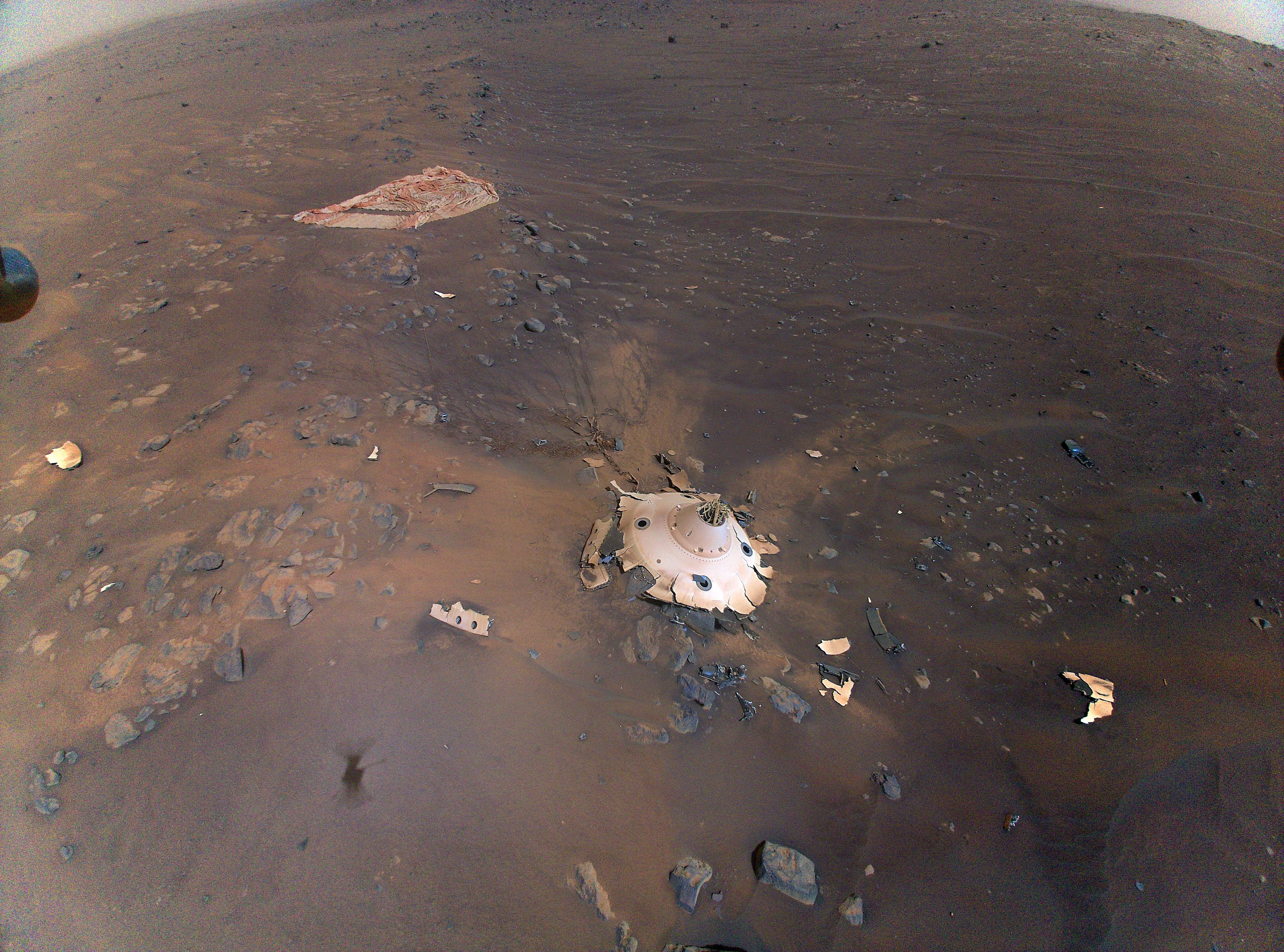
This image of Perseverance’s backshell sitting upright on the surface of Jezero Crater was collected from an altitude of 26 feet (8 meters) by NASA’s Ingenuity Mars Helicopter during its 26th flight at Mars on April 19, 2022.
NASA/JPL-Caltech
Mars rovers can only make exciting new discoveries thanks to human scientists making careful decisions about their next stop. The Mars 2020 mission is aimed at exploring the geology of Jezero Crater and seeking signs of ancient microbial life on Mars using the Perseverance rover. Scientists at NASA’s Jet Propulsion Laboratory (JPL) in Southern California used novel mapping techniques to direct both the rover and the flights of the Ingenuity helicopter, which rode to Mars on Perseverance — and they did it all with open-source tools.
JPL mapping specialists Dr. Fred Calef III and Dr. Nathan Williams used geospatial analysis to help the scientific community and NASA science leadership select Jezero Crater as the landing site for Perseverance and Ingenuity. Before the vehicles arrived on Mars, they helped create maps of the terrain using data from orbiting satellites.
“Maps and images are a common language between different people — scientists, engineers, and management,” Williams said. “They help make sure everyone’s on the same page moving forward, in a united front to achieve the best science that we can.”
Maps and images are a common language between different people.
Dr. Nathan Williams
NASA JPL Geologist and Systems Engineer
After the mission touched down on Mars in February 2021, the Ingenuity helicopter opportunistically scouted ahead to take photos. The team then generated more detailed maps from both rover and helicopter image data to help plan the Perseverance rover’s path and science investigations.
To enable this full-scale mapping of Mars, Calef created the Multi-Mission Geographic Information System (MMGIS), an open-source web-based mapping interface. Online demos of the software, pre-loaded with Mars imagery taken from orbit, allow visitors to explore the paths of Perseverance, Ingenuity, and the Curiosity rover, a sister Mars mission that landed in 2012.
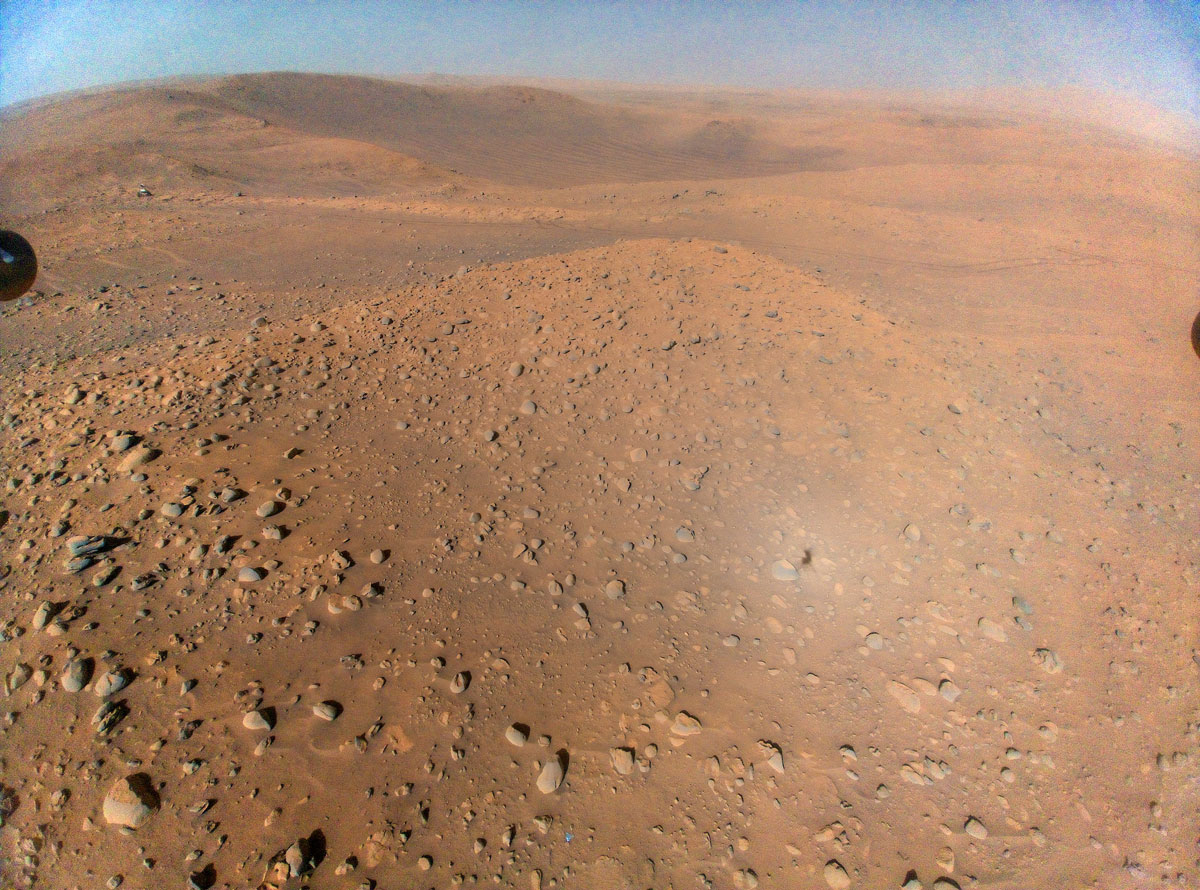
This image of NASA’s Perseverance Mars rover at the rim of Belva Crater was taken by the agency’s Ingenuity Mars Helicopter during the rotorcraft’s 51st flight on April 22, 2023. The rover is in the upper left of the image, parked at a light-toned rocky outcrop.
NASA/JPL-Caltech
The open nature of the software was key to the mission’s success. “We have people literally all over the world who are working on the mission, and we need to be able to give them fast and quick access to software and data,” Calef said.
MMGIS aimed to help people understand the full scope of Martian geography. By combining images from orbit and augmenting with images from Perseverance and Ingenuity, the JPL team allows researchers to zoom in to see individual boulders and zoom out to see all of Mars. This variety of viewpoints gives the team a sense of scale and context to properly understand the landscape around the Perseverance rover, and how to optimally achieve their science goals within the available terrain.
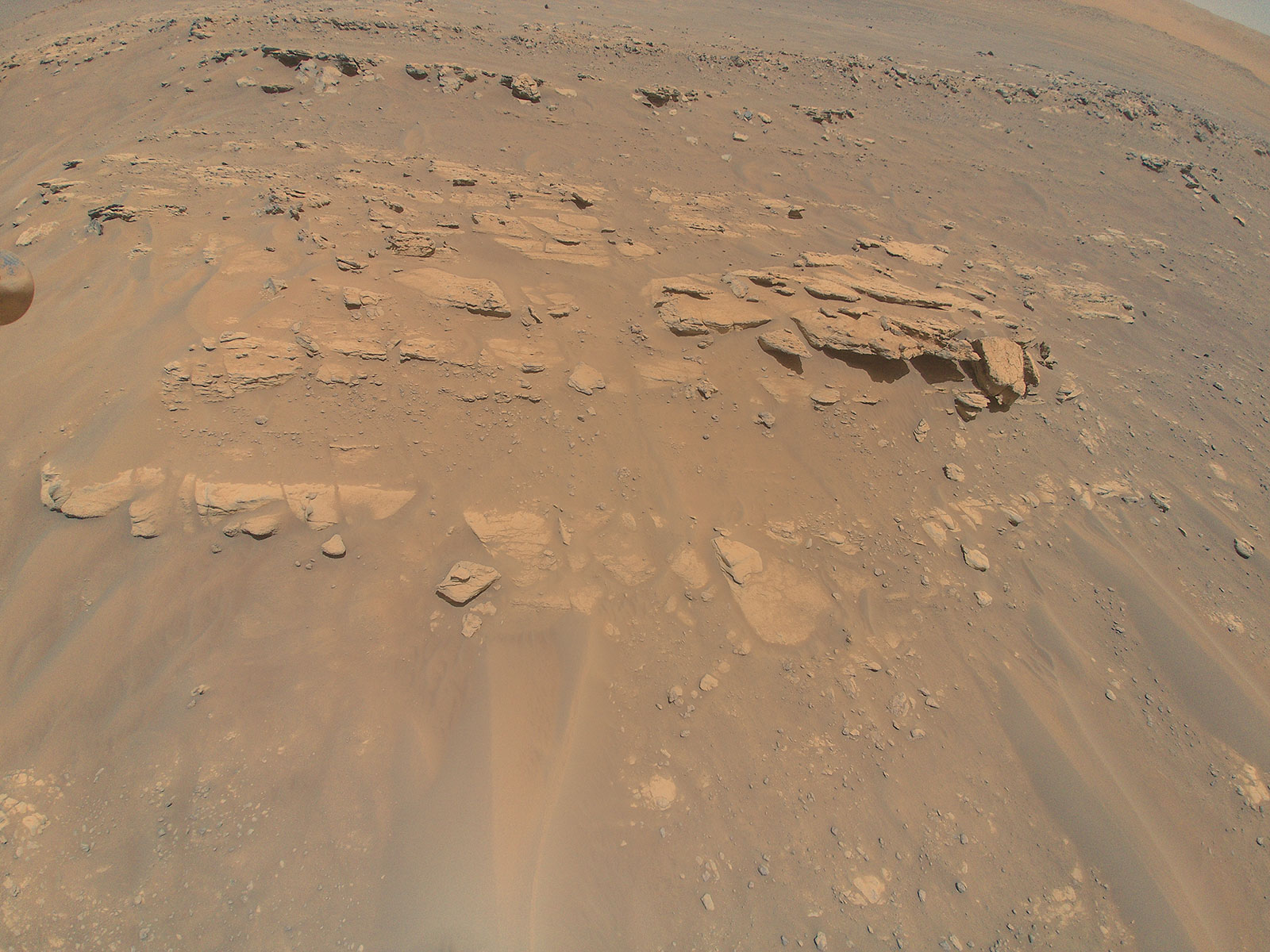
This image of an area the Mars Perseverance rover team calls “Faillefeu” was captured by NASA’s Ingenuity Mars Helicopter during its 13th flight at Mars on Sept. 4, 2021. Images of the geologic feature were taken at the request of the Mars Perseverance rover science team, which was considering visiting the geologic feature during the first science campaign.
NASA/JPL-Caltech
The impact of the tools developed by the JPL team went beyond the Mars 2020 mission. The team wanted their software to help other researchers easily visualize their data without needing to be data visualization experts themselves. Thanks to this open-source approach, other teams have now used MMGIS to map Earth and other planetary bodies.
In keeping with this open philosophy, the images taken by Perseverance and Ingenuity over the course of the Mars 2020 mission are freely available to the public. By sharing these data with the rest of the world, the results from the mission can be used to educate, inspire, and enable further research.
It’s being able to share data between people … getting a higher order of science.
Dr. Fred Calef III
NASA JPL Geologist and Data Scientist
As Mars scientists look to the future, with the Perseverance rover team deploying even more advanced tools powered by AI, open science will pave the way for further exploration. JPL is now working on designs for potential future Mars helicopters that are far more capable and complex than Ingenuity. Payload mass, flight range, and affordability are at the forefront of their minds.
Existing open-source tools will help address those concerns. Not only are open-source applications free to use, but the large amount of collaboration in creating and testing them means that they’re often highly reliable.
Ultimately, the JPL team views its work as part of the cycle of open science, using open tools to make its job easier while also developing new features in the tools for others to use in the future. “Every mission is contributing back to the other missions and future missions in terms of new tools and techniques to develop,” Calef said. “It’s not just you working on something. It’s being able to share data between people … getting a higher order of science.”
By Lauren Leese Web Content Strategist for the Office of the Chief Science Data Officer
NASA Parachute Sensor Testing Could Make EPIC Mars Landings
4 min read
Preparations for Next Moonwalk Simulations Underway (and Underwater)
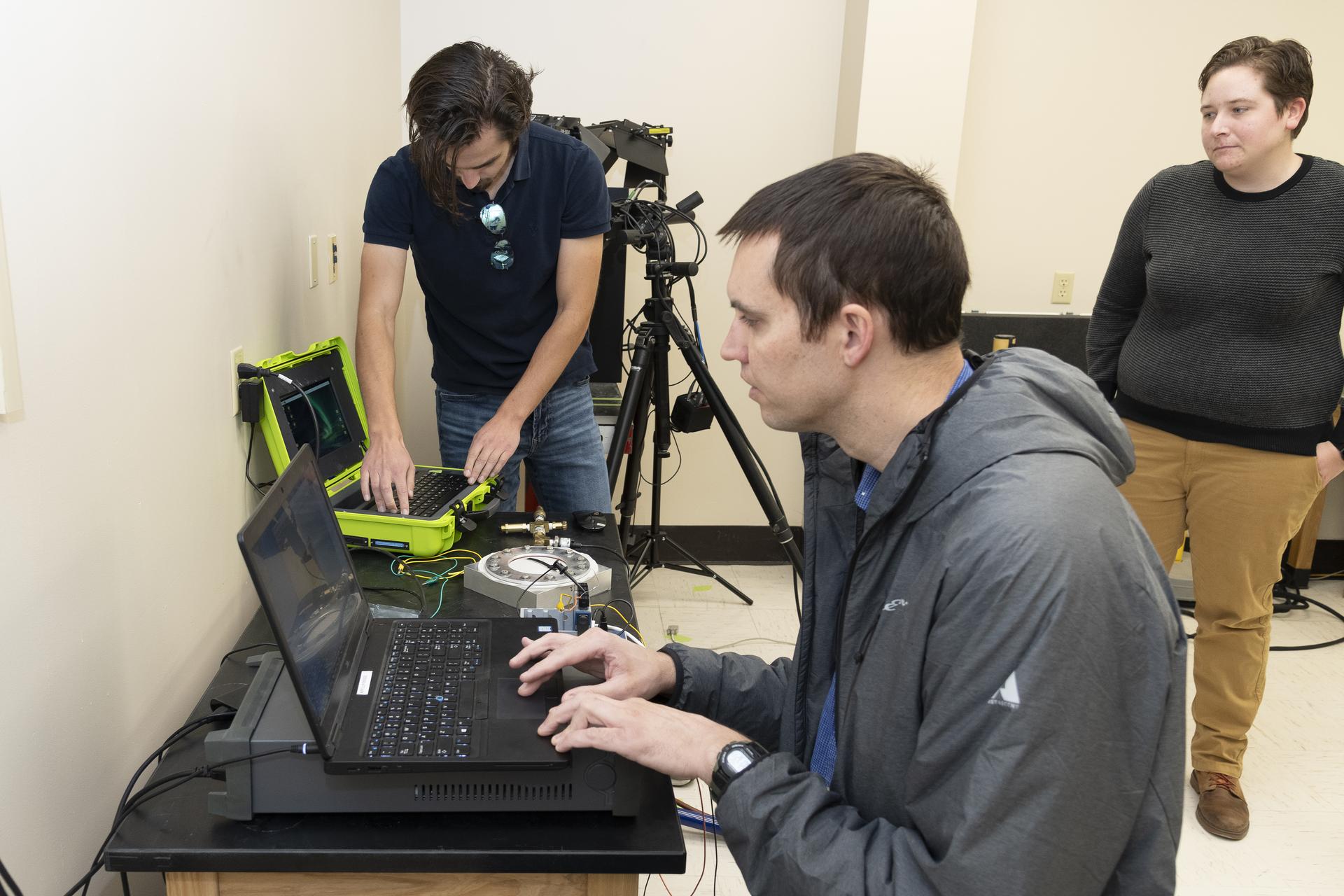
Coby Asselin, from left, Adam Curry, and L. J. Hantsche set up the data acquisition systems used during testing of a senor to determine parachute canopy material strength at NASA’s Armstrong Flight Research Center in Edwards, California. The sensor tests seek to quantify the limits of the material to improve computer models and make more reliable supersonic parachutes.
NASA/Genaro Vavuris
Landing rovers and helicopters on Mars is a challenge. It’s an even bigger challenge when you don’t have enough information about how the parachutes are enduring strain during the descent to the surface. Researchers at NASA’s Armstrong Flight Research Center in Edwards, California, are experimenting with readily available, highly elastic sensors that can be fixed to a parachute during testing to provide the missing data.
Knowing how the canopy material stretches during deployment can enhance safety and performance by quantifying the limits of the fabric and improving existing computer models for more reliable parachutes for tasks such as landing astronauts on Earth or delivering scientific instruments and payloads to Mars. This is the work Enhancing Parachutes by Instrumenting the Canopy, or EPIC, seeks to advance the ability to measure the strain on a parachute.
“We are aiming to prove which sensors will work for determining the strain on parachute canopy material without compromising it,” said L.J. Hantsche, project manager. NASA’s Space Technology Mission Directorate funds the team’s work through the Early Career Initiative project.
Starting with 50 potential sensor candidates, the team narrowed down and tested 10 kinds of different sensors, including commercially available and developmental sensors. The team selected the three most promising sensors for continued testing. Those include a silicone-based sensor that works by measuring a change in storage of electrical charge as the sensor is stretched. It is also easy to attach to data recording systems, Hantsche explained. The second sensor is a small, stretchable braided sensor that measures the change in electrical storage. The third sensor is made by printing with a metallic ink onto a thin and pliable plastic.
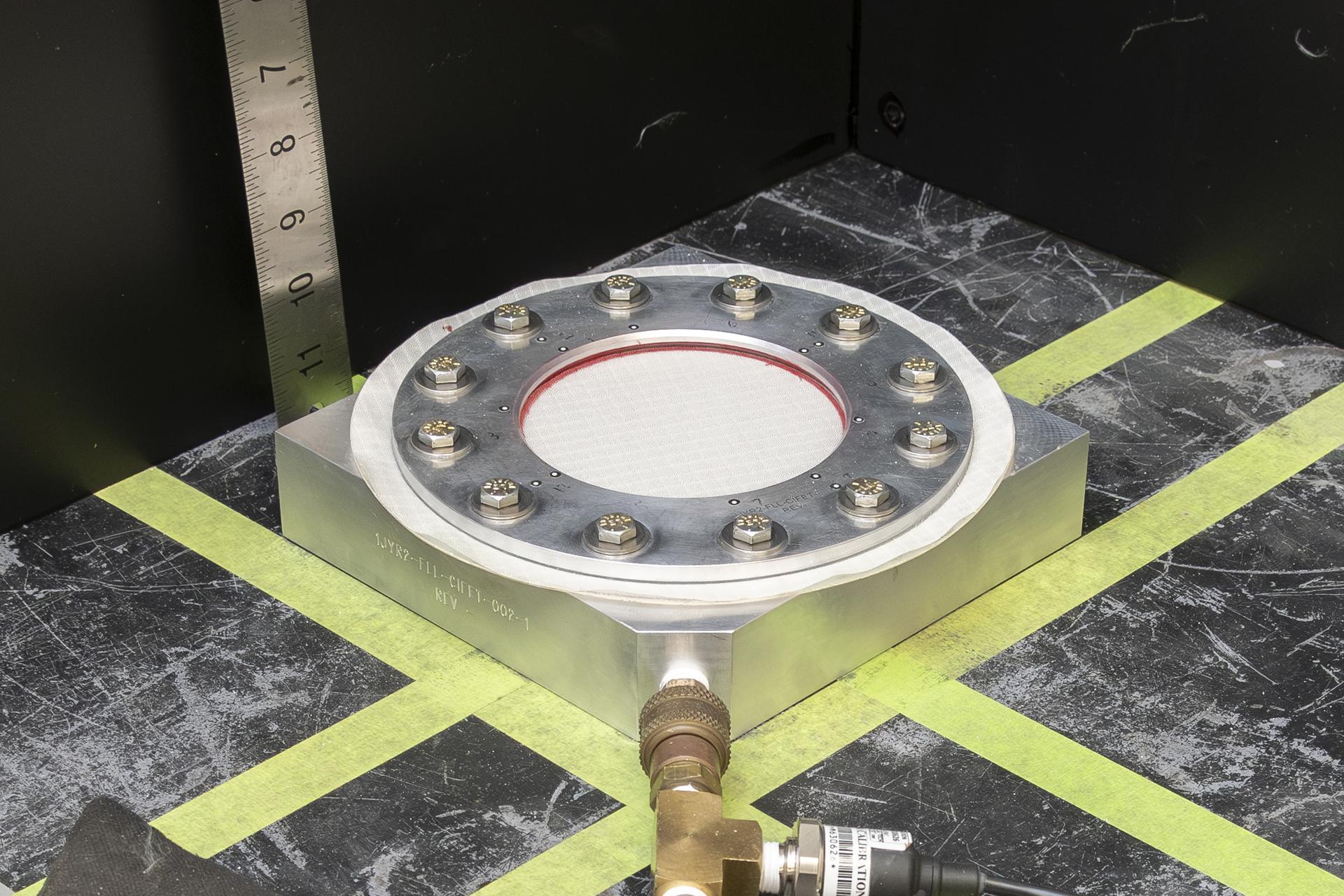
The test team prepares a test fixture with a nylon fabric sample at NASA’s Armstrong Flight Research Center in Edwards, California. The fabric in the test fixture forms a bubble when pressure is applied to the silicone bladder underneath. A similar test can be performed with a sensor on the fabric to verify the sensor will work when stretched in three dimensions.
NASA/Genaro Vavuris
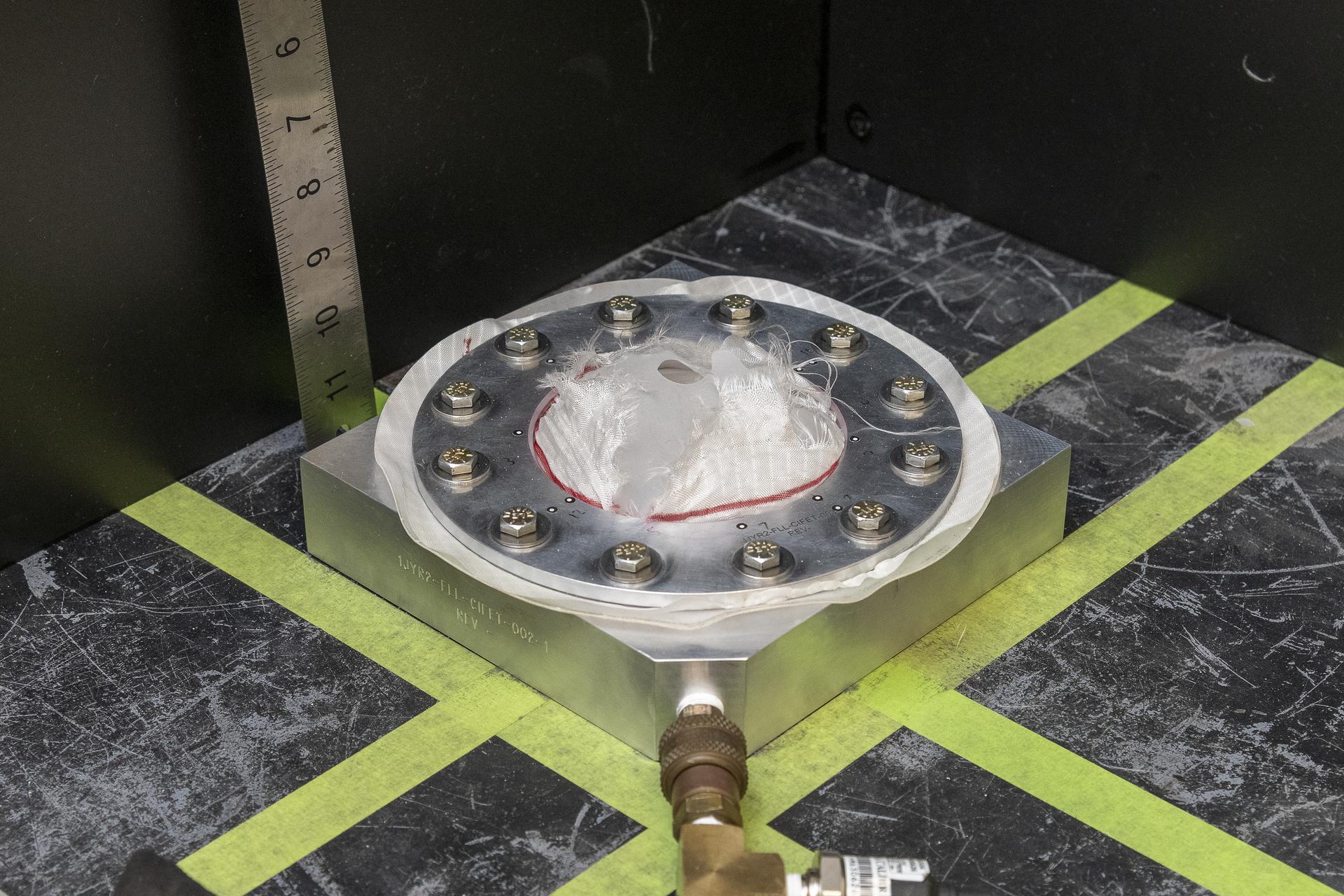
Pressure is applied to a test fixture with a nylon fabric sample until it fails at NASA’s Armstrong Flight Research Center in Edwards, California. The fabric in the test fixture forms a bubble when pressure is applied to the silicone bladder underneath. In this frame, the silicone bladder is visible underneath the torn fabric after it was inflated to failure. A similar test can be performed with a sensor on the fabric to verify the sensor will work when stretched in three dimensions.
NASA/Genaro Vavuris
Determining methods to bond each of the sensors to super thin and slippery canopy material was hard, Hantsche said. Once the team figured out how to attach the sensors to the fabric, they were ready to begin testing.
“We started with uniaxial testing, where each end of the parachute material is secured and then pulled to failure,” she said. “The test is important because the stretching of the sensor causes its electrical response. Determining the correlation of strain and the sensor response when it is on the fabric is one of our main measurement goals.”
This stage of testing was accomplished in partnership with NASA’s Jet Propulsion Laboratory in Pasadena, California. A high-speed version of this test, which simulates the speed of the parachute deployment, was performed at NASA’s Glenn Research Center in Cleveland.
The team used a bubble test for the sensors, which simulates testing of a 3D parachute. It consists of the fabric sample and a silicone membrane sandwiched between a four-inch-diameter ring and the test structure. When it is pressurized from the inside, the silicone membrane expands the fabric and sensor into a bubble shape. The test is used to validate the sensor’s performance as it bends and is compared to the other test results.
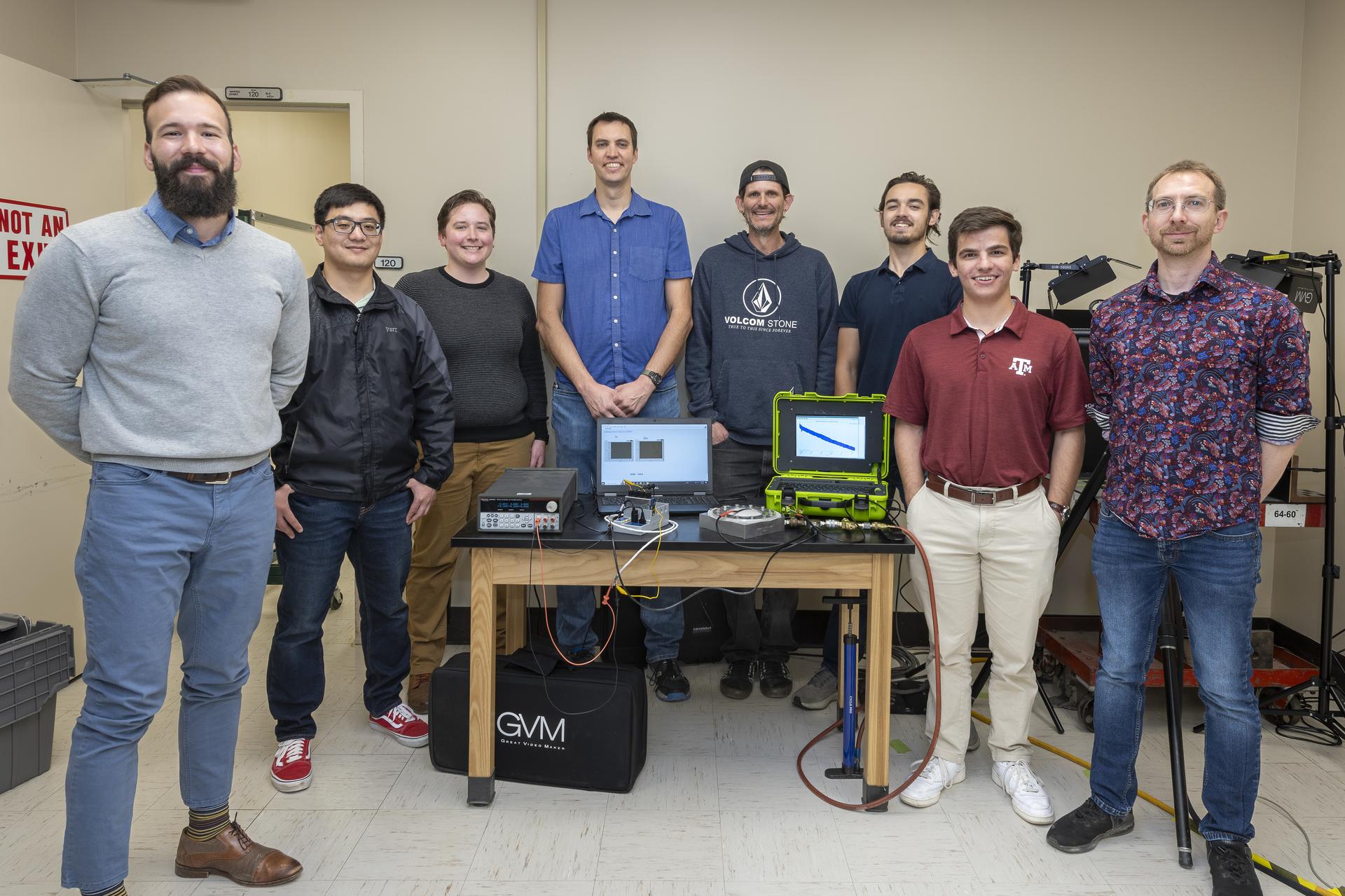
Erick Rossi De La Fuente, from left, John Rudy, L. J. Hantsche, Adam Curry, Jeff Howell, Coby Asselin, Benjamin Mayeux, and Paul Bean pose with a test fixture, material, sensor, and data acquisition systems at NASA’s Armstrong Flight Research Center in Edwards, California. The sensor tests seek to quantify the limits of the material to improve computer models and make more reliable supersonic parachutes.
NASA/Genaro Vavuris
With the EPIC project nearing completion, follow-on work could include temperature tests, developing the data acquisition system for flight, determining if the sensor can be packed with a parachute without adverse effects, and operating the system in flight. The EPIC team is also working with researchers at NASA’s Langley Research Center in Hampton, Virginia, to flight test their sensors later this year using the center’s drone test, which drops a capsule with a parachute.
In addition, the EPIC team is partnering with the Entry Systems Modeling Group at NASA’s Ames Research Center in California’s Silicon Valley to propose an all-encompassing parachute project aimed at better understanding parachutes through modeling and test flights. The collaborative NASA project may result in better parachutes that are safer and more dependable for the approaching era of exploration.
Alphabet Soup: NASA’s GOLD Finds Surprising C, X Shapes in Atmosphere
5 min read
Alphabet Soup: NASA’s GOLD Finds Surprising C, X Shapes in Atmosphere
Who knew Earth’s upper atmosphere was like alphabet soup?
NASA’s Global-scale Observations of the Limb and Disk (GOLD) mission has revealed unexpected C- and X-shaped formations in an electrified layer of gas high above our heads called the ionosphere.
While these alphabetical shapes have been observed before, GOLD sees them more clearly than other instruments have and is now finding them where and when scientists didn’t expect. Their surprise appearances prove that we have more to learn about the ionosphere and its effects on communication and navigation signals that pass through it.
Earth’s Dynamic Interface to Space
Extending some 50 to 400 miles overhead, the ionosphere becomes electrically charged during the daytime when sunlight strikes our planet and its energy knocks electrons off atoms and molecules. This creates a soup of charged particles, known as plasma, that allows radio signals to travel over long distances.
Near Earth’s magnetic equator, charged particles are funneled upward and outward along magnetic field lines, creating two dense bands of particles north and south of the equator that scientists call crests. As night falls and the Sun’s energy fades, low-density pockets in the plasma, called bubbles, can form in the ionosphere. Because of their varying density, the crests and bubbles can interfere with radio and GPS signals.
Under the combined influence of gravity and Earth’s electric and magnetic fields, charged particles in the ionosphere flow upward and outward away from Earth’s magnetic equator, forming two dense bands, or crests, to the north and south of the equator. Learn more here.
NASA’s Scientific Visualization Studio
While previous observations provided brief glimpses of crests and bubbles in the ionosphere, GOLD monitors these features over extended periods of time. That’s thanks to its geostationary orbit, which circles our planet at the same rate Earth rotates, allowing GOLD to hover over the Western Hemisphere.
Unexpected X-Shaped Crests from Quiet Conditions
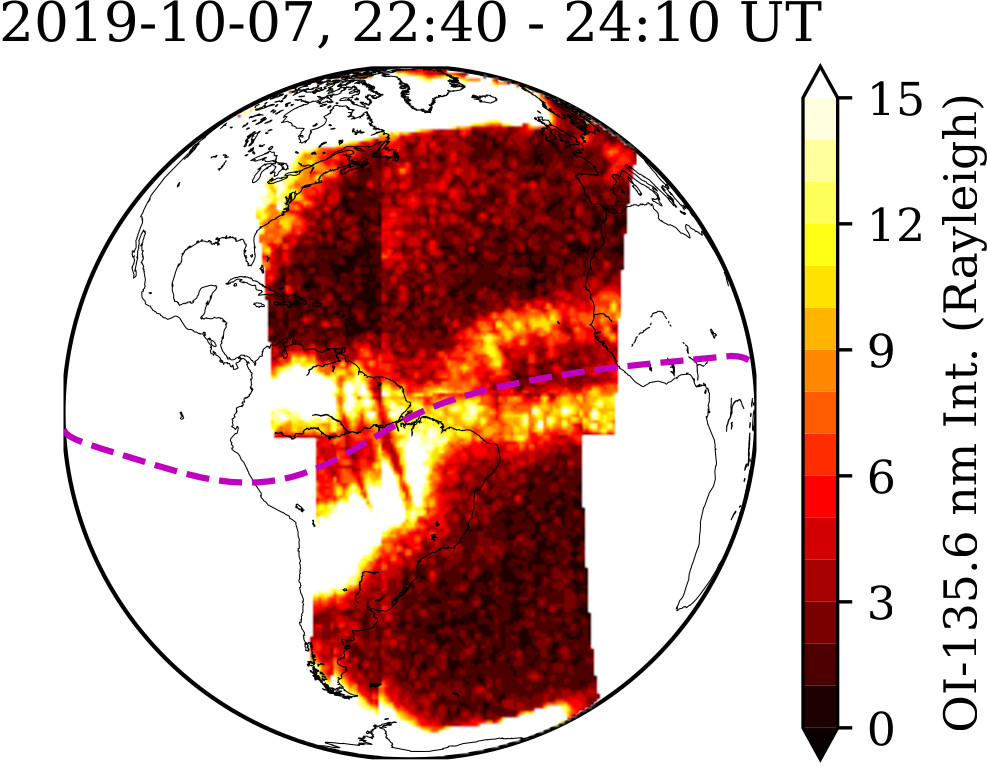
The ionosphere is sensitive to disturbances from both space and terrestrial weather. GOLD has previously revealed that after a solar storm or huge volcanic eruption, the crests in the ionosphere can merge to form an X shape. But now, GOLD has seen an X shape form on multiple occasions when there were no such disturbances — what scientists refer to as “quiet time.”
“Earlier reports of merging were only during geomagnetically disturbed conditions — it is an unexpected feature during geomagnetic quiet conditions,” said Fazlul Laskar, of the University of Colorado’s Laboratory for Atmospheric and Space Physics (LASP), who is the lead author of a paper about this discovery published in April 2024 by the Journal of Geophysical Research: Space Physics.
Observations from NASA’s GOLD mission shows charged particles in the ionosphere forming an X shape on Oct. 7, 2019. (The colors indicate the intensity of the ultraviolet light emitted, with yellow and white indicating the strongest emission, or highest ionospheric density.)
F. Laskar et al.
These unexpected appearances tell scientists that something else must be involved in forming these X shapes. Computer models suggest that the X could develop when changes in the lower atmosphere pull plasma downward.
“The X is odd because it implies that there are far more localized driving factors,” said Jeffrey Klenzing, a scientist at NASA’s Goddard Space Flight Center in Greenbelt, Maryland, who studies the ionosphere. “This is expected during the extreme events, but seeing it during ‘quiet time’ suggests that the lower atmosphere activity is significantly driving the ionospheric structure.”
This visualization shows a bright, horizontal X-shaped feature appearing in the ionosphere on Oct. 7, 2019, as observed by NASA’s GOLD mission. Each of GOLD’s observations cover about 45 degrees in longitude and proceed from east to west, alternating between the Northern and Southern hemispheres. Rayleigh is a unit for measuring the amount of light (in this case, ultraviolet light).
NASA’s Scientific Visualization Studio
C-Shaped Bubbles Point to Strong Turbulence
GOLD has also found surprising C-shaped plasma bubbles that point to other puzzling dynamics influencing the ionosphere.
Most plasma bubbles appear long and straight, forming along magnetic field lines. But some bubbles are curved into C shapes and reverse-C shapes, which scientists think are shaped by terrestrial winds. Computer models suggest a C-shape forms if winds increase with altitude at the magnetic equator and a reverse-C forms if the winds decrease with altitude.
“It’s a little like a tree growing in a windy area,” explains Klenzing. “If the winds are typically to the east, the tree starts to tilt and grow in that direction.”
In a paper published in November 2023 in the Journal of Geophysical Research: Space Physics, LASP scientist Deepak Karan and colleagues report that GOLD has observed C-shaped and reverse-C-shaped plasma bubbles appearing surprisingly close together — as close as about 400 miles apart (roughly the distance between Baltimore and Boston).
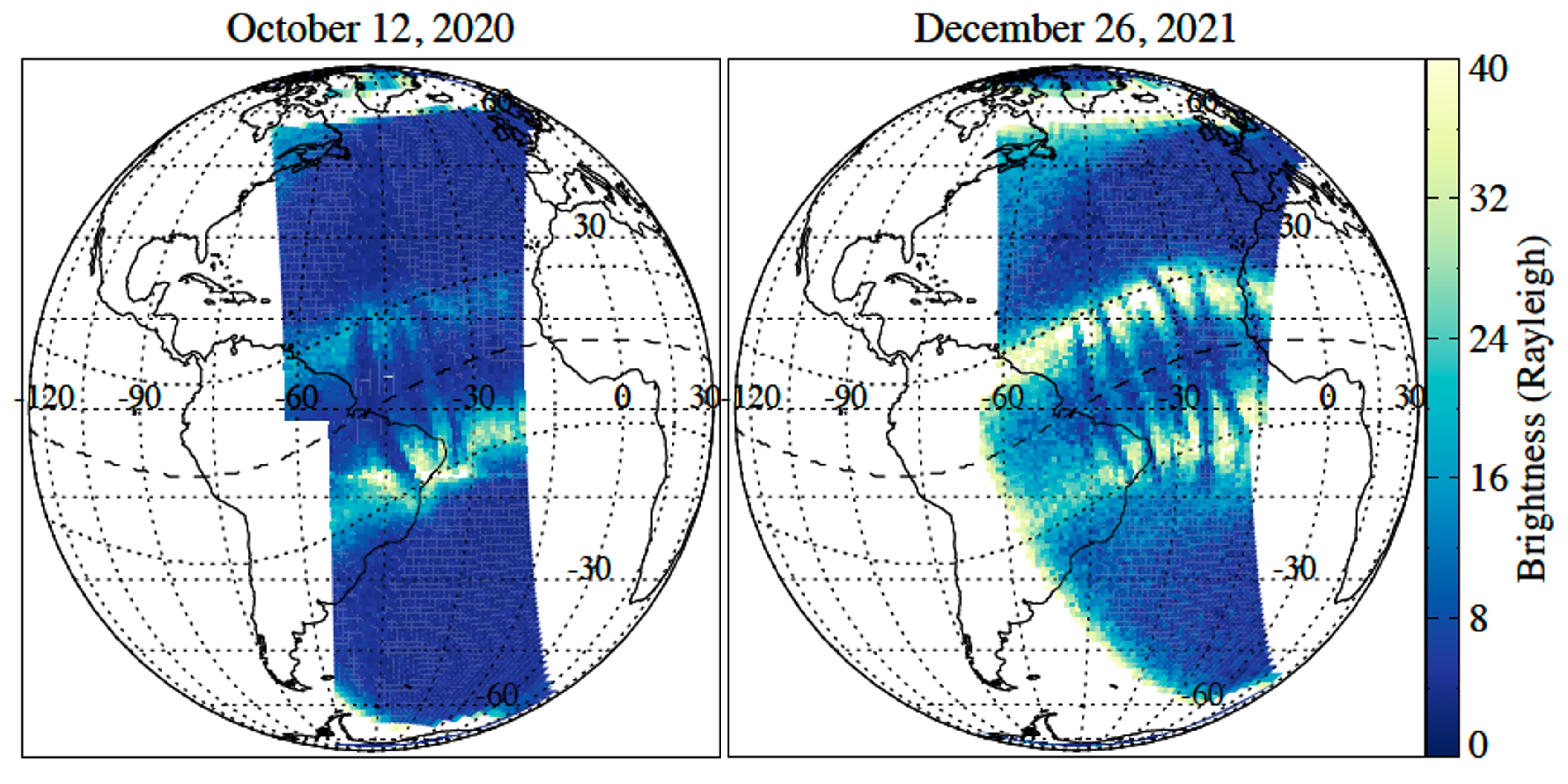
Images from NASA’s GOLD mission show C-shaped and reverse-C-shaped plasma bubbles appearing close together in the ionosphere on Oct. 12, 2020, and Dec. 26, 2021.
D. Karan et al.
“Within that close proximity, these two opposite-shaped plasma bubbles had never been thought of, never been imaged,” said Karan. To have wind patterns change course in such a small area, Karan thinks some sort of strong turbulence — like a vortex, wind shear, or tornado-like activity — is likely at play in the atmosphere.
“The fact that we have very different shapes of bubbles this close together tells us that the dynamics of the atmosphere is more complex than we expected,” Klenzing said.
These close pairings appear to be rare, with only two instances recorded by GOLD so far. Yet because these features can disrupt critical communication and navigation technology, “It’s really important to find out why this is happening,” Karan said. “If a vortex or a very strong shear in the plasma has happened, this will completely distort the plasma over that region. Signals will be lost completely with a strong disturbance like this.”
This visualization shows C-shaped and reverse-C-shaped plasma bubbles appearing close together in the ionosphere on Oct. 12, 2020, and Dec. 26, 2021, as observed by NASA’s GOLD mission. The bubbles appear as dark blue vertical features extending between two bright (dense) crests.
NASA’s Scientific Visualization Studio
Scientists hope GOLD’s continued observations, combined with those from other heliophysics missions, can help unlock these mysteries of the ionosphere and their effects on our lives.
By Vanessa Thomas NASA’s Goddard Space Flight Center, Greenbelt, Md.
Blasting into Summer: Thousands Enjoy NASA in the Park
By Wayne Smith
It was a super Saturday in the park to celebrate space and the Rocket City.
NASA’s Marshall Space Flight Center joined Downtown Huntsville Inc. and other community partners to host NASA in the Park, a public outreach event that attracted thousands to Big Spring Park East in Huntsville on June 22.
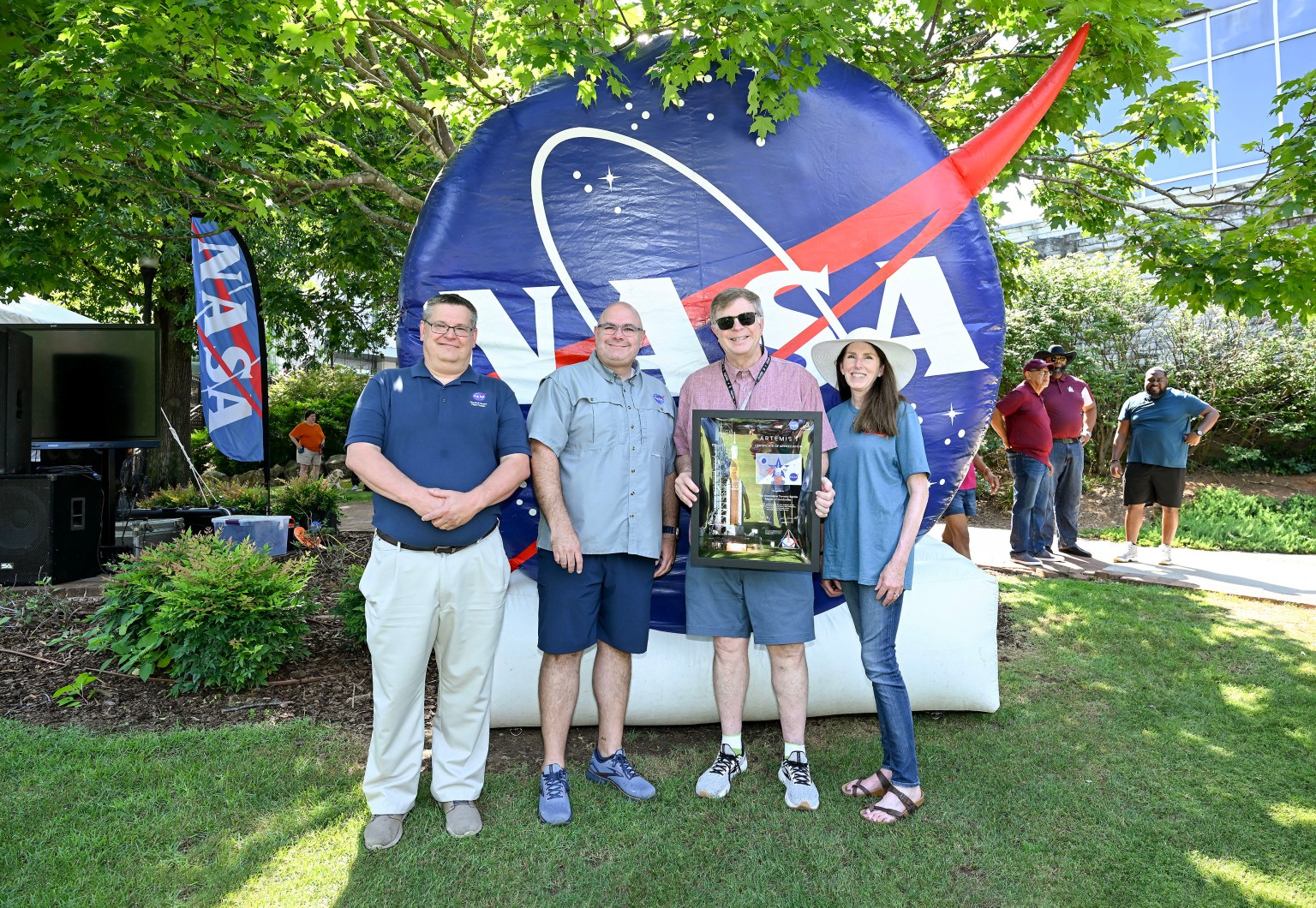
NASA Marshall Space Flight Center Director Joseph Pelfrey, second from left, presented Huntsville Mayor Tommy Battle, third from left, with an Artemis I Certificate of Appreciation during NASA in the Park on June 22 at Huntsville’s Big Spring Park East. They are joined by Larry Leopard, Marshall associate director, technical, far left, and Rae Ann Meyer, Marshall deputy director.
NASA/Charles Beason
And the reach of the event may go far beyond North Alabama in the years ahead, according to Huntsville Mayor Tommy Battle.
“Marshall Space Flight Center is the soul of space exploration,” said Battle, who was presented with an Artemis I Certificate of Appreciation by Marshall Director Joseph Pelfrey at the event. “Huntsville is proud of NASA’s leadership in space, and it was exciting for locals to see all of Marshall’s cool projects on display at NASA in the Park. Seeing thousands of people, particularly young people, engaged at the event shows the enthusiasm for space and science. This event may have inspired a future astronaut or scientist who will take man back to the Moon, and one day to Mars.”
Visitors to NASA in the Park get some relief from the heat underneath shade trees surrounding the canal that runs through Big Spring Park.
NASA/Charles Beason
Attendees of all ages packed the park to enjoy NASA exhibits and science demonstrations, giveaways, food vendors, and live music at the event, which was from 10–2 p.m. About 14,000 people attended, according to official estimates. The greenspace in the heart of Huntsville offered a welcome respite from temperatures that reached the upper 90s on the first Saturday of summer.
An RS-25 engine display attracts visitors during NASA in the Park. The display was one of several exhibits at Big Spring Park East highlighting NASA missions.
NASA/Charles Beason
“Thank you to all our Marshall team members who helped make this year’s NASA in the Park a huge success,” said Marshall Director Joseph Pelfrey. “It was truly incredible to see the overwhelming support and participation we received from our partners in government, industry, academia, and the community.”
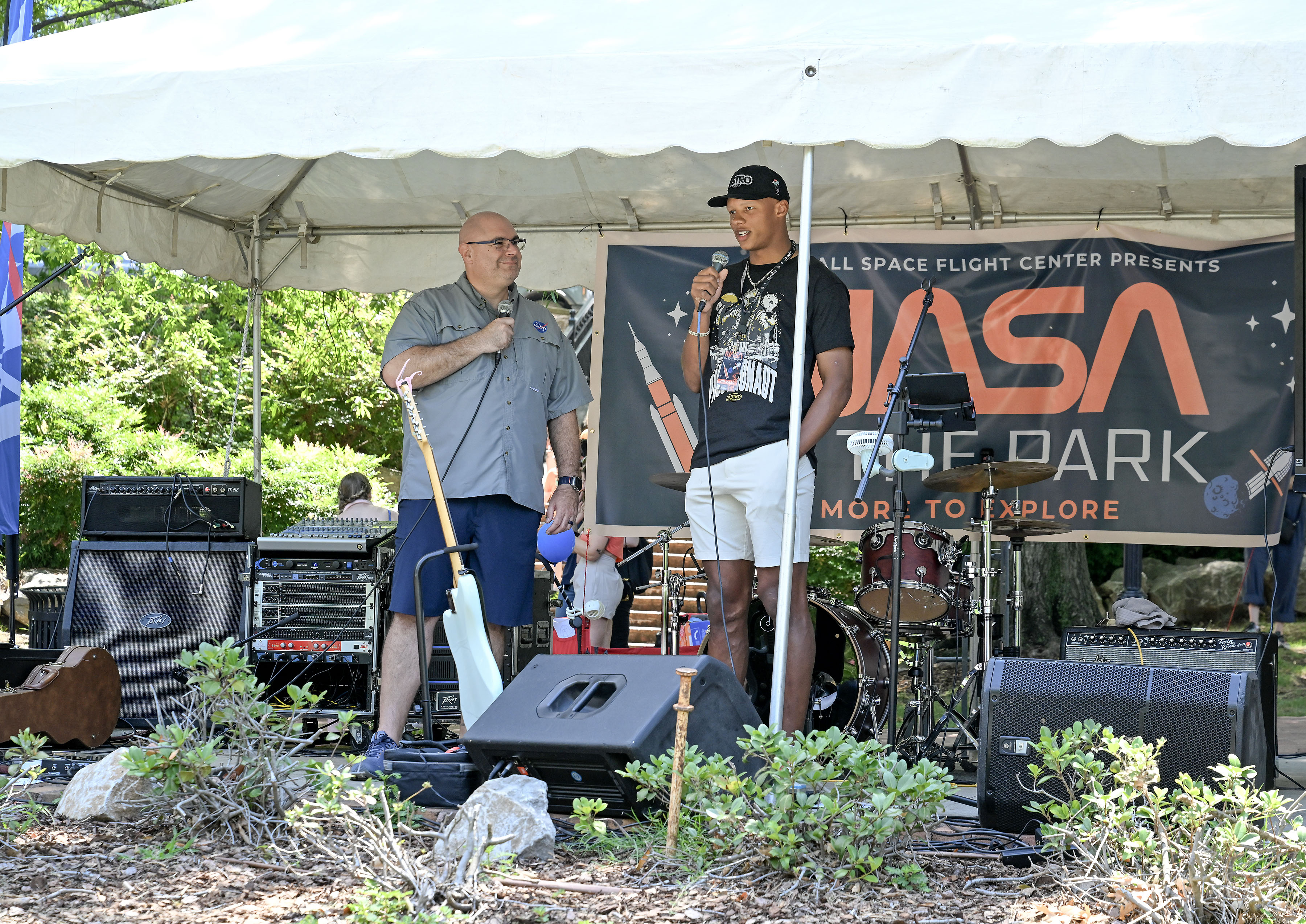
Marshall Director Joseph Pelfrey, left, interviews NFL quarterback Joshua Dobbs at NASA in the Park. In addition to his football career, Dobbs has an aerospace engineering degree and is engaged in STEM outreach through his foundation, ASTROrdinary.
NASA/Charles Beason
The exhibits at the park included NASA’s SLS (Space Launch System) Program, which is managed by Marshall, the RS-25 engine that will power the rocket, and the Human Landing System, which is also managed by Marshall.
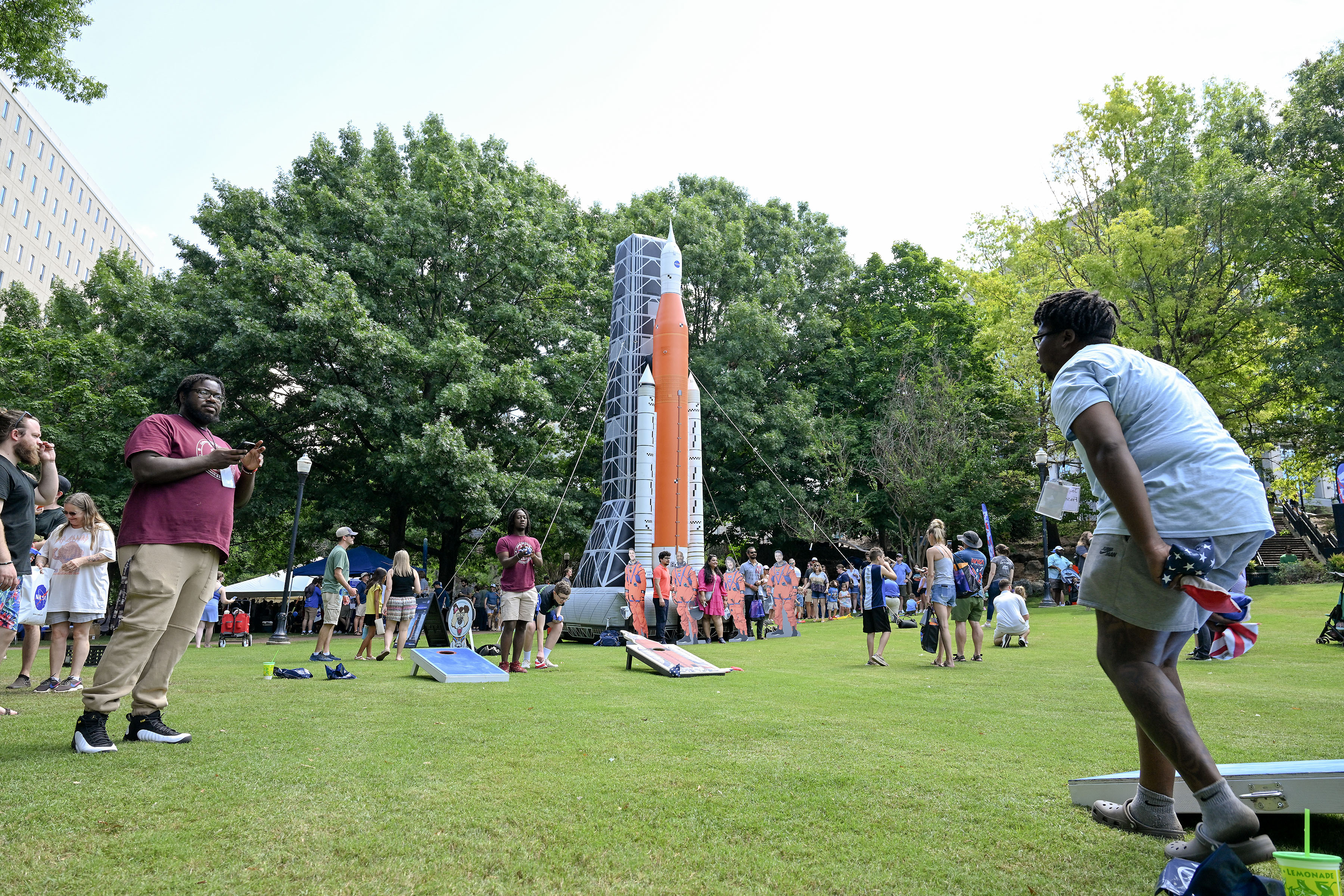
Visitors to NASA in the Park participate in a game of cornhole in front of a display featuring Artemis and NASA’s SLS (Space Launch System).
NASA/Charles Beason
Smith, a Media Fusion employee and the Marshall Star editor, supports the Marshall Office of Communications.
SLS Spotlight: Getting Ready for the First Crewed SLS Flights for Artemis
The featured business unit for June at NASA’s Marshall Space Flight Center is SLS. Building off the legacies of the Mercury-Redstone rocket, mighty Saturn V, and the space shuttle, teams at Marshall are preparing for the first crewed missions under the agency’s Artemis campaign with NASA’s SLS (Space Launch System) rocket. Marshall manages the SLS Program.
Marshall teams are finishing outfitting and integration work on the major adapters for the SLS Block 1 configuration that will launch Artemis II and Artemis III. Beginning with Artemis IV, SLS will evolve into a larger, more powerful configuration called Block 1B. Already, development, test, manufacturing, and operation teams across Marshall – and across the country – are readying for its debut flight.
Below, meet some of the Marshall teammates who are working on the mega rocket.
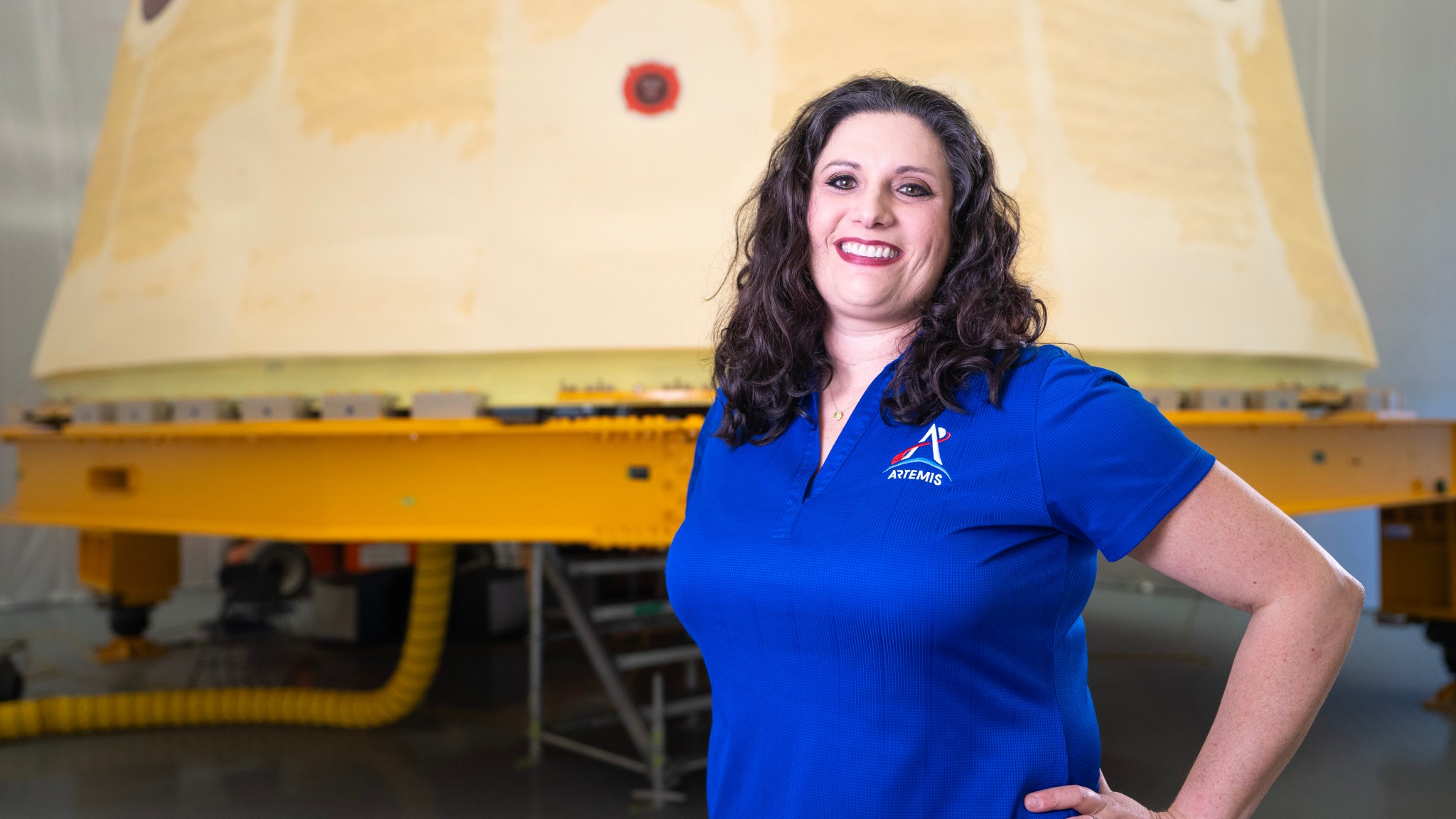
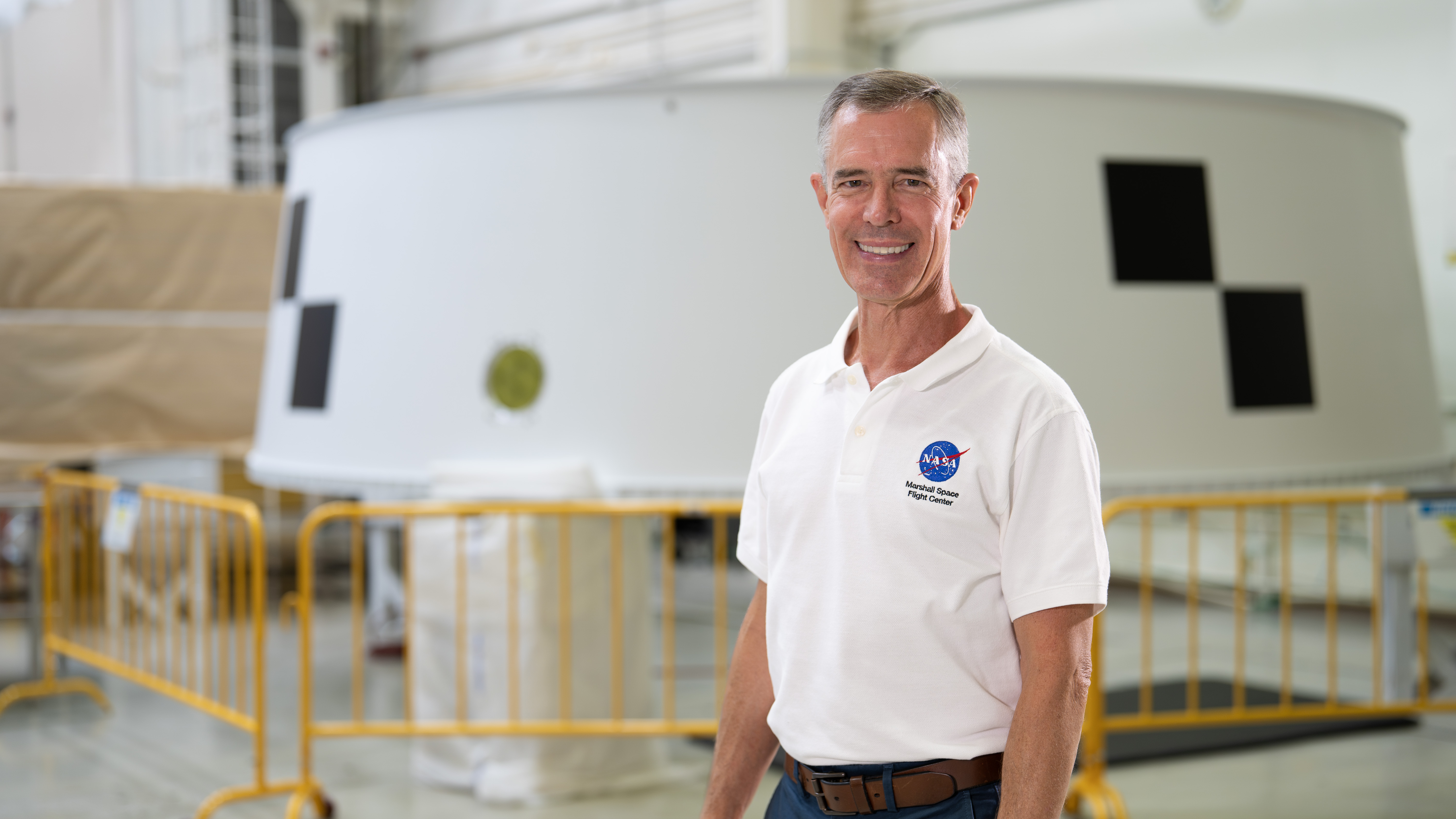
Structural materials engineer Lauren Fisher stands in front of the launch vehicle stage adapter for the SLS rocket. The hardware will be used for the agency’s Artemis III mission that will land astronauts on the lunar surface. Being part of the Artemis Generation is incredibly inspiring for Fisher, who takes pride in her work supporting the first three Artemis missions, including Artemis II, the first crewed mission under Artemis, in 2025. “I’m literally building the hardware that will send the first woman to deep space,” Fisher said. “Watching our rocket take shape, I’m like ‘you see that thing? I did that; that’s mine. See that one? My team did that one. We did that, and see this?’” She beams with pride. “You can do that, too. Just being a part of the generation that’s changing the workforce and changing the space program – it gives me goosebumps.” (NASA/Sam Lott)
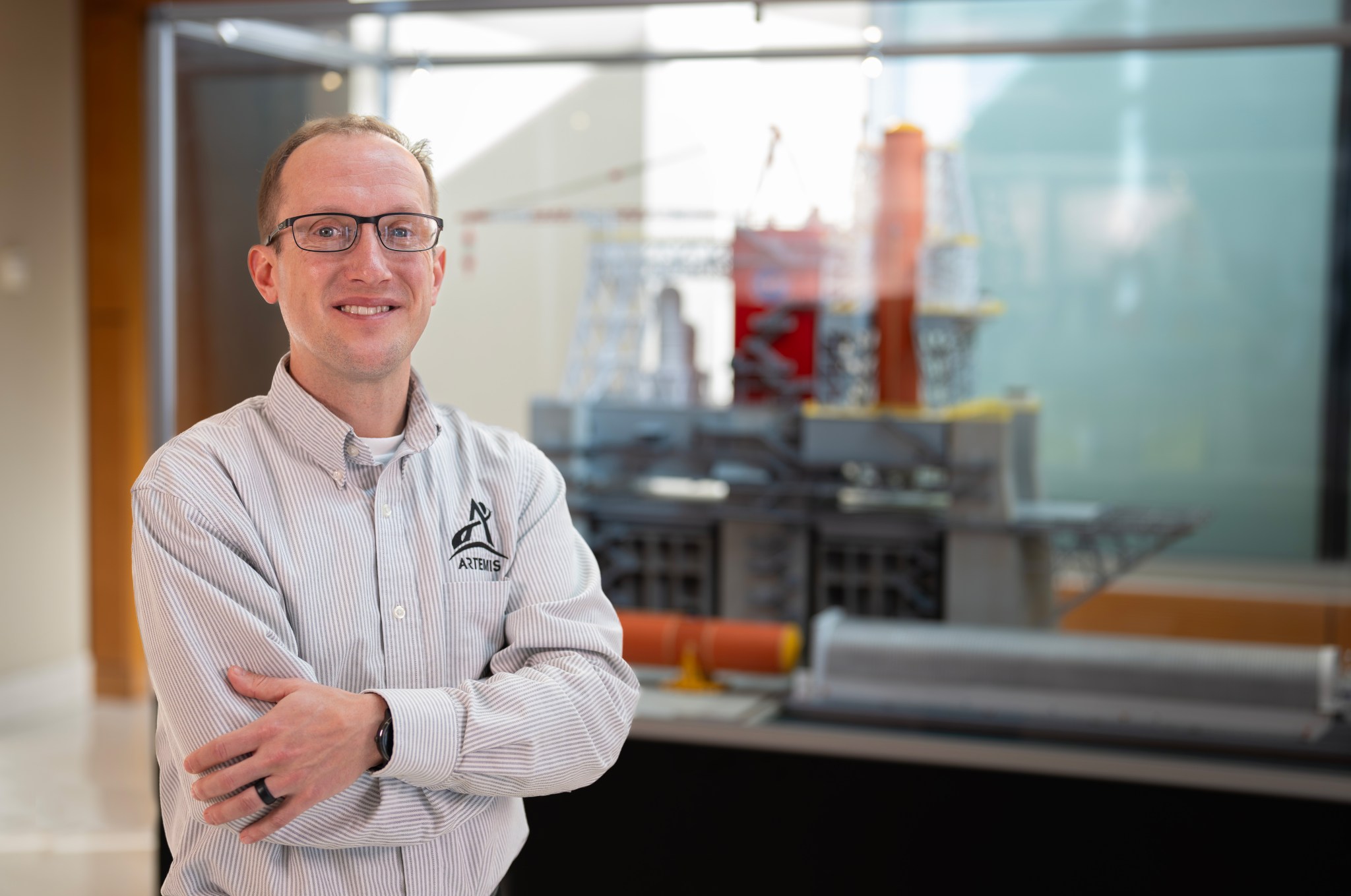
Bruce Askins desire to explore other worlds always made him want to be an astronaut. Though he did not become an astronaut, Askins has built a 42-year career at NASA, and, as the infrastructure management lead for NASA’s SLS Program at Marshall, Askins is an integral part for the next generation of explorers. Askins and his team are the gatekeepers and protectors of data and responsible for both cybersecurity and physical security for the SLS Program. Under Askins’ leadership, his team ensures all data is stored properly, that information about the rocket shared outside NASA is done with proper data markings, and access is given to those that need it. (NASA/Sam Lott)
Casey Wolfe.
Casey Wolfe, a Huntsville native, joined Marshall first as a Pathways intern in 2012. Now the assistant branch chief of the advanced manufacturing branch within the Materials and Processing Laboratory at Marshall, Wolfe and her branch support Artemis through composites and additive manufacturing work for the key elements of both the Block 1 and Block 1B SLS configurations. Wolfe led the manufacturing efforts on the composite payload adapter that will be housed inside the universal stage adapter as part of the Block 1B configuration, beginning with Artemis IV. The engineering development unit is currently undergoing structural testing in the West Test Area. “It’s an incredible feeling knowing that you are part of an effort that helps to inspire so many people,” Wolfe said. “My work has helped move the Artemis campaign forward in many different, directly helping to build and lay the foundation for the materials, processes, and manufacturing efforts that are assisting the advancement of humankind in space exploration.” (NASA/Sam Lott)
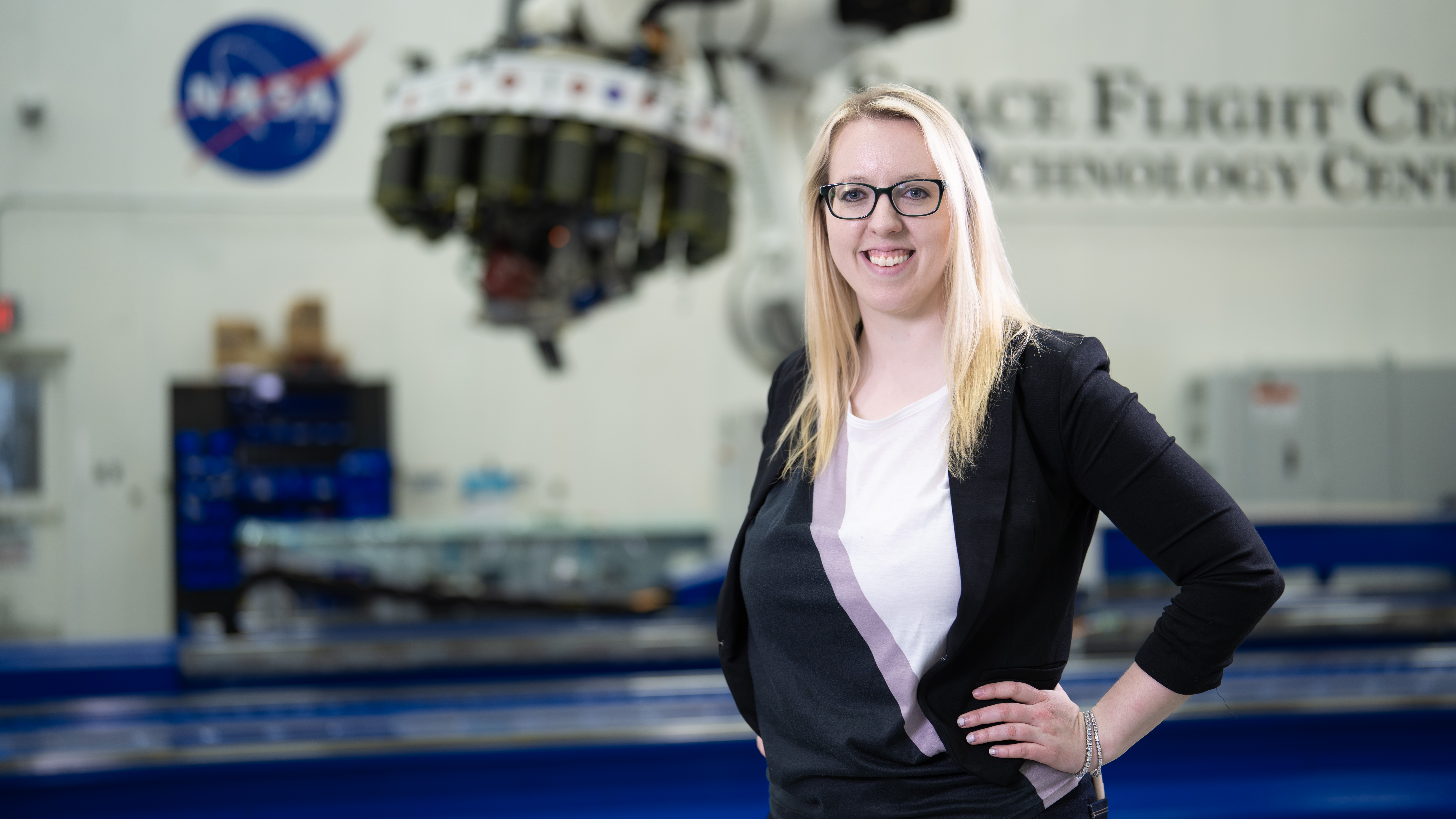
Launching a rocket to the Moon takes perseverance and diligence. Josh Whitehead – a world-class engineer, race-winning long-distance runner, and father – knows that it also takes a good attitude. “Positive energies are vital, particularly when working through challenges,” Whitehead said. “Challenges are opportunities to learn and grow. There’s always more than one way; always more than one solution.” Whitehead’s job as the associate manager for the SLS Stages Office supports design, development, certification, and operation of the 212-foot-tall SLS core stage. The massive core stage with two propellant tanks that collectively hold more than 733,000 gallons of super-cold propellant is one of the largest cryogenic propulsion rocket stages. Whitehead and his team are currently preparing to deliver the core stage that will power Artemis II and send a crew of four around the Moon to NASA’s Kennedy Space Center. (NASA/Sam Lott)
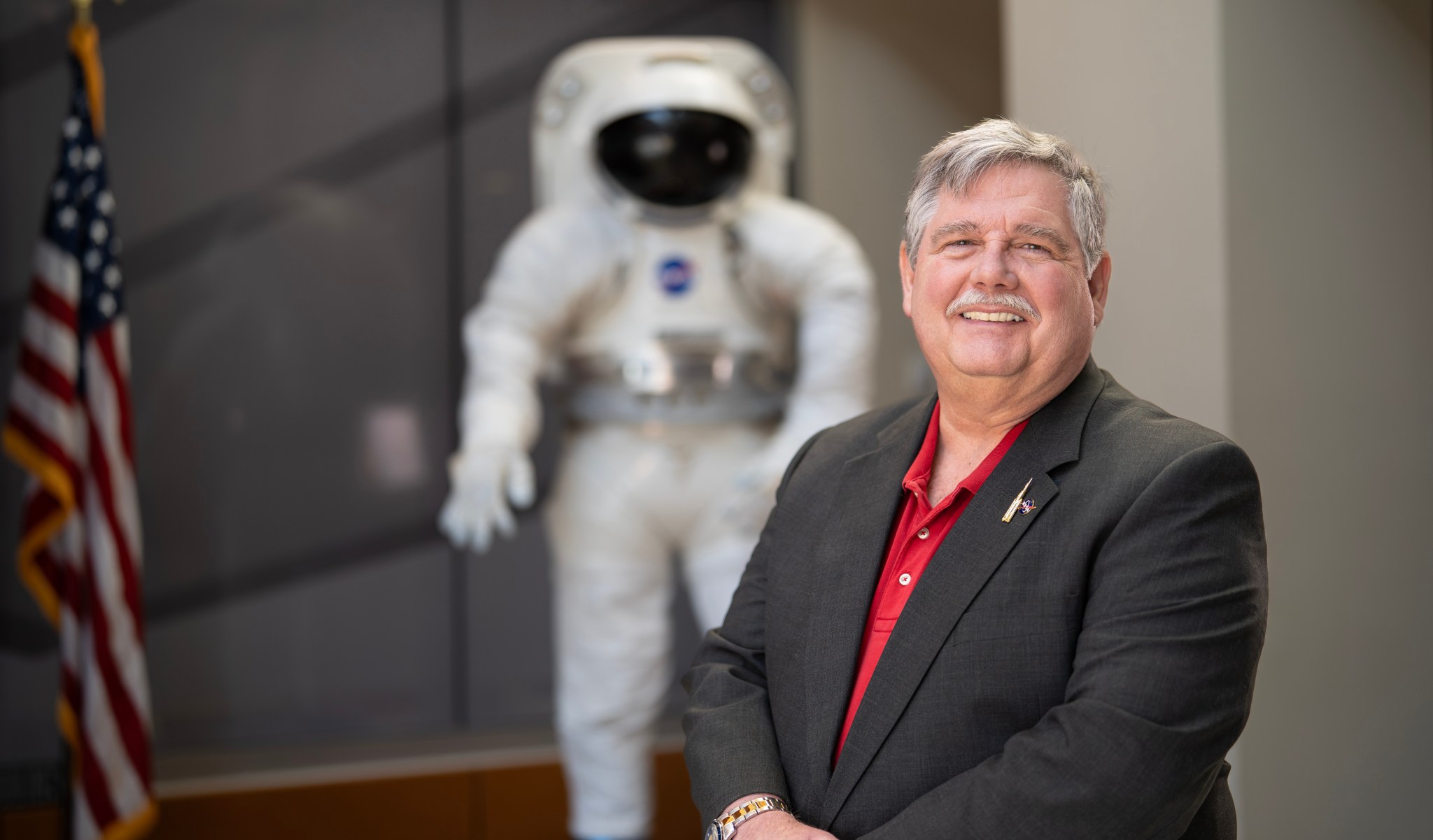
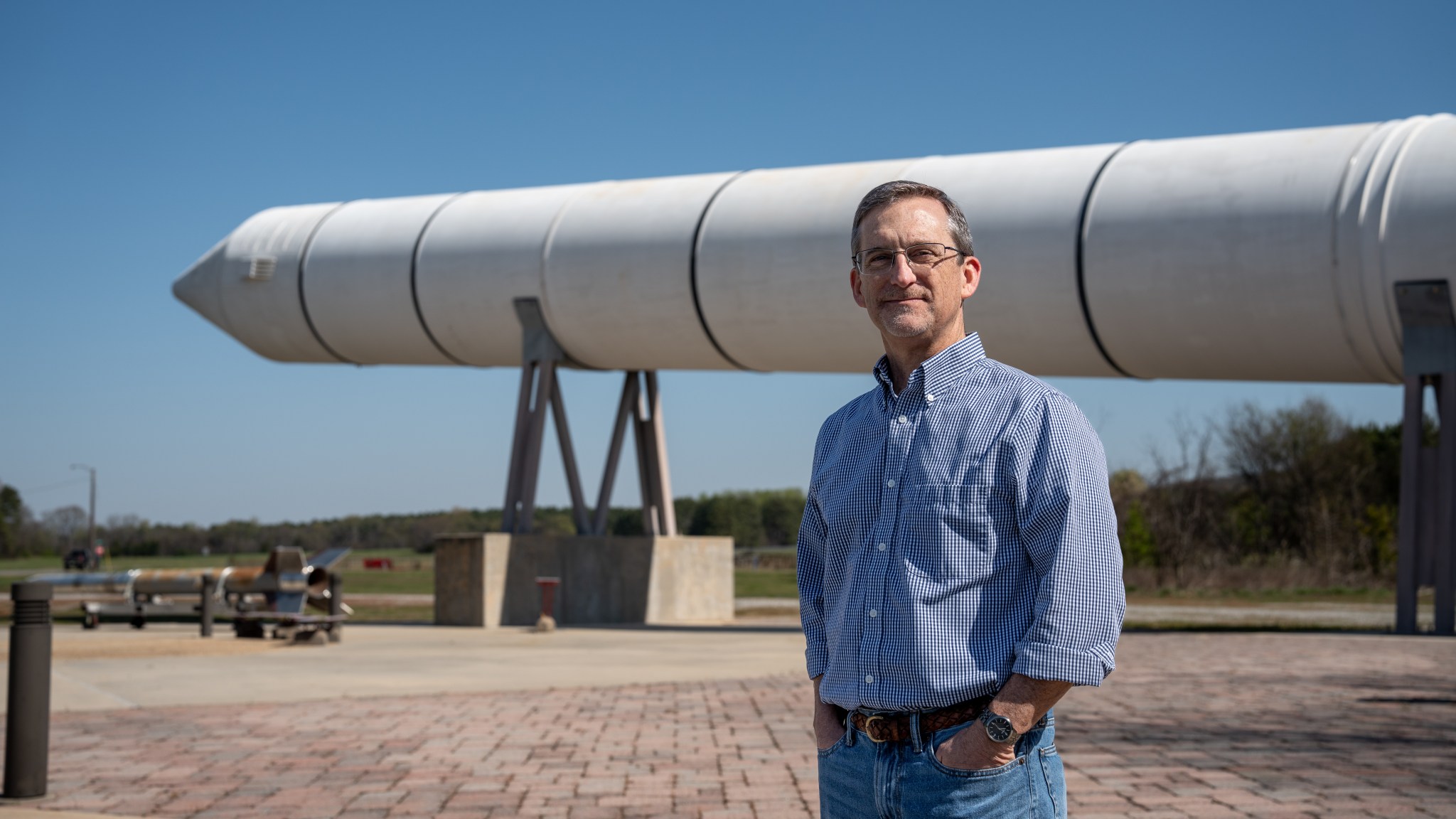
Mat Bevill, the associate chief engineer for NASA’s SLS Program, stands in front of a four-segment solid rocket booster that powered the space shuttle at Marshall. As the associate chief engineer for the SLS Program, Bevill assists the program chief engineer by interfacing with each of the element chief engineers and helping make critical decisions for the development and flight of the SLS mega rocket that will power NASA’s Artemis campaign. With the launch of Artemis II, the first crewed test flight of SLS and the Orion spacecraft, Bevill’s technical leadership and support for the SLS Chief Engineer’s Office will place him, once again, at a notable moment in time. “Think of me as the assistant coach,” Bevill said. “While the head coach is on the front line leading the team, I’m on the sidelines providing feedback and advising those efforts.” As a jack-of-all-trades, he enables progress in any way that he can, something he’s familiar with after 37 years with NASA. (NASA/Brandon Hancock)
Brent Gaddes got his start at Marshall supporting the Space Shuttle Program as it made history in low Earth orbit. Now, his work is taking human deep space exploration to the Moon and beyond with NASA’s SLS rocket. As the lead for the Orion stage adapter and payload adapter in the SLS Spacecraft/Payload Integration & Evolution Office, Gaddes is responsible for managing the teams that design, test, and build the Orion stage adapter for the first three Artemis flights, as well as the payload adapter for the future SLS Block 1B configuration. It means having his eye on a lot of moving parts: the Artemis II Orion stage adapter is awaiting shipment to NASA Kennedy later this year, while the major structure for the Artemis III Orion stage adapter is complete with installations of its avionics unit and diaphragm to come as Marshall test teams continue testing and analysis on an engineering development unit of the Artemis IV payload adapter. Gaddes was born in Decatur, Alabama, but grew up a few hours away in Brentwood, Tennessee. His love of space has stayed with him most of his life: “Seeing the Apollo missions on TV as a child led to a fascination with one of humankind’s most remarkable achievements,” Gaddes said. “To work for NASA has fulfilled a dream of mine, and now to be involved with sending humans back to the Moon is truly an incredible privilege and blessing!” (NASA/Sam Lott)
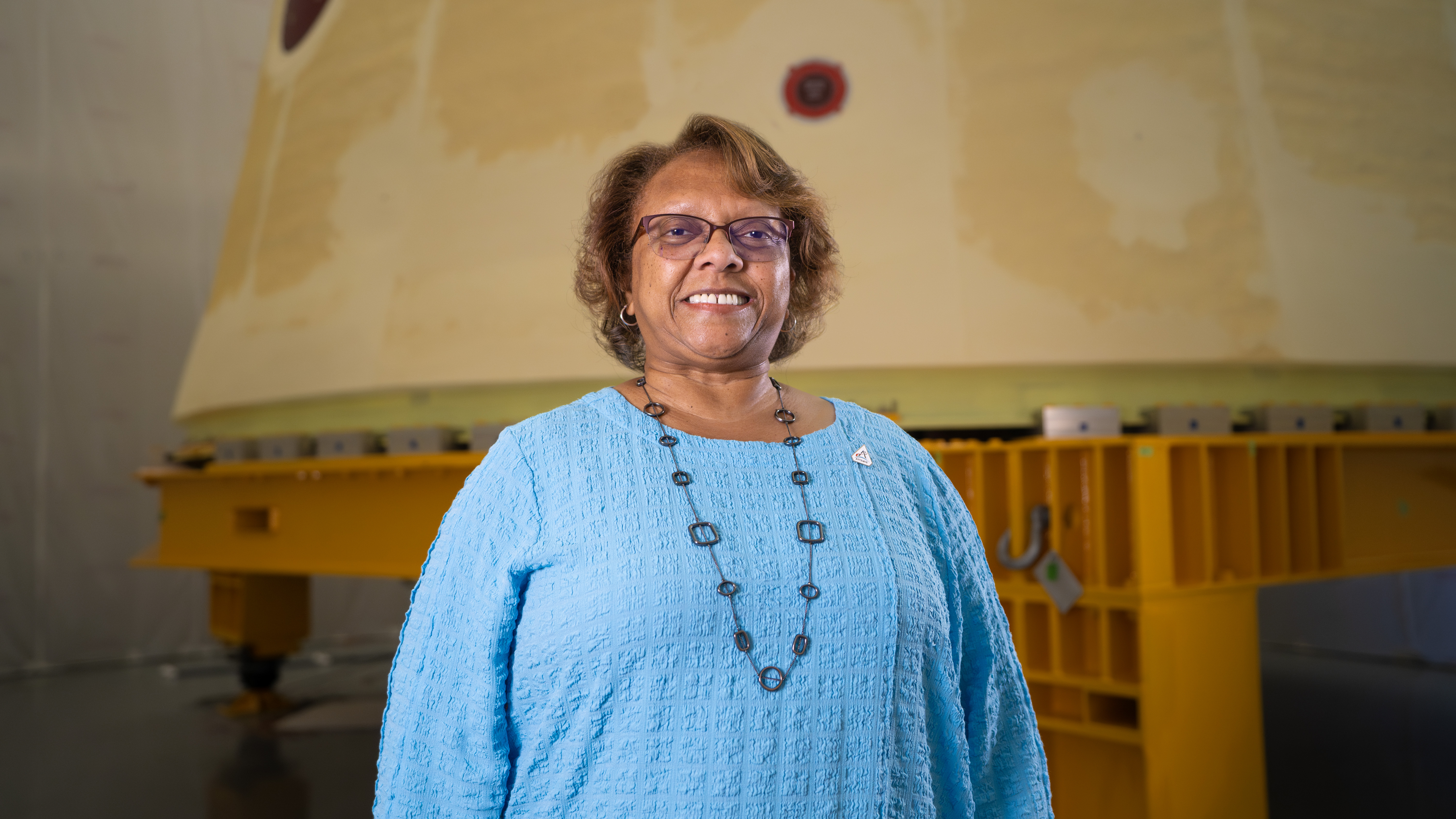
Gwen Artis started her career at NASA as one of the first high school summer interns at Marshall. Although she briefly relocated to Houston to work with retired astronaut Mae Jemison – the first woman of color to go to space – the majority of Artis’ 40-year career has centered at Marshall, where she has worked on a variety of programs including Spacelab, the Chandra X-Ray Observatory, in-space propulsion, SERVIR, and SLS. As systems engineer professional expert for Jacobs with the Jacobs Space Exploration Group ESSCA contract, Artis assists with the management and oversite of the production for each of the launch vehicle stage adapters for the first three SLS flights for Artemis I, II, and III. The cone-shaped adapter partially encloses the rocket’s interim cryogenic propulsion stage and serves as a key connector to the core stage below it and the upper stage above it. “Marshall has made and led countless contributions in technology advancement and human space exploration and to be a small part of that legacy, and particularly a part of the Artemis Generation, is inconceivable,” Artis said. “I constantly share with great enthusiasm how blessed I am to endeavor into this next great era of human space exploration in hopes that my experiences, my personal story, will embolden others and encourage future engineers, scientists, astronauts, technologists, and all other contributors of space exploration.” (NASA/Sam Lott)
Marshall Juneteenth Festival Honors Black History, Accomplishments
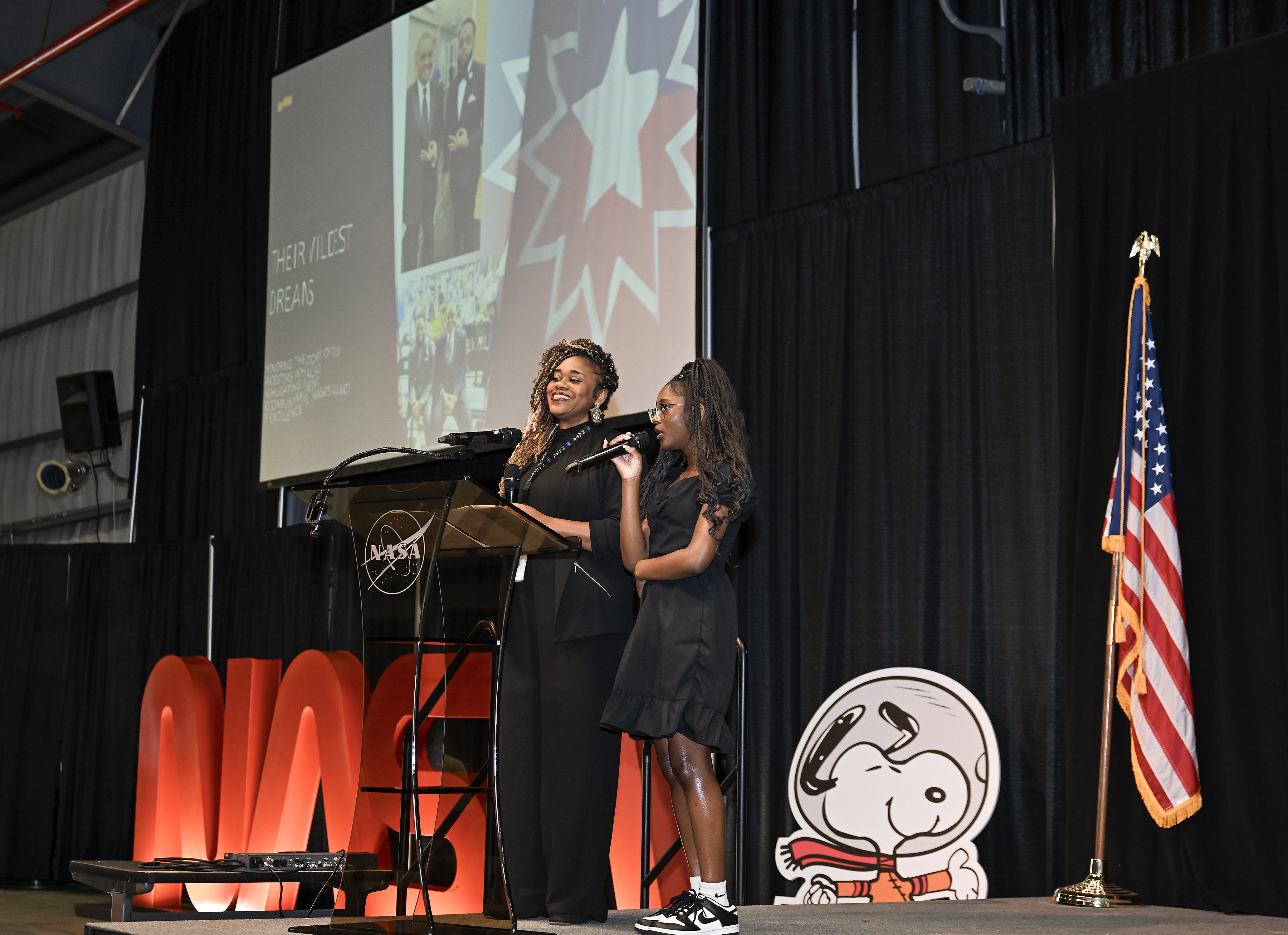
Black Employees and Allies at Marshall (BEAM), NASA Marshall Space Flight Center’s Office of Diversity and Equal Opportunity, and Harambee hosted a Juneteenth Festival on June 17. The event was in Activities Building 4316 for Marshall team members.
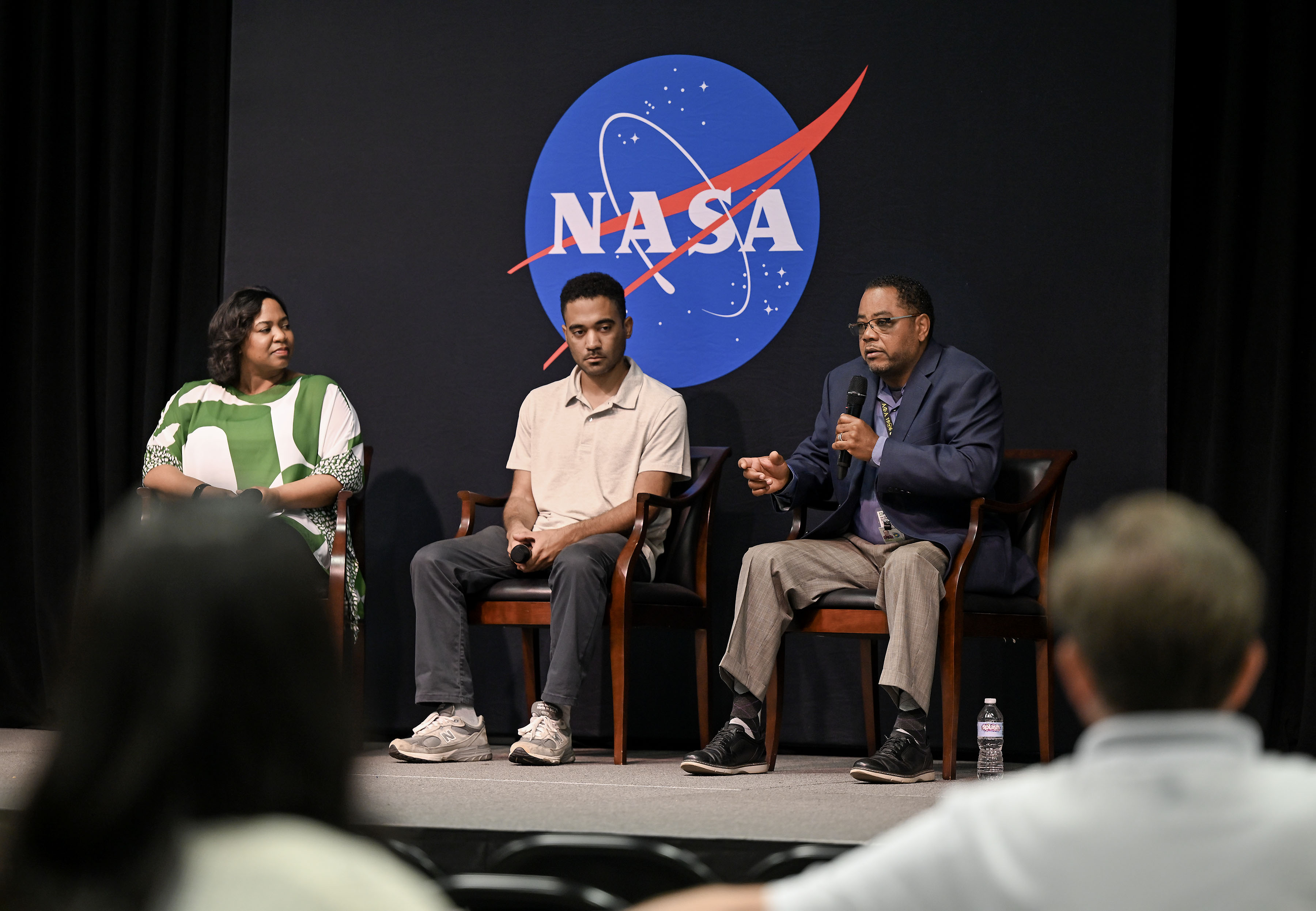
From left, Marshall’s Tawnya Laughinghouse and Alix Martin, and Joseph Price from Jacobs participate in a panel discussion June 17 during the Juneteenth Festival at NASA’s Marshall Space Flight Center. The festival’s theme was “Their Wildest Dreams.”
NASA/Charles Beason
The theme for Juneteenth 2024 was “Their Wildest Dreams,” in honor of Black history and the present accomplishments of African American employees. The festival featured panelists, vendors, food trucks, and more.
“The Juneteenth Festival has become an event that BEAM looks forward to planning for Marshall team members, and we have enjoyed seeing the growth in attendance over the past four years,” said Amanda Otieno, an equal employment specialist in the Office of Diversity & Equal Opportunity and a BEAM member. “Inclusion and cultural awareness are vital for creating a safe and supporting workforce and it’s great to see the center come together to celebrate the significance of the day, but also to learn about and appreciate different cultures. Together we are building a workforce that not only respects but thrives on diversity.”
Marshall team member Andrea Brown sings with her daughter, Jaya Brown, at the Juneteenth Festival.
NASA/Charles Beason
Juneteenth is the oldest nationally celebrated event marking the end of slavery in the United States. BEAM is an employee resource group at Marshall, and Harambee is an employee resource group for Jacobs. To learn more or join BEAM, Marshall team members can email Otieno.
Black Space Week 2024: A Conversation with the ‘Passtronaut’ – NFL quarterback Joshua Dobbs
As part of Black Space Week (June 16-22), NASA had a conversation with NFL quarterback Joshua Dobbs, also known as the “Passtronaut.” In addition to his football career, Dobbs holds an aerospace engineering degree, and has a passion for space and STEM education. NASA’s Gary Willis sat down for a conversation about Dobbs’ life on and off the field, and how his interests guide his professional and personal journey. Dobbs also attended the NASA in the Park event June 22 at Huntsville’s Big Spring Park East. The event was hosted by NASA’s Marshall Space Flight Center and Downtown Huntsville Inc. (NASA)
Andrew Schnell grew up in Murfreesboro, Tennessee, just a two-hour trip from the U.S. Space & Rocket Center in Huntsville.
Being nearby, the museum was an obvious attraction because of Schnell’s interest in space exploration as a child. So, too, was a journey toward a long career with NASA’s Marshall Space Flight Center.
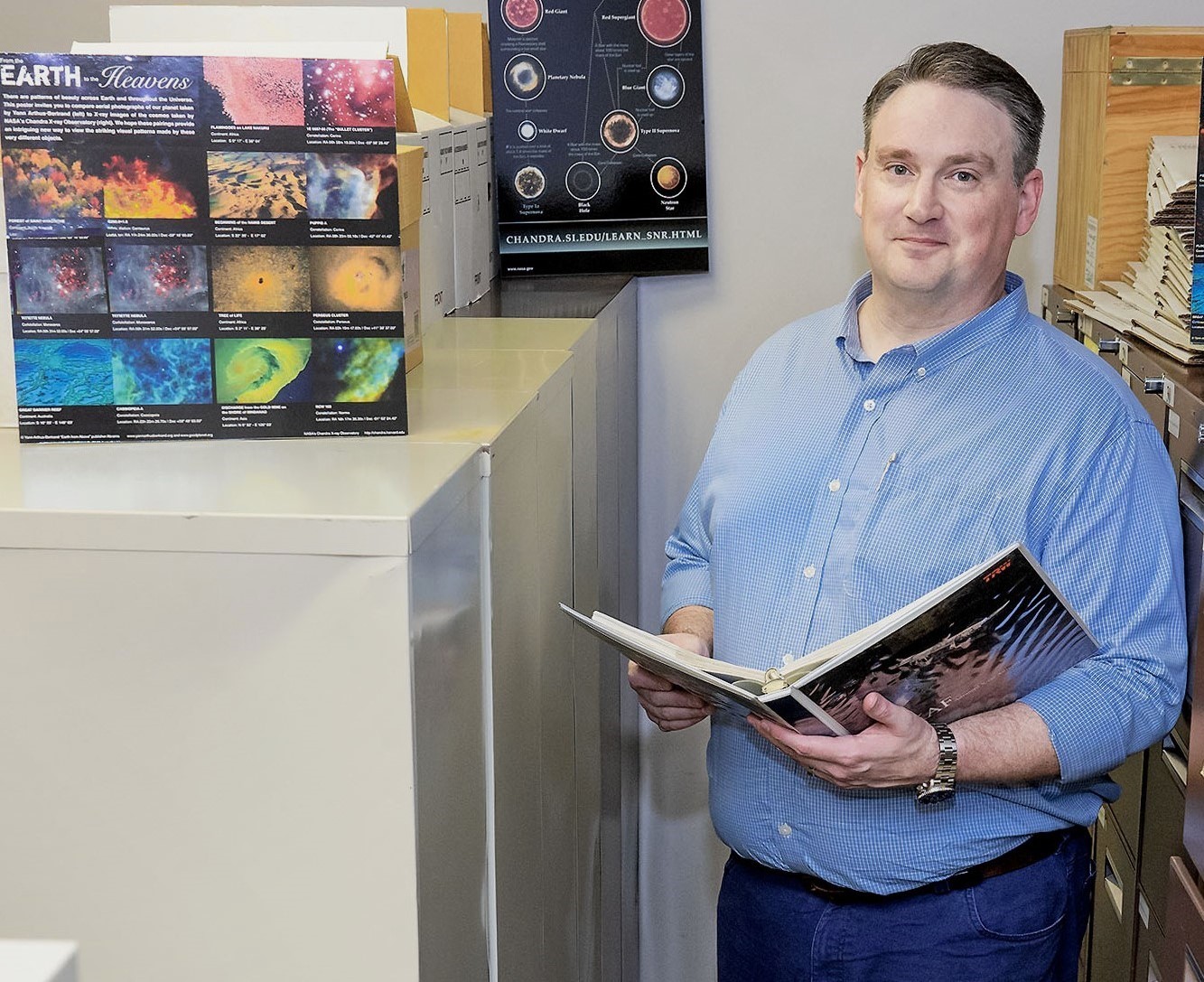
Andrew Schnell is the acting manager of NASA’s Chandra X-ray Observatory at the agency’s Marshall Space Flight Center.
NASA/Charles Beason
“I remember being fascinated with NASA and the Space Shuttle Program from the beginning, and my parents were happy to foster my interest,” said Schnell, the acting manager of NASA’s Chandra X-ray Observatory at Marshall. “We probably visited the Space & Rocket Center once a year, and we toured Kennedy Space Center when I was young. So, when I decided to pursue engineering, NASA was just the obvious place for me.”
As Chandra’s acting project manager today, Schnell and his team monitor the observatory’s operations, “making sure it continues to meet its obligations to the international community of astronomers and astrophysicists that we serve.”
Launched July 23, 1999, NASA is celebrating 25 years of Chandra helping to unravel the secrets of the universe. The observatory is a telescope specially designed to detect X-ray emission from very hot regions of the universe such as exploded stars, clusters of galaxies, and matter around black holes. Marshall has served as home for the Chandra Program Office since its inception.
NASA’s flagship mission for X-ray astronomy, Chandra continues to make contributions to astronomers and astrophysicists. Schnell said what he impresses him most about the observatory is Chandra’s ability to actively contribute to other science missions.
“Over the past year, more than 50 Chandra observations were coordinated with observatories like the James Webb Space Telescope, Hubble, and Marshall’s own IXPE (Imaging X-ray Polarimetry Explorer),” Schnell said. “Our team can respond to a request in a few days, giving astronomers the unique opportunity to observe the same phenomena in multiple wavelengths.”
And 15 years into his NASA career, Schnell said the entire Chandra team continues to motivate him.
“Every one of them is a world-class scientist or engineer,” Schnell said. “Many of them have spent their entire careers keeping Chandra thriving for almost 25 years now with no servicing missions. They know the observatory inside and out, down to the wiring. It’s amazing watching them troubleshoot a problem in real time. They motivate me to do the best job I can do. I don’t want to let such an amazing team down.”
Question: What excites you most about the future of human space exploration, or your NASA work, and your team’s role it?
Schnell: The thing that excites me the most about working with Chandra is that not only are we helping scientists rewrite our understanding of the universe today, but the data we collect with Chandra now will answer questions that scientists haven’t even asked yet. Years from now, an astrophysicist, maybe one who hasn’t been born yet, is going to have a theory about how some aspect of the universe works, and they’re going to use the data we’re collecting right now to test their theory.
Schnell smiles during a visit to NASA’s Kennedy Space Center in 1984.
Photo courtesy of Andrew Schnell
Chandra is the only X-ray observatory of its caliber flying today, and its replacement isn’t even on the drawing board. It’s really important that we continue to keep it operating, pulling in every bit of data we can for tomorrow’s astrophysicists.
Question: What has been the proudest moment of your career and why?
Schnell: A few years ago, I coached a team of summer interns as they built a CubeSat-scale pulsed plasma thruster and tested it in a vacuum chamber. They won one of the research awards at the expo that summer, with a big check and everything. It was one of the coolest things I’ve ever been a part of.
Question: Who or what inspired you to pursue an education/career that led you to NASA and Marshall?
Schnell: I was a summer intern at Marshall in 2001 and 2002, working with Mike Tinker, who was a structural engineer here in the Engineering Directorate. Mike would mentor several interns every summer, pushing us to write conference papers based on our projects. I will never forget his kindness and his willingness to work with interns every summer, all while managing his other tasks. He inspired me, not only to pursue a career at NASA, but to seek out opportunities to serve as a mentor for interns, co-ops, and younger engineers.
Question: What advice do you have for employees early in their NASA career or those in new leadership roles?
Schnell: I’ve seen how easy it is for younger engineers to lose some confidence when they start working here. They’ll measure themselves against their coworkers and think they’ll never be that good, that they’re imposters, that it’s a fluke that they’re working here. I would tell them that no one becomes a NASA employee or a NASA contractor by accident. You are meant to be here. Be kind to yourself, bring your full self to work every day, and you’ll be an expert in your discipline before you realize it.
Question: What do you enjoy doing with your time while away from work?
Schnell: I enjoy drawing and making comics. And as a native of Cincinnati, Ohio, I try to watch as many Cincinnati Reds games as I can during baseball season.
Smith, a Media Fusion employee and the Marshall Star editor, supports the Marshall Office of Communications.
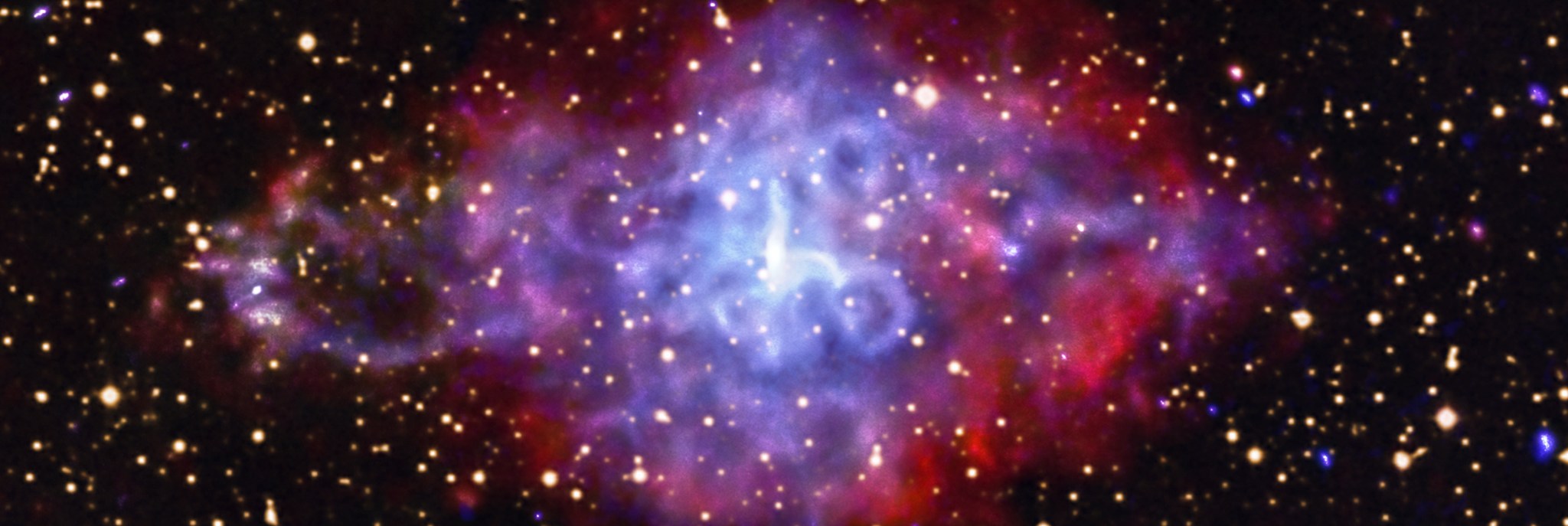
The supernova remnant 3C 58 contains a spinning neutron star, known as PSR J0205+6449, at its center. Astronomers studied this neutron star and others like it to probe the nature of matter inside these very dense objects. A new study, made using NASA’s Chandra X-ray Observatory and ESA’s XMM-Newton, reveals that the interiors of neutron stars may contain a type of ultra-dense matter not found anywhere else in the Universe.
In this image of 3C 58, low-energy X-rays are colored red, medium-energy X-rays are green, and the high-energy band of X-rays is shown in blue. The X-ray data have been combined with an optical image in yellow from the Digitized Sky Survey. The Chandra data show that the rapidly rotating neutron star (also known as a “pulsar”) at the center is surrounded by a torus of X-ray emission and a jet that extends for several light-years.
X-ray: NASA/CXC/ICE-CSIC/A. Marino et al.; Optical: SDSS; Image Processing: NASA/CXC/SAO/J. Major
In this image of 3C 58, low-energy X-rays are colored red, medium-energy X-rays are green, and the high-energy band of X-rays is shown in blue. The X-ray data have been combined with an optical image in yellow from the Digitized Sky Survey. The Chandra data show that the rapidly rotating neutron star (also known as a “pulsar”) at the center is surrounded by a torus of X-ray emission and a jet that extends for several light-years. The optical data shows stars in the field.
The team in this new study analyzed previously released data from neutron stars to determine the so-called equation of state. This refers to the basic properties of the neutron stars including the pressures and temperatures in different parts of their interiors.
The authors used machine learning, a type of artificial intelligence, to compare the data to different equations of state. Their results imply that a significant fraction of the equations of state – the ones that do not include the capability for rapid cooling at higher masses – can be ruled out.
The researchers capitalized on some neutron stars in the study being located in supernova remnants, including 3C 58. Since astronomers have age estimates of the supernova remnants, they also have the ages of the neutron stars that were created during the explosions that created both the remnants and the neutron stars. The astronomers found that the neutron star in 3C 58 and two others were much cooler than the rest of the neutron stars in the study.
The team thinks that part of the explanation for the rapid cooling is that these neutron stars are more massive than most of the rest. Because more massive neutron stars have more particles, special processes that cause neutron stars to cool more rapidly might be triggered.
One possibility for what is inside these neutron stars is a type of radioactive decay near their centers where neutrinos – low mass particles that easily travel through matter – carry away much of the energy and heat, causing rapid cooling.
Another possibility is that there are types of exotic matter found in the centers of these more rapidly cooling neutron stars.
The Nature Astronomy paper describing these results is available here. The authors of the paper are Alessio Marino (Institute of Space Sciences (ICE) in Barcelona, Spain), Clara Dehman (ICE), Konstantinos Kovlakas (ICE), Nanda Rea (ICE), J. A. Pons (University of Alicante in Spain), and Daniele Viganò (ICE).
NASA’s Marshall Space Flight Center manages the Chandra program. The Smithsonian Astrophysical Observatory’s Chandra X-ray Center controls science from Cambridge Massachusetts and flight operations from Burlington, Massachusetts.
Team members at NASA’s Marshall Space Flight Center learn about the center’s pollinator garden from Joni Melson, left, and Kristen Wagner during a Pollinator Week event June 17. The Pollinator Club at Marshall hosted the event,showing the benefits of cultivating a healthy biosphere of flowering plants and other greenery to support local populations of bees, butterflies, and other pollinating insects. Attendees also received free native plants and seeds. The event was part of Pollinator Week, the annual nationwide environmental activity held this year from June 17-23. The center’s pollinator garden is situated between Building 4315 and the Redstone Arsenal walking trail. The garden is a volunteer-maintained collection of more than 160 plants, mostly drought-tolerant perennials which will draw pollinating insects. The habitat, a registered Monarch Waystation, is certified with the North American Butterfly Association. Marshall team members can learn more about the Pollinator Club on Inside Marshall. (NASA/Charles Beason)
NASA, Partners Conduct Fifth Asteroid Impact Exercise, Release Summary
For the benefit of all, NASA released a summary June 20 of the fifth biennial Planetary Defense Interagency Tabletop Exercise. NASA’s Planetary Defense Coordination Office, in partnership with FEMA (Federal Emergency Management Agency) and with the assistance of the U.S. Department of State Office of Space Affairs, convened the tabletop exercise to inform and assess our ability as a nation to respond effectively to the threat of a potentially hazardous asteroid or comet.
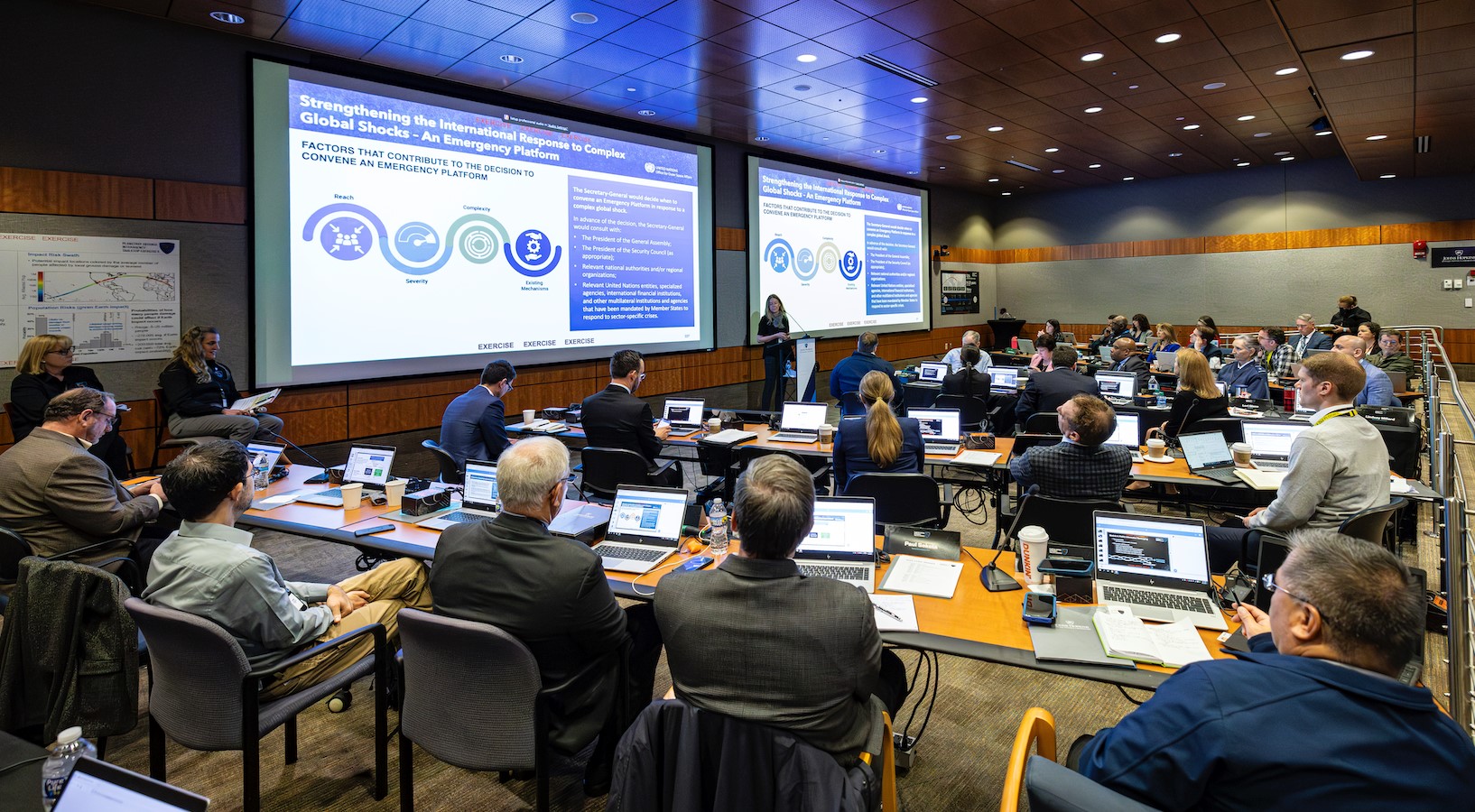
Representatives from NASA, FEMA, and the planetary defense community participate in the 5th Planetary Defense Interagency Tabletop Exercise to inform and assess our ability as a nation to respond effectively to the threat of a potentially hazardous asteroid or comet.
NASA/JHU-APL/Ed Whitman
Although there are no known significant asteroid impact threats for the foreseeable future, hypothetical exercises provide valuable insights by exploring the risks, response options, and opportunities for collaboration posed by varying scenarios, from minor regional damage with little warning to potential global catastrophes predicted years or even decades in the future.
“The uncertainties in these initial conditions for the exercise allowed participants to consider a particularly challenging set of circumstances,” said Lindley Johnson, planetary defense officer emeritus NASA Headquarters. “A large asteroid impact is potentially the only natural disaster humanity has the technology to predict years in advance and take action to prevent.”
During the exercise, participants considered potential national and global responses to a hypothetical scenario in which a never-before-detected asteroid was identified that had, according to initial calculations, a 72% chance of hitting Earth in approximately 14 years. The preliminary observations described in the exercise, however, were not sufficient to precisely determine the asteroid’s size, composition, and long-term trajectory. To complicate this year’s hypothetical scenario, essential follow-up observations would have to be delayed for at least seven months – a critical loss of time – as the asteroid passed behind the Sun as seen from Earth’s vantage point in space.
Conducting exercises enable government stakeholders to identify and resolve potential issues as part of preparation for any real-world situation. It was held in April at the Johns Hopkins Applied Physics Laboratory (APL) in Laurel, Maryland, and brought together nearly 100 representatives from across U.S. government agencies and, for the first time, international collaborators on planetary defense.
“Our mission is helping people before, during, and after disasters,” said Leviticus “L.A.” Lewis, FEMA detailee to NASA’s Planetary Defense Coordination Office. “We work across the country every day before disasters happen to help people and communities understand and prepare for possible risks. In the event of a potential asteroid impact, FEMA would be a leading player in interagency coordination.”
This exercise was the first to use data from NASA’s DART (Double Asteroid Redirection Test) mission, the first in-space demonstration of a technology for defending Earth against potential asteroid impacts. The DART spacecraft, which impacted the asteroid moonlet Dimorphos on Sept. 26, 2022, confirmed a kinetic impactor could change the trajectory of an asteroid. Applying this or any type of technology to an actual impact threat would require many years of advance planning.
To help ensure humanity will have the time needed to evaluate and respond to a potentially hazardous asteroid or comet, NASA continues the development of its NEO Surveyor (Near-Earth Object Surveyor), an infrared space telescope designed specifically to expedite our ability to discover and characterize most of the potentially hazardous near-Earth objects many years before they could become an impact threat. The agency’s NEO Surveyor’s proposed launch date is set for June 2028.
NASA will publish a complete after-action report for the tabletop exercise later, which will include strengths and gaps identified from analysis of the response, other discussions during the exercise, and recommendations for improvement.
“These outcomes will help to shape future exercises and studies to ensure NASA and other government agencies continue improving planetary defense preparedness,” said Johnson.
NASA established the Planetary Defense Coordination Office in 2016 to manage the agency’s ongoing planetary-defense efforts. Johns Hopkins APL managed the DART mission for NASA as a project of the agency’s Planetary Missions Program Office, which is at NASA’s Marshall Space Flight Center.
NASA Selects International Space Station US Deorbit Vehicle
NASA logo
NASA is fostering continued scientific, educational, and technological developments in low Earth orbit to benefit humanity, while also supporting deep space exploration at the Moon and Mars. As the agency transitions to commercially owned space destinations closer to home, it is crucial to prepare for the safe and responsible deorbit of the International Space Station in a controlled manner after the end of its operational life in 2030.
NASA announced SpaceX has been selected to develop and deliver the U.S. Deorbit Vehicle that will provide the capability to deorbit the space station and ensure avoidance of risk to populated areas.
“Selecting a U.S. Deorbit Vehicle for the International Space Station will help NASA and its international partners ensure a safe and responsible transition in low Earth orbit at the end of station operations. This decision also supports NASA’s plans for future commercial destinations and allows for the continued use of space near Earth,” said Ken Bowersox, associate administrator for Space Operations Mission Directorate at NASA Headquarters in Washington. “The orbital laboratory remains a blueprint for science, exploration, and partnerships in space for the benefit of all.”
While the company will develop the deorbit spacecraft, NASA will take ownership after development and operate it throughout its mission. Along with the space station, it is expected to destructively breakup as part of the re-entry process.
Since 1998, five space agencies, CSA (Canadian Space Agency), ESA (European Space Agency), JAXA (Japan Aerospace Exploration Agency), NASA (National Aeronautics and Space Administration), and State Space Corporation Roscosmos, have operated the International Space Station with each agency responsible for managing and controlling the hardware it provides. The station was designed to be interdependent and relies on contributions from across the partnership to function. The United States, Japan, Canada, and the participating countries of ESA have committed to operating the station through 2030. Russia has committed to continued station operations through at least 2028. The safe deorbit of the International Space Station is the responsibility of all five space agencies.
The single-award contract has a total potential value of $843 million. The launch service for the U.S. Deorbit Vehicle will be a future procurement.
In its 24th year of continuously crewed operations, the space station is a unique scientific platform where crew members conduct experiments across multiple disciplines of research, including Earth and space science, biology, human physiology, physical sciences, and technology demonstrations not possible on Earth. Crews living aboard station are the hands of thousands of researchers on the ground having conducted more than 3,300 experiments in microgravity. Station is the cornerstone of space commerce, from commercial crew and cargo partnerships to commercial research and national lab research, and lessons learned aboard International Space Station are helping to pass the torch to future commercial stations.