NASA Stennis Achieves Primary Success for Historic In-Space Mission

NASA Stennis Achieves Primary Success for Historic In-Space Mission

NASA’s Stennis Space Center and partner Sidus Space Inc. announced primary mission success July 2 for the center’s historic in-space mission – an autonomous systems payload aboard an orbiting satellite.

“Our ASTRA (Autonomous Satellite Technology for Resilient Applications) payload is active and operational,” NASA Stennis Center Director John Bailey said. “This is an incredible achievement for Stennis, our first-ever in-space mission flying on a new state-of-the-art satellite. We are all celebrating the news.”

ASTRA is the on-orbit payload mission developed by NASA Stennis and is an autonomous systems hardware/software payload. The NASA Stennis ASTRA technology demonstrator is a payload rider aboard the Sidus Space premier satellite, LizzieSat-1 (LS-1) small satellite. Partner Sidus Space is responsible for all LS-1 mission operations, including launch and satellite activation, which allowed the NASA Stennis ASTRA team to complete its primary mission objectives.

LS-1 launched into space on the SpaceX Transporter 10 rideshare mission March 4 and deployed the same day. The LS-1 satellite commissioning began after deployment and was completed on May 12. Sidus Space’s next step was to begin activation of payloads, including ASTRA.

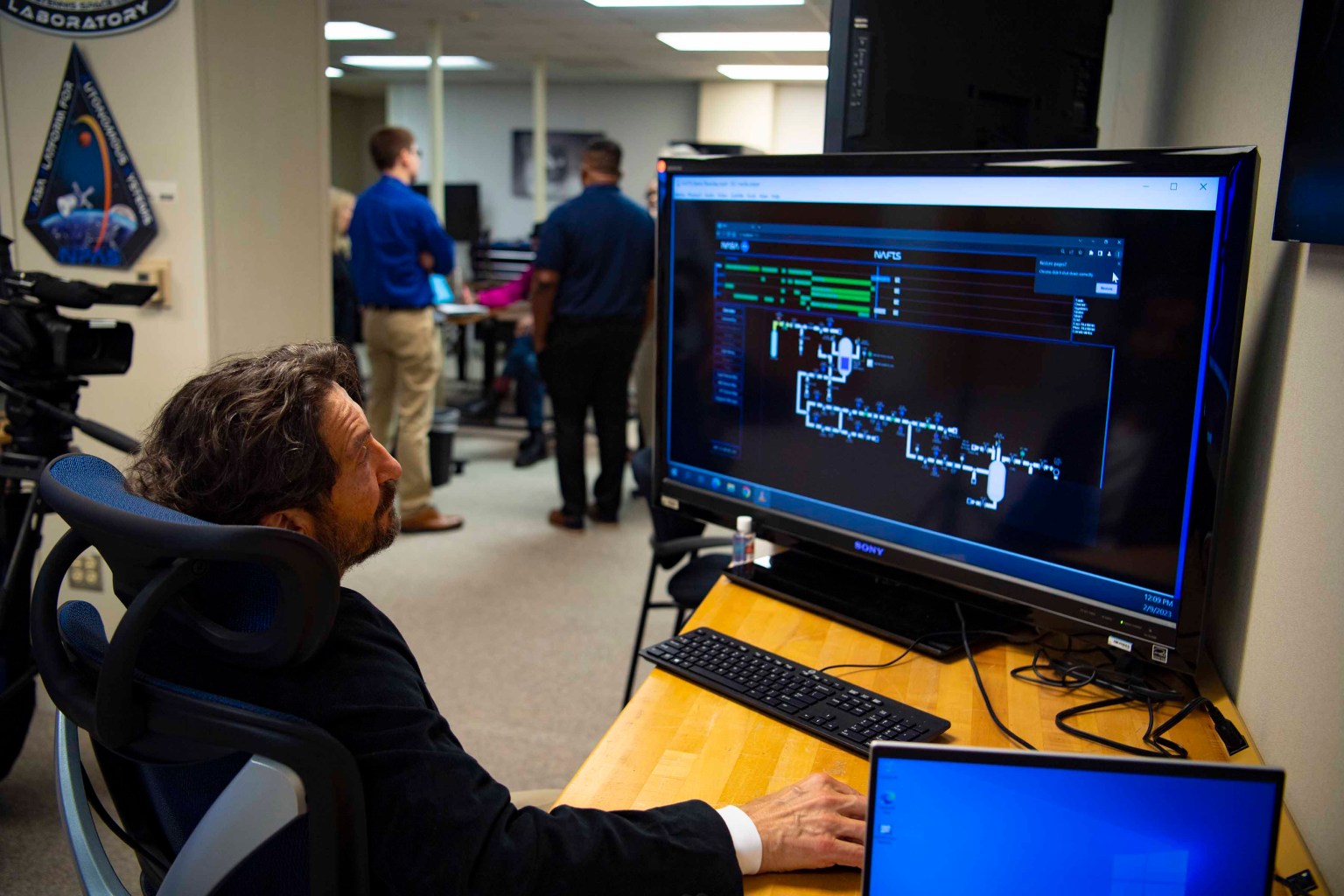
After the payload was activated, the NASA Stennis Autonomous Systems Laboratory (ASL) team confirmed they had established a telemetry link to send and receive data in the ASTRA Payload Operation Command Center. The ASL team continued to checkout and verify operation of ASTRA and has confirmed that ASTRA primary mission objectives have been successfully achieved.  

“This is just a remarkable and inspiring accomplishment for the entire team,” said Chris Carmichael, NASA Stennis ASL branch chief. “So many people put in a tremendous effort to bring us to this point. It is a great demonstration of the team’s vision and capabilities, and I am excited to see what the future holds.”

The NASA Stennis ASL works to create safe-by-design autonomous systems. ASTRA demonstrates technology that is required by NASA and industry for upcoming space missions. The ASTRA computer on the satellite runs a digital twin of satellite systems, which detects and identifies the causes of anomalies, and autonomously generates plans to resolve those issues. Ultimately, ASTRA will demonstrate autonomous operations of LS-1.

“Achieving ASTRA’s primary mission objectives underscores our dedication and commitment to driving innovation while advancing space technology alongside NASA, our trusted partner,” said Carol Craig, Founder and CEO of Sidus Space. “We are proud to support such groundbreaking projects in our industry and eagerly anticipate the continued progress of our LizzieSat-1 mission.”

The success of the ASTRA mission comes as NASA Stennis moves forward with strategic plans to design autonomous systems that will help accelerate development of intelligent aerospace systems and services for government and industry.

For information about NASA’s Stennis Space Center, visit:

Stennis Space Center – NASA

Share

Details

Last Updated

Jul 02, 2024

Editor
NASA Stennis Communications
Contact
C. Lacy Thompson
Location
Stennis Space Center

Related Terms

Powered by WPeMatico

Get The Details…
clthomp2

Mission Success: HERA Crew Successfully Completes 45-Day Simulated Journey to Mars 

Mission Success: HERA Crew Successfully Completes 45-Day Simulated Journey to Mars 

Four dedicated explorers—Jason Lee, Stephanie Navarro, Shareef Al Romaithi, and Piyumi Wijesekara—just returned from a 45-day simulated journey to Mars, testing the boundaries of human endurance and teamwork within NASA’s HERA (Human Exploration Research Analog) habitat at Johnson Space Center in Houston. Their groundbreaking work on HERA’s Campaign 7 Mission 2 contributes to NASA’s efforts to study how future astronauts may react to isolation and confinement during deep-space journeys. 

A group of four smiling NASA personnel in black jumpsuits stands together in front of a spacecraft module. Each individual has a NASA patch and name tag on their suit.
NASA’s HERA (Human Exploration Research Analog) Campaign 7 Mission 2 crew members outside the analog environment on June 24, 2024. From left: Piyumi Wijesekara, Shareef Al Romaithi, Jason Lee, and Stephanie Navarro. Credit: NASA/James Blair
Credit: NASA/James Blair

Throughout their mission, the crew conducted operational tasks and participated in 18 human health studies. These studies focused on behavioral health, team dynamics, and human-system interfaces, with seven being collaborative efforts with the Mohammed Bin Rashid Space Centre (MBRSC) of the United Arab Emirates (UAE) and the European Space Agency. These experiments assessed the crew’s physiological, behavioral, and psychological responses in conditions designed to be similar to a mission to Mars. 

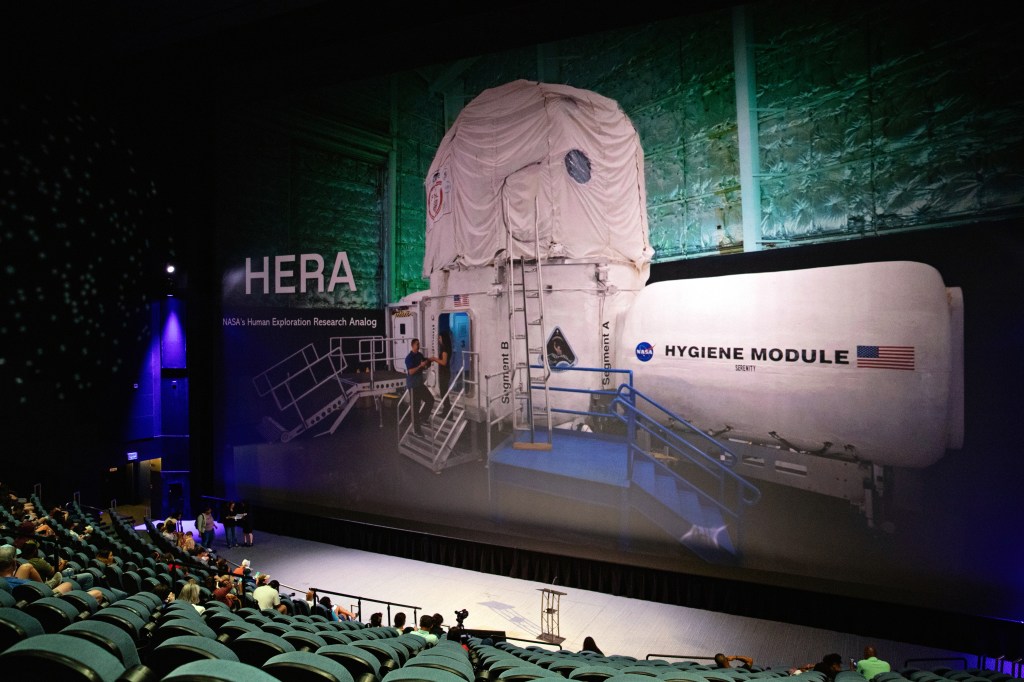
A white cylindrical habitat module with a ladder and metal railings stands in an industrial facility. The area is surrounded by blue platforms and metal stairs.
The HERA Campaign 7 Mission 2 crew experience a simulated landing on their return home.
Credit: NASA/James Blair

As their mission concluded, the HERA crew watched real footage from the Artemis I mission to simulate their landing.

HERA operations lead Ted Babic rang the bell outside the habitat nine times to celebrate the crew’s egress—seven for the campaign and two for the mission—saying, “All in a safe passage to Mars and a safe return to Earth. May this vessel be a safe home to future HERA crews.” Babic then presented the crew with their mission patch, which they placed on the door of the HERA habitat. 

Four NASA personnel in black jumpsuits and face masks are seen placing a mission patch on the door of a spacecraft module labeled "Segment C." An American flag is visible above the door.
The HERA Campaign 7 Mission 2 crew members place their mission patch on the habitat’s airlock door after egress.
Credit: NASA/James Blair

The crew expressed their gratitude to everyone involved in the mission, including NASA and MBRSC, the HERA mission control center, NASA’s Human Research Program (HRP) team, Analog Mission Control, medical teams, and their family and friends.

Wijesekara shared, “This was one of the best experiences I’ve had in my life. I’d like to thank my crewmates for making this experience memorable and enjoyable.” 

Four NASA personnel in black jumpsuits stand outside and smile with their arms outstretched. The background features a bright blue sky with scattered clouds and some buildings.
The HERA Campaign 7 Mission 2 crew members at NASA’s Johnson Space Center in Houston after their 45-day simulated mission to Mars. From left: Piyumi Wijesekara, Shareef Al Romaithi, Jason Lee, and Stephanie Navarro.
Credit: NASA/James Blair

Connecting With Students  

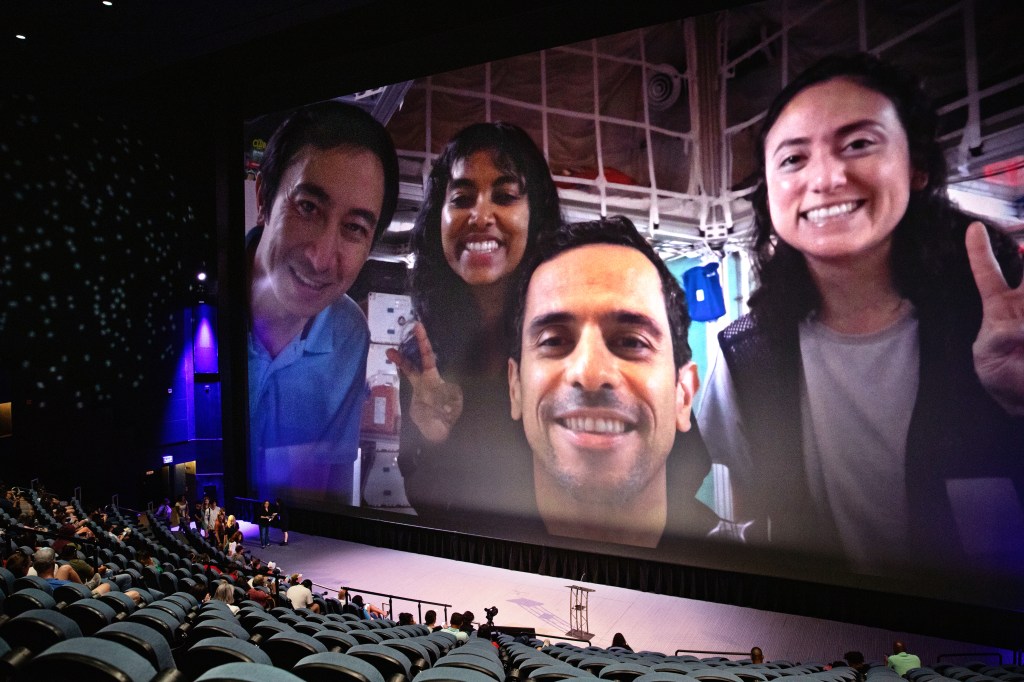
On June 21, three days before crew egress, about 200 people gathered at Space Center Houston’s theater for a live Q&A session where students had the opportunity to share their questions with crew members Al Romaithi and Wijesekara. They discussed team dynamics, adapting to unexpected circumstances, and coping with isolation.  

When asked about what prompted her to apply for the mission, Wijesekara emphasized the importance of helping NASA collect data that could help future long-duration space flights, saying, “This will be very useful when we get to the Moon with Artemis missions and even beyond that when we go to Mars.” 

A large screen in an auditorium displays two NASA personnel in black jumpsuits with NASA patches, speaking to the audience. They stand in a spacecraft interior with equipment and a mission patch visible on the wall. Below the screen, a few people are on the stage, and the auditorium seats are partially filled with attendees watching the presentation.
The HERA Campaign 7 Mission 2 crew members Piyumi Wijesekara and Shareef Al Romaithi join a groundlink Q&A with students at Space Center Houston on June 21, 2024.
Credit: Space Center Houston/Jennifer Foulds 

Inside HERA, mealtimes were bonding moments where the crew shared stories, laughed, and supported each other. When a student asked about building stronger teams, Wijesekara advised, “Spend time with your crewmates, get to know them deeply, and be a good listener.” 

Al Romaithi, who hails from the UAE, shared that his academic background in aerospace engineering and aviation helped him stand out in the application process. In addition, this HERA campaign is focused on cultural diversity, which opened the opportunity for him to apply through a partnership between HERA and MBRSC. 

Discussing the mental effects of isolation, Al Romaithi highlighted the comfort provided by personal items, books, and board games. Wijesekara noted that the white noise of instruments running became their constant companion that her senses adjusted to over time. 

Wijesekara told the audience her favorite experience was performing spacewalks and “flying drones on Mars,” via virtual reality, which allowed them to observe Martian landscapes and even lava caves. Through the habitat’s window screens, they could see simulated views of space and Martian landscapes.  

The crew addressed the challenges they faced inside the analog environment, such as communication delays, which taught them teamwork, patience, and precise planning. They utilized a 3D printer aboard HERA to address equipment issues. A curious student asked what happens to the crew and the mission in case of an outside emergency, like a hurricane. Both crew members explained that HERA provided them with step-by-step emergency instructions. 

Medical evaluations and nutrition-specific meal plans were crucial for the mission, Al Romaithi and Wijesekara noted, with daily monitoring of the crew’s physical and mental health. The crew also grew lettuce hydroponically and had four pet triops shrimp named Buzz, Alvin, Simon, and Theodore. 

When a student asked what food he missed most, Al Romaithi replied, “Home-cooked meals.”  

Wijesekara shared the first thing she plans to do post-mission is see her family and visit a list of restaurants with her crewmates. She also looks forward to running on the beach. 

Reflecting on their experience, Al Romaithi noted, “We’ve become more disciplined and efficient in our daily activities.”  

What was the most valuable lesson learned? “The importance of teamwork and communication,” he said.  

Both crewmembers also gave students in the audience some advice. “Never hesitate or be shy to ask for help,” Al Romaithi said. “Always push for your biggest dreams, don’t let self-doubt slow you down, and believe in yourself.” 

“And keep studying!” added Wijesekara. 

Powered by WPeMatico

Get The Details…
Sumer Loggins

Sols 4232-4233: Going For a Ride, Anyone?

Sols 4232-4233: Going For a Ride, Anyone?

5 min read

Sols 4232-4233: Going For a Ride, Anyone?

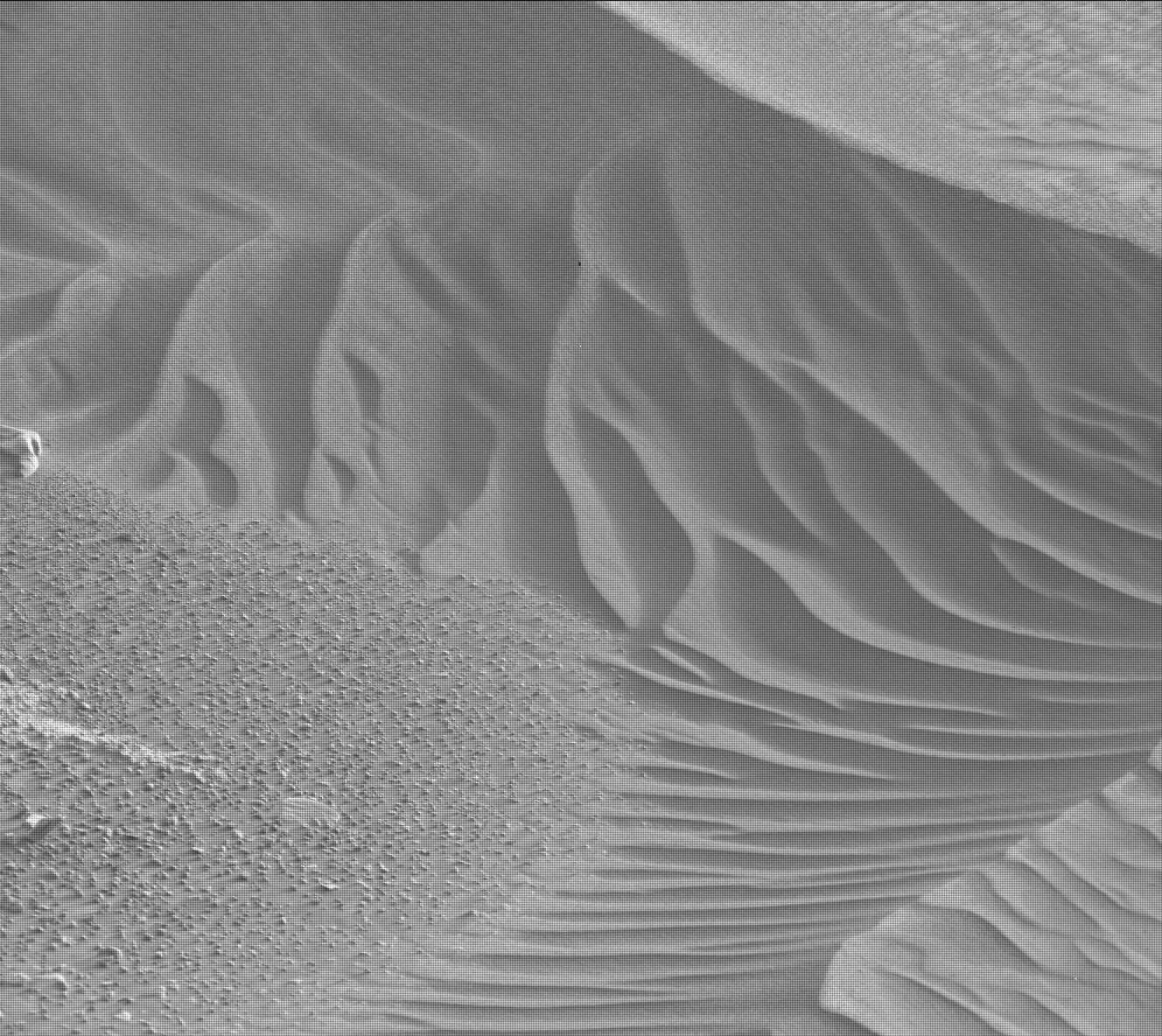
A black and white photo of a Martian landscape, looking cross-hatched as if viewed through a window screen. The terrain at lower left resembles coarse sandpaper, while the other three-quarers of the image frame show undulating dunes, looking like folds in satin fabric.
This image shows some of the sand ripples we spot all around the rover between the rocks. It was taken by Mast Camera (Mastcam) onboard NASA’s Mars rover Curiosity on Sol 4225 (2024-06-25 01:10:39 UTC).

Earth planning date: Monday, July 1, 2024

Have you ever wondered what it might look like to ride along with the rover? Probably not as much as we have here on the planning team, where we are looking at the images on a daily basis. I always wish I could walk around there myself, or drive around in a vehicle, maybe. As you likely know, we don’t even get video, “just” images. But of course those images are stunning and the landscape is unique and – apart from being scientifically interesting – so very, very beautiful. And some cameras record images so often that it’s actually possible to create the impression of a movie. The front hazard camera is among them. And that can create a stunning impression of looking out of the front window! If you want to see that for yourself, you can! If you go to the NASA interactive tool called “Eyes on the Solar System” there is a Curiosity Rover feature that allows you to do just that: simulate a drive between waypoints and look out of the window, which is the front hazard camera. Here is the link to “Experience Curiosity.” The drive there is a while back, but the landscape is just so fascinating, I can watch and rewatch that any number of times!

Now, after reminiscing about the past, what did we do today? First of all: change all plans we ever had. We don’t have – as scheduled – the SAM data on Earth just yet. But we have a good portion of the sample still in the drill, and if SAM gets their data and wants to do more analysis with that sample, then we can’t move the arm as we originally had planned. Why didn’t we consider that to begin with? Normally, there isn’t enough sample for all the analysis; you may have seen this blog post: “Sols 4118-4119: Can I Have a Second Serving, Please? Oh, Me Too!” But it’s the sample that dictates how much we get to begin with, and how much we need, which only becomes clear as the data come in. And there is an unusually lucky combination here that would avoid us having to drill a second hole for getting the second helping. Instead, we just sit here carefully holding the arm still so we do not lose sample. That saves a lot of rover resources. But then, once we had settled how we adjust to keeping our current position, we also learnt that the uplink time might shift from the original slot we had been allocated to a later one… And all of this with a pretty new-to-the-role Science Operations Working Group (SOWG) chair (me) and a similarly new Geology and Mineralogy theme group science lead. Well, we managed, with lots of help from the great team around us.

Those sudden-change planning days are so tricky because there is so much more to remember. It’s not, “This is what we came to do…,” and it had been carefully pre-planned, and it is all in the notes. Instead, the pre-planning preparation doesn’t fit the new reality anymore, and all that work has to be redone. So we have to do all the pre-planning work, and the actual planning work, and sometimes also account for some “if… then…” scenarios in the same amount of time we usually have to do the planning on the basis of all the pre-planning work. 

Sounds stressful? Yes, I can tell you it is!

Once we had changed all the skeleton plans, the team got very excited about the extra time. This is such an interesting area, there are rocks that are almost white, there are darker rocks, very interesting sand features with beautiful ripples, so much to look at! Mars has much to offer here, so the team got to work swiftly and the plan filled up with a great set of observations. ChemCam used LIBS on the target “Tower Peak,” which is one of those white-ish rocks, and on “Quarry Peak.” Mastcam delivers all the pictures to go along with these two activities and gets its own science, too. These are mainly so-called “change detection” images, where the same area is pictured repeatedly to see what particles might move in the time between the two images. ChemCam uses its long-distance imaging capability to add to the stunning images they are getting from faraway rocks. They have two mosaics on a target called “Edge Bench.” There is also a lot of atmospheric science in the plan; looking for dust devils and the opacity of the atmosphere are just two examples. REMS and DAN are also active throughout, to assess the wind, and the water underground, respectively. And as if that weren’t enough, CheMin also performs another night of analysis. We get to uplink a full plan, and we’ll see what the data say and what decisions we’ll make for next Wednesday.

Written by Susanne Schwenzer, Planetary Geologist at The Open University

Share

Details

Last Updated
Jul 02, 2024

Related Terms

Powered by WPeMatico

Get The Details…

Sols 4229-4231: More Analyses of the Mammoth Lakes 2 Sample!

Sols 4229-4231: More Analyses of the Mammoth Lakes 2 Sample!

2 min read

Sols 4229-4231: More Analyses of the Mammoth Lakes 2 Sample!

A black and white photograph of
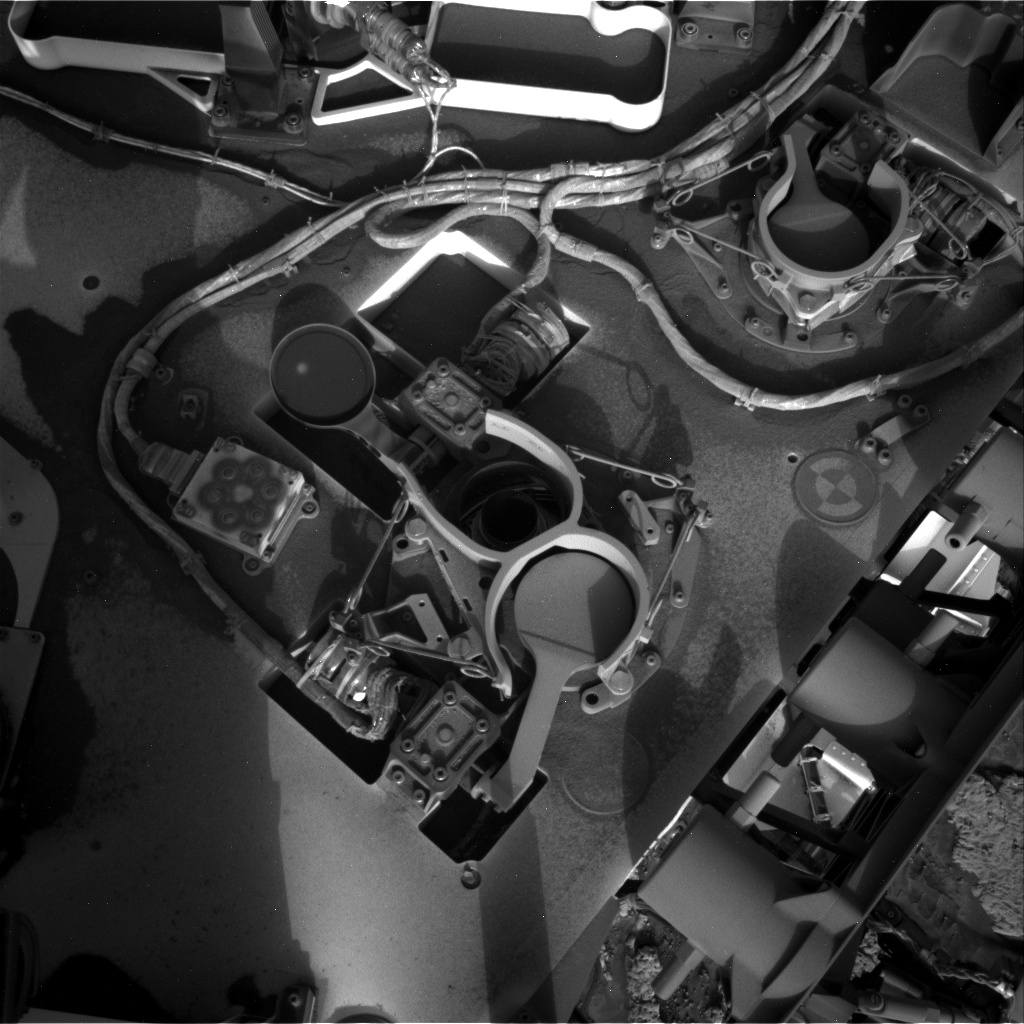
The inlet into to the SAM instrument open and awaiting sample delivery. This image was taken by Right Navigation Camera onboard NASA’s Mars rover Curiosity on Sol 4226 (2024-06-26 11:06:46 UTC).

Earth Planning Date: Friday, June 28, 2024

After reviewing results from the Evolved Gas Analysis (EGA) experiment that were downlinked yesterday afternoon (Sols 4226-4228: A Powerful Balancing Act), the SAM team decided they’d like to go ahead with a second experiment to analyze the Mammoth Lakes 2 drilled sample. This experiment is known as the Gas Chromatograph/Mass Spectrometer (GCMS) experiment.

SAM, whose full name is Sample Analysis at Mars, is actually a suite of three different analytical instruments that are used to measure the composition of gases which come off drilled samples as we bake them in SAM’s ovens. The three analytical instruments are called a gas chromatograph, quadrupole mass spectrometer, and tunable laser spectrometer. Each one is particularly suited for measuring specific kinds of compounds in the gases, and these include things like water, methane, carbon, or organic (carbon-containing) molecules. In the EGA experiment that we ran in our last plan, we baked the Mammoth Lakes 2 sample and measured the gas compositions using the tunable laser spectrometer and quadrupole mass spectrometer. In this plan, we’ll deliver a new pinch of sample to the SAM oven and then measure the composition of the gases that are released using the gas chromatograph and quadrupole mass spectrometer. By running both experiments, we’ll have a more thorough understanding of the materials that are in this rock.

The SAM GCMS experiment takes a lot of power to run, so it will be the focus of today’s three-sol plan. However, we still managed to fit in some other science activities around the experiment, including a ChemCam RMI mosaic of some far-off ridges, a ChemCam LIBS observation of a nodular target named “Trail Lakes,” environmental monitoring activities, and a couple Mastcam mosaics to continue imaging the terrain around the rover. Should be another fun weekend of science in Gale crater!

Written by Abigail Fraeman, Planetary Geologist at NASA’s Jet Propulsion Laboratory

Share

Details

Last Updated
Jul 01, 2024

Related Terms

Powered by WPeMatico

Get The Details…

NASA’s NEOWISE Infrared Heritage Will Live On

NASA’s NEOWISE Infrared Heritage Will Live On

5 min read

Preparations for Next Moonwalk Simulations Underway (and Underwater)

NASA’s near-Earth-object-hunting mission NEOWISE is nearing its conclusion. But its work will carry on with NASA’s next-generation infrared mission: NEO Surveyor.

After more than 14 successful years in space, NASA’s NEOWISE (Near-Earth Object Wide-field Infrared Survey Explorer) mission will end on July 31. But while the mission draws to a close, another is taking shape, harnessing experience gained from NEOWISE: NASA’s NEO Surveyor (Near Earth Object Surveyor), the first purpose-built infrared space telescope dedicated to hunting hazardous near-Earth objects. Set for launch in late 2027, it’s a major step forward in the agency’s planetary defense strategy.

“After developing new techniques to find and characterize near-Earth objects hidden in vast quantities of its infrared survey data, NEOWISE has become key in helping us develop and operate NASA’s next-generation infrared space telescope. It is a precursor mission,” said Amy Mainzer, principal investigator of NEOWISE and NEO Surveyor at the University of California, Los Angeles. “NEO Surveyor will seek out the most difficult-to-find asteroids and comets that could cause significant damage to Earth if we don’t find them first.”

WISE mission’s telescope is worked on by engineers
Seen here in a clean room at the Space Dynamics Laboratory in Logan, Utah, the WISE mission’s telescope is worked on by engineers. Avionics hardware and solar panels would later be attached before the spacecraft’s launch on Dec. 14, 2009.
SDL

WISE Beginnings

NEOWISE’s end of mission is tied to the Sun. About every 11 years, our star experiences a cycle of increased activity that peaks during a period called solar maximum. Explosive events, such as solar flares and coronal mass ejections, become more frequent and heat our planet’s atmosphere, causing it to expand. Atmospheric gases, in turn, increase drag on satellites orbiting Earth, slowing them down. With the Sun currently ramping up to predicted maximum levels of activity, and with no propulsion system for NEOWISE to keep itself in orbit, the spacecraft will soon drop too low to be usable.

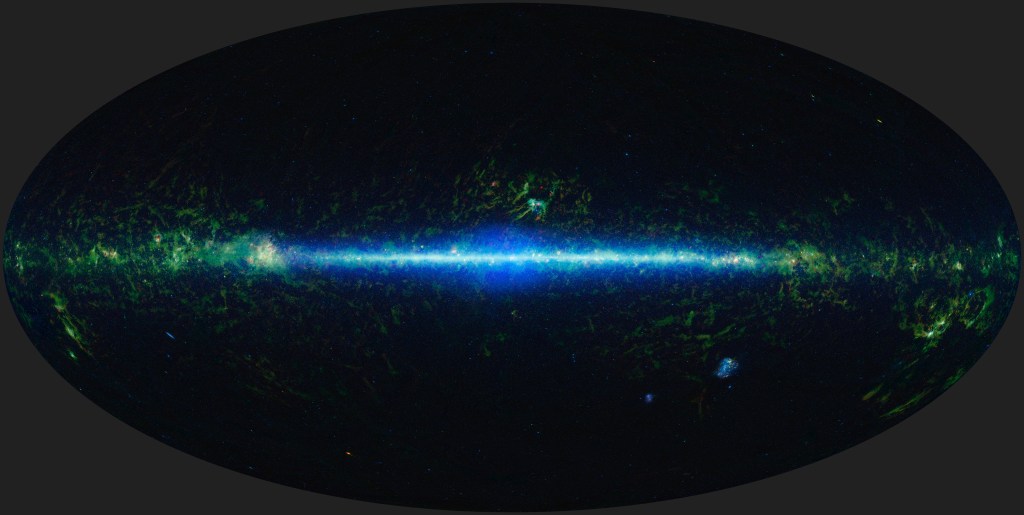
The infrared telescope is going out of commission having exceeded scientific objectives for not one, but two missions, beginning as WISE (Wide-field Infrared Survey Explorer).

Managed by NASA’s Jet Propulsion Laboratory in Southern California, WISE launched in December 2009 with a six-month missionto scan the entire infrared sky. By July 2010, WISE had achieved this with far greater sensitivity than previous surveys, and NASA extended the mission until 2011.

During this phase, WISE studied distant galaxies, outgassing comets, exploding white dwarf stars, and brown dwarfs. It identified tens of millions of actively feeding supermassive black holes. It also generated data on circumstellar disks — clouds of gas, dust, and rubble spinning around stars — that citizen scientists continue to mine through the Disk Detective project.

In addition, it excelled at finding main belt asteroids, as well as near-Earth objects, and discovered the first known Earth Trojan asteroid. What’s more, the mission provided a census of dark, faint near-Earth objects that are difficult for ground-based telescopes to detect, revealing that these objects constitute a sizeable fraction of the near-Earth object population.

Comet NEOWISE was discovered by its namesake mission on March 27, 2020, and became a dazzling celestial object visible in the Northern Hemisphere for several weeks that year. It was one of 25 comets discovered by the mission.
SDL/Allison Bills

Infrared Heritage

Invisible to the naked eye, infrared wavelengths are emitted by warm objects. To keep the heat generated by WISE itself from interfering with its infrared observations, the spacecraft relied on cryogenic coolant. By the time the coolant had run out, WISE had mapped the sky twice, and NASA put the spacecraft into hibernation in February 2011.

Soon after, Mainzer and her team proposed a new mission for the spacecraft: to search for, track, and characterize near-Earth objects that generate a strong infrared signal from their heating by the Sun.

“Without coolant, we had to find a way to cool the spacecraft down enough to measure infrared signals from asteroids,” said Joseph Masiero, NEOWISE deputy principal investigator and a scientist at IPAC, a research organization at Caltech in Pasadena, California. “By commanding the telescope to stare into deep space for several months, we determined it would radiate only enough heat to reach lower temperatures that would still allow us to acquire high-quality data.” NASA reactivated the mission in 2013 under the Near-Earth Object Observations Program, a precursor to the agency’s current planetary defense program, with the new name NEOWISE.

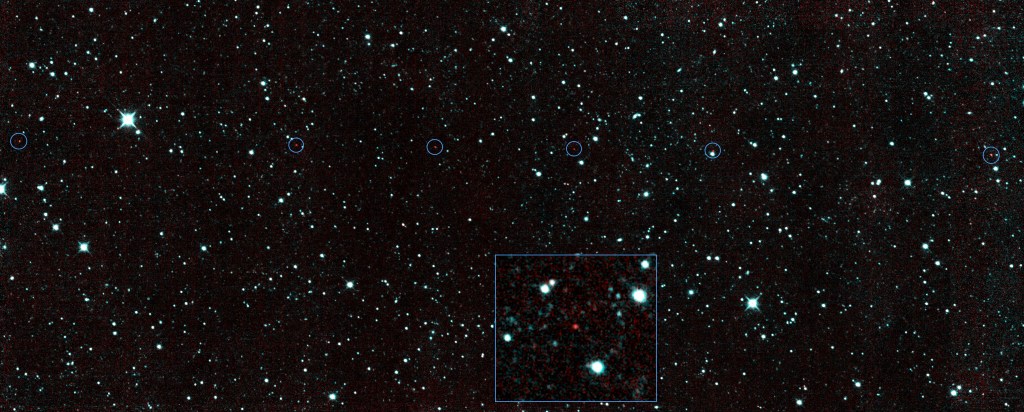
By repeatedly observing the sky from low Earth orbit, NEOWISE has made 1.45 million infrared measurements of over 44,000 solar system objects to date. That includes more than 3,000 NEOs, 215 of which the space telescope discovered. Twenty-five of those are comets, among them the famed comet NEOWISE that was visible in the night sky in the summer of 2020.

“The spacecraft has surpassed all expectations and provided vast amounts of data that the science community will use for decades to come,” said Joseph Hunt, NEOWISE project manager at JPL. “Scientists and engineers who worked on WISE and through NEOWISE also have built a knowledge base that will help inform future infrared survey missions.”

The space telescope will continue its survey until July 31. Then, on Aug. 8, mission controllers at JPL will send a command that puts NEOWISE into hibernation for the last time. Since its launch, NEOWISE’s orbit has been dropping closer to Earth. NEOWISE is expected to burn up in our planet’s atmosphere sometime between late 2024 and early 2025.

More About the Mission

NEOWISE and NEO Surveyor support the objectives of NASA’s Planetary Defense Coordination Office (PDCO) at NASA Headquarters in Washington. The NASA Authorization Act of 2005 directed NASA to discover and characterize at least 90% of the near-Earth objects more than 140 meters (460 feet) across that come within 30 million miles (48 million kilometers) of our planet’s orbit. Objects of this size can cause significant regional damage, or worse, should they impact the Earth.

JPL manages and operates the NEOWISE mission for PDCO within the Science Mission Directorate. The Space Dynamics Laboratory in Logan, Utah, built the science instrument. Ball Aerospace & Technologies Corp. of Boulder, Colorado, built the spacecraft. Science data processing, archiving, and distribution is done at IPAC at Caltech. Caltech manages JPL for NASA.

For more information about NEOWISE, visit:

https://www.nasa.gov/neowise

Media Contacts

Ian J. O’Neill
Jet Propulsion Laboratory, Pasadena, Calif.
818-354-2649
ian.j.oneill@jpl.nasa.gov

Karen Fox / Charles Blue
NASA Headquarters, Washington
202-358-1600 / 202-802-5345
karen.c.fox@nasa.gov / charles.e.blue@nasa.gov

2024-094

Powered by WPeMatico

Get The Details…
Anthony Greicius