Clouds Swimming over Lago Argentino
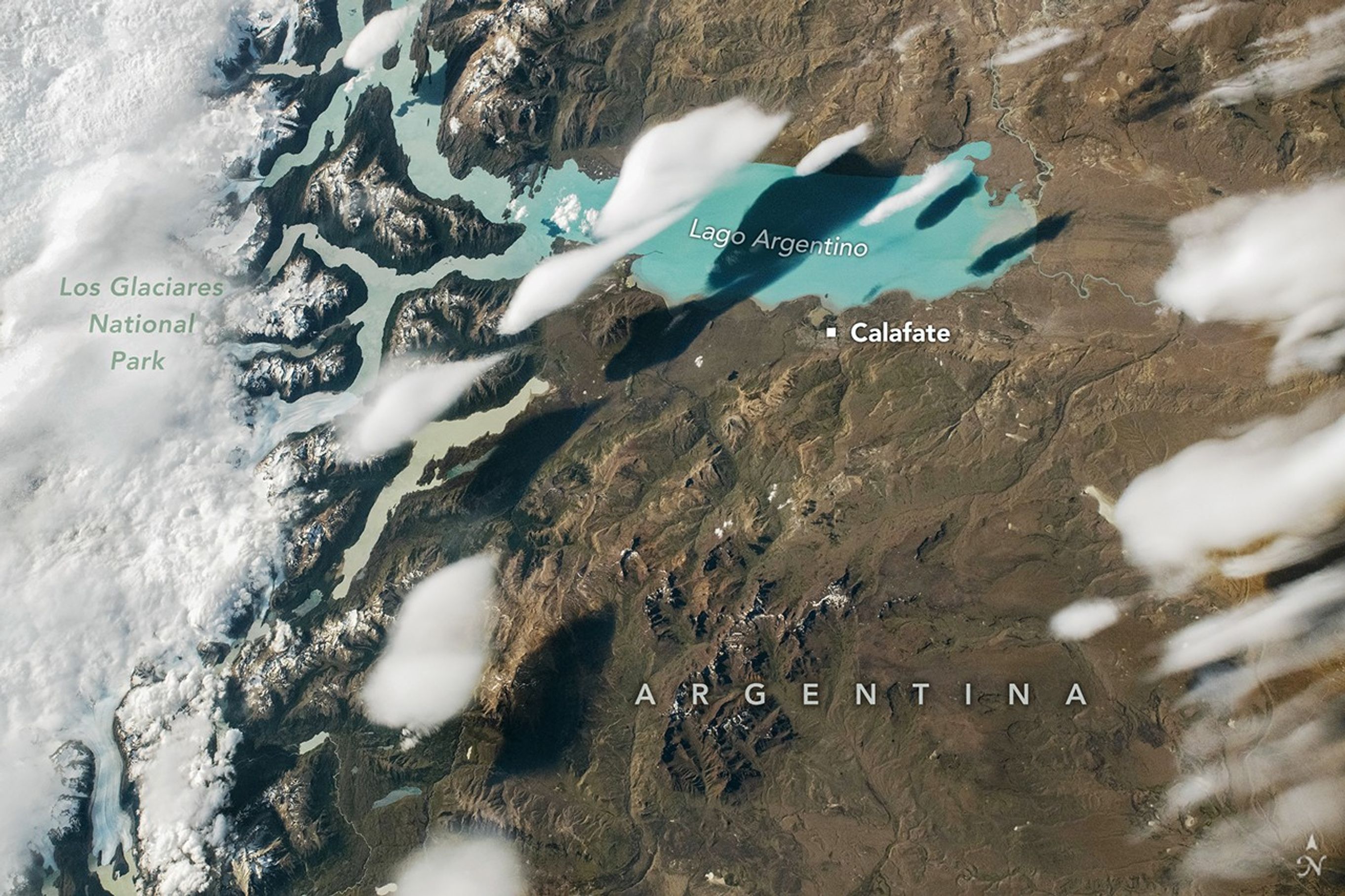
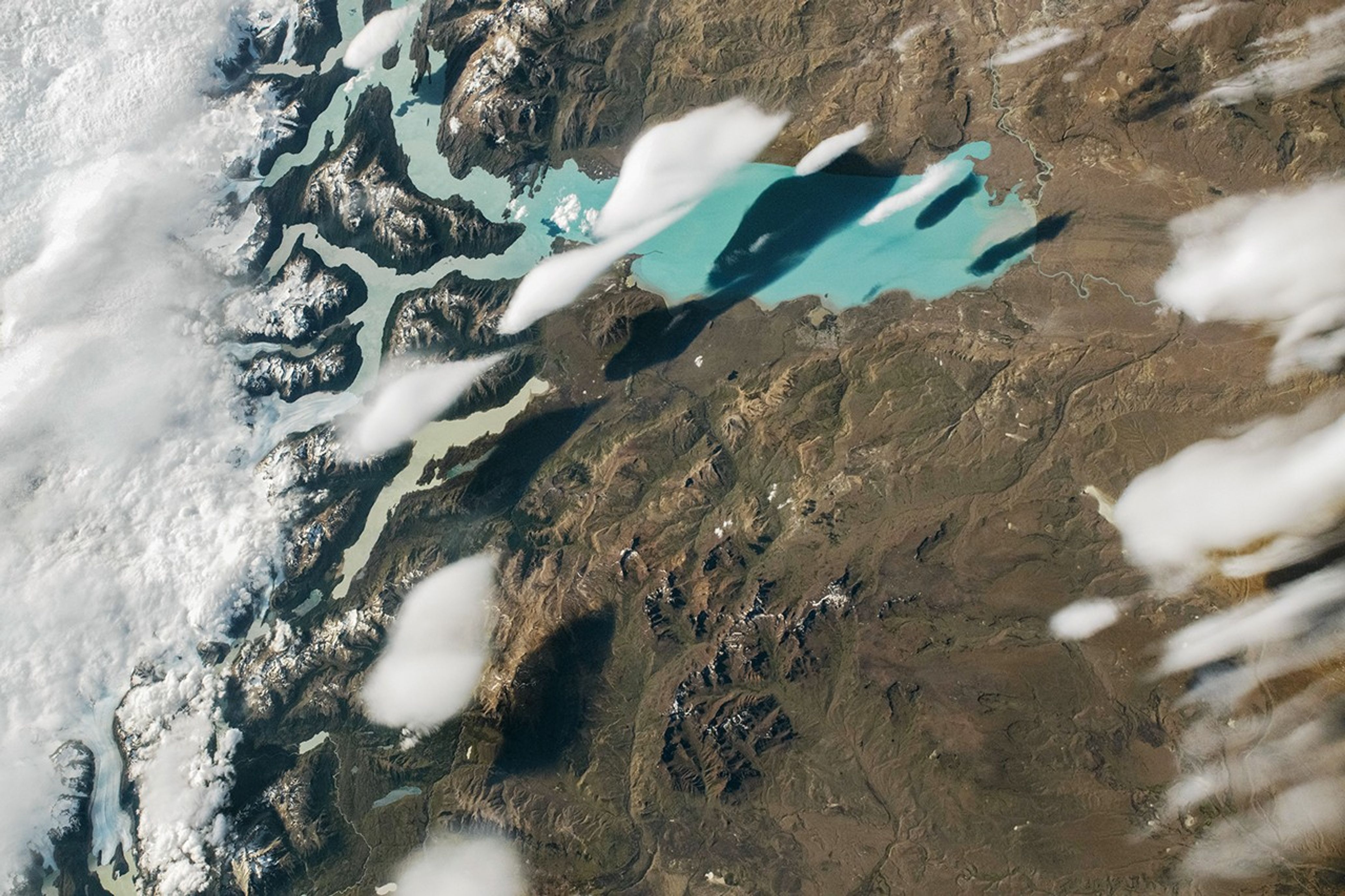
When an astronaut aboard the International Space Station snapped this photograph of Lago Argentino in Patagonia on December 27, 2025, a school of fish-shaped clouds lingered over the glacial lake’s teal waters. Determining the clouds’ type and origin from the photograph alone is challenging, but several NASA scientists and university researchers offered a theory after reviewing the image.
“The lens shape reminds me of lenticular clouds, which usually form near or over mountains,” said Maria Hakuba, a research scientist in the aerosols and clouds group at NASA’s Jet Propulsion Laboratory. “The edges of the cloud also look quite smooth rather than ‘fuzzy,’ which suggests they’re ice clouds that are relatively high up.”
Lenticular clouds form as a result of lee waves, which develop when prevailing winds are forced up and over a topographic barrier, often a mountain range, and when the overlying air is stable. Air expands and cools at the crest of the waves, causing vapor to condense and form cloud droplets. Conversely, air on the other side of the waves descends, warming the air and causing the cloud to evaporate. The result is a set of seemingly stationary clouds that hover in place downwind of mountains. Lenticular clouds are often eye-catching, sometimes described as having shapes like almonds, upside-down dinner plates, lentils, flying saucers, or stacks of pancakes.
Hazem Mahmoud, an atmospheric science lead at NASA’s Langley Research Center, agreed that the clouds were likely lenticular and offered additional insight. MODIS (Moderate Resolution Spectroradiometer) data suggest cloud-top altitudes near 9,200 meters (30,000 feet) and cloud-top temperatures around 220 Kelvin, along with relatively large particle sizes consistent with the presence of ice crystals, he said. “The high altitude and microphysical properties suggest Cirrocumulus lenticularis,” he said.
Strong surface-level winds common in Patagonia likely swept across the glacial lakes of Los Glaciares National Park, forcing unusually moist air over the Andes, producing the lens-shaped clouds. Sublimation—the conversion of ice directly into water vapor—of glacial ice likely contributed to their formation by adding extra moisture into the air, he added.
Wind shear and turbulence may have caused the elongated, trailing appearance that made the clouds resemble a school of fish, Mahmoud explained. These forces stretched and organized the clouds horizontally above the lake, while shadows cast onto the landscape accentuated their forms. “Together these clouds tell a remarkable story of interaction between the lake’s moisture source, the Andes’ dynamic topography, and atmospheric circulation,” he said.
Santiago Gassó, an atmospheric scientist at NASA’s Goddard Space Flight Center, agreed they were likely lenticular clouds, citing the environmental context and Patagonia’s reputation as a hotspot for lenticular cloud formation.
“Very often the clouds here are stationary and trapped by lee waves on the downwind side of the mountains,” Gassó said. “They often don’t precipitate because most of the moisture gets left on the west side of the mountain.” The stereotypical image of lenticular clouds is that they sit stationary at the top of mountains, but in reality, they tend to drift away “depending on the turbulence and flow,” he added.
All three scientists agreed that without analyzing more data, it’s hard to say definitively whether the cloud is lenticular or a type of cumulus. The challenge with a single astronaut photograph or satellite image is that we largely see the cloud-top properties, Mahmoud said. “If we also had lidar or cloud radar data, we could measure the vertical structure and thickness and more confidently differentiate a thin lenticular layer from a deep cumulonimbus column,” he said.
Whether cumulus or lenticular, it’s a coincidence that “fish” is the name atmospheric scientists sometimes use to describe formations of a type of shallow convective cloud found over the ocean. It was one of the patterns, along with “sugar,” “gravel,” and “flowers,” identified by a team of researchers who analyzed decades of MODIS cloud observations.
Readers with a penchant for cloud classification can participate in GLOBE Clouds, a GLOBE citizen science project that makes it possible for students and members of the public to contribute to NASA research projects. As part of the project, participants have the opportunity to use Clouds Wizard, a feature that guides users through cloud identification with a series of interactive questions, animations, and photos.
Astronaut photograph ISS074-E-8940 was acquired on December 27, 2025, with a Nikon Z9 digital camera using a focal length of 116 millimeters. It is provided by the ISS Crew Earth Observations Facility and the Earth Science and Remote Sensing Unit at NASA Johnson Space Center. The image was taken by a member of the Expedition 74 crew. The image has been cropped and enhanced to improve contrast, and lens artifacts have been removed. The International Space Station Program supports the laboratory as part of the ISS National Lab to help astronauts take pictures of Earth that will be of the greatest value to scientists and the public, and to make those images freely available on the Internet. Additional images taken by astronauts and cosmonauts can be viewed at the NASA/JSC Gateway to Astronaut Photography of Earth. Story by Adam Voiland.
References & Resources
- Alexander, J.M. & Teitelbaum, H. (2011) Three-dimensional properties of Andes mountain waves observed by satellite: A case study. Journal of Geophysical Research Atmospheres, 116(D23).
- American Meteorological Society Lenticularis. Accessed January 14, 2026.
- American Meteorological Society Cumulus. Accessed January 14, 2026.
- Bony, S., et al. (2020) Sugar, Gravel, Fish, and Flowers: Dependence of Mesoscale Patterns of Trade-Wind Clouds on Environmental Conditions. Geophysical Research Letters, 47(7), e2019GL085988.
- DLR Institute of Atmospheric Physics (2020, September 7) Discovery of record-breaking mountain waves above the South American Andes. Accessed January 14, 2026.
- The GLOBE Observer What is GLOBE Clouds? Accessed January 14, 2026.
- Mount Washington Observatory A Closer Look at Lenticular Clouds. Accessed January 14, 2026.
- NASA Earth Observatory (2024, September 12) Marvelous Lenticularis. Accessed January 14, 2026.
- Pautet, P.D., et al. (2021) Mesospheric Mountain Wave Activity in the Lee of the Southern Andes. Journal of Geophysical Research: Atmospheres 126(7).
- Smith, R. (2005) Orographic Atmospheric Phenomena in Patagonia: A preliminary survey. Croatian Meteorological Journal, 40(40), 325-328.
- World Meteorological Organization Lenticularis. Accessed January 14, 2026.
You may also be interested in:
Stay up-to-date with the latest content from NASA as we explore the universe and discover more about our home planet.
The Large Magellanic Cloud—one of our closest neighboring galaxies—is a hotbed of star formation that is visible to both astronauts…

The peninsula in eastern Siberia features rugged terrain with towering, snow-covered peaks and cloud-filled valleys stretching between the Pacific Ocean…
A long-exposure photo taken from low Earth orbit captured the brilliant illumination coming from airglow, lightning, and stars.




Powered by WPeMatico