NASA Ships Moon Rocket Stage Ahead of First Crewed Artemis Flight

NASA Ships Moon Rocket Stage Ahead of First Crewed Artemis Flight

The core stage of the Artemis Space Launch System being loaded on a covered barge. The stage is a large cylinder shape with the engines facing toward the camera on two yellow transporters that are guiding the stage into a covered grey container in the background. The body of the cylinder is mostly an orange color and white around the bottom. The four engines on the bottom are covered with red material.
Move teams with NASA and Boeing, the SLS (Space Launch System) core stage lead contractor, position the massive rocket stage for NASA’s SLS rocket on special transporters to strategically guide the flight hardware the 1.3-mile distance from the factory floor onto the agency’s Pegasus barge on July 16. The core stage will be ferried to NASA’s Kennedy Space Center in Florida, where it will be integrated with other parts of the rocket that will power NASA’s Artemis II mission. Pegasus is maintained at NASA’s Michoud Assembly Facility.
Credit: NASA

NASA rolled out the SLS (Space Launch System) rocket’s core stage for the Artemis II test flight from its manufacturing facility in New Orleans on Tuesday for shipment to the agency’s spaceport in Florida. The rollout is key progress on the path to NASA’s first crewed mission to the Moon under the Artemis campaign.

Using highly specialized transporters, engineers maneuvered the giant core stage from inside NASA’s Michoud Assembly Facility in New Orleans to the agency’s Pegasus barge. The barge will ferry the stage more than 900 miles to NASA’s Kennedy Space Center in Florida, where engineers will prepare it in the Vehicle Assembly Building for attachment to other rocket and Orion spacecraft elements.

“With Artemis, we’ve set our sights on doing something big and incredibly complex that will inspire a new generation, advance our scientific endeavors, and move U.S. competitiveness forward,” said Catherine Koerner, associate administrator for NASA’s Exploration Systems Development Mission Directorate at NASA Headquarters in Washington. “The SLS rocket is a key component of our efforts to develop a long-term presence at the Moon.”

Technicians moved the SLS rocket stage from inside NASA Michoud on the 55th anniversary of the launch of Apollo 11 on July 16, 1969. The move of the rocket stage for Artemis marks the first time since the Apollo Program that a fully assembled Moon rocket stage for a crewed mission rolled out from NASA Michoud.

The SLS rocket’s core stage is the largest NASA has ever produced. At 212 feet tall, it consists of five major elements, including two huge propellant tanks that collectively hold more than 733,000 gallons of super-chilled liquid propellant to feed four RS-25 engines. During launch and flight, the stage will operate for just over eight minutes, producing more than 2 million pounds of thrust to propel four astronauts inside NASA’s Orion spacecraft toward the Moon.

“The delivery of the SLS core stage for Artemis II to Kennedy Space Center signals a shift from manufacturing to launch readiness as teams continue to make progress on hardware for all major elements for future SLS rockets,” said John Honeycutt, SLS program manager at NASA’s Marshall Space Flight Center in Huntsville, Alabama. “We are motivated by the success of Artemis I and focused on working toward the first crewed flight under Artemis.”

After arrival at NASA Kennedy, the stage will undergo additional outfitting inside the Vehicle Assembly Building. Engineers then will join it with the segments that form the rocket’s twin solid rocket boosters. Adapters for the Moon rocket that connect it to the Orion spacecraft will be shipped to NASA Kennedy this fall, while the interim cryogenic propulsion stage is already in Florida. Engineers continue to prepare Orion, already at Kennedy, and exploration ground systems for launch and flight.

All major structures for every SLS core stage are fully manufactured at NASA Michoud. Inside the factory, core stages and future exploration upper stages for the next evolution of SLS, called the Block 1B configuration, currently are in various phases of production for Artemis III, IV, and V. Beginning with Artemis III, to better optimize space at Michoud, Boeing, the SLS core stage prime contractor, will use space at NASA Kennedy for final assembly and outfitting activities.

Building, assembling, and transporting the SLS core stage is a collaborative effort for NASA, Boeing, and lead RS-25 engines contractor Aerojet Rocketdyne, an L3Harris Technologies company. All 10 NASA centers contribute to its development with more than 1,100 companies across the United States contributing to its production. 

NASA is working to land the first woman, first person of color, and its first international partner astronaut on the Moon under Artemis. SLS is part of NASA’s backbone for deep space exploration, along with the Orion spacecraft, supporting ground systems, advanced spacesuits and rovers, the Gateway in orbit around the Moon, and commercial human landing systems. SLS is the only rocket that can send Orion, astronauts, and supplies to the Moon in a single launch.

For more on NASA’s Artemis campaign, visit: 

http://www.nasa.gov/artemis

-end- 

Madison Tuttle/Rachel Kraft
Headquarters, Washington
202-358-1600
madison.e.tuttle@nasa.gov/rachel.h.kraft@nasa.gov

Corinne Beckinger 
Marshall Space Flight Center, Huntsville, Ala. 
256-544-0034  
corinne.m.beckinger@nasa.gov

Powered by WPeMatico

Get The Details…
Tiernan P. Doyle

NASA Deputy Administrator Holds First Bilateral Engagement with KASA

NASA Deputy Administrator Holds First Bilateral Engagement with KASA

NASA Deputy Administrator Pam Melroy and senior NASA leaders conduct the first bilateral meeting with KASA’s administrator, Dr. Young-bin Yoon on Monday, July 15, 2024 in Busan, Korea.
NASA/Amber Jacobson

NASA Deputy Administrator Pam Melroy conducted the first bilateral meeting on Monday with Dr. Young-bin Yoon, administrator of the newly established KASA (Korea AeroSpace Administration), which opened on May 27. The creation of KASA underscores the Republic of Korea’s commitment to advancing space exploration.

The bilateral meeting marks a pivotal moment for a NASA’s relationship with KASA, building upon decades of bilateral ties with several Korean ministries and institutions. Melroy emphasized enhancing cooperation under the Artemis program and expanding science collaboration during discussions with Yoon. Looking ahead, NASA and KASA are exploring a wide range of opportunities and fostering innovation in new areas.

Over the past year, the U.S.-Korea space relationship has seen significant progress, highlighted by increased engagements and collaborative initiatives across various space disciplines. These efforts include sharing data from the Korea Pathfinder Lunar Orbiter and leveraging NASA’s Deep Space Network, showcasing Korea’s commitment to open science, and enabling scientists globally to access valuable data for future lunar activities.

Historically, NASA has collaborated across a wide range of disciplines with KARI (Korea Aerospace Research Institute) and KASI (Korea Astronomy and Space Science Institute). The establishment of KASA allows Korea to focus its space efforts under one agency, further enhancing space collaboration and cooperation.

Powered by WPeMatico

Get The Details…
Dacia Massengill

NASA Celebrates 20 Years of Earth-Observing Aura Satellite

NASA Celebrates 20 Years of Earth-Observing Aura Satellite

4 Min Read

NASA Celebrates 20 Years of Earth-Observing Aura Satellite

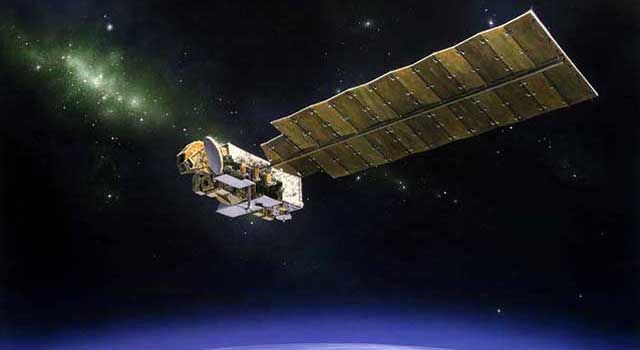
This image is an animated version of the Aura satellite in orbit. The satellite, seen centered in the image, is made up of silver and gold box-like shapes and instruments. Spanning out to the right of the satellite is a long sheet of solar panels. In the background of the image at the bottom is a portion of Earth seen with clouds and a blue haze surrounding it. The top of the background is the deep black of space, with a cluster of green colored stars to the left.
The Aura spacecraft, shown in this artist’s concept, is a NASA atmospheric chemistry mission that monitors Earth’s protective atmosphere.
Credits:
NASA

From monitoring the hole in the ozone above the Antarctic to studying air quality around the entire planet, NASA’s Aura satellite has provided scientists with essential measurements during its two decades in orbit.

“The Aura mission has been nothing short of transformative for scientific research and applied sciences,” said Bryan Duncan, project scientist for NASA’s Aura satellite mission. “The mission’s data have given scientists and applied scientists an unparalleled view of air pollution around the world.”

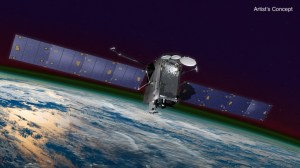
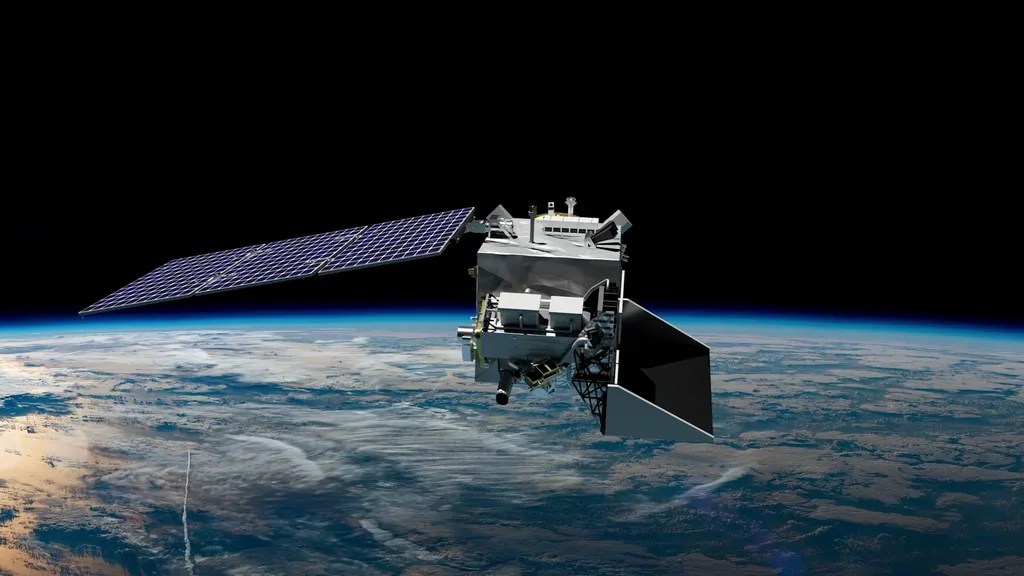
Aura has revealed the effects of industrialization, environmental regulations, wildfires, the COVID-19 pandemic, and many other aspects of the air we breathe. The satellite paved the way for recent missions to study the atmosphere and its inner workings, including PACE and TEMPO. As the Aura mission team celebrates its launch anniversary of July 15, 2004, here are a few of the many highlights from the last 20 years.

Aura Eyes Ozone Hole over Antarctica

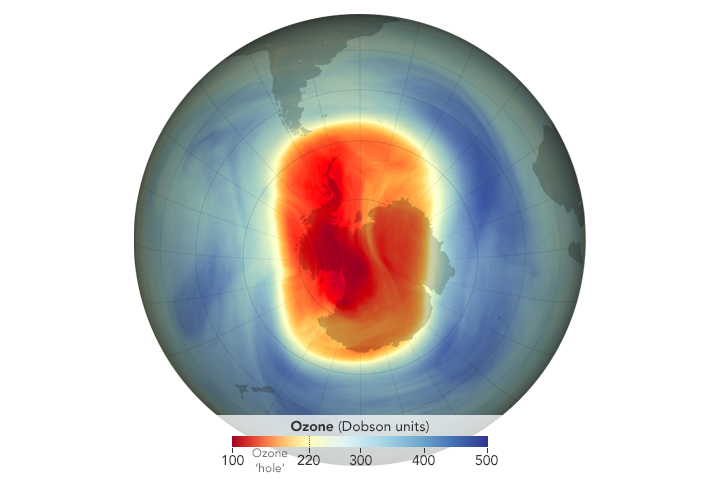
The first publicly released image from the Aura mission (autumn 2004) showed dramatically depleted levels of ozone in the stratosphere over Antarctica.

NASA Study: First Direct Proof of Ozone Hole Recovery Due to Chemicals Ban

In a 2018 study, scientists showed for the first time through direct satellite observations that levels of chlorine in the atmosphere declined, resulting in less ozone depletion. Because of an international ban on chlorine-containing manmade chemicals called chlorofluorocarbons, there was about 20% less ozone depletion during the Antarctic winter in 2016 than there was in 2005. 

New NASA Satellite Maps Show Human Fingerprint on Global Air Quality

Illustrated map of Earth’s landmasses, with data overlaying to show the concentration of nitrogen dioxide in the troposphere. The colors range from light blue (low concentration) to yellow to red (high concentration). Majority of the map is in light blue with splatters of yellow. Red appears concentrated primarily over east Asia and Europe.
This global map shows the concentration of nitrogen dioxide in the troposphere as detected by the Ozone Monitoring Instrument aboard the Aura satellite, averaged over 2014.
NASA

Using high-resolution global maps of air quality indicators made with data from the Aura satellite, NASA scientists tracked air pollution trends between 2005 and 2015 in various regions and 195 cities around the globe. The study found that the United States, Europe, and Japan saw improved air quality due to emission control regulations, while China, India, and the Middle East, with their fast-growing economies and expanding industry, saw more air pollution.

How NASA is Helping the World Breathe More Easily

Many of NASA’s Earth-observing satellites, including Aura, can see what the human eye can’t — including potentially harmful pollutants lingering in the air we breathe. These satellites help us measure and track air pollution as it moves around the globe and have contributed significantly to a decades-long quest for cleaner air. For example, data from Aura’s Ozone Monitoring Instrument helped the EPA and NASA identify a drop in nitrogen dioxide that researchers cited as evidence of the success of the Clean Air Act.

Air Quality: A Tale of Three Cities

Air quality in Beijing, Los Angeles, and Atlanta — like air quality across the globe — is dynamic. This video describes how scientists use instruments like Aura’s Ozone Monitoring Instrument to study questions including what causes ozone, sulfur dioxide, and nitrogen dioxide emissions. It also explores why reductions in volatile organic carbon pollution worked to reduce ground-level ozone in Los Angeles, but not in Atlanta.

Seeing the COVID-19 Pandemic from Space

Economic and social shutdowns in response to the COVID-19 pandemic led to noticeable changes in Earth’s environment, at least in the short term. NASA researchers used satellite and ground-based observations – including nitrogen dioxide levels from Ozone Monitoring Instrument – to track these impacts on our air, land, water, and climate. 

A Satellite’s View of Ship Pollution

With natural-color satellite imagery of the atmosphere over the ocean, scientists have observed “ship tracks” — bright, linear trails amidst the cloud layers that are created by particles and gases from ships. Scientists used Ozone Monitoring Instrument data to detect the almost invisible tracks of nitrogen dioxide along several shipping routes from 2005 to 2012.

First Global Maps of Volcanic Emissions Use NASA Satellite Data

Grayscale map of Indonesia with orange data overlay. The orange is concentrated in a splotch in the bottom middle of the image as well as in the top right.
Volcanic sulfur dioxide emissions from Indonesia’s many volcanoes are shown in shades of orange. The data was produced from observations from NASA’s Aura satellite.

With the Ozone Monitoring Instrument data, researchers compiled emissions data from 2005 to 2015 create the first global inventory for volcanic sulfur dioxide emissions. The data set helped refine climate and atmospheric chemistry models and provided more insight into human and environmental health risks.

Scientists Show Connection Between Gas Flaring and Arctic Pollution

Flaring of excess natural gas from industrial oil fields in the Northern Hemisphere was found to be a potentially significant source of nitrogen dioxide and black carbon emissions polluting the Arctic, according to a 2016 NASA study that included data from Aura.

2023 Ozone Hole Ranks 16th Largest, NASA and NOAA Researchers Find

Researchers continue to rely on Aura data to monitor the Antarctic ozone hole, two decades after the satellite launched. Each Southern Hemisphere spring, NASA and NOAA (National Oceanic and Atmospheric Administration) use satellite and balloon-based measurements to measure the maximum size of the ozone hole. The story above notes the 2023 result; stay tuned for what Aura helps us discover in 2024 and beyond.

Visualization of Earth as seen from the south pole over Antarctica. Data is overlayed, showing the level of ozone in the area. Centered over Antarctica is a red and orange oval, while the rest of the visualization shows dark and light blues.
This map shows the size and shape of the ozone hole over the South Pole on Sept. 21, 2023, the day of its maximum extent that year, as calculated by the NASA Ozone Watch team. Moderate ozone losses (orange) are visible amid widespread areas of more potent ozone losses (red).

By Erica McNamee and Kate Ramsayer

NASA’s Goddard Space Flight Center, Greenbelt, Md.

Share

Details

Last Updated
Jul 16, 2024
Editor
Erica McNamee
Contact
Erica McNamee
Location
Goddard Space Flight Center

Powered by WPeMatico

Get The Details…

Apollo 11 Lifts Off

Apollo 11 Lifts Off

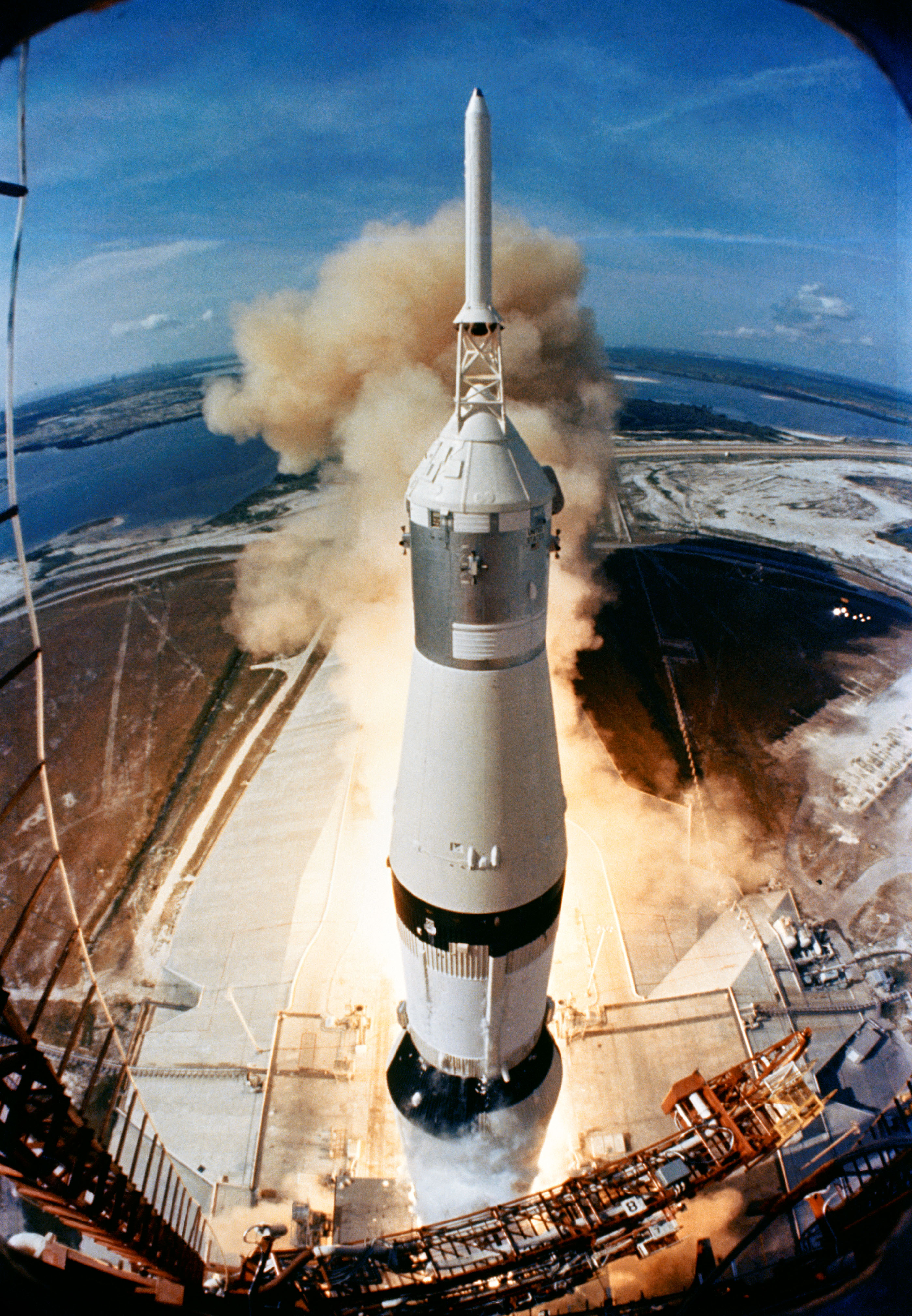
The Apollo 11 spacecraft lifts off from a launchpad. The view looks downward at an angle, so the entirety of the spacecraft is visible. Vapor spreads out behind the rocket. Further in the distance is blue water and sky.
NASA

55 years ago on July 16, 1969, NASA’s Apollo 11 spacecraft launched from the agency’s Kennedy Space Center in Florida, as seen in this photo. Astronauts Neil Armstrong, Michael Collins, and Buzz Aldrin were aboard.

Apollo 11’s primary mission objective was to fulfill a national goal set by President John F. Kennedy on May 25, 1961: perform a crewed lunar landing and return safely to Earth before the decade ended. Additional flight objectives included scientific exploration by the lunar module (LM) crew, deployment of a television camera to transmit signals to Earth, and deployment of a solar wind composition experiment, seismic experiment package, and a Laser Ranging Retroreflector. During the exploration, Armstrong and Aldrin were to gather samples of lunar-surface materials for return to Earth. They also were to extensively photograph the lunar terrain, the deployed scientific equipment, the LM spacecraft, and each other, both with still and motion picture cameras.

Experience the countdown to liftoff.

Image credit: NASA

Powered by WPeMatico

Get The Details…
Monika Luabeya

NASA to Provide Background on Space Station Deorbit Planning

NASA to Provide Background on Space Station Deorbit Planning

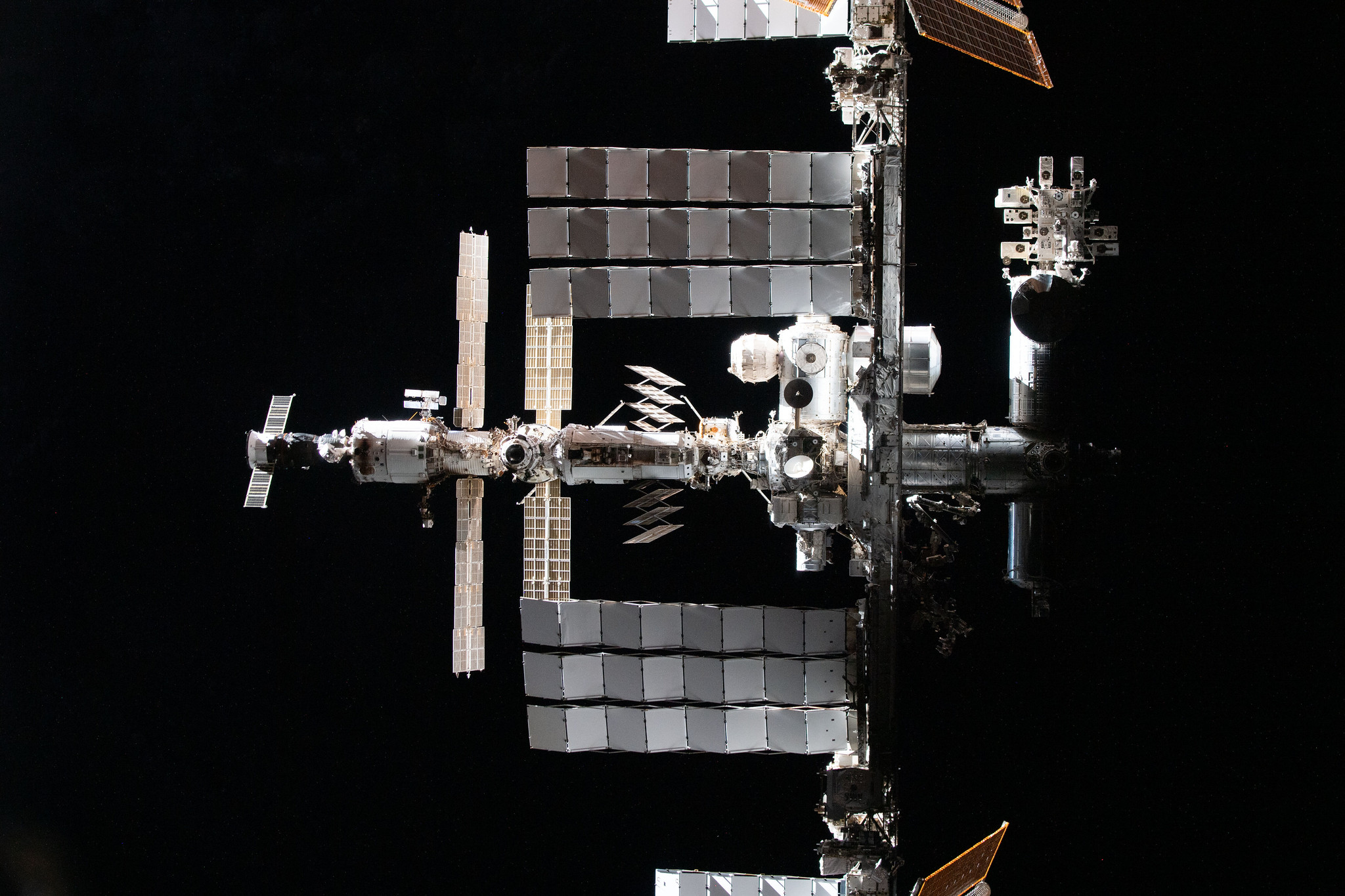
The International Space Station is pictured from the SpaceX Crew Dragon Endeavour during a fly around of the orbiting lab that took place following its undocking from the Harmony module’s space-facing port on Nov. 8, 2021.

NASA is planning for the future in low Earth orbit for science, research, and commercial opportunities as the agency and its international partners maximize the use of the International Space Station.

As the agency fosters new commercial space stations, leadership from NASA and SpaceX will participate in a media teleconference at 2 p.m. EDT Wednesday, July 17, to discuss the company’s selection to develop and deliver the U.S. Deorbit Vehicle, which will safely move the International Space Station out of orbit and into a remote area of an ocean at the end of its operations.

Audio of the teleconference will stream live on the agency’s website:

https://www.nasa.gov/nasatv

Participants include:

  • Ken Bowersox, associate administrator, NASA’s Space Operations Mission Directorate
  • Dana Weigel, manager, NASA’s International Space Station Program
  • Sarah Walker, director, Dragon mission management, SpaceX

Media interested in participating must contact the newsroom at NASA Johnson no later than one hour prior to the start of the call at 281-483-5111 or jsccommu@mail.nasa.gov. A copy of NASA’s media accreditation policy is online.

As the agency transitions to commercially owned space destinations, it is crucial to prepare for the safe and responsible deorbit of the space station in a controlled manner after the end of its operational life in 2030.

Read more about the agency’s International Space Station Deorbit Analysis Summary white paper.

Learn more about space station operations at:

https://www.nasa.gov/station

-end-

Josh Finch / Jimi Russell
Headquarters, Washington
202-358-1100
joshua.a.finch@nasa.gov / james.j.russell@nasa.gov

Sandra Jones
Johnson Space Center, Houston
281-483-5111
sandra.p.jones@nasa.gov

Powered by WPeMatico

Get The Details…
Abbey A. Donaldson