The Earth Observer Editor’s Corner: Summer 2024

The Earth Observer Editor’s Corner: Summer 2024

Editor's Corner header

8 min read

The Earth Observer Editor’s Corner: Summer 2024

Welcome to a new era for The Earth Observer newsletter! This communication marks the official public release of our new website. While this release moves us into a new online future, the newsletter team has worked to ensure the new website also allows for continuity with our publication’s robust 35-year history.  The Executive Editor has written a more detailed overview of our new site that is posted separately.

I am happy to report on the success of several recent launches. The Geostationary Operational Environmental Satellite–U (GOES-U) successfully launched at 5:26 PM Eastern Daylight Time (EDT) on June 25 aboard a SpaceX Falcon Heavy rocket from Launch Complex 39A at NASA’s Kennedy Space Center in Florida.

GOES-U (renamed GOES-19 after reaching geostationary orbit on July 8) is the fourth and final satellite in the GOES-R Series, providing advanced imagery and atmospheric measurements, real-time mapping of lightning activity, and space weather observations. Once the checkout phase is complete, NASA will hand operational control to NOAA. After checkout, the plan is for GOES-19 to replace GOES-16 (originally GOES–R) as GOES-East. GOES-19 will work in tandem with GOES-18 (GOES–T), NOAA’s GOES-West satellite, to enable observations from the west coast of Africa to New Zealand.

In addition to its critical role in terrestrial weather prediction, the GOES constellation of satellites helps forecasters predict near Earth space weather that can interfere with satellite and terrestrial electronics and communication. The GOES-U satellite goes beyond the capabilities of its predecessors with a new space weather instrument, the Compact Coronagraph-1 (CCOR-1), which blocks light from the solar disk to allow imagery of the faint solar corona, providing low latency observations for detecting coronal mass ejections.

Speaking of space weather, Solar Cycle 25 is nearing its peak, which typically results in an increase in solar activity and geomagnetic storms. A particularly intense geomagnetic storm took place in mid-May 2024—the strongest in over two decades The G5 storm culminated in a remarkable display of the aurora overnight—in both hemispheres—on May 10–11, visible from many areas worldwide—including latitudes where sightings of auroras are uncommon. It also caused concerns for the safety of some of NASA’s Earth science satellite missions, although fortunately there was no lasting impact.

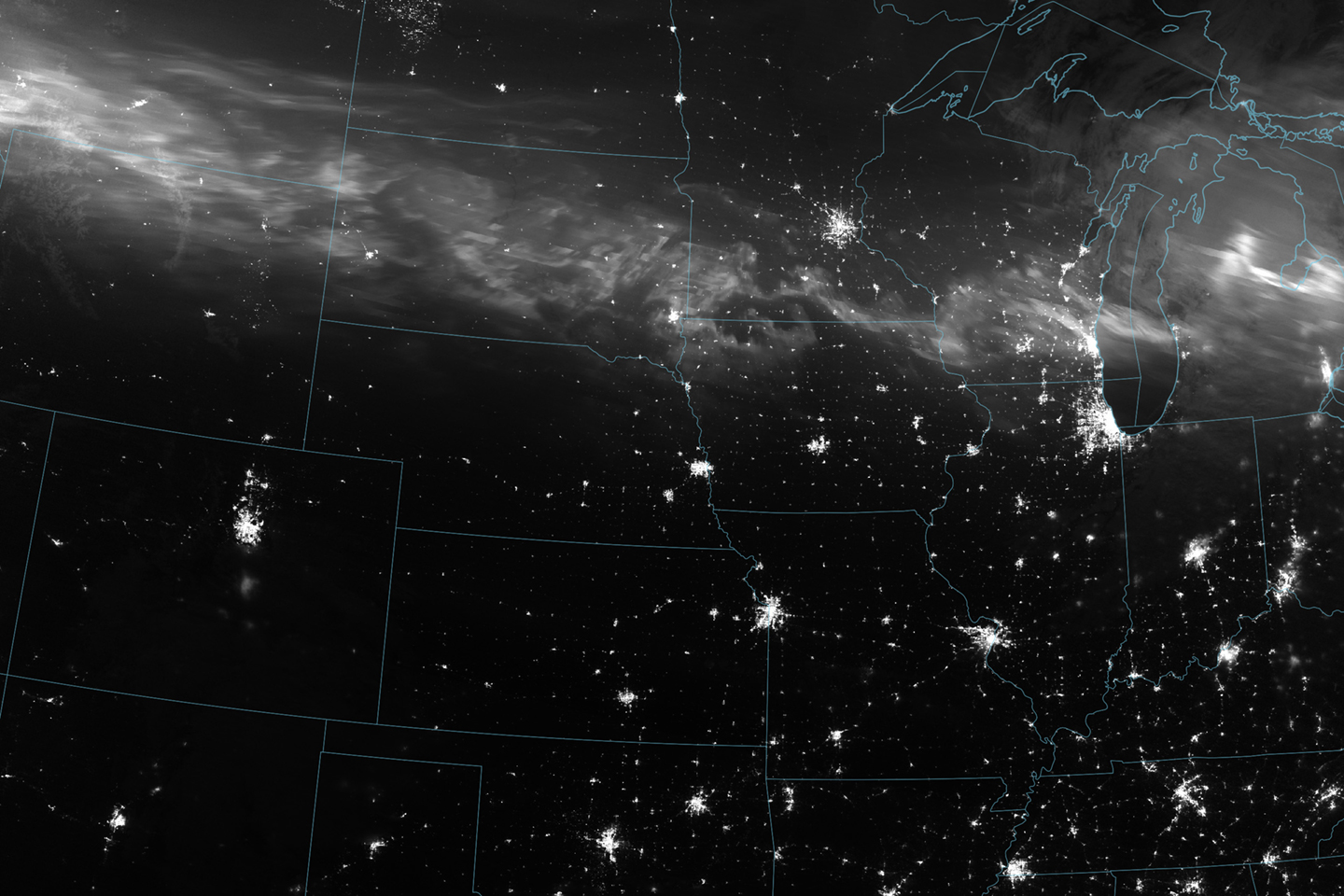
The aurora produced by the storm could be observed from the day-night band on the NASA–NOAA Suomi NPP Visible Infrared Imaging Radiometer Suite (VIIRS) that is sensitive enough to detect nighttime light across a broad band of wavelengths (green to near-infrared) to observe signals such as city lights, reflected moonlight, and auroras. VIIRS captured the image shown below on the night of May 11, 2024. 
Editor's Corner Figure
Figure. The day-night band on Visible Infrared Imaging Radiometer Suite (VIIRS) captured this image of the aurora borealis that occurred on the night of May 11, 2024, as the culminating event of a particularly intense geomagnetic storm that occurred in May 2024. In this view, the northern lights appear as a bright white strip across parts of Montana, Wyoming, the Dakotas, Minnesota, Wisconsin, Iowa, and Michigan. 
Figure credit: NASA’s Earth Observatory

There were two deployments from the International Space Station (ISS) as part of NASA’s Earth Science Technology Office (ESTO) In-Space Validation of Earth Science Technologies (InVEST) program. The SigNals Of Opportunity: P-band Investigation (SNOOPI) was launched on March 21 from NASA’s Cape Canaveral Space Force Station to the International Space Station aboard SpaceX’s Dragon cargo spacecraft (CRS-30) as part of the company’s thirtieth commercial resupply mission. On April 21, the instrument was released into orbit from the station. The SNOOPI mission will demonstrate and validate the in-space use of P-band (~300 MHz) signals of opportunity to measure root zone soil moisture and snow water equivalent, reducing the risk of utilizing this technique on future space missions. SNOOPI will also verify important assumptions about reflected signal coherence, robustness to the RFI environment, and the ability to capture and process the transmitted signal in space. James Garrison [Purdue University] is PI for SNOOPI, with co-investigators from GSFC.

The Hyperspectral Thermal Imager (HyTI) CubeSat was also flown aboard CRS-30 and deployed from the ISS. HyTI is a technology demonstration mission by the University of Hawaiiʻi at Mānoa designed to demonstrate how high spatial resolution (60-m ground resolution), high spectral resolution (25 bands), and long-wave infrared image data can be acquired to monitor water resources using a 6U CubeSat. Robert Wright [University of Hawaiʻi at Mānoa] is principal investigator for HyTI.

NASA is conducting the Arctic Radiation Cloud Aerosol Surface Interaction Experiment (ARCSIX) over the Arctic Ocean north of Greenland this spring and summer. Altogether, about 75 scientists (including sea ice surface researchers, aerosol researchers, and cloud researchers), along with instrument operators and flight crew, are participating in ARCSIX’s two phases based out of Pituffik Space Base in northwest Greenland. The first three-week deployment, from late May to mid-June of this year, was timed to document the start of the ice melt season. The second deployment will occur in late July and August to monitor late summer conditions leading up to the freeze-up period.

As part of ARCSIX, NASA is flying two of its aircraft, with the first flights having occurred on May 28, 2024. The P-3 Orion aircraft from NASA’s Wallops Flight Facility flies at relatively low altitudes to characterize sea ice surface properties, the optical and microphysical properties of cloud and aerosol particles, atmospheric chemistry, radiative fluxes, and other lower atmospheric properties. At the same time, a Gulfstream III aircraft, managed by NASA’s Langley Research Center, flies at higher altitudes to provide hyperspectral imagery and obtain atmospheric profiles, adding a perspective similar to those of orbiting satellites.

Two members of NASA’s Earth observing fleet celebrate milestone anniversaries this summer. The third of NASA’s EOS Flagships—Aura—marks 20 years in orbit on July 15. During the 1990s and early 2000s, an international team of engineers and scientists worked together to design the first integrated observatory for studying atmospheric composition. This was a “bold endeavor” at the time, intended to provide unprecedented detail essential to understanding how Earth’s ozone layer and air quality respond to changes in atmospheric composition caused by both human activities and natural phenomena, a key NASA Earth science objective. The Aura spacecraft (Latin for “breeze” and “air”) was launched on July 15, 2004, with its four instruments.

Twenty years later, the spacecraft and two of its instruments, the Microwave Limb Sounder (MLS) and Ozone Monitoring Instrument (OMI), are in remarkable shape, which is a testament to Aura’s solid engineering. MLS and OMI are remarkably stable, allowing for the continuation of their science- and trend-quality datasets. However, all good things must come to an end. Insufficient solar power generation will require that data collection end in mid-2026. In the meantime, MLS and OMI will continue to monitor the everchanging composition of Earth’s atmosphere. I extend my congratulations to Bryan Duncan [GSFC—Aura Project Scientist] and the entire Aura team, past and present, on this remarkable achievement.

On July 2, 2024, the Orbiting Carbon Observatory-2 (OCO-2) celebrated ten years since its launch, marking a decade of gold-standard measurements of carbon dioxide (CO2) from space. OCO-2 was originally designed as a pathfinder mission to measure CO2 with the precision and accuracy needed to quantify regional sources and sinks of this key greenhouse gas.

OCO-2 has tracked the relentless rise of CO2 in our atmosphere and has provided unprecedented information on where, when, and how CO2 is released into and removed from the atmosphere. OCO-2 data have provided new insights into how CO2 emissions are offset by natural carbon sinks such as forests and oceans. The data have demonstrated that spaceborne measurements can be used to accurately quantify CO2 emissions from power plants and cities. The long-term, global record has also been used to examine the two-way interactions between CO2 and climate. As the length of the data record has increased, OCO-2 is beginning to be able to provide policy-relevant information and to address an ever more diverse range of carbon cycle science questions. Because of the mission’s success, NASA now has two instruments in space monitoring Earth’s carbon cycle. OCO-2’s spare parts were repurposed and nested as OCO-3 on the International Space Station in 2019. OCO-2 is unique among NASA missions in providing near-global sampling in combination with the spectral resolution and signal to noise needed to provide CO2 with the sensitivity required to inform studies of the natural carbon cycle as well as anthropogenic sources. The OCO-2 mission has been and will remain a key element of any U.S. or international greenhouse gas observational network to enhance our scientific understanding of the carbon cycle and inform climate mitigation efforts. Congratulations to Vivienne Payne [JPL—OCO-2 Principal Investigator] and the entire OCO-2 team on this noteworthy achievement.

The Earth Observer plans more in-depth feature coverage of both these missions celebrating milestones in July over the coming months. Last but certainly not least, I would like to congratulate Sarah Ringerud [GSFC] on being chosen as the Deputy Project Scientist for the Global Precipitation Measurement (GPM) mission. Ringerud holds a Ph.D. in Atmospheric Science with an emphasis on Remote Sensing from Colorado State University. Ringerud is a research meteorologist at GSFC, leading projects focused on GPM and future mission concepts. Her expertise lies in satellite algorithm development, particularly for microwave instruments, and she actively collaborates with government and academic partners to advance the field of precipitation remote sensing. Congratulations to Sarah and best wishes in her new role. 

Steve Platnick
EOS Senior Project Scientist
steven.e.platnick@nasa.gov

Share

Details

Last Updated

Jul 18, 2024

Powered by WPeMatico

Get The Details…

The Earth Observer’s 35th Anniversary

The Earth Observer’s 35th Anniversary

The Earth Observer 35th Anniversary Banner

3 min read

The Earth Observer’s 35th Anniversary

Welcome to a new era for The Earth Observer newsletter! Our 35th anniversary also marks the official public release of our new website. Over the past year and a half, The Earth Observer has migrated from a print publication (the last printed issue was November–December 2022) to publishing PDFs online only (final PDF issue published in May 2024) to publishing individual articles on our new site. While this move shifts The Earth Observer’s format to be more in line with that of other online publications, our intent is for the content to remain distinctive. Readers can expect to continue receiving the same quality reporting on NASA Earth Science activities that they have come to depend on from The Earth Observer for over 35 years.

The release of the website coincides with a historical milestone for The Earth Observer. It was 35 years ago – in March 1989 – that the first print issue of the newsletter was produced. At that time, The Earth Observer was a crucial communication tool for the initial group of investigators for the Earth Observing System (EOS), which had been selected that same year. They depended on the periodic delivery of the newsletter to their physical mailboxes to keep them informed about decisions made at recent science team and payload panel meetings, and other activities related to the program.  

As communication technologies have evolved, so has The Earth Observer. The interweaving tale of the evolution of EOS and The Earth Observer has been told in previous issues of our publication. (For example, see  The Earth Observer: Twenty-Five Years Telling NASA’s Earth Science Story in the March–April 2014 issue [Volume 26Issue 2, pp. 4–13] and  A Thirtieth Anniversary Reflection by the Executive Editor in the March–April 2019 issue [Volume 31Issue 2 – online version, pp. 1–4.) Publishing content online marks the next step in the evolution of The Earth Observer

On the new website, readers will find overlapping content from our November–December 2023 and final PDF issues – as well as original content. To maintain a sense of continuity with our past, the content is organized much like previous issues. There are separate sections for Feature Articles, Meeting Summaries, News Content, and “The Editor’s Corner,” as well as Calendars for NASA and Global Science Community activities. 

Given The Earth Observer’s focus on history, and in keeping with the organization of our previous website, the new site also includes an Archives section where readers can view PDFs of all previous issues of The Earth Observer. There is also a listicle in which our team has compiled links to many of our most popular historical articles. In addition to articles written to mark anniversaries of The Earth Observer (including the two referenced earlier), the page contains a link to the popular Perspectives on EOS Series. These articles originally ran in The Earth Observer from 2008–2011, with each article focusing on a particular aspect (or aspects) of the early history of EOS from the perspective of someone who lived it. There are also links to articles that have been written to mark milestone anniversaries for satellite missions and observing networks, and to summaries of several symposia that include historical information.

We hope readers find this collection of historical information a useful link to the past as The Earth Observer moves full speed ahead into its digital future.

Share

Details

Last Updated

Jul 18, 2024

Related Terms

Powered by WPeMatico
Get The Details…

Artemis II Core Stage on the Move

Artemis II Core Stage on the Move

An aerial view of the Artemis II SLS core stage on a road. The core stage is a massive orange and white cylinder with four silver and red engines at the bottom. There are two vehicles on the road behind the core stage, highlighting its size. The road curves up from bottom left of the photo to the top middle, where it ends at a body of water. The land surrounding the road is a bright green.
NASA/Eric Bordelon & Michael DeMocker

On July 16, 2024, the first core stage of NASA’s SLS (Space Launch System) rocket for the agency’s Artemis II mission began a journey from NASA’s Michoud Assembly Facility in New Orleans. The core stage was moved onto the agency’s Pegasus barge, where it will be ferried 900 miles to NASA’s Kennedy Space Center in Florida. Once at Kennedy, engineers will prepare it in the Vehicle Assembly Building for attachment to other rocket and Orion spacecraft elements.

The SLS rocket’s core stage is the largest NASA has ever produced. At 212 feet tall, it consists of five major elements, including two huge propellant tanks that collectively hold more than 733,000 gallons of super-chilled liquid propellant to feed four RS-25 engines. During launch and flight, the stage will operate for just over eight minutes, producing more than 2 million pounds of thrust to propel four astronauts inside NASA’s Orion spacecraft toward the Moon.

Watch a timelapse video of the SLS core stage rollout.

Image credit: NASA/Eric Bordelon & Michael DeMocker

Powered by WPeMatico

Get The Details…
Monika Luabeya

Registration Opens for the 2024 NASA International Space Apps Challenge

Registration Opens for the 2024 NASA International Space Apps Challenge

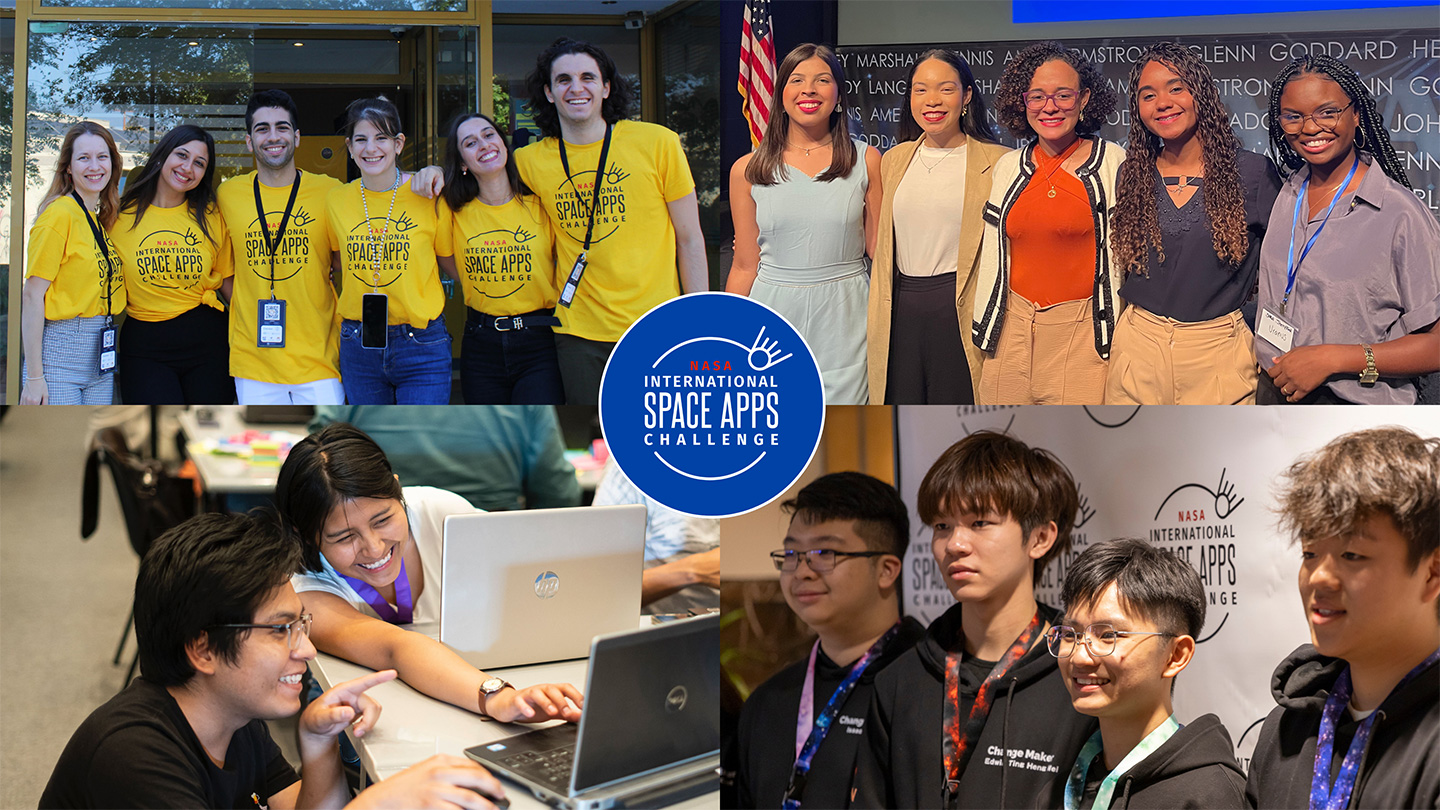
A montage showing several participants in NASA's Space Apps Challenge.

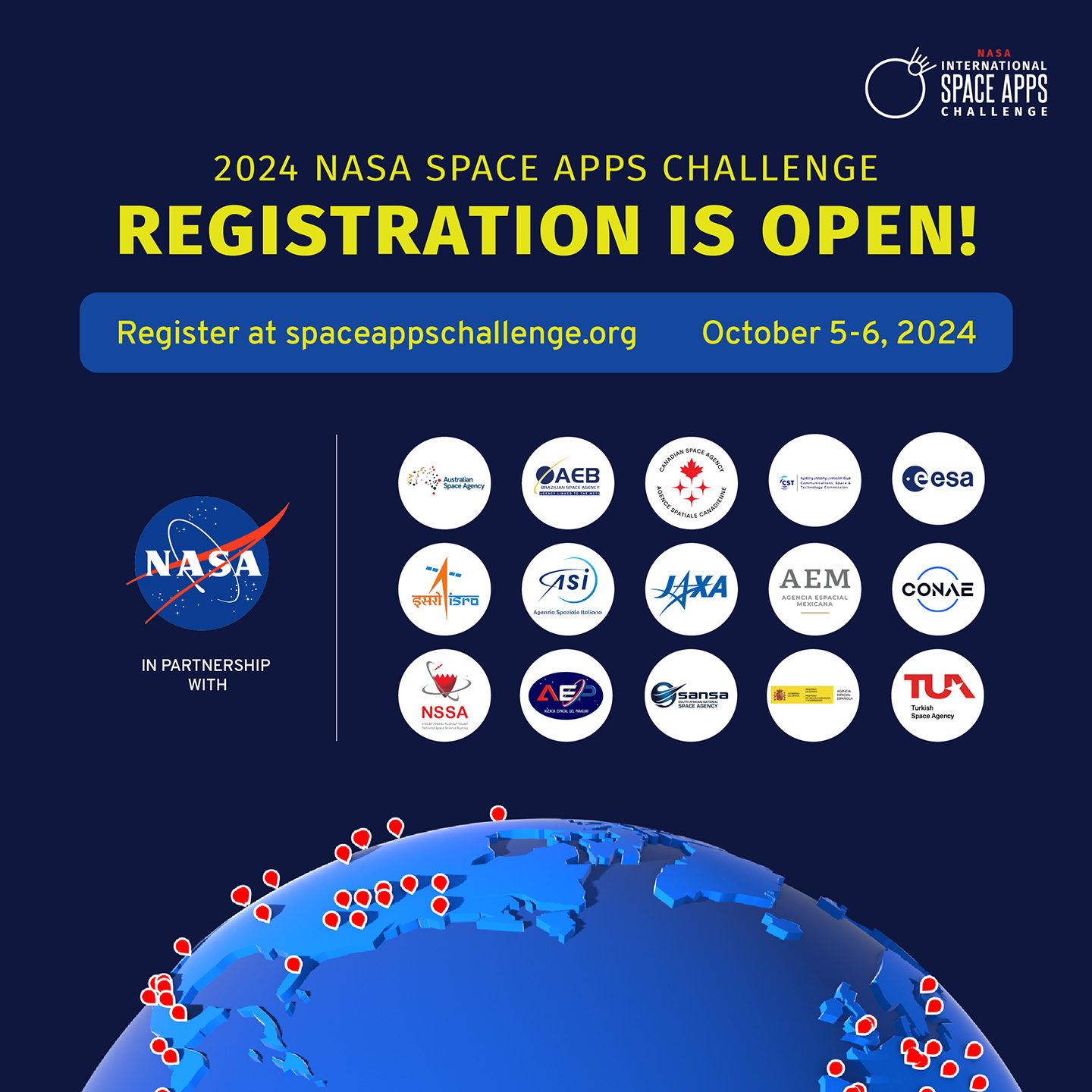
NASA invites a global community of innovators, technologists, storytellers, and problem solvers to register for the 2024 NASA Space Apps Challenge, the largest annual global hackathon. The annual event,  held this year on October 5-6, fosters innovation through international collaboration by providing an opportunity for participants to utilize NASA’s free and open data and space-based data from space agency partners.

“It takes a variety of skills and perspectives to launch a mission into space, and NASA’s Space Apps Challenge brings people together across cultures and borders toward solving real world problems on Earth and in space,” said Nicky Fox, associate administrator for the Science Mission Directorate at NASA Headquarters in Washington. “I am excited that this year’s NASA Space Apps Challenge participants will join in our global Heliophysics Big Year celebration. I look forward to seeing all the innovative ideas that our future generation puts forth.”

This year, the NASA Space Apps Challenge welcomes 15 international space agency partners, including two new agencies: the Communications, Space & Technology Commission of Saudi Arabia and the Spanish Space Agency. NASA Space Apps also welcomes back the Australian Space Agency, Brazilian Space Agency, Canadian Space Agency, European Space Agency, Indian Space Research Organization, Italian Space Agency, Japan Aerospace Exploration Agency, Mexican Space Agency, National Space Activities Commission of Argentina, National Space Science Agency of Bahrain, Paraguayan Space Agency, South African National Space Agency, and the Turkish Space Agency.

2023 NASA Space Apps Challenge registration is open -- Register at spaceappschallenge.org

During the NASA Space Apps Challenge, participants around the world gather at hundreds of simultaneous in-person and virtual local events to address challenges submitted by subject matter experts across NASA divisions. These challenges range in complexity and topic, tasking participants with everything from creating artistic visualizations of NASA data to conceptualizing and developing informational apps and software programs.

In keeping with this year’s theme, “The Sun Touches Everything,” NASA Space Apps invites participants to consider the far-reaching influence of the Sun on Earth and space science. The theme connects participants with NASA’s Heliophysics Division’s celebration of the Helio Big Year.

After the hackathon, project submissions are judged by space agency experts. Winners are selected for one of 10 global awards and invited to an in-person celebration with NASA leadership and subject matter experts.

NASA Space Apps is funded by NASA’s Earth Science Division through a contract with Booz Allen Hamilton, Mindgrub, and SecondMuse. The theme for the 2024 NASA Space Apps Challenge is funded by NASA Heliophysics Division.

We invite you to register for the 2024 NASA Space Apps Challenge and choose a virtual or in-person local event near you at:

 spaceappschallenge.org

Stay up to date with #SpaceApps by following these accounts:

X: @SpaceApps

Instagram: @nasa_spaceapps

Facebook: @spaceappschallenge

YouTube: @NASASpaceAppsChallenge

Powered by WPeMatico

Get The Details…

NASA Ames Welcomes New Zealand Prime Minister, Celebrates Partnership 

NASA Ames Welcomes New Zealand Prime Minister, Celebrates Partnership 

1 min read

Preparations for Next Moonwalk Simulations Underway (and Underwater)

Ames Center Director Eugene Tu, left, and New Zealand Prime Minister Christopher Luxon, left, pose in front of the NASA Advanced Supercomputing facility hyperwall as it displays New Zealand and Earth’s ocean currents.
NASA/ Brandon Torres Navarrete

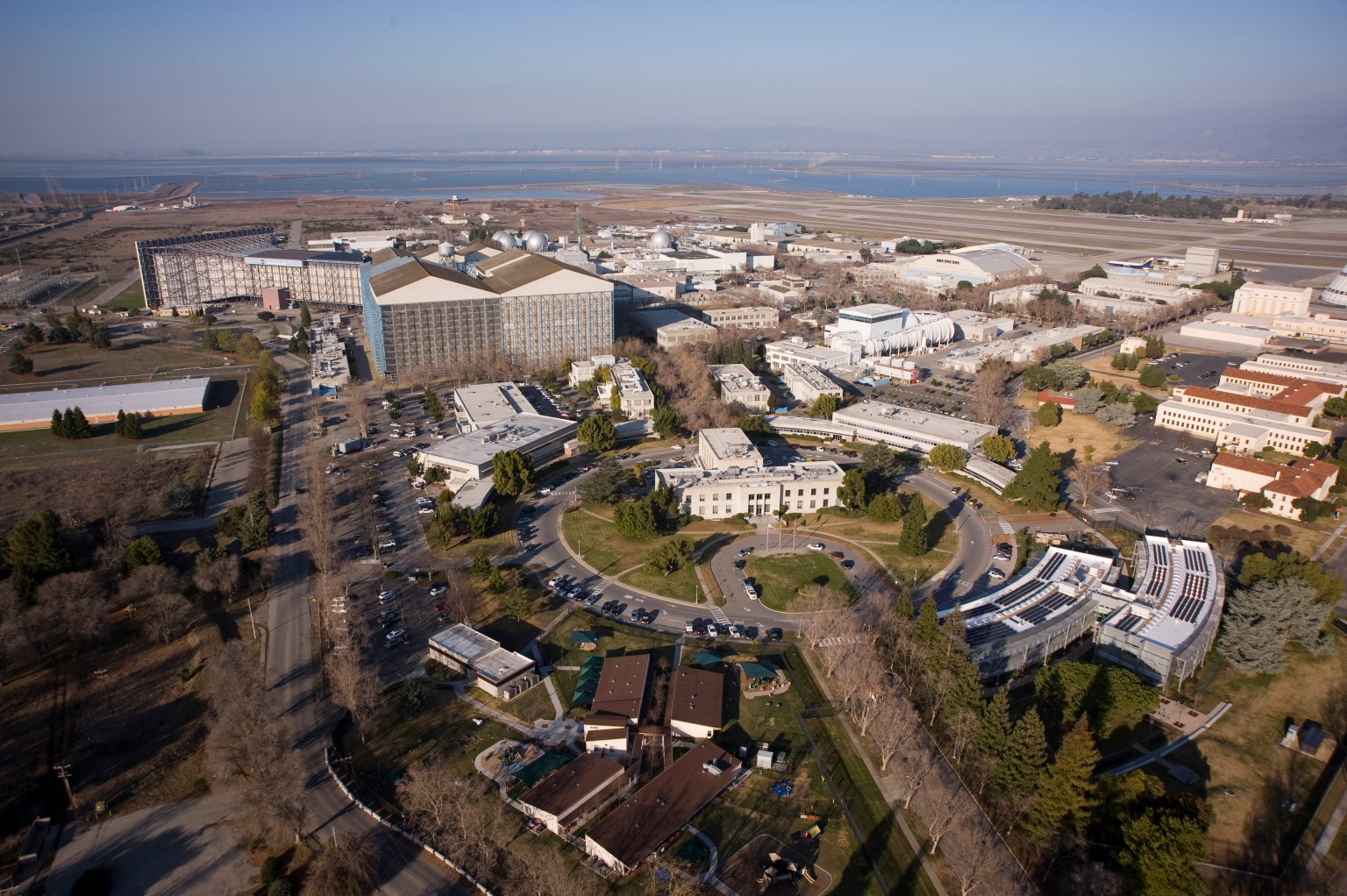
As one of eight nations that helped to develop the Artemis Accords, New Zealand is a valuable NASA partner. On July 12, New Zealand Prime Minister Christopher Luxon visited NASA’s Ames Research Center in California’s Silicon Valley to learn more about how Ames supports efforts to return humans to the Moon and the ongoing collaboration between NASA and New Zealand to observe and study Earth’s interconnected systems. 

Share

Details

Last Updated

Jul 18, 2024

Powered by WPeMatico

Get The Details…
Tara Friesen