Cygnus Arrives at Station, Astronauts Unpack New Science

Cygnus Arrives at Station, Astronauts Unpack New Science
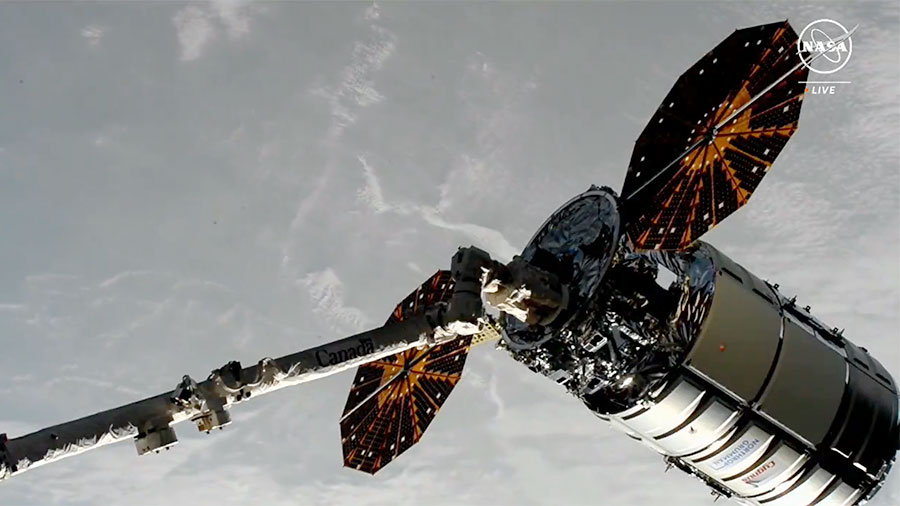
The Cygnus space freighter is pictured in the grips of the Canadarm2 robotic arm shortly after its capture delivering 8,200 pounds of science and supplies to the orbital outpost. Credit: NASA TV

Northrop Grumman’s Cygnus cargo craft has arrived at its new home for the next six months and the International Space Station residents have begun unloading some of its 8,200 pounds of science and supplies.

NASA Flight Engineer Matthew Dominick captured Cygnus with the Canadarm2 robotic arm at 3:11 a.m. EDT on Tuesday following its automated approach and rendezvous. The maneuver marked the 50th free-flying capture for Canadarm2. Just over two hours later mission controllers on Earth remotely commanded the Canadarm2 and installed Cygnus to the Unity module’s Earth-facing port where it will stay until January. Cygnus began its trip to the orbital outpost with a launch atop a SpaceX Falcon 9 rocket from Florida at 11:02 a.m. EDT on Sunday.

Dominick later joined NASA Flight Engineer Jeanette Epps and conducted cable connections and leak checks before opening Cygnus’ hatch and entering the space freighter for the first time. Next, the rest of the NASA astronauts including Tracy C. Dyson, Mike Barratt, Suni Williams, and Butch Wilmore started offloading research samples stowed in Cygnus and preserved in portable science freezers and double coldbags. Those samples were then placed inside station science freezers in preparation for upcoming research. The orbital residents will soon be exploring liquid and gas flows, centripetal force, DNA repair mechanisms, cellular expansion, and more.

During a break in the cargo activities Dominick set up photography gear in the cupola and took pictures of the Moon to measure sunshine reflected from the Earth. Dyson worked in the Destiny laboratory module and connected a microscope to an advanced research incubator to support space biology investigations.

The orbital lab’s three cosmonauts representing Roscosmos stayed focused on their science and maintenance schedule throughout Tuesday. Commander Oleg Kononenko began his morning setting up carbon dioxide monitors and installing Earth observation hardware. During the afternoon, the five-time station visitor studied futuristic planetary piloting techniques on a computer. Flight Engineer Alexander Grebenkin attached sensors to himself measuring his heart activity during an hour-and-a-half long relaxation session. Next, he jogged on a treadmill for a fitness test before ending his day with computer maintenance in the Nauka science module. Flight Engineer Nikolai Chub worked throughout the day servicing hardware batteries and exercise gear.


Learn more about station activities by following the space station blog@space_station and @ISS_Research on X, as well as the ISS Facebook and ISS Instagram accounts.

Get weekly video highlights at: https://roundupreads.jsc.nasa.gov/videoupdate/

Get the latest from NASA delivered every week. Subscribe here: www.nasa.gov/subscribe

Powered by WPeMatico

Get The Details…

Mark Garcia

Doomed Star Eta Carinae

Doomed Star Eta Carinae

Hubble image of Eta Carinae

Eta Carinae may be about to explode. But no one knows when – it may be next year, it may be one million years from now. Eta Carinae’s mass – about 100 times greater than our Sun – makes it an excellent candidate for a full blown supernova. Historical records do show that about 170 years ago Eta Carinae underwent an unusual outburst that made it one of the brightest stars in the southern sky. Eta Carinae, in the Keyhole Nebula, is the only star currently thought to emit natural LASER light.

This featured image brings out details in the unusual nebula that surrounds this rogue star. Diffraction spikes, caused by the telescope, are visible as bright multi-colored streaks emanating from Eta Carinae’s center. Two distinct lobes of the Homunculus Nebula encompass the hot central region, while some strange radial streaks are visible in red extending toward the image right. The lobes are filled with lanes of gas and dust which absorb the blue and ultraviolet light emitted near the center. The streaks, however, remain unexplained.

NASA, ESA, Hubble; Processing & License: Judy Schmidt

Powered by WPeMatico

Get The Details…
Gary Daines

Doomed Star Eta Carinae

Doomed Star Eta Carinae

Hubble image of Eta Carinae

Eta Carinae may be about to explode. But no one knows when – it may be next year, it may be one million years from now. Eta Carinae’s mass – about 100 times greater than our Sun – makes it an excellent candidate for a full blown supernova. Historical records do show that about 170 years ago Eta Carinae underwent an unusual outburst that made it one of the brightest stars in the southern sky. Eta Carinae, in the Keyhole Nebula, is the only star currently thought to emit natural LASER light.

This featured image brings out details in the unusual nebula that surrounds this rogue star. Diffraction spikes, caused by the telescope, are visible as bright multi-colored streaks emanating from Eta Carinae’s center. Two distinct lobes of the Homunculus Nebula encompass the hot central region, while some strange radial streaks are visible in red extending toward the image right. The lobes are filled with lanes of gas and dust which absorb the blue and ultraviolet light emitted near the center. The streaks, however, remain unexplained.

NASA, ESA, Hubble; Processing & License: Judy Schmidt

Powered by WPeMatico

Get The Details…
Gary Daines

NASA to Provide Crew Flight Test, Space Station Missions Update

NASA to Provide Crew Flight Test, Space Station Missions Update

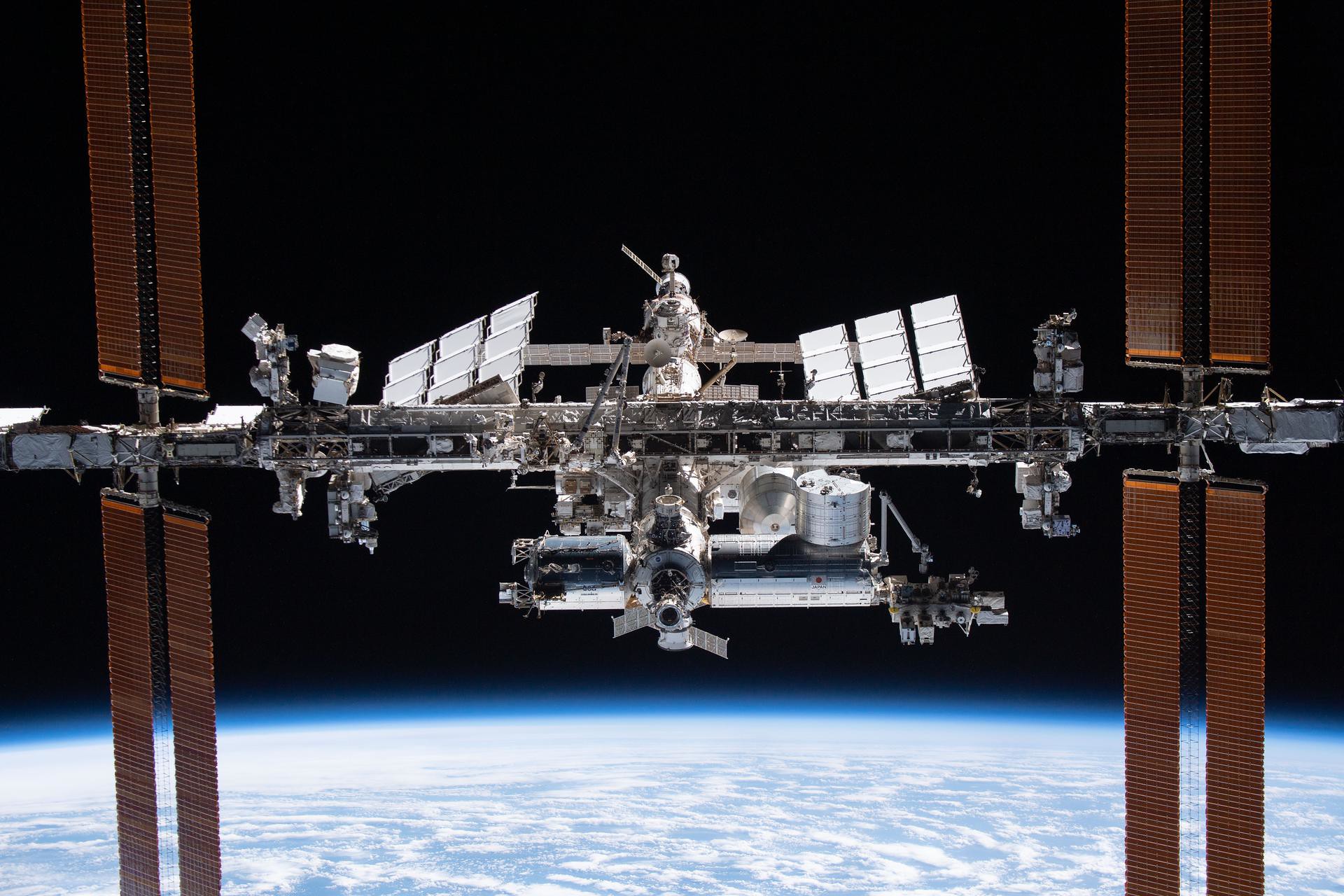
The International Space Station flies 263 miles above the Marshall Islands in the Pacific Ocean.
The International Space Station was pictured flying 263 miles above the Marshall Islands in the Pacific Ocean.
Credit: NASA

NASA will host a media teleconference at 12:30 p.m. EDT, Wednesday, Aug. 7, to discuss ongoing International Space Station operations, including the agency’s Boeing Crew Flight Test and NASA’s SpaceX Crew-9 mission.  

Audio of the briefing will stream live on NASA’s website.

Agency participants include:

  • Ken Bowersox, associate administrator, Space Operations Mission Directorate
  • Steve Stich, manager, Commercial Crew Program
  • Dana Weigel, manager, International Space Station Program

To ask questions during the teleconference, media must RSVP no later than two hours prior to the start of the call to Jimi Russell at: james.j.russell@nasa.gov. NASA’s media accreditation policy is available online.

For more than two decades, people have lived and worked continuously aboard the International Space Station, advancing scientific knowledge, demonstrating new technologies, and making research breakthroughs not possible on Earth. The station is a critical testbed for NASA to understand and overcome the challenges of long-duration spaceflight and to expand commercial opportunities in low Earth orbit. As commercial companies focus on providing human space transportation services and destinations as part of a robust low Earth orbit economy, NASA’s Artemis campaign is underway at the Moon, where the agency is preparing for future human exploration of Mars.

For more information about the International Space Station, visit:

https://www.nasa.gov/international-space-station

-end-

Josh Finch / Jimi Russell
Headquarters, Washington
202-358-1100
joshua.a.finch@nasa.gov / james.j.russell@nasa.gov

Powered by WPeMatico

Get The Details…
Tiernan P. Doyle

NASA to Provide Crew Flight Test, Space Station Missions Update

NASA to Provide Crew Flight Test, Space Station Missions Update

The International Space Station flies 263 miles above the Marshall Islands in the Pacific Ocean.
The International Space Station was pictured flying 263 miles above the Marshall Islands in the Pacific Ocean.
Credit: NASA

NASA will host a media teleconference at 12:30 p.m. EDT, Wednesday, Aug. 7, to discuss ongoing International Space Station operations, including the agency’s Boeing Crew Flight Test and NASA’s SpaceX Crew-9 mission.  

Audio of the briefing will stream live on NASA’s website.

Agency participants include:

  • Ken Bowersox, associate administrator, Space Operations Mission Directorate
  • Steve Stich, manager, Commercial Crew Program
  • Dana Weigel, manager, International Space Station Program

To ask questions during the teleconference, media must RSVP no later than two hours prior to the start of the call to Jimi Russell at: james.j.russell@nasa.gov. NASA’s media accreditation policy is available online.

For more than two decades, people have lived and worked continuously aboard the International Space Station, advancing scientific knowledge, demonstrating new technologies, and making research breakthroughs not possible on Earth. The station is a critical testbed for NASA to understand and overcome the challenges of long-duration spaceflight and to expand commercial opportunities in low Earth orbit. As commercial companies focus on providing human space transportation services and destinations as part of a robust low Earth orbit economy, NASA’s Artemis campaign is underway at the Moon, where the agency is preparing for future human exploration of Mars.

For more information about the International Space Station, visit:

https://www.nasa.gov/international-space-station

-end-

Josh Finch / Jimi Russell
Headquarters, Washington
202-358-1100
joshua.a.finch@nasa.gov / james.j.russell@nasa.gov

Powered by WPeMatico

Get The Details…
Tiernan P. Doyle