NASA to Launch 8 Scientific Balloons From New Mexico

NASA to Launch 8 Scientific Balloons From New Mexico

4 min read

Preparations for Next Moonwalk Simulations Underway (and Underwater)
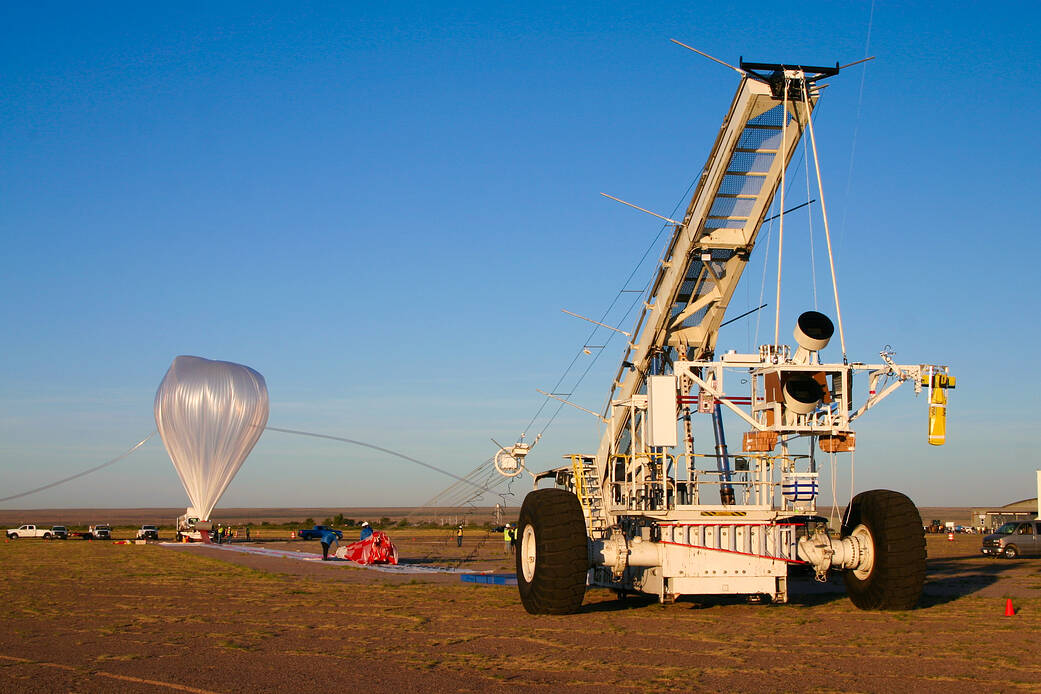
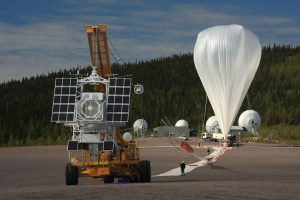
A crane holds a science instrument as a large scientific balloon, tethered to the ground, inflates before liftoff in New Mexico.
A scientific balloon is inflated for the Salter Test Flight before being released during NASA’s 2023 fall balloon campaign. The test flight returns for the 2024 campaign in Fort Sumner, New Mexico, carrying several smaller payloads.
NASA/Andrew Hynous

NASA’s Scientific Balloon Program has kicked off its annual fall balloon campaign at the agency’s balloon launch facility in Fort Sumner, New Mexico. Eight balloon flights carrying scientific experiments and technology demonstrations are scheduled to launch from mid-August through mid-October.

The flights will support 16 missions, including investigations in the fields of astrophysics, heliophysics, and atmospheric research.

“The annual Fort Sumner campaign is the cornerstone of the NASA Balloon Program operations,” said Andrew Hamilton, acting chief of NASA’s Balloon Program Office. “Not only are we launching a large number of missions, but these flights set the foundation for follow-on missions from our long-duration launch facilities in Antarctica, New Zealand, and Sweden. The Fort Sumner campaign is also a strong focus for our student-based payloads and is an excellent training opportunity for our up-and-coming scientists and engineers.”

Returning to the fall lineup is the EXCITE (Exoplanet Climate Infrared Telescope) mission led by Peter Nagler, principal investigator, NASA’s Goddard Space Flight Center in Greenbelt, Maryland. EXCITE features an astronomical telescope developed to study the atmospheric properties of Jupiter-type exoplanets from near space. EXCITE’s launch was delayed during the 2023 campaign due to weather conditions.

“The whole EXCITE team is looking forward to our upcoming field campaign and launch opportunity from Fort Sumner,” said Nagler. “We’re bringing a more capable instrument than we did last year and are excited to prove EXCITE from North America before we bring it to the Antarctic for our future long-duration science flight.”

Some additional missions scheduled to launch include:

  • Salter Test Flight: The test flight aims to verify system design and support several smaller payloads on the flight called piggyback missions.
  • HASP 1.0 (High-Altitude Student Platform): This platform supports up to 12 student payloads and assists in training the next generation of aerospace scientists and engineers. It is designed to flight test compact satellites, prototypes, and other small payloads.
  • HASP 2.0 (High-Altitude Student Platform 2): This engineering test flight of the upgraded gondola and systems for the HASP program aims to double the carrying capability of student payloads.
  • DR-TES (mini-Dilution Refrigerator and a Transition Edge Sensor): This flight will test a cooling system and a gamma-ray detector in a near-space environment.
  • TIM Test Flight (Terahertz Intensity Mapper): This experiment will study galaxy evolution and the history of cosmic star formation.
  • THAI-SPICE (Testbed for High-Acuity Imaging ­­– ­­­Stable Photometry and Image-motion Compensation Experiment): The goal of this project is to build and demonstrate a fine-pointing system for stratospheric payloads with balloon-borne telescopes. 
  • TinMan (Thermalized Neutron Measurement Experiment): This hand-launch mission features a 60-pound payload designed to help better understand how thermal neutrons may affect aircraft electronics.

An additional eight piggyback missions will ride along on flights to support science and technology development. Three of these piggyback missions are technology demonstrations led by the balloon program team at NASA’s Wallops Flight Facility in Virginia. Their common goal is to enhance the capabilities of NASA balloon missions. CASBa (Comprehensive Avionics System for Balloons) aims to upgrade the flight control systems for NASA balloon missions. DINGO (Dynamics INstrumentation for GOndolas) and SPARROW-5 (Sensor Package for Attitude, Rotation, and Relative Observable Winds – Five) are technology maturation projects designed to provide new sensing capabilities to NASA balloon missions.

Zero-pressure balloons, used in this campaign, are in thermal equilibrium with their surroundings as they fly. They maintain a zero-pressure differential with ducts that allow gas to escape to prevent an increase in pressure from inside the balloons as they rise above Earth’s surface. This zero-pressure design makes the balloons very robust and well-suited for short, domestic flights, such as those in this campaign. The loss of lift gas during the day-to-night cycle affects the balloon’s altitude after repeated day-to-night cycles; however, this can be overcome by launching from the polar regions, such as Sweden or Antarctica, where the Sun does not set on the balloon in the summer.

To follow the missions in the 2024 Fort Sumner fall campaign, visit NASA’s Columbia Scientific Balloon Facility website for real-time updates of balloons’ altitudes and locations during flight.

NASA’s Wallops Flight Facility in Virginia manages the agency’s scientific balloon flight program with 10 to 15 flights each year from launch sites worldwide. Peraton, which operates NASA’s Columbia Scientific Balloon Facility (CSBF) in Palestine, Texas, provides mission planning, engineering services, and field operations for NASA’s Scientific Balloon Program. The CSBF team has launched more than 1,700 scientific balloons over some 40 years of operations. NASA’s balloons are fabricated by Aerostar. The NASA Scientific Balloon Program is funded by the Science Mission Directorate’s Astrophysics Division at NASA Headquarters in Washington. 

For more information on NASA’s Scientific Balloon Program, visit: https://www.nasa.gov/scientificballoons 

By Olivia Littleton
NASA’s Wallops Flight Facility, Wallops Island, Va.

Share

Details

Last Updated

Aug 09, 2024

Editor
Olivia F. Littleton
Contact
Olivia F. Littleton
Location
Wallops Flight Facility

Powered by WPeMatico

Get The Details…
Olivia F. Littleton

NASA Tests Deployment of Roman Space Telescope’s ‘Visor’

NASA Tests Deployment of Roman Space Telescope’s ‘Visor’

In this clip, engineers are testing the the Nancy Grace Roman Space Telescope’s Deployable Aperture Cover. This component is responsible for keeping light out of the telescope barrel. It will be deployed once in orbit using a soft material attached to support booms and remains in this position throughout the observatory’s lifetime. Credit: NASA’s Goddard Space Flight Center

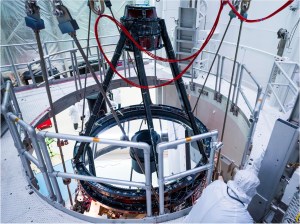
The “visor” for NASA’s Nancy Grace Roman Space Telescope recently completed several environmental tests simulating the conditions it will experience during launch and in space. Called the Deployable Aperture Cover, this large sunshade is designed to keep unwanted light out of the telescope. This milestone marks the halfway point for the cover’s final sprint of testing, bringing it one step closer to integration with Roman’s other subsystems this fall.

Designed and built at NASA’s Goddard Space Flight Center in Greenbelt, Maryland, the Deployable Aperture Cover consists of two layers of reinforced thermal blankets, distinguishing it from previous hard aperture covers, like those on NASA’s Hubble. The sunshade will remain folded during launch and deploy after Roman is in space via three booms that spring upward when triggered electronically. 

“With a soft deployable like the Deployable Aperture Cover, it’s very difficult to model and precisely predict what it’s going to do — you just have to test it,” said Matthew Neuman, a Deployable Aperture Cover mechanical engineer at Goddard. “Passing this testing now really proves that this system works.”

Roman's Deployable Aperture Cover
After a successful test deployment at NASA’s Goddard Space Flight Center in Greenbelt, Md., clean room technicians inspect the Deployable Aperture Cover for NASA’s Nancy Grace Roman Space Telescope.
NASA/Chris Gunn

During its first major environmental test, the sunshade endured conditions simulating what it will experience in space. It was sealed inside NASA Goddard’s Space Environment Simulator — a massive chamber that can achieve extremely low pressure and a wide range of temperatures. Technicians placed the DAC near six heaters — a Sun simulator — and thermal simulators representing Roman’s Outer Barrel Assembly and Solar Array Sun Shield. Since these two components will eventually form a subsystem with the Deployable Aperture Cover, replicating their temperatures allows engineers to understand how heat will actually flow when Roman is in space. 

When in space, the sunshade is expected to operate at minus 67 degrees Fahrenheit, or minus 55 degrees Celsius. However, recent testing cooled the cover to minus 94 degrees Fahrenheit, or minus 70 degrees Celsius — ensuring that it will work even in unexpectedly cold conditions. Once chilled, technicians triggered its deployment, carefully monitoring through cameras and sensors onboard. Over the span of about a minute, the sunshade successfully deployed, proving its resilience in extreme space conditions.

“This was probably the environmental test we were most nervous about,” said Brian Simpson, project design lead for the Deployable Aperture Cover at NASA Goddard. “If there’s any reason that the Deployable Aperture Cover would stall or not completely deploy, it would be because the material became frozen stiff or stuck to itself.”

Brian Simpson, product design lead at NASA’s Goddard Space Flight Center, adjusts sensors on the Deployable Aperture Cover for NASA’s Nancy Grace Roman Space Telescope. The sensors will collect data on the DAC’s response to testing.
NASA/Chris Gunn

If the sunshade were to stall or partially deploy, it would obscure Roman’s view, severely limiting the mission’s science capabilities.

After passing thermal vacuum testing, the sunshade underwent acoustic testing to simulate the launch’s intense noises, which can cause vibrations at higher frequencies than the shaking of the launch itself. During this test, the sunshade remained stowed, hanging inside one of Goddard’s acoustic chambers — a large room outfitted with two gigantic horns and hanging microphones to monitor sound levels. 

With the sunshade plastered in sensors, the acoustic test ramped up in noise level, eventually subjecting the cover to one full minute at 138 decibels — louder than a jet plane’s takeoff at close range! Technicians attentively monitored the sunshade’s response to the powerful acoustics and gathered valuable data, concluding that the test succeeded.

Roman's Deployable Aperture Cover
Technicians prepare for acoustic testing at NASA’s Goddard Space Flight Center in Greenbelt, Md. During testing, the Deployable Aperture Cover for NASA’s Nancy Grace Roman Space Telescope was suspended in the air and exposed to 138 decibels for one full minute to simulate launch’s intense noise.
NASA/Chris Gunn

“For the better part of a year, we’ve been building the flight assembly,” Simpson said. “We’re finally getting to the exciting part where we get to test it. We’re confident that we’ll get through with no problem, but after each test we can’t help but breathe a collective sigh of relief!”

Next, the Deployable Aperture Cover will undergo its two final phases of testing. These assessments will measure the sunshade’s natural frequency and response to the launch’s vibrations. Then, the Deployable Aperture Cover will integrate with the Outer Barrel Assembly and Solar Array Sun Shield this fall.

For more information about the Roman Space Telescope, visit NASA’s website. To virtually tour an interactive version of the telescope, visit:

https://roman.gsfc.nasa.gov/interactive

The Nancy Grace Roman Space Telescope is managed at NASA’s Goddard Space Flight Center in Greenbelt, Maryland, with participation by NASA’s Jet Propulsion Laboratory and Caltech/IPAC in Southern California, the Space Telescope Science Institute in Baltimore, and a science team comprising scientists from various research institutions. The primary industrial partners are BAE Systems, Inc in Boulder, Colorado; L3Harris Technologies in Rochester, New York; and Teledyne Scientific & Imaging in Thousand Oaks, California.

Download high-resolution video and images from NASA’s Scientific Visualization Studio

By Laine Havens
NASA’s Goddard Space Flight Center, Greenbelt, Md.

Media contact:
Claire Andreoli
claire.andreoli@nasa.gov

NASA’s Goddard Space Flight Center, Greenbelt, Md.
301-286-1940

Share

Details

Last Updated

Aug 09, 2024

Editor
Ashley Balzer
Contact
Ashley Balzer
Location
Goddard Space Flight Center

Powered by WPeMatico

Get The Details…
Ashley Balzer

Hubble Spotlights a Supernova

Hubble Spotlights a Supernova

2 min read

Hubble Spotlights a Supernova

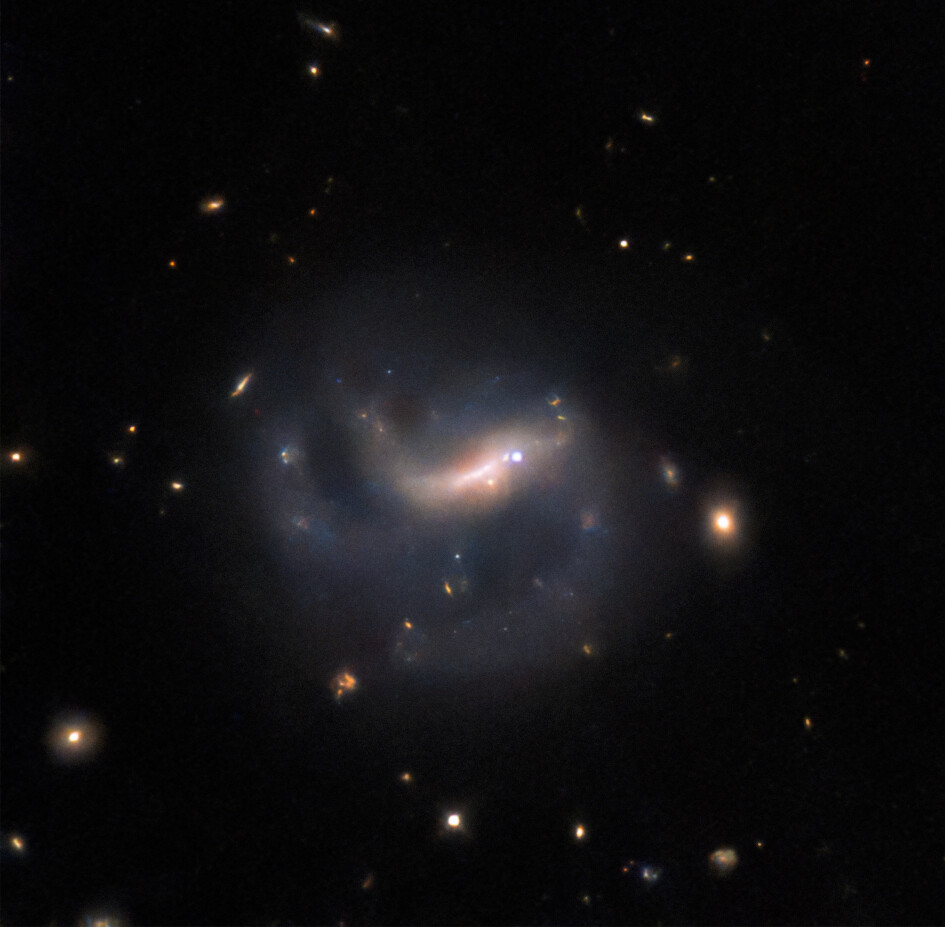
A close-in view of a barred spiral galaxy. A bright, glowing bar crosses the center of the galaxy, with blurred spiral arms curving away from its ends and continuing out of view. Bright points of light that indicate stars and background galaxies surround the featured barred spiral galaxy. The galaxy also hosts a bright supernova in its central bar, just right of image center.
This NASA/ESA Hubble Space Telescope image reveals the galaxy LEDA 857074.
Credit: ESA/Hubble & NASA, R. J. Foley

This NASA/ESA Hubble Space Telescope image features the galaxy LEDA 857074, located in the constellation Eridanus. LEDA 857074 is a barred spiral galaxy, with partially broken spiral arms. The image also captured a supernova, named SN 2022ADQZ, shining brightly on the right side of the galaxy’s bar.

Several evolutionary paths can lead to a supernova explosion. One is the death of a supermassive star. When a supermassive star runs out of its hydrogen fuel, it begins a stage where it fuses the remaining elements to heavier and heavier ones. These final fusion reactions generate less and less outward force (radiation pressure) to balance the star’s gravitational tug inward. As heavier elements form in the star’s core, the core itself begins to fully collapse under its own gravity, and the star’s outer layers blast away in a supernova explosion. Depending on the star’s original mass, its core may collapse to nothing but neutrons, leaving behind a neutron star, or its gravity may be so great that it collapses to a black hole.

Astronomers detected supernova SN 2022ADQZ with an automated survey in late 2022. This discovery led them to look at the supernova’s host galaxy, LEDA 857074, with Hubble in early 2023.

Hubble’s sharp vision means that it can see supernovae that are billions of light years away and difficult for other telescopes to study. A supernova image from the ground usually blends in with the image of its host galaxy, but Hubble can distinguish a supernova’s light from its host galaxy’s, measuring the supernova directly.

Astronomers detect thousands of supernovae annually, but the chance that they spot one in any particular galaxy of the millions that are cataloged is slim. Thanks to this supernova, LEDA 857074 joins the ranks of other celestial objects with its own Hubble image.

Explore More

Media Contact:

Claire Andreoli
NASA’s Goddard Space Flight CenterGreenbelt, MD
claire.andreoli@nasa.gov

Powered by WPeMatico

Get The Details…

NASA Mission Concludes After Years of Successful Asteroid Detections

NASA Mission Concludes After Years of Successful Asteroid Detections

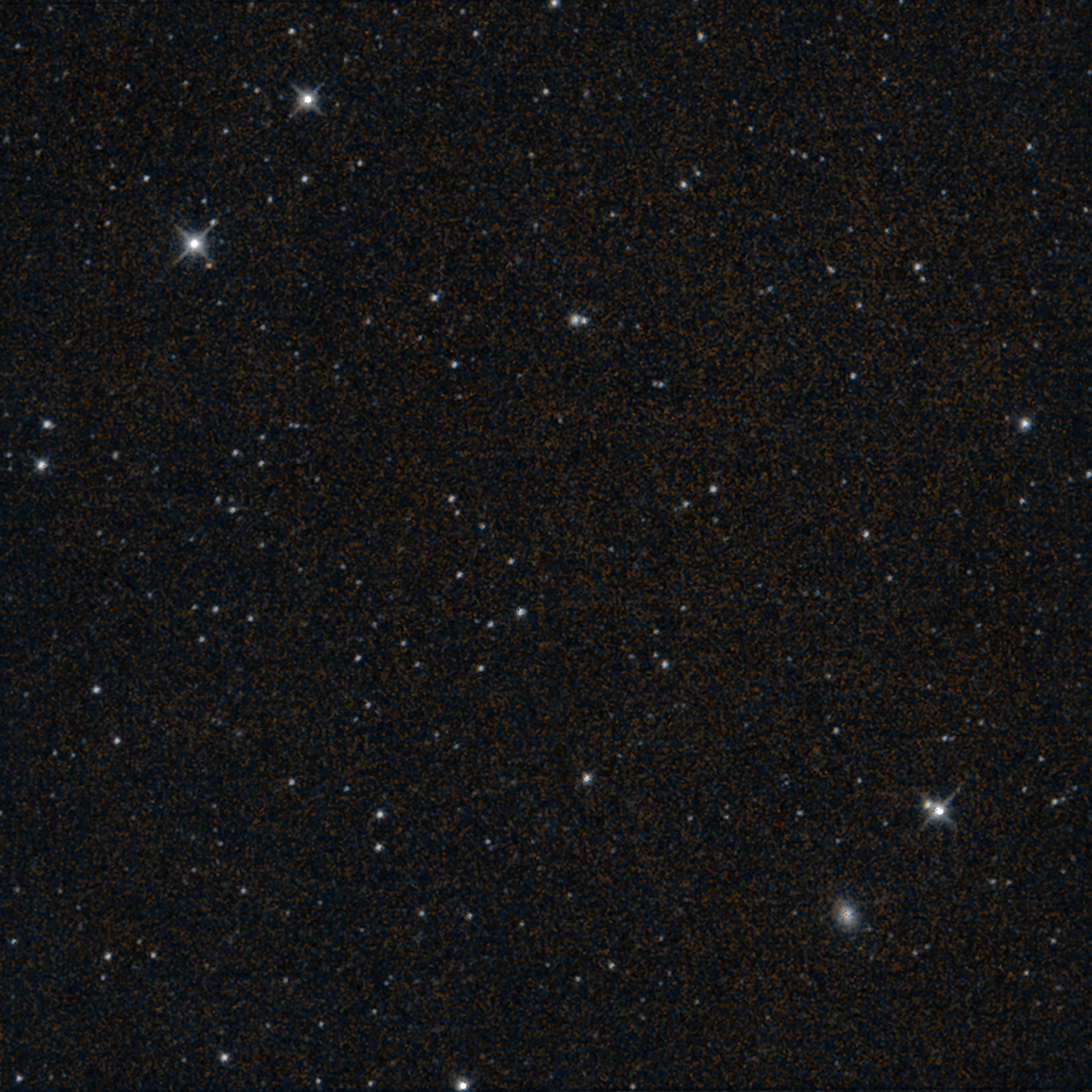
An image captured by NASA’s NEOWISE shows part of the Fornax constellation in the Southern Hemisphere.
This final image captured by NASA’s NEOWISE shows part of the Fornax constellation in the Southern Hemisphere. Processed by IPAC at Caltech, this is the mission’s 26,886,704th exposure. It was taken by the spacecraft just before 3 a.m. EDT on Aug. 1, when the mission’s survey ended.
Credits: NASA/JPL-Caltech/IPAC/UCLA

Engineers on NASA’s NEOWISE (Near-Earth Object Wide-field Infrared Survey Explorer) mission commanded the spacecraft to turn its transmitter off for the last time Thursday. This concludes more than 10 years of its planetary defense mission to search for asteroids and comets, including those that could pose a threat to Earth.

The final command was sent from the Earth Orbiting Missions Operation Center at NASA’s Jet Propulsion Laboratory in Southern California, with mission members past and present in attendance alongside officials from the agency’s headquarters in Washington. NASA’s Tracking and Data Relay Satellite System then relayed the signal to NEOWISE, decommissioning the spacecraft. As NASA previously shared, the spacecraft’s science survey ended on July 31, and all remaining science data was downlinked from the spacecraft.

“The NEOWISE mission has been an extraordinary success story as it helped us better understand our place in the universe by tracking asteroids and comets that could be hazardous for us on Earth,” said Nicola Fox, associate administrator, Science Mission Directorate at NASA Headquarters. “While we are sad to see this brave mission come to an end, we are excited for the future scientific discoveries it has opened by setting the foundation for the next generation planetary defense telescope.”

NASA ended the mission because NEOWISE will soon drop too low in its orbit around Earth to provide usable science data. An uptick in solar activity is heating the upper atmosphere, causing it to expand and create drag on the spacecraft, which does not have a propulsion system to keep it in orbit. Now decommissioned, NEOWISE is expected to safely burn up in our planet’s atmosphere in late 2024.

During its operational lifetime, the infrared survey telescope exceeded scientific objectives for not one but two missions, starting with the WISE (Wide-field Infrared Survey Explorer) mission. Managed by JPL, WISE launched in December 2009 with a seven-month mission to scan the entire infrared sky. By July 2010, WISE had accomplished this with far greater sensitivity than previous surveys. A few months later, the telescope ran out of the coolant that kept heat produced by the spacecraft from interfering with its infrared observations. (Invisible to the human eye, infrared wavelengths are associated with heat.)

NASA extended the mission under the name NEOWISE until February 2011 to complete a survey of the main belt asteroids, at which point the spacecraft was put into hibernation. Analysis of this data showed that although the lack of coolant meant the space telescope could no longer observe the faintest infrared objects in the universe, it could still make precise observations of asteroids and comets that generate a strong infrared signal from being heated by the Sun as they travel past our planet.

NASA brought the telescope out of hibernation in 2013 under the Near-Earth Object Observations Program, a precursor for the agency’s Planetary Defense Coordination Office, to continue the NEOWISE survey of asteroids and comets in the pursuit of planetary defense.

“The NEOWISE mission has been instrumental in our quest to map the skies and understand the near-Earth environment. Its huge number of discoveries have expanded our knowledge of asteroids and comets, while also boosting our nation’s planetary defense,” said Laurie Leshin, director, NASA JPL. “As we bid farewell to NEOWISE, we also celebrate the team behind it for their impressive achievements.” 

By repeatedly observing the sky from low Earth orbit, NEOWISE created all-sky maps featuring 1.45 million infrared measurements of more than 44,000 solar system objects. Of the 3,000-plus near-Earth objects it detected, 215 were first spotted by NEOWISE. The mission also discovered 25 new comets, including the famed comet C/2020 F3 NEOWISE that streaked across the night sky in the summer of 2020.

In addition to leaving behind a trove of science data, the spacecraft has helped inform the development of NASA’s first infrared space telescope purpose-built for detecting near-Earth objects: NEO Surveyor.

“The NEOWISE mission has provided a unique, long-duration data set of the infrared sky that will be used by scientists for decades to come,” said Amy Mainzer, principal investigator for both NEOWISE and NEO Surveyor at the University of California, Los Angeles. “But its additional legacy is that it has helped lay the groundwork for NASA’s next planetary defense infrared space telescope.”

Also managed by JPL, NEO Surveyor will seek out some of the hardest-to-find near-Earth objects, such as dark asteroids and comets that don’t reflect much visible light, as well as objects that approach Earth from the direction of the Sun. The next-generation infrared space telescope will greatly enhance the capabilities of the international planetary defense community, which includes NASA-funded ground surveys. Construction of NEO Surveyor is already well under way, with a launch date set for no earlier than 2027.

More Mission Information

The NEOWISE and NEO Surveyor missions support the objectives of NASA’s Planetary Defense Coordination Office at the agency’s headquarters. The NASA Authorization Act of 2005 directed NASA to discover and characterize at least 90% of the near-Earth objects more than 460 feet (140 meters) across that come within 30 million miles (48 million kilometers) of our planet’s orbit. Objects of this size can cause significant regional damage, or worse, should they impact the Earth.

NASA JPL manages and operates the NEOWISE mission for the agency’s Planetary Defense Coordination Office within the Science Mission Directorate. The Space Dynamics Laboratory in Logan, Utah, built the science instrument. BAE Systems of Boulder, Colorado, built the spacecraft. Science data processing, archiving, and distribution is done at IPAC at Caltech in Pasadena, California. Caltech manages JPL for NASA.

To learn more about NEOWISE, visit:

https://www.nasa.gov/neowise

-end-

Karen Fox / Alana Johnson
Headquarters, Washington
202-358-1600
karen.c.fox@nasa.govalana.r.johnson@nasa.gov

Ian J. O’Neill
Jet Propulsion Laboratory, Pasadena, Calif.
818-354-2649
ian.j.oneill@jpl.nasa.gov 

Powered by WPeMatico

Get The Details…
Tiernan P. Doyle

Science Fills Day Aboard Station as Cygnus Unpacking Continues

Science Fills Day Aboard Station as Cygnus Unpacking Continues

An orbital sunrise colorfully illuminates the Earth's atmosphere and highlights the boundary between night and day, also known as the terminator, in this photograph from the space station.
An orbital sunrise colorfully illuminates the Earth’s atmosphere and highlights the boundary between night and day, also known as the terminator, in this photograph from the space station.

It was a packed day aboard the International Space Station as the astronauts and cosmonauts conducted a wide array of space research and serviced a range of science hardware. The orbital residents also continued to unload a U.S. cargo craft, maintained a variety of life support gear, and participated in eye checks.

Stem cells were being analyzed today inside the Life Science Glovebox to explore their potential for disease treatments and commercial purposes both in space and on Earth. Expedition 71 Flight Engineers Tracy C. Dyson and Jeanette Epps from NASA worked together in the Kibo laboratory module harvesting stem cells and peering at the samples in a microscope. Dyson earlier installed new hardware in the Destiny laboratory module that can host a variety of science experiments and space manufacturing studies. Epps also watered plants growing for the Plant UV-B botany study then scanned the cornea, retina, and lens of NASA astronaut and Starliner Pilot Suni Williams using standard medical imaging hardware.

Williams spent the majority of her day with Starliner Commander Butch Wilmore of NASA, both from the Boeing Crew Flight Test, checking out life support components inside Destiny and the Harmony and Tranquility modules. The duo took turns working on thermal control gear and orbital plumbing hardware throughout the orbital outpost’s U.S. segment.

Wilmore also partnered with NASA Flight Engineer Matthew Dominick unpacking some of the 8,200 pound of science and supplies packed inside the Cygnus space freighter that arrived at the space station on Aug. 6. Dominick also removed batteries from the CIMON artificial intelligence assistant then stowed double coldbags that contained research samples delivered aboard Cygnus.

NASA Flight Engineer Mike Barratt concentrated his activities inside Kibo attaching new science experiments on the NanoRacks External Platform that will be placed outside the space station in the vacuum of space. The external studies will explore ultra-high-resolution spectral imagery downloads to Earth (OPTICA), electromagnetic interference and radiation tolerance (ASTRID), and the performance of electronics components in the radiation environment (ENCORE).

The three cosmonauts representing Roscosmos also had a busy day with a schedule full of research and maintenance. Flight Engineer Nikolai Chub studied a variety of topics on Thursday including Earth observations, how space affects the digestive system, and future planetary mission piloting techniques. Flight Engineer Alexander Grebenkin worked in the Nauka science and Zvezda service modules transferring water and filling an oxygen generator. Finally, station Commander Oleg Kononenko focused primarily on computer maintenance task duties throughout the orbital lab’s Roscosmos segment.


Learn more about station activities by following the space station blog@space_station and @ISS_Research on X, as well as the ISS Facebook and ISS Instagram accounts.

Get weekly video highlights at: https://roundupreads.jsc.nasa.gov/videoupdate/

Get the latest from NASA delivered every week. Subscribe here: www.nasa.gov/subscribe

Powered by WPeMatico

Get The Details…

Mark Garcia