Sols 4277-4279: Getting Ready To Say Goodbye to the King!

Sols 4277-4279: Getting Ready To Say Goodbye to the King!

4 min read

Sols 4277-4279: Getting Ready To Say Goodbye to the King!
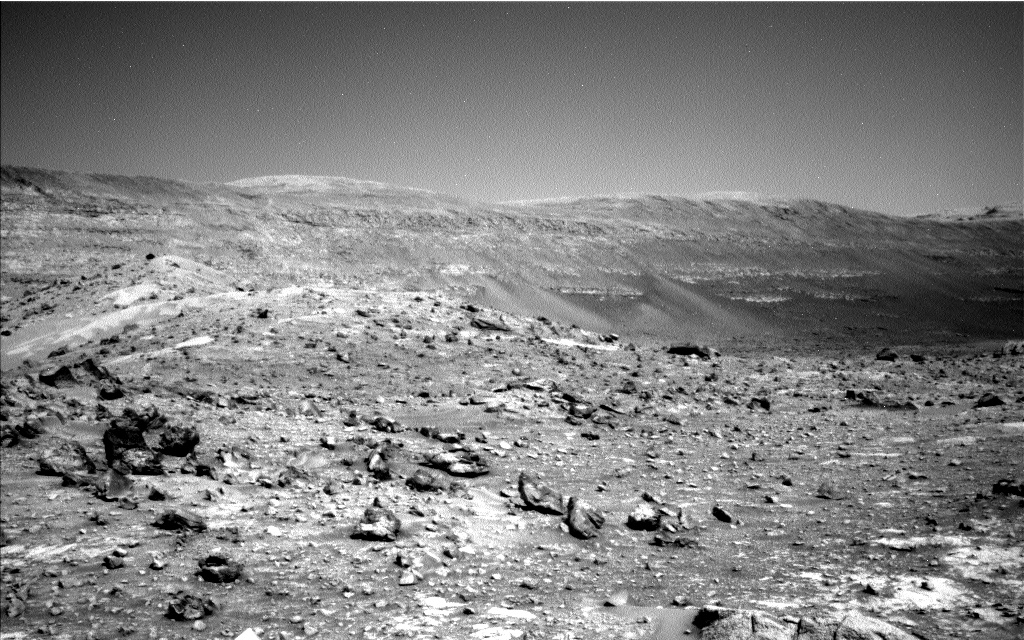
Left navigation camera image from Sol 4255, showing “Milestone Peak” on the left, the subject of an RMI in this plan
NASA/JPL-Caltech

Earth planning date: Friday, Aug. 16, 2024

It’s time to move on from our “Kings Canyon” drill site, so today’s plan focused on our usual tidy up routine after a drill campaign. First we need to dump out any material in the drill chambers, in an action called “RAGE” – this sounds aggressive but stands for “Rotation to Agitate Granules for Expulsion,” so it’s more of a gentle turning than an angry shaking. This ensures that the drill chambers won’t spill later and we are ready for the next drill campaign – whenever we find a worthy target! Mastcam will document the entire process, and then image the drill bit that was used, making sure it is still in good condition.

At that point, we are free to use the arm instruments again (no turret movements allowed while there is sample in the drill chamber). So our contact science focuses today on the drill tailings, the pile of ground up rock generated by the drill action. That pile has been sitting there for over two weeks, but luckily it’s not too windy right now and the pile remained more or less intact. MAHLI will image the drill hole and the tailings pile on the first afternoon, APXS will integrate on the tailings on the first night and then MAHLI will image the tailings again on the second day. This post-retract image is just to confirm that APXS did not hit the pile of loose drill fines. As APXS Science Planner today, I worked with RPs to pick out the spot we will focus on and to make sure that we are using the correct sequences to ensure safety of the instrument – but it’s always nice to confirm that we didn’t hit the pile!

ChemCam has a suite of activities, from LIBS activities close to the rover, to “passive” (non destructive) activities and RMI images (which can be relatively near field or long distance). LIBS on the bedrock target “Marck Lake” will be used to compared with the nearby Kings Canyon target and assess homogeneity across the drill block, while the passive observation of “Red Slate Mountain” will examine a large light toned block about 10 metres away from the rover. ChemCam will also acquire a long distance RMI of loose blocks and boulders about 85 metres away, looking towards “Milestone Peak” (shown in the accompanying image).

APXS will acquire an overnight “atmospheric” measurement, looking at levels of argon as part of an ongoing campaign. This is paired with ChemCam’s second passive measurement, this time of the sky. We also have monitoring of dust levels, with Mastcam taus of the atmosphere (which atmospheric scientist Alex Innanen talked about here), and a whole host of Navcam dust devil movies, and suprahorizon and zenith movies (which target different parts of the horizon). All of these … and DAN and REMS activities too – our environmental monitoring team is working hard as usual!

ChemCam has spent the last two weeks or so getting LIBS and passive measurements on “Sam Mack Meadow” – an area of darker toned, sometimes broken up rocks just outside of the current workspace. In fact, ChemCam is getting LIBS on two further targets there in this plan: “Horse Creek Spire” and the somewhat nodular “Kearsarge Pinnacles.” Mastcam will image all of the LIBS targets too. There are some interesting textures here that APXS and MAHLI are keen to sample too, so our next drive is more of a bump to get close enough to allow contact science here too. We will still be able to gaze on the King (Canyon) for another while, so I guess it’s not really goodbye just yet!

Written by Catherine O’Connell-Cooper, Planetary Geologist at University of New Brunswick

Share

Details

Last Updated
Aug 19, 2024

Related Terms

Powered by WPeMatico

Get The Details…

Hubble Spots Billowing Bubbles of Stellar Floss

Hubble Spots Billowing Bubbles of Stellar Floss

2 min read

Hubble Spots Billowing Bubbles of Stellar Floss

Glowing clouds of pink and red gas and dust fill the image, along with several stars – foreground stars shine with diffraction spikes, and more distant stars fill the background.
NASA, ESA, and J. M. Apellaniz (Centro de Astrobiologia (CSIC/INTA Inst. Nac. de Tec. Aero.); Image Processing: Gladys Kober (NASA/Catholic University of America)

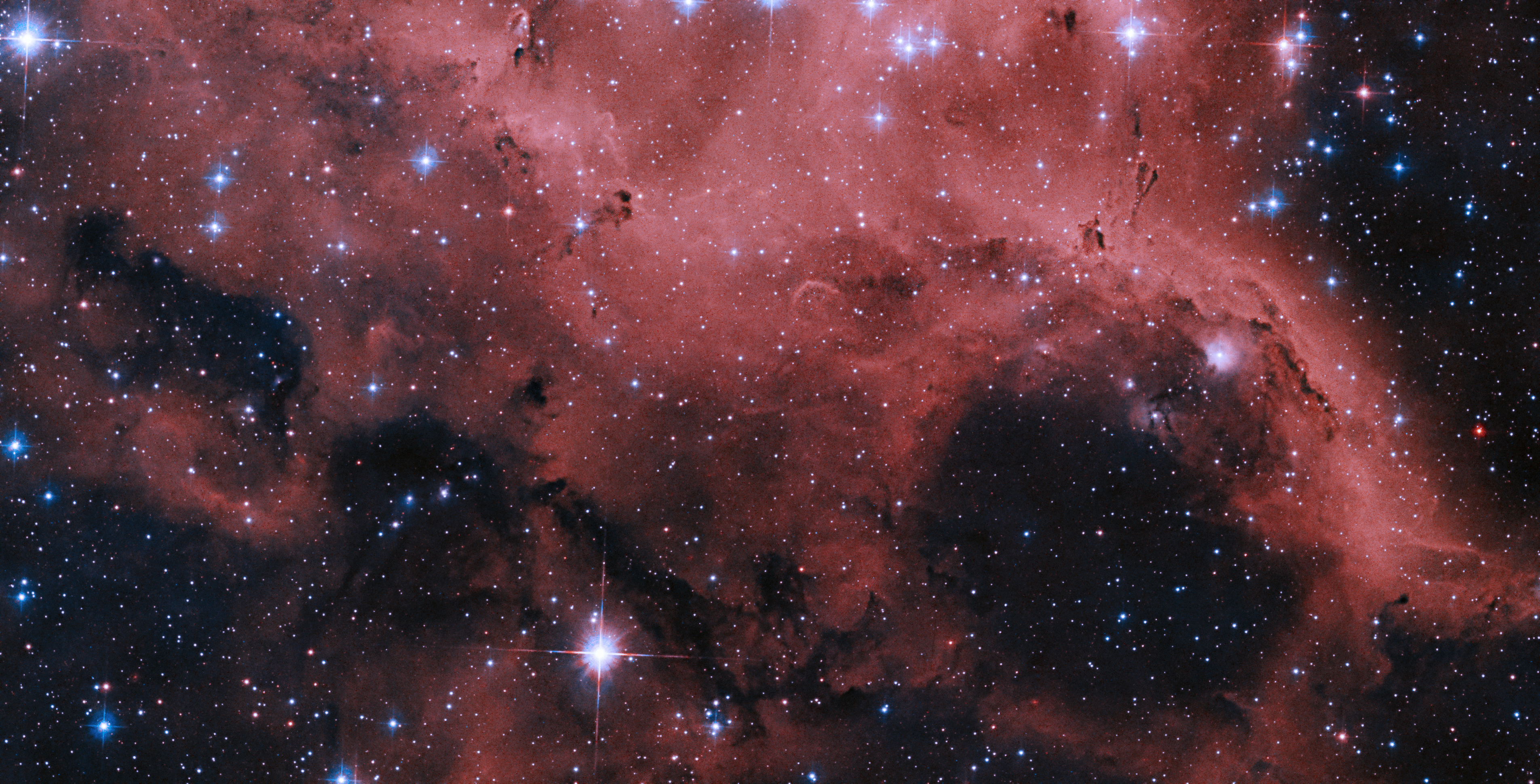
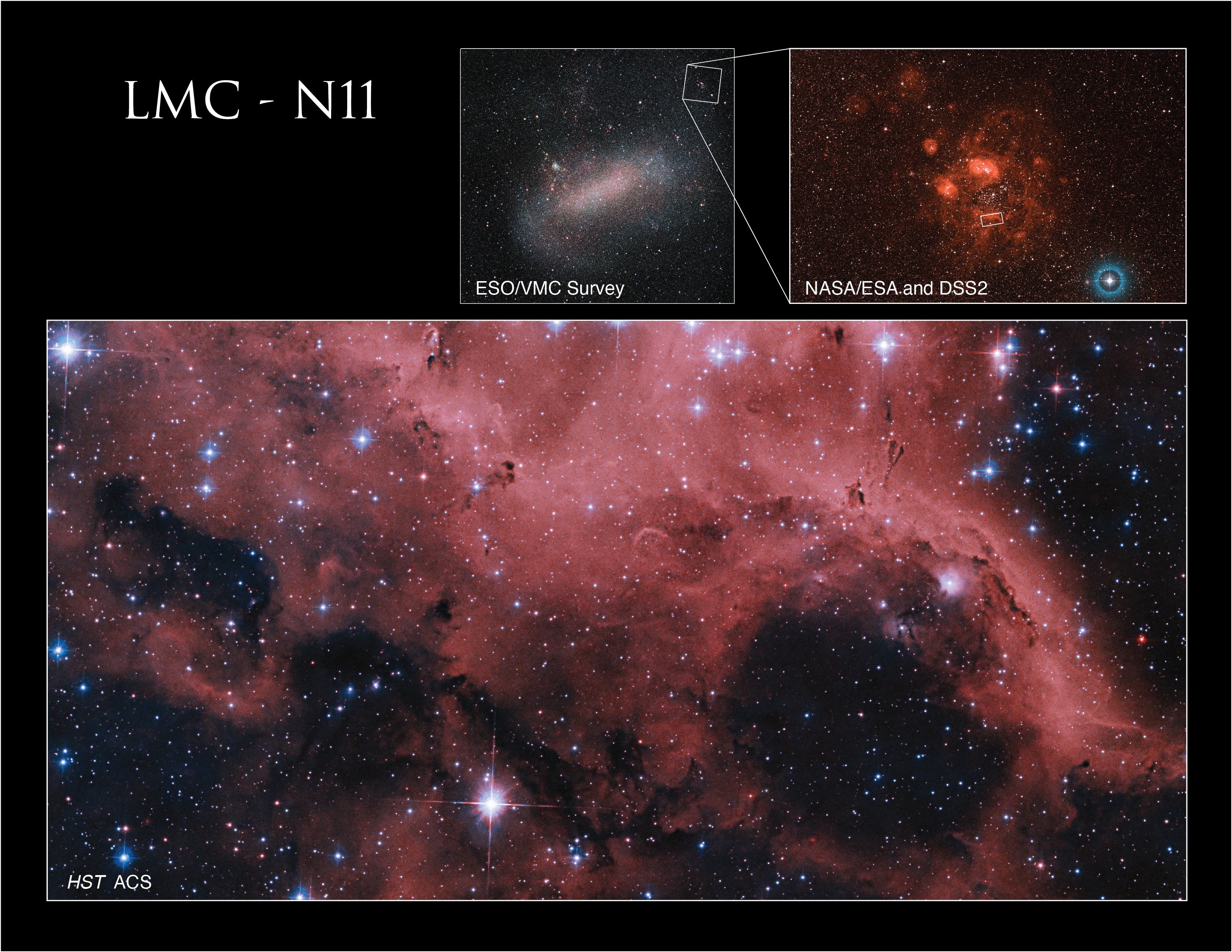
A bubbling region of stars both old and new lies some 160,000 light-years away in the constellation Dorado. This complex cluster of emission nebulae is known as N11, and was discovered by American astronomer and NASA astronaut Karl Gordon Henize in 1956. NASA’s Hubble Space Telescope brings a new image of the cluster in the Large Magellanic Cloud (LMC), a nearby dwarf galaxy orbiting the Milky Way.

The bottom half of the image shows N11. Glowing clouds of pink and red gas and dust fill the image, along with several stars – foreground stars shine with diffraction spikes, and more distant stars fill the background. Above it to the right, a smaller image shows a starry region of space with orange tendrils of gas and dust with a white rectangle designating the portion that shows N11. To its left, another small image shows a wide view of a diffuse galaxy with a white rectangle designating the portion that shows N11. To its left, white text reads “LMC - N11”.

About 1,000 light-years across, N11’s sprawling filaments weave stellar matter in and out of each other like sparkling candy floss. These cotton-spun clouds of gas are ionized by a burgeoning host of young and massive stars, giving the complex a cherry-pink appearance. Throughout N11, colossal cavities burst from the fog. These bubbles formed as a result of the vigorous emergence and death of stars contained in the nebulae. Their stellar winds and supernovae carved the surrounding area into shells of gas and dust.

N11’s stellar activity caught the attention of many astronomers, as it is one of the largest and most energetic regions in the LMC. To investigate the distribution of stars in N11, scientists used Hubble’s Advanced Camera for Surveys, taking advantage of its sensitivity and excellent wide-field resolution. The cluster houses a wide array of stars for Hubble to examine, including one area that has stopped forming stars, and another that continues to form them. Hubble’s unique capabilities allowed astronomers to comprehensively study the diversity of stars in the N11 complex, and map the differences between each region.

Explore More

Media Contact:

Claire Andreoli
NASA’s Goddard Space Flight CenterGreenbelt, MD
claire.andreoli@nasa.gov

Share

Details

Last Updated
Aug 19, 2024
Editor
Michelle Belleville

Powered by WPeMatico
Get The Details…

At Work and Beyond, NASA Employees Find Joy in Aviation

At Work and Beyond, NASA Employees Find Joy in Aviation

4 min read

Preparations for Next Moonwalk Simulations Underway (and Underwater)

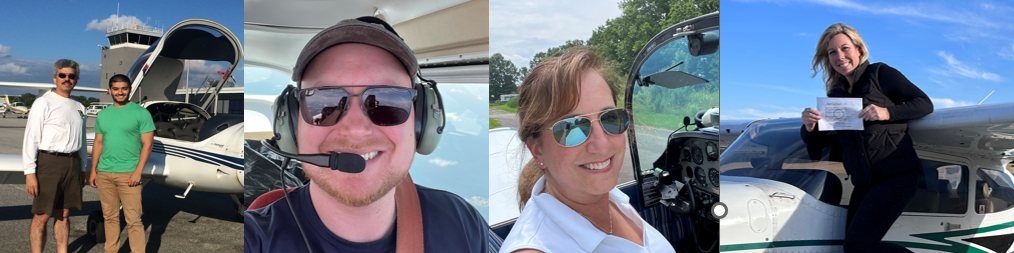
A collage photo of four NASA Glenn employee pilots.
Meet four employees from NASA’s Glenn Research Center who have a personal connection to aviation, at work and beyond.
Credit: (Left to right): Waldo Acosta, Jared Berg, Lori Manthey, Lindsay Kaldon

The first “A” in NASA stands for aeronautics. Glenn Research Center in Cleveland is just one of several NASA centers conducting revolutionary research to make flight cleaner, safer, and quieter.

But an interest in flying goes beyond the professional for many at NASA. Meet a handful of NASA Glenn employees who have a personal connection to aviation, at work and beyond.

Jared Berg

“I think my flying and engineering work positively influence each other. Flying integrates a lot of technical disciplines and serves as a real-word application of things I know theoretically about aerodynamics or heat transfer.”

jared berg

jared berg

Thermal Subsystem Manager for Gateway’s Power and Propulsion Element

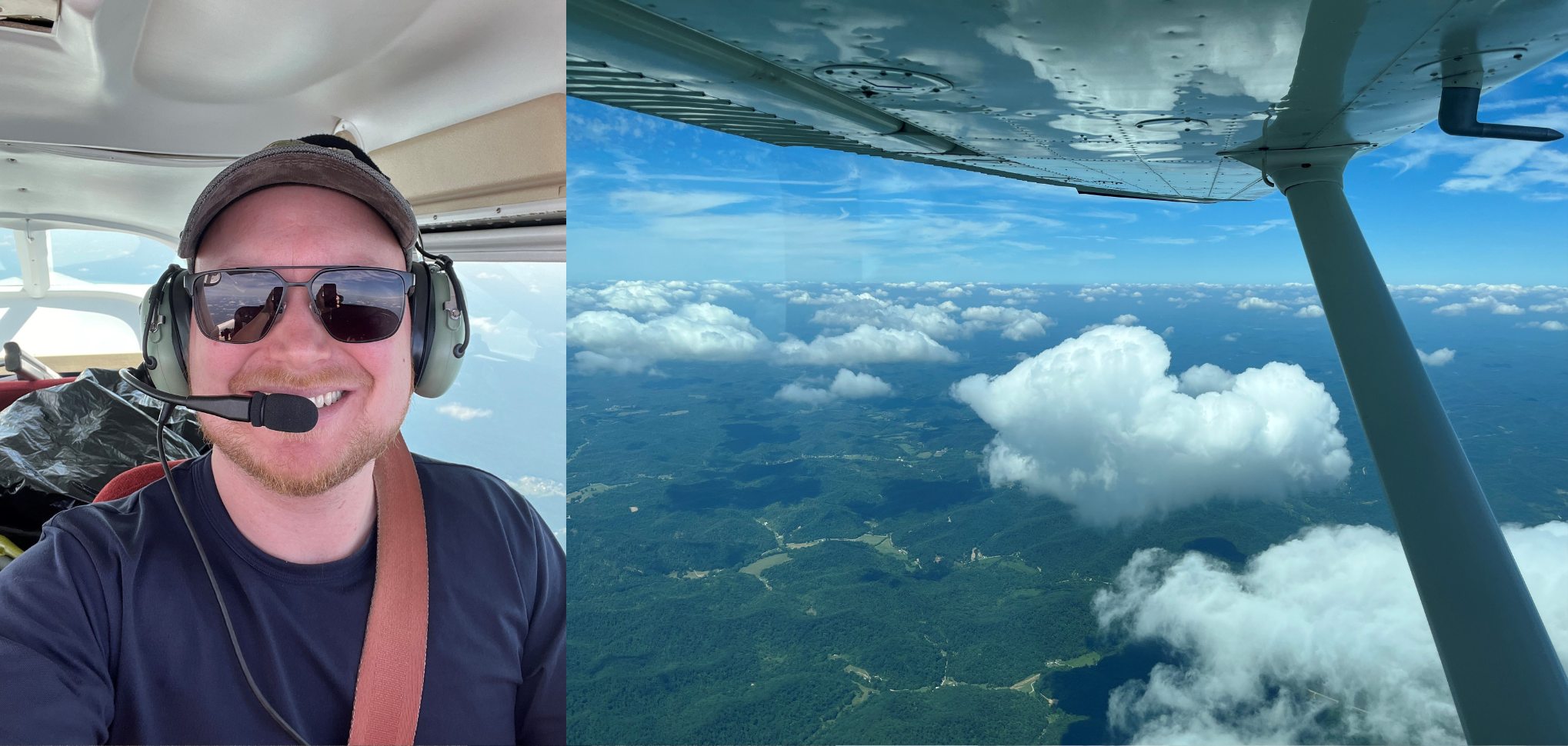
: A man wearing a hat, sunglasses, and an aviation headset smiles at the camera as he sits in an aircraft cockpit. Clouds and sky can be seen out the windows beside and behind him.
Left photo: Jared Berg flying above the clouds in the the NASAIRS Flying Club’s Cessna 172. Right photo: A view out the plane window.
Credit: Jared Berg

Planting the Seed: Berg grew up reading aviation books with his family and building model planes. Attending the EAA AirVenture airshow in Oshkosh, Wisconsin, throughout childhood inspired him to pursue flight training once he had a full-time NASA job.

Joining the Club: Berg is currently a member of the NASAIRS Flying Club at NASA Glenn, which he says helps make flying more accessible and lets him constantly learn from other pilots.

Flying High: Berg has now been flying recreationally for over a decade and considers it a part of his everyday life. “Flying allows an escape from the mundane and brings a sense of adventure to traveling,” Berg said. “You also get to experience nature, specifically weather but also the land you’re flying over, in a way that’s relatively raw and somehow personal.”

Lindsay Kaldon

«I love the feeling after takeoff and when you’ve reached cruising altitude. It’s as if all the stresses of life wash away when you’re up there in the sky. Being up in the clouds with all the beauty of the Earth below, it’s as if you’re in heaven.”

Lindsay Kaldon

Lindsay Kaldon

Fission Surface Power Project Manager

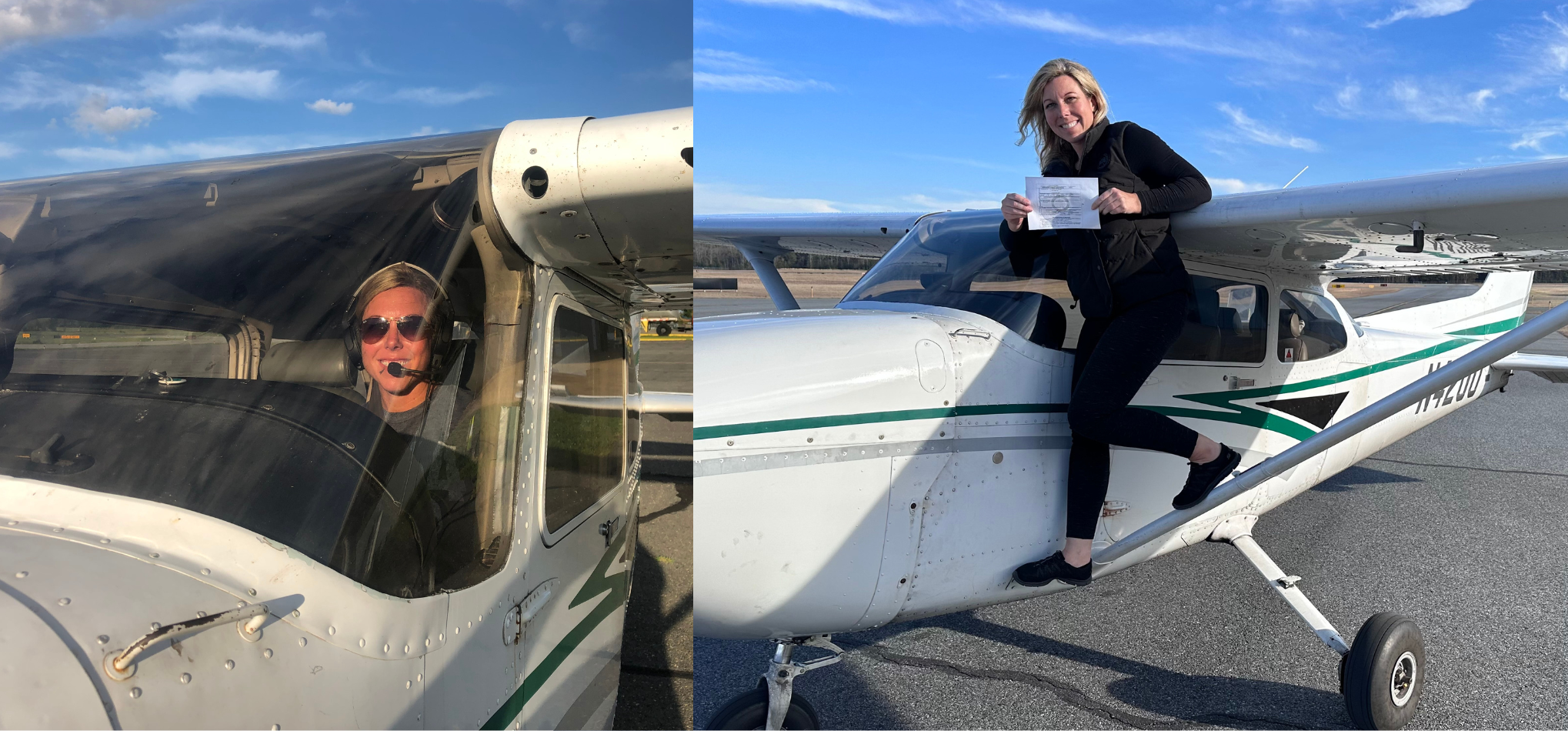
A woman stands on the wing outside a small white plane and holds up a certificate as she smiles at the camera.
Left photo: Lindsay Kaldon after her first solo flight. Right photo: Kaldon celebrates passing her private pilot exam.
Credit: Lindsay Kaldon

Air Force and Astronauts: Kaldon’s father was an Air Force F-16 crew chief and a member of the Thunderbirds demonstration team, so Kaldon was no stranger to jets growing up. “Every day was an airshow living on the base that they trained out of,” Kaldon said. After earning a bachelor’s degree in electrical engineering, Kaldon joined the Air Force herself with hopes of one day becoming an astronaut.

Going Solo: Kaldon later earned her private pilot’s license and says she’ll always remember her first solo cross-country flight. She chose Kitty Hawk, the site of the Wright brothers’ first flight, as her destination.

Keeping the Energy: A monument that stands along the runway at Kitty Hawk is inscribed with words Kaldon remembers whenever solving difficult challenges through her work at NASA. “It says, ‘Achieved by Dauntless Resolution and Unconquerable Faith.’ The Wright brothers were faced with a lot of doubters who didn’t think flight was possible. Yet they proved them wrong and never gave up,” Kaldon said. “I love that. When things get tough, I just close my eyes and think about that phrase.”

Lori Manthey

“I encourage anyone who has an interest in flying to take a discovery flight at your local airport. If you get bitten by the flying bug, it just may become a life-long obsession. Ask me how I know!”

Lori Manthey

Lori Manthey

Chief of Administrative Services and Exchange Operations Manager

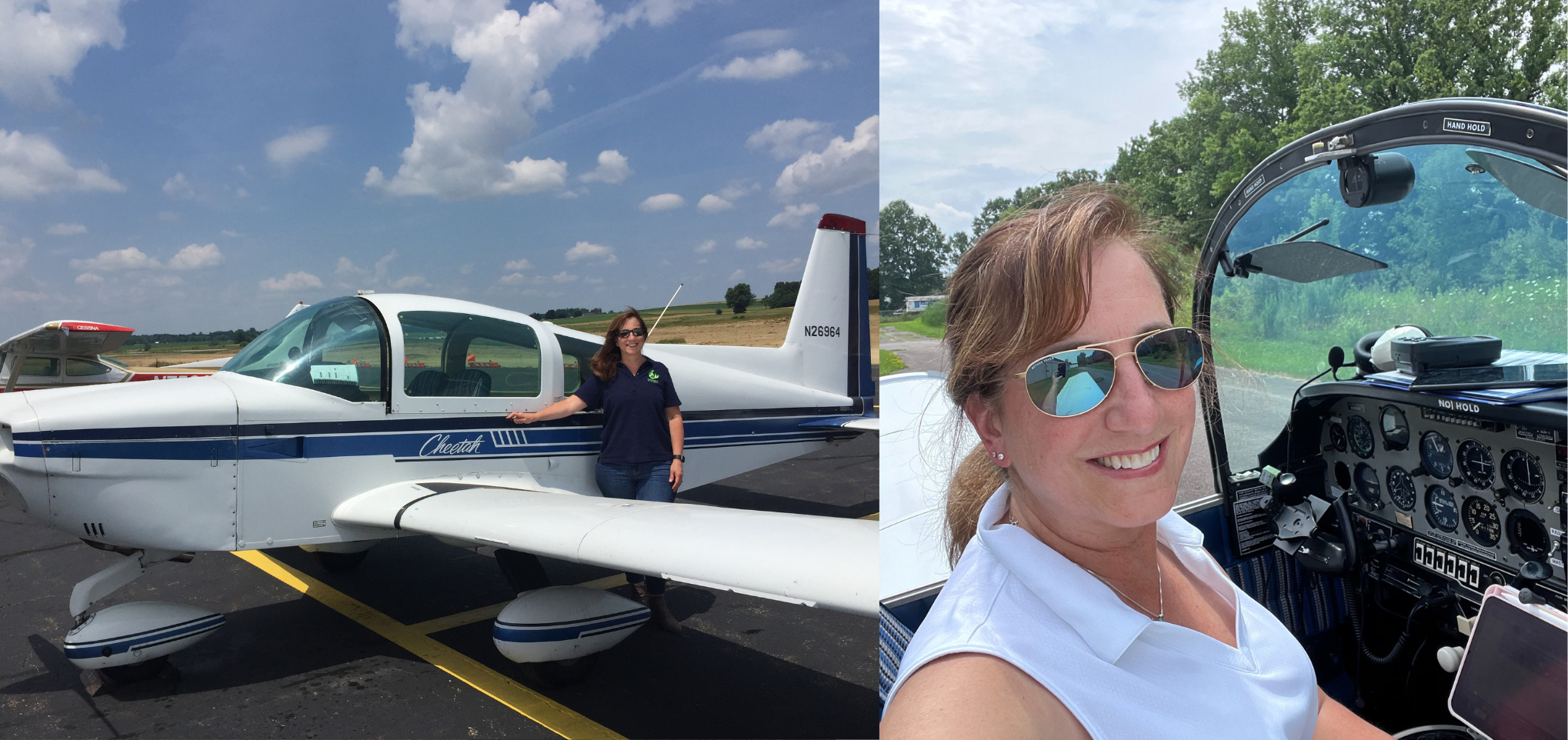
Left photo: Lori Manthey with a Grumman Cheetah plane. Right photo: Lori Manthey at the Grumman Cheetah controls.
Credit: Lori Manthey

Head in the Clouds: After a discovery flight in a small Cessna 150 plane, Manthey was hooked on flying. On weekends and evenings after beginning a full-time NASA job, she hopped in a Piper Tomahawk single-engine trainer at Lorain County Regional Airport to earn her private pilot certificate. “I love the feeling of floating in the air and seeing the world below,” she said.

Women in Aero: Manthey is passionate about advancing and supporting female pilots and currently serves as membership chair of the Lake Erie chapter of the Ninety-Nines, an organization started by Amelia Earhart in 1929. She is also a member of the Cleveland chapter of Women in Aviation.

Looking to the Future: Every year, Manthey participates in Girls in Aviation Day at Cleveland’s Burke Lakefront Airport to introduce girls to the world of aviation. “I think it is so important to help encourage young women and girls to become part of the next generation of female pilots,” she said.

Back in the Cockpit: Manthey is currently working to earn her instrument rating, which will let her fly “blind” in cloudy and foggy weather conditions.

Waldo J. Acosta

“Flying gives me a thrill. The perspective you’re able to see of the world from up in the sky is a special feeling. Aircraft have the ability to take us all over the world so we can experience different cultures and meet different people, and that has shaped me into who I am today.”

Waldo J. Acosta

Waldo J. Acosta

Icing Research Tunnel Lead Facility Engineer

A collage of photos of a NASA employee. In the left photo, two men smile and pose in front of a white aircraft at an airport. The one on the left is taller and wearing sunglasses and a white shirt, and the one on the right is wearing a green shirt. In the top right photo, a man sits in the grass beside a child in a stroller. Both are looking away from the camera, and the man is wearing a shirt that says, "Oshkosh." In the bottom right photo, three researchers work on laptops and examine documents inside a control room with monitors and equipment.
Left photo: Waldo J. Acosta, right, stands beside his father before taking him for a ride in a DA20 aircraft. Top right photo: A young Acosta and his father at the EAA AirVenture airshow in Oshkosh, Wisconsin. Lower right photo: Acosta (center) works with colleagues Tadas Bartkus (left) and Emily Timko in the control room of NASA Glenn Research Center’s Icing Research Tunnel.
Credit: Waldo J. Acosta, NASA/Jef Janis

Family Ties: Throughout Acosta’s childhood, Acosta’s father, a former researcher at NASA Glenn, brought his family along on work trips to the EAA AirVenture airshow in Oshkosh, Wisconsin. “I fell in love with everything related to flying during those trips, and they set the tone early on my path to working in aviation,” Acosta said.

Next Steps: Acosta started taking flying lessons while studying aerospace engineering at The Ohio State University, eventually receiving his private pilot’s license.

Safety First: Overseeing testing and maintenance operations at NASA Glenn’s Icing Research Tunnel, Acosta is now directly involved in aviation safety research. The facility, the longest-running icing wind tunnel in the world, helps NASA and industry study how ice affects aircraft and test ice protection systems and tools.

Flying Full Circle: Acosta still attends airshows every chance he can get and has taken both his father and wife soaring into the clouds.

Powered by WPeMatico

Get The Details…
Ellen Bausback

Merging Art and Analysis: The Collaborative Efforts Behind NASA Johnson’s Visual Legacy  

Merging Art and Analysis: The Collaborative Efforts Behind NASA Johnson’s Visual Legacy  

In the heart of NASA’s Johnson Space Center in Houston, a team of photographers, imagery acquisition specialists, analytic scientists, and graphic designers work together to create visual narratives that capture the defining moments of space exploration with creativity and precision. 

From the Apollo missions to the Artemis campaign, these images, videos, and graphics chronicle NASA’s rich history and the people behind its monumental missions. 

Four people in orange and blue space suits pose in front of a blue backdrop.
Official portrait of the Artemis II crew.
NASA/Josh Valcarcel

Each team at Johnson within Mission Imagery, the ISAG (Image Science and Analysis Group), and NASA’s OCOMM (Office of Communications) plays a role in this effort, ensuring the accuracy and artistry of visual narratives that have inspired generations.  

“Behind every great leap for mankind, there is the courage, determination, and teamwork of people committed to pushing the boundaries of what’s possible,” said NASA photographer Josh Valcarcel.  

A space shuttle flies above Central Park in New York City.
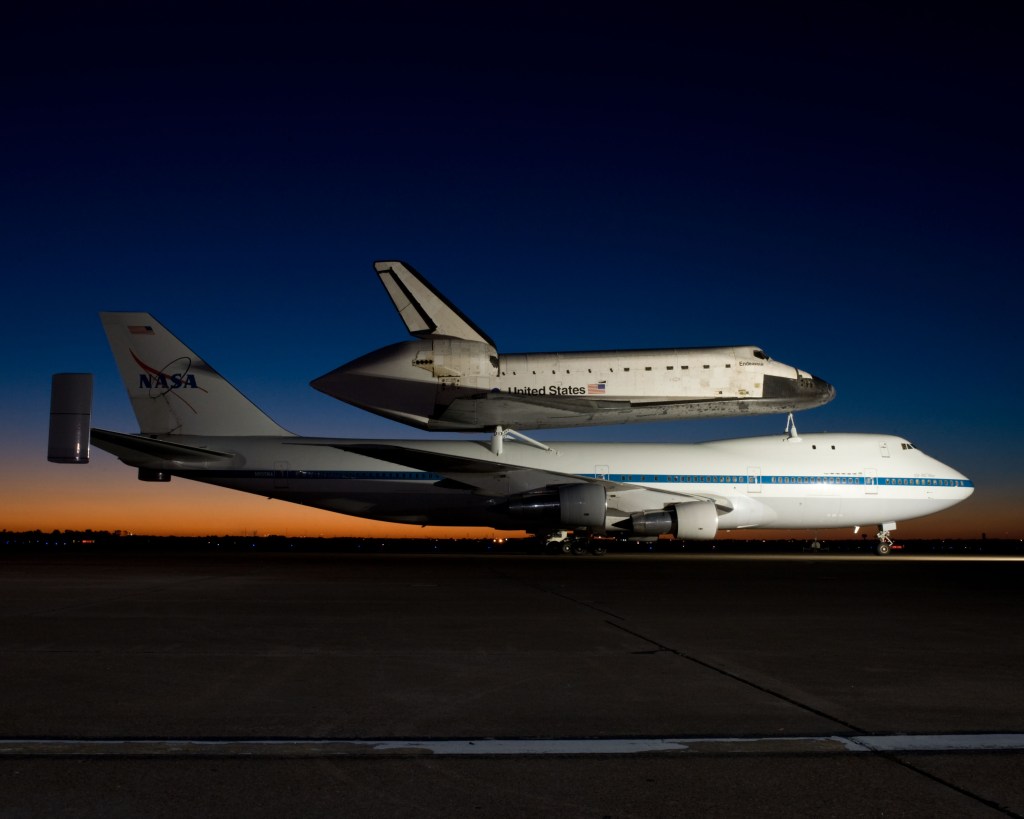
Space Shuttle Enterprise atop the Shuttle Carrier Aircraft as it flies over New York City on April 27, 2012.
NASA/Robert Markowitz

“We consider ourselves exceptionally fortunate to contribute our passion to an esteemed agency, aiming to evoke joy and enduring memories through our imagery,” said NASA photographer Robert Markowitz.  

Operating eight camera systems, the imagery acquisition group captures a range of visuals, from HD video and high-speed digital motion pictures to spherical 360 panoramas. These visuals document everything from engineering tests to astronaut training and mission control operations. The team is certified to fly on parabolic flights, T-38 jets, and helicopters, capturing pivotal moments in space exploration history. 

“The duty to bear witness to events or conversations and preserve these moments in time – not only for those who cannot, but for the record books – is a noble cause,” said NASA photographer Helen Arase Vargas.  

After capturing the imagery, the photo operations team processes these visuals using advanced software to enhance quality, perform color correction, and ensure they meet NASA’s high standards. Every frame is meticulously archived, including photos taken by astronauts aboard the International Space Station, preserving them for future generations. 

“None of what we deliver would be possible without the work of the photo laboratory,” said Mark Sowa, the imagery acquisition group lead who brings over three decades of experience in scientific photography to his role.  

The team also manages the care and handling of original Apollo mission films, which are preserved in a specially built cold storage vault. The goal is to preserve Apollo era spaceflight films – in both the digital and physical formats – for generations to come. 

A storage room with stainless steel walls and flooring, containing rows of metal canisters with maroon and white labels.
The cold storage film vault at NASA’s Johnson Space Center in Houston.
NASA/Robert Markowitz

The ISAG is charged with a different but equally critical mission. This team of scientists performs complex and in-depth analysis of engineering imagery. Their work involves evaluating space vehicle performance, dynamic events, and anomalies by measuring distances, sizes, motion, and hardware conditions to uncover crucial mission insights.  

Their data visualization techniques bring these analyses to life, contributing to successful mission execution.

“At NASA we often say ‘the camera is the mission’ because in every image, there’s a story to be told – whether it’s one of engineering analysis or human inspiration,” said Dr. Kenton Fisher, the ISAG lead. “Our work helps ensure crew safety and provides insights that drive the next giant leap in space exploration.”

A spacecraft descends towards Earth under three large, red-and-white parachutes. The parachutes are fully deployed.
The Artemis I test flight marks the safe return of the Orion spacecraft to Earth.
NASA/Josh Valcarcel
A space capsule floats in the ocean, partially submerged, with several orange inflatable balloons attached to its top.
NASA’s Orion spacecraft for Artemis I after splashdown in the Pacific Ocean on December 11, 2022.
NASA/James Blair

NASA’s OCOMM graphics team works closely with the imagery acquisition group, astronauts, and subject matter experts to create visuals that symbolize NASA’s missions and values.

From patches to educational infographics, their art reaches museums and schools nationwide, inspiring future generations and showcasing NASA’s commitment to exploration, innovation, and education. 

A compilation of NASA’s graphics team highlights from 2023.

“Every design we create is a piece of a larger narrative, helping to tell the story of space exploration in a way that’s engaging and accessible to everyone,” said Sean Collins, Johnson’s lead graphic designer. 

The collaborative efforts of these teams ensure that NASA’s achievements are not just recorded but celebrated worldwide. 

A group of people on a football field holding a large American flag during a stadium event. They are all wearing black shirts with "2024" and a logo on the back. Fireworks are being launched around them.
NASA team members participate in the National Collegiate Athletic Association Championship Game opening flag ceremonies on January 8, 2024, at NRG Stadium.
NASA/Helen Arase Vargas

NASA photographer Bill Stafford recalls a moment of awe when capturing the Moon juxtaposed with the U.S. flag above the Mission Control Center, a symbol of America’s space achievements. 

“I feel a weight because my job is important,” he said. “I want people to look at my pictures and see what I was able to see.” 

A full moon shines brightly in the night sky, with a small star visible below it. In the foreground, a blurred American flag is partially visible.
The Moon juxtaposed with the U.S. flag above the Mission Control Center at NASA’s Johnson Space Center in Houston.
NASA/Bill Stafford

Powered by WPeMatico
Get The Details…
Sumer Loggins

Space Delivery Arrives After Roscosmos Cargo Craft Docks

Space Delivery Arrives After Roscosmos Cargo Craft Docks

The Progress 89 cargo craft approaches the space station above the south Pacific Ocean for an automated docking to the Zvezda service module. Credit: NASA TV

The unpiloted Progress 89 spacecraft arrived at the aft port of the orbiting laboratory’s Zvezda Service module at 1:53 a.m. EDT, Saturday, Aug. 17. The spacecraft launched at 11:20 p.m. Wednesday, Aug. 14 (8:20 a.m. Baikonur time, Thursday, Aug. 15), on a Soyuz rocket from the Baikonur Cosmodrome in Kazakhstan.

The Roscosmos spacecraft is delivering about three tons of food, fuel, and supplies for the Expedition 71 crew aboard the International Space Station and will remain docked for approximately six months before departing for a re-entry into Earth’s atmosphere to dispose of trash loaded by the crew.


Learn more about station activities by following the space station blog@space_station and @ISS_Research on X, as well as the ISS Facebook and ISS Instagram accounts.

Get weekly video highlights at: https://roundupreads.jsc.nasa.gov/videoupdate/

Get the latest from NASA delivered every week. Subscribe here: www.nasa.gov/subscribe

Powered by WPeMatico
Get The Details…

Mark Garcia