NASA JPL Developing Underwater Robots to Venture Deep Below Polar Ice

NASA JPL Developing Underwater Robots to Venture Deep Below Polar Ice
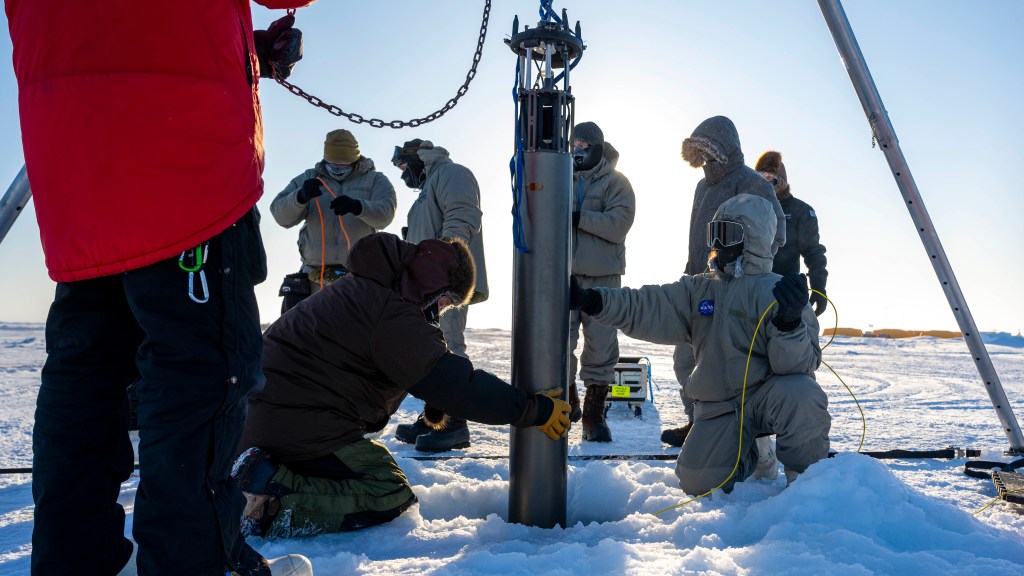
Called IceNode, the project envisions a fleet of autonomous robots that would help determine the melt rate of ice shelves.

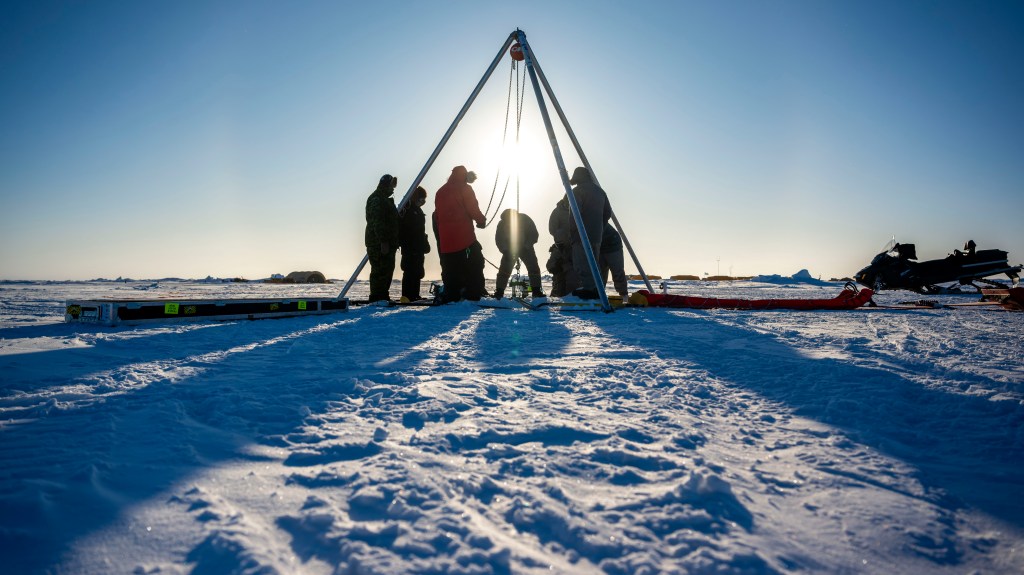
On a remote patch of the windy, frozen Beaufort Sea north of Alaska, engineers from NASA’s Jet Propulsion Laboratory in Southern California huddled together, peering down a narrow hole in a thick layer of sea ice. Below them, a cylindrical robot gathered test science data in the frigid ocean, connected by a tether to the tripod that had lowered it through the borehole.

This test gave engineers a chance to operate their prototype robot in the Arctic. It was also a step toward the ultimate vision for their project, called IceNode: a fleet of autonomous robots that would venture beneath Antarctic ice shelves to help scientists calculate how rapidly the frozen continent is losing ice — and how fast that melting could cause global sea levels to rise.

Warming Waters, Treacherous Terrain

If melted completely, Antarctica’s ice sheet would raise global sea levels by an estimated 200 feet (60 meters). Its fate represents one of the greatest uncertainties in projections of sea level rise. Just as warming air temperatures cause melting at the surface, ice also melts when in contact with warm ocean water circulating below. To improve computer models predicting sea level rise, scientists need more accurate melt rates, particularly beneath ice shelves — miles-long slabs of floating ice that extend from land. Although they don’t add to sea level rise directly, ice shelves crucially slow the flow of ice sheets toward the ocean.

A remote camera captured an IceNode prototype deployed below the frozen surface of Lake Superior, off Michigan’s Upper Peninsula, during a field test in 2022.
A remote camera captured an IceNode prototype deployed below the frozen surface of Lake Superior, off Michigan’s Upper Peninsula, during a field test in 2022. The three thin legs of the robot’s “landing gear” affix the prototype to the icy ceiling.
NASA/JPL-Caltech

The challenge: The places where scientists want to measure melting are among Earth’s most inaccessible. Specifically, scientists want to target the underwater area known as the “grounding zone,” where floating ice shelves, ocean, and land meet — and to peer deep inside unmapped cavities where ice may be melting the fastest. The treacherous, ever-shifting landscape above is dangerous for humans, and satellites can’t see into these cavities, which are sometimes beneath a mile of ice. IceNode is designed to solve this problem.

“We’ve been pondering how to surmount these technological and logistical challenges for years, and we think we’ve found a way,” said Ian Fenty, a JPL climate scientist and IceNode’s science lead. “The goal is getting data directly at the ice-ocean melting interface, beneath the ice shelf.”

Floating Fleet

Harnessing their expertise in designing robots for space exploration, IceNode’s engineers are developing vehicles about 8 feet (2.4 meters) long and 10 inches (25 centimeters) in diameter, with three-legged “landing gear” that springs out from one end to attach the robot to the underside of the ice. The robots don’t feature any form of propulsion; instead, they would position themselves autonomously with the help of novel software that uses information from models of ocean currents.

JPL’s IceNode project is designed for one of Earth’s most inaccessible locations: underwater cavities deep beneath Antarctic ice shelves. The goal is getting melt-rate data directly at the ice-ocean interface in areas where ice may be melting the fastest. Credit: NASA/JPL-Caltech

Released from a borehole or a vessel in the open ocean, the robots would ride those currents on a long journey beneath an ice shelf. Upon reaching their targets, the robots would each drop their ballast and rise to affix themselves to the bottom of the ice. Their sensors would measure how fast warm, salty ocean water is circulating up to melt the ice, and how quickly colder, fresher meltwater is sinking.

The IceNode fleet would operate for up to a year, continuously capturing data, including seasonal fluctuations. Then the robots would detach themselves from the ice, drift back to the open ocean, and transmit their data via satellite.

“These robots are a platform to bring science instruments to the hardest-to-reach locations on Earth,” said Paul Glick, a JPL robotics engineer and IceNode’s principal investigator. “It’s meant to be a safe, comparatively low-cost solution to a difficult problem.”

Arctic Field Test

While there is additional development and testing ahead for IceNode, the work so far has been promising. After previous deployments in California’s Monterey Bay and below the frozen winter surface of Lake Superior, the Beaufort Sea trip in March 2024 offered the first polar test. Air temperatures of minus 50 degrees Fahrenheit (minus 45 Celsius) challenged humans and robotic hardware alike.

The test was conducted through the U.S. Navy Arctic Submarine Laboratory’s biennial Ice Camp, a three-week operation that provides researchers a temporary base camp from which to conduct field work in the Arctic environment.

As the prototype descended about 330 feet (100 meters) into the ocean, its instruments gathered salinity, temperature, and flow data. The team also conducted tests to determine adjustments needed to take the robot off-tether in future.

“We’re happy with the progress. The hope is to continue developing prototypes, get them back up to the Arctic for future tests below the sea ice, and eventually see the full fleet deployed underneath Antarctic ice shelves,” Glick said. “This is valuable data that scientists need. Anything that gets us closer to accomplishing that goal is exciting.”

IceNode has been funded through JPL’s internal research and technology development program and its Earth Science and Technology Directorate. JPL is managed for NASA by Caltech in Pasadena, California.

News Media Contact

Melissa Pamer
Jet Propulsion Laboratory, Pasadena, Calif.
626-314-4928
melissa.pamer@jpl.nasa.gov

2024-115

Share

Details

Last Updated

Aug 29, 2024

Powered by WPeMatico

Get The Details…
Naomi Hartono
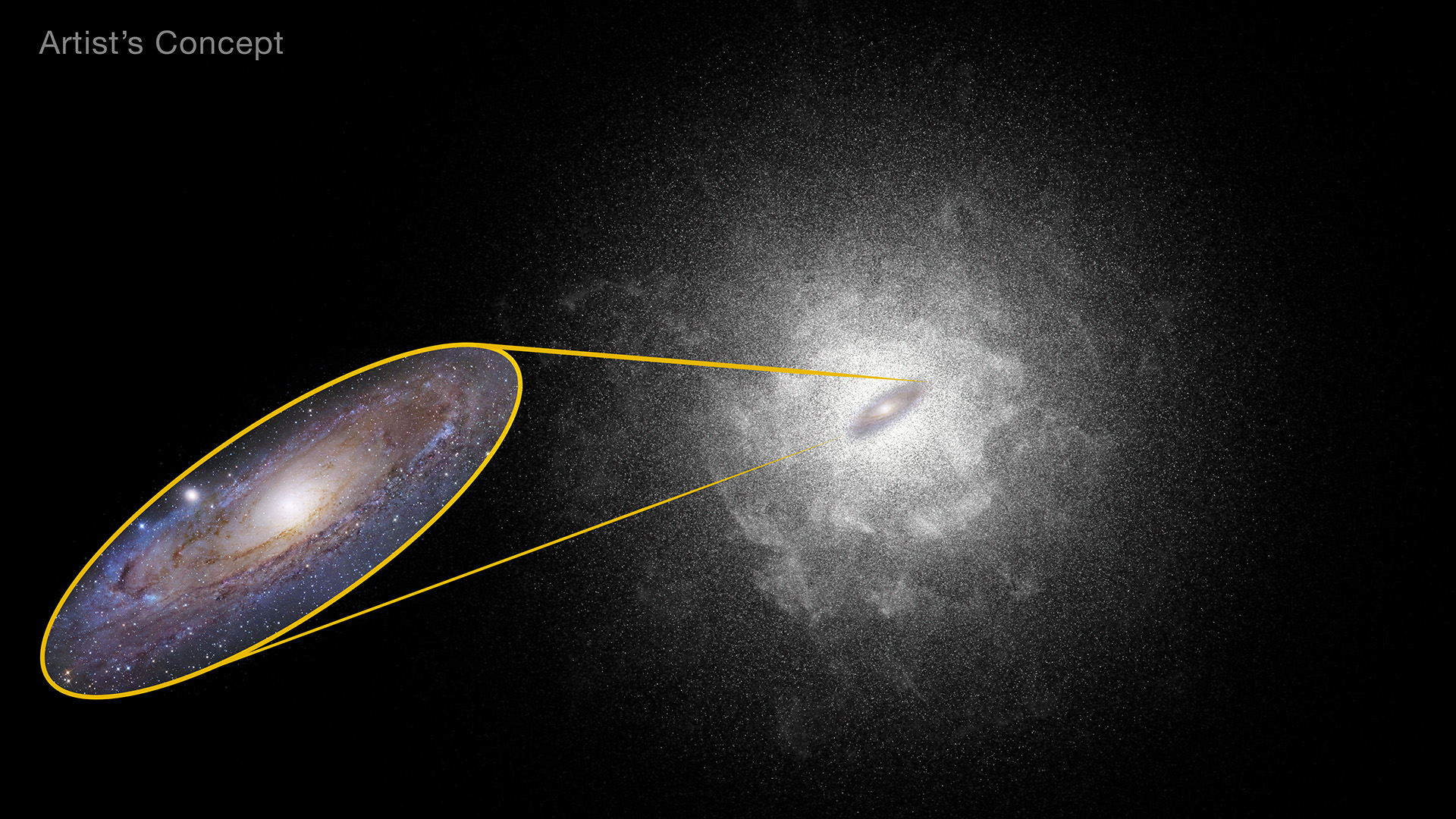
NASA’s Roman Space Telescope to Investigate Galactic Fossils

NASA’s Roman Space Telescope to Investigate Galactic Fossils

Galaxy Illustration
A galactic halo is a loose collection of stars that extends 15 to 20 times beyond the radius of the brightest part of the galaxy. One of the few galaxies with a well-studied stellar halo is our neighbor, Andromeda, depicted here in the graphic. The stellar halo is illustrated with exaggerated brightness and density to show how far it extends. When the Nancy Grace Roman Space Telescope launches, it will be able to use its wide field of view to comprehensively image many more stellar halos of more distant galaxies.
NASA, Ralf Crawford (STScI)

The universe is a dynamic, ever-changing place where galaxies are dancing, merging together, and shifting appearance. Unfortunately, because these changes take millions or billions of years, telescopes can only provide snapshots, squeezed into a human lifetime.

However, galaxies leave behind clues to their history and how they came to be. NASA’s upcoming Nancy Grace Roman Space Telescope will have the capacity to look for these fossils of galaxy formation with high-resolution imaging of galaxies in the nearby universe.

Astronomers, through a grant from NASA, are designing a set of possible observations called RINGS (the Roman Infrared Nearby Galaxies Survey) that would collect these remarkable images, and the team is producing publicly available tools that the astronomy community can use once Roman launches and starts taking data. The RINGS survey is a preliminary concept that may or may not be implemented during Roman’s science mission.

Roman is uniquely prepared for RINGS due to its resolution akin to NASA’s Hubble Space Telescope and its wide field of view – – 200 times that of Hubble in the infrared – – making it a sky survey telescope that complements Hubble’s narrow-field capabilities.

Galactic Archaeologists

Scientists can only look at brief instances in the lives of evolving galaxies that eventually lead to the fully formed galaxies around us today. As a result, galaxy formation can be difficult to track.

Luckily, galaxies leave behind hints of their evolution in their stellar structures, almost like how organisms on Earth can leave behind imprints in rock. These galactic “fossils” are groups of ancient stars that hold the history of the galaxy’s formation and evolution, including the chemistry of the galaxy when those stars formed.  

These cosmic fossils are of particular interest to Robyn Sanderson, the deputy principal investigator of RINGS at the University of Pennsylvania in Philadelphia. She describes the process of analyzing stellar structures in galaxies as “like going through an excavation and trying to sort out bones and put them back together.”  

Roman’s high resolution will allow scientists to pick out these galactic fossils, using structures ranging from long tidal tails on a galaxy’s outskirts to stellar streams within the galaxy. These large-scale structures, which Roman is uniquely capable of capturing, can give clues to a galaxy’s merger history. The goal, says Sanderson, is to “reassemble these fossils in order to look back in time and understand how these galaxies came to be.” 

Shedding Light on Dark Matter

RINGS will also enable further investigations of one of the most mysterious substances in the universe: dark matter, an invisible form of matter that makes up most of a galaxy’s mass. A particularly useful class of objects for testing dark matter theories are ultra-faint dwarf galaxies. According to Raja GuhaThakurta of the University of California, Santa Cruz, “Ultra faint dwarf galaxies are so dark matter-dominated that they have very little normal matter for star formation. With so few stars being created, ultra-faint galaxies can essentially be seen as pure blobs of dark matter to study.” 

Roman, thanks to its large field of view and high resolution, will observe these ultra-faint galaxies to help test multiple theories of dark matter. With these new data, the astronomical community will come closer to finding the truth about this unobservable dark matter that vastly outweighs visible matter: dark matter makes up about 80% of the universe’s matter while normal matter comprises the remaining 20%. 

Ultra-faint galaxies are far from the only test of dark matter. Often, just looking in an average-sized galaxy’s backyard is enough. Structures in the halo of stars surrounding a galaxy often give hints to the amount of dark matter present. However, due to the sheer size of galactic halos (they are often 15-20 times as big as the galaxy itself), current telescopes are deeply inefficient at observing them.

At the moment, the only fully resolved galactic halos scientists have to go on are our own Milky Way and Andromeda, our neighbor galaxy. Ben Williams, the principal investigator of RINGS at the University of Washington in Seattle, describes how Roman’s power will amend this problem: “We only have reliable measurements of the Milky Way and Andromeda, because those are close enough that we can get measurements of a large number of stars distributed across their stellar halos. So, with Roman, all of a sudden we’ll have 100 or more of these fully resolved galaxies.”

When Roman launches by May 2027, it is expected to fundamentally alter how scientists understand galaxies. In the process, it will shed some light on our own home galaxy. The Milky Way is easy to study up close, but we do not have a large enough selfie stick to take a photo of our entire galaxy and its surrounding halo. RINGS shows what Roman is capable of should such a survey be approved. By studying the nearby universe, RINGS can examine galaxies similar in size and age to the Milky Way, and shed light on how we came to be here. 

The Nancy Grace Roman Space Telescope is managed at NASA’s Goddard Space Flight Center in Greenbelt, Maryland, with participation by NASA’s Jet Propulsion Laboratory and Caltech/IPAC in Southern California, the Space Telescope Science Institute in Baltimore, and a science team comprising scientists from various research institutions. The primary industrial partners are BAE Systems, Inc in Boulder, Colorado; L3Harris Technologies in Rochester, New York; and Teledyne Scientific & Imaging in Thousand Oaks, California.

By Patt Molinari
Space Telescope Science Institute, Baltimore, Md.

Media contact:

Claire Andreoli
claire.andreoli@nasa.gov
NASA’s Goddard Space Flight Center, Greenbelt, Md.
301-286-1940

Ann Jenkins
Space Telescope Science Institute, Baltimore, Md.

Christine Pulliam
Space Telescope Science Institute, Baltimore, Md.

Share

Details

Last Updated

Aug 29, 2024

Editor
Ashley Balzer
Contact
Ashley Balzer
Location
Goddard Space Flight Center

Powered by WPeMatico

Get The Details…
Ashley Balzer

Bring NASA Into Your Classroom This Fall Through Virtual Experiences

Bring NASA Into Your Classroom This Fall Through Virtual Experiences

5 min read

Preparations for Next Moonwalk Simulations Underway (and Underwater)

High school students sit with their backs to the camera as they watch a large screen displaying a white extravehicular activity suit being tested via virtual classroom
Texas High School Aerospace Scholars get a virtual view of an extravehicular activity (EVA) suit in testing at NASA’s Johnson Space Center in Houston.
Photo credit: NASA/Helen Arase Vargas

Explore the universe this fall without leaving your classroom through live virtual engagements with NASA space and aviation experts. NASA is offering a new lineup of stellar virtual experiences to spark STEM excitement and connect students with the agency’s missions, science, careers, and more.

The virtual engagements, managed by NASA’s Next Gen STEM project, are free to join and open to both formal and informal education groups. These options are sure to launch your students’ love of STEM:

NASA Back-to-School Career Day (Grades K-12)

On Sept. 26, NASA is hosting a Back-to-School Career Day showcasing a variety of NASA careers with virtual tours of agency facilities, live Q&A with experts, and more.

Open to K-12 formal and informal education organizations, the registration deadline is Thursday, Sept. 5. In addition to the live event, the interactive platform will be available from Monday, Sept. 23, through Friday, Sept. 27.

Europa Clipper Launch Virtual Watch Party (All Grade Levels)

NASA’s Europa Clipper spacecraft is scheduled to launch no earlier than Oct. 10 on a mission to investigate whether Jupiter’s icy moon, Europa, could contain the building blocks needed to support life. The launch window opens on Oct. 10 during the school day at 12:32 p.m. EDT, and your classroom can be part of this pioneering mission. Sign up to watch the launch online, visit Europa Clipper’s Participation Hub for more opportunities, and find additional resources on Europa Clipper’s Kids Resources Hub.

NQuest Virtual Workshops (Grades 6-8)

NQuest offers 45-minute virtual workshops every Monday and Thursday. Available on a first-come, first-served basis, these free workshops include a live presentation, captivating NASA videos, and a hands-on activity to bring STEM concepts to life. All you need is a laptop, projector, and basic classroom supplies. Workshops can be scheduled to fit your school’s bell schedule between 11:30 a.m. and 6:30 p.m. EDT. Register your class by Oct. 11.

“Astro-Not-Yets” Virtual Classroom Connections (Grades K-4)

Introduce your students to the Astro-Not-Yets, a series of short stories that teach students about NASA’s Commercial Crew Program. In each of these monthly virtual events, a NASA expert whose job relates to the story will read the book to students, then answer their questions.

  • Wednesday, Oct. 23: The Astro-Not-Yets! Explore Sound. Students will learn how sound travels and experiment with transmitting sound through a string-cup phone. Registration deadline: Wednesday, Oct. 9.
  • Wednesday, Nov. 20: Astro-Not-Yets! Explore Energy. Students will learn how spacecraft safely bring astronauts home from space, then design and test their own system to safely land an egg on the ground. Registration deadline: Wednesday, Nov. 6.
  • Wednesday, Dec. 11: Astro-Not-Yets! Explore Microgravity. Students will learn all about gravity, microgravity, and the International Space Station. Registration deadline: Wednesday, Nov. 27.

“First Women” Virtual Classroom Connections (Grades 5-12)

This series introduces some of the women at NASA who have made significant achievements in STEM. Students get to hear their stories first-hand and ask them questions in a live Q&A.

  • Wednesday, Oct. 16: Meet NASA’s first female launch director, Charlie Blackwell-Thompson. She led the launch team during the uncrewed Artemis I mission around the Moon in 2022. Now, she and her team are preparing for the first crewed Artemis mission, Artemis II. Registration deadline: Monday, Sept. 30.
  • Wednesday, Nov. 6: Meet Laurie A. Grindle and learn about NASA’s first X-43A Guinness world record. Today, Grindle is deputy center director at NASA’s Armstrong Flight Research Center in Edwards, California, but in 2004, the X-43A aircraft she and her team developed set the Guinness World Record for “the fastest air-breathing aircraft” twice in one year. Registration deadline: Monday, Oct. 21.
  • Wednesday, Dec. 4: Meet Dr. Ruth Jones, NASA’s 2024 Wings of Excellence Awardee. Jones will share her experience as a woman in STEM and tell students what it was like to become the first woman to earn a bachelor’s degree in physics from the University of Arkansas at Pine Bluff. Registration deadline: Monday, Nov. 18.

Surprisingly STEM Career Explorations Virtual Events (Grades 5-12)

The Surprisingly STEM video series highlights some of NASA’s many unexpected careers. In these events, experts from the videos discuss their unusual and exciting jobs and share their journeys that led them to NASA.

  • Thursday, Oct. 24: Soft robotics engineer Jim Neilan explains the importance of soft robotics in human spaceflight and some of the role’s critical skills. Registration deadline: Friday, Oct. 18.
  • Thursday, Nov. 14: Exploration geologist Angela Garcia takes students behind the scenes of her job training NASA astronauts to explore for the “crater” good of humanity. Registration deadline: Thursday, Nov. 7.
  • Thursday, Dec. 12: Memory metal engineer Othmane Benafan explains how he “trains” metal to bend, stretch, and twist when prompted, and how this technology benefits NASA missions. Registration deadline: Thursday, Dec. 5.

Bring NASA Experts Into the Classroom (All Grades)

NASA recently launched NASA Engages, a new, database-driven platform designed to connect a wide range of audiences with experts from across the space agency – both virtually and in person. Available to classrooms from preschool to college, informal education organizations such as libraries and science centers, and other eligible groups, NASA Engages enables educators and group leaders to find inspirational guest speakers, knowledgeable science fair judges, and more.

There’s More to Explore

Powered by WPeMatico

Get The Details…
Sandra May

Hubble Observes An Oddly Organized Satellite

Hubble Observes An Oddly Organized Satellite

2 min read

Hubble Observes An Oddly Organized Satellite

Several stars fill the image, more closely concentrated near the center. Foreground stars with diffraction spikes shine throughout as well.
NASA, ESA, and E. Skillman (University of Minnesota – Twin Cities; Processing: Gladys Kober (NASA/Catholic University of America)

Andromeda III is one of at least 13 dwarf satellite galaxies in orbit around the Andromeda galaxy, or Messier 31, the Milky Way’s closest grand spiral galactic neighbor. Andromeda III is a faint, spheroidal collection of old, reddish stars that appears devoid of new star formation and younger stars. In fact, Andromeda III seems to be only about 3 billion years younger than the majority of globular clusters ― dense knots of stars thought to have been mostly born at the same time, which contain some of the oldest stars known in the universe. 

Astronomers suspect that dwarf spheroidal galaxies may be leftovers of the kind of cosmic objects that were shredded and melded by gravitational interactions to build the halos of large galaxies. Curiously, studies have found that several of the Andromeda Galaxy’s dwarf galaxies, including Andromeda III, orbit in a flat plane around the galaxy, like the planets in our solar system orbit around the Sun. The alignment is puzzling because models of galaxy formation don’t show dwarf galaxies falling into such orderly formations, but rather moving around the galaxy randomly in all directions. As they slowly lose energy, the dwarf galaxies merge into the larger galaxy.

The odd alignment could be because many of Andromeda’s dwarf galaxies fell into orbit around it as a single group, or because the dwarf galaxies are scraps left over from the merger of two larger galaxies. Either of these theories, which are being researched via NASA’s James Webb Space Telescope, would complicate theories of galaxy formation but also help guide and refine future models. 

NASA’s Hubble Space Telescope took this image of Andromeda III as part of an investigation into the star formation and chemical enrichment histories of a sample of M31 dwarf spheroidal galaxies that compared their first episodes of star formation to those of Milky Way satellite galaxies.

Explore More

Media Contact:

Claire Andreoli
NASA’s Goddard Space Flight CenterGreenbelt, MD
claire.andreoli@nasa.gov

Share

Details

Last Updated

Aug 29, 2024

Editor
Michelle Belleville

Powered by WPeMatico

Get The Details…

Sols 4289-4290: From Discovery Pinnacle to Kings Canyon and Back Again

Sols 4289-4290: From Discovery Pinnacle to Kings Canyon and Back Again

4 min read

Sols 4289-4290: From Discovery Pinnacle to Kings Canyon and Back Again

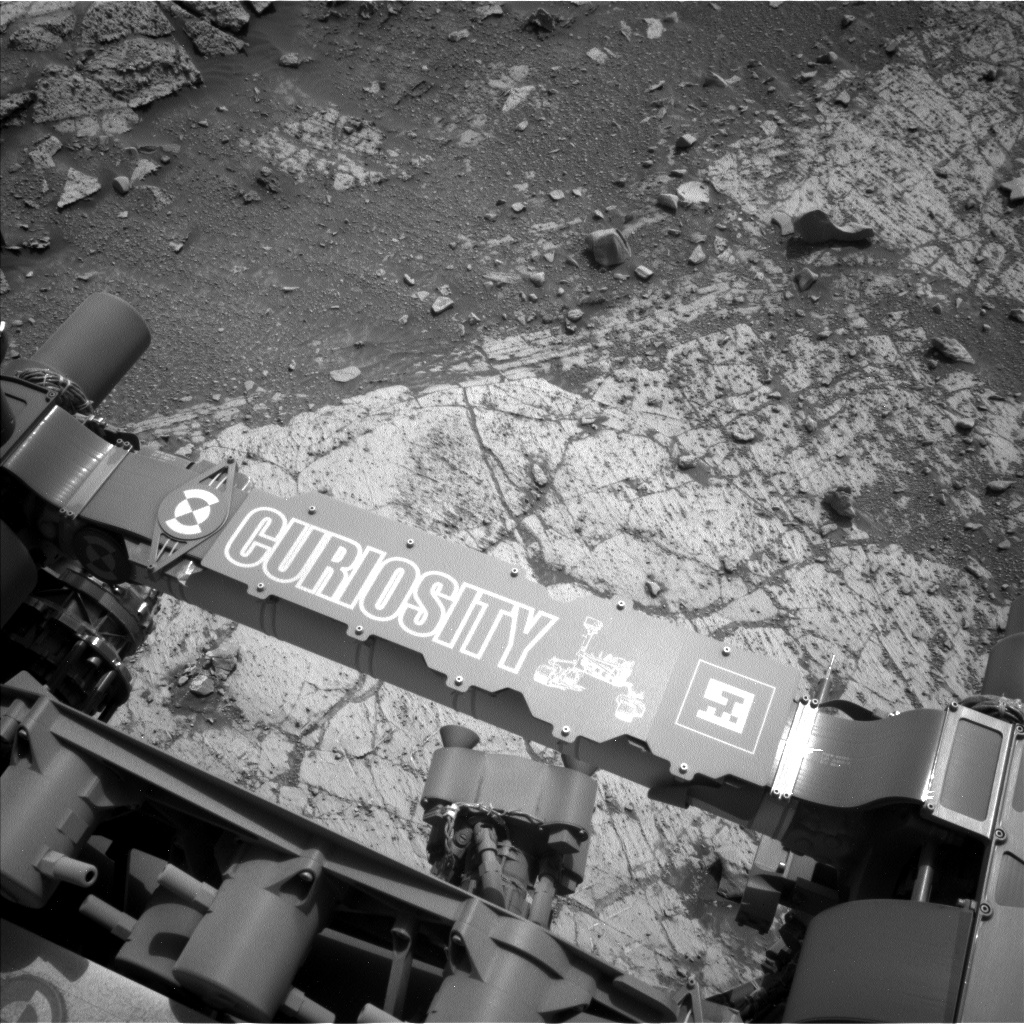
A grayscale photograph of the Martian surface from the Curiosity rover captures parts of the rover in the bottom third of the frame, including a crosspiece imprinted with its name and a line drawing of Curiosity. Ahead of the rover, on the right side of the frame, terrain consisting of large slabs of flat, light gray rock are criss-crossed with long, dark gouges, and sprinkled with small rocks. The left side of the frame is also flat, but with smaller slabs barely visible underneath the soil covering them. Beneath Curiosity, in a patch of ground visible between the rover’s body and the crosspiece, is a very light-colored rock, visible just below the “C” in Curiosity’s name.
This image shows the workspace in front of NASA’s Mars rover Curiosity, taken by the Left Navigation Camera aboard the rover on sol 4287 — Martian day 4,287 of the Mars Science Laboratory mission — on Aug. 28, 2024, at 02:23:27 UTC.
NASA/JPL-Caltech

Earth planning date: Wednesday, Aug. 28 2024

We are back … almost, anyways. Today’s parking location is very close to where we parked on sol 4253, and in an area near one of the previous contact science targets “Discovery Pinnacle.” You can read in this blog post that most of the team, this blogger included, was in Pasadena for our team meeting when we were last in this area. That was July and Curiosity was about to turn 12 on Mars. Coming back is a very rare occasion and is always planned carefully. Once or twice during the last 12 years it happened because we saw something “in the rear mirror.” One of the examples is the target “Old Soaker,” where we spotted mud cracks in the images from a previous parking position, and promptly went back because this was such an important discovery. At other times it was carefully planned, such as the “walkabout” at “Pink Cliffs,” which you can watch in this video from as long back as Earth year 2015. In the past few planning cycles, it’s more of the latter as we made our way from Discovery Pinnacle, where we were on sol 4253, “Just passing through” “Russell Pass” and arriving at “Kings Canyon,” our drill location, which we reached on sol 4257. You can follow all the action of the drilling at Kings Canyon on the blogs. It took a while — it always does — because it’s an activity with many steps and investigations to complete. We actually celebrated Curiosity’s 12th birthday at Kings Canyon! We departed on sol 4283, came back via “Cathedral Peak,” and are now near the Discovery Pinnacle location again. After that little walkabout through the history of (some) of Curiosity’s walkabouts, especially the very last one, let’s look at today’s plan.

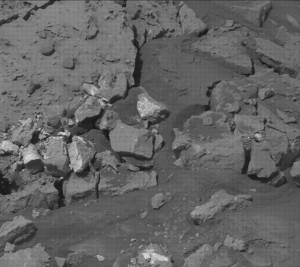
It is a pretty normal two-sol plan, with a one-hour science block before we drive away from this location. We were greeted by a nicely flat surface, and the engineers informed us that we have all six wheels firmly on flat and stable ground. That’s always a relief, because only then can we use the arm. That nice piece of flat rock Curiosity is so firmly parked on became our science target …well, mostly. Some of the little pebbles on the surface attracted our attention, too. The very eagle-eyed can spot a small white spot in the image above. It’s right between the arm and the rover itself, about where the C is written. That’s a rock that we likely broke up with our wheel and that has a very white part to it. We called it “Thousand Island Lake,” and will image it with MAHLI. APXS is investigating a target called “Eichorn Pinnacle,” squarely on the big flat area. LIBS is also making the most of the large target underneath and in front of us, investigating the target “Nine Lakes Basin.”

In recent blogs you will have read about the dust-storm watch making the atmospheric investigations even more important, so we don’t miss any changes. We are looking for dust devils, atmospheric opacity, and are of course monitoring the weather throughout the plan.

Our drive will hopefully — if Mars agrees — be a long one, and we will also plan an activity that we call MARDI sidewalk. That’s when we take very frequent pictures with the MARDI instrument while driving. This results in a long strip of images nicely showing the nature of the terrain the rover has driven over. This is in addition to the MARDI single frame we are taking every time the rover stops. I often get the question, why are we taking an image just downwards whenever the rover stops? Well, humans are easy to bias toward the outliers, toward the things that look special, and of course the Curiosity team is no exception. For some things this is great, because it allows for the discoveries of new things. But it doesn’t provide an unbiased overview. That’s what MARDI does: It always points down and reliably records the terrain under the rover. We don’t have to do anything but put the commands for that one image into our plan after the drive — something that’s pretty routine after 12 years now!

Written by Susanne Schwenzer, Planetary Geologist at The Open University

Share

Details

Last Updated
Aug 29, 2024

Related Terms

Powered by WPeMatico

Get The Details…