Sols 4297-4299: This Way to Tungsten Hills

Sols 4297-4299: This Way to Tungsten Hills

2 min read

Sols 4297-4299: This Way to Tungsten Hills

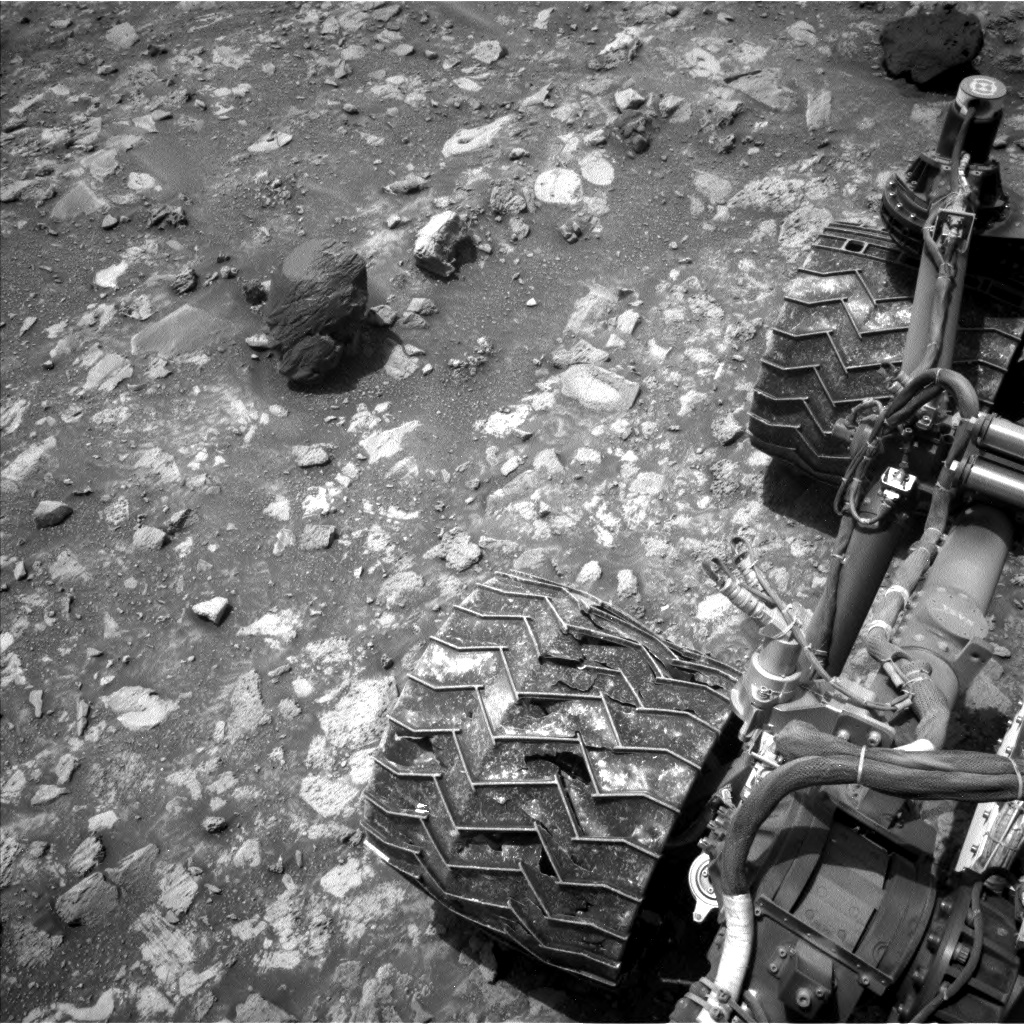
A grayscale photograph of the Martian surface shows medium gray soil interspersed with numerous light-colored rocks poking up from beneath the surface, on the left side of the frame, where one, much larger and darker rock, sits alone near the top of the frame. The right side of the image shows part of the rover, including two of its zig-zag treaded wheels, themselves covered in rocks and dust of various shades of gray.
This image was taken by Left Navigation Camera aboard NASA’s Mars rover Curiosity on Sol 4296 — Martian day 4,296 of the Mars Science Laboratory mission — on Sept. 6, 2024, at 06:47:03 UTC.
NASA/JPL-Caltech

Earth planning date: Friday, Sept. 6, 2024

Contact science in our immediate workspace includes a joint effort by MAHLI and APXS to characterize a gray rock with two targets named “Big Baldy” and “Big Bird Lake.” ChemCam focused its Laser Induced Breakdown Spectroscopy (LIBS) instrument on a rock with a reddish coating, “Purple Creek,” and a light-toned rock, “Garlic Meadow,” to determine their chemical composition. ChemCam included a long distance RMI image of the yardang unit that caps Mount Sharp as well as a standard post-drive AEGIS activity, which allows autonomous target selection for upcoming geochemical spectrometry.

The Mastcam team assembled several beautiful mosaics to document Curiosity’s surroundings. One mosaic will extend the imaging of the current workspace and is planned at dusk to take advantage of the diffuse lighting. Two separate mosaics, one of which is in stereo, will characterize the floor of the depression in front of Tungsten Hills to investigate the exposed light rocks and document depositional processes. Finally, a stereo mosaic will image Tungsten Hills and the surrounding terrain in advance of our approach over the weekend.

With the weekend plan in place the science team will now patiently wait for data to be returned and for planning to resume on Monday!

Curiosity completed an impressive 60-meter drive (about 197 feet) across the channel floor within Gediz Vallis and parked along the edge of a shallow linear depression. Just about 20 meters (66 feet) away, an intriguing dark, textured rock named “Tungsten Hills” is the destination for our weekend drive and our contact science on Monday. Today I served as the “Keeper of the Plan” for the Geology theme group and worked with the science team to compile a variety of contact science and targeted science in this three-sol plan.

Written by Sharon Wilson Purdy, Planetary Geologist at the Smithsonian National Air and Space Museum

Share

Details

Last Updated
Sep 10, 2024

Related Terms

Powered by WPeMatico

Get The Details…

NASA JPL Scientists, Engineers Collaborate With Artists for Exhibition

NASA JPL Scientists, Engineers Collaborate With Artists for Exhibition

5 min read

Preparations for Next Moonwalk Simulations Underway (and Underwater)

Artist David Bowen
Artist David Bowen works on “tele-present wind,” featuring grass stalks that move in response to Martian wind data previously collected by NASA’s Perseverance rover mission. Behind him sits JPL data systems architect Rishi Verma.
NASA/JPL-Caltech

Works in ‘Blended Worlds: Experiments in Interplanetary Imagination,’ an exhibit in Glendale, California, help shrink the universe into something tangible.

The universe is vast and filled with countless worlds, but a new exhibit at the Brand Library & Art Center in Glendale, California, aims to shrink time and space. For “Blended Worlds: Experiments in Interplanetary Imagination,” artists collaborated with scientists and engineers from NASA’s Jet Propulsion Laboratory to create cross-disciplinary works that help illuminate the universe by bringing art and science together.

On view from Sept. 21, 2024, to Jan. 4, 2025, the exhibition is part of “PST ART: Art & Science Collide,” an event presented by the Getty and involving more than 70 exhibitions from museums and institutions across Southern California exploring the intersection of art and science.

“The magic of art is that it enhances our experiences and interactions with the world — and in this case, our universe,” said Dr. Laurie Leshin, director of JPL in Southern California. “We’re honored to work with great artists to bring the wonders of space to our community through this exhibition, which invites us all to be part of a grand journey of exploration and discovery.”

126 grass stalks
The 126 grass stalks of “tele-present wind” are attached to mechanical tilting devices that move in response to Martian wind data.
NASA/JPL-Caltech

David Bowen’s installation “tele-present wind” features grass stalks attached to tilting mechanical devices that move in response to Martian wind data previously collected by NASA’s Perseverance rover mission. Helping make the effort possible were Rishi Verma, a data systems architect at JPL, and José Antonio Rodríguez-Manfredi, the principal investigator of the Mars Environmental Dynamics Analyzer (MEDA) system on Perseverance.

For “Seismic Percussion,” artist Moon Ribas creates an interplanetary drum score by translating seismic data from Earth, the Moon, and Mars. For Mars data, JPL’s Verma worked with Nobuaki Fuji of the Institut de Physique du Globe de Paris, who collaborated on NASA’s now-retired InSight lander. Ceri Nunn, a JPL planetary scientist, assisted with moonquake data.

Also featured is a handwritten version of U.S. Poet Laureate Ada Limón’s “In Praise of Mystery: A Poem for Europa,” the poem she dedicated to NASA’s Europa Clipper mission, which is targeting an October launch and will make multiple flybys of Jupiter’s icy moon Europa. The poem has been etched onto a metal plate on the spacecraft and will ride with the orbiter on its long journey.

Additional works allow visitors to experience Earth’s wonders through scents, use sound to convey the vast distances between our planet and those beyond our solar system, and blend heartbeats and other Earthly sounds with sonified data from Europa’s magnetic field.  

“We were looking to create imaginative opportunities for people to connect with each other as they connect with the awe-inspiring science being conducted today,” said David Delgado, a cultural strategist and the project lead at JPL. “I know this experience has really opened the eyes of everyone collaborating on the project, and we hope it does the same for people who come to see ‘Blended Worlds.’”

As part of PST ART, a number of public programs and community events will also accompany the “Blended Worlds” gallery exhibition, including “Blended Worlds: An Evening of Art, Theater, and Science” hosted by Reggie Watts at the Alex Theatre in Glendale on Oct. 5, and “Earth Data: The Musical,” an original musical developed by Theater Arts at Caltech exploring the challenges of climate research and science as a human pursuit at Caltech’s Ramo Auditorium Nov. 1 to 3.

Artists’ collaborations with JPL and the display of their works at Glendale’s Brand Library were made possible by the generous support of the Glendale Arts and Culture Commission and the Glendale Library, Arts & Culture Trust.

More About JPL

A division of Caltech in Pasadena, California, JPL began in 1936 and ultimately built and helped launch America’s first satellite, Explorer 1, in 1958. By the end of that year, Congress established NASA and JPL became a part of the agency. Since then, JPL has managed such historic missions as Voyager, Galileo, Cassini, the Mars Exploration Rover program, the Perseverance Mars rover, and many more.

More About Glendale Library, Arts & Culture

Founded in 1907, the Glendale Library, Arts & Culture Department includes eight neighborhood libraries including the Brand Library & Art Center, a regional visual arts and music library and performance venue housed in the historic 1904 mansion of Glendale pioneer Leslie C. Brand, and the Central Library, a 93,000-square-foot center for individuals and groups to convene, collaborate, and create. The department also serves as the chief liaison to the Glendale Arts and Culture Commission which works to continually transform Glendale into an ever-evolving arts destination. Glendale Library Arts & Culture is supported in part through the efforts of the Glendale Library Arts & Culture Trust (GLACT). For more information visit GlendaleLAC.org, or contact Library, Arts & Culture at 818-548-2021 or via email at LibraryInfo@GlendaleCA.gov. Follow on Instagram, Facebook, and X at @MyGlendaleLAC.

For more information about PST ART: Art & Science Collide, visit: pst.art

News Media Contact

Matthew Segal / Melissa Pamer
Jet Propulsion Laboratory, Pasadena, Calif.
818-354-8307 / 626-314-4928
matthew.j.segal@jpl.nasa.gov / melissa.pamer@jpl.nasa.gov

2024-120

Share

Details

Last Updated

Sep 09, 2024

Powered by WPeMatico

Get The Details…
Anthony Greicius

Astronauts Rest After Starliner Lands; Soyuz Crew Nears Launch

Astronauts Rest After Starliner Lands; Soyuz Crew Nears Launch

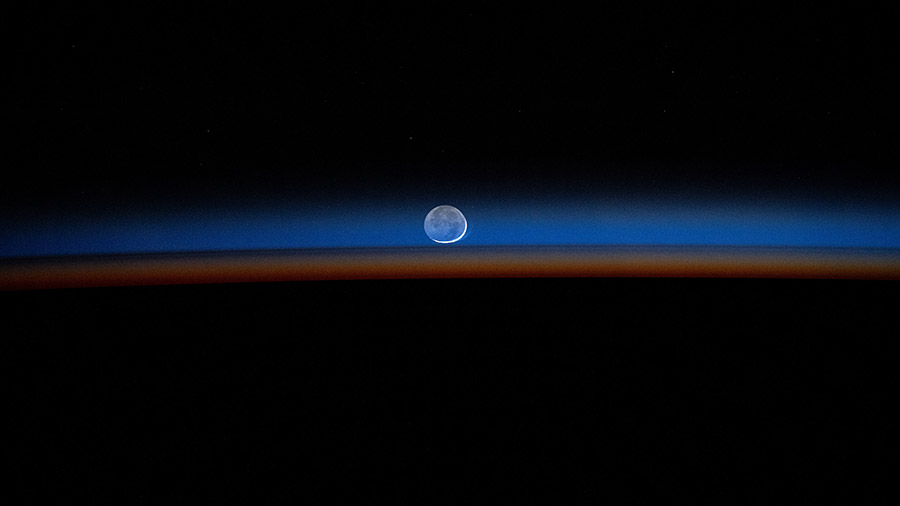
The New Moon sets behind Earth's colorful, but dimming atmosphere in this long-duration photograph taken with a camera programmed for high sensitivity.
The New Moon sets behind Earth’s colorful, but dimming atmosphere in this long-duration photograph taken with a camera programmed for high sensitivity.

Six of the nine orbital residents living and working aboard the International Space Station relaxed on Monday following last week’s departure of Boeing’s uncrewed Starliner spacecraft. The trio on duty today readied for the next crew to launch to the orbital outpost and tested a negative pressure suit.

NASA astronauts Butch Wilmore and Suni Williams congratulated flight teams and said goodbye to the Starliner spacecraft (listen to the audio on X) that launched the duo to the station on June 5. The uncrewed Starliner undocked from the Harmony module’s forward port at 6:04 p.m. EDT on Friday, Sept. 6, and parachuted to a landing in New Mexico nearly six hours later. Wilmore and Williams will remain in low-Earth orbit until February when they are scheduled to return to Earth aboard the SpaceX Dragon spacecraft with the Crew-9 mission.

The two veteran station residents relaxed today enjoying a three-day weekend along with fellow NASA astronauts Tracy C. Dyson, Matthew Dominick, Mike Barratt, and Jeanette Epps. However, Wilmore, Williams, and Epps spent a few moments during Monday afternoon setting up hardware for human research activities planned for all day Tuesday. The trio prepared a specialized thigh cuff being studied for its ability to reverse the space-caused headward fluid shifts in astronauts potentially preventing vision issues and helping crews adjust to different gravity environments.

Expedition 71 Commander Oleg Kononenko readied the Rassvet module for the docking of the Soyuz MS-26 crew ship planned for 3:33 p.m. EDT on Wednesday. Kononenko organized tools and cargo making space inside Rassvet and set up crew sleep stations for the new crewmates. The Soyuz rocket will launch from the Baikonur Cosmodrome in Kazakhstan at 12:23 p.m. on Wednesday carrying NASA astronaut Don Pettit and Roscosmos cosmonauts Alexey Ovchinin and Ivan Wagner to the space station for a six-and-a-half month mission.

Kononenko also joined fellow cosmonauts Nikolai Chub and Alexander Grebenkin and tested the lower body negative pressure suit for its ability to counter the effects of weightlessness on the human body and help crews adjust quicker to the return to Earth’s gravity. Kononenko and Chub are due to return to Earth with Dyson inside the Soyuz MS-25 spacecraft in late September. Grebenkin is targeting his return to Earth in early October with SpaceX Crew-8 crewmates Dominick, Barratt, and Epps.

Powered by WPeMatico

Get The Details…

Mark Garcia

NASA Astronauts to Discuss Mission from Space Station

NASA Astronauts to Discuss Mission from Space Station

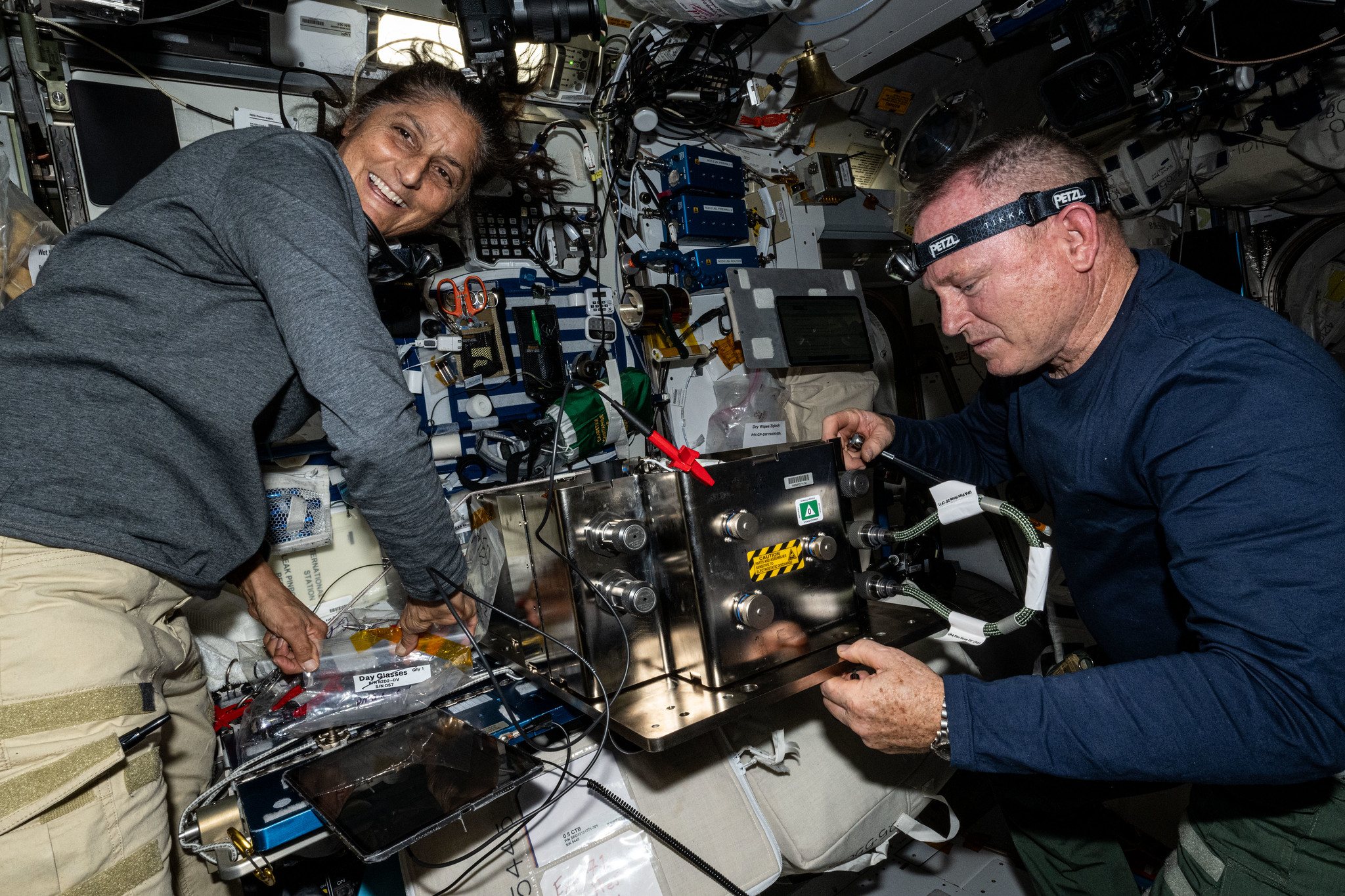
NASA astronauts Butch Wilmore and Suni Williams prepare orbital hardware for installation inside the International Space Station.
Credit: NASA

Media are invited to hear from NASA astronauts Butch Wilmore and Suni Williams during an Earth to space call at 2:15 p.m. EDT, Friday, Sept. 13. The pair will participate in a news conference aboard the International Space Station in low Earth orbit.

Coverage of the event will stream on NASA+, the NASA app, and the agency’s website. Learn how to stream NASA content through a variety of platforms, including social media.

Media interested in participating must contact the newsroom at NASA’s Johnson Space Center in Houston no later than 5 p.m., Thursday, Sept. 12, at 281-483-5111 or jsccommu@mail.nasa.gov. To ask questions, media must dial into the news conference no later than 10 minutes prior to the start of the call. A copy of NASA’s media accreditation policy is online.

NASA astronauts Butch Wilmore and Suni Williams launched aboard Boeing’s Starliner spacecraft on June 5 for its first crewed flight, arriving at the space station on June 6. Following the agency’s decision to return Starliner uncrewed, the duo will remain on the space station as part of the Expedition 71/72 crew and return home in February 2025 aboard the SpaceX Dragon spacecraft with two other crew members on NASA’s SpaceX Crew-9 mission.

For more information about space station research and operations, visit:

https://www.nasa.gov/station

-end-

Josh Finch / Claire O’Shea
Headquarters, Washington
202-358-1100
joshua.a.finch@nasa.gov / claire.a.o’shea@nasa.gov

Courtney Beasley
Johnson Space Center, Houston
281-483-5111
courtney.m.beasley@nasa.gov

Powered by WPeMatico

Get The Details…
Tiernan P. Doyle

NASA Ames Fire Department to Conduct Live Aircraft Fire Training

NASA Ames Fire Department to Conduct Live Aircraft Fire Training

The NASA Ames Fire Department will conduct emergency response fire training on the west ramp of the Moffett Federal Airfield between 8 a.m. and 8 p.m. PDT Tuesday, Sept. 10 through Saturday, Sept. 14. The media and the public are advised that sirens may be audible and smoke plumes and flames may be visible from U.S. Highway 101 during this time. However, officials generally expect little to no smoke.

The session will include a live burn created by a propane-fueled aircraft fire simulator at the field. The drill is intended to prepare Ames fire responders and Ames Emergency Operations Center staff for real-life fire emergencies.

For more information about NASA’s Ames Research Center, visit: 

https://www.nasa.gov/ames

-end-

Rachel Hoover
Ames Research Center, Silicon Valley
650-604-4789
rachel.hoover@nasa.gov

Powered by WPeMatico

Get The Details…
Rachel Hoover