NASA’s Hubble, Chandra Find Supermassive Black Hole Duo

NASA’s Hubble, Chandra Find Supermassive Black Hole Duo

5 min read

NASA’s Hubble, Chandra Find Supermassive Black Hole Duo
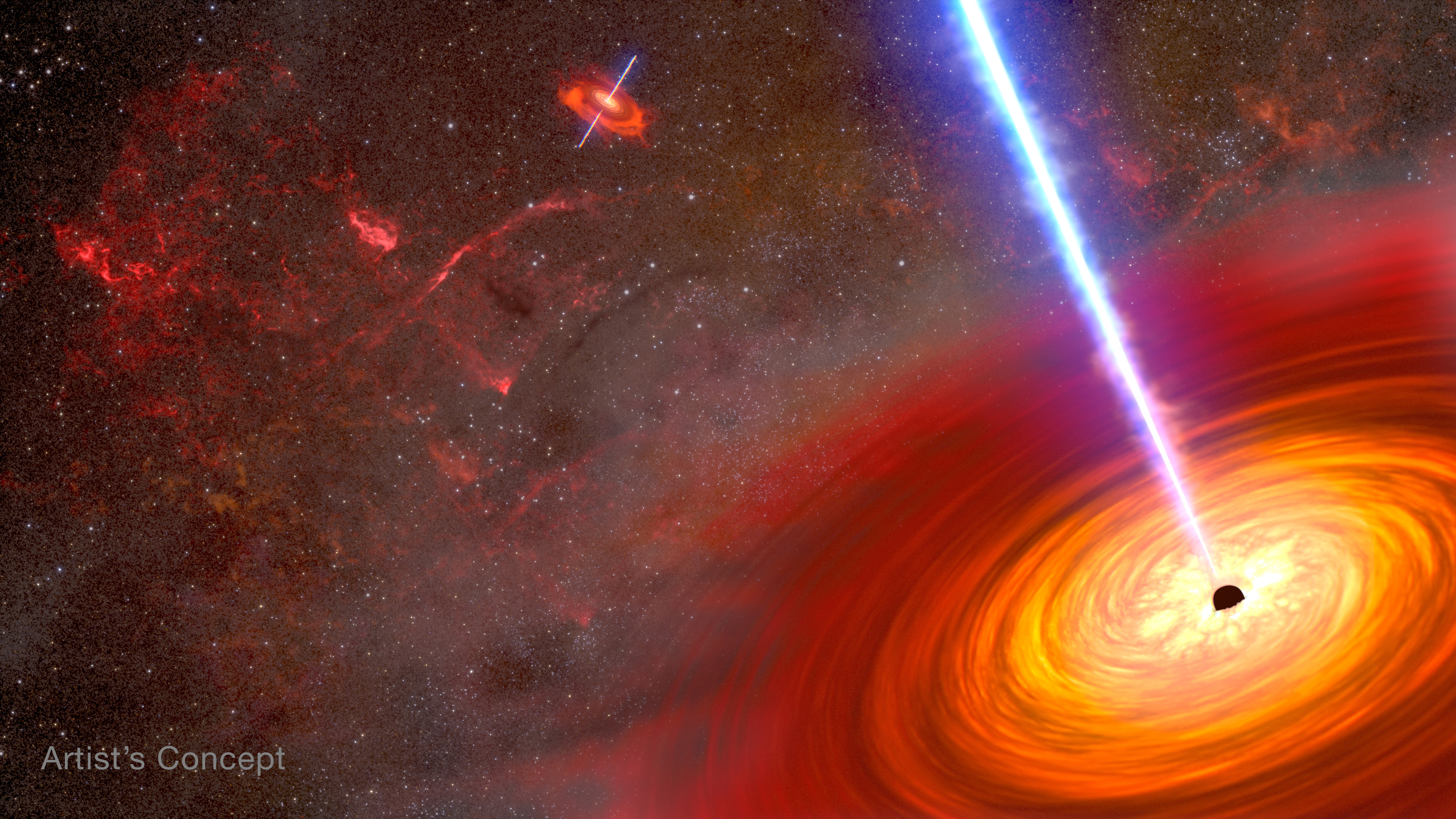
Artist's depiction of a pair of active black holes at the heart of two merging galaxies. One distant black hole is at upper left, and a foreground black hole is at lower right.
This is an artist’s depiction of a pair of active black holes at the heart of two merging galaxies. They are both surrounded by an accretion disk of hot gas. Some of the material is ejected along the spin axis of each black hole. Confined by powerful magnetic fields, the jets blaze across space at nearly the speed of light as devastating beams of energy.
NASA, ESA, Joseph Olmsted (STScI)

Like two Sumo wrestlers squaring off, the closest confirmed pair of supermassive black holes have been observed in tight proximity. These are located approximately 300 light-years apart and were detected using NASA’s Hubble Space Telescope and the Chandra X-ray Observatory. These black holes, buried deep within a pair of colliding galaxies, are fueled by infalling gas and dust, causing them to shine brightly as active galactic nuclei (AGN).

This AGN pair is the closest one detected in the local universe using multiwavelength (visible and X-ray light) observations. While several dozen “dual” black holes have been found before, their separations are typically much greater than what was discovered in the gas-rich galaxy MCG-03-34-64. Astronomers using radio telescopes have observed one pair of binary black holes in even closer proximity than in MCG-03-34-64, but without confirmation in other wavelengths.

AGN binaries like this were likely more common in the early universe when galaxy mergers were more frequent. This discovery provides a unique close-up look at a nearby example, located about 800 million light-years away.
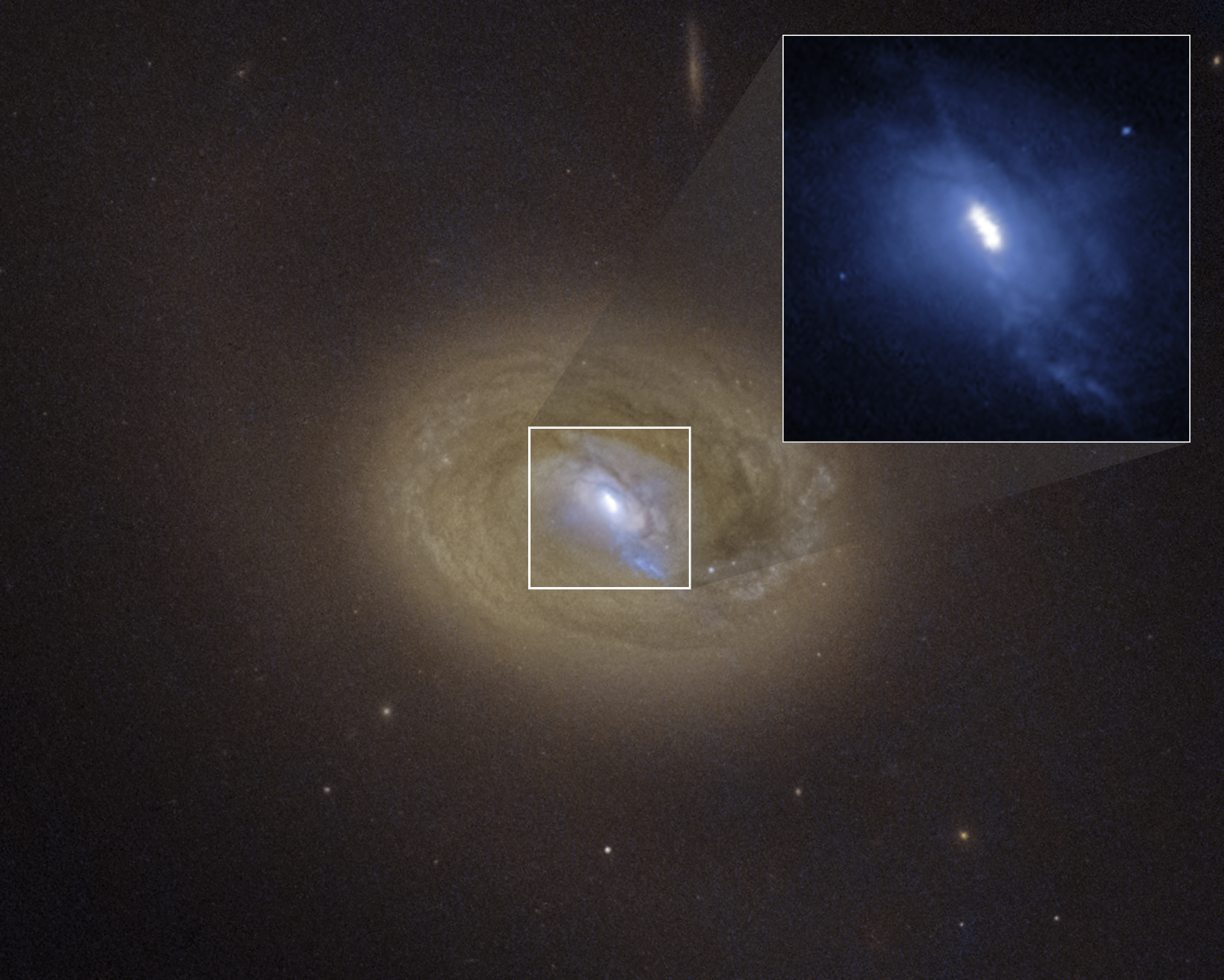
A Hubble Space Telescope visible-light image of the galaxy MCG-03-34-064 that appears as an orange spiral. It has a blue center (expanded in an inset image at upper right) with three bright spots embedded in a white ellipse at the galaxy's center. Two of these bright spots are the source of strong X-ray emission, a telltale sign that they are supermassive black holes converting matter to energy.
A Hubble Space Telescope visible-light image of the galaxy MCG-03-34-064. Hubble’s sharp view reveals three distinct bright spots embedded in a white ellipse at the galaxy’s center (expanded in an inset image at upper right). Two of these bright spots are the source of strong X-ray emission, a telltale sign that they are supermassive black holes. The black holes shine brightly because they are converting infalling matter into energy, and blaze across space as active galactic nuclei. Their separation is about 300 light-years. The third spot is a blob of bright gas. The blue streak pointing to the 5 o’clock position may be a jet fired from one of the black holes. The black hole pair is a result of a merger between two galaxies that will eventually collide.
NASA, ESA, Anna Trindade Falcão (CfA); Image Processing: Joseph DePasquale (STScI)

The discovery was serendipitous. Hubble’s high-resolution imaging revealed three optical diffraction spikes nested inside the host galaxy, indicating a large concentration of glowing oxygen gas within a very small area. “We were not expecting to see something like this,” said Anna Trindade Falcão of the Center for Astrophysics | Harvard & Smithsonian in Cambridge, Massachusetts, lead author of the paper published today in The Astrophysical Journal. “This view is not a common occurrence in the nearby universe, and told us there’s something else going on inside the galaxy.”

Diffraction spikes are imaging artifacts caused when light from a very small region in space bends around the mirror inside telescopes.

Falcão’s team then examined the same galaxy in X-rays light using the Chandra observatory to drill into what’s going on. “When we looked at MCG-03-34-64 in the X-ray band, we saw two separated, powerful sources of high-energy emission coincident with the bright optical points of light seen with Hubble. We put these pieces together and concluded that we were likely looking at two closely spaced supermassive black holes,” said Falcão.

In a surprise finding, astronomers, using NASA’s Hubble Space Telescope have discovered that the jet from a supermassive black hole at the core of M87, a huge galaxy 54 million light years away, seems to cause stars to erupt along its trajectory. The stars, called novae, are not caught inside the jet, but in a dangerous area near it.
NASA’s Goddard Space Flight Center; Lead Producer: Paul Morris

To support their interpretation, the researchers used archival radio data from the Karl G. Jansky Very Large Array near Socorro, New Mexico. The energetic black hole duo also emits powerful radio waves. “When you see bright light in optical, X-rays, and radio wavelengths, a lot of things can be ruled out, leaving the conclusion these can only be explained as close black holes. When you put all the pieces together it gives you the picture of the AGN duo,” said Falcão.

The third source of bright light seen by Hubble is of unknown origin, and more data is needed to understand it. That might be gas that is shocked by energy from a jet of ultra high-speed plasma fired from one of the black holes, like a stream of water from a garden hose blasting into a pile of sand.

“We wouldn’t be able to see all of these intricacies without Hubble’s amazing resolution,” said Falcão.

The two supermassive black holes were once at the core of their respective host galaxies. A merger between the galaxies brought the black holes into close proximity. They will continue to spiral closer together until they eventually merge — in perhaps 100 million years — rattling the fabric of space and time as gravitational waves.

The National Science Foundation’s Laser Interferometer Gravitational-Wave Observatory (LIGO) has detected gravitational waves from dozens of mergers between stellar-mass black holes. But the longer wavelengths resulting from a supermassive black hole merger are beyond LIGO’s capabilities. The next-generation gravitational wave detector, called the LISA (Laser Interferometer Space Antenna) mission, will consist of three detectors in space, separated by millions of miles, to capture these longer wavelength gravitational waves from deep space. ESA (European Space Agency) is leading this mission, partnering with NASA and other participating institutions, with a planned launch in the mid-2030s.

NASA’s Marshall Space Flight Center manages the Chandra program. The Smithsonian Astrophysical Observatory’s Chandra X-ray Center controls science from Cambridge, Massachusetts and flight operations from Burlington, Massachusetts. Northrop Grumman Space Technologies in Redondo Beach, California was the prime contractor for the spacecraft.

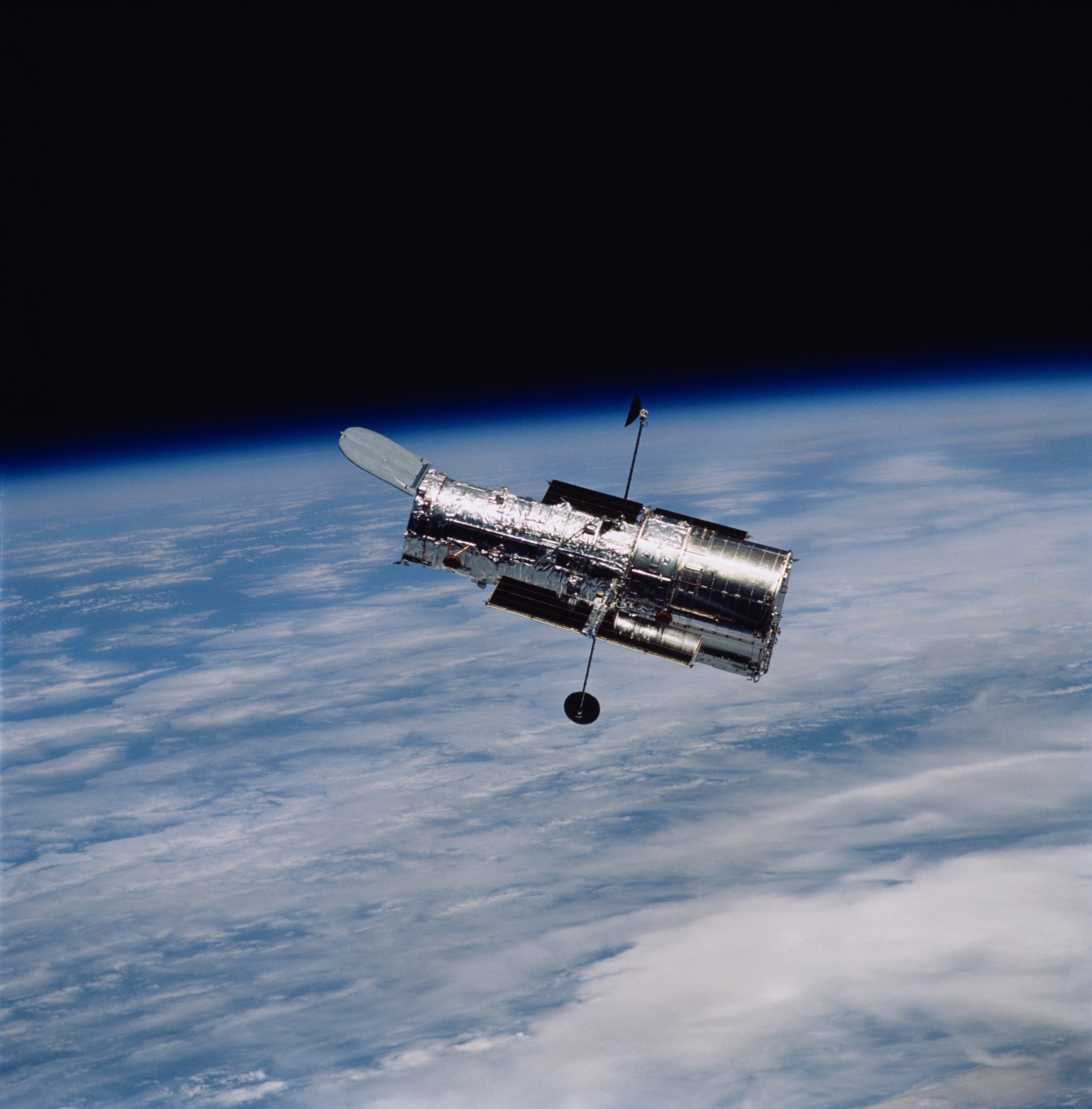
The Hubble Space Telescope has been operating for over three decades and continues to make ground-breaking discoveries that shape our fundamental understanding of the universe. Hubble is a project of international cooperation between NASA and ESA (European Space Agency). NASA’s Goddard Space Flight Center in Greenbelt, Maryland, manages the telescope and mission operations. Lockheed Martin Space, based in Denver, Colorado, also supports mission operations at Goddard. The Space Telescope Science Institute in Baltimore, Maryland, which is operated by the Association of Universities for Research in Astronomy, conducts Hubble science operations for NASA.

Media Contacts:

Claire Andreoli
NASA’s Goddard Space Flight Center, Greenbelt, MD
claire.andreoli@nasa.gov

Ray Villard
Space Telescope Science Institute, Baltimore, MD

Science Contact:

Anna Trindade Falcão
Center for Astrophysics | Harvard & Smithsonian, Cambridge, MA
Powered by WPeMatico
Get The Details…

NASA Science for Your Classroom: Opportunities for Educators

NASA Science for Your Classroom: Opportunities for Educators

4 min read

NASA Science for Your Classroom: Opportunities for Educators

The summer season for educators can be a time of rest and rejuvenation, but it can also offer opportunities for professional learning with new colleagues beyond your own school. The following programs from NASA’s Science Activation Program offer end-of-summer/early-fall curricular resources and connections with other educators that can help you bring new science ideas and activities into your instructional practice.  

Celebrating the Moon & Moon Rocks with NASA – A Webinar for Educators

Join us, as the world awaits this year’s International Observe the Moon Night (InOMN on September 14, 2024), for this free NASA Astromaterials Research and Exploration Science (ARES) interactive webinar focusing on the Moon, Moon rocks, Apollo and future Artemis Missions! This session will be geared towards educators and their students (targeting grades 5-9 but other grade levels, college students, and individual educators are welcome to participate). Participants will interact with Dr. Juliane Gross, Artemis Curation Lead at the NASA Johnson Space Center in Houston, TX. The presentation will last approximately 45 minutes followed by an optional 15-30 minutes of Q&A. If you can’t participate live, feel free to register to receive an archived recording of the presentation. 

Infusing Space Rock Content and More into Learning Environments

Join NASA Astromaterials Research and Exploration Science for an interactive webinar focusing on hands-on and digital Earth and Space Science resources appropriate for both formal and informal learning settings. This session, geared towards educators who work with grades 3 through HS or general audiences at public events, will prepare you to engage learners with content associated with Moon rocks, meteorites, samples from asteroids and more! Presentation will last approximately 50 minutes followed by an optional 10+ minutes of Q&A. Those who register below will receive an archived recording of the presentation. 

Spark Curiosity with Infiniscope’s Free Resources!

Infiniscope is a NASA-funded project focused on sparking curiosity, fostering exploration, and delivering digital content and tools that transform the learning experience. NGSS-Designed digital learning experiences are just the beginning. Whether you want classroom-ready content or the tools and support to build your own, we’ve got you covered. 

If you’re a middle school or highschool educator, join the webinars below and discover the incredible FREE resources waiting for you at Infiniscope.org. In this guided tour, you’ll learn how to: search for classroom-ready content on the website, find educator resources and detailed lesson information, enroll students in lessons and collections, sign up for future training events, access the virtual field trip creator, and get more information on our adaptive lesson builder. Learn more about Infiniscope.

  • Intro to Infiniscope Registration – September 17 at 4 p.m. EDT
  • Intro to Infiniscope Registration – October 22  at 6 p.m. EDT

Take Your Learners Anywhere with Tour It!

With Tour It, Infiniscope’s free virtual field trip creator, you can make place-based learning accessible to all your learners, boosting engagement and learning outcomes while enabling them to build personal connections. Tour It is your gateway to creating captivating virtual field trips! As a member of the Infiniscope teaching network, you’ll have exclusive access to this amazing tool that brings immersive learning experiences to life. Whether you’re a seasoned educator or just starting your journey, Tour It empowers you to craft engaging and interactive virtual tours that inspire learners and enable them to build personal connections to a place. Learn more about Tour it.

Heliophysics Webinars for Educators: Physics in an Astronomy Context

NASA’s Heliophysics Education Activation Team (HEAT) and the American Association of Physics Teachers (AAPT) have put together a free, monthly, virtual workshop series for teachers of astrophysics taught in the context of introductory and upper division physics and astronomy courses. While these workshops are intended for secondary- and tertiary-level teachers who teach in formal classroom contexts, other educators are also welcome if the content covered is appropriate to your teaching context. 

These virtual gatherings of 25-50 teachers occur one Saturday per month and provide an astrophysics mini-lecture, a small group engagement with the core activity, and discussion time to connect with like-minded educators. 

Dates and Topics: 

  • September, 21, 2024 – Coronal Mass Ejection Science
  • October 12, 2024 – Planetary Magnetism Science
  • November 9, 2024 – Auroral Currents
  • December 7, 2024 – Star Spectra Science

Time: 1 – 2:30 p.m. EDT

Register here 

We hope these resources will help prepare you for a wonderful year of amazing science learning… and beyond!

Share

Details

Last Updated
Sep 09, 2024

Powered by WPeMatico

Get The Details…

Starliner Lands in New Mexico

Starliner Lands in New Mexico

Boeing’s Starliner touches down at White Sands Space Harbor in New Mexico at 12:01 a.m. EDT Saturday, Sept. 7, completing the agency’s Crew Flight Test. Photo credit: NASA

At 12 a.m. EDT, Boeing’s uncrewed Starliner spacecraft landed at White Sands Space Harbor in New Mexico.

NASA will provide coverage of a post-landing news conference at 1:30 a.m. on NASA+, the NASA app, YouTube, and the agency’s website.

The following will participate in the news conference:

  • Joel Montalbano, deputy associate administrator, Space Operations Mission Directorate at NASA Headquarters in Washington
  • Steve Stich, manager, Commercial Crew Program, NASA Kennedy Space Center in Florida
  • Dana Weigel, manager, International Space Station, NASA Johnson

Learn more about the mission by following the commercial crew blog, @commercial_crew on X, and @NASACommercialCrew on Facebook.

Powered by WPeMatico

Get The Details…

Stephanie Plucinsky

NASA, Boeing Welcome Starliner Spacecraft to Earth, Close Mission

NASA, Boeing Welcome Starliner Spacecraft to Earth, Close Mission

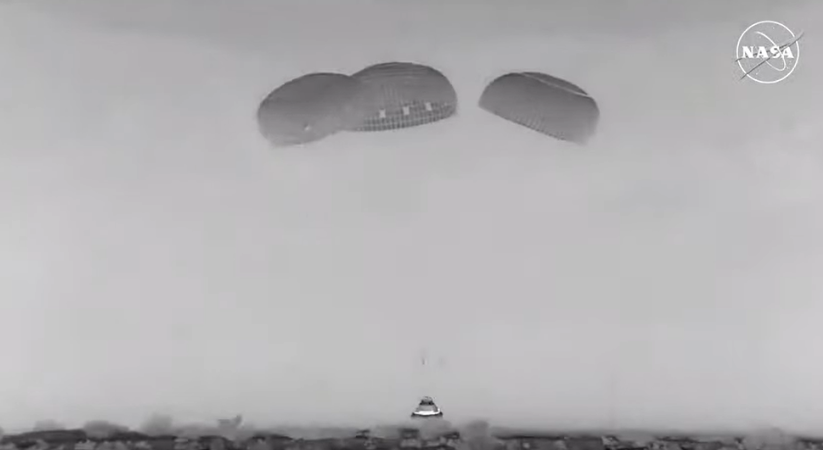
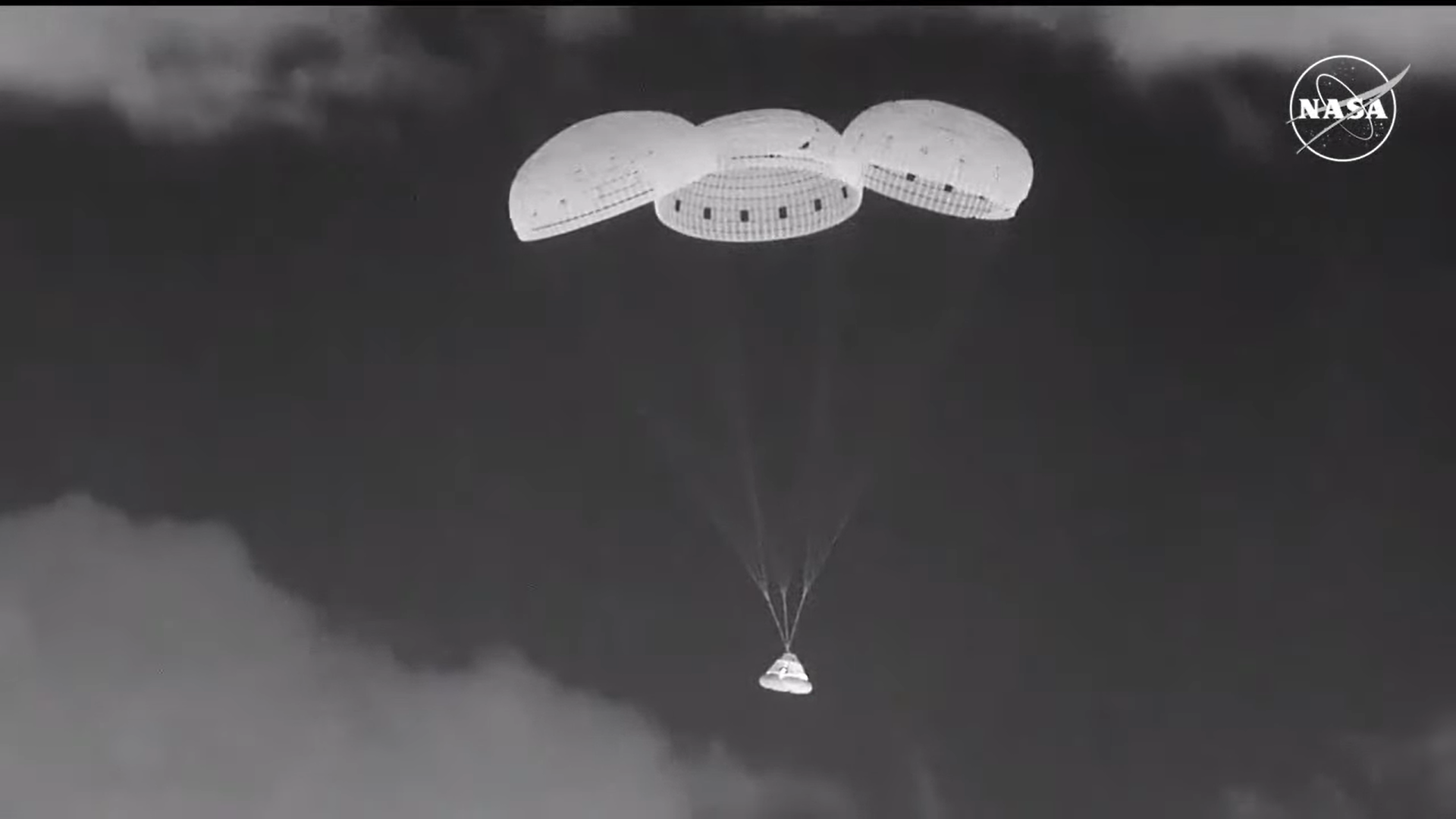
Night vision view of Boeing's Starliner and its parachutes descending to New Mexico.
NASA and Boeing welcomed Starliner back to Earth following the uncrewed spacecraft’s successful landing at 10:01 p.m. MDT Sept. 6, 2024, at the White Sands Space Harbor in New Mexico. 
Credit: NASA

NASA and Boeing safely returned the uncrewed Starliner spacecraft following its landing at 10:01 p.m. MDT Sept. 6 at White Sands Space Harbor in New Mexico, concluding a three-month flight test to the International Space Station.

“I am extremely proud of the work our collective team put into this entire flight test, and we are pleased to see Starliner’s safe return,” said Ken Bowersox, associate administrator, Space Operations Mission Directorate at NASA Headquarters in Washington. “Even though it was necessary to return the spacecraft uncrewed, NASA and Boeing learned an incredible amount about Starliner in the most extreme environment possible. NASA looks forward to our continued work with the Boeing team to proceed toward certification of Starliner for crew rotation missions to the space station.”

The flight on June 5 was the first time astronauts launched aboard the Starliner. It was the third orbital flight of the spacecraft, and its second return from the orbiting laboratory. Starliner now will ship to NASA’s Kennedy Space Center in Florida for inspection and processing.

NASA’s Commercial Crew Program requires a spacecraft to fly a crewed test flight to prove the system is ready for regular flights to and from the orbiting laboratory. Following Starliner’s return, the agency will review all mission-related data.

“We are excited to have Starliner home safely. This was an important test flight for NASA in setting us up for future missions on the Starliner system,” said Steve Stich, manager of NASA’s Commercial Crew Program. “There was a lot of valuable learning that will enable our long-term success. I want to commend the entire team for their hard work and dedication over the past three months.”

NASA astronauts Butch Wilmore and Suni Williams launched on June 5 aboard Starliner for the agency’s Boeing Crewed Flight Test from Cape Canaveral Space Force Station in Florida. On June 6, as Starliner approached the space station, NASA and Boeing identified helium leaks and experienced issues with the spacecraft’s reaction control thrusters. Following weeks of in-space and ground testing, technical interchange meetings, and agency reviews, NASA made the decision to prioritize safety and return Starliner without its crew. Wilmore and Williams will continue their work aboard station as part of the Expedition 71/72 crew, returning in February 2025 with the agency’s SpaceX Crew-9 mission.

The crew flight test is part of NASA’s Commercial Crew Program. The goal of NASA’s Commercial Crew Program is safe, reliable, and cost-effective transportation to and from the International Space Station and low Earth orbit. This already is providing additional research time and has increased the opportunity for discovery aboard humanity’s microgravity testbed, including helping NASA prepare for human exploration of the Moon and Mars.

Learn more about NASA’s Commercial Crew program at:

https://www.nasa.gov/commercialcrew

-end-

Joshua Finch / Jimi Russell
Headquarters, Washington
202-358-1100
joshua.a.finch@nasa.gov / james.j.russell@nasa.gov

Leah Cheshier
Johnson Space Center, Houston
281-483-5111
leah.d.cheshier@nasa.gov

Steve Siceloff / Danielle Sempsrott / Stephanie Plucinsky
Kennedy Space Center, Florida
321-867-2468
steven.p.siceloff@nasa.gov / danielle.c.sempsrott@nasa.gov / stephanie.n.plucinsky@nasa.gov

Share

Details

Last Updated

Sep 07, 2024

Editor
Jessica Taveau

Powered by WPeMatico

Get The Details…
Jessica Taveau

NASA’s Coverage Underway, Starliner Prepares for Deorbit Burn

NASA’s Coverage Underway, Starliner Prepares for Deorbit Burn

Boeing’s Starliner spacecraft is seen during its return to Earth after undocking from the International Space Station at 6:04 p.m. EDT on Friday, June 6, 2024. Photo credit: NASA

NASA’s coverage is underway on NASA+, the NASA app, and YouTube, and the agency’s website as Boeing’s uncrewed Starliner spacecraft prepares for deorbit burn, entry, and landing.

Starliner autonomously undocked from the forward-facing port of the International Space Station’s Harmony module at 6:04 p.m. EDT, and mission managers gave a “go” for the spacecraft to proceed for a deorbit burn.

Starliner’s deorbit burn is expected at 11:17 p.m. EDT and involves the spacecraft firing its larger orbital maneuvering and attitude control thrusters, providing the power necessary to re-enter Earth’s atmosphere.

Learn how to stream NASA programming through a variety of platforms including social media.

Powered by WPeMatico

Get The Details…

Stephanie Plucinsky