Dragon Operations Continue During Stem Cell Research on Station

Dragon Operations Continue During Stem Cell Research on Station
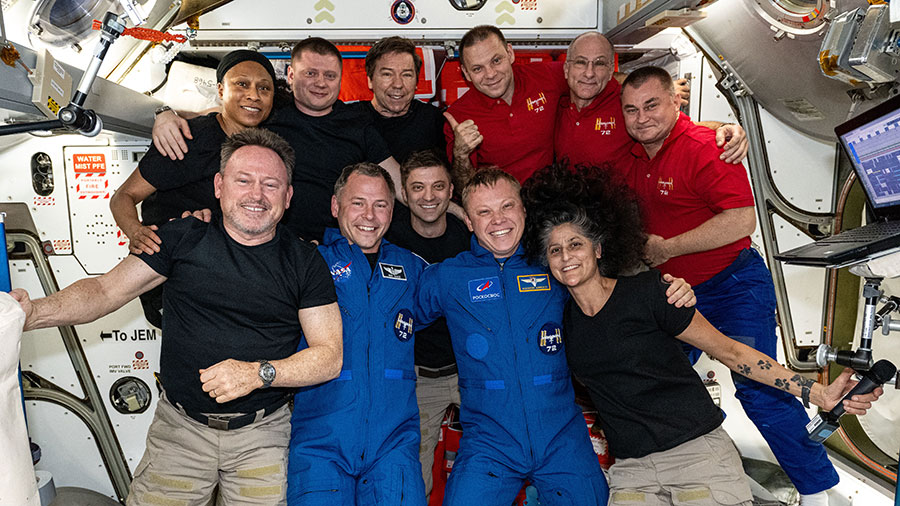
The 11-member Expedition 72 crew poses for a portrait inside Harmony module. In the front (from left) are, Butch Wilmore, Nick Hague, Matthew Dominick, Aleksandr Gorbunov, and Suni Williams. In the back are, Jeanette Epps, Aleksandr Grebenkin, Mike Barratt, Ivan Vagner, Don Pettit, and Alexey Ovchinin.

The Expedition 72 crew continued working inside the two SpaceX Dragon spacecraft docked to the International Space Station on Friday. The orbital residents also kept up stem cell research, serviced a  pair of spacesuits, and maintained life support systems at the end of the week.

Three NASA astronauts and one Roscosmos cosmonaut representing NASA’s SpaceX Crew-8 are nearing the end of a seven-month mission and are waiting for NASA and SpaceX to announce their return to Earth time and date, pending weather. Dragon Endeavour Commander Matthew Dominick is poised to lead Pilot Mike Barratt with Mission Specialists Jeanette Epps and Alexander Grebenkin back to Earth inside Dragon with a splashdown off the coast of Florida. The quartet has been packing cargo and personal items inside the spacecraft for several days and spent the end of the day Friday reviewing emergency equipment.

The space station’s two newest crew members, NASA astronaut Nick Hague and Roscosmos cosmonaut Aleksandr Gorbunov, joined Expedition 72 Commander Suni Williams and Flight Engineer Butch Wilmore inside Dragon Freedom and trained the duo on Dragon operations. Hague also worked with Barratt and NASA Flight Engineer Don Pettit inside Freedom configuring its seats for docked operations.

Stem cell research has been underway aboard the orbital outpost this week using the microgravity environment to learn how to produce advanced cell-based therapies and treat certain blood diseases and cancers. Williams and Epps partnered together processing stem cell samples and peering at them with through a microscope. Researchers are exploring how weightlessness enables stem cells to produce blood and immune cells with superior attributes than those created on Earth.

Wilmore spent his day in the Quest airlock servicing a pair of U.S. spacesuits. The veteran NASA astronaut swapped out components and cleaned cooling loops inside the suits as part of regularly scheduled maintenance.

Roscosmos cosmonauts Alexey Ovchinin and Ivan Vagner, who have been aboard the orbital lab with Pettit since Sept. 11, split their day with computer maintenance and life support operations. They also joined Gorbunov and recorded a video for educators and students on Earth. Grebenkin inventoried medical gear and tested power supply systems in the Nauka science module.


Learn more about station activities by following the space station blog@space_station and @ISS_Research on X, as well as the ISS Facebook and ISS Instagram accounts.

Get weekly video highlights at: https://roundupreads.jsc.nasa.gov/videoupdate/

Get the latest from NASA delivered every week. Subscribe here: www.nasa.gov/subscribe

Powered by WPeMatico

Get The Details…

Mark Garcia

JOB OPPORTUNITIES: NASA OFFICE OF THE GENERAL COUNSEL

JOB OPPORTUNITIES: NASA OFFICE OF THE GENERAL COUNSEL

1 min read

Preparations for Next Moonwalk Simulations Underway (and Underwater)

There are no current openings. Please check back later for opportunities to join our team.

Powered by WPeMatico

Get The Details…
Justyna M. Ragiel-Smith

Sunglint on the Alabama River

Sunglint on the Alabama River

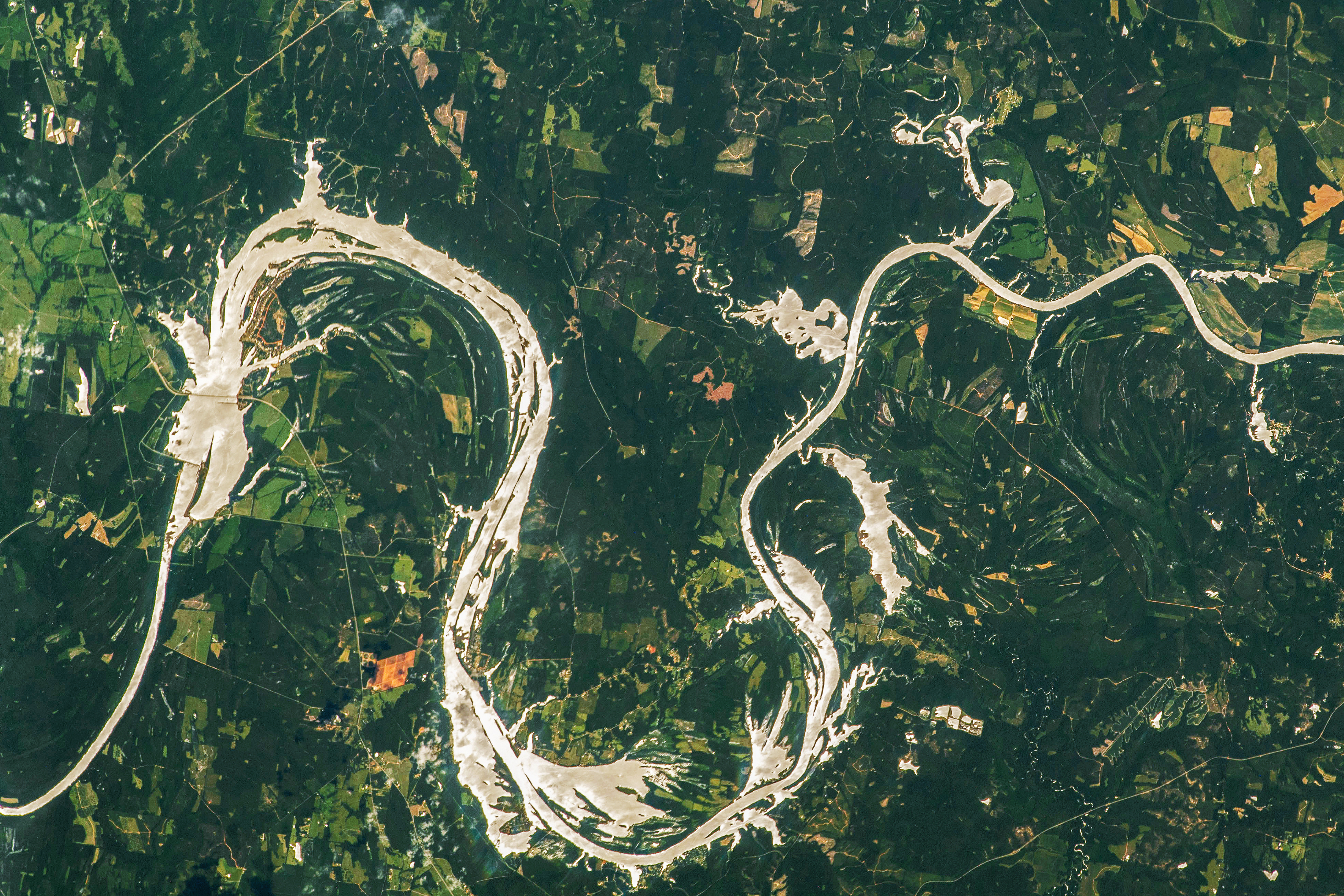
The silvery waters of the Alabama River meander across the image, contrasted against surrounding land in shades of green. At various points, the water extends outward from the borders of the river.
An astronaut aboard the International Space Station shot this photo of large meanders of the Alabama River while orbiting over the southern United States. The river’s smooth water surface reflects sunlight back toward the astronaut’s camera, producing an optical phenomenon known as sunglint.
NASA/Woody Hoburg

In this June 26, 2023, photo taken from the International Space Station, sunlight shines off the smooth waters of the Alabama River in a phenomenon known as sunglint. When photographing Earth, astronauts often take advantage of sunglint’s tendency to increase the contrast between water surfaces and surrounding land surfaces.

In the 1960s, the Alabama River was dammed, creating Dannelly Reservoir (the large shining area at center left). Construction of the dam also raised water levels upriver. This resulted in flooding at several points along the river. These flooded zones are typical of floodplains—the low, flat areas immediately next to larger rivers. In this image, flooded zones appear as irregular, bright shapes extending away from the river, like at Gee’s Bend (center bottom).

Text Credit: Justin Wilkinson

Image Credit: NASA/Woody Hoburg

Powered by WPeMatico

Get The Details…
Monika Luabeya

Science Activation’s PLACES Team Facilitates Third Professional Learning Institute

Science Activation’s PLACES Team Facilitates Third Professional Learning Institute

5 min read

Science Activation’s PLACES Team Facilitates Third Professional Learning Institute

The NASA Science Activation program’s Place-Based Learning to Advance Connections, Education, and Stewardship (PLACES) project supports middle and high school educators to engage students in data-rich Earth science learning through the integration of NASA data sets, images, classroom lessons, and other assets. This project draws on a place-based approach as a means to increase “data fluency” — the ability and confidence to make sense of and use data. This means knowing when, how, and why to use data for a specific purpose, such as solving problems and communicating ideas grounded in evidence.

As part of this effort, PLACES facilitated its third Professional Learning (PL) Summer Institute (SI) for 22 educators at the Gulf of Maine Research Institute (GMRI) in Portland, Maine the week of August 12th, 2024. This is the third PL Summer Institute the PLACES team has facilitated, each focusing on engaging educators in place-based, data-rich teaching and learning with NASA data and resources.

The GMRI PL development and facilitation was a collaborative co-design effort between two NASA Science Activation projects (PLACES led by WestEd and the Learning Ecosystems Northeast project led by GMRI) and colleagues from the Concord Consortium and NASA Langley Research Center. During this PL, teachers took part in community science projects developed by GMRI to incorporate youth in ongoing research projects, including a mix of field- and classroom-based experiences that explored the phenomena of Hemlock Woolly Adelgid (HWA) and the changes to intertidal crab populations – two invasive species that are proliferating as a result of climate change. During two field-based experiences, teachers gathered primary data using protocols from GMRI’s Ecosystem Investigation Network and the NASA-sponsored program, GLOBE (Global Learning and Observations to Benefit the Environment). Teachers then explored these primary data using Concord Consortium’s Common Online Data Analysis Platform (CODAP) to better understand the geographic and temporal spread of these species. To connect their local experiences to global happenings, teachers then explored secondary data sets, including those sourced from the My NASA Data (MND – also supported by NASA Science Activation as part of the GLOBE Mission Earth project) Earth System Explorer (e.g., Normalized Difference Vegetation Index, salinity, sea surface temperature). The facilitation team also used the MND Data Literacy Cubes to encourage teachers to consider a multitude of diverse questions about place, data, and the phenomena. The GLOBE protocols supplemented existing GMRI data collection protocols, presenting new opportunities for teachers already experienced with HWA and Green Crabs. The MND data and Data Literacy Cubes moved teachers from questions they generated as part of their primary data collection towards new knowledge.

Daily feedback from teachers highlighted their appreciation for the responsiveness of the facilitation team, as well as a growing curiosity and desire for using NASA resources such as protocols from GLOBE and data from MND’s Earth System Explorer. This is exciting to see as the teachers transition from the Summer Institute into a virtual Community of Practice during the school year. The Community of Practice engages them in peer-to-peer collaboration and dialogue as they develop, test, and give feedback on their own place-based, data-rich experiences using NASA data and resources. So far, teachers are planning to tackle a variety of topics ranging from ocean chemistry to human connections to the environment. Teachers indicated their interest in “making place-based experiences meaningful to our unique populations of students and having cultural representation in the classroom,” and focusing on “cross-school collaboration.” Preliminary evaluation data indicated that 76% of teachers thought their experiences with NASA resources during the SI helped them identify ways to bring data into their classroom. 85% of teachers indicated they feel a greater connection to NASA and knowledge of NASA resources for enhancing student understanding and engagement in science. Moving into the fall, teachers will take part in a Community of Practice, where they will work to implement a place-based, data-rich moment in their individual classrooms. In the summer of 2025, teachers will take part in a second summer institute where they will continue to learn more about implementing place-based, data-rich instruction.

The PLACES GMRI Summer Institute was made possible by a large co-design, collaborative effort across our partner organizations. This included:

  • Facilitation Team: Catherine Bursk (GMRI), Meggie Harvey (GMRI), Sara Salisbury (GMRI), Daniel Damelin (Concord Consortium)
  • In-person Facilitation Support Team: Leigh Peake (GMRI), Karen Lionberger (WestEd), Kristin Hunter-Thomson (Dataspire), Angela Rizzi (NASA Langley)
  • In-Person Team Member Participants: Janet Struble and Kevin Czaikowski (GLOBE, University of Toledo), Svetlana Darche (WestEd)
  • Virtual Observers: Kirsten Daehler, Nicole Wong, Leticia Perez (WestEd), Tracy Ostrom (GLOBE, UC Berkeley), Lori Rubino-Hare (NAU)
  • Additional support: Frieda Reichsman (Concord Consortium), Barbie Buckner and Jessia Taylor (NASA Langley), Sean Ryan (NAU), Lauren Shollenberger (NAU)

PLACES is supported by NASA under cooperative agreement award number 80NSSC22M0005 and is part of NASA’s Science Activation Portfolio. Learn more about how Science Activation connects NASA science experts, real content, and experiences with community leaders to do science in ways that activate minds and promote deeper understanding of our world and beyond: https://science.nasa.gov/learn

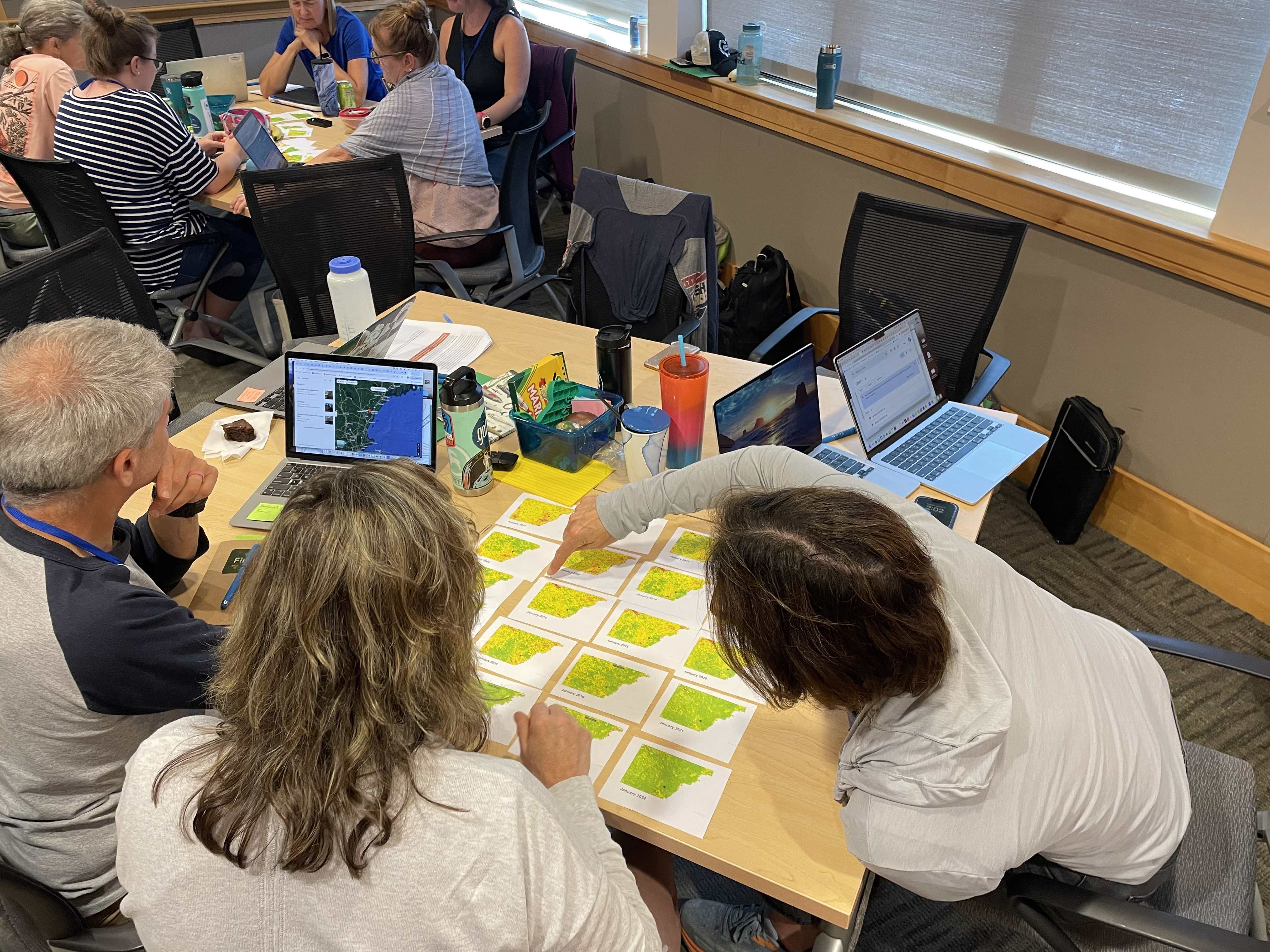
3 teachers at the GMRI summer institute look at a series of NDVI data on small individual maps. One of the teachers is pointing at the small maps, and another had Google Maps open on their nearby computer. In the background, another group of teachers looks at the same data.
Teachers at the GMRI summer institute review NDVI data ranging from 2002 to 2022 and identify patterns and trends.

Share

Details

Last Updated
Oct 04, 2024
Editor
NASA Science Editorial Team
Location
NASA Langley Research Center

Powered by WPeMatico

Get The Details…

NASA Announces Teams for 2025 Student Launch Challenge

NASA Announces Teams for 2025 Student Launch Challenge

3 min read

Preparations for Next Moonwalk Simulations Underway (and Underwater)

Students raise their hands in celebration and cheer after a successful launch of their vehicle in the 2024 Student Launch competition.
Students celebrate after a successful performance in the 2024 Student Launch competition at Bragg Farms in Toney, Alabama.
NASA

NASA has selected 71 teams from across the U.S. to participate in its 25th annual Student Launch Challenge, one of the agency’s Artemis Student Challenges. The competition is aimed at inspiring Artemis Generation students to explore science, technology, engineering, and math (STEM) for the benefit of humanity.

As part of the challenge, teams will design, build, and fly a high-powered amateur rocket and scientific payload. They also must meet documentation milestones and undergo detailed reviews throughout the school year.

The nine-month-long challenge will culminate with on-site events starting on April 30, 2025. Final launches are scheduled for May 3, at Bragg Farms in Toney, Alabama, just minutes north of NASA’s Marshall Space Flight Center in Huntsville, Alabama. Teams are not required to travel for their final launch, having the option to launch from a qualified site. Details are outlined in the Student Launch Handbook.

Each year, NASA updates the university payload challenge to reflect current scientific and exploration missions. For the 2025 season, the payload challenge will again take inspiration from the Artemis missions, which seek to land the first woman and first person of color on the Moon, and pave the way for future human exploration of Mars.

As Student Launch celebrates its 25th anniversary, the payload challenge will include reports from STEMnauts, non-living objects representing astronauts. The STEMnaut crew must relay real-time data to the student team’s mission control via radio frequency, simulating the communication that will be required when the Artemis crew achieves its lunar landing.

University and college teams are required to meet the 2025 payload requirements set by NASA, but middle and high school teams have the option to tackle the same challenge or design their own payload experiment.

Student teams will undergo detailed reviews by NASA personnel to ensure the safety and feasibility of their rocket and payload designs. The team closest to their target will win the Altitude Award, one of multiple awards presented to teams at the end of the competition. Other awards include overall winner, vehicle design, experiment design, and social media presence.

In addition to the engineering and science objectives of the challenge, students must also participate in outreach efforts such as engaging with local schools and maintaining active social media accounts. Student Launch is an all-encompassing challenge and aims to prepare the next generation for the professional world of space exploration.

The Student Launch Challenge is managed by Marshall’s Office of STEM Engagement (OSTEM). Additional funding and support are provided by NASA’s OSTEM via the Next Gen STEM project, NASA’s Space Operations Mission Directorate, Northrup Grumman, National Space Club Huntsville, American Institute of Aeronautics and Astronautics, National Association of Rocketry, Relativity Space, and Bastion Technologies.

For more information about Student Launch, visit:

Taylor Goodwin
Marshall Space Flight Center, Huntsville, Ala.
256.544.0034
taylor.goodwin@nasa.gov

Share

Details

Last Updated

Oct 04, 2024

Editor
Beth Ridgeway

Powered by WPeMatico

Get The Details…
Beth Ridgeway