Kathryn Sullivan: The First American Woman to Walk in Space
8 Min Read
Kathryn Sullivan: The First American Woman to Walk in Space
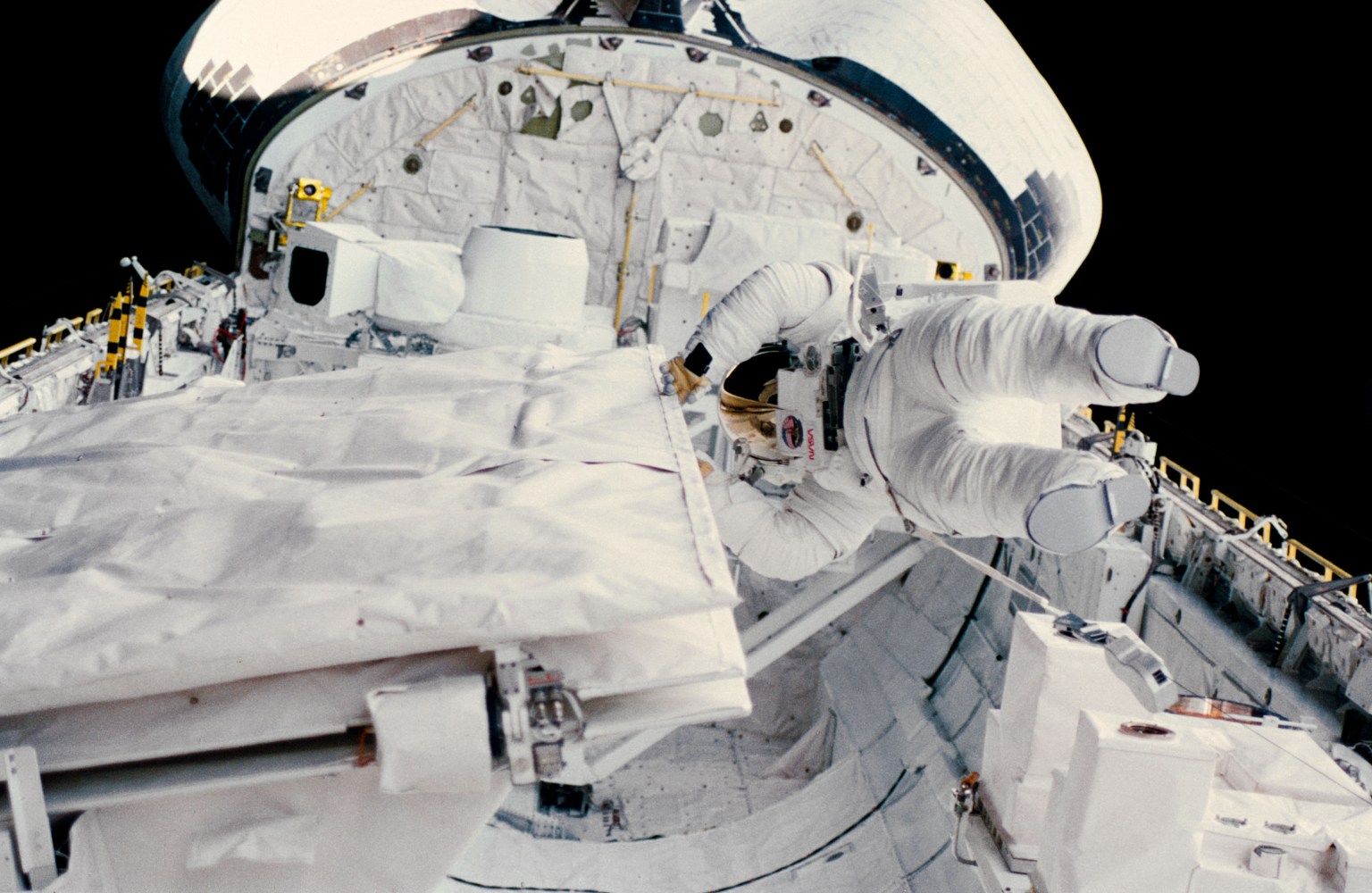
Astronaut Kathryn D. Sullivan checks the latch of the SIR-B antenna in the space shuttle Challenger’s open cargo bay during her historic extravehicular activity (EVA) on Oct. 11, 1984. Earlier, America’s first woman to perform an EVA and astronaut David C. Leestma, participated in an in-space simulation of refueling a spacecraft in orbit.
Credits: NASA
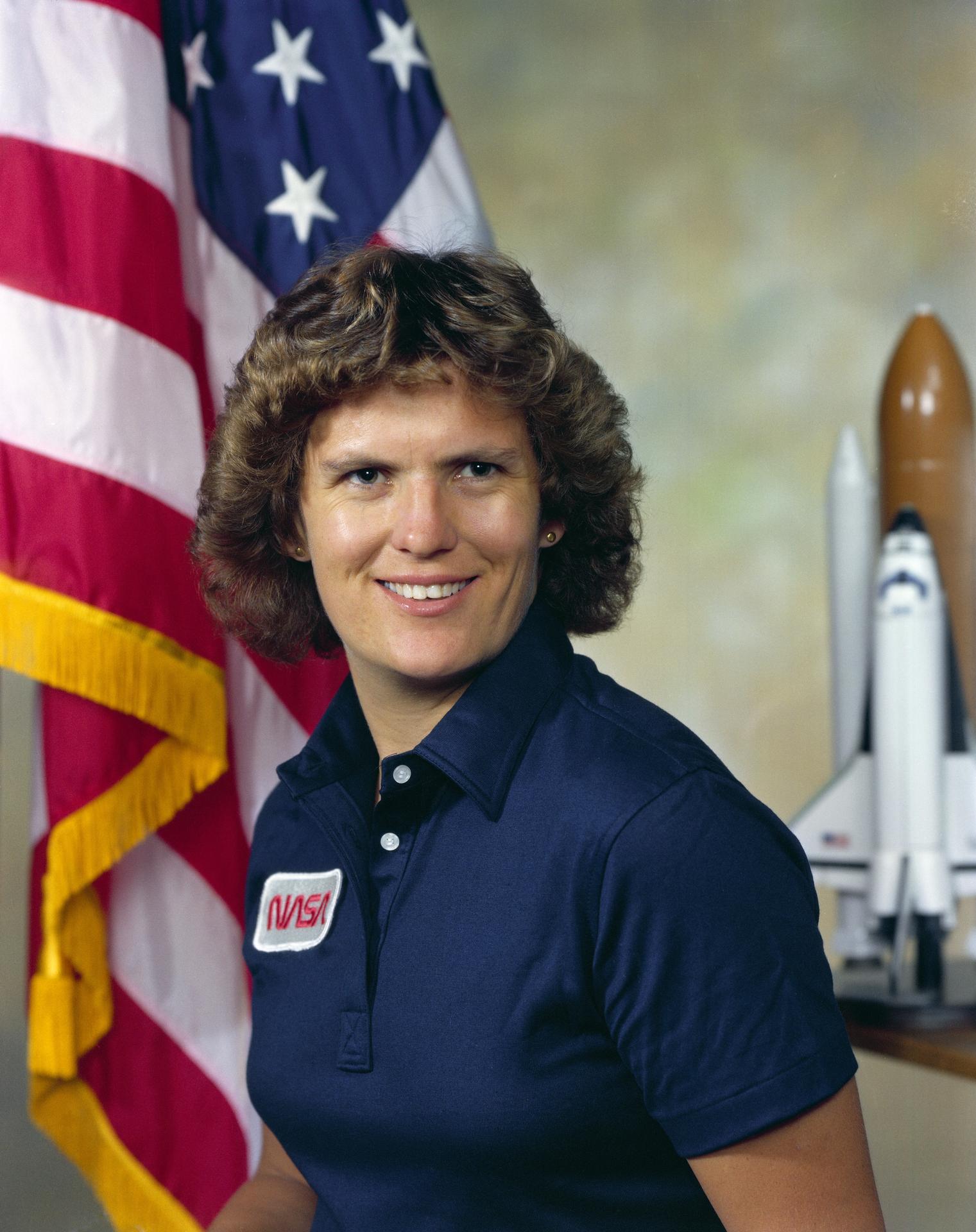
Forty years ago, in October 1984, Kathryn D. Sullivan became the first American woman to walk in space. But being the first presented several challenges that started well before she took those historic steps. Things got complicated just after she learned of her assignment.
Questions of Physiology
Biomedical researchers at NASA’s Johnson Space Center (JSC) raised what they believed was a serious issue with women walking in space and alerted George W.S. Abbey, the head of the Flight Crew Operations Directorate. Females, he learned, were more likely than their male counterparts to develop the bends in the low-pressure environment of the extravehicular mobility unit (EMU), the spacesuit she would wear. To alleviate the possibility of developing decompression syndrome, all spacewalkers had to breathe pure oxygen before a spacewalk to eliminate nitrogen from their bloodstream. Researchers insisted Sullivan (and any future women spacewalkers) spend more time than their male counterparts breathing pure oxygen before going outside of the space shuttle. Sullivan quickly learned that there were flaws in the research, which she countered, and Abbey ended up approving the same requirements for men and women doing an extravehicular activity (EVA).
Setting the Record
After the STS-41G crew had been named in the fall of 1983, a colleague—flush with excitement over the recent flight announcement — congratulated Sally K. Ride and Sullivan on their new titles: Ride being the first woman to fly in space twice and Sullivan the first woman to walk in space. Both shook their heads and explained that it would be many months before launch and that a Soviet woman would fly and do a spacewalk well before the space shuttle Challenger and her crew made it to orbit. As expected, the Soviets assigned cosmonaut Svetlana Y. Savitskaya to a second mission in 1983, less than a month after NASA’s crew announcement. In July 1984, Savitskaya, not Ride, went on to become the first woman to enter space twice and earned the distinction of being the first female to walk in space.
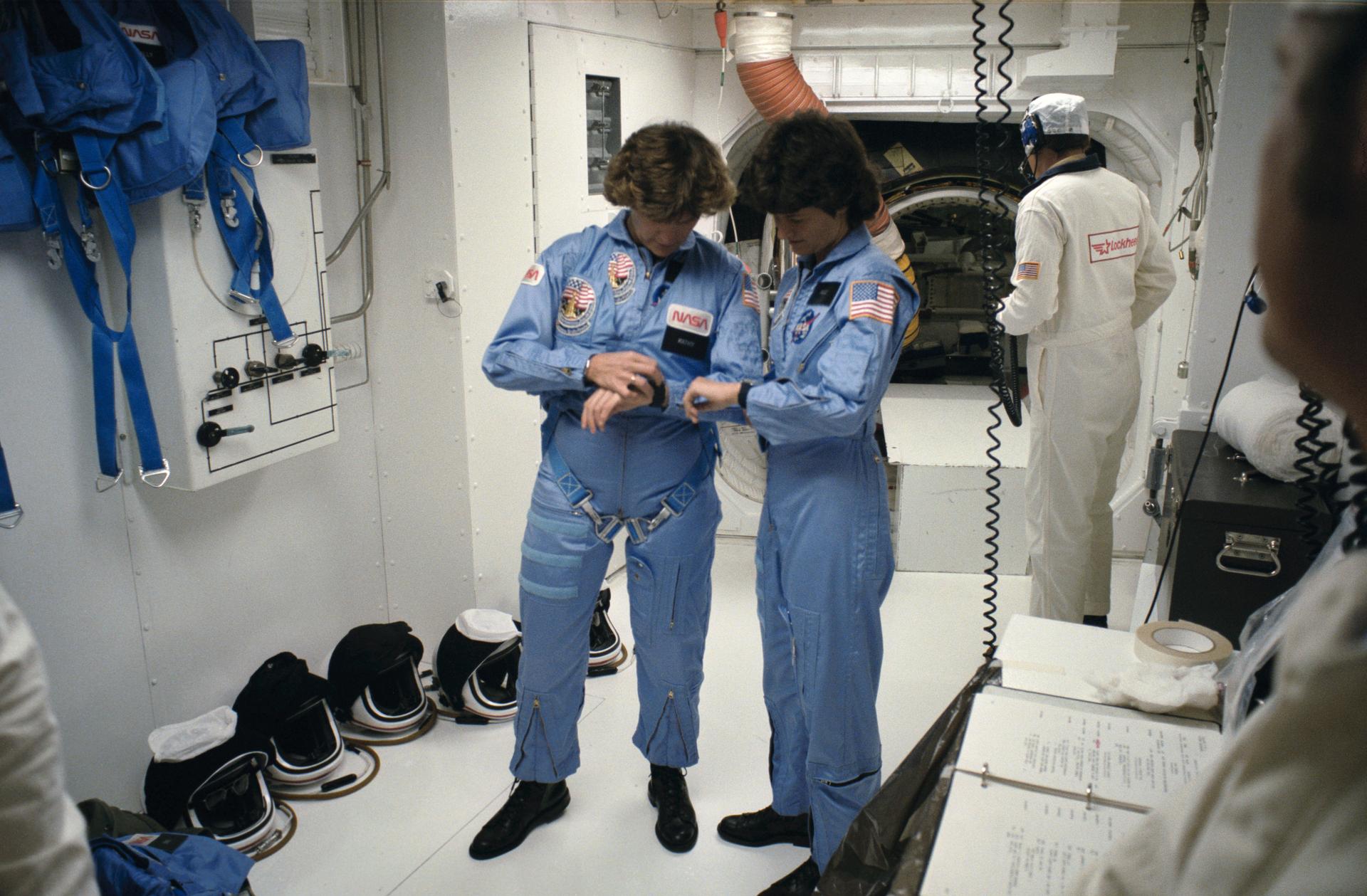
Astronauts Sally K. Ride (right) and Kathryn D. Sullivan, two of three mission specialists, synchronize their watches prior to ingressing the Space Shuttle Challenger on the launch pad at Kennedy Space Center on October 5, 1984.
NASA
Sullivan was not disappointed at losing the title. As she recalled in an oral history interview, being selected for an EVA was an “extraordinary opportunity,” and it did not matter where she was in the queue. She could not understand how people arrived at the idea that the “seventh, tenth, or thirteenth … is [any] less meaningful … than some historical first.”
Others at the Johnson Space Center still thought there was a way they could best the Soviets. Sullivan’s trainers took note of how short Savitskaya’s EVA was. It was only about three and a half hours. “A little bit more than that,” they explained, and “you’ll get the duration record!” But the idea of breaking her record by a few minutes seemed ludicrous. “I’m certainly not going to go tromping around on dinner speeches … saying, ‘Well yes, but I have the duration record.’”
“Hello, I’m right here!”
While the issue of breaking and setting records remained of interest at NASA more than twenty years after the Soviets sent cosmonaut Yuri Gagarin into space, Sullivan found herself grappling with other matters she found equally frustrating. First, there was the sexist media. No journalist asked how she was feeling about her role in the mission. Flying women in space was still new to the American news media in 1983—Ride had only flown her first mission in June, and while Judith A. Resnik had been named to a mission, she had not yet been in orbit. But Ride had not completed an EVA; only men had walked in space, and some found the activity challenging. Astronaut Eugene A. Cernan described his first EVA as the “spacewalk from hell.” Spacewalks can be physically demanding, and it was assumed that women might not have the strength to do so. Reporters asked commander Robert L. Crippen and Ride, “Do you think Kathy can do this?” Sitting at the preflight press conference she reminded reporters that she could speak for herself. “Hello, I’m right here! Hello. Hello.”
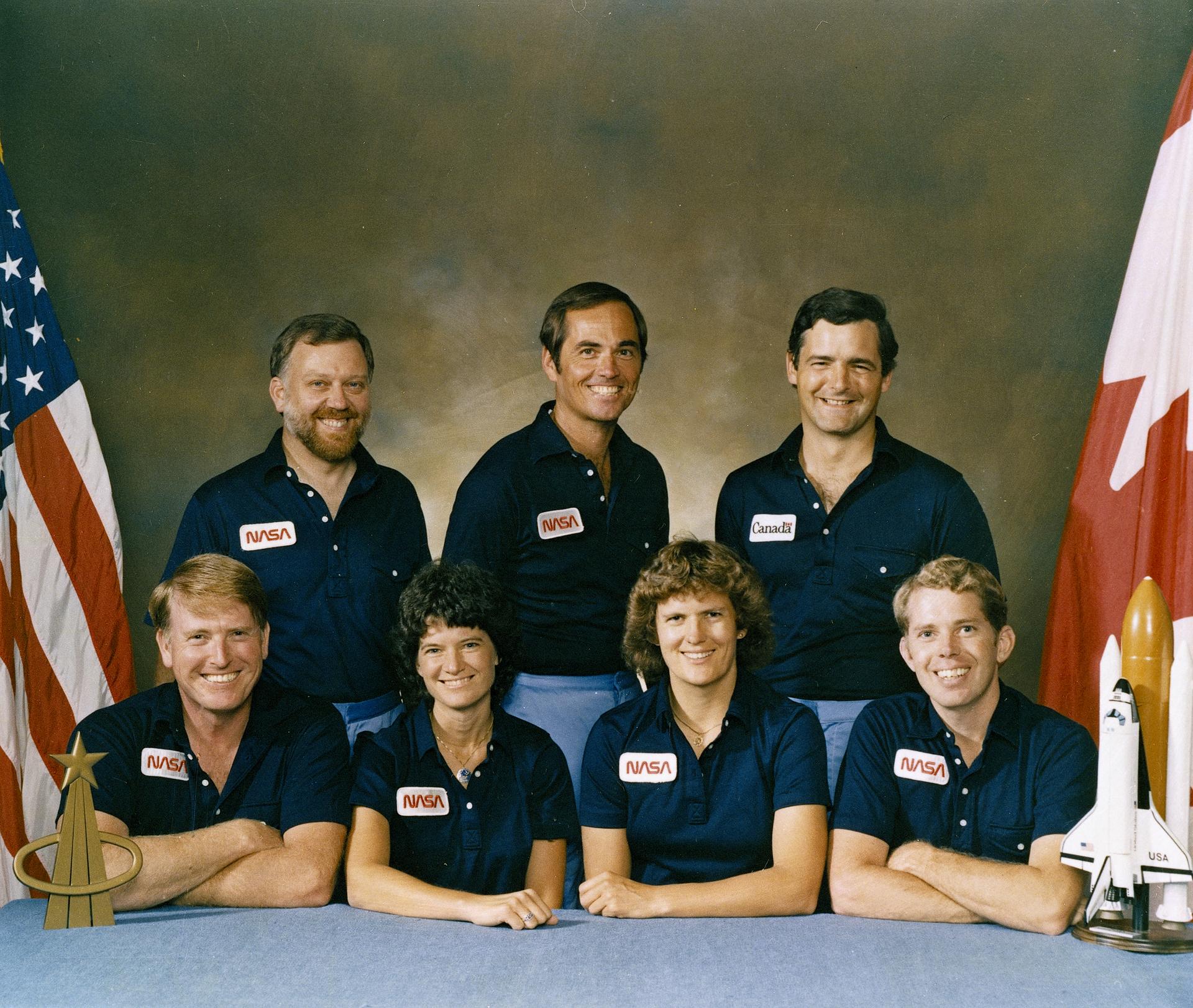
The crew assigned to the STS-41G mission included (seated left to right) Jon A. McBride, pilot; mission specialists Sally K. Ride, Kathryn D. Sullivan, and David C. Leestma. Standing in the rear, left to right, are payload specialist Paul D. Scully-Power, mission commander Robert Crippen, and payload specialist Marc Garneau. Launched aboard the Space Shuttle Challenger on October 5, 1984, the STS-41G mission marked the first flight to include two women.
NASA
There was also the matter of why her spacewalking partner, David C. Leestma, led the EVA. She had two years seniority in the Astronaut Office, arriving in 1978; NASA named Leestma to the corps in 1980. She also worked on spacesuit issues and the mission’s payload longer than he had, but both were rookies on this mission. Sullivan did not think Crippen and Abbey thought she was incapable, but for traditional norms to have been breached in this instance she could not explain why she—the senior ranking astronaut—was playing a support role instead of leading. If anyone asked why, Sullivan told Crippen he—not she—would have to answer the tough questions.
Space Suit Fit
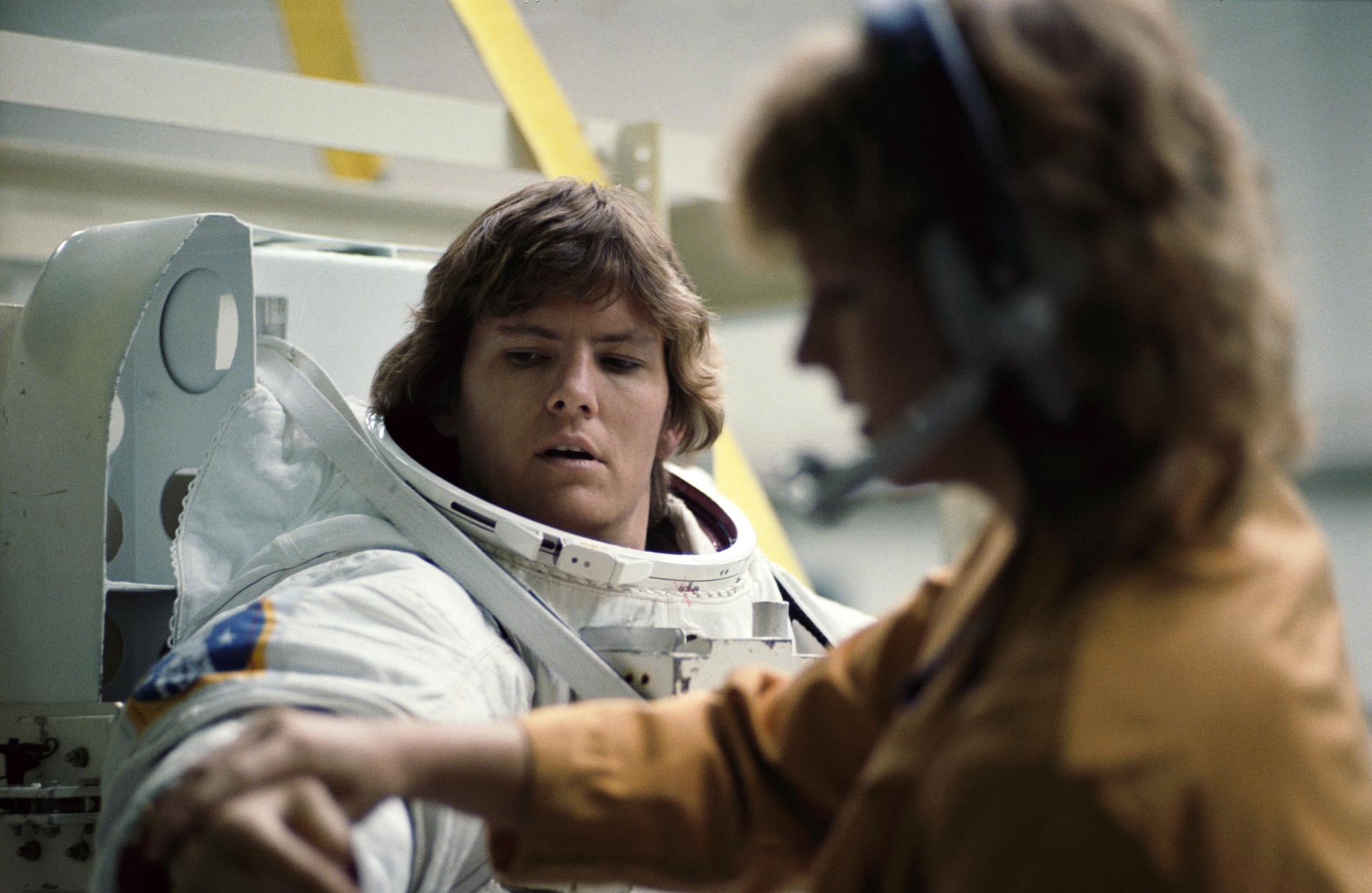
As she prepared for the flight, she began training in the shuttle EMU, which never quite fit her body. The suit’s elbow did not align with hers so when she bent her arm, she had to use extra force. The lower portion of the suit was misaligned, making it difficult to bend her knee. Being the first American woman to do a spacewalk, she decided what was most important was to perform the EVA and demonstrate the EMU worked for women. “I reckoned the wrong thing to do was to turn the first evolution of a woman doing a spacewalk into a controversy. … I just sucked it up and dealt with it.” The suit techs knew the EMU was not quite her size, but she made it work. Later, when assigned to STS-45, one of the techs noticed how poorly the suit fit. “We ought to do something about it. It ought to fit you,” he said. Sullivan responded, “We can start that conversation now, but if you think I was going to make that the conversation on the first EVA you’re crazy.”
Astronaut Kathryn D. Sullivan, STS-41G mission specialist, gets some help with her extravehicular mobility unit (EMU) prior to participating in an underwater simulation of an extravehicular activity (EVA) scheduled for her flight aboard the Columbia in October 1984. Dr. Sullivan and David C. Leestma (out of frame) participated in the rehearsal in NASA’s weightless environment training facility (WET-F) at the Johnson Space Center.
NASA
A Walk to Remember
Two days after Sullivan’s thirty-third birthday, STS-41G launched on October 5, 1984. Once in orbit, the flight plan changed quickly. A problem with a malfunctioning Ku-band antenna meant that the EVA had to be pushed back to the day before reentry. Sullivan worried that the walk might be scrapped, but when they finally began the pre-breathing protocol, she relaxed. “Challenger, Houston: You are GO for EVA,” Sullivan recalled, “were the sweetest words I had ever heard.” Sullivan and Leestma’s EVA was short—only three hours and twenty-nine minutes—but busy. Leestma demonstrated it was possible to refuel satellites in orbit, while Sullivan monitored his work. When he wrapped up his task, Sullivan finally had the opportunity to “do something, not just watch things.” She stowed the malfunctioning antenna and before they went back inside the shuttle, they filmed a scene for an IMAX film, The Dream is Alive—where the two spacewalkers rose from the bottom of the space shuttle’s windows and waved at the crew inside, mimicking the “Kilroy Was Here” meme. When filming concluded, Sullivan and Leestma returned to Challenger. “My first spacewalking adventure,” Sullivan wrote in her memoir, “was over all too soon.” The next day, President Ronald Reagan called to ask Sullivan about her experience. “Kathy, when we met at the White House, I know you were excited about walking in space. Was it what you expected?” he asked. Sullivan responded affirmatively and added, “I think it was the most fantastic experience of my life.”
I think it was the most fantastic experience of my life.
Kathryn Sullivan
NASA Astronaut
When she returned to JSC she learned that the EVA flight team had tried to figure out how to send her a diplomatic message to stay outside longer to beat Savitskaya’s record. There ended up being a “five-or six-minute difference” between Sullivan and Savitskaya, “and in the wrong direction as far as they were concerned.”
Despite all the challenges she faced as the first American woman to walk in space, Sullivan called the EVA “a fabulously cool experience.” She hoped to do another, but she never received another assignment to walk in space. She recognized what a unique opportunity she had—very few people have flown in space, and even fewer “get to sneak outside. I’m not going to diminish one dose of sneaking outside just because I didn’t get two, three, or four.”
Watch Suit Up – 50 Years of Spacewalks
About the Author
Jennifer Ross-Nazzal
NASA Human Spaceflight Historian
Jennifer Ross-Nazzal is the NASA Human Spaceflight Historian. She is the author of Winning the West for Women: The Life of Suffragist Emma Smith DeVoe and Making Space for Women: Stories from Trailblazing Women of NASA’s Johnson Space Center.
Does Distant Planet Host Volcanic Moon Like Jupiter’s Io?
5 min read
Preparations for Next Moonwalk Simulations Underway (and Underwater)
This artist’s concept depicts a potential volcanic moon between the exoplanet WASP-49 b, left, and its parent star. New evidence indicating that a massive sodium cloud observed near WASP-49 b is produced by neither the planet nor the star has prompted researchers to ask if its origin could be an exomoon.
NASA/JPL-Caltech
The existence of a moon located outside our solar system has never been confirmed but a new NASA-led study may provide indirect evidence for one.
New research done at NASA’s Jet Propulsion Laboratory reveals potential signs of a rocky, volcanic moon orbiting an exoplanet 635 light-years from Earth. The biggest clue is a sodium cloud that the findings suggest is close to but slightly out of sync with the exoplanet, a Saturn-size gas giant named WASP-49 b, although additional research is needed to confirm the cloud’s behavior. Within our solar system, gas emissions from Jupiter’s volcanic moon Io create a similar phenomenon.
Although no exomoons (moons of planets outside our solar system) have been confirmed, multiple candidates have been identified. It’s likely these planetary companions have gone undetected because they are too small and dim for current telescopes to detect.
The sodium cloud around WASP-49 b was first detected in 2017, catching the attention of Apurva Oza, formerly a postdoctoral researcher at NASA’s Jet Propulsion Laboratory and now a staff scientist at Caltech, which manages JPL. Oza has spent years investigating how exomoons might be detected via their volcanic activity. For example, Io, the most volcanic body in our solar system, constantly spews sulfur dioxide, sodium, potassium, and other gases that can form vast clouds around Jupiter up to 1,000 times the giant planet’s radius. It’s possible that astronomers looking at another star system could detect a gas cloud like Io’s even if the moon itself were too small to see.
Exomoons — moons around planets outside our solar system — are most likely too small to observe directly with current technology. In this video, learn how scientists tracked the motion of a sodium cloud 635 light-years away and found that it could be created by volcanos on a potential exomoon. NASA/JPL-Caltech
Both WASP-49 b and its star are composed mostly of hydrogen and helium, with trace amounts of sodium. Neither contains enough sodium to account for the cloud, which appears to be coming from a source that is producing roughly 220,000 pounds (100,000 kilograms) of sodium per second. Even if the star or planet could produce that much sodium, it’s unclear what mechanism could eject it into space.
Could the source be a volcanic exomoon? Oza and his colleagues set out to try to answer that question. The work immediately proved challenging because from such a great distance, the star, planet, and cloud often overlap and occupy the same tiny, faraway point in space. So the team had to watch the system over time.
A Cloud on the Move
As detailed in a new study published in the Astrophysical Journal Letters, they found several pieces of evidence that suggest the cloud is created by a separate body orbiting the planet, though additional research is needed to confirm the cloud’s behavior. For example, twice their observations indicated the cloud suddenly increased in size, as if being refueled, when it was not next to the planet.
New NASA-led research suggests a sodium cloud seen around the exoplanet WASP-49 b might be created by a volcanic moon, which is depicted in this artist’s concept. Jupiter’s fiery moon Io produces a similar cloud.
NASA/JPL-Caltech
They also observed the cloud moving faster than the planet in a way that would seem impossible unless it was being generated by another body moving independent of, and faster, than the planet.
“We think this is a really critical piece of evidence,” said Oza. “The cloud is moving in the opposite direction that physics tells us it should be going if it were part of the planet’s atmosphere.”
While these observations have intrigued the research team, they say they would need to observe the system for longer to be sure of the cloud’s orbit and structure.
A Chance of Volcanic Clouds
For part of their sleuthing, the researchers used the European Southern Observatory’s Very Large Telescope in Chile. Oza’s co-author Julia Seidel, a research fellow at the observatory, established that the cloud is located high above the planet’s atmosphere, much like the cloud of gas Io produces around Jupiter.
They also used a computer model to illustrate the exomoon scenario and compare it to the data. The exoplanet WASP-49 b orbits the star every 2.8 days with clocklike regularity, but the cloud appeared and disappeared behind the star or behind the planet at seemingly irregular intervals. Using their model, Oza and team showed that a moon with an eight-hour orbit around the planet could explain the cloud’s motion and activity, including the way it sometimes seemed to move in front of the planet and did not seem to be associated with a particular region of the planet.
“The evidence is very compelling that something other than the planet and star are producing this cloud,” said Rosaly Lopes, a planetary geologist at JPL who co-authored the study with Oza. “Detecting an exomoon would be quite extraordinary, and because of Io, we know that a volcanic exomoon is possible.”
A Violent End
On Earth, volcanoes are driven by heat in its core left over from the planet’s formation. Io’s volcanoes, on the other hand, are driven by Jupiter’s gravity, which squeezes the moon as it gets closer to the planet then reduces its “grip” as the moon moves away. This flexing heats the small moon’s interior, leading to a process called tidal volcanism.
If WASP-49 b has a moon similar in size to Earth’s, Oza and team estimate that the rapid loss of mass combined with the squeezing from the planet’s gravity will eventually cause it to disintegrate.
“If there really is a moon there, it will have a very destructive ending,” said Oza.
Marshall Lends Insight, Expertise to Auburn Aerospace Industry Day Event
By Rick Smith
Nearly 500 students and faculty of Auburn University gathered on campus Sept. 30-Oct. 2 to hear lectures from leading NASA propulsion and engineering experts and to talk careers goals and opportunities with representatives of the U.S. space program and various aerospace industry firms.
The Aerospace Industry Day event, exclusively focused on careers supporting rocketry and space exploration, was the first of its kind at Auburn. University spokespersons said they hope to make it an annual expo – and team members from NASA’s Marshall Space Flight Center helped ensure the kickoff was a success.
Heather Haney, center, test and verification subsystem manager in the Space Launch System Program Office at NASA’s Marshall Space Flight Center, discusses aerospace career options with Auburn University faculty and students during Aerospace Industry Day events.
Photo courtesy of Auburn University/John Sluis
“The event marked a significant milestone for our organization and the university as a whole,” said Austin Miranda, an Auburn aerospace engineering undergraduate and president of Auburn’s chapter of the American Institute of Aeronautics and Astronautics. “We deeply appreciate NASA’s participation, which significantly enriched the experience for our attendees.”
Marshall managers and engineers in the Space Launch System and Human Landing System programs, the Engineering Directorate, and the Space Nuclear Propulsion Office presented guest lectures, staffed exhibit booths, and met informally with students. The event also included a pair of intensive focus sessions on propulsion engineering, face-to-face networking opportunities between students and NASA and industry leaders, and a career fair with Marshall, the U.S. Space & Rocket Center, and more than a dozen leading aerospace industry companies.
“As an Auburn alum, it’s always great to be able to return to the plains and engage in activities on campus,” said Josh Whitehead, associate manager of the SLS Stages Element at Marshall. “I was impressed not only with the outstanding faculty who engaged from multiple engineering departments, but also with the engineering students who asked informed, insightful questions about NASA, our missions, and the new technologies we are developing to enable exploration of space.”
Mike Houts, nuclear research manager for NASA’s Space Nuclear Propulsion Office at Marshall, also was struck by students’ enthusiasm.
“The students’ depth of interest and understanding was impressive,” he said. “Many of them stayed to talk long after events were officially over, and several have already followed up by email. I foresee lots of ‘win-win’ potential moving forward.”
Alex Ifkovits, left, a Marshall liquid engine systems engineer, talks with an Auburn University student during Aerospace Industry Day events, which ran Sept. 30-Oct. 2. The event was the first of its kind at Auburn and is expected to become a perennial mainstay for the engineering curriculum.
Photo courtesy of Auburn University/John Sluis
Among the aerospace industry participants were representatives from the U.S. Missile Defense Agency, Gulfstream Aerospace Corp., Jacobs Technology, Lockheed Martin, Relativity Space, Reliable Microsystems, RTX subsidiaries Pratt & Whitney and UTC Aerospace Systems, and Technology Service Corp.
“Everyone was impressed with the level of knowledge and interest from Auburn students, many of whom waited in long lines to ask questions and talk about career opportunities,” said Heather Haney, SLS Program test and verification subsystem manager. “NASA has a great history of collaborating with Auburn to support our nation’s space program, and that was reflected by the excitement on so many faces during the event.”
Auburn has contributed to a number of key Marshall endeavors in recent years, including support for Marshall’s RAMPT (Rapid Analysis and Manufacturing Propulsion Technology) project, refining a variety of additive manufacturing processes, and for a new laser-ablation technology study to develop multi-material 3D printers for use in microgravity. The latter is set to begin testing in spring 2025. Additive manufacturing research at Auburn was pivotal to development of NASA’s 2024 Invention of the Year, an innovative rocket engine thrust chamber liner and fabrication method. Auburn students also are perennial contenders in annual NASA STEM events, including the NASA Human Exploration Rover Challenge and the Student Launch rocketry competition.
The Aerospace Industry Day event was hosted by Auburn’s Office of Career Development and the Samuel Ginn College of Engineering.
Smith, an Aeyon employee, supports the Marshall Office of Communications.
NASA, SpaceX Secure Europa Clipper Ahead of Hurricane
NASA and SpaceX are standing down from the Oct. 10 launch attempt of the agency’s Europa Clipper mission due to anticipated hurricane conditions in the area.
Hurricane Milton is expected to move east to the Space Coast after making landfall on Florida’s west coast. High winds and heavy rain are expected in the Cape Canaveral and Merritt Island regions on Florida’s east coast. Launch teams have secured NASA’s Europa Clipper spacecraft in SpaceX’s hangar at Launch Complex 39A at the agency’s Kennedy Space Center ahead of the severe weather, and the center began hurricane preparations Oct. 6.
Technicians encapsulated NASA’s Europa Clipper spacecraft inside payload fairings Oct. 2 in the Payload Hazardous Servicing Facility at the agency’s Kennedy Space Center.
NASA/Ben Smegelsky
“The safety of launch team personnel is our highest priority, and all precautions will be taken to protect the Europa Clipper spacecraft,” said Tim Dunn, senior launch director at NASA’s Launch Services Program.
On Oct. 4, workers transported NASA’s Europa Clipper spacecraft from the Payload Hazardous Servicing Facility at Kennedy to the SpaceX Falcon Heavy rocket in the hangar as part of final launch preparations ahead of its journey to Jupiter’s icy moon. While Europa Clipper’s launch period opens Oct. 10, the window provides launch opportunities until Nov. 6.
Once the storm passes, recovery teams will assess the safety of the spaceport before personnel return to work. Then launch teams will assess the launch processing facilities for damage from the storm.
“Once we have the ‘all-clear’ followed by facility assessment and any recovery actions, we will determine the next launch opportunity for this NASA flagship mission,” Dunn said.
Managed by Caltech in Pasadena, California, NASA’s Jet Propulsion Laboratory (JPL) leads the development of the Europa Clipper mission in partnership with the Johns Hopkins Applied Physics Laboratory (APL) in Laurel, Maryland, for NASA’s Science Mission Directorate. The main spacecraft body was designed by APL in collaboration with JPL and NASA’s Goddard Space Flight Center. The Planetary Missions Program Office at NASA’s Marshall Space Flight Center executes program management of the Europa Clipper mission. NASA’s Launch Services Program, based at Kennedy, manages the launch service for the Europa Clipper spacecraft.
Crew Departure Preps Continue Aboard Space Station
The seven NASA astronauts aboard the International Space Station relaxed and took a break Oct. 8 before the SpaceX Crew-8 mission leaves. Mission managers are monitoring weather conditions off the coast of Florida with Hurricane Milton.
Expedition 72 flight engineers Matthew Dominick, Mike Barratt, and Jeanette Epps of NASA and Alexander Grebenkin from Roscosmos are now targeting departure from the orbital outpost aboard the SpaceX Dragon Endeavour spacecraft for no earlier than 2:05 a.m. CDT on Oct. 13, pending weather. The Commercial Crew Program (CCP) crew is scheduled to call down to Mission Control Center for farewell remarks Oct. 10 at 8:15 a.m. Watch live coverage of both events on NASA+. Learn how to watch NASA content through a variety of platforms, including social media.
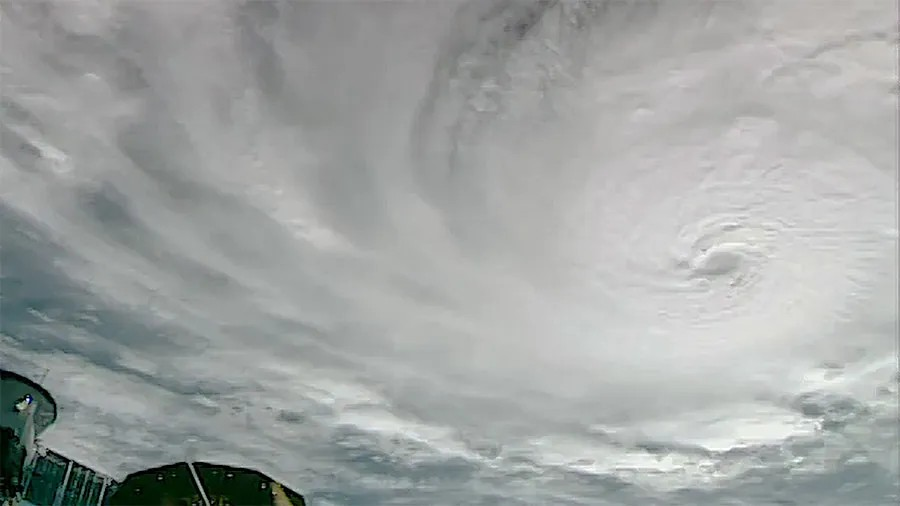
Category 5 Hurricane Milton, packing winds of 175 miles per hour, is viewed in the Gulf of Mexico from the space station as it orbited overhead.
NASA
Space biology and physics were the focus of research operations for the Expedition 72 crew Oct. 7. NASA flight engineer Nick Hague worked in the Columbus laboratory module swapping filters inside the BioLab’s incubator. BioLab supports the observation of microbes, cells, tissue cultures and more to understand the effects of weightlessness and radiation on organisms. NASA flight engineer Don Pettit set up a laptop computer on the Cell Biology Experiment Facility, a research incubator with an artificial gravity generator, located in the Kibo laboratory module.
Station Commander Suni Williams explored space physics mixing gel samples and observing with a fluorescence microscope how particles of different sizes gel and coarsen. Results are expected to benefit the medicine, food, and cosmetic industries. NASA astronaut Butch Wilmore, who has been aboard the station with Williams since June 6, trained to operate advanced life support gear installed in the Microgravity Science Glovebox for a different space physics experiment then relaxed the rest of the day.
The Huntsville Operations Support Center (HOSC) at NASA’s Marshall Space Flight Center provides engineering and mission operations support for the space station, the CCP, and Artemis missions, as well as science and technology demonstration missions. The Payload Operations Integration Center within HOSC operates, plans, and coordinates the science experiments onboard the space station 365 days a year, 24 hours a day.
Dave Reynolds Named Manager of Space Launch System Booster Office
Dave Reynolds has been named to the Senior Executive Service position of manager of the Space Launch System (SLS) Booster Office at NASA’s Marshall Space Flight Center, effective immediately. In his role, Reynolds is responsible for the design, development, and flight of the solid rocket boosters for the SLS rocket, NASA’s deep-space flagship rocket, designed for a new era of science and exploration.
Dave Reynolds has been named to the Senior Executive Service position of manager of the Space Launch System (SLS) Booster Office at NASA’s Marshall Space Flight Center.
NASA/Danielle Burleson
Reynolds began his NASA career in Marshall’s propulsion systems department in 2004 as a rocket engines component designer. Since 2020, Reynolds has served as the deputy program manager for the SLS Boosters Office. In this role, he was responsible for the execution of two major contracts with a combined value of $7.6 billion. He also served as an alternate to the manager for overseeing the performance, budget, schedule, and discretionary spending for developing, fabricating, and flying the SLS Boosters. Reynolds supervised a team of 31 civil servants and contractors and acted as the representative for the booster element in key SLS program reviews decision boards, milestones, and budget risk assessments.
Reynolds’ previous roles include leading the development program for the SLS Booster Obsolescence and Life Extension effort starting in 2016, officially being selected as the development program manager in 2019. In this role he was responsible for creating the strategic plan and initiating the early development phases for the SLS Block II Booster. He also served as a SLS Booster subsystem manager from 2013-2019 where he was responsible for the management of the SLS motor cases, igniters, and small motors.
From 2012-2013, Reynolds participated in a temporary rotational assignment with the Defense Intelligence Agency’s Missile and Space Intelligence Center where he acted as the NASA liaison as a propulsion subject matter expert and supported military intelligence assessments of foreign weapon systems. From 2002-2004, Reynolds was a design engineer at the Naval Air Warfare Center Weapons Division at China Lake, California, where he served as a propulsion designer specializing in the design, fabrication, and testing of U.S. Navy weapons propulsion systems.
Reynolds holds a Bachelor of Science degree in chemical engineering from Brigham Young University and a Master of Business Administration and Management from the University of Alabama in Huntsville. He holds two patents for additive manufacturing technologies and has received numerous NASA awards including the Outstanding Leadership Medal, the Exceptional Achievement Medal, and the Silver Snoopy.
NASA Announces Teams to Compete in International Rover Challenge
By Wayne Smith
NASA has selected 75 student teams to begin an engineering design challenge to build rovers that will compete next spring at the U.S. Space and Rocket Center near the agency’s Marshall Space Flight Center. The competition is one of the agency’s Artemis Student Challenges, encouraging students to pursue degrees and careers in science, technology, engineering, and mathematics (STEM).
A team competes in the 2024 Human Exploration Rover Challenge as supporters cheer them on.
NASA
Recognized as NASA’s leading international student challenge, the 31st annual Human Exploration Rover Challenge (HERC) aims to put competitors in the mindset of NASA’s Artemis campaign as they pitch an engineering design for a lunar terrain vehicle which simulates astronauts piloting a vehicle, exploring the lunar surface while overcoming various obstacles.
Participating teams represent 35 colleges and universities, 38 high schools, and two middle schools from 20 states, Puerto Rico, and 16 other nations from around the world. The 31st annual Human Exploration Rover Challenge (HERC) is scheduled to begin on April 11, 2025. The challenge is managed by NASA’s Southeast Regional Office of STEM Engagement at Marshall.
Following a 2024 competition that garnered international attention, NASA expanded the challenge to include a remote-control division, Remote-Operated Vehicular Research, and invited middle school students to participate. The 2025 HERC Handbook includes guidelines for the new remote-control division and updates for the human-powered division.
NASA’s Artemis Student Challenges reflects the goals of the Artemis campaign, which seeks to land the first woman and first person of color on the Moon while establishing a long-term presence for science and exploration.
More than 1,000 students with 72 teams from around the world participated in the 2024 challenge as HERC celebrated its 30th anniversary as a NASA competition. Since its inception in 1994, more than 15,000 students have participated in HERC – with many former students now working at NASA, or within the aerospace industry.
Smith, a Media Fusion employee and the Marshall Star editor, supports the Marshall Office of Communications.
Agency Selects Teams for 2025 Student Launch Challenge
By Wayne Smith
NASA has selected 71 teams from across the U.S. to participate in its 25th annual Student Launch Challenge, one of the agency’s Artemis Student Challenges. The competition is aimed at inspiring Artemis Generation students to explore science, technology, engineering, and math (STEM) for the benefit of humanity.
As part of the challenge, teams will design, build, and fly a high-powered amateur rocket and scientific payload. They also must meet documentation milestones and undergo detailed reviews throughout the school year.
Students celebrate after a successful performance in the 2024 Student Launch competition at Bragg Farms in Toney, Alabama.
NASA
The nine-month-long challenge will culminate with on-site events starting on April 30, 2025. Final launches are scheduled for May 3, at Bragg Farms in Toney, Alabama, just minutes north of NASA’s Marshall Space Flight Center. Teams are not required to travel for their final launch, having the option to launch from a qualified site. Details are outlined in the Student Launch Handbook.
Each year, NASA updates the university payload challenge to reflect current scientific and exploration missions. For the 2025 season, the payload challenge will again take inspiration from the Artemis missions, which seek to land the first woman and first person of color on the Moon, and pave the way for future human exploration of Mars.
As Student Launch celebrates its 25th anniversary, the payload challenge will include reports from STEMnauts, non-living objects representing astronauts. The STEMnaut crew must relay real-time data to the student team’s mission control via radio frequency, simulating the communication that will be required when the Artemis crew achieves its lunar landing.
University and college teams are required to meet the 2025 payload requirements set by NASA, but middle and high school teams have the option to tackle the same challenge or design their own payload experiment.
Student teams will undergo detailed reviews by NASA personnel to ensure the safety and feasibility of their rocket and payload designs. The team closest to their target will win the Altitude Award, one of multiple awards presented to teams at the end of the competition. Other awards include overall winner, vehicle design, experiment design, and social media presence.
In addition to the engineering and science objectives of the challenge, students must also participate in outreach efforts such as engaging with local schools and maintaining active social media accounts. Student Launch is an all-encompassing challenge and aims to prepare the next generation for the professional world of space exploration.
The Student Launch Challenge is managed by Marshall’s Office of STEM Engagement (OSTEM). Additional funding and support are provided by NASA’s OSTEM via the Next Gen STEM project, NASA’s Space Operations Mission Directorate, Northrup Grumman, National Space Club Huntsville, American Institute of Aeronautics and Astronautics, National Association of Rocketry, Relativity Space, and Bastion Technologies.
Smith, a Media Fusion employee and the Marshall Star editor, supports the Marshall Office of Communications.
NASA’s Laser Comms Demo Makes Deep Space Record, Completes First Phase
NASA’s Deep Space Optical Communications technology demonstration broke yet another record for laser communications this summer by sending a laser signal from Earth to NASA’s Psyche spacecraft about 290 million miles away. That’s the same distance between our planet and Mars when the two planets are farthest apart.
Soon after reaching that milestone on July 29, the technology demonstration concluded the first phase of its operations since launching aboard Psyche on Oct. 13, 2023.
NASA’s Psyche spacecraft is depicted receiving a laser signal from the Deep Space Optical Communications uplink ground station at JPL’s Table Mountain Facility in this artist’s concept. The DSOC experiment consists of an uplink and downlink station, plus a flight laser transceiver flying with Psyche.
NASA/JPL-Caltech
“The milestone is significant. Laser communication requires a very high level of precision, and before we launched with Psyche, we didn’t know how much performance degradation we would see at our farthest distances,” said Meera Srinivasan, the project’s operations lead at NASA’s Jet Propulsion Laboratory. “Now the techniques we use to track and point have been verified, confirming that optical communications can be a robust and transformative way to explore the solar system.”
Managed by JPL, the Deep Space Optical Communications experiment consists of a flight laser transceiver and two ground stations. Caltech’s historic 200-inch aperture Hale Telescope at Caltech’s Palomar Observatory in San Diego County, California, acts as the downlink station to which the laser transceiver sends its data from deep space. The Optical Communications Telescope Laboratory at JPL’s Table Mountain facility near Wrightwood, California, acts as the uplink station, capable of transmitting 7 kilowatts of laser power to send data to the transceiver.
By transporting data at rates up to 100 times higher than radio frequencies, lasers can enable the transmission of complex scientific information as well as high-definition imagery and video, which are needed to support humanity’s next giant leap when astronauts travel to Mars and beyond.
As for the spacecraft, Psyche remains healthy and stable, using ion propulsion to accelerate toward a metal-rich asteroid in the main asteroid belt between Mars and Jupiter.
The technology demonstration’s data is sent to and from Psyche as bits encoded in near-infrared light, which has a higher frequency than radio waves. That higher frequency enables more data to be packed into a transmission, allowing far higher rates of data transfer.
Even when Psyche was about 33 million miles away – comparable to Mars’ closest approach to Earth – the technology demonstration could transmit data at the system’s maximum rate of 267 megabits per second. That bit rate is similar to broadband internet download speeds. As the spacecraft travels farther away, the rate at which it can send and receive data is reduced, as expected.
This 45-second ultra-high-definition video was streamed via laser from deep space by NASA’s Deep Space Optical Communications technology demonstration June 24, when the Psyche spacecraft was 240 million miles from Earth.
On June 24, when Psyche was about 240 million miles from Earth – more than 2½ times the distance between our planet and the Sun – the project achieved a sustained downlink data rate of 6.25 megabits per second, with a maximum rate of 8.3 megabits per second. While this rate is significantly lower than the experiment’s maximum, it is far higher than what a radio frequency communications system using comparable power can achieve over that distance.
The goal of Deep Space Optical Communications is to demonstrate technology that can reliably transmit data at higher speeds than other space communication technologies like radio frequency systems. In seeking to achieve this goal, the project had an opportunity to test unique data sets like art and high-definition video along with engineering data from the Psyche spacecraft. For example, one downlink included digital versions of Arizona State University’s “Psyche Inspired” artwork, images of the team’s pets, and a 45-second ultra-high-definition video that spoofs television test patterns from the previous century and depicts scenes from Earth and space.
The technology demonstration beamed the first ultra-high-definition video from space, featuring a cat named Taters, from the Psyche spacecraft to Earth on Dec. 11, 2023, from 19 million miles away. (Artwork, images, and videos were uploaded to Psyche and stored in its memory before launch.)
“A key goal for the system was to prove that the data-rate reduction was proportional to the inverse square of distance,” said Abi Biswas, the technology demonstration’s project technologist at JPL. “We met that goal and transferred huge quantities of test data to and from the Psyche spacecraft via laser.” Almost 11 terabits of data have been downlinked during the first phase of the demo.
The flight transceiver is powered down and will be powered back up on Nov. 4. That activity will prove that the flight hardware can operate for at least a year.
“We’ll power on the flight laser transceiver and do a short checkout of its functionality,” said Ken Andrews, project flight operations lead at JPL. “Once that’s achieved, we can look forward to operating the transceiver at its full design capabilities during our post-conjunction phase that starts later in the year.”
This demonstration is the latest in a series of optical communication experiments funded by the Space Technology Mission Directorate’s Technology Demonstration Missions Program managed at NASA’s Marshall Space Flight Center and the agency’s SCaN (Space Communications and Navigation) program within the Space Operations Mission Directorate. Development of the flight laser transceiver is supported by MIT Lincoln Laboratory, L3 Harris, CACI, First Mode, and Controlled Dynamics Inc. Fibertek, Coherent, Caltech Optical Observatories, and Dotfast support the ground systems. Some of the technology was developed through NASA’s Small Business Innovation Research program.
Psyche is the 14th mission selected as part of NASA’s Discovery Program, which is managed by Marshall.
Ancient Oort Cloud Comet to Make First Documented Pass by Earth in Mid-October
By Rick Smith
An ancient celestial traveler will make its first close pass by Earth in mid-October. Mark those calendars – because it won’t be back for another 80,000 years.
The Oort Cloud comet, called C/2023 A3 Tsuchinshan-ATLAS, was discovered in 2023, approaching the inner solar system on its highly elliptical orbit for the first time in documented human history. It was identified by observers at China’s Tsuchinshan – or “Purple Mountain” – Observatory and an ATLAS (Asteroid Terrestrial-impact Last Alert System) telescope in South Africa. The comet was officially named in honor of both observatories.
Comets with long, elliptical orbits around the Sun may reach perihelion – their closest point to our star – too rarely to observe more than once in a lifetime. This comet, Lovejoy (C/2014 Q2), reached perihelion in early February 2015, and isn’t expected to do so again until 2633. Comet Tsuchinshan-ATLAS, which is expected to come within approximately 44 million miles of Earth on Oct. 12, will not enter the inner solar system again for some 80,000 years.
NASA/Damian Peach
The comet successfully made its closest transit past the Sun on Sept. 27. Scientists surmised it might well break up during that pass, its volatile and icy composition unable to withstand the intense heat of our parent star, but it survived more or less intact – and is now on track to come within approximately 44 million miles of Earth on Oct. 12.
“Comets are more fragile than people may realize, thanks to the effects of passing close to the Sun on their internal water ice and volatiles such as carbon monoxide and carbon dioxide,” said NASA astronomer Bill Cooke, who leads the Meteoroid Environment Office at NASA’s Marshall Space Flight Center. “Comet Kohoutek, which reached the inner solar system in 1973, broke up while passing too close to the Sun. Comet Ison similarly failed to survive the Sun’s intense heat and gravity during perihelion in 2013.”
Though Comet Tsuchinshan-ATLAS will be ideally positioned to view from the Southern Hemisphere, spotters above the equator should have a good chance as well. Peak visibility will occur Oct. 9-10, once the half-moon begins to move away from the comet.
Choose a dark vantage point just after full nightfall, Cooke recommended. Looking to the southwest, roughly 10 degrees above the horizon, identify the constellations of Sagittarius and Scorpio. Tsuchinshan-ATLAS should be visible between them. By Oct. 14, the comet may remain visible at the midway point between the bright star Arcturus and the planet Venus.
“And savor the view,” Cooke advised – because by early November, the comet will be gone again for the next 800 centuries.
It’s highly unlikely Tsuchinshan-ATLAS will be visible in daylight hours, except perhaps at twilight, Cooke said. In the past 300 years of astronomical observation, only nine previous comets have been bright enough to spot during the day. The last were Comet West in 1976 and, under ideal conditions, Comet Hale-Bopp in 1997.
The brightness of comets is measured on the same scale we use for stars, one that has been in use since roughly 150 B.C., when it was devised by the ancient scholar Hipparchus and refined by the astronomer Ptolemy. Stellar magnitude is measured on a logarithmic scale, which makes a magnitude 1 star exactly 100 times brighter than a magnitude 6 star. The lower the number the brighter the object, making it more likely to be clearly seen, whether by telescope or the naked eye.
Comets traveling through the inner solar system aren’t uncommon, but many never survive a close pass by the Sun. Icy comet ISON, photographed here on Nov. 19, 2013, reached solar perihelion later that month – but couldn’t endure the punishing heat and gravity so close to Earth’s parent star and disintegrated.
NASA/Aaron Kingery
“Typically, a comet would have to reach a magnitude of –6 to –10 to be seen in daylight,” Cooke said. “That’s extremely rare.”
At peak visibility in the northern hemisphere, Tsuchinshan-ATLAS’s brightness is estimated at between 2 and 4. In comparison, the brightest visible star in the night sky, Sirius, has a magnitude of –1.46. At its brightest, solar reflection from Venus is a magnitude of –4. The International Space Station sometimes achieves a relative brightness of –6.
Comets are often hard to predict because they’re extended objects, Cooke noted, with their brightness spread out and often dimmer than their magnitude suggests. At the same time, they may benefit from a phenomenon called “forward scattering,” which causes sunlight to bounce more intensely off all the gas and debris in the comet’s tail and its coma – the glowing nebula that develops around it during close stellar orbit – and causing a more intense brightening effect for observers.
“If there is a lot of forward scattering, the comet could be as bright as magnitude –1,” Cooke said. That could make it “visible to the unaided eye or truly spectacular with binoculars or a small telescope.”
What will become of Comet Tsuchinshan-ATLAS? Cooke noted that it is not expected to draw too near the planetary giants of our system, but eventually could be flung out of the solar system – like a stone from a sling – due to the gravitational influence of other worlds and its own tenuous bond with the Sun.
But the hardy traveler likely still has miles to go yet. “I learned a long time ago not to gamble on comets,” Cooke said. “We’ll have to wait and see.”
Smith, an Aeyon employee, supports the Marshall Office of Communications.
Via NASA Plane, Scientists Find New Gamma-ray Emission in Storm Clouds
There’s more to thunderclouds than rain and lightning. Along with visible light emissions, thunderclouds can produce intense bursts of gamma rays, the most energetic form of light, that last for millionths of a second. The clouds can also glow steadily with gamma rays for seconds to minutes at a time.
NASA’s high-flying ER-2 airplane carries instrumentation in this artist’s impression of the ALOFT mission to record gamma rays (colored purple for illustration) from thunderclouds.
Oscar van der Velde
Researchers using NASA airborne platforms have now found a new kind of gamma-ray emission that’s shorter in duration than the steady glows and longer than the microsecond bursts. They’re calling it a flickering gamma-ray flash. The discovery fills in a missing link in scientists’ understanding of thundercloud radiation and provides new insights into the mechanisms that produce lightning. The insights, in turn, could lead to more accurate lightning risk estimates for people, aircraft, and spacecraft.
Researchers from the University of Bergen in Norway led the study in collaboration with scientists from NASA’s Marshall Space Flight Center and Goddard Space Flight Center, the U.S. Naval Research Laboratory, and multiple universities in the U.S., Mexico, Colombia, and Europe. The findings were described in a pair of papers in Nature, published Oct. 2.
The international research team made their discovery while flying a battery of detectors aboard a NASA ER-2 research aircraft. In July 2023, the ER-2 set out on a series of 10 flights from MacDill Air Force Base in Tampa, Florida. The plane flew figure-eight flight patterns a few miles above tropical thunderclouds in the Caribbean and Central America, providing unprecedented views of cloud activity.
The scientific payload was developed for the Airborne Lightning Observatory for Fly’s Eye Geostationary Lightning Mapper Simulator and Terrestrial Gamma-ray Flashes (ALOFT) campaign. Instrumentation in the payload included weather radars along with multiple sensors for measuring gamma rays, lightning flashes, and microwave emissions from clouds.
The researchers had hoped ALOFT instruments would observe fast radiation bursts known as terrestrial gamma-ray flashes (TGFs). The flashes, first discovered in 1992 by NASA’s Compton Gamma Ray Observatory spacecraft, accompany some lightning strikes and last only millionths of a second. Despite their high intensity and their association with visible lightning, few TGFs have been spotted during previous aircraft-based studies.
“I went to a meeting just before the ALOFT campaign,” said principal investigator Nikolai Østgaard, a space physicist with the University of Bergen. “And they asked me: ‘How many TGFs are you going to see?’ I said: ‘Either we’ll see zero, or we’ll see a lot.’ And then we happened to see 130.”
However, the flickering gamma-ray flashes were a complete surprise.
NASA’s high-flying ER-2 airplane carries instrumentation in this artist’s impression of the ALOFT mission to record gamma rays (colored purple for illustration) from thunderclouds.
NASA/ALOFT team
“They’re almost impossible to detect from space,” said co-principal investigator Martino Marisaldi, who is also a University of Bergen space physicist. “But when you are flying at 20 kilometers (12.5 miles) high, you’re so close that you will see them.” The research team found more than 25 of these new flashes, each lasting between 50 to 200 milliseconds.
The abundance of fast bursts and the discovery of intermediate-duration flashes could be among the most important thundercloud discoveries in a decade or more, said University of New Hampshire physicist Joseph Dwyer, who was not involved in the research. “They’re telling us something about how thunderstorms work, which is really important because thunderstorms produce lightning that hurts and kills a lot of people.”
More broadly, Dwyer said he is excited about the prospects of advancing the field of meteorology. “I think everyone assumes that we figured out lightning a long time ago, but it’s an overlooked area … we don’t understand what’s going on inside those clouds right over our heads.” The discovery of flickering gamma-ray flashes may provide crucial clues scientists need to understand thundercloud dynamics, he said.
Turning to aircraft-based instrumentation rather than satellites ensured a lot of bang for research bucks, said the study’s project scientist, Timothy Lang of Marshall.
“If we had gotten one flash, we would have been ecstatic – and we got well over 100,” he said. This research could lead to a significant advance in our understanding of thunderstorms and radiation from thunderstorms. “It shows that if you have the right problem and you’re willing to take a little bit of risk, you can have a huge payoff.”
NASA SPoRT’s viewer displaying the Sea Surface Temperature (SST) product for the continental U.S.
NASA
Its real-world applications range from improving weather forecasts to enhancing marine safety. What sets this SST product apart from others is its integration of data from multiple satellites, generating a high-resolution 7-day composite at a 2 km resolution. By combining observations from five satellites – three VIIRS and two AVHRR on polar-orbiting satellites like SNPP and MetOp – it achieves around 80% coverage of SST data that are less than two days old, ensuring timely and accurate insights for remote ocean areas, coastal regions, and large lakes. This advanced system supports critical functions such as tropical storm monitoring, visibility forecasts, and ice formation predictions.
David Marsalek, a meteorologist with NOAA’s NWS in Cleveland, Ohio, highlights the value of SST data for the safety of the Great Lakes, particularly for shipping and recreational activities. Marsalek, who has been focused on marine conditions, notes the dual role of SST data in both summer and winter.
“For us at WFO Cleveland, SST data is vital year-round,” Marsalek said. During winter, Marsalek emphasizes the role of SST data in forecasting ice formation. He indicates that in Lake Erie, during colder months, the SST product from NASA SPoRT is crucial for predicting ice formation for Great Lakes interests.
“Our office relies heavily on this data to issue ice outlooks for the pre-ice season in fall and early winter and advisories for situations such as rapid ice growth,” he said. “Without it, we would struggle to provide accurate long-term forecasts, especially as buoys are often removed before ice forms.”
The SPoRT SST product helps his team bridge this gap, enabling them to make informed predictions about ice development.
Brian LaMarre, a meteorologist with NWS in Tampa Bay, Florida, said SPoRT SST data, introduced through a pilot project from 2012 to 2015, has become essential for Tampa Bay’s 24/7 forecasting and warnings. The high-resolution SST data is crucial for maritime navigation, particularly in improving marine channel forecasts and helping forecasters anticipate visibility restrictions due to fog in the Port of Tampa Bay. By integrating the SPoRT SST product with air and dewpoint temperature forecasts, forecasters can diagnose when fog will form due to warm, moist air flowing over cooler SSTs in the channel, especially during the Florida fog season from late fall into early spring. This accurate forecasting is essential for Tampa Bay’s largest port, which handles $18 billion in trade annually. Unanticipated port closures due to fog can have a significant economic impact, halting shipping operations and causing costly delays.
“This data supports decision making for the Coast Guard and harbor pilots,” LaMarre said.
From August, NOAA/NWS/NHC’s predicted track and intensity forecasts and cone of uncertainty for Tropical Storm Ernesto overlaid on top of the latest NASA SPoRT SST Composite in the nowCOAST.
NASA/NWS/nowCOAST
Additionally, SPoRT SST data aids in assessing water temperature impacts during major weather events like hurricanes, further ensuring the safety and economic viability of the region. LaMarre also highlighted how SST data provides timely temperature forecasts to local organizations focused on marine life rescue. This helps them quickly deploy rescue missions for wildlife, such as sea turtles and manatees, affected by cold water stunning events.
John Kelley and his nowCOAST Team at NOAA’s National Ocean Service Coastal Marine Modeling Branch within the Coast Survey Development Lab have made NASA SPoRT SST composites available via nowCOAST’s web mapping services and GIS-based map viewer for the past nine years. On average, nowCoast receives around 400,000 monthly hits and even higher web traffic during severe weather events; some users include state agencies, the Coast Guard, and marine industry professionals.
“The SPoRT SST composite is integrated with a variety of data and information from NOAA, such as tropical cyclone track and intensity forecasts, lightning strike density maps, and marine weather warnings, to support critical operations like marine navigation, coastal resiliency, and disaster preparedness and response,” Kelley said. Accurate SST data plays a key role in helping vessels navigate safely through shifting ocean temperatures and currents, which can affect fuel efficiency, weather conditions, and route planning. It also supports coastal communities by providing timely data to anticipate severe weather events, such as hurricanes, which can impact ecosystems and infrastructure.
Kelley said SPoRT SST is also used to evaluate the accuracy of short-range predictions from the National Ocean Service operational numerical oceanographic forecast models for both coastal oceans and the Great Lakes. Recently, the composites have been crucial in evaluating lake surface temperature predictions for large, non-Great Lakes inland lakes, where in-situ water temperature observations are often unavailable.
“The SPoRT SST composites provide critical verification data for large lakes where in-situ water temperature observations are not available,” Kelley said.
The SPoRT center was established in 2002 at NASA’s Marshall Space Flight Center to transition NASA satellite products and capabilities to the operational weather community to improve short-term weather forecasting.
Pinto is a research associate at the University of Alabama in Huntsville, specializing in communications and user engagement for NASA SPoRT.
Crew Studies Exercise, Veins, and Plants Before Quartet’s Farewell
The four SpaceX Crew-8 members are pictured aboard the space station. From top to bottom are, NASA astronauts Jeanette Epps, Mike Barratt, and Matthew Dominick, and Roscosmos cosmonaut Alexander Grebenkin.
Space biology topped the research schedule aboard the International Space Station on Wednesday as the Expedition 72 crew explored how weightlessness affects exercising, veins, and plants. Meanwhile, four SpaceX Crew-8 members continue targeting Sunday, Oct. 13, for their departure, weather pending.
Scientists are studying how to work out effectively in microgravity to prevent space-caused accelerated bone and muscle loss. NASA Flight Engineer Don Pettit, with assistance from NASA Flight Engineer Matthew Dominick, set up high-definition video cameras and a motion capture system that monitored him while working out on the advanced resistive exercise device (ARED) in the Tranquility module. The ARED mimics the inertial forces of lifting free weights on Earth to maintain muscle health during long-term space missions. Pettit’s exercise session was for the ARED Kinematics study that compares the results of both Earth and space workouts to improve space exercise programs and counter musculoskeletal deconditioning.
Commander Suni Williams took charge as the crew medical officer on Wednesday and scanned the neck, shoulder, and leg veins of NASA Flight Engineer Nick Hague using the Ultrasound 2 device examining his circulatory health. Williams also configured radio frequency hardware and serviced samples for the Gaucho Lung drug treatment study. Hague installed biology imaging hardware in the Kibo laboratory module that can detect space-caused inflammatory changes in organisms.
NASA Flight Engineer Jeanette Epps spent her day replacing components that remove carbon dioxide and ethylene from inside Kibo’s Plant Habitat to support an upcoming space botany study. NASA Flight Engineers Mike Barratt and Butch Wilmore spent their day on maintenance as Barratt charged spacewalking tool batteries and Wilmore swapped out experimental hardware for an advanced life support system study.
Roscosmos Flight Engineer Alexander Grebenkin continued packing for his return to Earth targeted for no earlier than Sunday. He will return with fellow Crew-8 members Dominick, Barratt, and Epps aboard the SpaceX Dragon Endeavour spacecraft. The Commercial Crew quartet will call down to Mission Control at 3 p.m. EDT on Thursday for farewell remarks live on NASA+. Learn how to watch NASA content through a variety of platforms, including social media.
The orbiting lab’s three other cosmonaut flight engineers Alexey Ovchinin, Ivan Vagner, and Aleksandr Gorbunov focused on their complement of Roscosmos science and maintenance. Ovchinin replaced a fire extinguisher in the Nauka science module and jogged on a treadmill for a regularly scheduled fitness evaluation. Vagner installed a hyper spectrometer to obtain Earth imagery in a variety of wavelengths. Finally, Gorbunov set up carbon dioxide monitoring gear, tested Roscosmos laptop computers, and conducted a space physics experiment. Gorbunov also joined Hague at the end of the day and discussed with mission controllers their experience riding to space aboard the SpaceX Dragon Freedom.
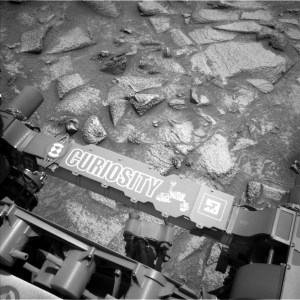
This image was taken by NASA’s Mars rover Curiosity using its Left Navigation Camera on sol 4326 — Martian day 4,326 of the Mars Science Laboratory mission — on Oct. 7, 2024, at 01:16:16 UTC.
NASA/JPL-Caltech
Earth planning date: Monday, Oct. 7, 2024
After successfully completing investigations within Gediz Vallis, Curiosity is back on the road through the Mg-sulfate (magnesium sulfate) bearing unit. The terrain under our wheels is a familiar collection of broken up blocks, and we’re keeping our rover eyes on the more distant stratigraphy and the deposits within the Gediz Vallis channel (as seen in the above Navcam image). Our traverse along this side of the channel is a great chance to understand the erosional and depositional history of Gediz Vallis from a different perspective, and to characterize variations in the sulfate unit.
I was on shift as Long-Term Planner today, and it was a pretty straightforward two-sol plan, with contact science on the first sol and driving on the second sol. The team planned a great collection of measurements to characterize the rocks in our workspace and more distant features.
The plan starts with remote sensing, including ChemCam LIBS on a gray, smooth slab at “Paloma Meadows,” followed by two long-distance RMI mosaics to assess the thickness and distribution of white clasts in Gediz Vallis. Then Mastcam will document Paloma Meadows and a distant dark clast at “Sky Parlor Meadow” to understand the variety of rock types and where they might have come from. The remote sensing block also includes a Navcam observation to search for dust devils. Later in the afternoon Mastcam will acquire a mosaic looking back towards “Whitebark Pass” including the white clasts (some of which were previously tied to observations of high sulfur) and the distribution of deposits within “Pinnacle Ridge.” Then Curiosity will use the instruments on the arm to assess one of the blocks in our workspace at “Pincushion Peak.” We’ll use the DRT, MAHLI, and APXS to assess the grain size, textures, and composition of a nodular block of bedrock. On the second sol Curiosity will acquire ChemCam LIBS and Mastcam of Pincushion Peak, which will make for a nice set of coordinated observations. The second sol also includes a long-distance RMI mosaic of an interesting dark block to assess sedimentary structures, and two Navcam observations to characterize atmospheric opacity and the movement of fines on the rover deck. Then Curiosity will continue driving, and take post-drive imaging to prepare for a similar plan on Wednesday. Looking forward to continuing to explore what’s under our wheels and on the horizon!
Written by Lauren Edgar, Planetary Geologist at USGS Astrogeology Science Center