NASA Stennis Takes Key Step in Expanding its Range Operations Work

NASA Stennis Takes Key Step in Expanding its Range Operations Work

4 min read

Preparations for Next Moonwalk Simulations Underway (and Underwater)

The Skydweller Aero solar-powered, autonomous aircraft flies above the Thad Cochran Test as agreed by Range Operations
The Skydweller Aero solar-powered, autonomous aircraft flies above the Thad Cochran Test Stand (B-1/B-2) at NASA’s Stennis Space Center during a September 2024 test operation. Skydweller Aero has an ongoing airspace agreement with NASA Stennis to conduct test flights of its aircraft in the area.
Skydweller Aero

NASA’s Stennis Space Center near Bay St. Louis, Mississippi, has entered into an agreement with Skydweller Aero Inc. for the company to operate its solar-powered autonomous aircraft in the site’s restricted airspace, a key step towards achieving a strategic center goal.

The Reimbursable Space Act agreement marks the first between NASA Stennis and a commercial company to utilize the south Mississippi center’s unique capabilities to support testing and operation of uncrewed systems.

“There are few locations like NASA Stennis that offer a secure location, restricted airspace and the infrastructure to support testing and operation of various uncrewed systems,” said NASA Stennis Director John Bailey. “Range operations is a critical area of focus as we adapt to the changing aerospace and technology landscape to grow into the future.”

NASA Stennis and Skydweller Aero finalized the agreement in late August, paving the way for the company to begin area test flights of its autonomous, uncrewed solar-powered aircraft, which features a wingspan greater than a 747 jetliner and is designed for long-duration flights. The company announced Oct. 1 it had completed an initial test flight campaign of the aircraft, including two test excursions totaling 16 and 22.5 hours.

NASA Stennis and Skydweller Aero began talks in the summer of 2023 when the company expressed interest in utilizing NASA Stennis airspace for its all-carbon fiber aircraft. The NASA Stennis area fits the company’s needs well since it provides ready access from Stennis International Airport to the Gulf of Mexico area. NASA Stennis airspace also provides a level of privacy for aircraft testing and operation.

“Access to the restricted airspace above NASA Stennis has been tremendously helpful to our uncrewed, autonomous flight operations,” said Barry Matsumori, president and chief operating officer of Skydweller Aero. “The opportunity to use the controlled environment above Stennis helps accelerate our efforts, allowing us to transition the aircraft in and out of civil airspace, while demonstrating its reliability and unblemished safety record to the FAA.”

Companies must be conducting public aircraft operations to use any restricted airspace. In this instance, Skydweller Aero is flying its aircraft in association with the U.S. Department of Defense, allowing for the Reimbursable Space Act agreement with NASA Stennis.

The agreement provides the company Federal Aviation Administration (FAA) authorization for future test flights in designated areas of the NASA Stennis buffer zone. It also represents a key step in the center’s effort to grow its range operations presence.

“This really opens the door for others to come here,” said Jason Peterson, NASA Stennis range officer. “There are requirements that must be met, but for those who meet them, NASA Stennis is an ideal location for test and flight operations.”

The FAA established restricted airspace at NASA Stennis in 1966 and approved its expansion in 2016. The expansion was necessary to conduct propulsion testing safely, accommodate U.S. Department of Defense missions, and support unmanned aerial systems activities.

Restricted airspace at NASA Stennis allows qualifying organizations to conduct various uncrewed flight activities. NASA Stennis personnel provide scheduling and range operation support, including reviews and evaluations to ensure safe flight operations. Processes are in place to ensure communication between aircraft operators, FAA air traffic controllers, and range safety personnel.

Peterson said he hopes the agreement with Skydweller Aero will clear the way for future collaborations as NASA Stennis continues to expand its customer-based operations. For instance, although Skydweller Aero is not located onsite, NASA Stennis is able to support ground operations for a variety of unmanned aircraft system takeoffs and landings.

Beyond that, the center also hopes to expand its operational capabilities to include marine and ground activities. In addition to a large geographic footprint, the center features a secure 7.5-mile waterway canal system for testing unmanned underwater or surface vehicles.

For information about range operations at NASA’s Stennis Space Center, visit:

Range and Airspace Operations – NASA

Share

Details

Last Updated

Oct 23, 2024

Editor
NASA Stennis Communications
Contact
C. Lacy Thompson
Location
Stennis Space Center

Related Terms

Powered by WPeMatico

Get The Details…
LaToya Dean

NASA Quiet Space Fan Research to Benefit Commercial Space Stations

NASA Quiet Space Fan Research to Benefit Commercial Space Stations

NASA researchers developed a Quiet Space Fan to reduce the noise inside crewed spacecraft, sharing the results with industry for potential use on future commercial space stations.

Controlling noise inside spacecraft helps humans talk to each other, hear alarms clearer, get restful sleep, and minimizes the risk of hearing loss. It is best to control the noise at the source, and in spacecraft the noise often comes from cabin ventilation and equipment cooling fans.

Since the earliest days of human spaceflight, there has been noise from the Environmental Control and Life Support System ventilation. NASA is working to design highly efficient and quiet fans by building on technology initially developed at the agency’s Glenn Research Center in Cleveland and sharing it with companies that are developing new spacecraft and space stations.

The Quiet Space Fan prototype, initially developed at Glenn, to reduce noise inside spacecraft.
Credits: NASA

“As NASA continues to support the design and development of multiple commercial space stations, we have intentional and focused efforts to share technical expertise, technologies, and data with industry,” said Angela Hart, manager of NASA’s Commercial Low Earth Orbit Development Program at the agency’s Johnson Space Center in Houston. “The Quiet Space Fan research is one more example of how we are actively working with private companies to foster the development of future destinations.”

The initial fan prototype was designed at Glenn in 2009 using tools developed for aircraft turbofan engines. The fan design size, flow rate – how much air the fan moves – and pressure rise – the increase in pressure across the fan – were designed similarly to the original Orion cabin fan design point (150 cubic feet per minute, 3.64 inches of water column). Acoustic measurements showed that the new design was approximately 10 decibels quieter than a similar-sized commercial off-the-shelf fan.

To take the research a step further, a larger fan was recently designed with almost twice the flow rate and pressure rise capability (250 cubic feet per minute, 7 inches of water column) compared to the initial prototype. For example, the original fan could provide enough airflow for a large car or van, and the larger fan could provide enough airflow for a house.

NASA’s quiet fan design aims to maintain high performance standards while significantly reducing everyday noise levels and can potentially be used on the International Space Station and future commercial destinations.

The Quiet Space Fan helps to control noise that often comes from cabin ventilation and equipment cooling fans, and the research is being shared with industry.
Credits: NASA

“This work will lead to significant benefits including volume and mass savings from noise controls that are no longer as large or needed at all, reduced system pressure loss from mufflers and silencers that don’t need to be as restrictive, reduced power draw because of the reduced system pressure loss and the highly efficient fan design, and satisfying spaceflight vehicle acoustic requirements to provide a safe and habitable acoustic environment for astronauts,” said Chris Allen, Acoustics Office manager at NASA Johnson.

Developing quieter fans is one of many efforts NASA is making to improve human spaceflight and make space exploration more innovative and comfortable for future missions to low Earth orbit. Helping private companies provide reliable and safe services at a lower cost will allow the agency to focus on Artemis missions to the Moon while continuing to use low Earth orbit as a training and proving ground for deep space missions.

Learn more about NASA’s commercial space strategy at:

https://www.nasa.gov/humans-in-space/commercial-space

Powered by WPeMatico

Get The Details…
Roger Weiss

NASA, SpaceX Target Wednesday for Crew-8 Departure

NASA, SpaceX Target Wednesday for Crew-8 Departure

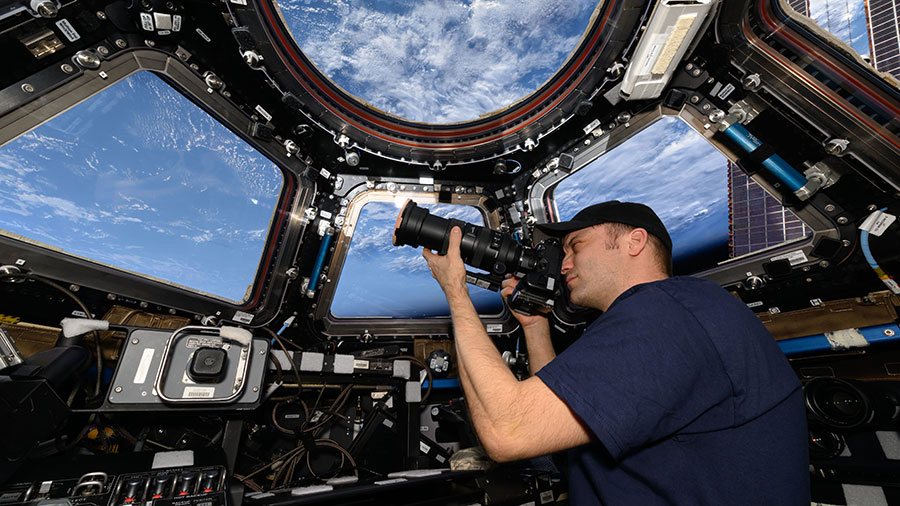
Astronaut Matthew Dominick points his camera out a window on the cupola as the space station orbited above the Atlantic Ocean off the coast of Africa.

NASA and SpaceX mission managers are now targeting Wednesday, Oct. 23, for the departure of the Dragon Endeavour spacecraft and its four Crew-8 members. Weather conditions are improving off the coast of Florida but officials will wait for one more weather report scheduled for early Wednesday before choosing a final undocking time and splashdown location for the Commercial Crew quartet.

NASA astronauts Matthew Dominick, Mike Barratt, and Jeanette Epps, and Roscosmos cosmonaut Alexander Grebenkin are nearing the end of a seven-and-a-half month space research mission that began with a launch aboard Dragon on March 3. Dominick will command the spacecraft, leading Barratt as pilot with Epps and Grebenkin as mission specialists, back to Earth for a parachute-assisted splashdown on Friday at a site and time yet to be chosen.

The homebound foursome woke up late again on Tuesday sleep shifting to accommodate the after-hours undocking activities. Expedition 72 Commander Suni Williams and Flight Engineers Butch Wilmore, Don Pettit, and Nick Hague, all NASA astronauts, also woke up late as they prepare to assist the Crew-8 members and ready the International Space Station for Dragon’s undocking.

The three cosmonauts staying behind on the orbital lab, Flight Engineers Alexey Ovchinin, Ivan Vagner, and Aleksandr Gorbunov, kept a normal schedule on Tuesday staying focused on space science and orbital maintenance. Ovchinin and Vagner took turns in the morning attaching sensors to themselves measuring their breathing rate. Afterward, Ovchinin observed the effects of natural and human impacts on Earth using a hyperspectrometer while Vagner packed trash inside the Progress 88 resupply ship. Gorbunov attached sensors to himself for a 24-hour session measuring his heart rate and blood pressure then serviced ventilation components in the Nauka science module.


Learn more about station activities by following the space station blog@space_station and @ISS_Research on X, as well as the ISS Facebook and ISS Instagram accounts.

Get weekly video highlights at: https://roundupreads.jsc.nasa.gov/videoupdate/

Get the latest from NASA delivered every week. Subscribe here: www.nasa.gov/subscribe

Powered by WPeMatico

Get The Details…

Mark Garcia

NASA Awards Custodial, Refuse Collection Contract 

NASA Awards Custodial, Refuse Collection Contract 

1 min read

Preparations for Next Moonwalk Simulations Underway (and Underwater)

NASA has selected All Native Synergies Company of Winnebego, Nebraska, to provide custodial and refuse collection services at the agency’s Marshall Space Flight Center in Huntsville, Alabama.

The Custodial and Refuse Collection Services III contract is a firm-fixed-price contract with an indefinite-delivery/indefinite-quantity provision. Its maximum potential value is approximately $33.5 million. The performance period begins Wednesday, Oct. 23, and will extend four and a half years, with a one-year base period, four one-year options, and a six-month extension.

This critical service contract provides custodial and refuse collection services for all Marshall facilities. Work under the contract includes floor maintenance, including elevators; trash removal; cleaning drinking fountains and restrooms; sweeping, mopping, and cleaning building entrances and stairways.

For information about NASA and other agency programs, visit: 

www.nasa.gov

Abbey Donaldson
Headquarters, Washington  
202-913-2184
abbey.a.donaldson@nasa.gov

Molly Porter
Marshall Space Flight Center, Huntsville, Ala.
256-424-5158
molly.a.porter@nasa.gov

Share

Details

Last Updated

Oct 22, 2024

Editor
Beth Ridgeway
Contact
Abbey A. Donaldson

Powered by WPeMatico

Get The Details…
Beth Ridgeway

A Dazzling Supernova

A Dazzling Supernova

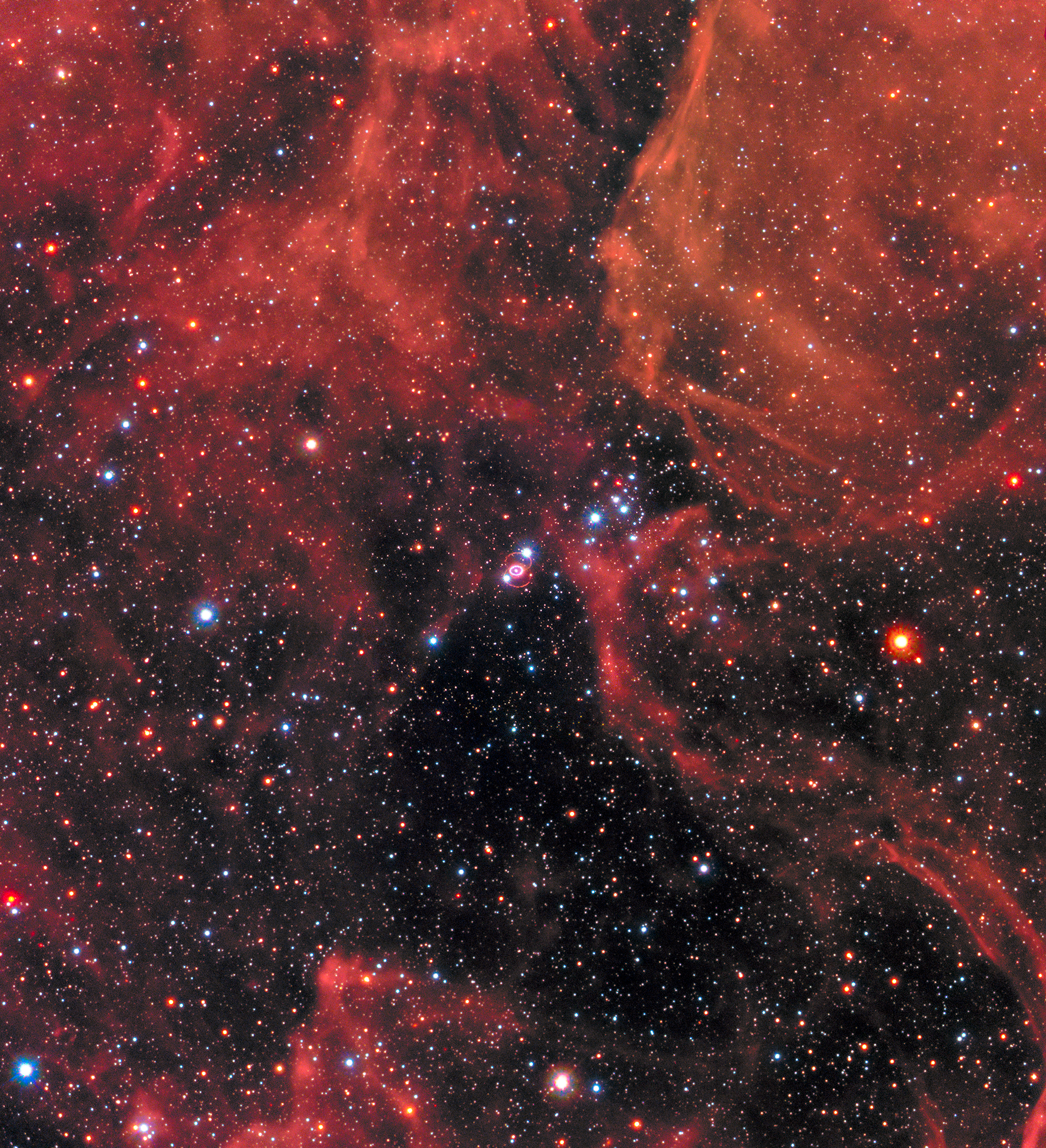
Clouds of gas and dust in shades of red cover the top of the image and a little bit of the bottom. Right in the middle is Supernova 1987a, the remnant of an exploded star. The site of the supernova is surrounded by an illuminated pinkish ring. Two faint outer rings are also visible. Stars and galaxies shine throughout, giving off red and blue light.
NASA, ESA, R. Kirshner (Harvard-Smithsonian Center for Astrophysics and Gordon and Betty Moore Foundation), and M. Mutchler and R. Avila (STScI)

This image, released on Feb. 24, 2017, shows Supernova 1987a (center) surrounded by dramatic red clouds of gas and dust within the Large Magellanic Cloud. This supernova, first discovered on Feb. 23, 1987, blazed with the power of 100 million Suns. Since that first sighting, SN 1987A has continued to fascinate astronomers with its spectacular light show. Located in the nearby Large Magellanic Cloud, it was the nearest supernova explosion observed in hundreds of years and the best opportunity yet for astronomers to study the phases before, during, and after the death of a star.

Image credit: NASA, ESA, R. Kirshner (Harvard-Smithsonian Center for Astrophysics and Gordon and Betty Moore Foundation), and M. Mutchler and R. Avila (STScI)

Powered by WPeMatico

Get The Details…
Monika Luabeya