Dragon Undocks from Station, Crew-8 Heads Toward Earth

Dragon Undocks from Station, Crew-8 Heads Toward Earth

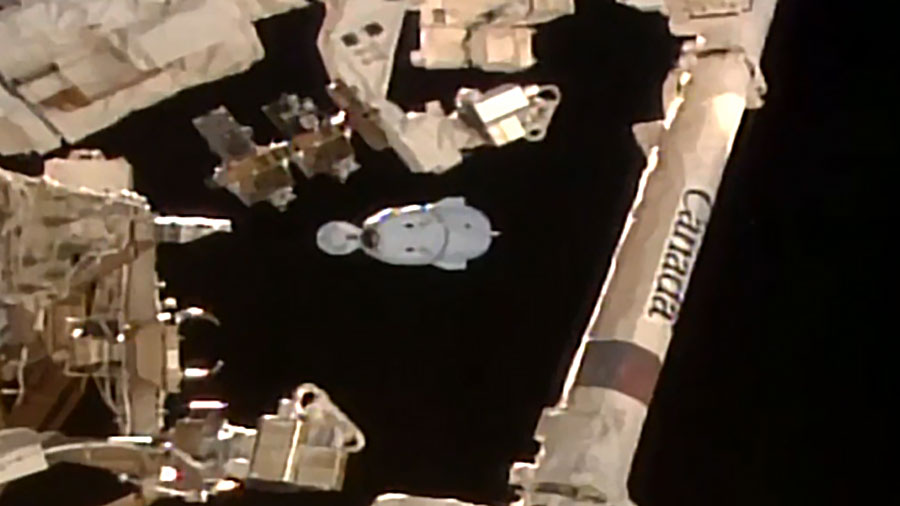
The SpaceX Dragon Endeavour spacecraft is pictured beyond the Candarm2 robotic arm moments after undocking from the Harmony module with four Crew-8 members. Credit: NASA TV

At 5:05 p.m. EDT, NASA astronauts Matt Dominick, Mike Barratt, and Jeanette Epps, along with Roscosmos cosmonaut Alexander Grebenkin undocked from the forward-facing port of International Space Station’s Harmony module aboard the SpaceX Dragon spacecraft.

NASA’s return coverage continues with real-time, audio only commentary, and full coverage will resume at the start of the splashdown broadcast. The audio feed will remain available, including astronaut conversations with mission control, in addition to a live video feed from the orbiting laboratory.

NASA’s coverage will resume at 2:15 a.m. Friday, Oct. 25, on NASA+ and the agency’s website until Dragon splashes down at approximately 3:29 a.m. off the coast of Florida, and Crew-8 members are safely recovered. Learn how to watch NASA content through a variety of platforms, including social media.


Learn more about the mission by following the commercial crew blog, @commercial_crew on X, and commercial crew on Facebook.

Learn more about station activities by following the space station blog@space_station and @ISS_Research on X, as well as the ISS Facebook and ISS Instagram accounts.

Get weekly video highlights at: https://roundupreads.jsc.nasa.gov/videoupdate/

Get the latest from NASA delivered every week. Subscribe here: www.nasa.gov/subscribe

Powered by WPeMatico

Get The Details…

Mark Garcia

NASA+ is Live as Crew-8 Prepares to Undock in Dragon

NASA+ is Live as Crew-8 Prepares to Undock in Dragon

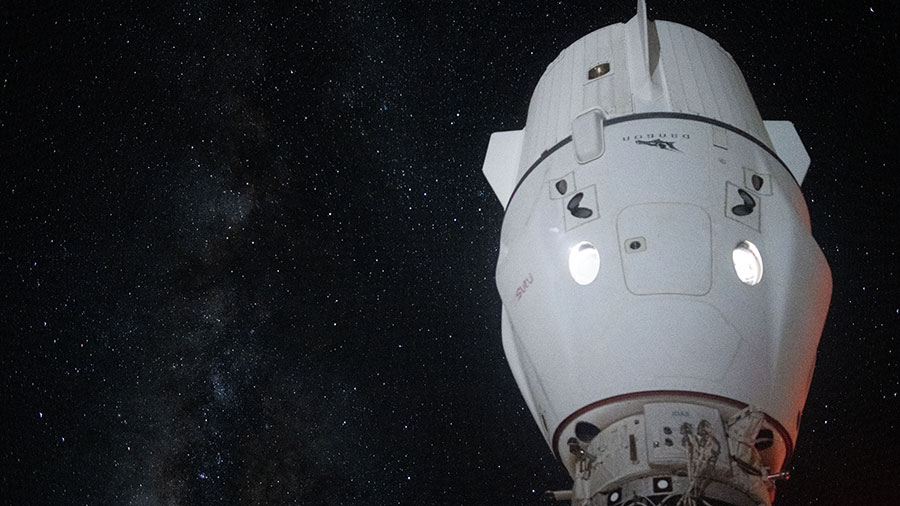
The Milky Way appears in the vastness of space behind the SpaceX Dragon Endeavour spacecraft docked to the space station's Harmony module.
The Milky Way appears in the vastness of space behind the SpaceX Dragon Endeavour spacecraft docked to the space station’s Harmony module.

NASA’s live coverage of undocking is now underway on NASA+ and the agency’s website. Learn how to watch NASA content through a variety of platforms, including social media.

At 3:24 p.m. EDT, hatches between the SpaceX Dragon spacecraft and the International Space Station closed in preparation for undocking and return to Earth of NASA astronauts Matt Dominick, Mike Barratt, and Jeanette Epps, along with Roscosmos cosmonaut Alexander Grebenkin.

The spacecraft will undock from the orbiting laboratory’s Harmony module at 5:05 p.m., heading for a targeted splashdown at approximately 3:29 a.m. Friday, Oct. 25, off the coast of Florida. NASA will provide coverage of deorbit burn, entry, and splashdown at beginning 2:15 a.m. on NASA+ and the agency’s website.


Learn more about station activities by following the space station blog@space_station and @ISS_Research on X, as well as the ISS Facebook and ISS Instagram accounts.

Get weekly video highlights at: https://roundupreads.jsc.nasa.gov/videoupdate/

Get the latest from NASA delivered every week. Subscribe here: www.nasa.gov/subscribe

Powered by WPeMatico

Get The Details…

Mark Garcia

Crew-8 Closes Dragon Hatch, Prepares for Undocking

Crew-8 Closes Dragon Hatch, Prepares for Undocking

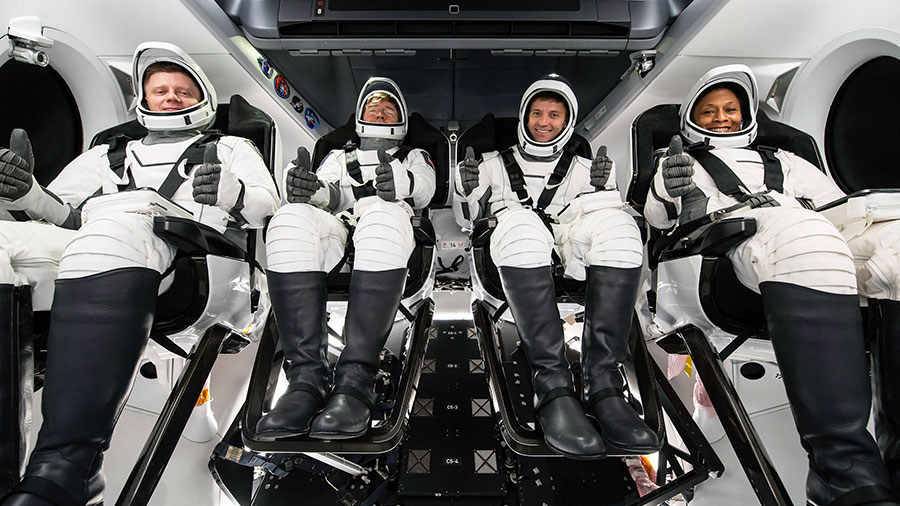
NASA's SpaceX Crew-8 members pose for a photo inside the SpaceX Dragon spacecraft during training on January 2024. From left are, Roscosmos cosmonaut Alexander Grebenkin and NASA astronauts Mike Barratt, Matthew Dominick, and Jeanette Epps. Credit: SpaceX
NASA’s SpaceX Crew-8 members pose for a photo inside the SpaceX Dragon spacecraft during training on January 2024. From left are, Roscosmos cosmonaut Alexander Grebenkin and NASA astronauts Mike Barratt, Matthew Dominick, and Jeanette Epps. Credit: SpaceX

At 3:24 p.m. EDT, the hatch closed between the SpaceX Dragon spacecraft and the International Space Station in preparation for the return of NASA’s SpaceX Crew-8 mission.

NASA’s undocking coverage begins at 4:45 p.m. on NASA+ and the agency’s website. The spacecraft will autonomously undock from the orbiting laboratory at approximately 5:05 p.m. to begin the return to Earth. Learn how to watch NASA content through a variety of platforms, including social media.

Following the conclusion of undocking coverage, NASA will switch to real-time audio-only before return coverage resumes at 2:15 a.m. Friday, Oct. 25 on NASA+ and the agency’s website.


Learn more about the mission by following the commercial crew blog, @commercial_crew on X, and commercial crew on Facebook.

Learn more about station activities by following the space station blog@space_station and @ISS_Research on X, as well as the ISS Facebook and ISS Instagram accounts.

Get the latest from NASA delivered every week. Subscribe here: www.nasa.gov/subscribe

Powered by WPeMatico

Get The Details…

Mark Garcia

Crew-8 Enters Dragon, Closes Hatch Live on NASA+

Crew-8 Enters Dragon, Closes Hatch Live on NASA+

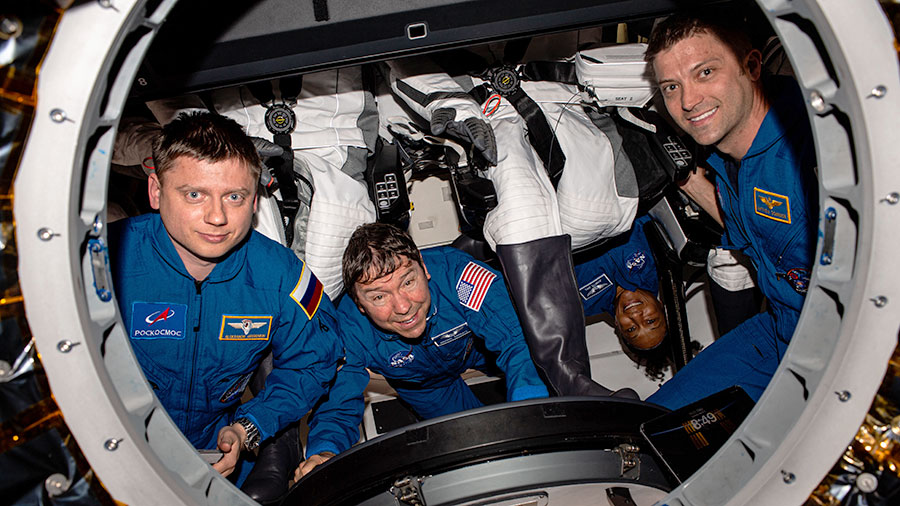
The SpaceX Crew-8 members are pictured inside the SpaceX Dragon Endeavour spacecraft after arriving on March 5, 2024. From left are, Roscosmos cosmonaut Alexander Grebenkin and NASA astronauts Mike Barratt, Jeanette Epps, and Matthew Dominick.

NASA’s live coverage is underway on NASA+ and the agency’s website ahead of hatch closure and undocking preparations for the return of NASA’s SpaceX Crew-8 mission. Learn how to stream NASA content through a variety of platforms, including social media.

NASA astronauts Matt Dominick, Mike Barratt, and Jeanette Epps, along with Roscosmos cosmonaut Alexander Grebenkin will close the hatch at 3:20 p.m. EDT Wednesday, Oct. 23, between the SpaceX Dragon spacecraft and the International Space Station.

NASA will provide live undocking coverage beginning at 4:45 p.m. on NASA+ and the agency’s website.

The spacecraft will autonomously undock from the space station at 5:05 p.m. to begin the 34-hour return to Earth. NASA and SpaceX are targeting splashdown at approximately 3:29 a.m. Friday, Oct. 25 off the coast of Florida.

As part of NASA’s Commercial Crew Program, the Crew-8 mission will return important and time-sensitive research to Earth. The crew launched March 3 on the Dragon spacecraft aboard a SpaceX Falcon 9 rocket from NASA’s Kennedy Space Center in Florida and will have completed a seven-month science expedition aboard the orbiting laboratory.


Learn more about station activities by following the space station blog@space_station and @ISS_Research on X, as well as the ISS Facebook and ISS Instagram accounts.

Get weekly video highlights at: https://roundupreads.jsc.nasa.gov/videoupdate/

Get the latest from NASA delivered every week. Subscribe here: www.nasa.gov/subscribe

Powered by WPeMatico

Get The Details…

Mark Garcia

Human Adaptation to Spaceflight: The Role of Food and Nutrition

Human Adaptation to Spaceflight: The Role of Food and Nutrition

3 min read

Preparations for Next Moonwalk Simulations Underway (and Underwater)

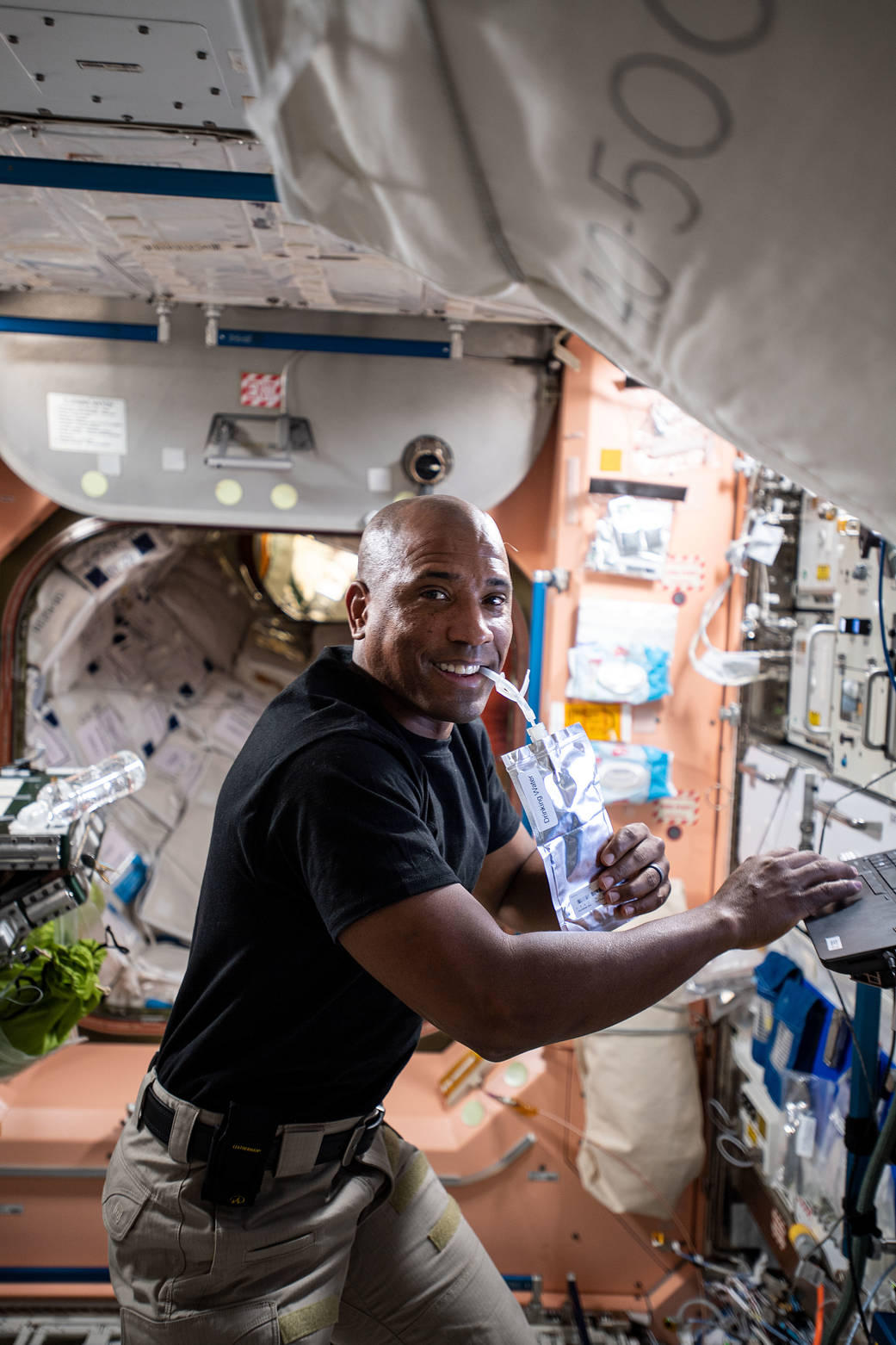
Expedition 64 Flight Engineer Victor Glover of NASA
Expedition 64 Flight Engineer Victor Glover of NASA sips on a water bag.

The latest book marks our third effort to review available literature regarding the role of nutrition in astronaut health. In 2009, we reviewed the existing knowledge and history of human nutrition for spaceflight, with a key goal of identifying additional data that would be required before NASA could confidently reduce the risk of an inadequate food system or inadequate nutrition to as low as possible in support of human expeditions to the Moon or Mars. We used a nutrient-by-nutrient approach to address this effort, and we included a brief description of the space food systems during historical space programs.

In 2014, we published a second volume of the book, which was not so much a second edition, but rather a view of space nutrition from a different perspective. This volume updated research that had been published in the intervening 6 years and addressed space nutrition with a more physiological systems-based approach.

The current version is an expanded, updated version of that second book, providing both a systems approach overall, but also including details of nutrients and their roles within each system. As such, this book is divided into chapters based on physiological systems (e.g., bone, muscle, ocular); highlighted in each chapter are the nutrients associated with that particular system. We provide updated information on space food
systems and constraints of the same, and provide dietary intake data from International Space Station (ISS) astronauts.

We present data from ground-based analog studies, designed to mimic one or more conditions similar to those produced by spaceflight. Head-down tilt bed rest is a common analog of the general (and specifically musculoskeletal) disuse of spaceflight. Nutrition research from Antarctica relies on the associated confinement
and isolation, in addition to the lack of sunlight exposure during the winter months. Undersea habitats help expand our understanding of nutritional changes in a confined space with a hyperbaric atmosphere. We also review spaceflight research, including data from now “historical” flights on the Space Shuttle, data from the Russian space station Mir, and earlier space programs such as Apollo and Skylab. The ISS, now more than
20 years old, has provided (and continues to provide) a wealth of nutrition findings from extended-duration spaceflights of 4 to 12 months. We review findings from this platform as well, providing a comprehensive review of what is known regarding the role of human nutrition in keeping astronauts healthy.

With this latest book, we hope we have accurately captured the current state of the field of space food and nutrition, and that we have provided some guideposts for work that remains to be done to enable safe and successful human exploration beyond low-Earth orbit.

Human Adaptation to Spaceflight: The Role of Food and Nutrition – 2nd Edition

Download 2nd Edition PDF

Human Adaptation to Spaceflight: The Role of Food and Nutrition – 1st Edition

Download 1st Edition PDF

Share

Details

Last Updated

Oct 23, 2024

Editor
Robert E. Lewis

Powered by WPeMatico

Get The Details…
Robert E. Lewis