Eye Health, Cargo Packing Ahead of Dragon Relocation

Eye Health, Cargo Packing Ahead of Dragon Relocation

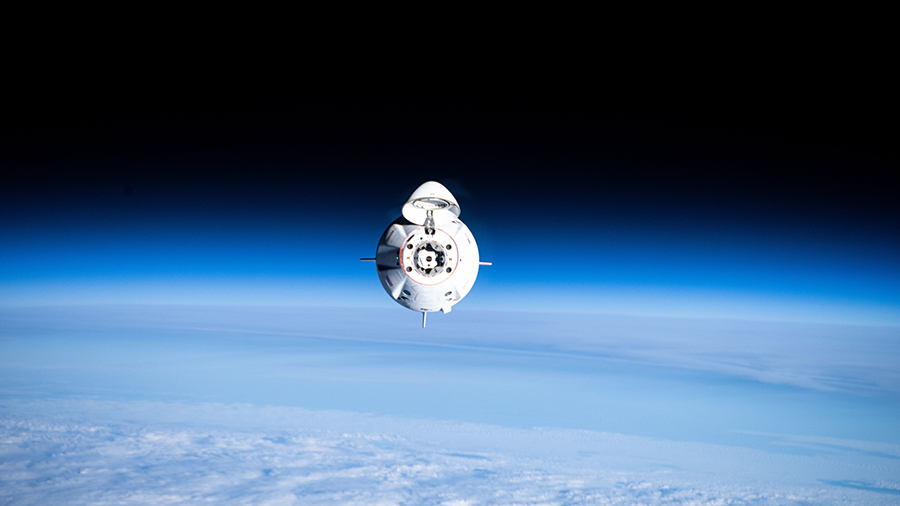
The SpaceX Dragon Freedom spacecraft approaches the International Space Station for a docking on Sept. 29, 2024.

Protecting eyesight to keep crews healthy and packing cargo for an upcoming mission were the main tasks for the Expedition 72 crew aboard the International Space Station on Tuesday.

Body fluids behave differently in weightlessness resulting in an upward flow toward an astronaut’s head. This condition creates pressure on a crew member’s eyes causing changes in eye structure and vision. Commander Suni Williams and Flight Engineer Butch Wilmore, both NASA astronauts, tested a specialized thigh cuff throughout the day that may prevent the headward fluid shifts. Researchers are monitoring these fluid shifts to learn how to safeguard eye health as NASA and its international partners plan longer missions farther out into space.

Back on Earth, the next resupply mission to the orbital outpost is getting ready for launch next week aboard the SpaceX Dragon cargo spacecraft. NASA Flight Engineers Don Pettit and Nick Hague geared up on Tuesday for the arrival of Dragon and its shipment of new science experiments and station hardware. Pettit began packing and staging cargo that will be stowed inside Dragon after its arrival then returned to Earth for retrieval. Hague trained to use the tools that will monitor the automated approach and rendezvous of Dragon.

However, before the cargo mission blasts off toward the space station, Hague will lead Williams, Wilmore, and Roscosmos cosmonaut Aleksandr Gorbunov on a short ride aboard the SpaceX Dragon Freedom spacecraft to a new docking port. The quartet will board Dragon on Sunday, Nov. 3, undock from the Harmony module’s forward port at 6:35 a.m. EDT, then maneuver the spacecraft to Harmony’s space-facing port for a docking at 7:18 a.m. The relocation opens up the forward port for the Dragon cargo mission.

After a training session at the beginning of his shift on the Destiny laboratory module’s exercise cycle, Gorbunov installed and activated hardware to observe Earth’s nighttime atmosphere in near-ultraviolet wavelengths. His fellow cosmonauts Alexey Ovchinin and Ivan Vagner partnered together on maintenance and inspection duties in the aft end of the Zvezda service module.


Learn more about station activities by following the space station blog@space_station and @ISS_Research on X, as well as the ISS Facebook and ISS Instagram accounts.

Get the latest from NASA delivered every week. Subscribe here: www.nasa.gov/subscribe

Powered by WPeMatico

Get The Details…

Mark Garcia

Ken Iliff: Engineering 40 Years of Success

Ken Iliff: Engineering 40 Years of Success

10 min read

Preparations for Next Moonwalk Simulations Underway (and Underwater)

Editor’s note: This article was published May 23, 2003, in NASA Armstrong’s X-Press newsletter. NASA’s Dryden Flight Research Center in Edwards, California, was redesignated Armstrong Flight Research Center on March 1, 2014. Ken Iliff was inducted into the National Hall of Fame for Persons with Disabilities in 1987. He died Jan. 4, 2016.

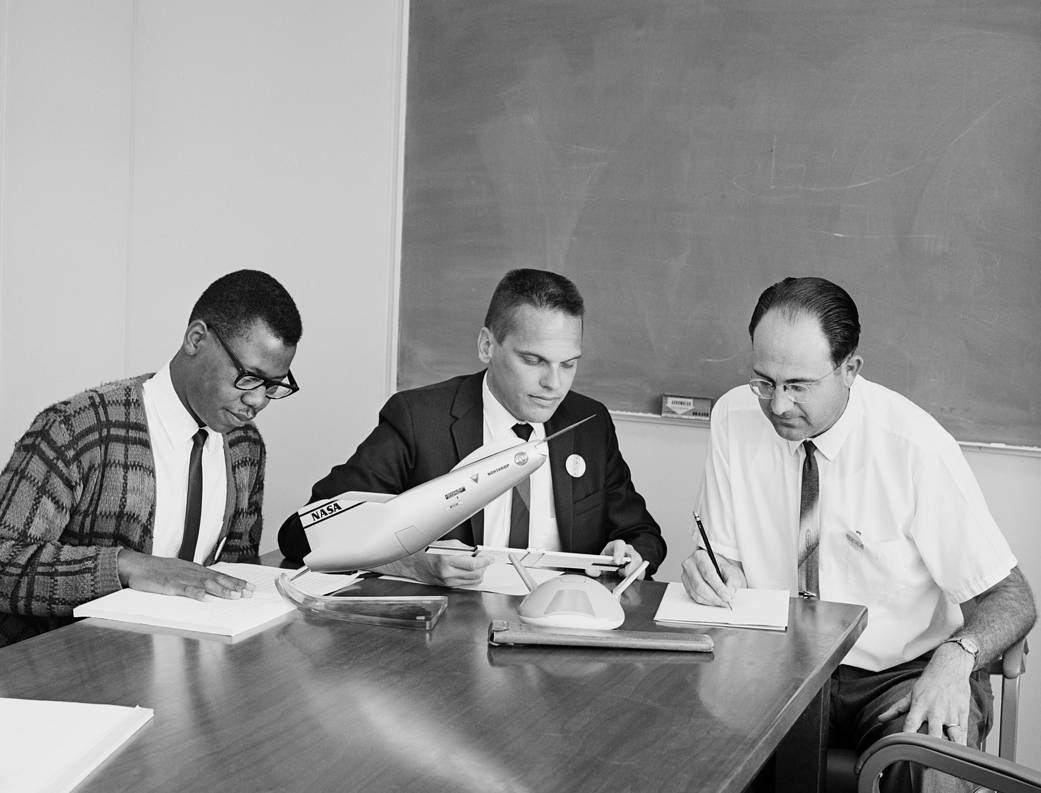
Three men look at aircraft models.
Alphonso Stewart, from left, Ken Iliff, and Dale Reed study lifting body aircraft models at NASA’s Armstrong (then Dryden) Flight Research Center in Edwards, California.
NASA

As an Iowa State University engineering student in the early 1960s, Ken Iliff was hard at work on a glider flight simulation.

Upon examining the final results – which, in those early days of the computer revolution, were viewed on a long paper printout – he noticed one glaring imperfection: the way he had programmed it, his doomed glider would determinedly accelerate as it headed for the ground.

The culprit was a single keystroke. At the time, programming was based on data that had been painstakingly entered into the computer by hand, on punch cards and piece by piece. Somewhere, Iliff had entered a plus sign instead of a minus sign.

The seemingly minor incident was to foreshadow great things to come in Iliff’s career.

Not long after graduation, the West Union, Iowa, native found himself at what was then called simply the NASA Flight Research Center located on Edwards Air Force Base.

“I just knew I didn’t want to be sitting somewhere in a big room full of engineers who were all doing the same thing,” Iliff said of choosing Dryden over other jobs and other NASA centers. “It was a small center doing important things, and it was in California. I knew I wanted to be there.”

Once at Dryden, the issue of data tidbits was central to the new hire’s workday. Iliff’s post called for him and many of his colleagues to spend much of their time “reading up” data – a laborious process of measuring data from film using a single reference line and a ruler. Measurements were made every tenth of a second; for a ten-second maneuver, a total of one hundred “traces” were taken for every quantity being recorded.

“I watched talented people spending entire days analyzing data,” he recalled. “And then, maybe two people would arrive at two entirely different conclusions” from the same data sets.

As has happened so often at the birth of revolutionary ideas, then, one day Iliff had a single, simple thought about the time-intensive and maddeningly inexact data analysis process:

“There just has to be a better way to do this.”

The remedy he devised was to result in a sea change at Dryden, and would reverberate throughout the world of computer-based scientific research.

Iliff’s work spanned the decades that encompassed some of Dryden’s greatest achievements, from the X-15 through the XB-70 and the tentative beginnings of the shuttle program. The solution he created to the problem of inaccuracy in data analysis focused on aerodynamic performance – how to formulate questions about an aircraft’s performance once answers about it are already known, how to determine the “why?” when the “what happens?” has already happened.

The work is known as “parameter estimation,” and is used in aerospace applications to extract precise definitions of aerodynamic, structural and performance parameters from flight data.

His methodology – cemented in computer coding Iliff developed using Fortran’s lumbering binary forerunner, machine code – allowed researchers to determine precisely the type of information previously derived only as best-estimate guesses through analysis of data collected in wind tunnels and other flight-condition simulators. In addition to aerospace science, parameter estimation is also used today in a wide array of research applications, including those involving submarines, economic models, and biomedicine.

With characteristic deference, Iliff now brushes off any suggestion of his discovery’s significance. Instead, he credits other factors for his successes, such as a Midwestern work ethic and Iowa State University’s early commitment to giving its engineering students good access to the new and emerging computer technology.

To hear him tell it, “all good engineers are a little bit lazy. We know how to innovate – how to find an easier way.

“I’d been trained well, and given the right tools – I was just in the right place at the right time.”

But however modestly he might choose to see it characterized, it’s fair to number Iliff’s among the longest and most distinguished careers to take root in the ranks of Dryden research engineers. Though his groundbreaking work will live forever in research science, when Iliff retired in December he brought to a close his official role in some of the most important chapters in Dryden history.

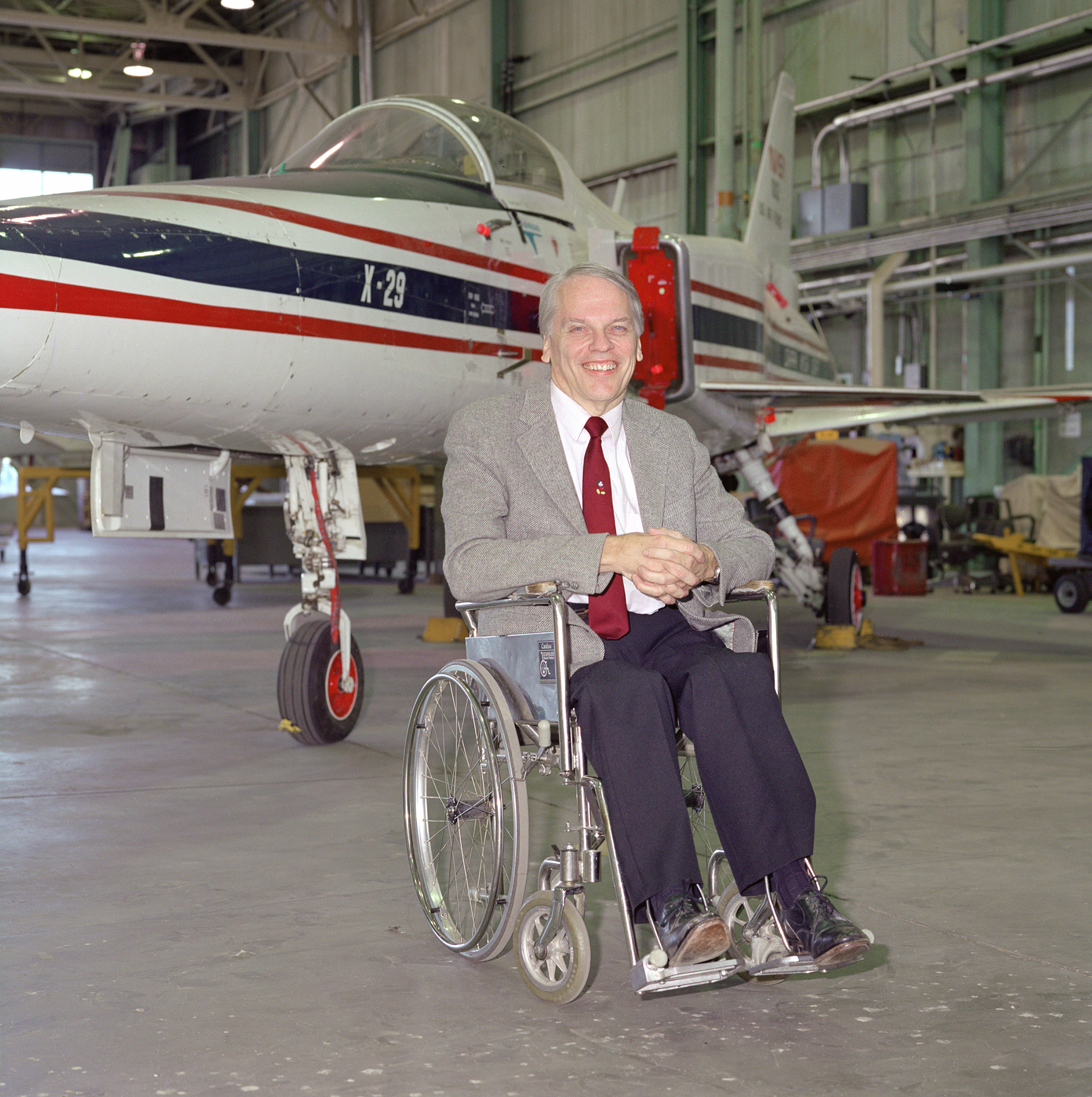
A man sits in a wheelchair with an experimental aircraft in the background.
Ken Iliff worked for four decades on revolutionary aircraft and spacecraft, including the X-29 forward swept wing aircraft behind him, at NASA’s Armstrong (then Dryden) Flight Research Center in Edwards, California.
NASA

His pioneering work with parameter estimation carried through years of aerodynamic assessment and data analysis involving lifting-body and wing-body aircraft, from the X-15 through the M2-F1, M2-F2 and M2-F3 projects, the HL-10, the X-24B and NASA’s entire fleet of space shuttles. His contributions aided in flight research on the forward-swept-wing X-29 and the F/A-18 High Angle of Attack program, on F-15 spin research vehicles, on thrust vectoring and supermaneuverability.

Iliff began work on the space shuttle program when it was little more than a speculative “what’s next?” chapter in manned spaceflight, long before it reached officially sanctioned program status. Together with a group spearheaded by the late NASA research pilot and long-time Dryden Chief Engineer Milt Thompson – who Iliff describes unflinchingly as “my hero” – Iliff helped explore the vast range of possibilities for a new orbiting craft that would push NASA to its next frontier after landing on the moon.

In an environment much more informal than today’s, when there were few designations of “program manager” or “task monitor” or “deputy director” among NASA engineers like Iliff and Thompson, a handful of creative, disciplined minds were at work dreaming up a reusable aircraft that would launch, orbit the Earth and return. Iliff’s role was to offer up the rigor of comparison in size, speed and performance among potential aircraft designs; Thompson and Iliff’s group was responsible, for example, for the decision to abandon the notion of jet engines on the orbiter, decreeing them too heavy, too risky and too inefficient.

Month in and month out, Iliff and his colleagues painstakingly researched and developed the myriad design details that eventually materialized into the shuttle fleet. There was, in Iliff’s words, “a love affair between the shuttle and the engineers.”

And in a display typifying the charged environment of creative collaboration that governed the effort – an effort many observe wryly that it would be difficult to replicate at NASA, today or anytime – the body of research was compiled into the now-legendary aero-data book, a living document that records in minute detail every scrap of design and performance data recorded about the shuttles’ flight activity.

Usually with more than a touch of irony, the compiling of the aero-data book has been described with phrases like “a remarkably democratic process,” involving as it did the need for a hundred independent minds and strong personalities to agree on indisputable facts about heat, air flow, turbulence, drag, stability and a dozen other aerodynamic principles. But Iliff says the success of the mammoth project, last updated in 1996, was ultimately enabled by a shared commitment to a culture that was unique to Dryden, one that made the Center great.

“Well, big, complicated things don’t always come out like you think they will,” Iliff said.

“But we understood completely the idea of ‘informed risk.’ We had a thorough understanding of risks before taking them – nobody ever did anything on the shuttle that they thought was dangerous, or likely to fail.

“The truly great thing (about that era at Dryden) was that they mentored us, and let us take those risks, and helped us get good right away. That was how we were able to do what we did.”

It was an era that Iliff says he was thrilled to be a part of, and which he admits was difficult to leave. It was also, he adds with a note of uncharacteristic nostalgia, a time that would be hard to reinvent today after the intrusion of so many bureaucratic tentacles into the hot zone that spawned Dryden’s greatest achievements.

A man not much given to dwelling on the past, however, Iliff has moved on to a retirement he is making the most of. Together with his wife, Mary Shafer, also retired from her career as a Dryden engineer, he plans to dedicate time to cataloging the couple’s extensive travel experiences with new video and graphics software, and adding to the travel library with footage from new trips. Iraq ranks high on the short list.

During his 40-year tenure, Iliff held the post of senior staff scientist of Dryden’s research division from 1988 to 1994, when he became the Center’s chief scientist. Among numerous awards he received were the prestigious Kelly Johnson Award from the Society of Flight Test Engineers (1989), an award permanently housed in the Smithsonian National Air and Space Museum, and NASA’s highest scientific honor, the NASA Exceptional Scientific Achievement Award (1976).

He was inducted into the National Hall of Fame for Persons with Disabilities in 1987, and served on many national aeronautic and aerospace committees throughout his career. He is a Fellow in the American Institute of Aeronautics and Astronautics (AIAA) and is the author of more than 100 technical papers and reports. He has given eleven invited lectures for NATO and AGARD (Advisory Group for Aerospace Research and Development), and served on four international panels as an expert in aircraft and spacecraft dynamics. Recently, he retired from his position as an adjunct professor of electrical engineering at the University of California, Los Angeles.

Iliff holds dual bachelor of science degrees in mathematics and aerospace engineering from Iowa State University; a master of science in mechanical engineering from the University of Southern California; a master of engineering degree in engineering management and a Ph.D. in electrical engineering, both from UCLA.

Iliff’s is the kind of legacy shared by a select group of American engineers, and to read the papers these days, there’s the suggestion that his is a vanishing breed. NASA and other science-based organizations are often depicted as scrambling for new engineering talent – particularly of the sort personified by Iliff and his pioneering achievements.

But, typical of the visionary approach he applies to life in general as well as to science, Iliff takes a wider view.

“I remember, after the X-1 – people figured all the good things had been done,” he said, with a smile in his voice. “And of course, they had not.

“If I was starting out now, I’d be starting in work with DNA, or biomedicine – improving lives with drug research. There are so many exciting things to be discovered there. They might not be as showy as lighting off a rocket, but they’re there.

“I’ve seen cycles. We’re at a low spot right now – but military, or space, will eventually be at the center again.”

And when that day comes, Iliff says he hopes officials in the flight research world will heed the example of Dryden’s early years, and give its engineers every opportunity to succeed unfettered – as he had been.

“Beware the ‘Chicken Littles’ out there,” he said. “I hope the government will be strong enough to resist them.”

Sarah Merlin
Former X-Press newsletter assistant editor

Former Dryden historian Curtis Peebles contributed to this article.

Share

Details

Last Updated

Oct 29, 2024

Editor
Dede Dinius
Contact

Powered by WPeMatico

Get The Details…
Dede Dinius

A Particular Lenticular Cloud

A Particular Lenticular Cloud


A part of New Zealand's South Island as seen by the Landsat 8 satellite. A long, thin white cloud floats above the green and brown landscape. A bit of water is visible on the right of the image.
New Zealand’s stunning scenery has famously provided the backdrop for fictional worlds in fantasy films. A unique cloud that forms over the Otago region of the country’s South Island also evokes the otherworldly, while very much existing in reality.
NASA/Lauren Dauphin; USGS

Landsat 8’s Operational Land Imager acquired this image of an elongated lenticular cloud, locally nicknamed the “Taieri Pet,” above New Zealand’s South Island on Sept. 7, 2024. Lenticular clouds form when prevailing winds encounter a topographic barrier, such as a mountain range. Wind that is forced to flow up and over the mountains creates a kind of wave in the atmosphere. Air cools at the crest of the wave, and the water vapor it contains condenses into clouds.

Image credit: NASA/Lauren Dauphin; USGS

Powered by WPeMatico

Get The Details…
Monika Luabeya

Station Science Top News: Oct. 25, 2024

Station Science Top News: Oct. 25, 2024

Better Monitoring of the Air Astronauts Breathe

Ten weeks of operations showed that a second version of the Spacecraft Atmosphere Monitor is sensitive enough to determine variations in the composition of cabin air inside the International Space Station. Volatile organic compounds and particulates in cabin air could pose a health risk for crew members, and this device increases the speed and accuracy of assessing such risk.

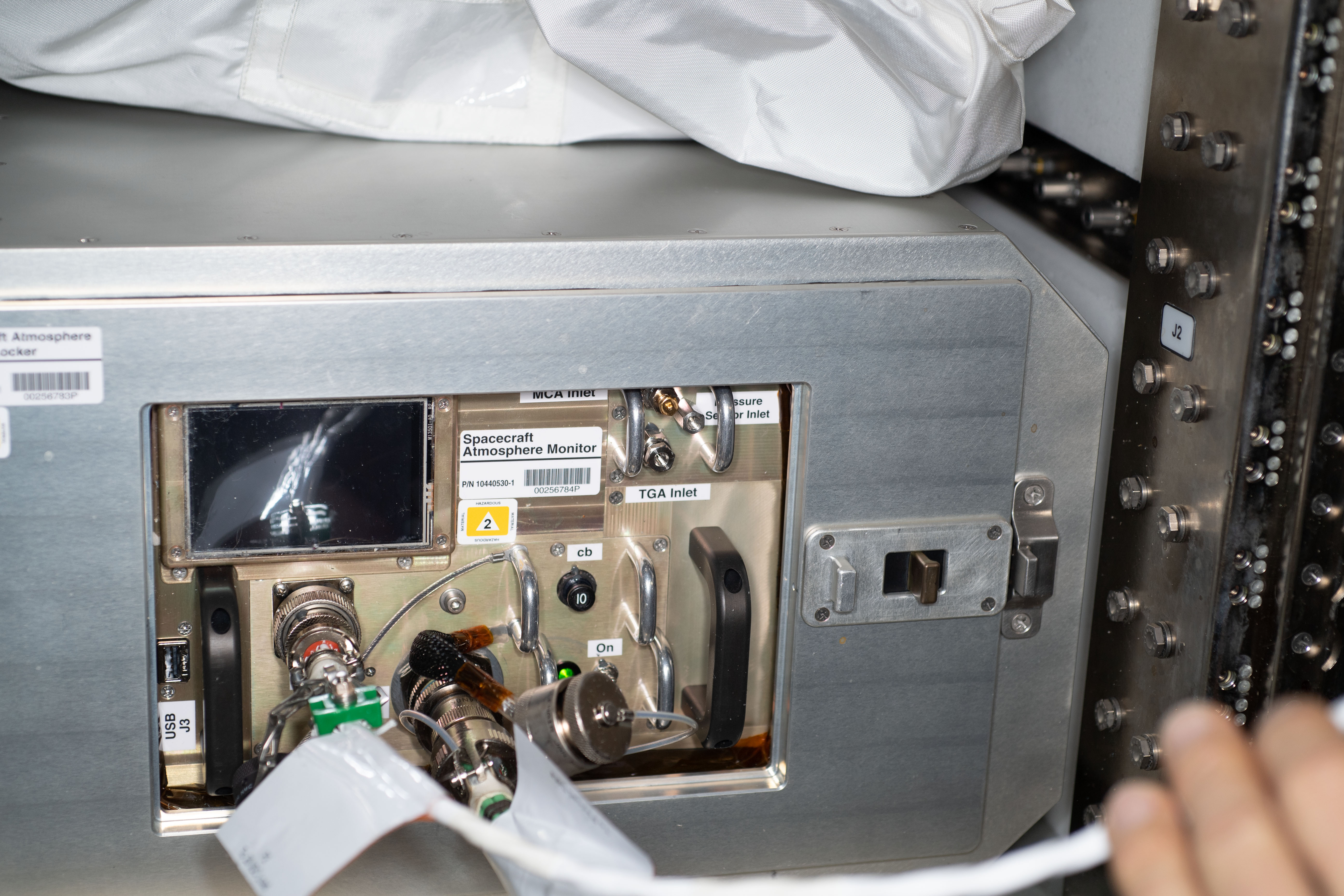
Spacecraft Atmosphere Monitor is a miniaturized gas chromatograph mass spectrometer used to analyze the air inside the space station and ensure that it is safe for the crew and equipment. The device automatically reports results to the ground, eliminating the need to return samples to Earth. This version has several other technological advances, including that it can be relocated, is smaller, and uses less power.

Close-up image of a Spacecraft Atmosphere Monitor inside the International Space Station. The monitor is surrounded by cables, connectors, and metal components.
The first Spacecraft Atmosphere Monitor device on the International Space Station.
NASA/Chris Cassidy

Digging Deeper into Microgravity Effects on Muscle

Prolonged exposure to microgravity affects human muscle precursor cells known as satellite cells and causes changes in the expression of specific genes involved in muscle structure and nerves. Exercise regimens on the space station do not adequately prevent or counteract muscle loss in astronauts, which can affect their motor function during missions and after return to Earth. Results could inform design of nutritional and pharmacological countermeasures to muscle changes during spaceflight.

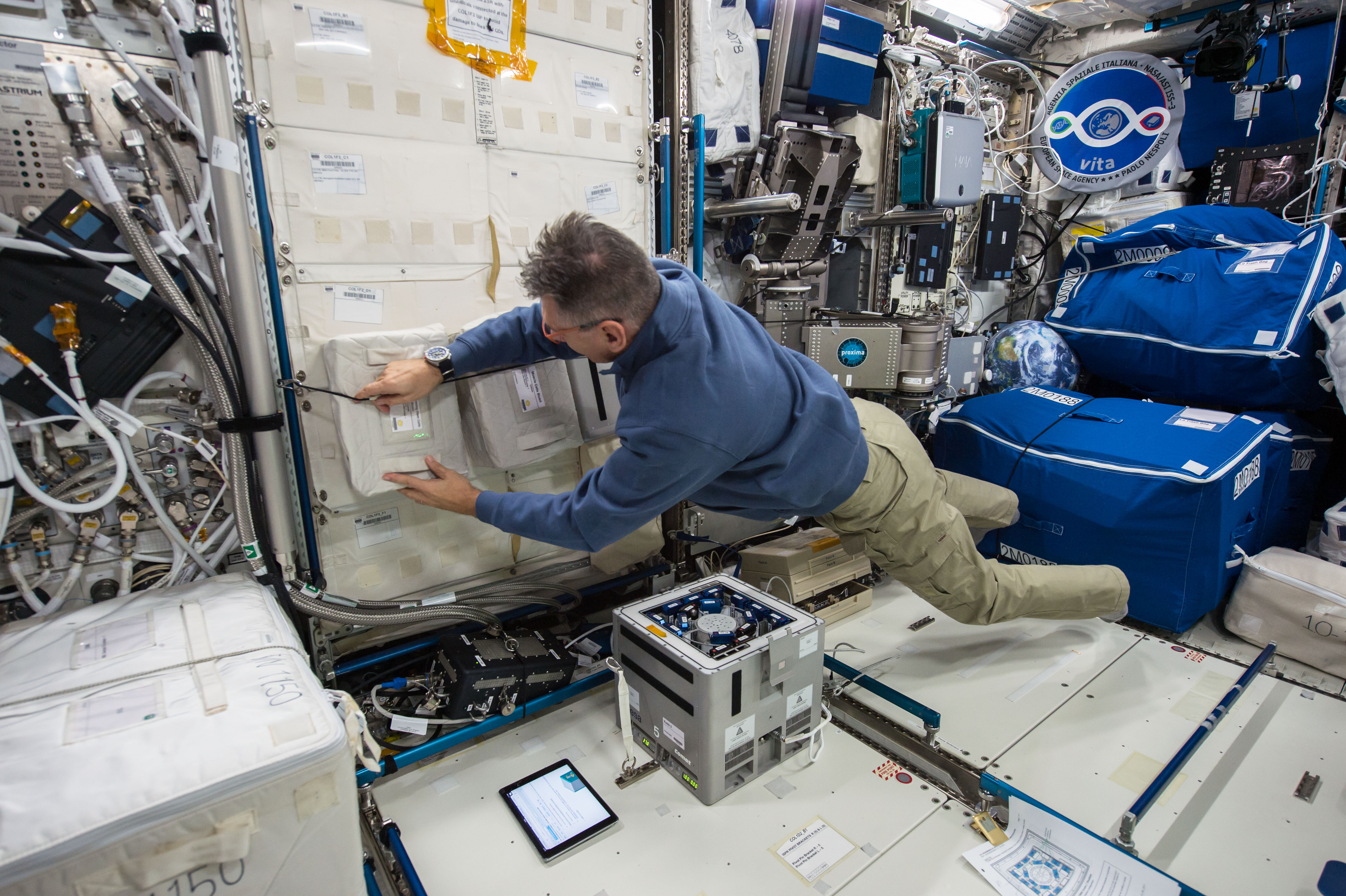
Muscle loss represents a major obstacle to human long-term spaceflight. Myogravity, an investigation developed with the Italian space agency ASI, looked at microgravity-induced changes in adult stem cells involved in the growth, maintenance, and repair of skeletal muscle tissue, known as satellite cells. These cells may play a major role in muscle loss during spaceflight.

NASA astronaut working inside the International Space Station, floating in a microgravity environment while securing a storage container to the wall.
European Space Agency astronaut Paolo Nespoli sets up the Myogravity experiment.
NASA

Validating Next-Generation Earth Measurements

Researchers completed a preliminary evaluation of the station’s Hyperspectral Imager Suite (HISUI) and report that the difference between model-corrected and actual measurements is small. Validation of spaceborne optical sensors like HISUI is important to demonstrate they provide the accuracy needed for scientific research.

The JAXA (Japan Aerospace Exploration Agency) HISUI investigation tests a next-generation spaceborne hyperspectral Earth imaging system for gathering data on reflection of light from Earth’s surface, which reveals characteristics and physical properties of a target area. This technology has potential applications such as monitoring vegetation and identifying natural resources.

The Hyperspectral Imager Suite is visible on the far left in this image outside the space station.
NASA

Powered by WPeMatico

Get The Details…
Sumer Loggins

Carissa Arillo: Testing Spacecraft, Penning the Owner’s Manuals

Carissa Arillo: Testing Spacecraft, Penning the Owner’s Manuals

Flight operations engineer Carissa Arillo helped ensure one of the instruments on NASA’s PACE mission made it successfully through its prelaunch testing. She and her group also documented the work rigorously, to ensure the flight team had a comprehensive manual to keep this Earth-observing satellite in good health for the duration of its mission.

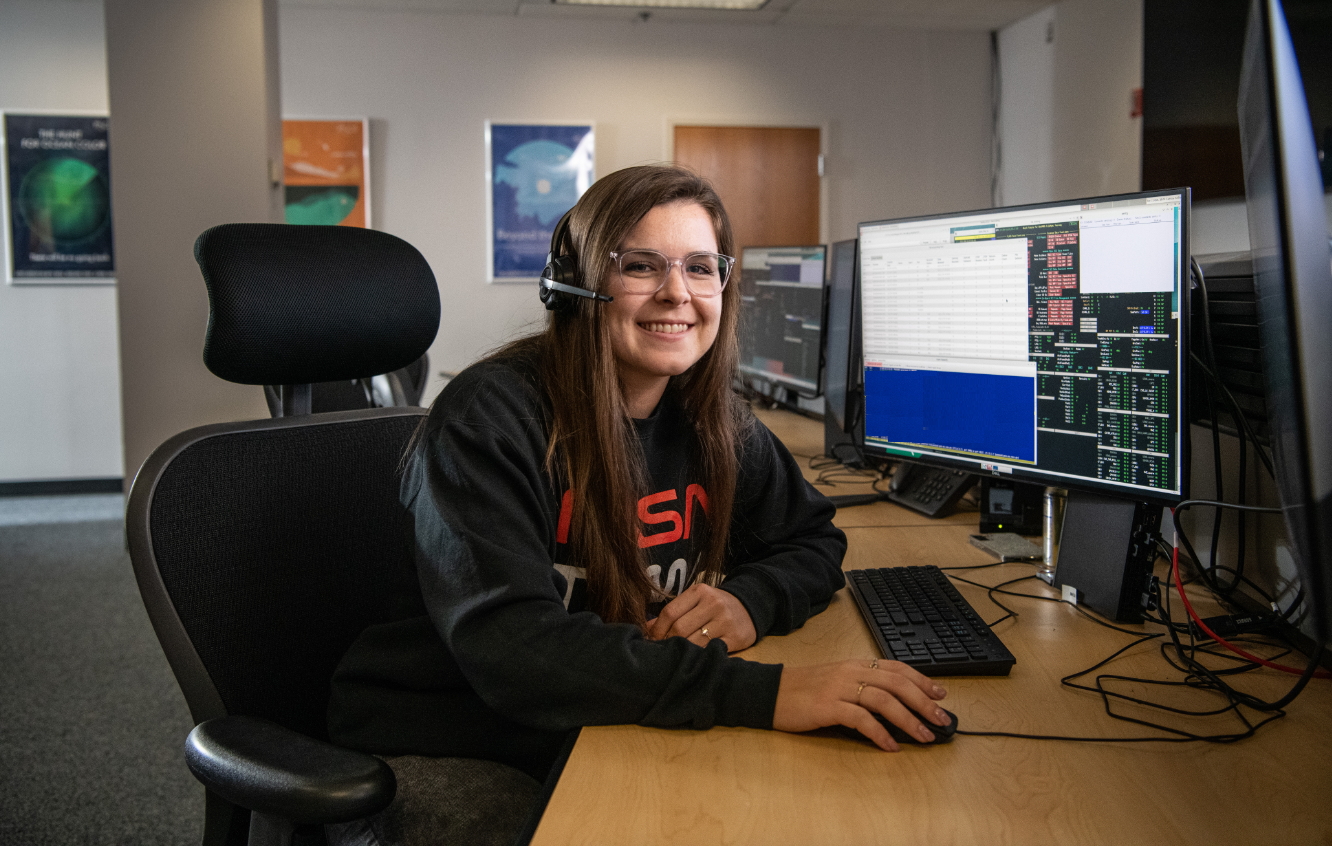
Carissa Arillo sits at a table with a monitor and a keyboard, wearing a headset. She smiles at the camera. On the screen is code, but it isn't clearly visible. She is wearing a long sleeve dark colored shirt with the NASA worm logo across the front in red. She has long, brown hair and wears glasses.
Carissa M. Arillo is a flight operations engineer at NASA’s Goddard Space Flight Center in Greenbelt, Md.
Photo courtesy of Carissa Arillo

Name: Carissa M. Arillo
Formal Job Classification: Flight Operations Engineer
Organization: Environmental Test Engineering and Integration Branch (Code 549)

What do you do and what is most interesting about your role here at Goddard?

I developed pre-launch test procedures for the HARP-2 instrument for the Phytoplankton, Aerosol, Cloud and Ecosystem (PACE) Mission. HARP-2 is a wide angle imaging polarimeter designed to measure aerosol particles and clouds, as well as properties of land and water surfaces.

I also developed the flight operations routine and contingency procedures that governed the spacecraft after launch. It is interesting to think about how to design procedures that can sustain the observatory in space for the life of the mission so that the flight operations team that inherits the mission will have a seamless transition.

What is your educational background?

In 2019, I got a Bachelor of Science in mechanical engineering from the University of Maryland, College Park. I am currently pursuing a master’s in robotics there as well.

Why did you become an engineer?

I like putting things together and understanding how they work. After starting my job at NASA Goddard, I became interested in coding and robotics.

How did you come to Goddard?

After getting my undergraduate degree, I worked at General Electric Aviation doing operations management for manufacturing aircraft engines. When I heard about an opening at Goddard, I applied and got my current position.

What was involved in developing pre-launch test procedures for the HARP-2 instrument?

I talked to the instrument manufacturer, which is a team from the University of Maryland, Baltimore County, and asked them what they wanted to confirm works every time we tested the instrument. We kept in constant communication while developing these test procedures to make sure we covered everything. The end product was code that was part of the comprehensive performance tests, the baseline tests throughout the prelaunch test campaign. Before, during, and after each prelaunch environmental test, we perform such a campaign. These prelaunch environmental tests include vibration, thermal (hot and cold), acoustic and radio frequency compatibility (making sure that different subsystems do not interfere with each other’s).

What goes through your head in developing a flight operations procedure for an instrument?

I think about a safe way of operating the instrument to accomplish the goals of the science team. I also think about not being able to constantly monitor the instrument. Every few hours, we can communicate with the instrument for about five to 10 minutes. We can, however, recover all the telemetry for the off-line time.

When we discover an anomaly, we look at all the history that we have and consult with our contingency procedures, our failure review board and potentially the instrument manufacturer. Together we try to figure out a recovery.

When developing a fight operations procedure, we must think of all possible scenarios. Our end product is a written book of procedures that lives with the mission and is updated as needed.

New cars come with an owner’s manual. We create the same sort of manual for the new instrument.

As a Flight Operations Team member, what else do you do?

The flight operations team runs the Mission Operations Center — the “MOC” — for PACE. That is where we command the spacecraft for the life of the mission. My specialty is the HARP-2 instrument, but I still do many supporting functions for the MOC. For example, I helped develop procedures to automate ground station contacts to PACE. These ground stations are positioned all over the world and enable us to talk with the spacecraft during those five to 10 minutes of communication. This automation includes the standard things we do every time we talk to the spacecraft whether or not someone is in the MOC.

Carissa Arillo stands to the right of the PACE observatory in a cleanroom and points at it. She is wearing a white clean room suit that covers her torso, arms, and over the top of her head and forehead. She also wears a white mask that covers her nose and mouth and blue latex gloves. Behind her and slightly to the left is the PACE observatory, which is large, silver colored, and is covered in wires and other metallic pieces of instrumentation and materials.
Carissa developed pre-launch test procedures for the HARP-2 instrument for the Phytoplankton, Aerosol, Cloud and Ecosystem (PACE) Mission. HARP-2 is a wide angle imaging polarimeter designed to measure aerosol particles and clouds, as well as properties of land and water surfaces.
NASA/Dennis Henry

How does it feel to be working on such an amazing mission so early in your career?

It is awesome, I feel very lucky to be in my position. Everything is new to me. At times it is difficult to understand where the ship is going. I rely on my experienced team members to guide me and my robotics curriculum in school to equip me with skills.

I have learned a lot from both the flight operations team and the integration and test team. The flight operations team has years of experience building MOCs that serve the needs of each unique mission. The integration and test team also has a lot of experience developing observatory functional procedures. I wish to thank both teams for taking me under their wings and educating me on the fly to support the prelaunch, launch and post-launch campaigns. I am very grateful to everyone for giving me this unbelievable opportunity.

Who is your engineering hero?

I don’t have one hero in particular but I love biographical movies that tell stories about influential people’s lives, such as the movie “Hidden Figures” that details the great endeavors and accomplishments of three female African-American mathematicians at NASA.

What do you do for fun?

I love to go to the beach and spend time with family and friends.

Who is your favorite author?

I like Kristen Hannah’s storytelling abilities.

What do you hope to be doing in five years?

I hope to be working on another exciting mission at Goddard that will bring us never-before-seen science.

By Elizabeth M. Jarrell
NASA’s Goddard Space Flight Center, Greenbelt, Md.

A banner graphic with a group of people smiling and the text "Conversations with Goddard" on the right. The people represent many genders, ethnicities, and ages, and all pose in front of a soft blue background image of space and stars.

Conversations With Goddard is a collection of Q&A profiles highlighting the breadth and depth of NASA’s Goddard Space Flight Center’s talented and diverse workforce. The Conversations have been published twice a month on average since May 2011. Read past editions on Goddard’s “Our People” webpage.

Share

Details

Last Updated

Oct 29, 2024

Editor
Madison Olson
Contact
Rob Garner
Location
Goddard Space Flight Center

Powered by WPeMatico

Get The Details…
Madison Olson