NASA Sets Coverage for SpaceX 31st Station Resupply Launch, Arrival

NASA Sets Coverage for SpaceX 31st Station Resupply Launch, Arrival

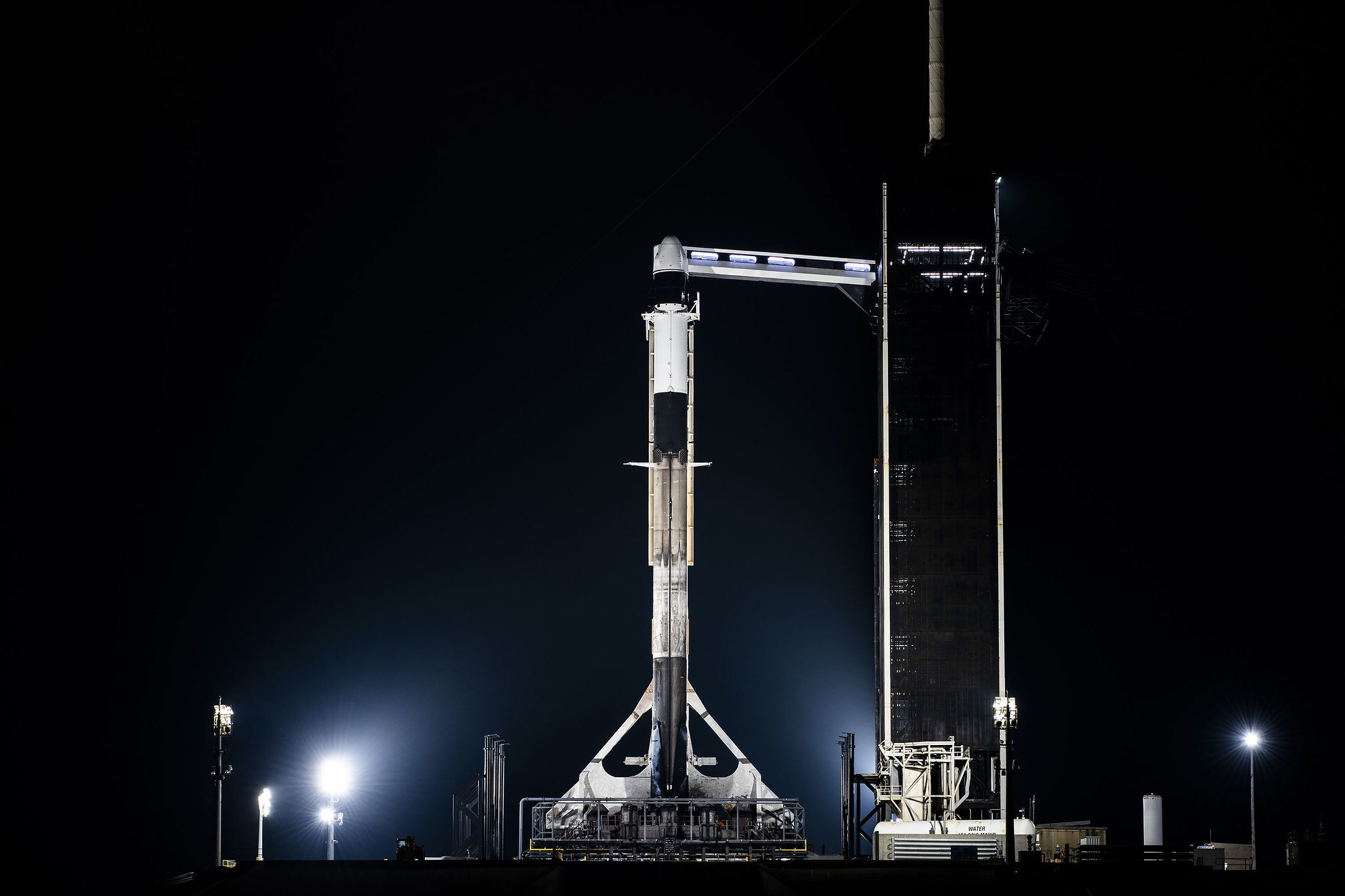
The SpaceX Dragon spacecraft, pictured on March 13, 2023, carried on the company’s Falcon 9 rocket, will launch from Launch Complex 39A at NASA’s Kennedy Space Center in Florida for the agency’s SpaceX 31st commercial resupply services mission to the International Space Station.
Credit: SpaceX

NASA and SpaceX are targeting 9:29 p.m. EST, Monday, Nov. 4, for the next launch to deliver science investigations, supplies, and equipment to the International Space Station. This is the 31st SpaceX commercial resupply services mission to the orbital laboratory for the agency.

Filled with nearly 6,000 pounds of supplies, a SpaceX Dragon spacecraft on a Falcon 9 rocket will lift off from Launch Complex 39A at NASA’s Kennedy Space Center in Florida.

Live launch coverage will begin at 9:10 p.m. on NASA+ and the agency’s website. Learn how to watch NASA content through a variety of platforms, including social media.

NASA’s coverage of arrival will begin at 8:45 a.m. Tuesday, Nov. 5, on NASA+ and the agency’s website. Dragon will dock autonomously to the forward port of the space station’s Harmony module.

In addition to food, supplies, and equipment for the crew, Dragon will deliver several new experiments, including the Coronal Diagnostic Experiment, to examine solar wind and how it forms. Dragon also delivers Antarctic moss to observe the combined effects of cosmic radiation and microgravity on plants. Other investigations aboard include a device to test cold welding of metals in microgravity, and an investigation that studies how space impacts different materials.

Media interested in speaking to a science subject matter expert should contact Leah Cheshier at: leah.d.cheshier@nasa.gov.

The Dragon spacecraft is scheduled to remain at the space station until December when it will depart the orbiting laboratory and return to Earth with research and cargo, splashing down off the coast of Florida.

NASA’s mission coverage is as follows (all times Eastern and subject to change based on real-time operations):

Monday, Nov. 4:

3:30 p.m. – Prelaunch media teleconference (no earlier than one hour after completion of the Launch Readiness Review) with the following participants:

  • Bill Spetch, operations and integration manager, NASA’s International Space Station Program
  • Meghan Everett, deputy chief scientist, NASA’s International Space Station Program
  • Jared Metter, director, flight reliability, SpaceX

Media who wish to participate by phone must request dial-in information by 5 p.m. Friday, Nov. 1, by emailing Kennedy’s newsroom at: ksc-media-accreditat@mail.nasa.gov.

Audio of the teleconference will stream live on the agency’s website.

9:10 p.m. – Launch coverage begins on NASA+ and the agency’s website.

9:29 p.m. – Launch

Tuesday, Nov. 5:

8:45 a.m. – Arrival coverage begins on NASA+ and the agency’s website.

10:15 a.m. – Docking

NASA website launch coverage
Launch day coverage of the mission will be available on the NASA website. Coverage will include live streaming and blog updates beginning no earlier than 9:10 p.m., Nov. 4, as the countdown milestones occur. On-demand streaming video on NASA+ and photos of the launch will be available shortly after liftoff. For questions about countdown coverage, contact the NASA Kennedy newsroom at 321-867-2468. Follow countdown coverage on our International Space Station blog for updates.

Attend Launch Virtually

Members of the public can register to attend this launch virtually. NASA’s virtual guest program for this mission also includes curated launch resources, notifications about related opportunities or changes, and a stamp for the NASA virtual guest passport following launch.

Watch, Engage on Social Media

Let people know you’re watching the mission on X, Facebook, and Instagram by following and tagging these accounts:

X: @NASA, @NASAKennedy, @NASASocial, @Space_StationISS_Research, @ISS National Lab

Facebook: NASANASAKennedyISSISS National Lab

Instagram: @NASA, @NASAKennedy, @ISS, @ISSNationalLab

Coverage en Espanol

Did you know NASA has a Spanish section called NASA en Espanol? Check out NASA en Espanol on X, Instagram, Facebook, and YouTube for additional mission coverage.

Para obtener información sobre cobertura en español en el Centro Espacial Kennedy o si desea solicitar entrevistas en español, comuníquese con Antonia Jaramillo o Messod Bendayan a: antonia.jaramillobotero@nasa.gov o messod.c.bendayan@nasa.gov.

Learn more about the commercial resupply mission at:

https://www.nasa.gov/mission/nasas-spacex-crs-31

-end-

Claire O’Shea / Josh Finch
Headquarters, Washington
202-358-1100
claire.a.o’shea@nasa.gov / joshua.a.finch@nasa.gov

Stephanie Plucinsky / Steven Siceloff
Kennedy Space Center, Fla.
321-876-2468
stephanie.n.plucinsky@nasa.gov / steven.p.siceloff@nasa.gov

Sandra Jones
Johnson Space Center, Houston
281-483-5111
sandra.p.jones@nasa.gov

Share

Details

Last Updated

Oct 30, 2024

Editor
Jessica Taveau

Powered by WPeMatico

Get The Details…
Jessica Taveau

Station Crew Gets Ready for Dragon Relocation and Cargo Missions

Station Crew Gets Ready for Dragon Relocation and Cargo Missions

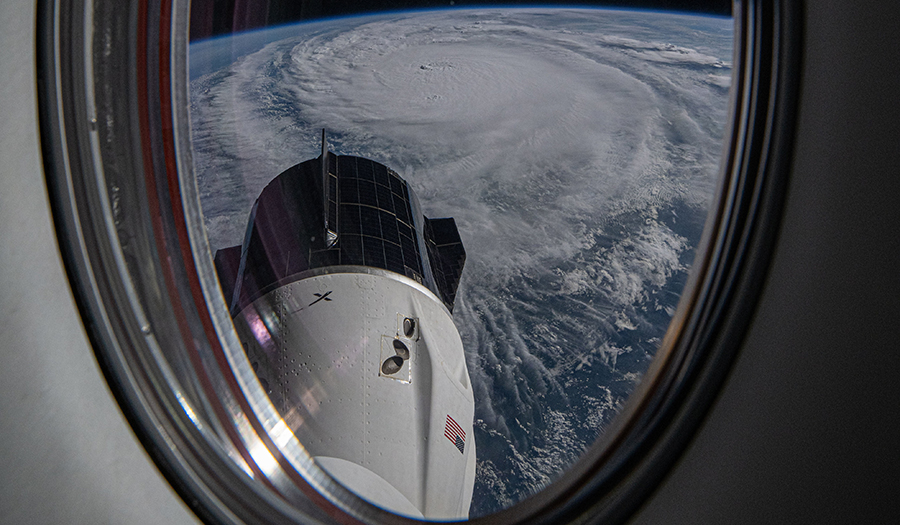
The SpaceX Dragon Freedom spacecraft is pictured docked to the International Space Station as it soared 257 miles above Hurricane Milton in the Gulf of Mexico on Oct. 8, 2024.

The Expedition 72 crew is getting ready for a port relocation maneuver this weekend as a new cargo mission counts down to a lift off next week to resupply the International Space Station. Meanwhile, stem cell research, a spacesuit check, and a host of lab maintenance kept the astronauts and cosmonauts busy on Wednesday.

NASA Flight Engineer Nick Hague will command the SpaceX Dragon Freedom spacecraft when it undocks from the Harmony module’s forward port at 6:35 a.m. EST on Sunday. He, NASA astronauts Butch Wilmore and Suni Williams, and Roscosmos cosmonaut Aleksandr Gorbunov will take a short ride in Freedom and redock to Harmony’s space-facing port at 7:18 a.m. The port relocation maneuver opens up Harmony’s forward port for the upcoming Dragon cargo mission.

Hague and Wilmore took turns on Wednesday preparing for the Dragon cargo mission arriving soon after Sunday’s Dragon Freedom relocation. The duo trained on cargo operations then reviewed rendezvous procedures and monitoring tools for the approaching SpaceX Dragon cargo craft. Hague also downloaded his health data collected from electrodes and the Ultrasound 2 device for analysis by researchers.

Science and maintenance rounded out the schedule on Wednesday as Commander Suni Williams serviced stem cells and checked out a spacesuit. She worked with Wilmore inside the Kibo laboratory module inserting stem cell samples into a microscope to image for a blood disease and cancer study. Following that, Williams entered the Quest airlock and resized and configured a spacesuit ahead of spacewalks planned for 2025.

NASA Flight Engineer Don Pettit, on his fourth spaceflight, spent his morning removing the small satellite deployer from Kibo’s airlock that had earlier deployed several CubeSats into Earth orbit for a series of technology studies. Afterward, Pettit worked on orbital plumbing tasks flushing resupply tanks and transferring water to life support components.

Roscosmos cosmonauts Alexey Ovchinin and Ivan Vagner continued maintenance and inspection activities in the aft end of the Zvezda service module. Flight Engineer Aleksandr Gorbunov completed an experiment run and deactivated hardware that imaged the Earth’s nighttime atmosphere in near-ultraviolet wavelengths.


Learn more about station activities by following the space station blog@space_station and @ISS_Research on X, as well as the ISS Facebook and ISS Instagram accounts.

Get the latest from NASA delivered every week. Subscribe here: www.nasa.gov/subscribe

Powered by WPeMatico

Get The Details…

Mark Garcia

60 Years Ago: The First Flight of the Lunar Landing Research Vehicle

60 Years Ago: The First Flight of the Lunar Landing Research Vehicle

President John F. Kennedy’s national commitment to land a man on the Moon and return him safely to the Earth before the end of the decade posed multiple challenges, among them how to train astronauts to land on the Moon, a place with no atmosphere and one-sixth the gravity on Earth. The Lunar Landing Research Vehicle (LLRV) and its successor the Lunar Landing Training Vehicle (LLTV) provided the training tool to simulate the final 200 feet of the descent to the lunar surface. The ungainly aircraft made its first flight on Oct. 30, 1964, at NASA’s Flight Research Center (FRC), now NASA’s Armstrong Flight Research Center (AFRC) in California. The Apollo astronauts who completed landings on the Moon attributed their successes largely to training in these vehicles.
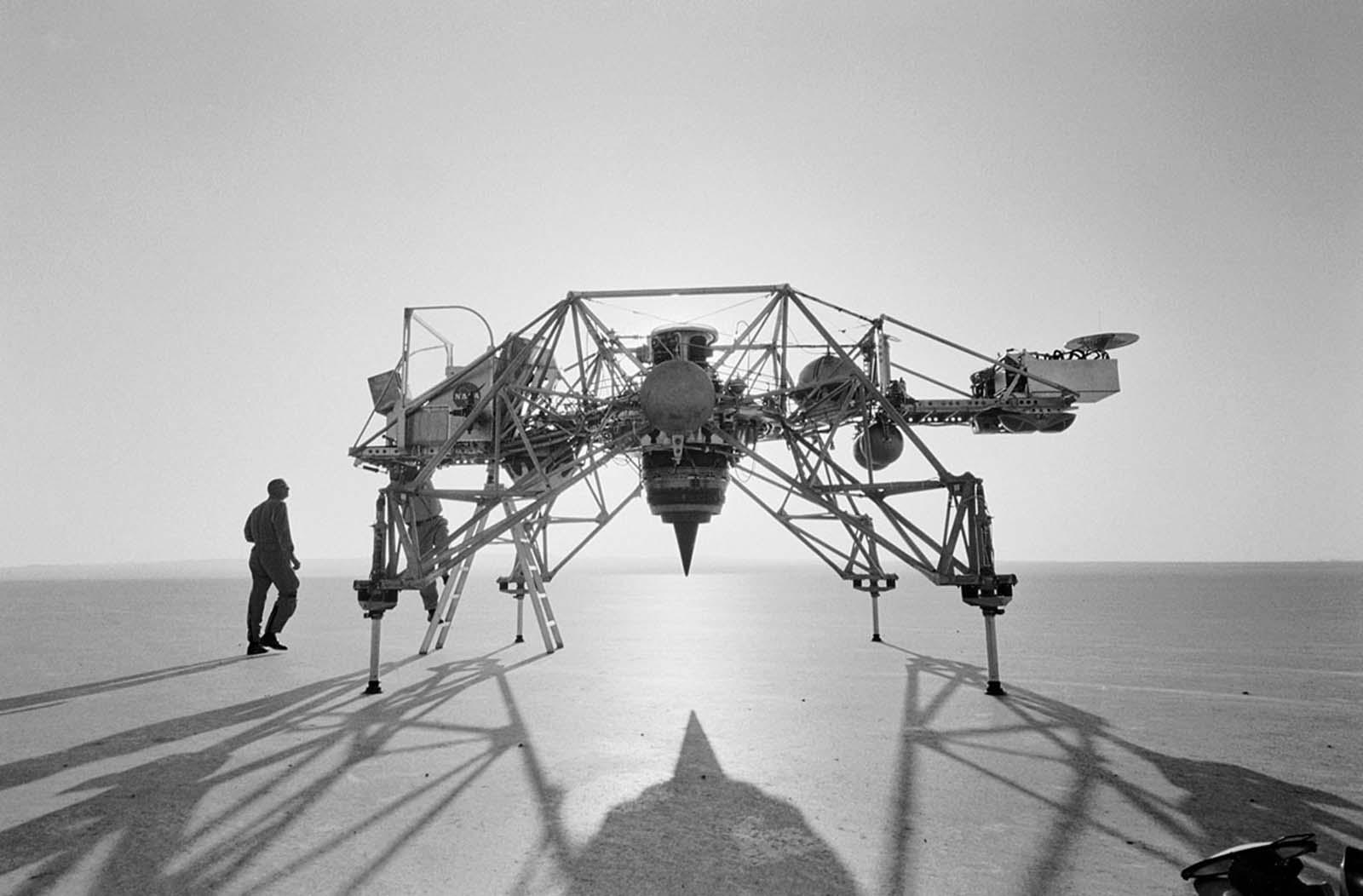
The first Lunar Landing Research Vehicle silhouetted against the rising sun on the dry lakebed at Edwards Air Force Base in California’s Mojave Desert
The first Lunar Landing Research Vehicle silhouetted against the rising sun on the dry lakebed at Edwards Air Force Base in California’s Mojave Desert.

In December 1961, NASA Headquarters in Washington, D.C., received an unsolicited proposal from Bell Aerosystems in Buffalo, New York, for a design of a flying simulator to train astronauts on landing a spacecraft on the Moon. Bell’s approach, using their design merged with concepts developed at NASA’s FRC, won approval and the space agency funded the design and construction of two Lunar Landing Research Vehicles (LLRV). At the time of the proposal, NASA had not yet chosen the method for getting to and landing on the Moon, but once NASA decided on Lunar Orbit Rendezvous in July 1962, the Lunar Module’s (LM) flying characteristics matched Bell’s proposed design closely enough that the LLRV served as an excellent trainer. 
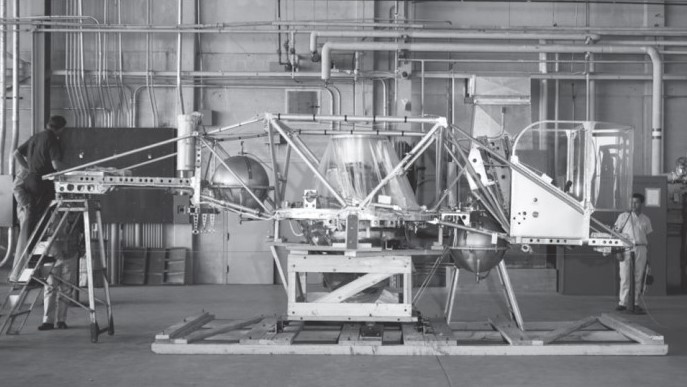
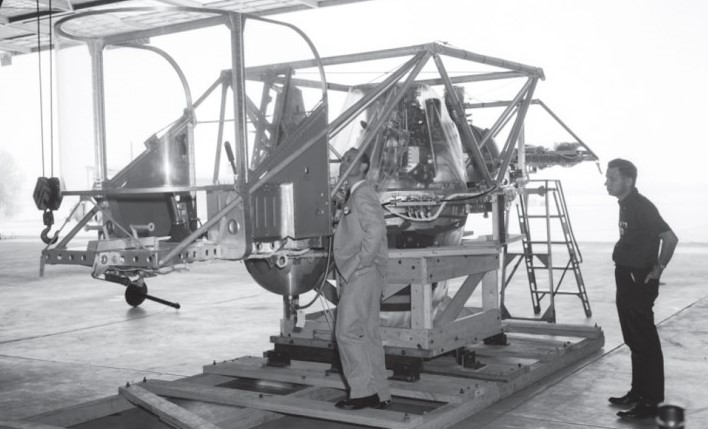
View of the first Lunar Landing Research Vehicle shortly after its arrival and prior to assembly at the Flight Research Center View of the first Lunar Landing Research Vehicle shortly after its arrival and prior to assembly at the Flight Research Center
Two views of the first Lunar Landing Research Vehicle shortly after its arrival and prior to assembly at the Flight Research Center, now NASA’s Armstrong Flight Research Center, in California.

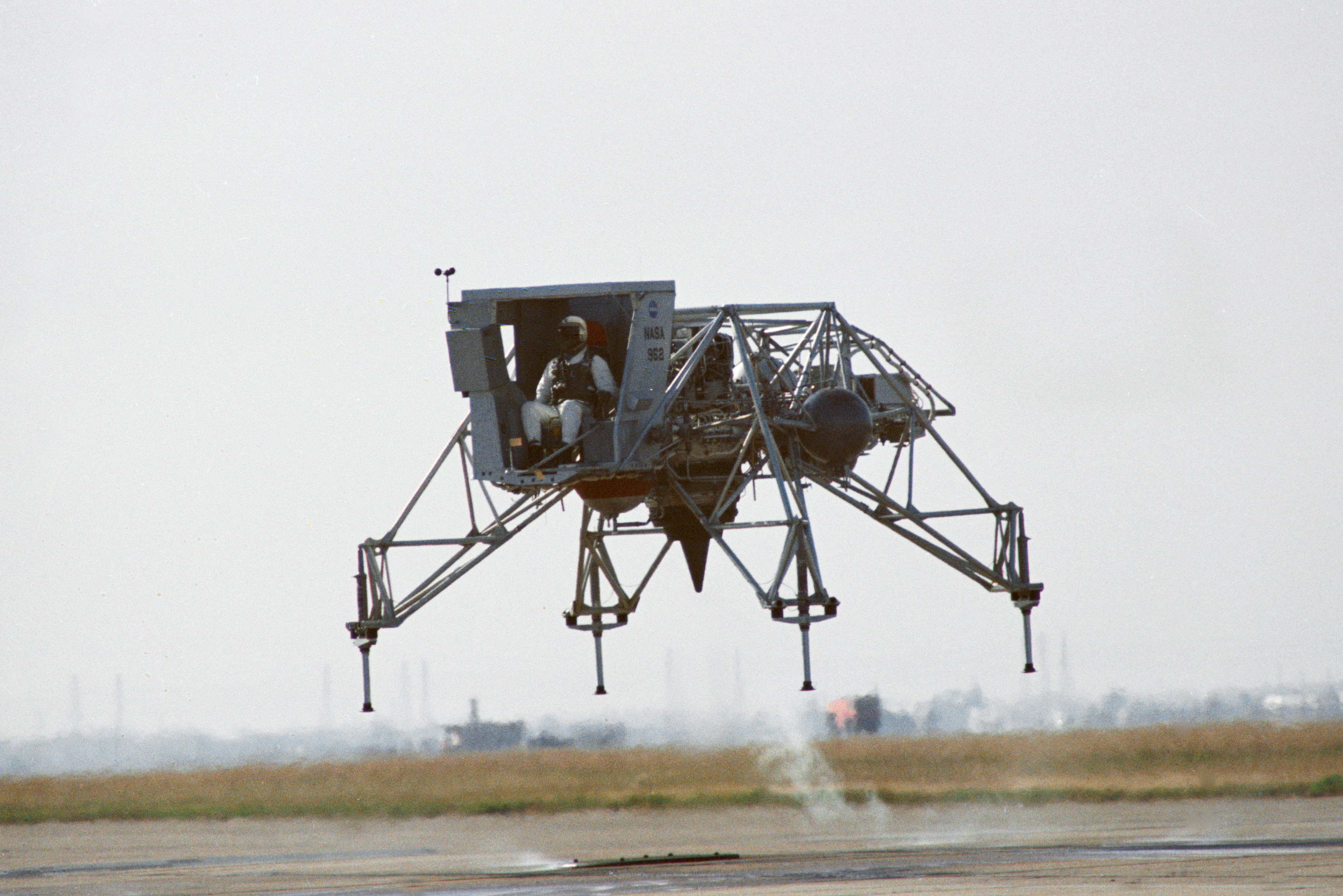
Bell Aerosystems delivered the LLRV-1 to FRC on April 8, 1964, where it made history as the first pure fly-by-wire aircraft to fly in Earth’s atmosphere. Its design relied exclusively on an interface with three analog computers to convert the pilot’s movements to signals transmitted by wire and to execute his commands. The open-framed LLRV used a downward pointing turbofan engine to counteract five-sixths of the vehicle’s weight to simulate lunar gravity, two rockets provided thrust for the descent and horizontal translation, and 16 LM-like thrusters provided three-axis attitude control. The astronauts could thus simulate maneuvering and landing on the lunar surface while still on Earth. The LLRV pilot could use an aircraft-style ejection seat to escape from the vehicle in case of loss of control.
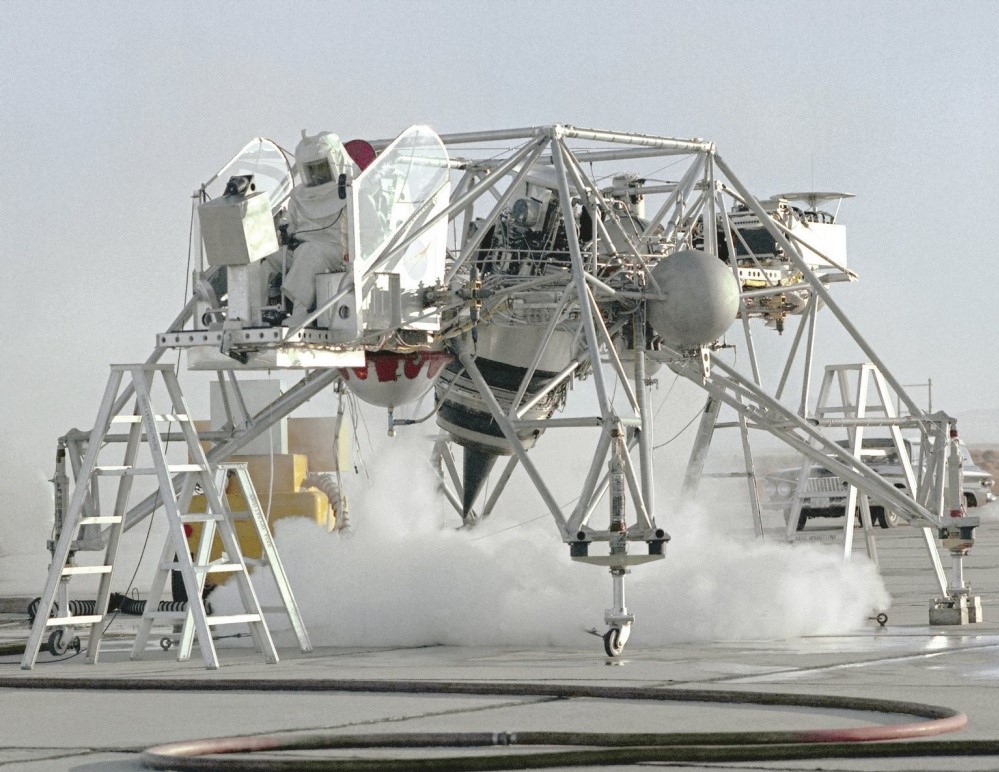
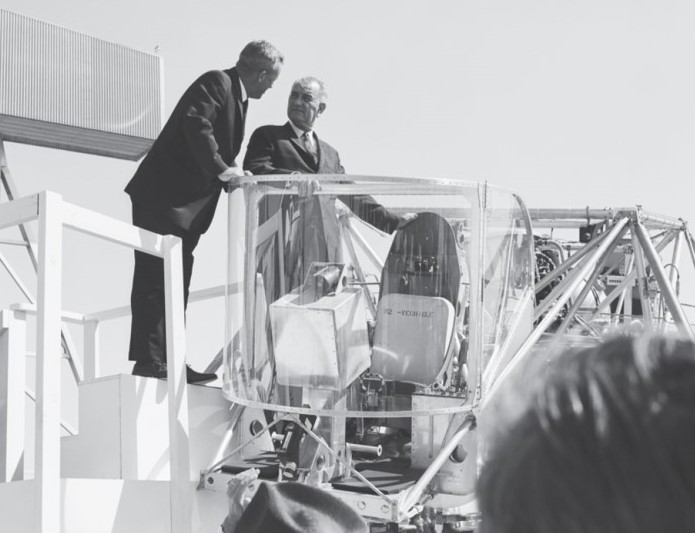
The Lunar Landing Research Vehicle-1 (LLRV-1) during an engine test at NASA’s Flight Research Center (FRC) NASA chief test pilot Joseph “Joe” A. Walker demonstrates the features of LLRV-1 to President Lyndon B. Johnson during his visit to FRC
Left: The Lunar Landing Research Vehicle-1 (LLRV-1) during an engine test at NASA’s Flight Research Center (FRC), now NASA’s Armstrong Fight Research Center, in California’s Mojave Desert. Right: NASA chief test pilot Joseph “Joe” A. Walker, left, demonstrates the features of LLRV-1 to President Lyndon B. Johnson during his visit to FRC.

Engineers conducted numerous tests to prepare the LLRV for its first flight. During one of the engine tests, the thrust generated was higher than anticipated, lifting crew chief Raymond White and the LLRV about a foot off the ground before White could shut off the engines. On June 19, during an official visit to FRC, President Lyndon B. Johnson inspected the LLRV featured on a static display. The Secret Service would not allow the President to sit in the LLRV’s cockpit out of an overabundance of caution since the pyrotechnics were installed, but not yet armed, in the ejection seat. Following a Preflight Readiness Review held Aug. 13 and 14, managers cleared the LLRV for its first flight.
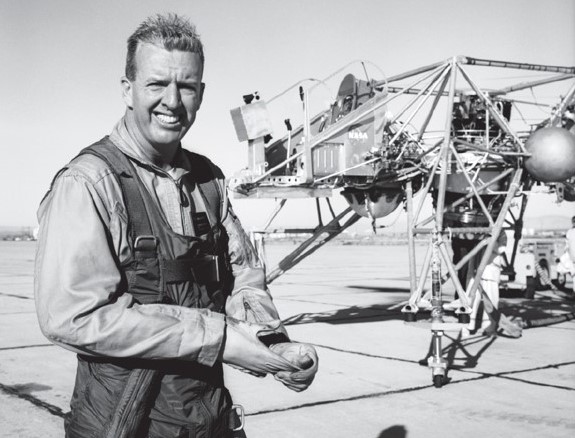
NASA chief test pilot Joseph “Joe” A. Walker during the first flight of the Lunar Landing Research Vehicle (LLRV) Walker shortly after the first LLRV flight
Left: NASA chief test pilot Joseph “Joe” A. Walker during the first flight of the Lunar Landing Research Vehicle (LLRV). Right: Walker shortly after the first LLRV flight.

In the early morning of Oct. 30, 1964, FRC chief pilot Joseph “Joe” A. Walker arrived at Edwards Air Force Base’s (AFB) South Base to attempt the first flight of the LLRV. Walker, a winner of both the Collier Trophy and the Harmon International Trophy, had flown nearly all experimental aircraft at Edwards including 25 flights in the X-15 rocket plane. On two of his X-15 flights, Walker earned astronaut wings by flying higher than 62 miles, the unofficial boundary between the Earth’s atmosphere and space. After strapping into the LLRV’s ejection seat, Walker ran through the preflight checklist before advancing the throttle to begin the first flight. The vehicle rose 10 feet in the air, Walker performed a few small maneuvers and then made a soft landing after having flown for 56 seconds. He lifted off again, performed some more maneuvers, and landed again after another 56 seconds. On his third flight, the vehicle’s electronics shifted into backup mode and he landed the craft after only 29 seconds. Walker seemed satisfied with how the LLRV handled on its first flights.
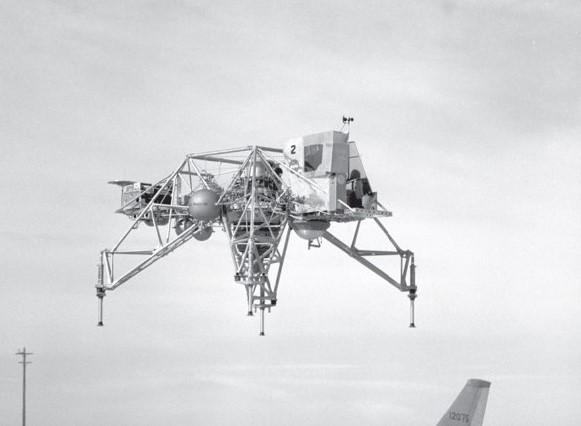
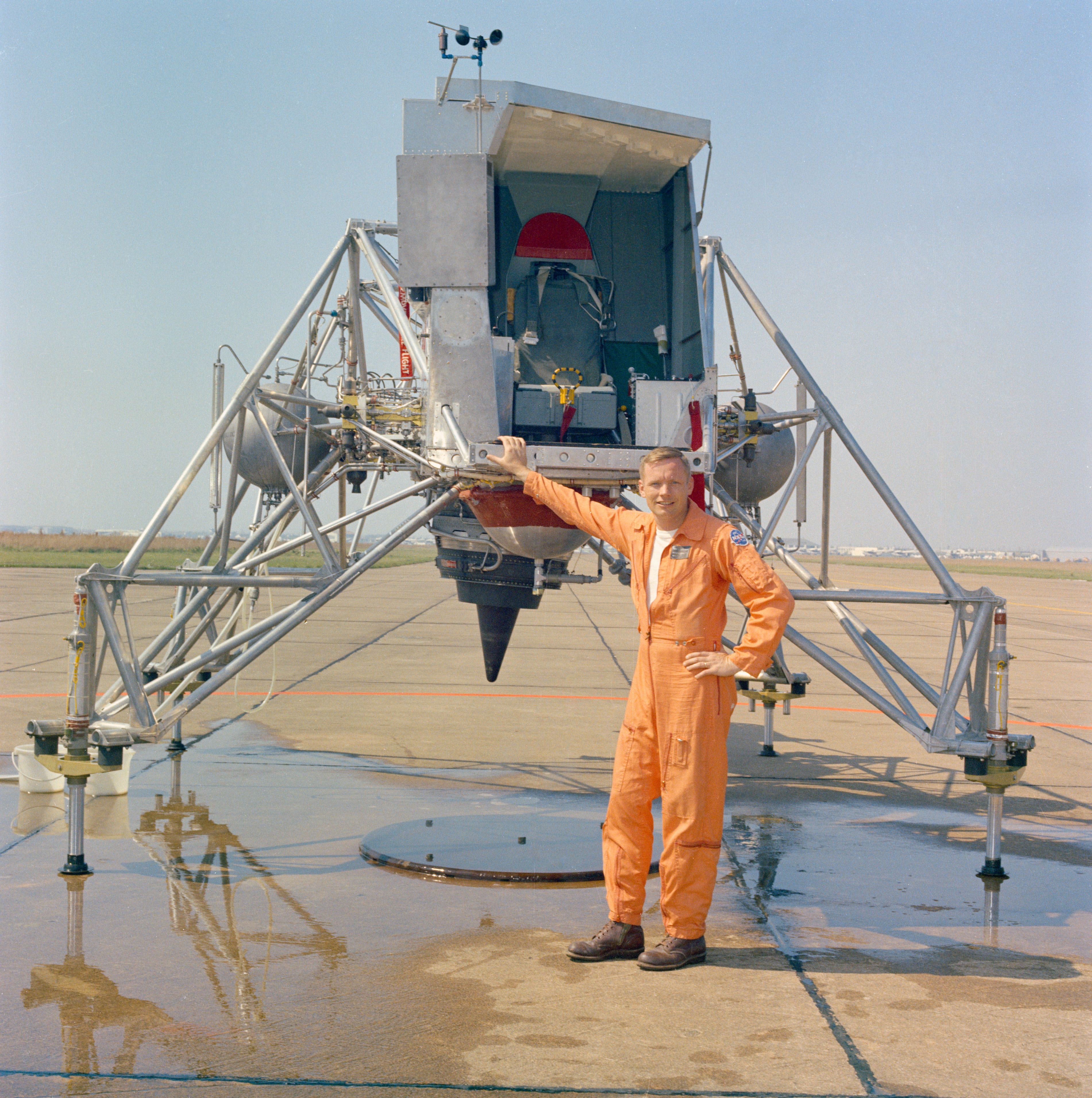
Lunar Landing Research Vehicle-2 (LLRV-2) during one of its six flights at the Flight Research Center NASA astronaut Neil A. Armstrong with LLRV-1 at Ellington Air Force Base in March 1967
Left: Lunar Landing Research Vehicle-2 (LLRV-2) during one of its six flights at the Flight Research Center, now NASA’s Armstrong Flight Research Center, in California in January 1967. Right: NASA astronaut Neil A. Armstrong with LLRV-1 at Ellington Air Force Base in March 1967.

Walker took LLRV-1 aloft again on Nov. 16 and eventually completed 35 test flights with the vehicle. Test pilots Donald “Don” L. Mallick, who completed the first simulated lunar landing profile flight during the LLRV’s 35th flight on Sept. 8, 1965, and Emil E. “Jack” Kluever, who made his first flight on Dec. 13, 1965, joined Walker to test the unique aircraft. Joseph S. “Joe” Algranti and Harold E. “Bud” Ream, pilots at the Manned Spacecraft Center (MSC), now NASA’s Johnson Space Center (JSC) in Houston, travelled to FRC to begin training flights with the LLRV in August 1966. Workers at FRC assembled the second vehicle, LLRV-2, during the latter half of 1966. In December 1966, after 198 flights workers transferred LLRV-1 to Ellington AFB near MSC for the convenience of astronaut training, and LLRV-2 followed in January 1967 after completing six test flights at FRC. The second LLRV made no further flights, partly because the three Lunar Landing Training Vehicles (LLTVs), more advanced models that better simulated the LM’s flying characteristics, began to arrive at Ellington in October 1967. Neil A. Armstrong completed the first astronaut flights aboard LLRV-1 on Mar. 23, 1967, and flew 21 flights before ejecting from the vehicle on May 6, 1968, seconds before it crashed. He later completed his lunar landing certification flights using LLTV-2 in June 1969, one month before peforming the actual feat on the Moon.
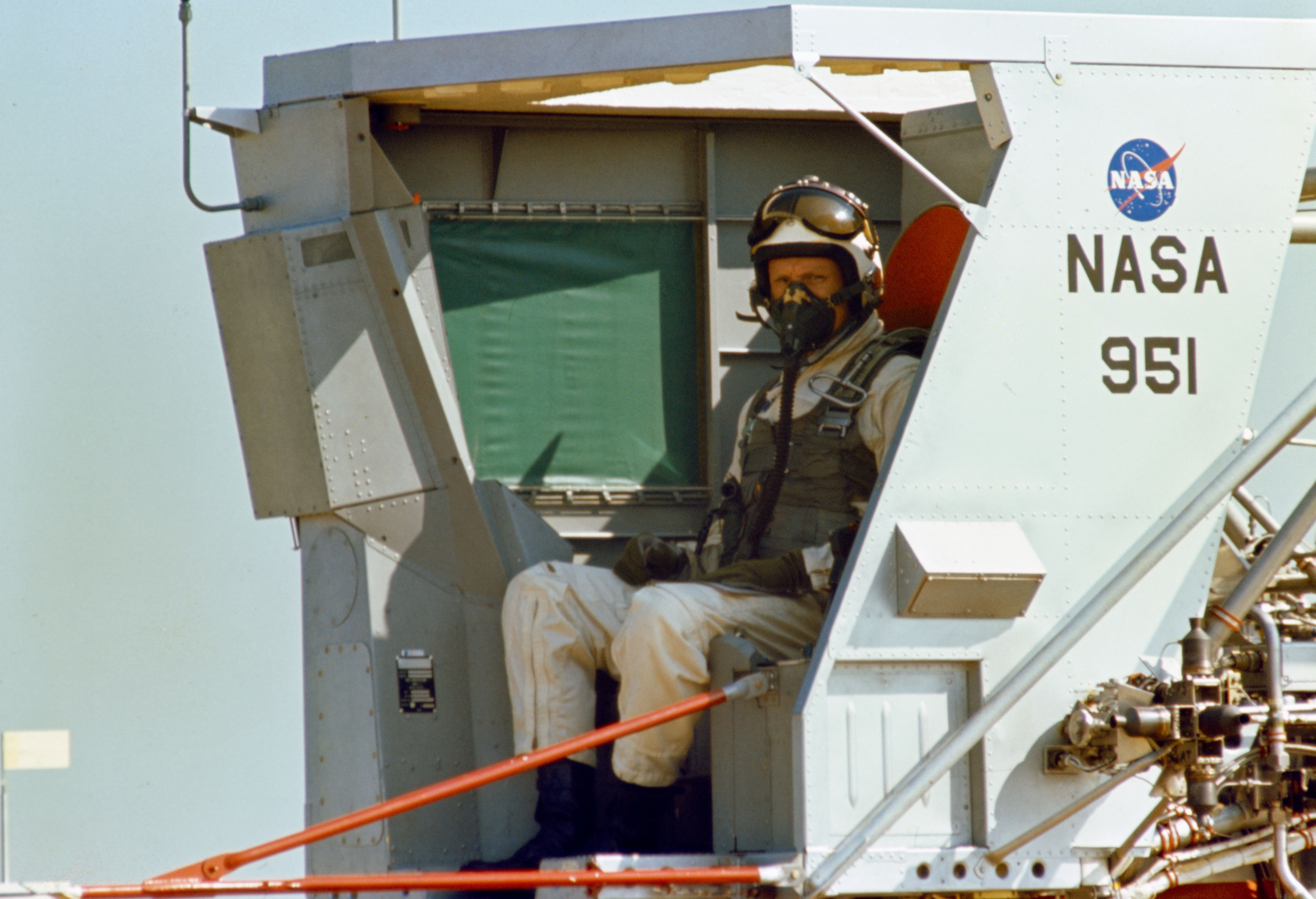
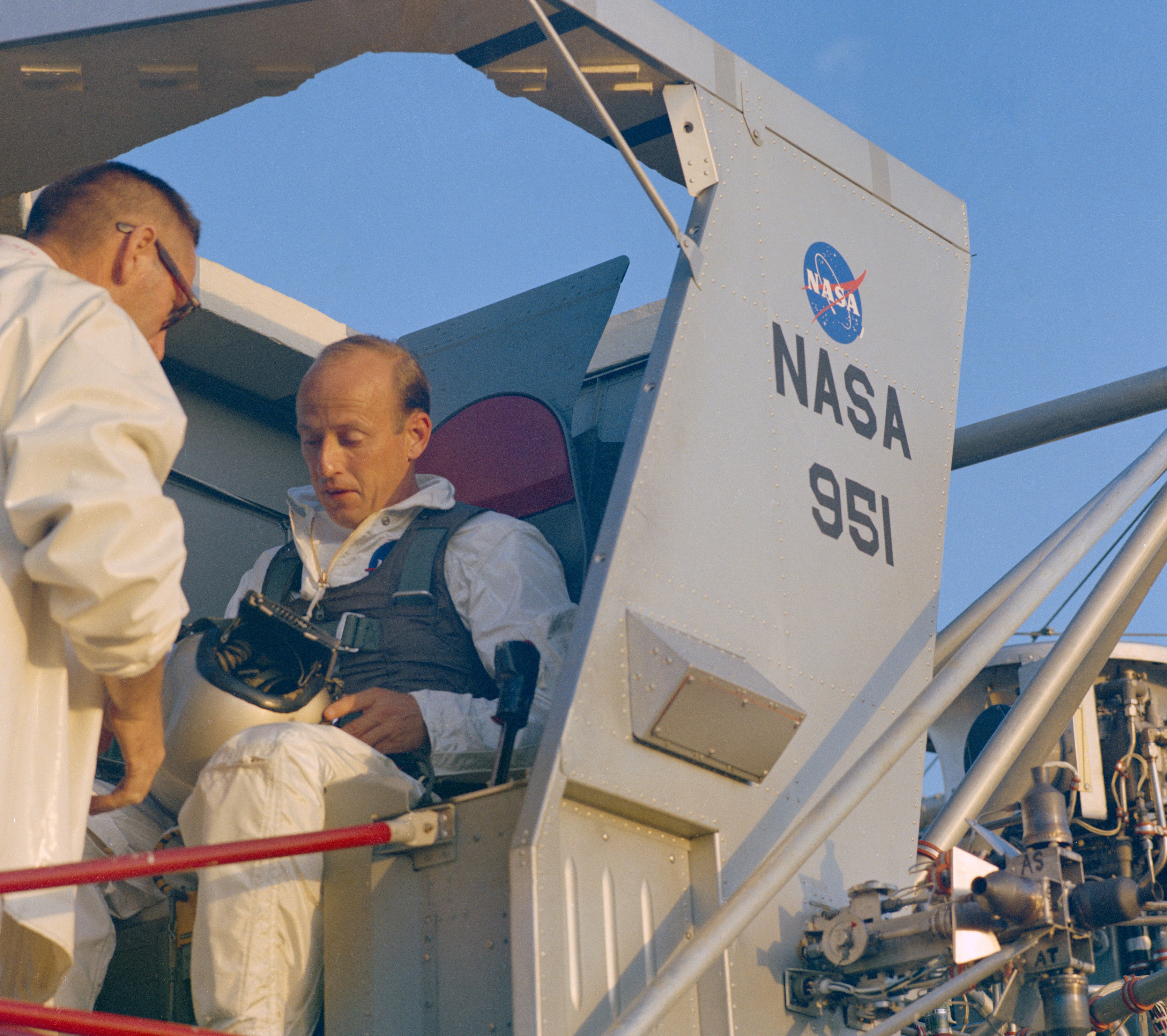
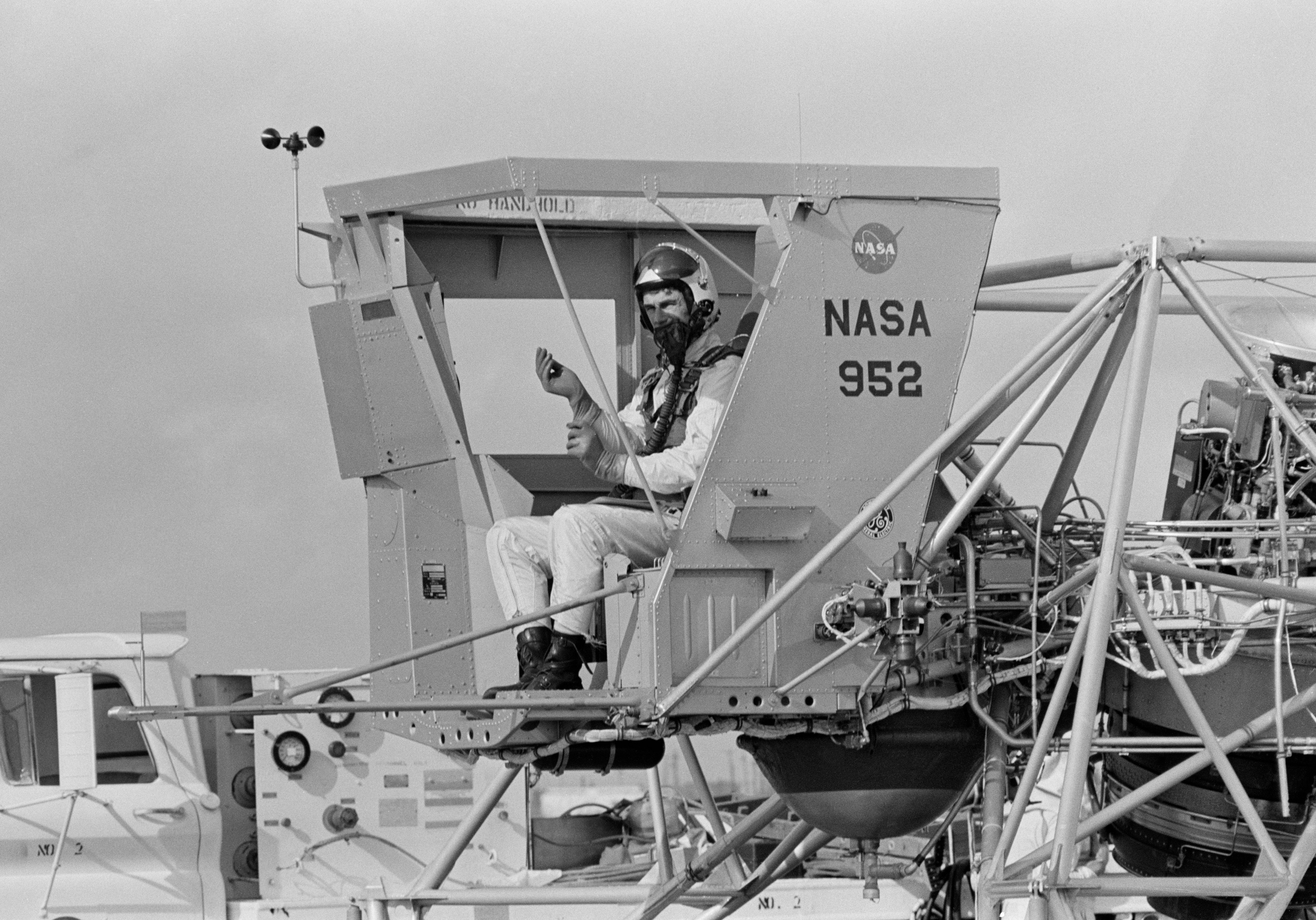
Apollo 11 Commander Neil A. Armstrong prepares to fly a lunar landing profile in LLTV-2 Apollo 12 Commander Charles “Pete” Conrad prepares to fly LLTV-2 Apollo 14 Commander Alan B. Shepard flies LLTV-3
Left: Apollo 11 Commander Neil A. Armstrong prepares to fly a lunar landing profile in Lunar Landing Training Vehicle-2 (LLTV-2) in June 1969. Middle: Apollo 12 Commander Charles “Pete” Conrad prepares to fly LLTV-2 in July 1969. Right: Apollo 14 Commander Alan B. Shepard flies LLTV-3 in December 1970.

All Apollo Moon landing mission commanders and their backups completed their lunar landing certifications using the LLTV, and all the commanders attributed their successful landings to having trained in the LLTV. Apollo 8 astronaut William A. Anders, who along with Armstrong completed some of the early LLRV test flights, called the training vehicle “a much unsung hero of the Apollo program.” During the flight readiness review in January 1970 to clear LLTV-3 for astronaut flights, Apollo 11 Commander Armstrong and Apollo 12 Commander Charles “Pete” Conrad, who had by then each completed manual landings on the Moon, spoke positively of the LLTV’s role in their training. Armstrong’s overall impression of the LLTV: “All the pilots … thought it was an extremely important part of their preparation for the lunar landing attempt,” adding “It was a contrary machine, and a risky machine, but a very useful one.” Conrad emphasized that were he “to go back to the Moon again on another flight, I personally would want to fly the LLTV again as close to flight time as possible.” During the Apollo 12 technical debriefs, Conrad stated the “the LLTV is an excellent training vehicle for the final phases. I think it’s almost essential. I feel it really gave me the confidence that I needed.” During the postflight debriefs, Apollo 14 Commander Alan B. Shepard stated that he “did feel that the LLTV contributed to my overall ability to fly the LM during the landing.”

Apollo 15 Commander David R. Scott flies Lunar Landing Training Vehicle-3 Apollo 16 Commander John W. Young prepares to fly LLTV-3 Apollo 17 Commander Eugene A. Cernan prepares for a flight aboard LLTV-3
Left: Apollo 15 Commander David R. Scott flies Lunar Landing Training Vehicle-3 (LLTV-3) in June 1971. Middle: Apollo 16 Commander John W. Young prepares to fly LLTV-3 in March 1972. Right: Apollo 17 Commander Eugene A. Cernan prepares for a flight aboard LLTV-3 in October 1972.

David R. Scott, Apollo 15 commander, stated in the final mission report that “the combination of visual simulations and LLTV flying provided excellent training for the actual lunar landing. Comfort and confidence existed throughout this phase.” In the Apollo 15 postflight debrief, Scott stated that he “felt very comfortable flying the vehicle (LM) manually, because of the training in the LLTV, and there was no question in my mind that I could put it down where I wanted to. I guess I can’t say enough about that training. I think the LLTV is an excellent simulation of the vehicle.” Apollo 16 Commander John W. Young offered perhaps the greatest praise for the vehicle just moments after landing on the lunar surface: “Just like flying the LLTV. Piece of cake.” Young reiterated during the postflight debriefs that “from 200 feet on down, I never looked in the cockpit. It was just like flying the LLTV.” Apollo 17 Commander Eugene A. Cernan stated in the postflight debrief that “the most significant part of the final phases from 500 feet down, … was that it was extremely comfortable flying the bird. I contribute (sic) that primarily to the LLTV flying operations.”
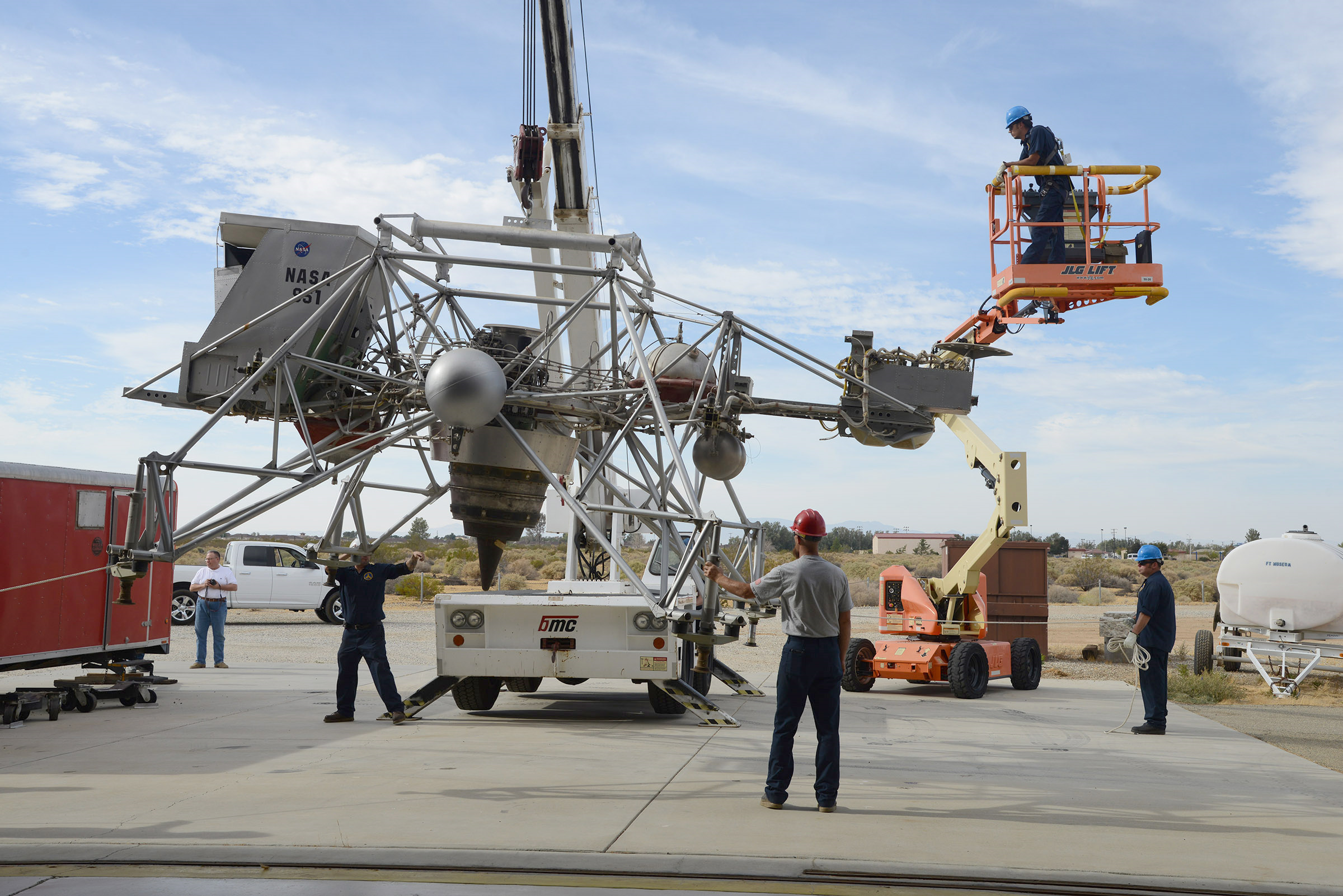
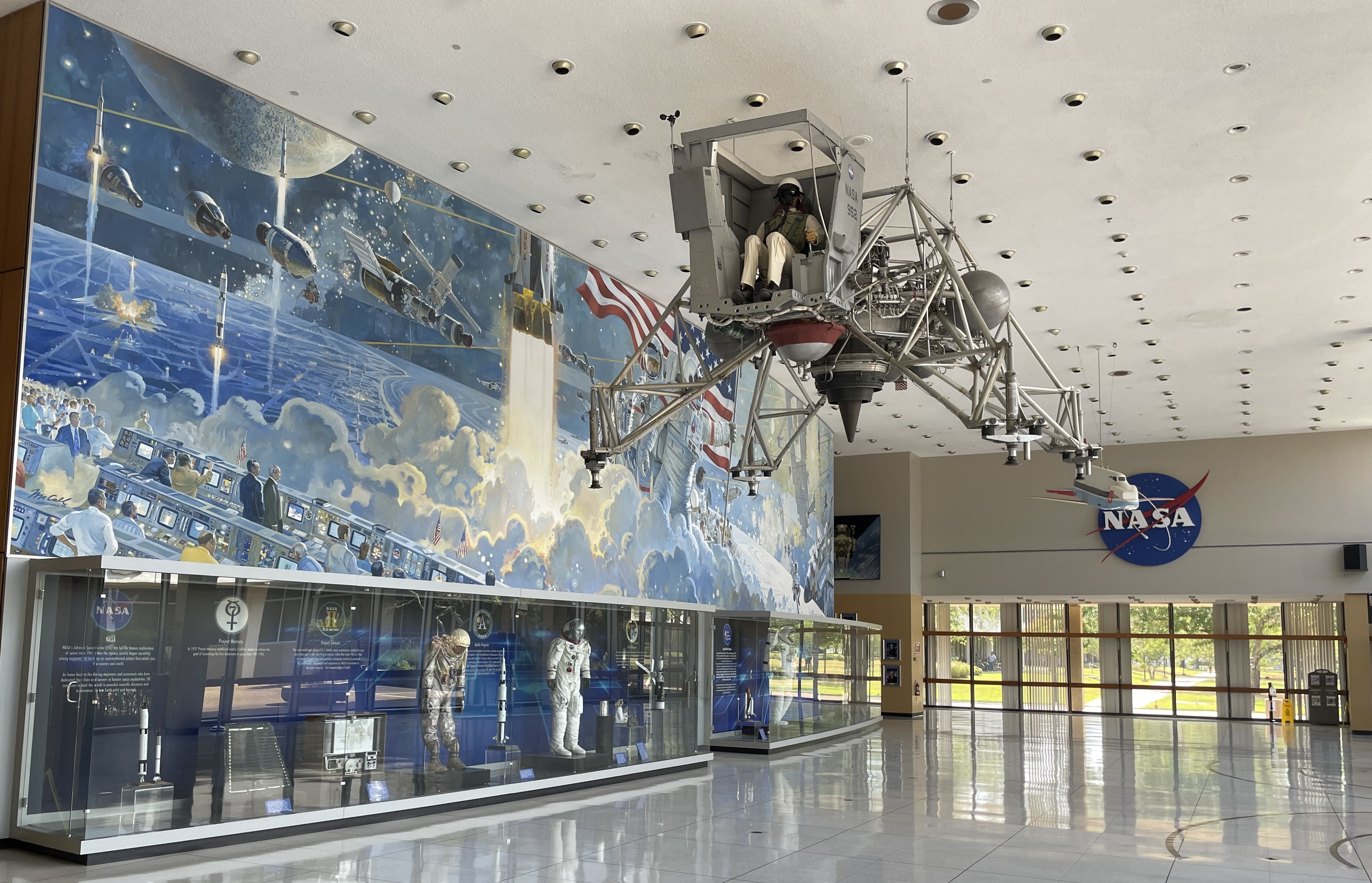
Workers move Lunar Landing Research Vehicle-2 from NASA’s Armstrong Flight Research Center for display at the Air Force Test Flight Museum Lunar Landing Training Vehicle-3 on display outside the Teague Auditorium at NASA’s Johnson Space Center in Houston
Left: Workers move Lunar Landing Research Vehicle-2 from NASA’s Armstrong Flight Research Center for display at the Air Force Test Flight Museum at Edwards Air Force Base. Right: Lunar Landing Training Vehicle-3 on display outside the Teague Auditorium at NASA’s Johnson Space Center in Houston.

In addition to playing a critical role in the Moon landing program, these early research and test vehicles aided in the development of digital fly-by-wire technology for future aircraft. LLRV-2 is on display at the Air Force Flight Test Museum at Edwards AFB (on loan from AFRC). Visitors can view LLTV-3 suspended from the ceiling in the lobby of the Teague Auditorium at JSC.

The monograph Unconventional, Contrary, and Ugly: The Lunar Landing Research Vehicle provides an excellent and detailed history of the LLRV.

Powered by WPeMatico

Get The Details…
Kelli Mars

NASA Technologies Named Among TIME Inventions of 2024

NASA Technologies Named Among TIME Inventions of 2024

As NASA continues to innovate for the benefit of humanity, agency inventions that use new structures to harness sunlight for space travel, enable communications with spacecraft at record-breaking distances, and determine the habitability of a moon of Jupiter, were named Wednesday among TIME’s Inventions of 2024.

“The NASA workforce — wizards, as I call them — have been at the forefront of invention and technology for more than 65 years,” said NASA Administrator Bill Nelson. “From developing Europa Clipper, the largest satellite for a planetary mission that NASA has ever launched, to the Advanced Composite Solar Sail System, and communicating with lasers from deep space, NASA is improving our understanding of life on Earth — and the cosmos — for the benefit of all.”

Solar Sailing with Composite Booms

Mario Perez, back, holds a deployable solar panel as Craig Turczynski, left, secures it to the Advanced Composite Solar Sail System (ACS3) spacecraft in the Integration Facility of NASA Ames Research Center.
Credit: NASA/Don Richey

NASA’s Advanced Composite Solar Sail System is testing technologies that could allow spacecraft to “sail on sunlight,” using the Sun’s rays for propulsion. Like a sailboat turning to catch the wind, a solar sail adjusts its trajectory by angling its sail supported by booms deployed from the spacecraft. This demonstration uses a composite boom technology that is stiffer, lighter, and more stable in challenging thermal environments than previous designs. After launching on April 23, aboard Rocket Lab’s Electron rocket, the mission team met its primary objective by deploying the boom and sail system in space in August. Next, they will work to prove performance by using the sail to maneuver in orbit.  

Results from this mission could provide an alternative to chemical and electric propulsion systems and inform the design of future larger-scale missions that require unique vantage points, such as space weather early warning satellites.

Communicating with Lasers from Deep Space

The Deep Space Optical Communications (DSOC) technology demonstration's flight laser transceiver is seen attached to NASA's Psyche spacecraft inside a clean room at the agency's Jet Propulsion Laboratory in Southern California. DSOC's tube-like gray/silver sunshade can be seen protruding from the side of the spacecraft. The bulge to which the sunshade is attached is DSOC's transceiver, which consists of a near-infrared laser transmitter to send high-rate data to Earth and a sensitive photon-counting camera to receive ground-transmitted low-rate data.
The Deep Space Optical Communications (DSOC) technology demonstration’s flight laser transceiver is seen attached to NASA’s Psyche spacecraft inside a clean room at the agency’s Jet Propulsion Laboratory in Southern California. DSOC’s tube-like gray/silver sunshade can be seen protruding from the side of the spacecraft. The bulge to which the sunshade is attached is DSOC’s transceiver, which consists of a near-infrared laser transmitter to send high-rate data to Earth and a sensitive photon-counting camera to receive ground-transmitted low-rate data.
Credits: NASA/JPL-Caltech

Since launching aboard NASA’s Psyche spacecraft on Oct. 13, 2023, a Deep Space Optical Communications technology demonstration has delivered record-breaking downlink data rates to ground stations as the Psyche spacecraft travels through deep space. To demonstrate the high data rates that are possible with laser communications, photos, telemetry data from the spacecraft, and ultra-high-definition video, including a streamed video of Taters the cat chasing a laser pointer, have been downlinked over hundreds of millions of miles. The mission, which is managed by NASA’s Jet Propulsion Laboratory in Southern California, has also sent and received optical communications out to Mars’ farthest distance from Earth, fulfilling one of the project’s primary goals.

Searching for Life’s Ingredients at Jupiter’s Icy Moon Europa

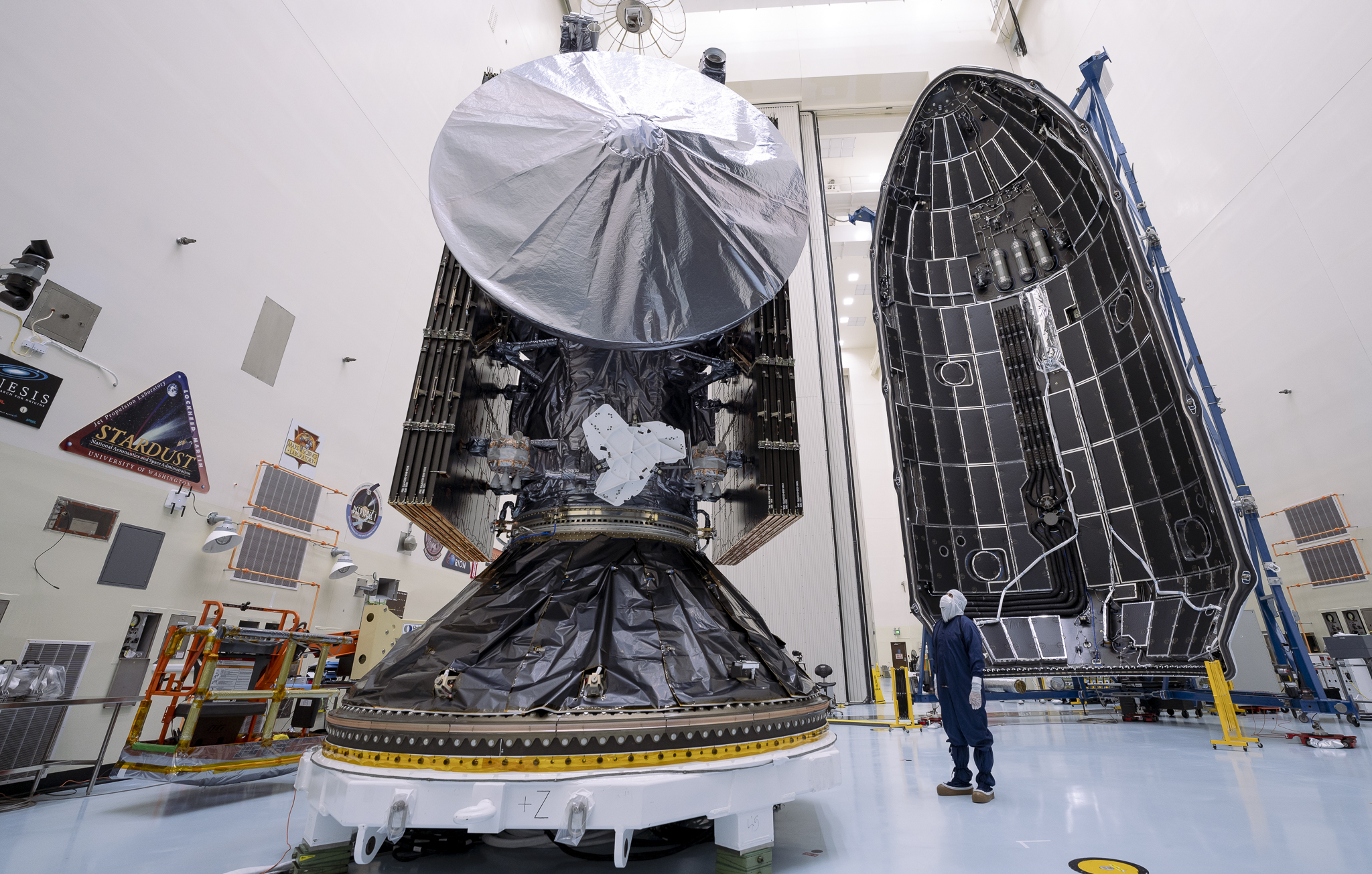
Technicians prepare to encapsulate NASA’s Europa Clipper spacecraft inside SpaceX’s Falcon Heavy payload fairing in the Payload Hazardous Servicing Facility at NASA’s Kennedy Space Center in Florida on Oct. 2, 2024.
Credit: SpaceX

The largest NASA spacecraft ever built for a mission headed to another planet, Europa Clipper also is the agency’s first mission dedicated to studying an ocean world beyond Earth. Using a suite of nine science instruments and a gravity experiment, the mission seeks to determine whether Jupiter’s moon, Europa, has conditions that could support life. There’s strong evidence that under Europa’s ice lies an enormous, salty ocean. Scientists also have found evidence that Europa may host organic compounds and energy sources under its surface. Managed by NASA’s Jet Propulsion Laboratory, the spacecraft launched on Oct. 14, and will begin orbiting Jupiter in 2030, flying by the icy moon 49 times to learn more about it.

Europa Clipper’s main science objectives are to determine the thickness of the moon’s icy shell and its interactions with the ocean below, to investigate its composition, and to characterize its geology. The detailed exploration will help scientists better understand the astrobiological potential for habitable worlds beyond our planet.

NASA’s Ames Research Center in California’s Silicon Valley manages the Advanced Composite Solar Sail System, and NASA’s Langley Research Center in Hampton, Virginia, designed and built the deployable composite booms and solar sail system. Within NASA’s Space Technology Mission Directorate (STMD), the Small Spacecraft Technology program funds and manages the mission and the Game Changing Development program developed the deployable composite boom technology.

The Deep Space Optical Communications experiment is funded by STMD’s Technology Demonstration Missions Program managed at NASA’s Marshall Space Flight Center in Huntsville, Alabama, and the agency’s Space Communications and Navigation program within the Space Operations Mission Directorate. Some of the technology was developed through NASA’s Small Business Innovation Research program.

Managed by Caltech in Pasadena, California, NASA’s Jet Propulsion Laboratory leads the development of the Europa Clipper mission in partnership with Johns Hopkins Applied Physics Laboratory in Laurel, Maryland for NASA’s Science Mission Directorate. The Applied Physics Laboratory designed the main spacecraft body in collaboration with the Jet Propulsion Laboratory as well as NASA’s Goddard Space Flight Center in Greenbelt, Maryland, NASA Marshall, and NASA Langley.

For more information about the agency’s missions, visit:

https://www.nasa.gov

Powered by WPeMatico

Get The Details…
Tiernan P. Doyle

A Spooky Soliday: Haunting Whispers from the Martian Landscape

A Spooky Soliday: Haunting Whispers from the Martian Landscape

2 min read

A Spooky Soliday: Haunting Whispers from the Martian Landscape

Image taken by Perseverance of rocky slopes of the Jezero crater rim.
NASA’s Mars Perseverance rover acquired this image, which was selected by the public as the rover’s “Image of the Week,” of the martian landscape on the Jezero crater rim using its Left Mastcam-Z camera. The image was acquired on Oct. 22, 2024 (Sol 1306) at the local mean solar time of 13:45:41.
NASA/JPL-Caltech/ASU

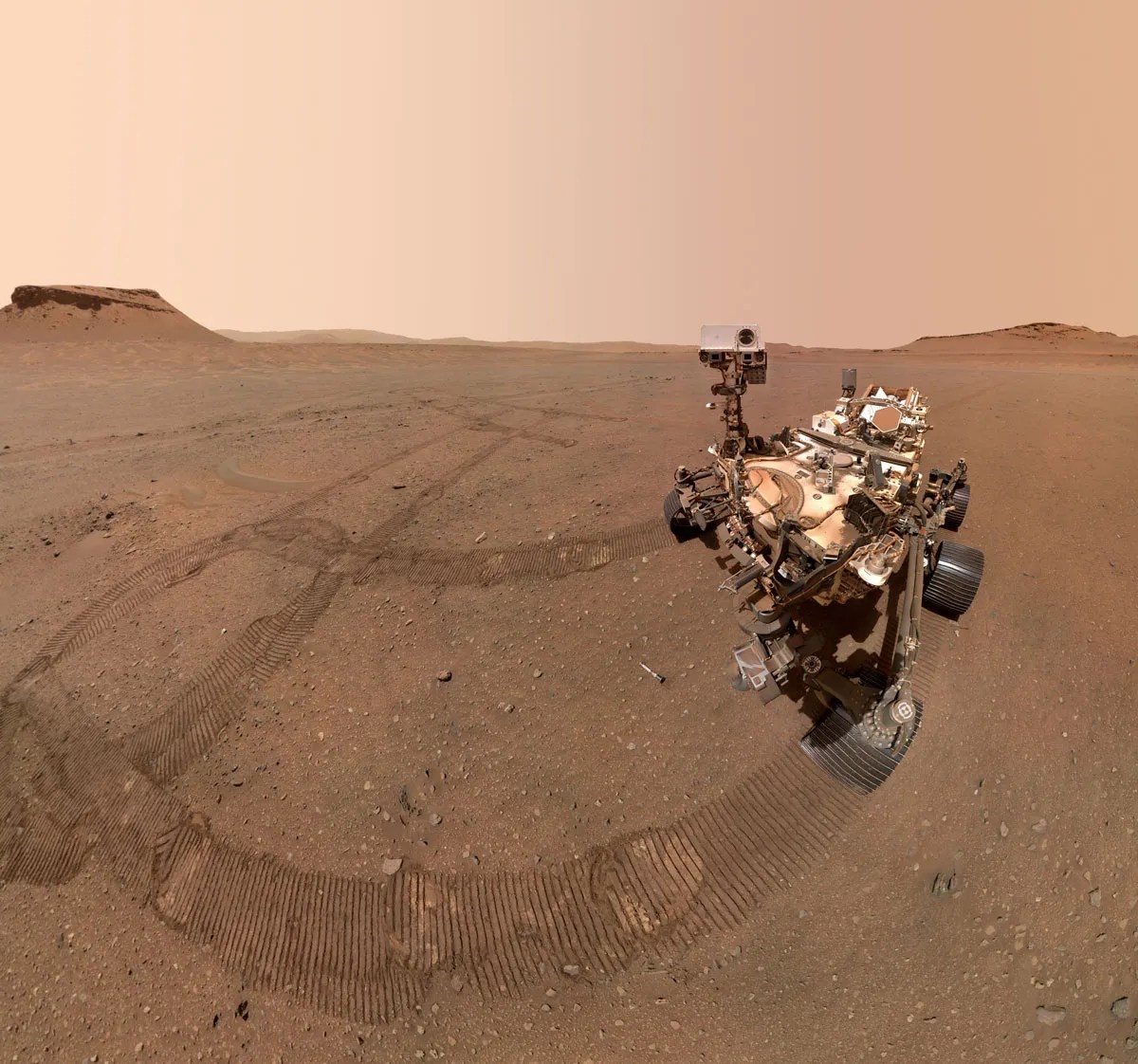
The Perseverance rover lurks in the quiet, cold, desolate landscape of Jezero crater on Mars, a place masked in shadows and haunted by past mysteries. Built to endure the planet’s harsh conditions, Perseverance braves the thin atmosphere and extreme temperature swings. Its microphone captures the eerie whispers of martian winds, sending shivers down your spine, and records ghostly dust devils swirling across the barren terrain. Has the microphone caught the sound of a skeleton rattling its bones? We’ll leave that up to your imagination.

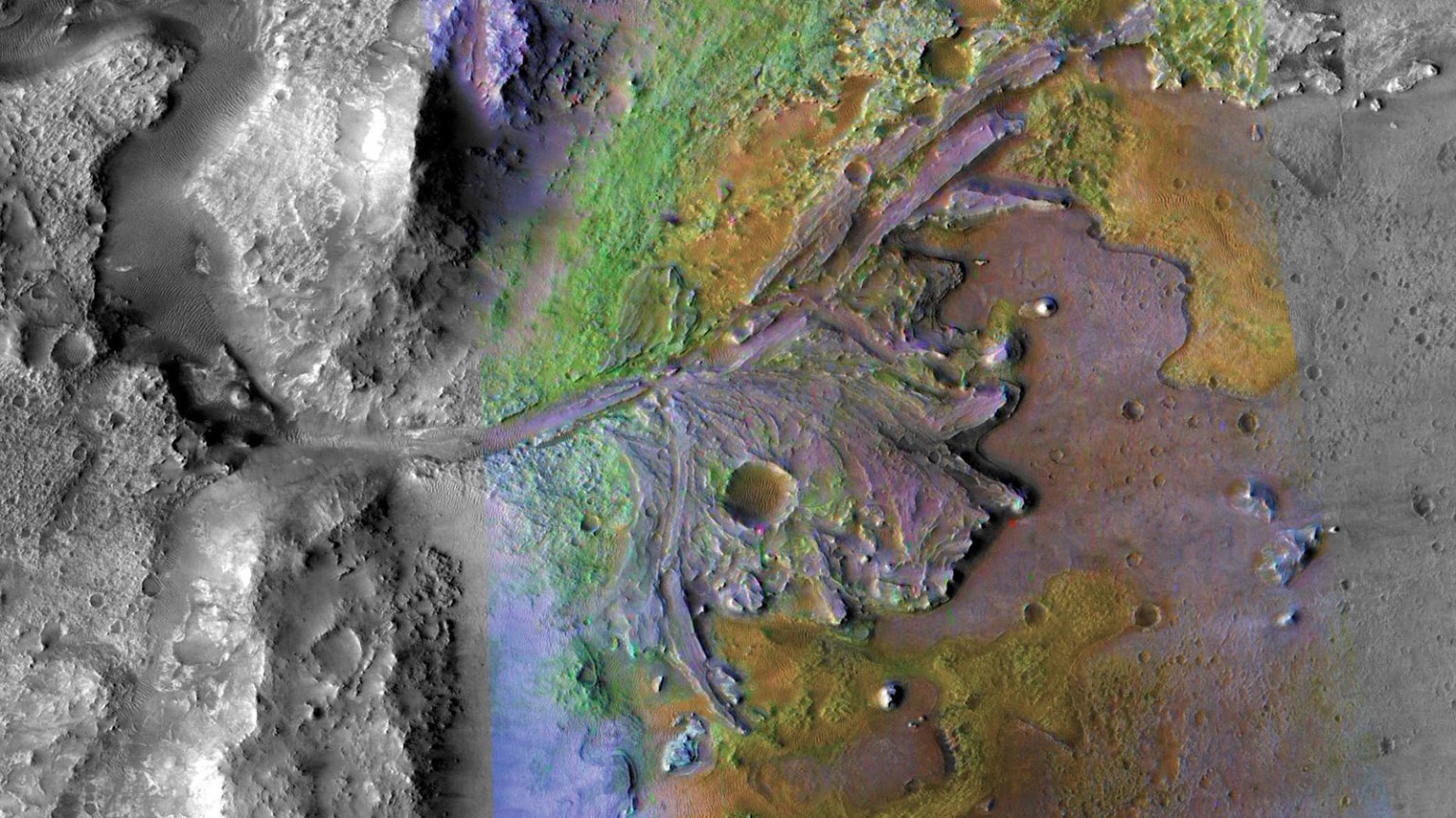
Recently, Perseverance navigated the sinister slopes of the Jezero crater rim, seeking out a series of ramshackle ridges to uncover the rim’s hidden geological secrets. The rover emerged from the shadows to descend into a field of light-toned rocks, illuminating the landscape reminiscent of bones and tombstones. Along the way, the rover encountered dark bedrock at Mist Park. Perseverance will then face another daunting climb back up the crater rim, venturing deeper into the great unknown.

Unlike vampires or other creatures of the night, Perseverance needs rest after long days of exploring the mystifying martian landscape. As night falls, the rover sleeps after watching the Sun sink below the horizon, casting ominous shadows across the landscape. The chilling winds howl through the night like a haunting lullaby for the fearless explorer. However, Perseverance sometimes wakes up from things that go bump in the night. While instruments mostly conduct their scientific measurements during the day, they are not afraid of the dark, often tasked with observing what lurks in the shadows and gazing at the martian night sky. Perseverance occasionally looks up to image the auroras and to get a glimpse of Phobos and Deimos, Mars’ two Moons.

Mars is like a hotel you can check in and out of, but you can never leave. It has become a graveyard of long-dead landers and rovers, but Perseverance is nowhere near ready to leave the land of the living. In fact, the ghosts of past rovers and landers guide Perseverance on its journey. As we continue to uncover the secrets of Mars, we are reminded of its past and the mysteries that still linger. Join us in pondering the mysteries of Mars as we explore its haunted history.   

Written by Stephanie Connell, Ph.D. Student Collaborator at Purdue University

Share

Details

Last Updated
Oct 30, 2024

Related Terms

Powered by WPeMatico

Get The Details…