Curiosity Blog, Sols 4852–4858: When Data Take Their Time…

Curiosity Blog, Sols 4852–4858: When Data Take Their Time…

4 min read

Curiosity Blog, Sols 4852–4858: When Data Take Their Time…

A grayscale photo from the Martian surface shows a barren, rocky landscape featuring a jagged, heavily striated rock formation resting on a flat, cracked surface beside a larger rocky ledge.
NASA’s Mars rover Curiosity acquired this image using its Mast Camera (Mastcam), showing polygons and other interesting textures that characterize the terrain beyond the boxwork area. Curiosity captured the image on April 3, 2026 — Sol 4855, or Martian day 4,85 of the Mars Science Laboratory mission — at 12:26:28 UTC.
NASA/JPL-Caltech/MSSS

Written by Susanne P. Schwenzer, Professor of Planetary Mineralogy at The Open University, UK

Earth planning date: Friday, April 3, 2026

I was the geology science team lead on Monday for planning Sols 4852-4853, when our data did not arrive on time for planning. Thus, we got creative as a team thinking what we could do, not knowing where exactly our rover might be. And for that we first thought about AEGIS, the capability of the rover to find a target for ChemCam LIBS measurements on its own. 

We normally use this capability after drives, before we have seen the data here on Earth, to get an extra LIBS measurement. This time, we put two of those observations into the plan, and added many atmospheric and environmental observations, such as dust-devil movies, too. It’s an interesting planning session that always makes the team talk more than normal, because there are no routines for those days! I find it both tense and rewarding at the same time. Anything that isn’t quite as expected adds levels of complexity that require more focus and more thinking, hence making me tense. But it is also really nice when we’ve succeeded in making the best of those days. My colleagues also seem to have lots of energy and are especially supportive of each other. That said, like everyone else I prefer the routine days where everything goes right and we focus on the science.

All our data arrived perfectly fine in time for planning on Wednesday and we found ourselves in a terrain with many blocks that have polygons on their top surface. Do check out the images, it’s a wild terrain that reminded me of some boulder-rich terrains we have seen back on the margins of the Gediz Vallis Channel. It is interesting to see the distribution of the blocks, and I am curious how they might change along the traverse up Mount Sharp. For now, we have an activity that we call “MARDI sidewalk” in the plan. This means the MARDI camera takes images while the rover is driving, on Sol 4855. Those image sequences give great insights into changing terrains, and we are looking forward to the data reaching us!

Over the course of the week, ChemCam did three AEGIS observations and four human-pointed observations on the targets “Las Petas,” “Punta Negra,” “Pampa del Molle,” and “Los Condores.” We were trying to measure the normal-looking bedrock and all the different features, some of which you can see in the image above. We want to find out what the higher-standing materials are that form those prominent polygons. APXS is getting four targets in the plan, also looking at the diversity of rocks. These are called “Rio Espiritu Santo,” “La Escalera,” “Los Condores,” and “Tropico de Capricornio.” It’s all focused on understanding what forms the polygons, because any differences in chemistry could tell us a lot about what happened and how the polygons came to be. By extension, this will then allow the team to deduce the environmental conditions at the time the polygons formed.

As you may guess, imaging is very important in a landscape as varied as this! Mastcam is looking in many directions in the near-field and further up the road — our projected drive path. In addition, ChemCam is taking long-distance images with its Remote Micro Imager (RMI) to get a closer look at the walls around us. The butte called “Mishe Mokwa” is still one of the RMI and Mastcam favorites because it gives us many insights into its structure as we are driving past and also somewhat around it.

Atmospheric and environmental observations occur all across the plans and include atmospheric opacity measurements, dust-devil searches and, in Friday’s plan, also an APXS atmospheric measurement. The DAN instrument is monitoring water in the subsurface across all plans. So, it’s three full plans, despite the little extra wait on the data!

And while I am writing this, four astronauts in the Orion capsule are on the way around the Moon. I am very excited! When Apollo 8 was the very first mission to ever fly around the Moon in December 1968, I wasn’t born yet. In fact, I arrived a few months after Apollo 11 had landed on the Moon for the first time. Now being able to witness these lunar missions myself, to hear the voices between the Integrity spacecraft and the control room in Houston, and to see the pictures as they arrive … magnificent! Go, Artemis II!

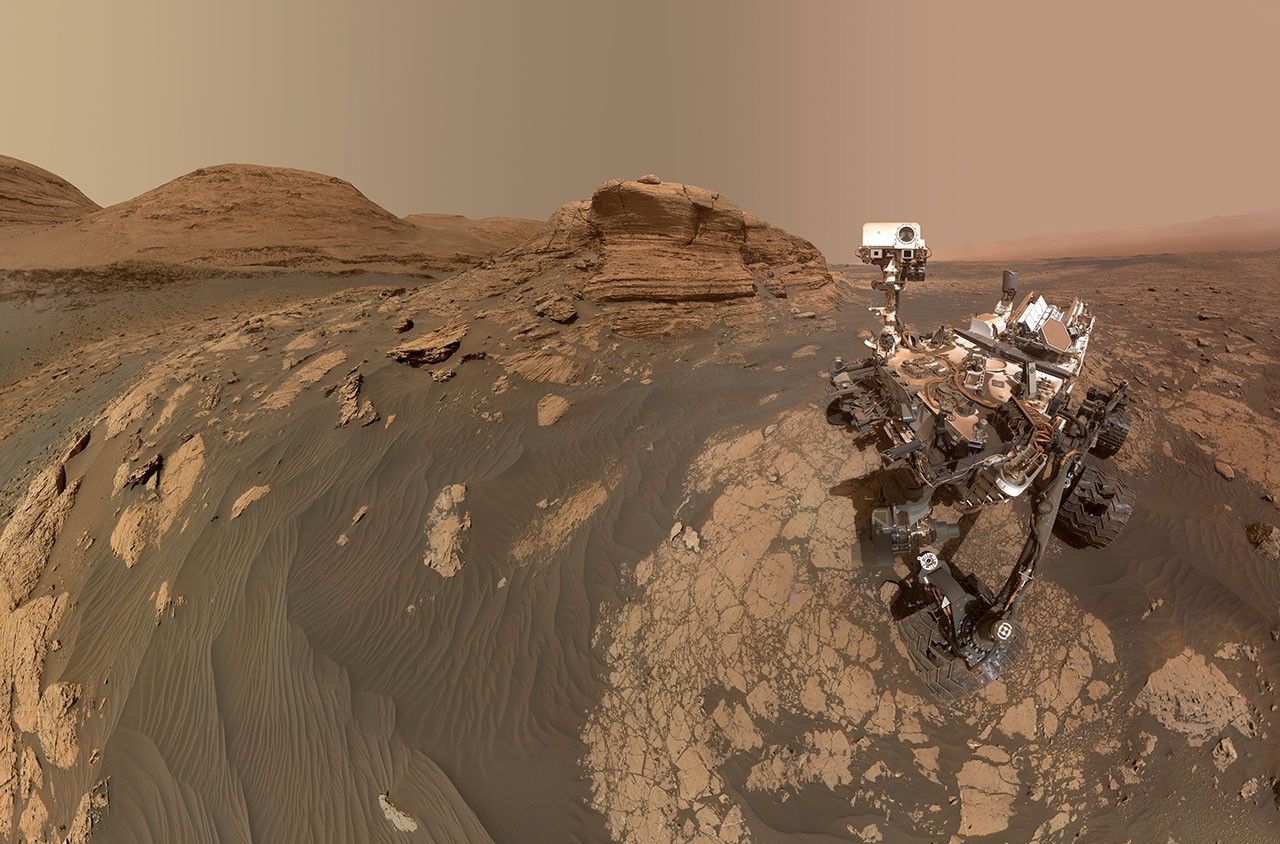
A rover sits on the hilly, orange Martian surface beneath a flat grey sky, surrounded by chunks of rock.
NASA’s Curiosity rover at the base of Mount Sharp
NASA/JPL-Caltech/MSSS

Share

Details

Last Updated
Apr 13, 2026

Related Terms

Powered by WPeMatico

Get The Details…

Curiosity Blog, Sols 4845-4851: Bye-Bye Boxwork, Bye-Bye

Curiosity Blog, Sols 4845-4851: Bye-Bye Boxwork, Bye-Bye

3 min read

Curiosity Blog, Sols 4845-4851: Bye-Bye Boxwork, Bye-Bye

A grayscale photo from the Martian surface shows very rocky terrain in front of the rover. What looks like sandy, wind-scalloped sand in medium to dark gray is covered everywhere in a variety of jagged rocks of many shapes and sizes, some flat on the ground and others sticking out above it, but all sharing markings that make them look like they’re covered in fish scales. A small portion of the rover is visible at the bottom of the frame.
NASA’s Mars rover Curiosity acquired this image, showing the polygonal sulfate unit currently being investigated by the rover after leaving the boxwork terrain. Curiosity captured the image using its Left Navigation Camera on March 27, 2026 — Sol 4848, or Martian day 4,848 of the Mars Science Laboratory mission — at 10:43:16 UTC.
NASA/JPL-Caltech

Written by Lucy Thompson, APXS Strategic Planner and Planetary Geologist at the University of New Brunswick, Canada

Earth planning date: Friday, March 27, 2026

Last weekend’s drive took us just over the southernmost contact of the boxwork terrain with the surrounding layered sulfate unit. This was our third time crossing this contact, providing an excellent opportunity to look for any changes across it. We have acquired multiple observations (chemistry and imaging for textures) of the boxwork-bearing bedrock close to the contact. We are also interested in determining whether the layered sulfate unit to the south of the boxwork terrain has the same depositional setting as that encountered to the north. Is the composition the same as the typical layered sulfate unit we encountered prior to the boxwork, or could there be a change associated with a different depositional environment, source sediment, or potential alteration along the contact with the boxwork?

Unfortunately, although the weekend drive was successful, Curiosity was not on stable enough ground coming into planning Monday to brush the dusty bedrock, although we were able to get MAHLI imaging of a block within the workspace. The rover engineers repositioned the rover so that we could safely unstow the arm, brush, image with MAHLI, and analyze with APXS the layered sulfate unit bedrock just across the contact (“Santa Rosa”) in Wednesday’s plan. We also looked at a concentration of granules with APXS and MAHLI (“Piedra Colgada”). They appear to be a collection of fine nodules that eroded from the bedrock, thereby allowing us to obtain chemical and textural data on these nodules.

The drive planned on Wednesday took us another 50 meters (about 164 feet) away from the boxwork, to a stunning sulfate unit workspace. The bedrock contained abundant resistant ridges forming a polygonal pattern. We wanted to compare these current exposures with polygonal textures observed previously, for example, within the boxwork, the sulfate unit before the boxwork, and the clay-sulfate transition. We are brushing two spots on the bedrock in front of us (“Ocharaza” and “Nevado Tres Cruces”) and analyzing them both with APXS and MAHLI for chemistry and texture.

Across the three plans, Mastcam imaging was acquired of the boxwork terrain behind, the sulfate unit ahead, and the rocks immediately in front of us. In particular, this weekend’s plan was jam-packed full of mosaics to capture the amazing polygonal textures surrounding the rover. The planned 30-meter drive (about 98 feet) should keep us in this same terrain.

The environmental group has also been busy planning multiple observations to monitor atmospheric opacity, optical depth and aerosol scattering properties, clouds, wind direction, and potential dust-devil activity. Navcam and Mastcam are utilized to make these observations. As usual, our plans this week included the standard DAN, REMS and RAD activities.

A rover sits on the hilly, orange Martian surface beneath a flat grey sky, surrounded by chunks of rock.
NASA’s Curiosity rover at the base of Mount Sharp
NASA/JPL-Caltech/MSSS

Share

Details

Last Updated
Apr 13, 2026

Related Terms

Powered by WPeMatico

Get The Details…

NASA to Host Artemis II Crew Postflight News Conference

NASA to Host Artemis II Crew Postflight News Conference

The four Artemis II crew members stand side-by-side and smiling in their blue flight suits on a stage at NASA Johnson. Bel
NASA’s Artemis II crew, NASA astronauts Reid Wiseman, Victor Glover, and Christina Koch, and CSA (Canadian Space Agency) astronaut Jeremy Hansen, shared brief remarks with friends, family, and colleagues after they landed at Ellington Airport near the agency’s Johnson Space Center in Houston on Saturday, April 11, 2026, after a nearly 10-day journey around the Moon and back to Earth.
Credit: NASA/Helen Arase Vargas

Fresh off their return to Earth, the Artemis II astronauts will hold a news conference at 2:30 p.m. EDT Thursday, April 16, at NASA’s Johnson Space Center in Houston to discuss their historic mission around the Moon.

NASA astronauts Reid Wiseman, Victor Glover, and Christina Koch, along with CSA (Canadian Space Agency) astronaut Jeremy Hansen, will answer questions about their mission. The crew returned to Earth on April 10, splashing down off the coast of San Diego, and arrived in Houston on April 11, where they are undergoing standard postflight reconditioning, evaluations, and lunar science debriefs.

NASA will provide live coverage of the news conference on the agency’s YouTube channel. Learn how to watch NASA content through a variety of additional online platforms, including social media. 

Media are invited to attend in person or by phone.

In-person attendance is limited to media previously credentialed by NASA Johnson for the Artemis II mission. To attend in person, contact the NASA Johnson newsroom by 5 p.m. CDT Tuesday, April 14, at jsccommu@mail.nasa.gov.

Media joining by phone must RSVP to the NASA Johnson newsroom via email by 5 p.m. CDT Wednesday, April 15. Those participating by phone must dial in no later than 10 minutes before the start of the event.

NASA’s media accreditation policy is available on the agency’s website.

The Artemis II mission launched April 1 on NASA’s SLS (Space Launch System) rocket from the agency’s Kennedy Space Center in Florida. During the nearly 10‑day test flight, the crew achieved the mission’s primary objectives, including testing its life support systems; manually piloting the Orion spacecraft; performing maneuvers to propel Orion to the Moon and adjust its course; conducting a lunar flyby with unprecedented views of the Moon’s far side; and completing a safe re-entry and recovery. The astronauts also set a record for the farthest distance traveled by humans away from Earth.

As part of a Golden Age of innovation and exploration, NASA will send Artemis astronauts on increasingly challenging missions to explore more of the Moon for scientific discovery, economic benefits, establish an enduring human presence on the lunar surface, and lay the groundwork for sending the first astronauts – American astronauts – to Mars.

Learn more about the mission by visiting:

https://www.nasa.gov/artemis-ii

-end-

Rachel Kraft / Lauren Low
Headquarters, Washington
202-358-1600
rachel.h.kraft@nasa.gov / lauren.e.low@nasa.gov

Courtney Beasley
Johnson Space Center, Houston
281-483-5111
courtney.m.beasley@nasa.gov

Powered by WPeMatico

Get The Details…
Jessica Taveau

Artemis II Astronauts Aboard USS John P. Murtha

Artemis II Astronauts Aboard USS John P. Murtha

NASA astronauts Reid Wiseman, commander; left, Christina Koch, mission specialist; CSA (Canadian Space Agency) astronaut Jeremy Hansen, mission specialist; and NASA astronaut Victor Glover, Artemis II pilot, right, pose for a group photo after viewing the Orion spacecraft in the well deck of USS John P. Murtha, Saturday, April 11, 2026, in the Pacific Ocean off the coast of California. The quartet splashed down Friday, April 10 at 5:07 p.m. PDT (8:07p.m. EDT).
NASA/Bill Ingalls

The first astronauts to travel to the Moon in more than half a century are back on Earth after a record-setting mission aboard NASA’s Artemis II test flight.

NASA astronauts Reid Wiseman (commander), Christina Koch (mission specialist), Victor Glover (pilot), and CSA astronaut Jeremy Hansen (mission specialist) pose for a group photo in the well deck of the USS John P. Murtha after inspecting the Orion spacecraft on Saturday, April 11, 2026.

The crew splashed down in the Pacific Ocean off the coast of California on Friday, April 10, at 5:07 p.m. PDT (8:07 p.m. EDT), marking the completion of their Artemis II mission.

After splashdown in the Pacific Ocean, the astronauts were met by a combined NASA and U.S. military team that assisted them out of the spacecraft in open water and transported them via helicopter to the USS John P. Murtha for initial medical checkouts. 

Artemis II is the first crewed flight aboard NASA’s human deep space capabilities, paving the way for future lunar surface missions.

Powered by WPeMatico

Get The Details…
Gary Daines

NASA Night-light Imagery Tracks US Energy Transition, Global Volatility

NASA Night-light Imagery Tracks US Energy Transition, Global Volatility

4 Min Read

NASA Night-light Imagery Tracks US Energy Transition, Global Volatility

This data visualization shows how nighttime light changed between 2014 and 2022 around the globe. For each date range, we see how much night lights changed during that period. Derived from satellite imagery taken daily over the past decade, golden areas feature brightening, purple areas feature dimming, and white areas show both kinds of changes. See full video.
Credits:
Kel Elkins/NASA’s Scientific Visualization Studio

New nighttime maps based on NASA satellite imagery are upending assumptions, revealing a world where artificial brightening and dimming have intensified over the past decade. The findings show intense flaring over major oil and gas fields in the United States, while factors such as rural electrification and energy conservation are changing how billions around the world experience the night.

Gold, purple, and white points of light brighten up a globe shrouded in darkness, while a shaft of sunlight is just visible peeking over the edge of the planet.
Scientists analyzed 1.6 million satellite images collected every night for nine years to picture Earth in a new light. Their findings reveal a world flickering with change.
Data image by Michala Garrison/ NASA Earth Observatory

“Unlocking energy sector insights is just one way NASA data is advancing national security interests at a critical time,” said Miguel Román, deputy director for atmospheres and data systems at NASA’s Goddard Space Flight Center in Greenbelt, Maryland. “Earth at night has so much to teach us.”

The study team, led by Tian Li and Zhe Zhu at the University of Connecticut, used a new algorithm to analyze 1.16 million satellite images collected at approximately 1:30 a.m. local time every day for nine years by the Visible Infrared Imaging Radiometer Suite (VIIRS). The refrigerator-size sensors, orbiting Earth at over 16,000 mph, can resolve light sources down to the scale of a toll booth on a dark highway. They fly aboard Earth science satellites that were launched and operated by NASA and the National Oceanic and Atmospheric Administration (NOAA).

The analysis, reported April 8 in Nature, covered most of the inhabited world, from latitudes between 60 degrees south and 70 degrees north. During the time frame analyzed—2014 to 2022—domestic production of oil and natural gas reached record levels, driven by technological developments and horizontal drilling. Satellite imagery revealed cycles of intense gas flaring over central U.S. regions, particularly the Permian Basin in Texas and North Dakota’s Bakken Formation. Flaring occurs at oil wellheads when excess gas—mostly methane—is burned off. The process releases carbon dioxide and soot, among other byproducts.

Flared gas is money burned, said Deborah Gordon, a methane expert at the non-profit Rocky Mountain Institute (RMI) who was not involved in the study. “Letting operators, investors, and insurers know that this is happening is a huge value proposition, both privately and publicly to the world. And it all starts with taxpayer dollars and NASA.”

Scientists, such as Gordon, and analysts across industries, use NASA night-light data to understand how energy moves through grids, pipelines, and supply chains in near real time. The data is free to access via the agency’s Black Marble product suite.

“Understanding where gas is being wasted around the globe and to have this data be public is huge for energy, and economic and environmental security,” Gordon said. “The Black Marble product provides free, openly validated flaring data that are critical inputs into RMI’s suite of public tools.”

City of Light saves energy, global shocks revealed

The latest nighttime maps also challenge some long-held assumptions.

Instead of a planet that simply glows brighter over time due to development—the prevailing view among researchers for decades—the new analysis portrays a world flickering with industrial booms and busts, construction, and blackouts, as well as more gradual shifts, such as policy-driven retrofits.

The study team was able to detect changes in night lights continuously, pixel by pixel, using methods that filter out interference from moonlight, clouds, and atmospheric effects. Their approach acts like giving satellites “smart glasses,” allowing them to focus on real changes.

Overall, the researchers found that global radiance increased by 34% during the study period, but that surge masks large areas of dimming. Such “bidirectional changes” often happen side by side. In the U.S., for example, West Coast cities grew brighter as their populations increased, while much of the East Coast showed dimming, which the team attributed to the use of energy-efficient LEDs and broader economic restructuring.

The authors concluded that internationally, nighttime light surged in China and northern India along with urban development, while LEDs and energy conservation measures coincided with reduced light pollution in Paris and throughout France (a 33% dimming), the UK (22% dimming), and the Netherlands (21% dimming). European nights dimmed sharply in 2022 during a regional energy crisis that followed the outbreak of the Russia-Ukraine conflict.

Tracking such dips and flares night after night “is like watching the heartbeat of the planet,” said coauthor Zhe Zhu, director of the Global Environmental Remote Sensing Laboratory at the University of Connecticut.

Flying since 2011, VIIRS sensors now are carried aboard three satellite platforms: Suomi NPP, NOAA-20, and NOAA-21. The instruments can sense light spanning visible to thermal infrared wavelengths. Their unique day-night band is ultrasensitive in low-light conditions, achieving finer resolution compared to previous night-light imagery provided by the Defense Meteorological Satellite Program.  

By Sally Younger

NASA’s Earth Science News Team

Share

Details

Last Updated
Apr 13, 2026
Keep Exploring

Discover More Topics From NASA

Powered by WPeMatico

Get The Details…