December’s Night Sky Notes: Spot the King of Planets

December’s Night Sky Notes: Spot the King of Planets

4 min read

December’s Night Sky Notes: Spot the King of Planets

by Kat Troche of the Astronomical Society of the Pacific

Jupiter is our solar system’s undisputed king of the planets! Jupiter is bright and easy to spot from our vantage point on Earth, helped by its massive size and banded, reflective cloud tops. Jupiter even possesses moons the size of planets: Ganymede, its largest, is bigger than the planet Mercury. What’s more, you can easily observe Jupiter and its moons with a modest instrument, just like Galileo did over 400 years ago.

Image of swirling cloud formation on Jupiter
This image taken on Feb. 7 by NASA’s Juno spacecraft, reveals swirling cloud formations in the northern area of Jupiter’s north temperate belt. Citizen scientist Kevin M. Gill processed the image using data from the JunoCam imager.
NASA, JPL-Caltech, SwRI, MSSS | Image processing by Kevin M. Gill, © CC BY

Jupiter’s position as our solar system’s largest planet is truly earned; you could fit 11 Earths along Jupiter’s diameter, and in case you were looking to fill up Jupiter with some Earth-size marbles, you would need over 1300 Earths to fill it up – and that would still not be quite enough! However, despite its formidable size, Jupiter’s true rule over the outer solar system comes from its enormous mass. If you took all of the planets in our solar system and put them together, they would still only be half as massive as Jupiter all by itself. Jupiter’s mighty mass has shaped the orbits of countless comets and asteroids. Its gravity can fling these tiny objects towards our inner solar system and also draw them into itself, as famously observed in 1994 when Comet Shoemaker-Levy 9, drawn towards Jupiter in previous orbits, smashed into the gas giant’s atmosphere. Its multiple fragments slammed into Jupiter’s cloud tops with such violence that the fireballs and dark impact spots were not only seen by NASA’s orbiting Galileo probe but also by observers back on Earth! 
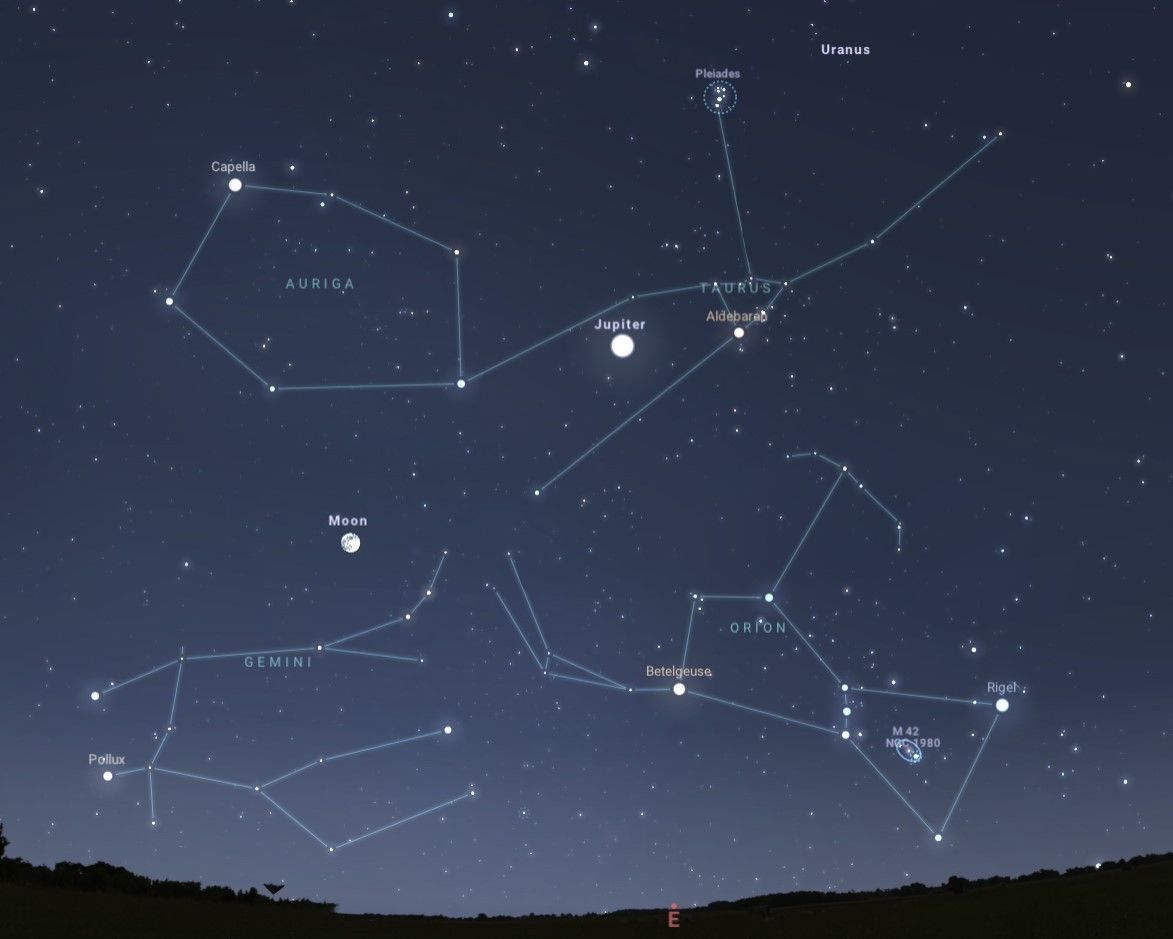
Sky map of an eastern horizon with the positions of Jupiter, the Moon, and Uranus labeled. Jupiter is in the center of the constellations Taurus, Orion, Gemini and Auriga.
Look for Jupiter near the Eye of the Bull, Aldebaran, in the Taurus constellation on the evening of December 15, 2024. Binoculars may help you spot Jupiter’s moons as small bright star-like objects on either side of the planet. A small telescope will show them easily, along with Jupiter’s famed cloud bands. How many can you count?
Credit: Stellarium Web

Jupiter is easy to observe at night with our unaided eyes, as well-documented by the ancient astronomers who carefully recorded its slow movements from night to night. It can be one of the brightest objects in our nighttime skies, bested only by the Moon, Venus, and occasionally Mars, when the red planet is at opposition. That’s impressive for a planet that, at its closest to Earth, is still over 365 million miles (587 million km) away. It’s even more impressive that the giant world remains very bright to Earthbound observers at its furthest distance: 600 million miles (968 million km)! While the King of Planets has a coterie of 95 known moons, only the four large moons that Galileo originally observed in 1610 – Io, Europa, Ganymede, and Calisto – can be easily observed by Earth-based observers with very modest equipment. These are called, appropriately enough, the Galilean moons. Most telescopes will show the moons as faint star-like objects neatly lined up close to bright Jupiter. Most binoculars will show at least one or two moons orbiting the planet. Small telescopes will show all four of the Galilean moons if they are all visible, but sometimes they can pass behind or in front of Jupiter or even each other. Telescopes will also show details like Jupiter’s cloud bands and, if powerful enough, large storms like its famous Great Red Spot, and the shadows of the Galilean moons passing between the Sun and Jupiter. Sketching the positions of Jupiter’s moons during the course of an evening – and night to night – can be a rewarding project! You can download an activity guide from the Astronomical Society of the Pacific at bit.ly/drawjupitermoons

Now in its eighth year, NASA’s Juno mission is one of just nine spacecraft to have visited this impressive world. Juno entered Jupiter’s orbit in 2016 to begin its initial mission to study this giant world’s mysterious interior. The years have proven Juno’s mission a success, with data from the probe revolutionizing our understanding of this gassy world’s guts. Juno’s mission has since been extended to include the study of its large moons, and since 2021 the plucky probe, increasingly battered by Jupiter’s powerful radiation belts, has made close flybys of the icy moons Ganymede and Europa, along with volcanic Io. What else will we potentially learn in 2030 with the Europa Clipper mission? 

Find the latest discoveries from Juno and NASA’s missions to Jupiter at science.nasa.gov/jupiter/

Originally posted by Dave Prosper: February 2023
Last Updated by Kat Troche: November 2024

Powered by WPeMatico

Get The Details…

Aaron Yazzie: Bridging Indigenous Heritage and Space Exploration

Aaron Yazzie: Bridging Indigenous Heritage and Space Exploration

4 min read

Preparations for Next Moonwalk Simulations Underway (and Underwater)

Photo of Aaron Yazzie standing with his arms crossed

Aaron Yazzie’s dream of being part of humanity’s exploration of space took him on a journey from his childhood home on the Navajo Nation to working at NASA’s Jet Propulsion Laboratory (JPL) in Southern California. His journey reflects not only his personal ambition, but also a commitment to elevating Indigenous representation in science, technology, engineering, and mathematics (STEM) fields.

“Getting an internship at NASA was the culmination of a lot of work done by myself, and many of the Indigenous trailblazers that came before me, to make a path and a space for Indigenous peoples at places where there might not have been any Indigenous Peoples in any rooms,” said Yazzie.

Born in Tuba City, Arizona, Yazzie is of the Salt Clan and born for the Bitter Water Clan, which reflect his maternal and paternal lineage, respectively. The Navajo clan system communicates family heritage and where their families come from.

Yazzie’s path to NASA began with a passion for engineering, which he pursued at Stanford University in Stanford, California, where he earned a bachelor’s degree in mechanical engineering in 2008. NASA is a dream job for many, from artists to engineers, and Yazzie was no exception. Securing an internship at NASA’s Jet Propulsion Laboratory in 2008 marked a significant milestone for him, particularly as an Indigenous person in STEM where Indigenous people are underrepresented. Throughout his academic and professional journey, he frequently found himself as the only Indigenous voice in the room with Indigenous people representing less than 0.6% of the American STEM workforce.

Yazzie’s work at NASA is deeply intertwined with his cultural identity. In the Navajo culture, traditional stories tell how the Diné (the people) came to exist in Dinétah (Navajo homelands).

Yazzie’s contributions to missions exploring Mars, including testing the Curiosity Rover’s sample acquisition system and developing drill bits for the Perseverance Rover, resonate with the Navajo creation story, which emphasizes nurturing life on a developing Earth—paralleling his efforts to support the possibility of life on Mars.  He approaches his role with a sense of purpose, reflecting on the importance of understanding origins–both of the Earth and of life itself.

“By studying Mars, we learn about how rocky, terrestrial planets, like Mars and Earth, formed over billions of years,” said Yazzie, “And by searching for ancient microbial life on Mars, we might learn how life on Earth originated. I am proud to be doing what my ancestors have been doing before me.”

Emphasizing a commitment to lifelong learning, Yazzie advises future interns to “embrace the opportunities of growth and learning that come with working at NASA.” His advice: learn how to be a good learner. Yazzie’s diverse responsibilities, from test engineer to systems engineer, keep him engaged and continuously evolving.

“I think I am most proud of the outreach work I have been able to do, especially to Indigenous communities,” said Yazzie, “I want to help Indigenous students understand that they can exist and thrive at places like NASA.”

Yazzie’s work has been recognized with awards from NASA JPL, Stanford University, and his own tribe, reinforcing his role as a trailblazer for generations. As he continues to contribute to humanity’s understanding of Mars and its potential for past life, he honors his ancestors by paving the way for a more inclusive future in space exploration. Through his work, Yazzie inspires a new generation of Diné scientists and engineers, proving their voices have an essential place in the story of the cosmos.

Like Yazzie, NASA is devoted to mentoring the next generation of Indigenous doers, thinkers, and innovators. Anyone interested in following his footsteps may consider applying for a NASA Internship. Outside of internships NASA offers numerous routes to help Indigenous students get involved with STEM. Additionally, through NASA’s Minority University Research and Education Project (MUREP), the agency provides financial assistance via competitive awards to Minority Serving Institutions. The MUREP American Indian and Alaska Native STEM Engagement (MAIANSE) program offers funding dedicated to supporting Indigenous students launch their careers at NASA.

Powered by WPeMatico

Get The Details…
Kaitlyn Adams

Advanced Tech Research Tops Crew Schedule Day Before Thanksgiving

Advanced Tech Research Tops Crew Schedule Day Before Thanksgiving

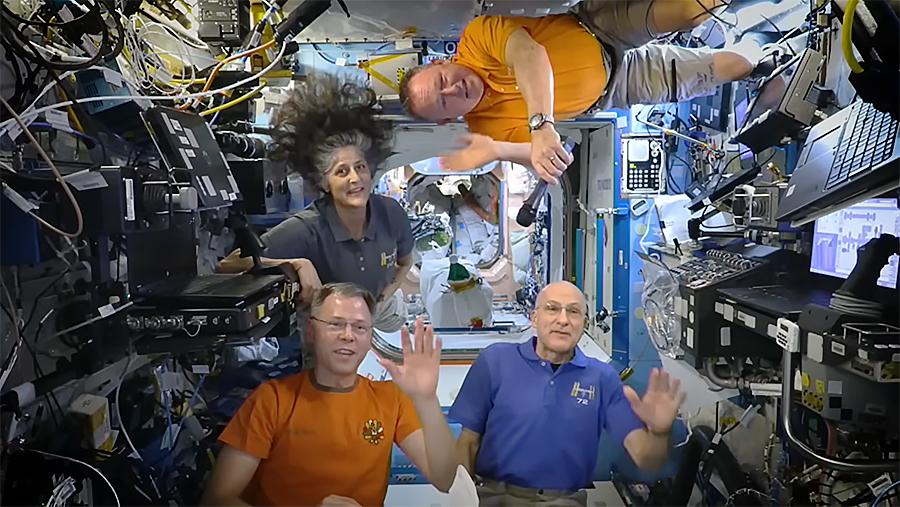
NASA astronauts (clockwise from bottom left) Nick Hague, Suni Williams, Butch Wilmore, and Don Pettit wish a Happy Thanksgiving in this video from the International Space Station. Credit: NASA/YouTube

Advanced technology research into DNA-like nanomaterials, bacterial genetic analysis, and 3D printing kept the Expedition 72 crew busy the day before Thanksgiving. The International Space Station residents also sent down a Thanksgiving message, checked out a Roscosmos cargo craft, and continued their standard orbital maintenance duties.

Commander Suni Williams kicked off her day with Flight Engineer Nick Hague, both NASA astronauts, in the Kibo laboratory module mixing samples of messenger RNA, or mRNA, and protein with water to manufacture nanomaterials that mimic DNA. Williams then imaged the samples using light intensity measurements to evaluate the quality of the nanomaterials. Results may benefit space manufacturing and lead to advanced therapies for Earthbound and space-caused health conditions.

NASA Flight Engineer Butch Wilmore spent all day Wednesday collecting microbe samples throughout the station to analyze their genetic characteristics. Wilmore first swabbed areas the crew touches frequently then transferred those samples to genetic research hardware for analysis. The samples will be incubated for a few days before undergoing a DNA extraction process for identification. Doctors want to understand how antibiotic-resistant bacteria evolve in the microgravity environment in an effort reduce the risk of crew infection aboard spacecraft.

NASA Flight Engineer Don Pettit worked in the Columbus laboratory module configuring the Metal 3D Printer that may be able to manufacture spare parts during space missions reducing the need for resupply missions launched from Earth. Williams assisted Pettit removing a printed specimen from the 3D printer and replacing components inside the device.

The four NASA astronauts sent down a Thanksgiving message video highlighting their upcoming meal and expressing their gratitude for their families and living and working in space. The quartet along with the three Roscosmos cosmonauts aboard the space station will take the day off on Thursday enjoying a hearty meal, talking to family members on the ground, and relaxing aboard the orbital outpost.

Roscosmos Flight Engineers Alexey Ovchinin and Ivan Vagner worked throughout Wednesday checking ventilation systems and docking hardware inside the Progress 89 cargo craft docked to the Zvezda service module’s rear port. The cosmonaut duo also took turns attaching electrodes to themselves recording their heart activity and measuring their blood pressure. Flight Engineer Aleksandr Gorbunov updated laptop computer software and continued unpacking the Progress 90 cargo craft.


Learn more about station activities by following the space station blog@space_station and @ISS_Research on X, as well as the ISS Facebook and ISS Instagram accounts.

Get the latest from NASA delivered every week. Subscribe here: www.nasa.gov/subscribe

Powered by WPeMatico

Get The Details…

Mark Garcia

John Herrington Performs a Spacewalk

John Herrington Performs a Spacewalk

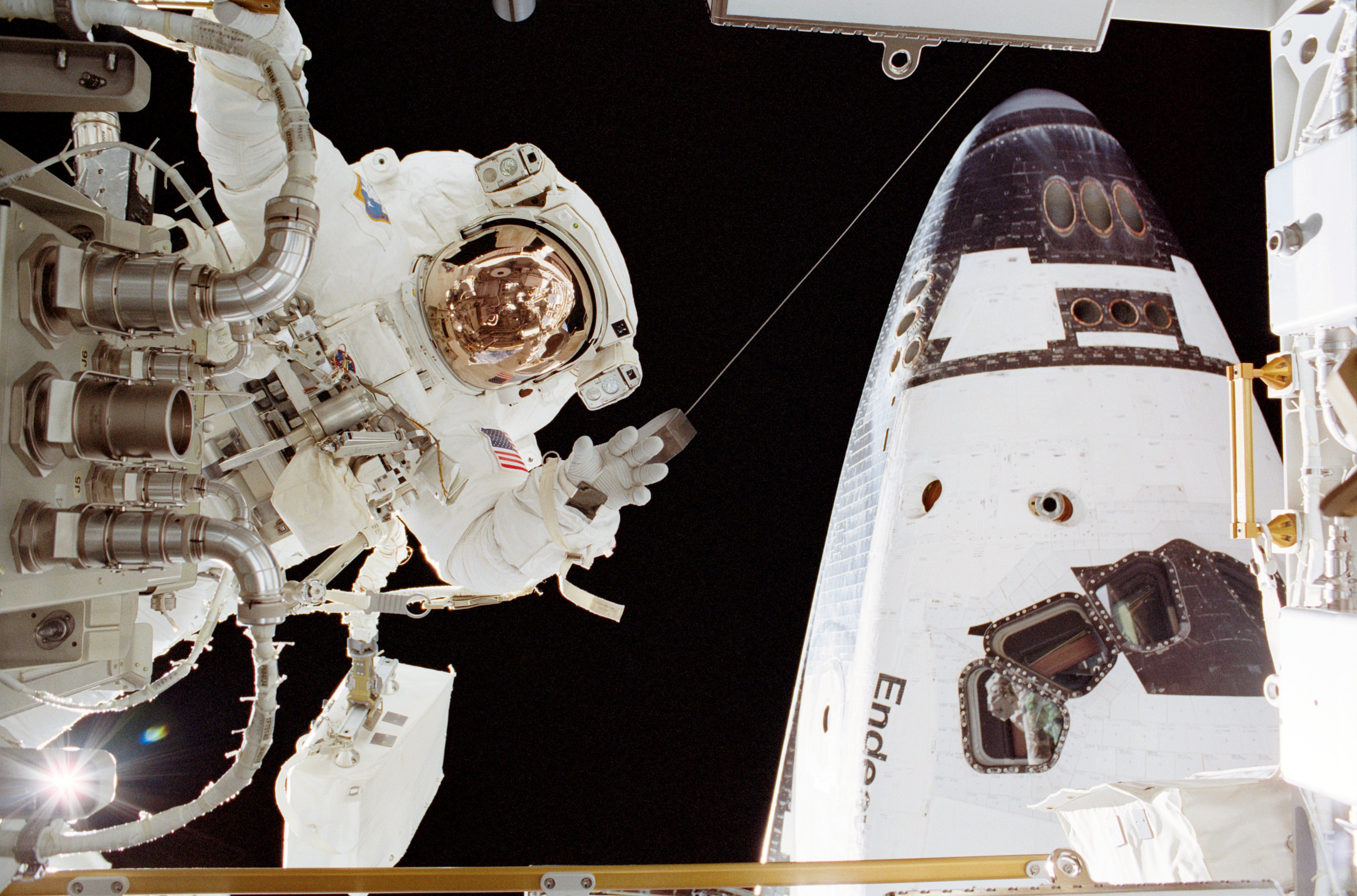
An astronaut in a white spacesuit appears on the left side of the image near a part. On the right in the back is part of the space shuttle Endeavour.
NASA

On Nov. 30, 2002, NASA astronauts John Herrington (pictured) and Michael Lopez-Alegria performed the third and final spacewalk of the STS-113 mission. The goal of the mission was to install and activate the Port 1 Integrated Truss Assembly (P1). The first major component installed on the left side of the Station, the P1 truss provides an additional three External Thermal Control System radiators.

Herrington, an enrolled member of the Chickasaw Nation, was the first Native American in space. On STS-113, he logged over 330 hours in space, including 3 spacewalks totaling 19 hours and 55 minutes.

Image credit: NASA

Powered by WPeMatico

Get The Details…
Monika Luabeya

NASA Plane Supported Innovative Microgravity Research in ‘90s

NASA Plane Supported Innovative Microgravity Research in ‘90s

A white DC-9 plane with a blue stripe and text that says “Lewis Research Center” flies upward against a blue sky with several wispy white clouds.
NASA Lewis Research Center’s DC-9 commences one of its microgravity-producing parabolas in the fall of 1994. It was the center’s largest aircraft since the B-29 Superfortress in the 1940s.
Credit: NASA/Quentin Schwinn

A bell rings and a strobe light flashes as a pilot pulls the nose of the DC-9 aircraft up sharply. The blood quickly drains from researchers’ heads as they are pulled to the cabin floor by a force twice that of normal gravity. Once the acceleration slows to the desired level, and the NASA aircraft crests over its arc, the flight test director declares, “We’re over the top!”

The pressure drops as the aircraft plummets forward in freefall. For the next 20 to 25 seconds, everybody and everything not tied down begins to float. The researchers quickly tend to their experiments before the bell rings again as the pilot brings the aircraft back to level flight and normal Earth gravity.

By flying in a series of up-and-down parabolas, aircraft can simulate weightlessness. Flights like this in the DC-9, conducted by NASA’s Lewis Research Center (today, NASA Glenn) in the 1990s, provided scientists with a unique way to study the behavior of fluids, combustion, and materials in a microgravity environment.

A white DC-9 plane with a blue stripe and text that says “Lewis Research Center” flies upward against a blue sky with several wispy white clouds.
Researchers conduct experiments in simulated weightlessness during a flight aboard the DC-9. The aircraft sometimes flew up to 40 parabolas in a single mission.
Credit: NASA/Quentin Schwinn

Beginnings

In the 1960s, NASA Lewis used a North American AJ-2 to fly parabolas to study the behavior of liquid propellants in low-gravity conditions. The center subsequently expanded its microgravity research to include combustion and materials testing.

So, when the introduction of the space shuttle in the early 1980s led to an increase in microgravity research, NASA Lewis was poised to be a leader in the agency’s microgravity science efforts. To help scientists test experiments on Earth before they flew for extended durations on the shuttle, Lewis engineers modified a Learjet aircraft to fly microgravity test flights with a single strapped-down experiment and researcher.

Twelve people wearing blue NASA flight suits stand in front of a white plane with a blue stripe and text that says, “Lewis Research Center.” In the background is the tan NASA Lewis hangar with a large NASA meatball logo sign affixed to the face of the building.
The DC-9 flight crew in May 1996. Each flight required two pilots, a flight engineer, and test directors. The flight crews participated in pre- and post-flight mission briefings and contributed to program planning, cost analysis, and the writing of technical reports.
Credit: NASA/Quentin Schwinn

Bigger And Better

In 1990, NASA officials decided that Lewis needed a larger aircraft to accommodate more experiments, including free-floating tests. Officials determined the McDonnell Douglas DC-9 would be the most economical option and decided to assume responsibility for a DC-9 being leased by the U.S. Department of Energy.

In the fall of 1993, 50 potential users of the aircraft visited the center to discuss the modifications that would be necessary to perform their research. In October 1994, the DC-9 arrived at Lewis in its normal passenger configuration. Over the next three months, Lewis technicians removed nearly all the seats; bolstered the floor and ceiling; and installed new power, communications, and guidance systems. A 6.5-by-11-foot cargo door was also installed to allow for the transfer of large equipment.

The DC-9 was the final element making NASA Lewis the nation’s premier microgravity institution. The center’s Space Experiments Division had been recently expanded, the 2.2-Second Drop Tower and the Zero Gravity Facility had been upgraded, and the Space Experiments Laboratory had recently been constructed to centralize microgravity activities.

Three people wearing green flight suits and four people wearing blue flight suits float around a plane cabin and interact with experiment equipment.
NASA Lewis researchers aboard the DC-9 train the STS-83 astronauts on experiments for the Microgravity Science Laboratory (MSL-1).
Credit: NASA/Quentin Schwinn

Conducting the Flights

Lewis researchers partnered with industry and universities to design and test experiments that could fly on the space shuttle or the future space station. The DC-9 could accommodate up to eight experiments and 20 research personnel on each flight.

The experiments involved space acceleration measurements, capillary pump loops, bubble behavior, thin film liquid rupture, materials flammability, and flame spread. It was a highly interactive experience, with researchers accompanying their tests to gain additional information through direct observation. The researchers were often so focused on their work that they hardly noticed the levitation of their bodies.

The DC-9 flew every other week to allow time for installation of experiments and aircraft maintenance. The flights, which were based out of Cleveland Hopkins International Airport, were flown in restricted air space over northern Michigan. The aircraft sometimes flew up to 40 parabolas in a single mission.

A person in a green flight suit watches as blue fluid floats out of a bottle during a microgravity flight.
Seth Lichter, professor at Northwestern University, conducts a thin film rupture experiment aboard the DC-9 in April 1997.
Credit: NASA/Quentin Schwinn

A Lasting Legacy

When the aircraft’s lease expired in the late 1990s, NASA returned the DC-9 to its owner. From May 18, 1995, to July 11, 1997, the Lewis microgravity flight team had used the DC-9 to fly over 400 hours, perform 70-plus trajectories, and conduct 73 research projects, helping scientists conduct hands-on microgravity research on Earth as well as test and prepare experiments designed to fly in space. The aircraft served as a unique and important tool, overall contributing to the body of knowledge around microgravity science and the center’s expertise in this research area.

NASA Glenn’s microgravity work continues. The center has supported experiments on the International Space Station that could improve crew health as well as spacecraft fire safety, propulsion, and propellants. Glenn is also home to two microgravity drop towers, including the Zero Gravity Research Facility, NASA’s premier ground-based microgravity research lab.

Additional Resources:

Powered by WPeMatico

Get The Details…
Robert S. Arrighi