A Mission at Home and at Work: Caregivers at Johnson Navigate Dual Role With Community Supports
Many team members at NASA’s Johnson Space Center in Houston may recognize Alicia Baker as the talented flutist in the Hispanic Employee Resource Group’s Mariachi Celestial band. Or, they may have worked with Baker in her role as a spacesuit project manager, testing NASA’s prototype spacesuits and preparing Johnson’s test chambers to evaluate vendor spacesuits.
Alicia Baker in a spacesuit test chamber at Johnson Space Center.
NASA/David DeHoyos
They might be surprised to learn that Baker juggled these responsibilities and more while also caring for her late husband, Chris, as he fought a terminal illness for 16 years.
“It was hard taking care of a loved one with cancer and working full-time,” Baker said. “My husband was also disabled from a brain tumor surgery, so I had to help him with reading, writing, walking, and remembering, while managing the household.”
Baker worked closely with her manager to coordinate schedules and get approval to telework so that she could work around her husband’s medical appointments and procedures. She also took medical leave when her husband entered hospice care in 2020. Baker said her manager’s flexibility “saved her job” and allowed her to continue providing for her family. She was even able to advance from project engineer to test director to project manager during this time period.
Alicia Baker and her husband Chris on their wedding day.
Image courtesy of Alicia Baker
Baker is one of the many Johnson employees who are or have been a caregiver for a loved one. These caregivers provide help to a person in need who often has a medical condition or injury that affects their daily functioning. Their needs may be temporary or long-term, and they could be physical, medical, financial, or domestic in nature.
Recognizing the challenging and critical role caregivers play in their families, the Johnson community provides a variety of resources to support team members through the Employee Assistance Program. Additionally, Johnson’s No Boundaries Employee Resource Group (NoBo) supports caregivers through its programs and initiatives.
Baker participates in both the support group and NoBo activities and takes comfort in sharing her and her husband’s story with others. “I would do it all over again,” she said of her caregiver role.
Now she looks forward to future missions to the Moon, when NASA astronauts will conduct spacewalks on the lunar surface while wearing new spacesuits. “Then I can say I helped make that possible!” Throughout all of her experiences, Baker has learned to never give up. “If you have a dream, keep fighting for it,” she said.
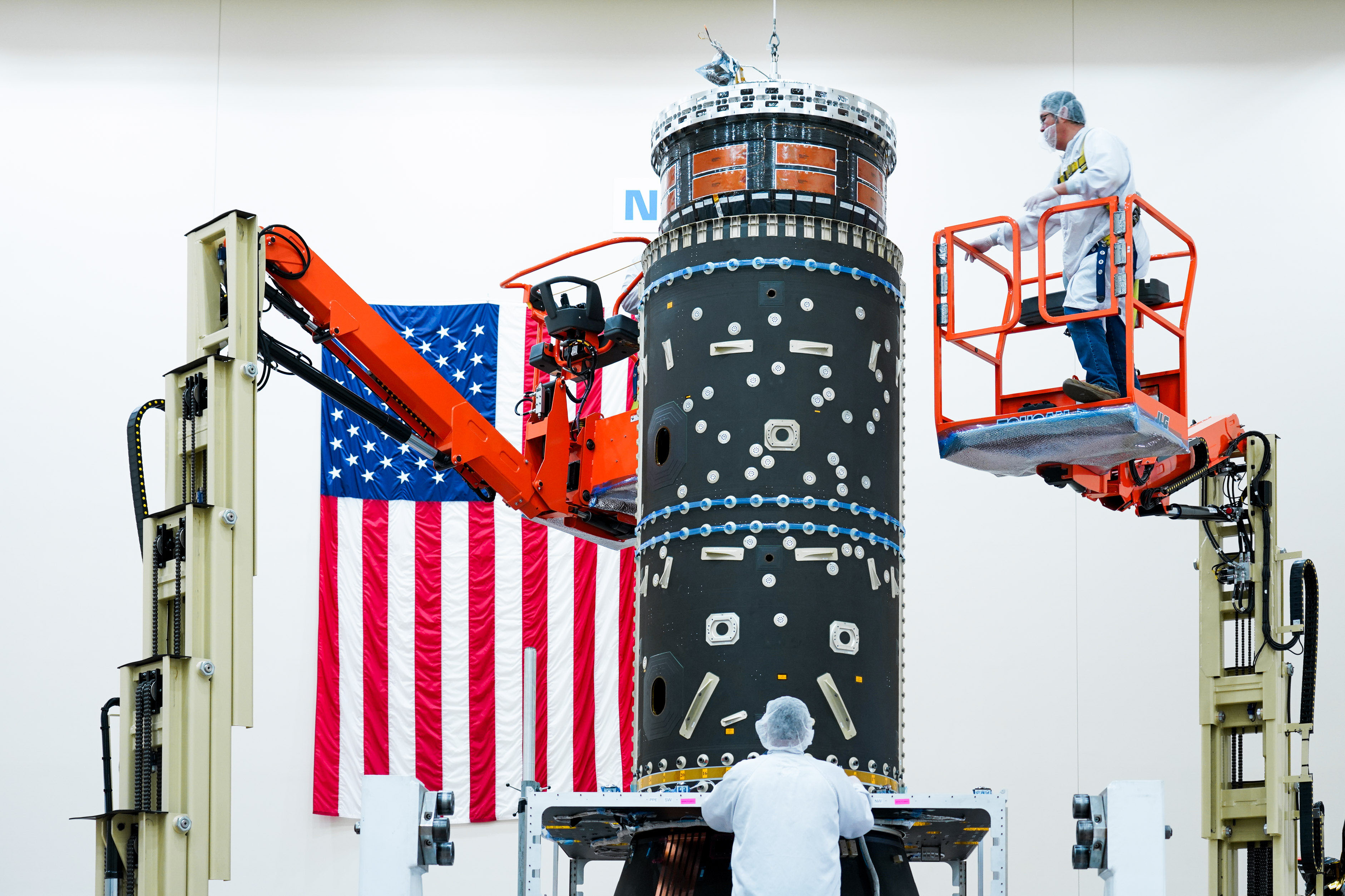
Technicians guide the equipment that will house Gateway’s xenon and liquid fuel tanks in this photo from July 1, 2024. The tanks are part of Gateway’s Power and Propulsion Element, which will make the lunar space station the most powerful solar electric spacecraft ever flown. Once fully assembled and launched to lunar orbit, the Power and Propulsion Element’s roll-out solar arrays will harness the Sun’s energy to energize xenon gas and produce the thrust to get Gateway to the Moon’s orbit where it will await the arrival of its first crew on the Artemis IV mission.
Expedition 71 Astronauts to Discuss Mission in NASA Welcome Home Event
Dec. 2, 2024
NASA astronauts Matthew Dominick, Mike Barratt, Jeanette Epps, and Tracy C. Dyson
NASA
RELEASE: J24-015
Expedition 71 Astronauts to Discuss Mission in NASA Welcome Home Event
Four NASA astronauts will participate in a welcome home ceremony at Space Center Houston after recently returning from a mission aboard the International Space Station.
NASA astronauts Matthew Dominick, Mike Barratt, Jeanette Epps, and Tracy C. Dyson will share highlights from their mission beginning at 6 p.m. CST Wednesday, Dec. 4, during a free, public event at NASA Johnson Space Center’s official visitor center. The crew will also recognize key contributors to mission success in an awards ceremony following thepresentation.
The astronauts will be available at 5 p.m. for media interviews before the event. Media may request an in-person interview no later than 5 p.m. Tuesday, Dec. 3, by emailing Dana Davis at dana.l.davis@nasa.gov.
Expedition 71
NASA’s SpaceX Crew-8 mission launched to the space station in March 2024 as the eighth commercial crew rotation mission. The crew spent 235 days in space, traveled 100 million miles, and completed 3,760 orbits around the Earth, splashing down off the coast of Pensacola, Florida, on Oct. 25, 2024. This was the first spaceflight for Dominick and Epps and the third spaceflight for Barratt, who has logged 447 days in space over the course of his career. The crew also saw the arrival and departure of eight visiting vehicles during their mission.
Dyson flew with an international crew, launching aboard the Soyuz MS-25 in March 2024. The six-month research mission was the third spaceflight of her career, and her second long-duration spaceflight. Dyson’s third spaceflight covered 2,944 orbits of the Earth and a journey of 78 million miles as an Expedition 70/71 flight engineer. She has now logged a total of 373 days in space, including more than 23 hours in four spacewalks. Dyson and her crewmembers landed safely in Kazakhstan on Sept. 24, 2024.
While aboard the station, the Expedition 71 crew contributed to hundreds of technology demonstrations and experiments including the bioprinting of human tissues. These higher quality tissues printed in microgravity could help advance the production of organs and tissues for transplant and improve 3D printing of foods and medicines on future long-duration space missions. The crew also looked at neurological organoids, created with stem cells from patients to study neuroinflammation, a common feature of neurodegenerative conditions such as Parkinson’s disease. The organoids provide a platform to study these diseases and their treatments and could help address how extended spaceflight affects the brain.
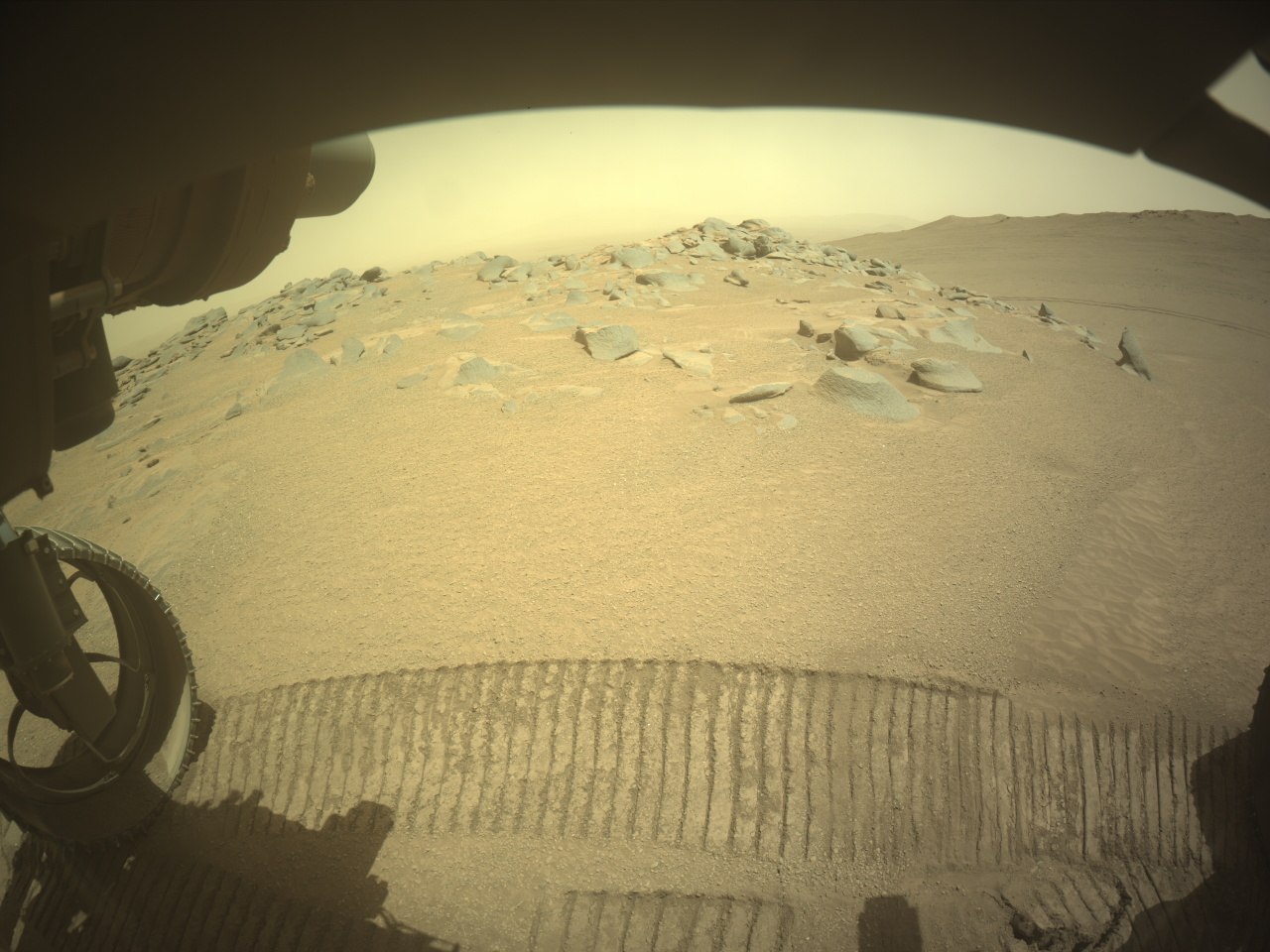
NASA’s Mars Perseverance rover acquired this image following a successful 107-meter (about 351 feet) drive on sol 1332, Martian day 1,332 of the Mars 2020 mission. The rocks in the foreground are part of “Pico Turquino,” a large ridge exposed in the Jezero crater rim that the mission team plans on investigating up-close. The rover acquired this image of the area in front of it using its onboard Front Left Hazard Avoidance Camera A, on Nov. 18, 2024 at the local mean solar time of 12:43:14.
NASA/JPL-Caltech
Earth planning date: Monday, Nov. 18, 2024
Perseverance has been continuing its sightseeing tour of the Jezero crater rim, with this week’s travel itinerary including an up-close look at “Pico Turquino.” Here, the team hopes to investigate the history recorded in this approximately 200-meter-long region (about 656 feet) of exposed outcrop. Such rocks may reveal clues of ancient geologic processes including those that predate or are related to the violent impact that formed Jezero crater. Recently, the team has been studying a number of outcropping ridges during the rover’s ascent of the crater rim, with the goal of characterizing the compositional diversity and structure of these exposed rocks.
After paralleling Pico Turquino about 70 meters (about 230 feet) to the south last week, the team planned a close approach over the weekend that positioned the rover at the southwestern extent of the ridge. Prior to the 107-meter drive (about 351 feet) on sol 1332, the team planned two sols of targeted remote sensing with Mastcam-Z and SuperCam to investigate local regolith and conduct long distance imaging of a steep scarp and 20-meter (about 66 feet) diameter crater to the northwest. The successful approach drive on sol 1332 allowed the team to come into Monday’s planning with the focus of assessing outcrop amenable for proximity science and repositioning the rover for upcoming abrasion activities.
Following our abrasion activities at Pico Turquino, the rover will be hitting the road en route to its next science stop at “Witch Hazel Hill.” Orbital views of Witch Hazel Hill suggest the area may contain layered and light-toned bedrock that likely record important information of the planet’s ancient climate. Prior to arriving at Witch Hazel Hill, the rover plans to pass through a high point known as Lookout Hill that will afford the team incredible views looking back into the crater, as well as get a glimpse westward of terrain far beyond Jezero.
Written by Bradley Garczynski, Postdoctoral Scientist at Western Washington University
This month, Venus dazzles as the “Evening Star,” Jupiter reaches its brightest for the year, and the Geminid meteor shower peaks under challenging moonlit skies.
Skywatching Highlights
All Month – Planet Visibility:
Mercury: Visible very low in the southeast just before sunrise during the last half of the month.
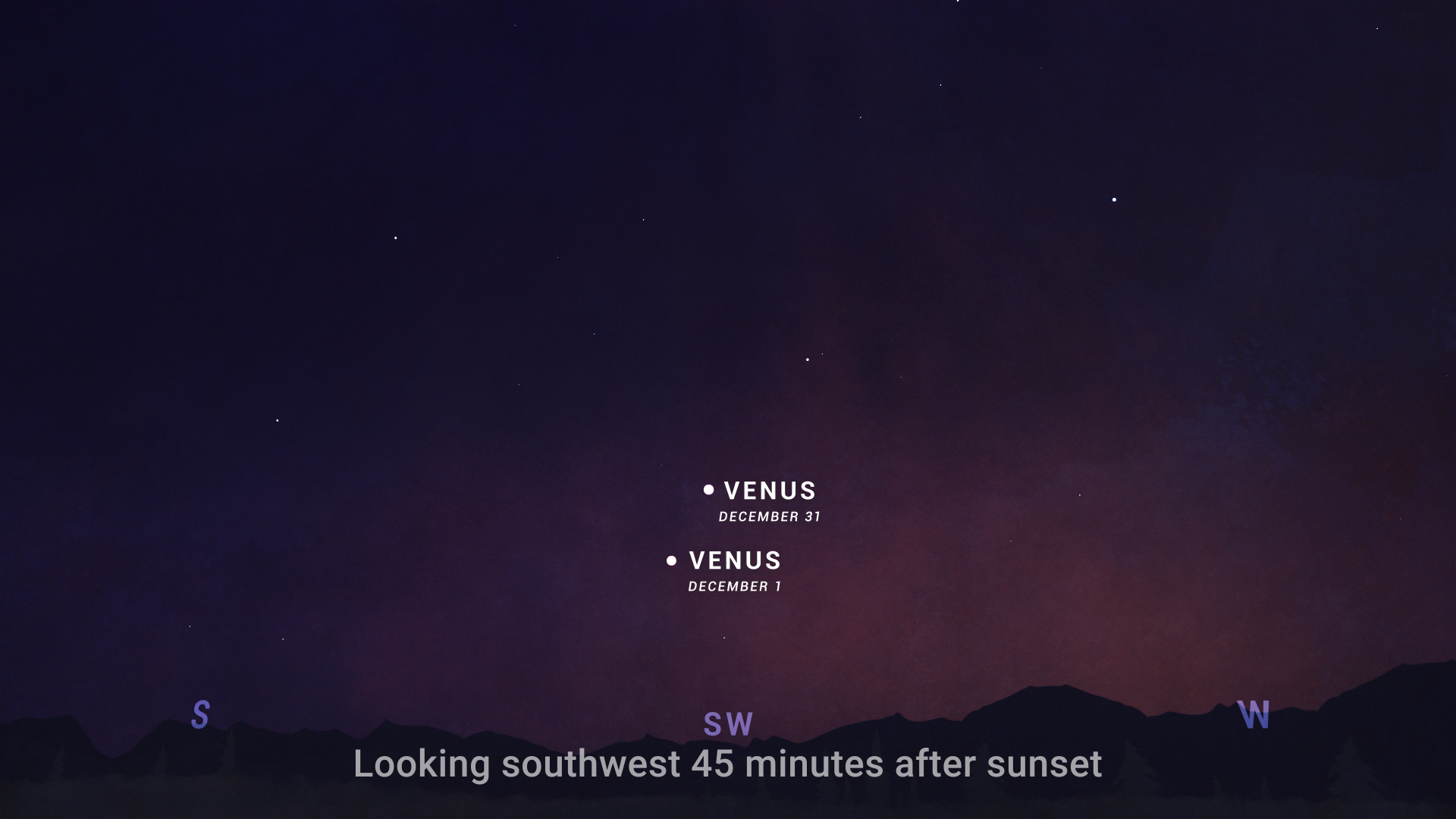
Venus: Shines brightly as the “Evening Star” in the southwest after sunset, climbing higher each evening.
Mars: Brightens significantly during December, rising in the east-northeast and visible from late evening to early morning.
Jupiter: Reaches opposition on December 7, making it visible all night, rising in the east-northeast.
Saturn: Visible after sunset in the southern sky, shifting slightly westward as the month progresses.
December 3-5 – Venus and the Moon: Look southwest after sunset to see a beautiful pairing. On December 4, a slim crescent Moon will sit directly below Venus.
December 7 – Jupiter at Opposition: Jupiter will shine at its brightest for the year, rising in the east-northeast among Taurus’s stars. Best viewed through a telescope for details like the Galilean moons and atmospheric belts.
December 14 – Jupiter, the Moon, and Aldebaran: Look for Jupiter midway between the nearly full Moon and bright orange star Aldebaran in the evening sky.
December 17 – Mars and the Moon: Mars, glowing brightly in its approach to opposition, appears super close to the waning gibbous Moon.
All Month – Winter Triangle: Formed by Sirius, Procyon, and Betelgeuse, this asterism marks the arrival of winter skies and is a prominent feature throughout the season.
December 13-14 – Geminid Meteor Shower: The peak occurs under a nearly full Moon, reducing visibility, but bright meteors may still be spotted the week before.
December 21 – Winter Solstice: At 4:20 a.m. EST, the solstice marks the beginning of winter in the Northern Hemisphere and summer in the Southern Hemisphere.
Transcript
What’s Up for December?
Venus, Jupiter, and Mars shine brightly; the stars of winter and their pointy little friend; and “Meteors, meet the Moon.”
Sky chart showing the changing position of Venus after sunset during December.
NASA/JPL-Caltech
Starting off with the planets, Venus is hard to miss in the southwest after sunset – it’s that dazzling bright “evening star.” You’ll find it getting a bit higher in the sky each evening through the month. On December 4th, look for a slim crescent Moon hanging right below it, making for a great photo opportunity!
Sky chart showing the changing position of Venus after sunset during December.
NASA/JPL-Caltech
Saturn is visible toward the south beginning at nightfall. Look for it to track a bit farther to the west as the weeks go by. Meanwhile, Jupiter reaches opposition on December 7th, meaning it’s at its brightest for the year and visible all night long. You’ll find it rising in the east-northeast as darkness falls, among the stars of the constellation Taurus. Mid-month, around December 14th, watch for Jupiter sitting between the nearly full Moon and Taurus’s brightest star, orange-colored Aldebaran.
Next, Mars will also be putting on its own show, doubling its brightness during December as it heads toward its own opposition in January. Early in the month, it rises about four hours after dark, but by New Year’s Eve, it’s rising just about 90 minutes after sunset – always shining with its distinctive reddish hue. And on December 17th, you’ll find the Red Planet super close to the Moon, which will be just two days past its full phase.
The stars of winter are making their grand entrance in December. As evening falls, you’ll see the mighty hunter Orion rising in the east, with Taurus the bull above it, and the stars of the twins in Gemini to their left. These constellations host some wonderful sights – like the Crab Nebula and Pleiades star cluster in Taurus and the misty Orion Nebula, which hangs below Orion’s belt. If you look to the western sky soon after dark, you can still spot the three bright stars of the Summer Triangle getting quite low on the horizon. But as they depart, three bright stars of winter bring their own prominent triangular shape to mark the season.
Once you spot Orion’s distinctive belt of three stars, you’re well on your way to finding what we call the Winter Triangle. Just follow the belt stars to the left and slightly downward – they point right to Sirius, the brightest star in the night sky. Then look upward and to the left of Sirius to spot Procyon, and back up toward Orion to find reddish Betelgeuse at its shoulder. These three bright stars form an equilateral triangle that’s visible throughout the season.
The Geminid meteor shower peaks after midnight in the early morning of December 14th, and they’re usually one of the best meteor showers of the year under good conditions. This year, the nearly full Moon will wash out the fainter meteors on the peak night. Still, the Geminids are known for bright meteors, and it’s common to spot their shooting stars up to a week before the peak. If you’re up before dawn that week, it’s worth looking up, just in case you spot a speck of dust from space streaking through the morning sky.
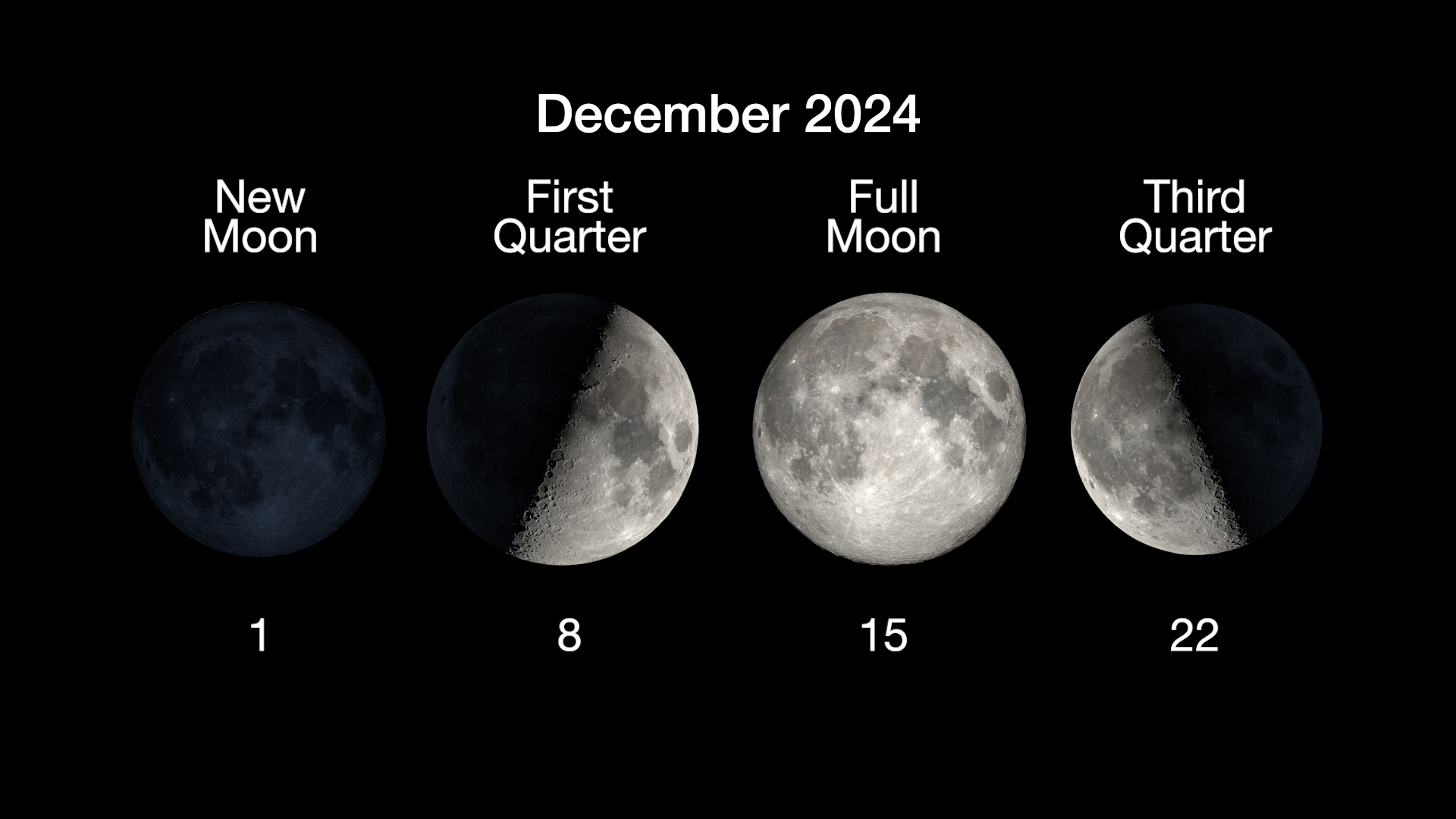
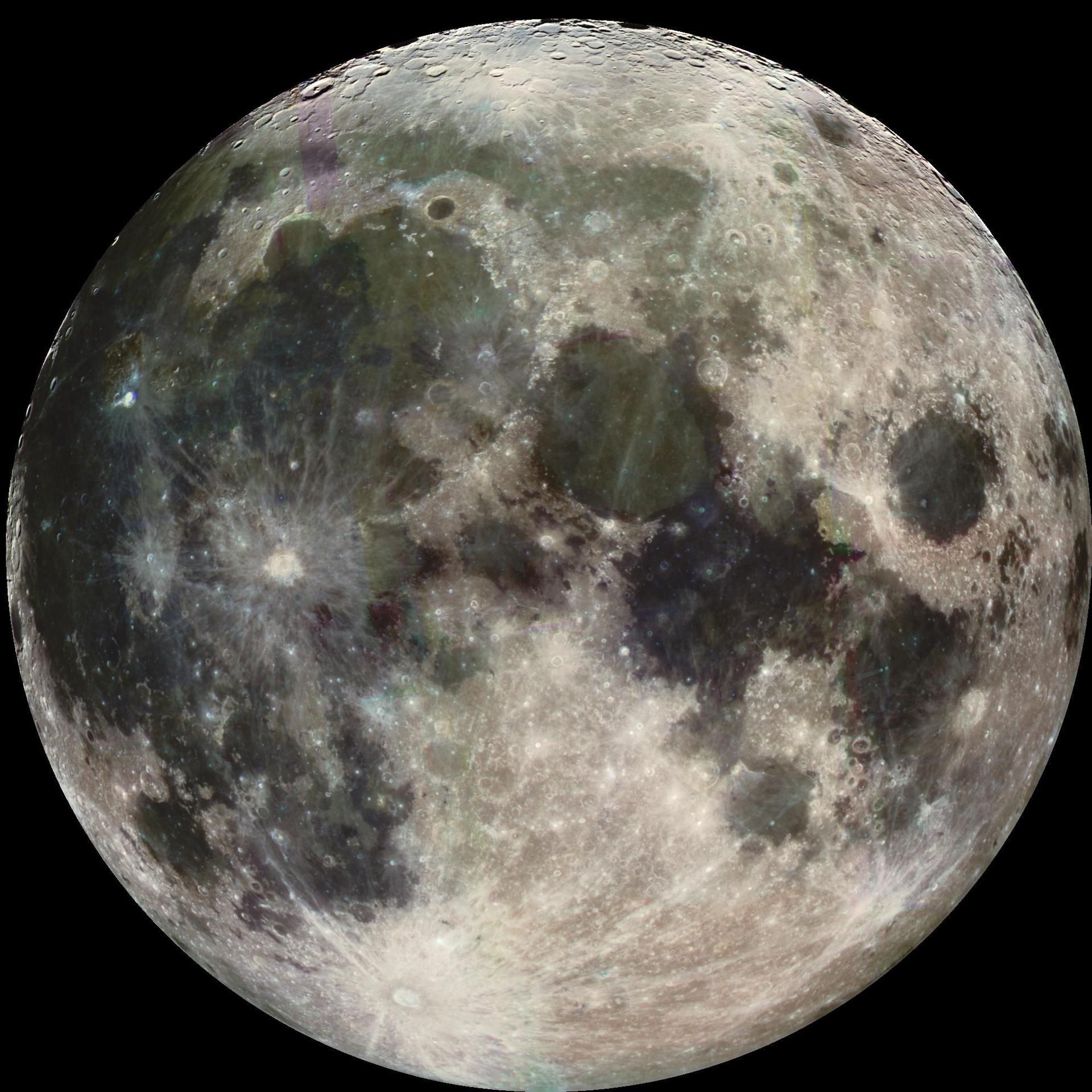
And here are the phases of the Moon for December.
The phases of the Moon for December 2024.
NASA/JPL-Caltech
Stay up to date on all of NASA’s missions exploring the solar system and beyond at NASA Science.
I’m Preston Dyches from NASA’s Jet Propulsion Laboratory, and that’s What’s Up for this month.