New Aircraft Wing Undergoes Crucial NASA Icing Testing

New Aircraft Wing Undergoes Crucial NASA Icing Testing
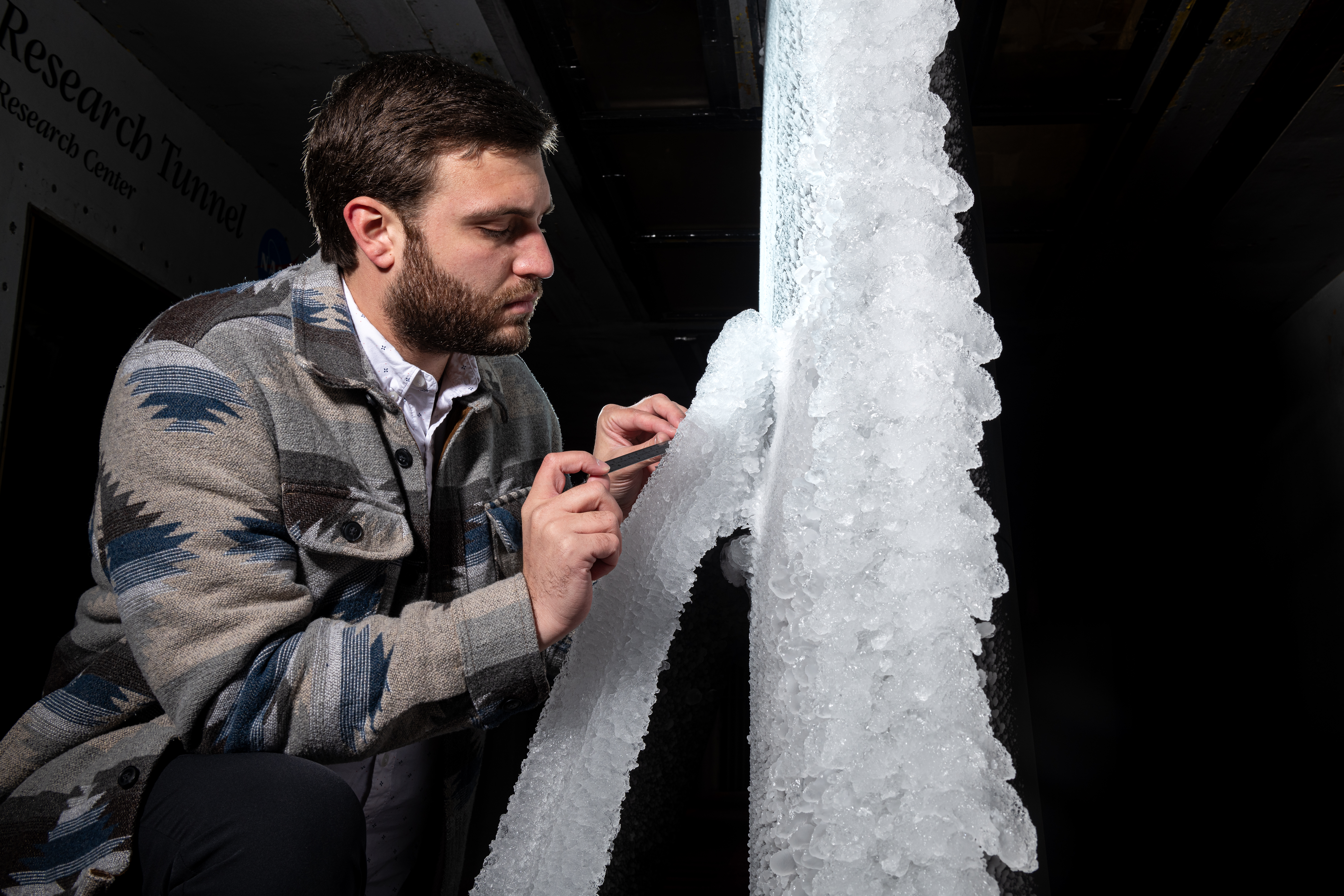
A man looks at white ice built up on a section of scale-model transonic truss-braced wing. The model wing stands vertically in NASA Glenn’s Icing Research Tunnel.
Thomas Ozoroski, a researcher at NASA’s Glenn Research Center in Cleveland, takes icing accretion measurements in October 2024 as part of transonic truss-braced wing concept research. Researchers at NASA Glenn conducted another test campaign in March 2025.
Credit: NASA/Jordan Cochran

In the future, aircraft with long, thin wings supported by aerodynamic braces could help airlines save on fuel costs. But those same wings could be susceptible to ice buildup. NASA researchers are currently working to determine if such an issue exists, and how it could be addressed.

In the historic Icing Research Tunnel at NASA’s Glenn Research Center in Cleveland, scientists and engineers are testing a concept for a transonic truss-braced wing. Their goal: to collect important data to inform the design of these potential efficient aircraft of the future.

Artist’s concept of how the truss braced wings would look on an aircraft with the longer, thinner wings braced by a truss, which is seen in red.
This artist’s concept shows the transonic truss-braced wing concept. NASA’s Advanced Air Transport Technology project is exploring the design, which involves a longer, thinner wing structure with struts to enhance aerodynamic efficiency and reduce fuel consumption.
Credit: NASA

A transonic truss-braced wing generates less drag in flight compared to today’s aircraft wings, requiring an aircraft to burn less fuel. This revolutionary design could make the wing more prone to ice buildup, so it must undergo a series of rigorous tests to predict its safety and performance. The data the research team has collected so far suggests large sections of the frontmost part of the wing (also known as the leading edge) will require an ice protection system, similar to those found on some commercial aircraft.

NASA Glenn can simulate icing conditions in its Icing Research Tunnel to identify potential challenges for new aircraft designs. These tests provide important information about how ice builds up on wings and can help identify the most critical icing conditions for safety. All commercial aircraft must be approved by the Federal Aviation Administration to operate in all kinds of weather.

White ice accumulated on stationary wing model in NASA Glenn’s Icing Research Tunnel.
Because of the thinness of transonic truss-braced wing design, ice tends to build up during cold conditions, as seen during a test in October 2024. Researchers at NASA’s Glenn Research Center in Cleveland conducted another test campaign in March 2025, collecting important data to ensure safety.
Credit: NASA/Jordan Cochran

This research is part of NASA’s work to mature transonic truss-braced technology by looking at issues including safety and how future aircraft could be integrated into U.S. aviation infrastructure. Boeing is also working with NASA to build, test, and fly the X-66, a full-sized demonstrator aircraft with transonic truss-braced wings. Because the experimental aircraft will not be flown in icy conditions, tests in the Icing Research Tunnel are providing answers to questions about ice buildup.

This work advances NASA’s role in developing ultra-efficient airliner technologies that are economically, operationally, and environmentally sustainable. For about two decades, NASA has invested in research aimed at advancing transonic truss-braced wing technology to the point where private sector aeronautics companies can integrate it into commercial aircraft configurations. NASA invests in this research through initiatives including its Advanced Air Transport Technology project, which investigates specific performance aspects of transonic truss-braced wing concepts, such as icing. The Advanced Air Transport Technology project is part of NASA’s Advanced Air Vehicles Program.

Powered by WPeMatico

Get The Details…
Kelly M. Matter

NASA’s Lunar Reconnaissance Orbiter Views Blue Ghost on Moon’s Surface

NASA’s Lunar Reconnaissance Orbiter Views Blue Ghost on Moon’s Surface

1 min read

Preparations for Next Moonwalk Simulations Underway (and Underwater)

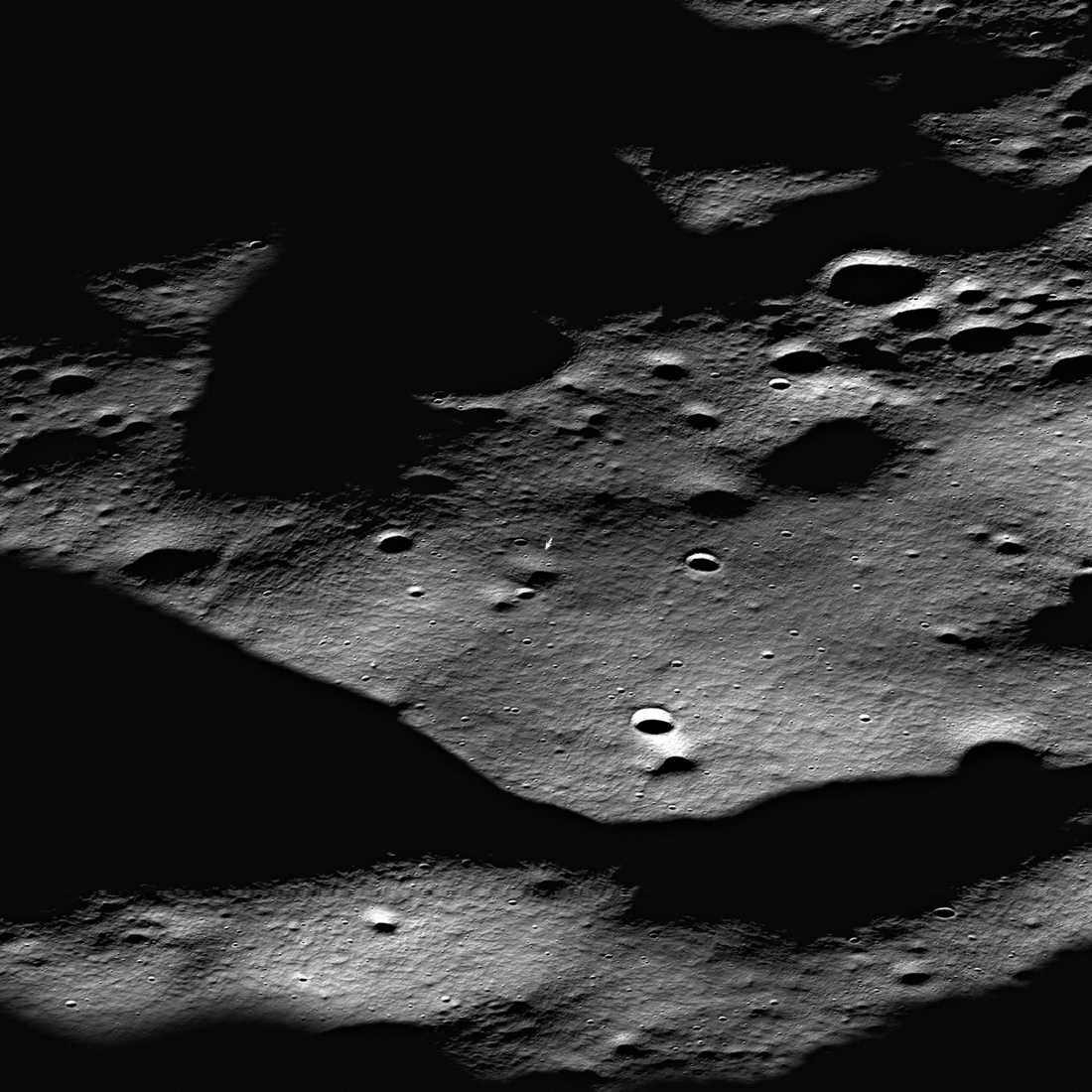
NASA’s LRO (Lunar Reconnaissance Orbiter) imaged Firefly Aerospace’s Blue Ghost Mission 1 lunar lander on the Moon’s surface the afternoon of March 2, not quite 10 hours after the spacecraft landed.

Black and white image of Firefly's Blue Ghost lunar lander landing site on the Moon. The gray cratered surface of the Moon is visible from an oblique angle above. The lander is a tiny white dot in the center of the image, with a square white box outlining it.
Firefly Aerospace’s Blue Ghost Mission 1 lunar lander, which appears in this image from NASA’s Lunar Reconnaissance Orbiter as a bright pixel casting a shadow in the middle of the white box, reached the surface of the Moon on March 2 at 3:34 a.m. EST.
NASA/Goddard/Arizona State University

The delivery is part of NASA’s CLPS (Commercial Lunar Payload Services) initiative and Artemis campaign. This is the first CLPS delivery for Firefly, and their first Moon landing.

LRO is managed by NASA’s Goddard Space Flight Center in Greenbelt, Maryland, for the Science Mission Directorate at NASA Headquarters in Washington. Launched on June 18, 2009, LRO has collected a treasure trove of data with its seven powerful instruments, making an invaluable contribution to our knowledge about the Moon. NASA is returning to the Moon with commercial and international partners to expand human presence in space and bring back new knowledge and opportunities.

More on this story from Arizona State University’s LRO Camera website

Media Contact:
Nancy N. Jones
NASA’s Goddard Space Flight Center, Greenbelt, Md.

Share

Details

Last Updated

Mar 25, 2025

Powered by WPeMatico

Get The Details…
Jamie Adkins

NASA’s Lunar Reconnaissance Orbiter Views IM-2 on Moon’s Surface

NASA’s Lunar Reconnaissance Orbiter Views IM-2 on Moon’s Surface

1 min read

Preparations for Next Moonwalk Simulations Underway (and Underwater)

NASA’s LRO (Lunar Reconnaissance Orbiter) imaged Intuitive Machines’ IM-2 on the Moon’s surface on March 7, just under 24 hours after the spacecraft landed.

Later that day Intuitive Machines called an early end of mission for IM-2, which carried NASA technology demonstrations as part of the agency’s CLPS (Commercial Lunar Payload Services) initiative and Artemis campaign.

Black and white image of the Moon taking from above from the Lunar Reconnaissance Orbiter. A tiny white arrow in the center points to the location of Intuitive Machines' Athena lander.
The Intuitive Machines IM-2 Athena lander, indicated here with a white arrow, reached the surface of the Moon on March 6, 2025, near the center of Mons Mouton. NASA’s Lunar Reconnaissance Orbiter (LRO) imaged the site at 12:54 p.m. EST on March 7.
NASA/Goddard/Arizona State University

The IM-2 mission lander is located closer to the Moon’s South Pole than any previous lunar lander.

LRO is managed by NASA’s Goddard Space Flight Center in Greenbelt, Maryland, for the Science Mission Directorate at NASA Headquarters in Washington. Launched on June 18, 2009, LRO has collected a treasure trove of data with its seven powerful instruments, making an invaluable contribution to our knowledge about the Moon. NASA is returning to the Moon with commercial and international partners to expand human presence in space and bring back new knowledge and opportunities.

More on this story from Arizona State University’s LRO Camera website

Media Contact:
Nancy N. Jones
NASA’s Goddard Space Flight Center, Greenbelt, Md.

Share

Details

Last Updated

Mar 25, 2025

Powered by WPeMatico

Get The Details…
Jamie Adkins

Sols 4488-4490: Progress Through the Ankle-Breaking Terrain (West of Texoli Butte, Climbing Southward)

Sols 4488-4490: Progress Through the Ankle-Breaking Terrain (West of Texoli Butte, Climbing Southward)

3 min read

Sols 4488-4490: Progress Through the Ankle-Breaking Terrain (West of Texoli Butte, Climbing Southward)

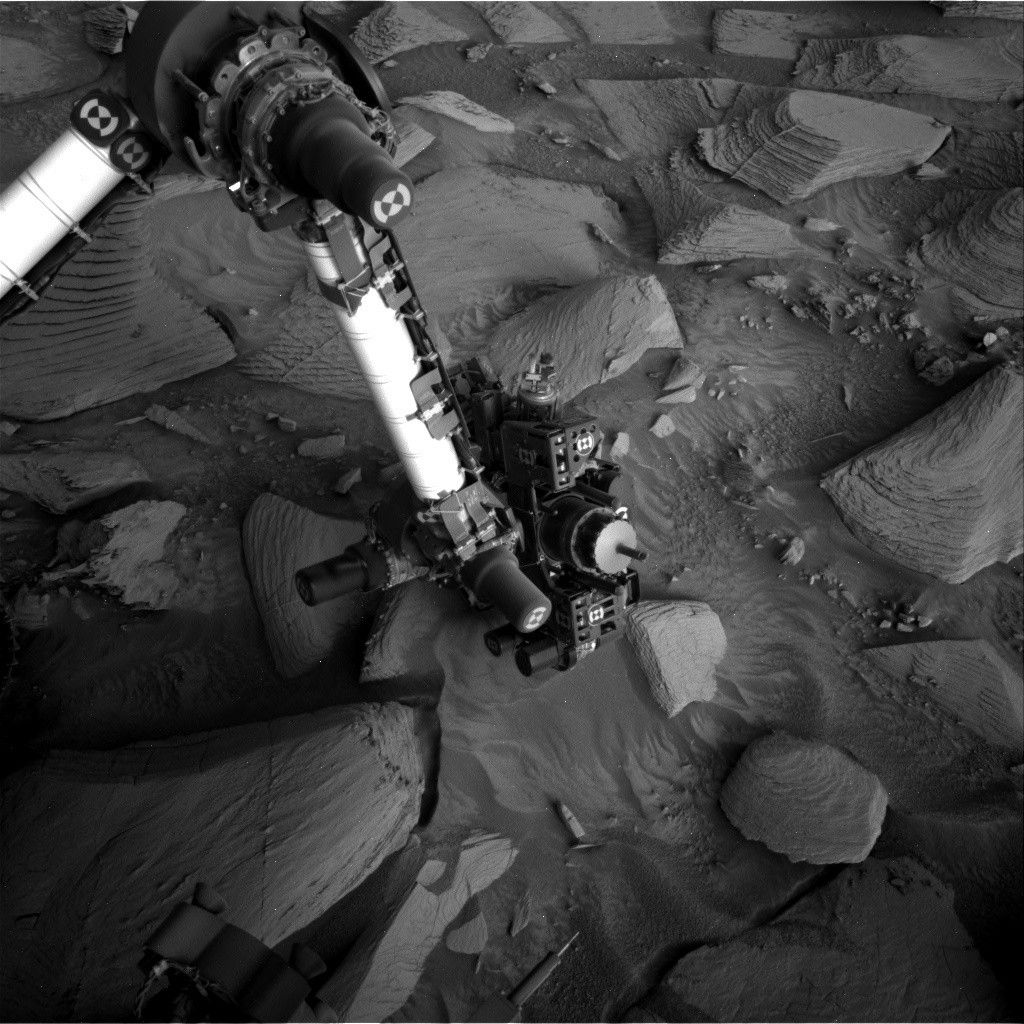
A grayscale photo from the Martian surface shows the Curiosity rover’s robotic arm reaching down to investigate a targeted rock. The surrounding terrain is very rocky and uneven, with stones of varied shapes and sizes pushing up out of the ground, everything a similar dark shade of gray. The soil between the rocks appears wavy in many places, as if sculpted by wind or water, and most of the rocks look like they have formed from horizontal layers stacking on one another, in the relatively short elevation they rise from the surface, looking like 3D versions of hills indicated on a topographic map. The rover’s arm extends down to the center of the image from the upper left corner of the frame where, at a pivot point, it bends at roughly 90-degree angle toward the left side of the image and out of the frame. The arm itself is bright-toned, nearly white, with a metallic sheen; the pivot point and the boxy suite of instruments at the end of the arm near the ground are mainly dark gray or black, with multiple knobby protrusions.
NASA’s Mars rover Curiosity captured this image showing its robotic arm in action; the view also illustrates bedding on a light-toned bedrock block of the layered sulfate-bearing unit. Curiosity acquired the image using its Right Navigation Camera on March 20, 2025 — sol 4486, or Martian day 4,486 of the Mars Science Laboratory mission — at 15:18:42 UTC.
NASA/JPL-Caltech

Written by Lucy Lim, Planetary Scientist at NASA’s Goddard Space Flight Center

Earth planning date: Friday, March 21, 2025

It’s the start of spring here in the Northern Hemisphere on Earth, but in Gale Crater on Mars our rover is still heading into the depths of Martian winter. We’re just a few weeks away from Mars’ aphelion — the time when it’s farthest from the Sun. The Mars-Sun distance varies more significantly than the Earth-Sun distance because of the greater eccentricity of Mars’ orbit, and its effect on the Martian weather is correspondingly more important.

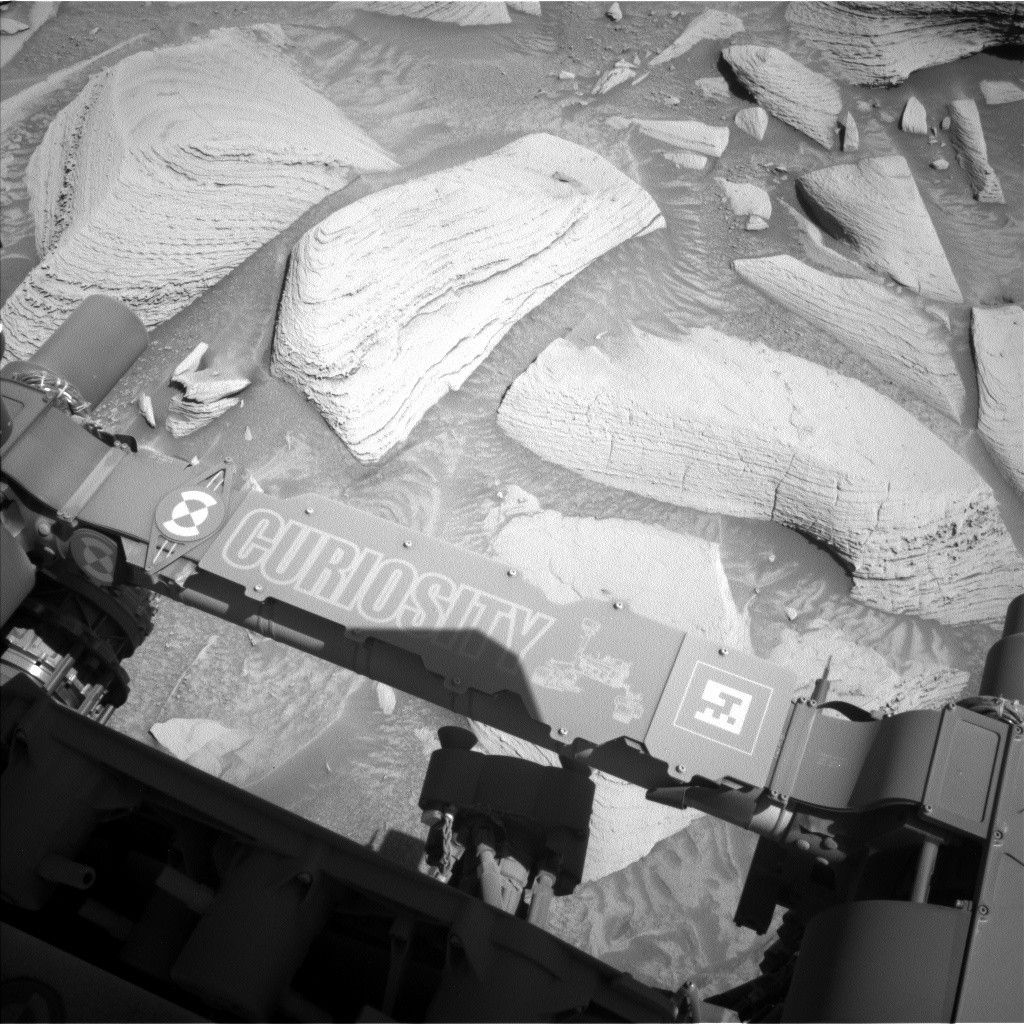
As my colleague mentioned in the previous blog post, the layered sulfate bedrock in this region is broken up into large blocks that often make the driving tough going. The drive in the sol 4486 plan went very well, however, moving Curiosity nearly 35 meters (about 115 feet) southward and upward. Our new workspace is in one of the “light-toned” stripes that can be seen in the orbital imagery and is correspondingly full of light-toned laminated blocks typical of what we’ve seen before in this geologic unit.

For the second plan in a row we were also able to use the rover arm, due to the rover having parked in a stable position — not always a given in this terrain! This enabled us to plan a pair of compositional measurements by the APXS on a bedrock target (“Solstice Canyon”) to assess both the bedrock composition after dust removal and the effect of the ubiquitous dust on the instrument at other locations where the rock cannot be brushed. Our other compositional measurement tool, the LIBS, was also recruited for a co-targeted measurement on Solstice Canyon.

The second LIBS measurement and a MAHLI observation went to the one distinctive, potentially diagenetic, feature visible among all of the light-toned workspace blocks, a small grayish patch that looks like a vein or a coating in the images available at planning (“Black Oak”). The planned observations will give us both the composition and morphology of it in much greater detail.

A long-distance RMI imaging mosaic was planned to investigate some ridges on an as-yet-unnamed butte off to the west. The ridges may be evidence of the same type of diagenetic activity that produced the boxwork structures that are the next major science target for Curiosity. A passive spectral raster was also planned for a potential boxwork region. As we won’t be able to rove to every potential boxwork on Aeolis Mons, longer-distance views such as these can give us a sense of how widespread the boxwork-forming activity may have been.

Mastcam imaging included some follow-up on a hummocky sedimentary feature (“Pino Alto”) and documentation of textures in the nearby local bedrock (“Piedra Blanca”) as well as documentation imagery for the two LIBS targets.

Finally, the modern Martian atmosphere was investigated with measurements by APXS and the ChemCam passive imager to track abundances of argon and oxygen, respectively, as they vary with the Martian seasons. 

Share

Details

Last Updated
Mar 24, 2025

Related Terms

Powered by WPeMatico

Get The Details…

Expedition 72 Astronauts Relax as Cosmonauts Keep Up Research, Maintenance

Expedition 72 Astronauts Relax as Cosmonauts Keep Up Research, Maintenance

JAXA (Japan Aerospace Exploration Agency) astronaut and Expedition 72 Flight Engineer Takuya Onishi is pictured inside the cargo-packed vestibule in between the International Space Station and the SpaceX Dragon crew spacecraft. Onishi was continuing to unpack cargo stowed inside Dragon that had docked to the orbital outpost the day before wth him and fellow SpaceX Crew-9 members Anne McClain and Nichole Ayers of NASA, and Kirill Peskov of Roscosmos aboard.
JAXA (Japan Aerospace Exploration Agency) astronaut Takuya Onishi unpacks cargo stowed inside a SpaceX Dragon spacecraft that had docked to the orbital outpost the day before wth him and fellow Crew-9 members Anne McClain and Nichole Ayers of NASA, and Kirill Peskov of Roscosmos aboard.
NASA

Four Expedition 72 astronauts took a well-deserved break on Monday following last week’s busy period of crew swap activities and advanced microgravity research. The rest of the International Space Station residents kicked off the week with ongoing space science and life support maintenance duties.

NASA astronauts Anne McClain and Nichole Ayers along with JAXA (Japan Aerospace Exploration Agency) astronaut Takuya Onishi and Roscosmos cosmonaut Kirill Peskov are in their second week aboard the orbiting lab. They arrived at the space station on March 15 as SpaceX Crew-10 members inside a SpaceX Dragon spacecraft. McClain and Onishi are both space veterans on their second station mission while Ayers and Peskov are first-time space flyers.

The four crewmates continue getting up to speed with living in weightlessness and the numerous space station systems they will use every day. They are also beginning a series of both new and ongoing station experiments benefiting humans living on and off the Earth.

However, McClain, Ayers, and Onishi relaxed on Monday with NASA Flight Engineer Don Pettit who has been aboard the space station since Sept. 11, 2024. Pettit assisted the new crewmates last week helping them adjust to life on orbit and start their first space science investigations. The quartet used the free time for catching up with family on the ground, personal activities such as reading and listening to music, and looking at the Earth below from the cupola.

Peskov stayed busy on Monday along with his fellow cosmonauts station Commander Alexey Ovchinin and Flight Engineer Ivan Vagner. Peskov began his day with water transfers then ended his shift inspecting and cleaning the station’s Roscosmos modules. Ovchinin installed and activated a camera remotely controlled by students to photograph landmarks on Earth from the Harmony module. Vagner worked in the Nauka science module’s glovebox exploring methods to create sterile conditions aboard spacecraft for safe biological research activities.

Learn more about station activities by following the space station blog, @space_station and @ISS_Research on X, as well as the ISS Facebook and ISS Instagram accounts.

Get the latest from NASA delivered every week. Subscribe here: https://www.nasa.gov/subscribe

Powered by WPeMatico

Get The Details…

Mark A. Garcia