New Report Analyzes Long History of NASA Support for Commercial Space

New Report Analyzes Long History of NASA Support for Commercial Space

3 min read

Preparations for Next Moonwalk Simulations Underway (and Underwater)

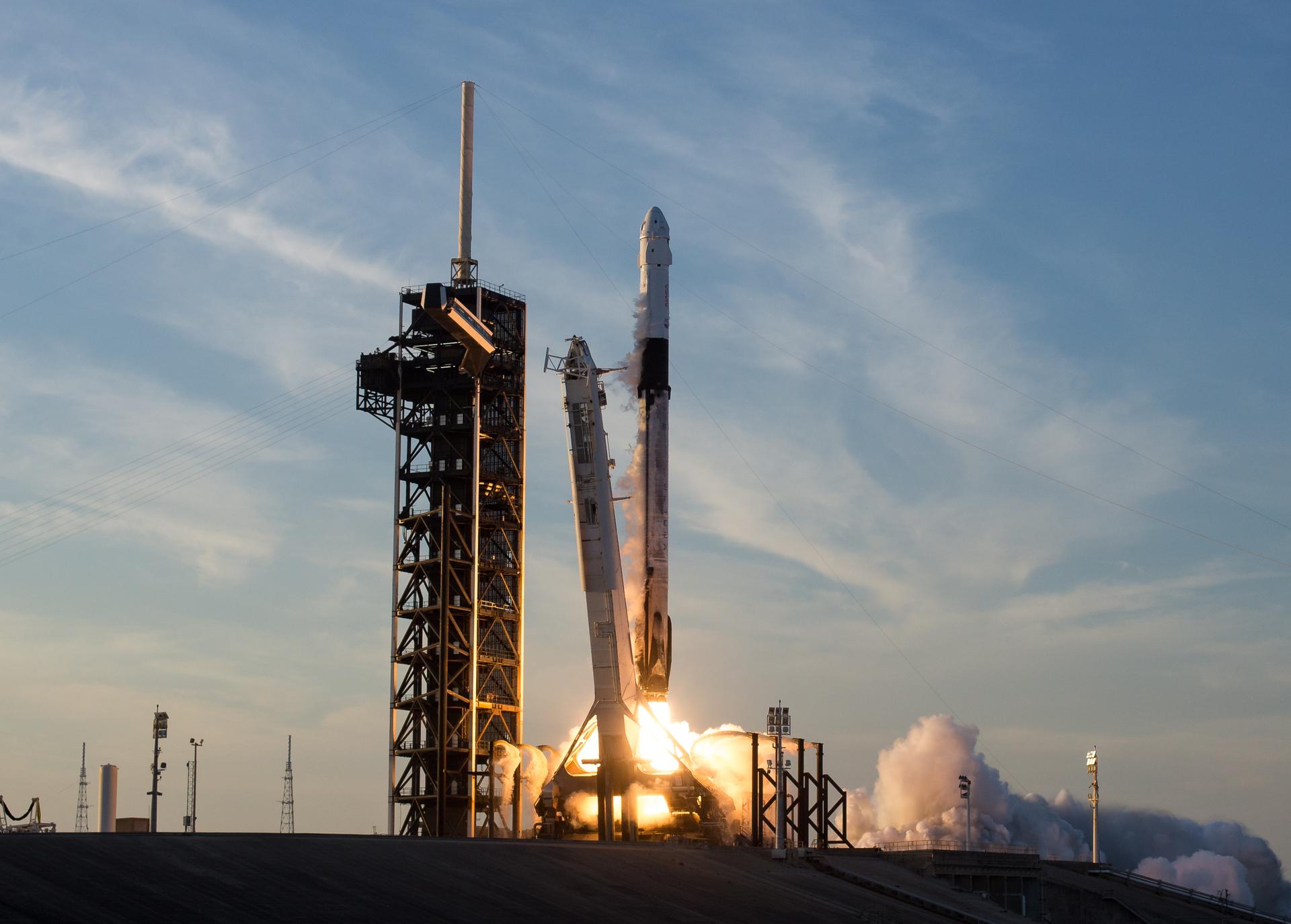
Dragon spacecraft approaches the International Space Station
The SpaceX Dragon Freedom spacecraft carrying NASA astronaut Nick Hague and Roscosmos cosmonaut Aleksandr Gorbunov approaches the International Space Station as it orbited 261 miles above Ontario, Canada, near James Bay.

NASA published a new report Thursday highlighting 17 agency mechanisms that have directly and indirectly supported the development and growth of the U.S. commercial space sector for the benefit of humanity.

The report, titled Enabling America on the Space Frontier: The Evolution of NASA’s Commercial Space Development Toolkit, is available on the agency’s website.

“This is the most extensive and comprehensive historical analysis produced by NASA on how it has contributed to commercial space development over the decades,” said Alex MacDonald, NASA chief economist. “These efforts have given NASA regular access to space with companies, such as SpaceX and Rocket Lab, modernizing our communications infrastructure, and even led to the first private lunar lander thanks to Intuitive Machines. With commercial space growth accelerating, this report can help agency leaders and stakeholders assess the numerous mechanisms that the agency uses to support this growth, both now and in the future.”

Throughout its history, NASA has supported the development of the commercial space sector, not only leading the way in areas such as satellite communications, launch, and remote sensing, but also developing new contract and operational models to encourage commercial participation and growth. In the last three decades, NASA has seen the results of these efforts with commercial partners able to contribute more to missions across NASA domains, and increasingly innovative agency-led efforts to engage, nurture, and integrate these capabilities. These capabilities support the agency’s mission needs, and have seen a dramatic rise in importance, according to the report.

NASA has nurtured technology, companies, people, and ideas in the commercial space sector, contributing to the U.S. and global economies, across four distinct periods in the agency’s history:

  • 1915–1960: NASA’s predecessor, the National Advisory Committee on Aeronautics (NACA), and NASA’s pre-Apollo years.
  • 1961–1980: Apollo era.
  • 1981–2010: Space shuttle era.
  • 2011–present: Post-shuttle commercial era.

Each of these time periods are defined by dominant technologies, programs, or economic trends further detailed in the report.

Though some of these mechanisms are relatively recent, others have been used throughout the history of NASA and NACA, leading to some overlap. The 17 mechanisms are as follows:

  • Contracts and Partnership Agreements
  • Research and Technology Development (R&TD)
  • Dissemination of Research and Scientific Data
  • Education and Workforce Development
  • Workforce External Engagement and Mobility
  • Technology Transfer
  • Technical Support
  • Enabling Infrastructure
  • Launch
  • Direct In-Space Support
  • Standards and Regulatory Framework Support
  • Public Engagement
  • Industry Engagement
  • Venture Capital Engagement
  • Market Stimulation Funding
  • Economic Analysis and Due Diligence Capabilities
  • Narrative Encouragement

NASA supports commercial space development in everything from spaceflight to supply chains. Small satellite capabilities have inspired a new generation of space start-ups, while new, smaller rockets, as well as new programs are just starting. Examples include CLPS (Commercial Lunar Payload Services), commercial low Earth orbit destinations, human landing systems, commercial development of NASA spacesuits, and lunar terrain vehicles. The report also details many indirect ways the agency has contributed to the vibrance of commercial space, from economic analyses to student engagement.

The agency’s use of commercial capabilities has progressed from being the exception to the default method for many of its missions. The current post-shuttle era of NASA-supported commercial space development has seen a level of technical development comparable to the Apollo era’s Space Race. Deploying the 17 commercial space development mechanisms in the future are part of NASA’s mission to continue encouraging commercial space activities.

To learn more about NASA’s missions, please visit:

https//:www.nasa.gov

Share

Details

Last Updated

Dec 19, 2024

Editor
Bill Keeter

Powered by WPeMatico

Get The Details…
Bill Keeter

Artemis II Core Stage Vertical Integration Begins at NASA Kennedy

Artemis II Core Stage Vertical Integration Begins at NASA Kennedy

NASA has taken a big step forward in how engineers will assemble and stack future SLS (Space Launch System) rockets for Artemis Moon missions inside the Vehicle Assembly Building (VAB) at the agency’s Kennedy Space Center in Florida.

The VAB’s High Bay 2 has been outfitted with new tooling to facilitate the vertical integration of the SLS core stage. That progress was on full display in mid-December when teams suspended the fully assembled core stage 225 feet in the air inside the high bay to complete vertical work before it is stacked on mobile launcher 1, allowing teams to continue solid rocket booster stacking simultaneously inside High Bay 3 for Artemis II.

The fully assembled SLS (Space Launch System) core stage for the Artemis II test flight is suspended 225 feet in the air inside the newly renovated High Bay 2 at Kennedy’s Vehicle Assembly Building. The core stage was lifted to enable engineers to complete work before it is stacked on mobile launcher 1 with other rocket elements. With the move to High Bay 2, technicians now have 360-degree tip to tail access to the core stage, both internally and externally.
NASA

With the move to High Bay 2, technicians with NASA and Boeing now have 360-degree tip to tail access to the core stage, both internally and externally. Michigan-based supplier Futuramic Tool and Engineering led the design and build of the Core Stage Vertical Integration Center tool that will hold the core stage in a vertical position.

“High Bay 2 tooling was originally scheduled to be complete for Artemis III. We had an opportunity to get it done earlier and that will put us in a good posture to complete work earlier than planned prior to moving the core stage for Artemis II into the full integrated stack over into in High Bay 3,” said Chad Bryant, deputy manager of the NASA SLS Stages Office. “This gives us an opportunity to go in and learn how to rotate, lift, and move the core stage into the high bay.”

This move also doubles the footprint of useable space within the VAB, giving engineers access to both High Bay 2 and High Bay 3 simultaneously, while also freeing up space at NASA’s Michoud Assembly Facility in New Orleans to continue work on the individual elements for future SLS core stages.

High Bay 2 has a long history of supporting NASA exploration programs: during Apollo, High Bay 2, one of four high bays inside the VAB, was used to stack the Saturn V rocket. During the Space Shuttle Program, the high bay was used for external tank checkout and storage and as an extra storage area for the shuttle.

Under the new assembly model beginning with Artemis III, all the major structures for the SLS core stage will continue to be fully produced and manufactured at NASA Michoud. Upon completion of manufacturing and thermal protection system application, the engine section will be shipped to Kennedy for final outfitting.

The 212-foot-tall SLS (Space Launch System) core stage for NASA Artemis II is seen being moved from a horizontal position to a vertical position in High Bay 2 at the Vehicle Assembly Building at NASA’s Kennedy Space Center in Florida. With the move to High Bay 2, NASA and Boeing technicians now have 360-degree access to the core stage both internally and externally. (NASA)

“Core stage 3 marks a significant change in the way we build core stages,” said Steve Wofford, manager of the SLS Stages Office. “The vertical capability in High Bay 2 allows us to perform parallel processing from the top to bottom of the stage. It’s a much more efficient way to build core stages. This new capability will streamline final production efforts, allowing our team to have 360-degree access to the stage, both internally and externally.”

The fully assembled core stage for Artemis II arrived July 23, 2024, at Kennedy, where it remained horizontal inside the VAB transfer aisle until its recent lift into the newly outfitted high bay.

Teams at NASA Michoud are outfitting the remaining core stage elements for Artemis III and preparing to horizontally join them. The four RS-25 engines for the Artemis III mission are complete at NASA’s Stennis Space Center in Bay St. Louis, Mississippi, and will be transported to NASA Kennedy in 2025. Major core stage and exploration upper stage structures are in work at NASA Michoud for Artemis IV and beyond.

NASA is working to land the first woman, first person of color, and its first international partner astronaut on the Moon under Artemis. SLS is part of NASA’s backbone for deep space exploration, along with the Orion spacecraft, supporting ground systems, advanced spacesuits and rovers, the Gateway in orbit around the Moon, and commercial human landing systems. SLS is the only rocket that can send Orion, astronauts, and supplies to the Moon in a single launch.

News Media Contact

Jonathan Deal
Marshall Space Flight Center
Huntsville, Ala.
256-544-0034

Powered by WPeMatico

Get The Details…
Lee Mohon

Five Ways to Explore NASA’s Portfolio of Technologies with TechPort 4.0

Five Ways to Explore NASA’s Portfolio of Technologies with TechPort 4.0

3 min read

Preparations for Next Moonwalk Simulations Underway (and Underwater)

Have you ever wanted to find all your favorite NASA technology in one place? NASA stakeholders did, too! We listened to your feedback, brainstormed user-focused features, and created the most robust technology system to date.

NASA’s Space Technology Mission Directorate is excited to announce the release of TechPort version 4.0 – your gateway into our technology community. NASA tuned into feedback from the public, industry, academia, and our internal audiences to make significant updates to the TechPort system. From improvements in usability, customizability, and analysis views, users will now be able to search and explore NASA’s vast portfolio of technologies more easily than ever before.

Video introducing 4 new features of TechPort 4.0.
NASA

“When it comes to the ever-growing advancements in space technology, we need a system that encompasses a modernized look and feel coupled with a more intuitive interface,” said Alesyn Lowry, director for Strategic Planning & Integration for STMD at NASA Headquarters in Washington. “TechPort 4.0 offers just that. As the largest and most significant update to TechPort in the past five years, users will now be able to enjoy the most accessible, user-friendly, and all-encompassing version yet.” 

Check out the five features of TechPort 4.0 and how they can help you research NASA’s cutting-edge technology projects and partnerships: 

1. New and Improved Homepage 

Featuring a new look and feel, users are able to search NASA’s comprehensive system of vast technologies. Including over 18,000 current and historical NASA technologies, users will now have more access to knowledge about the agency’s technology development at the touch of their fingertips! The modernized look and feel lends itself to a more intuitive interface that upgrades technology search capabilities. 

2. Advanced Search 

One of the most exciting features of TechPort 4.0 is the new capability to search and filter on all fields associated with technologies. This advanced filtering feature will allow users to uncover the exact information they are seeking, creating a more accessible and swifter experience for users. 

3. New Grid View 

Expanding upon the previous view, TechPort 4.0 offers a new grid view that enables users to view even more project data all at once. This upgrade also allows a user to customize all of the fields visible in search results, tailor how the data is sorted, and filter on any visible field. This new view provides a familiar interface tailored to data analysis needs that require rapid review of multiple data facets simultaneously. 

Gridview of TechPort 4.0

4. NASA Technology Taxonomy Recommendation (T-Rex) 

NASA’s Technology Taxonomy provides a structure for technology classification spanning over 350 categories. The Taxonomy is featured in TechPort, and all technologies in the system align to at least one Taxonomy area, making it easy to view technologies of interest. Technologists from various fields, including academia and nonprofits, now have the opportunity to use the T-Rex tool to automatically classify their technology according to the NASA Taxonomy. Serving as a machine learning model, TechPort will offer more organization and an easier way for users to access relevant information. 

5. Funding Opportunities 

Now, users can get connected, too! If your TechPort research is inspiring you to think about solving an aerospace or technology challenge, TechPort 4.0 gives users easy access to relevant opportunities and information on how to apply. 

Launch into TechPort 4.0 to embark on your journey into our technology community. With the wide range of improvements in accessibility and customizability, explore NASA technologies like never before! 

Gabrielle Thaw

Powered by WPeMatico

Get The Details…
Loura Hall

Nargess Memarsadeghi, Computer Engineer for the Cosmos

Nargess Memarsadeghi, Computer Engineer for the Cosmos

5 min read

Preparations for Next Moonwalk Simulations Underway (and Underwater)

When it comes to building spaceflight missions, the software is at least as important as the hardware. For computer engineer Nargess Memarsadeghi, having a hand in the programming is like getting to go along for the ride.

Name: Nargess Memarsadeghi
Title: Associate Branch Head, Software Systems Engineering Branch
Formal Job Classification: Supervisory Computer Engineer
Organization: Software Systems Engineering Branch, Software Engineering Division, Engineering Directorate (Code 581)

Nargess Memarsadeghi, wearing a black short sleeve shirt, smiles are the camera in front of a window looking into Goddard's large clean room with spacecraft equipment in the background.
Nargess Memarsadeghi is the associate branch head of the Software Systems Engineering branch at NASA’s Goddard Space Flight Center in Greenbelt, Md.
Courtesy of Nargess Memarsadeghi

What do you do and what is most interesting about your role here at Goddard?

As associate branch head for the Software Systems Engineering Branch, I spend half of my time supporting the branch head on internal functions, different planning activities, and supervising our employees who are senior software systems engineers and often team leads themselves.

For the other half of my time, I work on a technical project. Currently, I am supporting the Human Landing Systems (HLS) project. I am a member of NASA HLS Software Insight Team working with NASA’s Marshall Space Flight Center in Huntsville, Alabama, and Johnson Space Center in Houston, and industry partners SpaceX and Blue Origin to meet software requirements and milestones, and to ensure the Artemis campaign succeeds in taking astronauts to the Moon.

I enjoy learning about various NASA missions and being part of them either by supporting our branch employees who work on these missions or by being a project team member and making technical contributions directly.

Why did you become a software engineer?

I always loved math and sciences. Software engineering seemed like a good and practical way to apply math to different scientific and engineering applications.

What is your educational background?

I got my bachelor’s (2001), master’s (2004), and doctorate (2007) degrees in computer science from the University of Maryland at College Park.

How did you come to Goddard?

I joined Goddard in 2001 right after college. The university had a recruitment event at its career center. I signed up for an interview with NASA, which went well.  I then got an invitation for an onsite interview, and then an offer to join Goddard as a computer engineer.

What is your supervisory style?

I have been supervising on average 10 employees. We have tag-ups every two weeks to learn about their work and see if they have any issues or need anything from management. We keep in constant communication which goes both ways. I have an open-door policy. I try to match an employee’s interests and expertise to their work. I am willing to hear their concerns and address them to the best of my ability or putting them in contact with those who can. I enjoy learning about their work and celebrating the achievements.

What are some of the most exciting projects and missions that the Software Systems Engineering Branch is involved with?

We provide end-to-end software systems engineering support to many high-impact missions, like the upcoming flagship astrophysics Roman Space Telescope mission. We support Roman’s software systems, as well as its testing and assembly with one of our software products, the Goddard Dynamic Simulator.

Our team also supports a variety of Earth science missions, such as the Joint Polar Satellite Systems (JPSS), GOES-R, and GOES-U, all of which NASA supports on behalf of the National Oceanic and Atmospheric Administration (NOAA). We also develop and manage different ground segment software systems for different missions including PACE, TSIS-II, and others.

What are some of your career highlights so far?

One was being part of the James Webb Space Telescope team and working on stability testing of microshutters. Webb is a huge, multinational observatory  making many scientific discoveries.

Another is being part of the Dawn mission’s satellite working group searching for moons of the asteroid Vesta and dwarf planet Ceres. I worked on this from prelaunch through launch and operations. We were some of the first to see the scientific images soon after being downlinked. It felt like going on a ride with the spacecraft itself.

I would add my more recent work on the Roman Space Telescope.

In general, I really enjoyed working on various missions during their different stages of their life cycle. I got to see the whole picture of how software is used for missions, from technology development to post-launch.

What advice do you give your graduate students and interns as a mentor?

I emphasize that they also need to work on their communication skills, leadership skills, and team building. I tell them to focus not just on their technical skills but also on their interpersonal skills both written and oral. NASA has a lot of collaborative projects and being able to effectively communicate across different levels is crucial for mission success.

Whom do you wish to thank?

I would like to thank my family for their support. I would also like to thank my past teachers and mentors who made a big difference in me and positively impacted my life.

What do you do to relax?

I like going for long walks, spending time with family and friends, and doing activities with my son including attending his piano recitals.

Who is your favorite author?

As a young reader, I enjoyed reading Jules Verne. I also enjoy reading poetry. My favorites are Robert Frost, Emily Dickinson, and Persian poets Sohrab Sepehri and Saadi Shirazi.

What motto do you live by?

Be the change you want to see in the world.

By Elizabeth M. Jarrell
NASA’s Goddard Space Flight Center, Greenbelt, Md.

A banner graphic with a group of people smiling and the text "Conversations with Goddard" on the right. The people represent many genders, ethnicities, and ages, and all pose in front of a soft blue background image of space and stars.

Conversations With Goddard is a collection of Q&A profiles highlighting the breadth and depth of NASA’s Goddard Space Flight Center’s talented and diverse workforce. The Conversations have been published twice a month on average since May 2011. Read past editions on Goddard’s “Our People” webpage.

Share

Details

Last Updated

Dec 19, 2024

Powered by WPeMatico

Get The Details…
Jamie Adkins

Statistical Analysis Using Random Forest Algorithm Provides Key Insights into Parachute Energy Modulator System

Statistical Analysis Using Random Forest Algorithm Provides Key Insights into Parachute Energy Modulator System

Download PDF: Statistical Analysis Using Random Forest Algorithm Provides Key Insights into Parachute Energy Modulator System

Energy modulators (EM), also known as energy absorbers, are safety-critical components that are used to control shocks and impulses in a load path. EMs are textile devices typically manufactured out of nylon, Kevlar® and other materials, and control loads by breaking rows of stitches that bind a strong base webbing together as shown in Figure 1. A familiar EM application is a fall-protection harness used by workers to prevent injury from shock loads when the harness arrests a fall. EMs are also widely used in parachute systems to control shock loads experienced during the various stages of parachute system deployment.

Random forest is an innovative algorithm for data classification used in statistics and machine learning. It is an easy to use and highly flexible ensemble learning method. The random forest algorithm is capable of modeling both categorical and continuous data and can handle large datasets, making it applicable in many situations. It also makes it easy to evaluate the relative importance of variables and maintains accuracy even when a dataset has missing values.

IT NESC - Figure 1. EMs are textile devices typically manufactured out of nylon, Kevlar and other materials, and control tensile loads by breaking rows of zigzag stitches that bind a strong base webbing together.

Random forests model the relationship between a response variable and a set of predictor or independent variables by creating a collection of decision trees. Each decision tree is built from a random sample of the data. The individual trees are then combined through methods such as averaging or voting to determine the final prediction (Figure 2). A decision tree is a non-parametric supervised learning algorithm that partitions the data using a series of branching binary decisions. Decision trees inherently identify key features of the data and provide a ranking of the contribution of each feature based on when it becomes relevant. This capability can be used to determine the relative importance of the input variables (Figure 3). Decision trees are useful for exploring relationships but can have poor accuracy unless they are combined into random forests or other tree-based models.

The performance of a random forest can be evaluated using out-of-bag error and cross-validation techniques. Random forests often use random sampling with replacement from the original dataset to create each decision tree. This is also known as bootstrap sampling and forms a bootstrap forest. The data included in the bootstrap sample are referred to as in-the-bag, while the data not selected are out-of-bag. Since the out-of-bag data were not used to generate the decision tree, they can be used as an internal measure of the accuracy of the model. Cross-validation can be used to assess how well the results of a random forest model will generalize to an independent dataset. In this approach, the data are split into a training dataset used to generate the decision trees and build the model and a validation dataset used to evaluate the model’s performance. Evaluating the model on the independent validation dataset provides an estimate of how accurately the model will perform in practice and helps avoid problems such as overfitting or sampling bias. A good model performs well on
both the training data and the validation data.

The complex nature of the EM system made it difficult for the team to identify how various parameters influenced EM behavior. A bootstrap forest analysis was applied to the test dataset and was able to identify five key variables associated with higher probability of damage and/or anomalous behavior. The identified key variables provided a basis for further testing and redesign of the EM system. These results also provided essential insight to the investigation and aided in development of flight rationale for future use cases.

IT NESC- figure-3--example-of-decision-tree-and-variable-rankings-from-bootstrap-forest

For information, contact Dr. Sara R. Wilson. sara.r.wilson@nasa.gov

Powered by WPeMatico

Get The Details…
Meagan Chappell